REVIEW 1 major objections 1 minor 1 cited by
Reviewed by Pith at T0; open to challenge.
T0 means a machine referee read the full paper against a public rubric. The mark states how deep the mechanical check went, never who wrote it. the ladder, T0–T4 →
T0 review · grok-4.3
The apparent time dependence of the one-loop curvature power spectrum cancels when all loop scales and boundary terms are combined consistently.
2026-06-29 02:30 UTC pith:32LN6KXZ
load-bearing objection The paper shows that dropping the k >> q assumption and adding all-scale contributions plus boundary terms makes the one-loop time dependence cancel in the curvature power spectrum. the 1 major comments →
Cancellation of one-loop time dependence in superhorizon curvature perturbations from all scales
The pith
A machine-rendered reading of the paper's core claim, the machinery that carries it, and where it could break.
Core claim
In spatially-flat gauge, the one-loop curvature power spectrum on superhorizon scales shows no residual time dependence once the nonlinear δN relation between inflaton fluctuations and curvature perturbations is used and all contributions, including boundary terms from loop integrals over every scale, are retained consistently.
What carries the argument
The δN formalism that nonlinearly relates inflaton fluctuations to curvature perturbations, applied while integrating loop modes over all wavenumbers without a k ≫ q assumption and retaining boundary terms.
Load-bearing premise
The nonlinear mapping from inflaton fluctuations to curvature perturbations given by the δN formalism stays valid at one-loop order with no additional gauge or interaction corrections.
What would settle it
An explicit recomputation of the one-loop power spectrum that keeps the k ≲ q regime and boundary terms yet still finds uncancelled time dependence on superhorizon scales.
If this is right
- Superhorizon curvature perturbations are conserved at one-loop order for any loop wavenumber.
- The curvature power spectrum can be computed without restricting to k much larger than the external mode q.
- Boundary terms must be kept to obtain a time-independent result.
- The cancellation holds in spatially-flat gauge when the δN relation is used throughout.
Where Pith is reading between the lines
- Similar all-scale consistency might remove time dependence in higher-loop or multi-field calculations.
- Gauge-invariant observables could require explicit retention of boundary contributions whenever nonlinear field redefinitions are involved.
- Numerical checks of the power spectrum at fixed superhorizon times could test whether the cancellation persists beyond analytic approximations.
Editorial analysis
A structured set of objections, weighed in public.
Referee Report
Summary. The manuscript claims that the apparent time dependence in the one-loop superhorizon curvature power spectrum cancels when all loop contributions (including from modes with k ≲ q) are combined consistently with boundary terms, using the nonlinear δN relation between inflaton fluctuations and ζ in spatially-flat gauge, without assuming a scale hierarchy.
Significance. If the cancellation holds after all scales and terms are included, the result would confirm conservation of superhorizon ζ at one-loop order and strengthen the reliability of δN-based calculations of loop corrections to the power spectrum and non-Gaussianity. The absence of free parameters in the final cancellation and the explicit treatment of the full k-range are strengths.
major comments (1)
- [δN formalism application (abstract and main derivation sections)] The central cancellation result rests on the assumption that the δN mapping from inflaton fluctuation to ζ remains exact at one-loop order with no additional gauge or interaction corrections when the loop integral includes modes with k ≲ q. This assumption is load-bearing for the claim that all contributions combine to cancel time dependence, yet the manuscript does not provide an explicit verification or counterterm analysis for the non-hierarchical regime.
minor comments (1)
- Clarify the precise definition and handling of boundary terms in the one-loop integrals to ensure reproducibility.
Simulated Author's Rebuttal
We thank the referee for their careful reading of the manuscript and for highlighting the importance of the δN formalism's applicability across all scales. We address the single major comment below.
read point-by-point responses
-
Referee: [δN formalism application (abstract and main derivation sections)] The central cancellation result rests on the assumption that the δN mapping from inflaton fluctuation to ζ remains exact at one-loop order with no additional gauge or interaction corrections when the loop integral includes modes with k ≲ q. This assumption is load-bearing for the claim that all contributions combine to cancel time dependence, yet the manuscript does not provide an explicit verification or counterterm analysis for the non-hierarchical regime.
Authors: The δN formalism supplies the exact, nonlinear relation between the inflaton fluctuation δφ (in spatially flat gauge) and the curvature perturbation ζ on uniform-density slices; this relation follows directly from the definition of ζ and holds order by order without further gauge or interaction corrections at one-loop level. Our calculation implements this mapping uniformly for every mode in the loop integral, with no scale hierarchy imposed and with the regime k ≲ q treated on the same footing as k ≫ q. All time-dependent pieces, including those arising from the nonlinear expansion and the associated boundary terms, are retained and shown to cancel identically once the full set of contributions is assembled. Because the cancellation is obtained by direct, consistent application of the δN relation over the complete k range, a separate counterterm analysis is not required at this perturbative order; the result is parameter-free and follows from the gauge-invariant construction itself. revision: no
Circularity Check
No significant circularity; derivation uses established external δN formalism
full rationale
The paper's central result is a perturbative cancellation of apparent time dependence in the one-loop superhorizon curvature power spectrum when all scales (including k ≲ q) and boundary terms are included. This is obtained by applying the standard δN formalism to relate inflaton fluctuations to ζ, which is an independent, externally established relation from prior literature and not derived or fitted inside the paper. No self-citation chains, self-definitional reductions, fitted inputs renamed as predictions, or ansatzes smuggled via author citations are present in the described derivation. The calculation is self-contained against external benchmarks once the δN mapping is granted.
Axiom & Free-Parameter Ledger
axioms (2)
- domain assumption δN formalism applies to relate inflaton fluctuations to curvature perturbations at one-loop level
- domain assumption Spatially-flat gauge is suitable for the one-loop calculation of curvature perturbations
read the original abstract
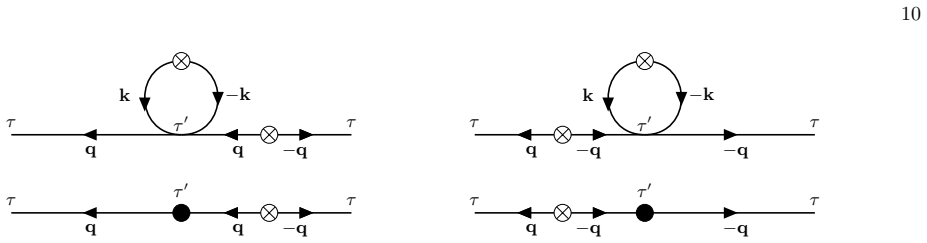
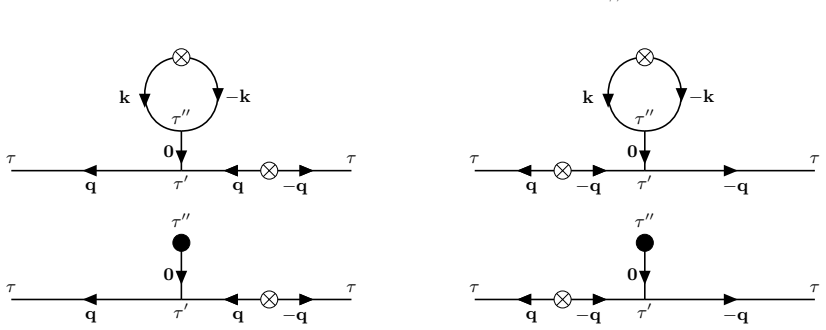
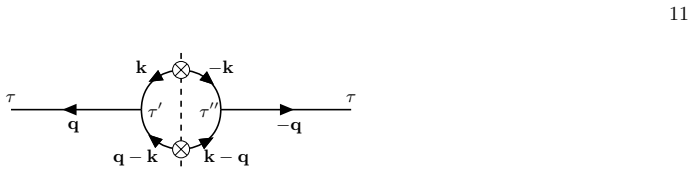
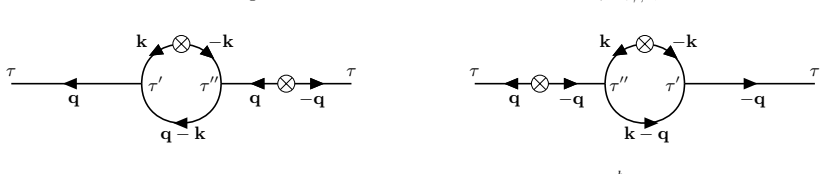
We show the conservation of the superhorizon curvature perturbations at one-loop level in spatially-flat gauge, including contributions from loop wavenumbers on all scales. In contrast to previous works, we do not assume a hierarchy $k \gg q$ between the wavenumber of the loop integral, $k$, and that of the power spectrum, $q$, and we explicitly include the regime $k \lesssim q$. Taking into account the nonlinear relation between the inflaton fluctuation and the curvature perturbation with the $\delta N$ formalism, we show that the apparent time dependence of the one-loop curvature power spectrum cancels once all contributions, including boundary terms, are combined consistently.
Figures
Forward citations
Cited by 1 Pith paper
-
Background-independent one-loop renormalization of tensor and scalar primordial spectra
UV divergences of one-loop primordial tensor and scalar spectra are absorbed by covariant and tadpole counterterms using only the universal WKB expansion of internal modes, yielding finite model-independent renormaliz...
Reference graph
Works this paper leans on
-
[1]
In our previous works, we focused on the situation where the linear relation between them is a good approximation for simplicity
We take into account the nonlinear relation between the curvature perturbationζand the inflaton fluctuation δϕin spatially-flat gauge. In our previous works, we focused on the situation where the linear relation between them is a good approximation for simplicity. In this work, we will see that the loop contributions fromk≲qgenerally cancel through the no...
-
[2]
8 ˆ τ τi dτ ′a4(τ ′)V(3)(τ ′)Im[u0(τ)u ∗ 0(τ ′)] 1 ˙¯ϕ(τ) T(q, τ f , τ ′, τi) +C(q, τ f , τi) # = 2π2 q3 Pζ,tr(q)
We consider the transition: the initial period→slow-roll (SR) period→the late period. We assume that the tree-level curvature perturbations onk≲qremain constant after the initial period. In contrast to our previous works, we do not assumeV (3) = 0 (V(3): third derivative of the inflaton potential) for any of the above periods, including the SR period. We ...
-
[3]
V. F. Mukhanov and G. V. Chibisov, JETP Lett.33, 532 (1981)
1981
-
[4]
V. F. Mukhanov and G. V. Chibisov, Sov. Phys. JETP56, 258 (1982)
1982
-
[5]
A. A. Starobinsky, Phys. Lett. B117, 175 (1982)
1982
-
[6]
A. H. Guth and S. Y. Pi, Phys. Rev. Lett.49, 1110 (1982)
1982
-
[7]
Panagiotakopoulos, A
C. Panagiotakopoulos, A. Salam, and J. A. Strathdee, Phys. Lett. B115, 29 (1982)
1982
-
[8]
J. M. Bardeen, P. J. Steinhardt, and M. S. Turner, Phys. Rev. D28, 679 (1983)
1983
-
[9]
G. F. Chapline, Nature253, 251 (1975)
1975
-
[10]
Ivanov, P
P. Ivanov, P. Naselsky, and I. Novikov, Phys. Rev. D50, 7173 (1994)
1994
-
[11]
Formation of MACHO-Primordial Black Holes in Inflationary Cosmology
J. Yokoyama, Astron. Astrophys.318, 673 (1997), arXiv:astro-ph/9509027
work page internal anchor Pith review Pith/arXiv arXiv 1997
-
[12]
Density Perturbations and Black Hole Formation in Hybrid Inflation
J. Garcia-Bellido, A. D. Linde, and D. Wands, Phys. Rev.D54, 6040 (1996), arXiv:astro-ph/9605094 [astro-ph]
work page internal anchor Pith review Pith/arXiv arXiv 1996
-
[13]
Primordial Black Holes as Dark Matter: The Power Spectrum and Evaporation of Early Structures
N. Afshordi, P. McDonald, and D. N. Spergel, Astrophys. J. Lett.594, L71 (2003), arXiv:astro-ph/0302035
work page internal anchor Pith review Pith/arXiv arXiv 2003
-
[14]
P. H. Frampton, M. Kawasaki, F. Takahashi, and T. T. Yanagida, JCAP1004, 023 (2010), arXiv:1001.2308 [hep-ph]
work page internal anchor Pith review Pith/arXiv arXiv 2010
-
[15]
K. M. Belotsky, A. D. Dmitriev, E. A. Esipova, V. A. Gani, A. V. Grobov, M. Y. Khlopov, A. A. Kirillov, S. G. Rubin, and I. V. Svadkovsky, Mod. Phys. Lett. A29, 1440005 (2014), arXiv:1410.0203 [astro-ph.CO]
work page internal anchor Pith review Pith/arXiv arXiv 2014
-
[16]
B. Carr, F. Kuhnel, and M. Sandstad, Phys. Rev.D94, 083504 (2016), arXiv:1607.06077 [astro-ph.CO]
work page internal anchor Pith review Pith/arXiv arXiv 2016
-
[17]
Inflationary Primordial Black Holes as All Dark Matter
K. Inomata, M. Kawasaki, K. Mukaida, Y. Tada, and T. T. Yanagida, Phys. Rev.D96, 043504 (2017), arXiv:1701.02544 [astro-ph.CO]
work page internal anchor Pith review Pith/arXiv arXiv 2017
-
[18]
J. R. Espinosa, D. Racco, and A. Riotto, Phys. Rev. Lett.120, 121301 (2018), arXiv:1710.11196 [hep-ph]
work page internal anchor Pith review Pith/arXiv arXiv 2018
-
[19]
S. Bird, I. Cholis, J. B. Mu˜ noz, Y. Ali-Ha¨ ımoud, M. Kamionkowski, E. D. Kovetz, A. Raccanelli, and A. G. Riess, Phys. Rev. Lett.116, 201301 (2016), arXiv:1603.00464 [astro-ph.CO]
work page internal anchor Pith review Pith/arXiv arXiv 2016
-
[20]
S. Clesse and J. Garc´ ıa-Bellido, Phys. Dark Univ.10, 002 (2016), arXiv:1603.05234 [astro-ph.CO]
work page internal anchor Pith review Pith/arXiv arXiv 2016
-
[21]
Primordial Black Hole Scenario for the Gravitational-Wave Event GW150914
M. Sasaki, T. Suyama, T. Tanaka, and S. Yokoyama, Phys. Rev. Lett.117, 061101 (2016), arXiv:1603.08338 [astro-ph.CO]
work page internal anchor Pith review Pith/arXiv arXiv 2016
-
[22]
Y. N. Eroshenko, J. Phys. Conf. Ser.1051, 012010 (2018), arXiv:1604.04932 [astro-ph.CO]
work page internal anchor Pith review Pith/arXiv arXiv 2018
-
[23]
Primordial Black Holes - Perspectives in Gravitational Wave Astronomy -
M. Sasaki, T. Suyama, T. Tanaka, and S. Yokoyama, Class. Quant. Grav.35, 063001 (2018), arXiv:1801.05235 [astro- ph.CO]
work page internal anchor Pith review Pith/arXiv arXiv 2018
-
[24]
B. Carr, K. Kohri, Y. Sendouda, and J. Yokoyama, Rept. Prog. Phys.84, 116902 (2021), arXiv:2002.12778 [astro-ph.CO]
work page internal anchor Pith review Pith/arXiv arXiv 2021
-
[25]
A. M. Green and B. J. Kavanagh, J. Phys. G48, 043001 (2021), arXiv:2007.10722 [astro-ph.CO]
work page internal anchor Pith review Pith/arXiv arXiv 2021
-
[26]
A. Escriv` a, F. Kuhnel, and Y. Tada, (2022), 10.1016/B978-0-32-395636-9.00012-8, arXiv:2211.05767 [astro-ph.CO]
-
[27]
The NANOGrav 15-year Data Set: Evidence for a Gravitational-Wave Background
G. Agazieet al.(NANOGrav), Astrophys. J. Lett.951, L8 (2023), arXiv:2306.16213 [astro-ph.HE]
work page internal anchor Pith review Pith/arXiv arXiv 2023
-
[28]
The NANOGrav 15-year Data Set: Search for Signals from New Physics
A. Afzalet al.(NANOGrav), Astrophys. J. Lett.951, L11 (2023), arXiv:2306.16219 [astro-ph.HE]
work page internal anchor Pith review Pith/arXiv arXiv 2023
-
[29]
J. Antoniadiset al.(EPTA, InPTA:), Astron. Astrophys.678, A50 (2023), arXiv:2306.16214 [astro-ph.HE]
work page internal anchor Pith review Pith/arXiv arXiv 2023
-
[30]
J. Antoniadiset al.(EPTA, InPTA), Astron. Astrophys.685, A94 (2024), arXiv:2306.16227 [astro-ph.CO]
work page Pith review arXiv 2024
-
[31]
D. J. Reardonet al., Astrophys. J. Lett.951, L6 (2023), arXiv:2306.16215 [astro-ph.HE]
work page internal anchor Pith review Pith/arXiv arXiv 2023
-
[32]
H. Xuet al., Res. Astron. Astrophys.23, 075024 (2023), arXiv:2306.16216 [astro-ph.HE]
work page internal anchor Pith review Pith/arXiv arXiv 2023
-
[33]
Quantum Contributions to Cosmological Correlations
S. Weinberg, Phys. Rev. D72, 043514 (2005), arXiv:hep-th/0506236
work page internal anchor Pith review Pith/arXiv arXiv 2005
-
[34]
L. Senatore and M. Zaldarriaga, JHEP12, 008 (2010), arXiv:0912.2734 [hep-th]
work page internal anchor Pith review Pith/arXiv arXiv 2010
-
[35]
Constraining Primordial Black Hole Formation from Single-Field Inflation
J. Kristiano and J. Yokoyama, Phys. Rev. Lett.132, 221003 (2024), arXiv:2211.03395 [hep-th]
work page Pith review arXiv 2024
-
[36]
The Primordial Black Hole Formation from Single-Field Inflation is Not Ruled Out
A. Riotto, (2023), arXiv:2301.00599 [astro-ph.CO]. 29
work page Pith review arXiv 2023
-
[37]
No-go for the formation of heavy mass Primordial Black Holes in Single Field Inflation
S. Choudhury, M. R. Gangopadhyay, and M. Sami, Eur. Phys. J. C84, 884 (2024), arXiv:2301.10000 [astro-ph.CO]
work page Pith review arXiv 2024
-
[38]
J. Kristiano and J. Yokoyama, Phys. Rev. D109, 103541 (2024), arXiv:2303.00341 [hep-th]
work page Pith review arXiv 2024
-
[39]
The Primordial Black Hole Formation from Single-Field Inflation is Still Not Ruled Out
A. Riotto, (2023), arXiv:2303.01727 [astro-ph.CO]
work page Pith review arXiv 2023
-
[40]
Firouzjahi, JCAP10, 006 (2023), arXiv:2303.12025 [astro-ph.CO]
H. Firouzjahi, JCAP10, 006 (2023), arXiv:2303.12025 [astro-ph.CO]
-
[41]
H. Motohashi and Y. Tada, JCAP08, 069 (2023), arXiv:2303.16035 [astro-ph.CO]
-
[42]
Primordial Black Holes and Loops in Single-Field Inflation
H. Firouzjahi and A. Riotto, JCAP02, 021 (2024), arXiv:2304.07801 [astro-ph.CO]
work page Pith review arXiv 2024
-
[43]
One loop to rule them all: Perturbativity in the presence of ultra slow-roll dynamics
G. Franciolini, A. Iovino, Junior., M. Taoso, and A. Urbano, Phys. Rev. D109, 123550 (2024), arXiv:2305.03491 [astro- ph.CO]
work page Pith review arXiv 2024
-
[44]
A large $|\eta|$ approach to single field inflation
G. Tasinato, Phys. Rev. D108, 043526 (2023), arXiv:2305.11568 [hep-th]
work page Pith review arXiv 2023
-
[45]
S.-L. Cheng, D.-S. Lee, and K.-W. Ng, JCAP03, 008 (2024), arXiv:2305.16810 [astro-ph.CO]
- [46]
-
[47]
Revisiting Loop Corrections in Single Field USR Inflation
H. Firouzjahi, Phys. Rev. D109, 043514 (2024), arXiv:2311.04080 [astro-ph.CO]
work page Pith review arXiv 2024
- [48]
-
[49]
L. Iacconi, D. Mulryne, and D. Seery, JCAP06, 062 (2024), arXiv:2312.12424 [astro-ph.CO]
-
[50]
S. Saburov and S. V. Ketov, Universe10, 354 (2024), arXiv:2402.02934 [gr-qc]
-
[51]
G. Ballesteros and J. G. Egea, JCAP07, 052 (2024), arXiv:2404.07196 [astro-ph.CO]
work page Pith review arXiv 2024
-
[52]
J. Kristiano and J. Yokoyama, JCAP10, 036 (2024), arXiv:2405.12145 [astro-ph.CO]
-
[53]
J. Kristiano and J. Yokoyama, “Generating Large Primordial Fluctuations in Single-Field Inflation for Primordial Black Hole Formation,” (2025) arXiv:2405.12149 [astro-ph.CO]
-
[54]
H. Sheikhahmadi and A. Nassiri-Rad, (2024), arXiv:2411.18525 [astro-ph.CO]
work page internal anchor Pith review arXiv 2024
-
[55]
D. Frolovsky and S. V. Ketov, Phys. Rev. D111, 083533 (2025), arXiv:2502.00628 [gr-qc]
-
[56]
Absence of one-loop effects on large scales from small scales in non-slow-roll dynamics
J. Fumagalli, JHEP05, 162 (2025), arXiv:2305.19263 [astro-ph.CO]
work page Pith review arXiv 2025
-
[57]
Y. Tada, T. Terada, and J. Tokuda, JHEP01, 105 (2024), arXiv:2308.04732 [hep-th]
work page Pith review arXiv 2024
-
[58]
Superhorizon Curvature Perturbations Are Protected against One-Loop Corrections
K. Inomata, Phys. Rev. Lett.133, 141001 (2024), arXiv:2403.04682 [astro-ph.CO]
work page Pith review arXiv 2024
-
[59]
R. Kawaguchi, S. Tsujikawa, and Y. Yamada, JHEP12, 095 (2024), arXiv:2407.19742 [hep-th]
-
[60]
J. Fumagalli, JHEP01, 108 (2025), arXiv:2408.08296 [astro-ph.CO]
work page Pith review arXiv 2025
-
[61]
K. Inomata, Phys. Rev. D111, 103504 (2025), arXiv:2502.08707 [astro-ph.CO]
-
[62]
C.-J. Fang, Z.-H. Lyu, C. Chen, and Z.-K. Guo, Phys. Rev. D112, 023547 (2025), arXiv:2502.09555 [gr-qc]
-
[63]
Role of the counterterms in the conservation of superhorizon curvature perturbations at one loop
K. Inomata, Phys. Rev. D111, 123517 (2025), arXiv:2502.12112 [astro-ph.CO]
work page Pith review arXiv 2025
-
[64]
Ward Identity Constraints on Loop Corrections in Non-Attractor Inflation
C.-J. Fang, Z.-H. Lyu, C. Chen, and Z.-K. Guo, (2025), arXiv:2507.00077 [astro-ph.CO]
work page internal anchor Pith review Pith/arXiv arXiv 2025
-
[65]
M. Braglia and L. Pinol, Phys. Rev. D113, 063513 (2026), arXiv:2504.07926 [astro-ph.CO]
-
[66]
Freezing of the renormalized one-loop primordial scalar power spectrum,
M. Braglia and L. Pinol, Phys. Rev. D113, L061302 (2026), arXiv:2504.13136 [astro-ph.CO]
-
[67]
Inflationary background renormalization
J. Kristiano and J. Yokoyama, (2025), arXiv:2504.18514 [hep-th]
work page Pith review arXiv 2025
-
[68]
L. Iacconi, D. Mulryne, and D. Seery, (2026), arXiv:2601.14229 [astro-ph.CO]
- [69]
-
[70]
Locality in effective field theory for inflationary soft modes
T. Tanaka and Y. Urakawa, (2026), arXiv:2605.19331 [gr-qc]
work page internal anchor Pith review Pith/arXiv arXiv 2026
-
[71]
D. H. Lyth, K. A. Malik, and M. Sasaki, JCAP05, 004 (2005), arXiv:astro-ph/0411220
work page internal anchor Pith review Pith/arXiv arXiv 2005
-
[72]
Conserved non-linear quantities in cosmology
D. Langlois and F. Vernizzi, Phys. Rev. D72, 103501 (2005), arXiv:astro-ph/0509078
work page internal anchor Pith review Pith/arXiv arXiv 2005
-
[73]
G. L. Pimentel, L. Senatore, and M. Zaldarriaga, JHEP07, 166 (2012), arXiv:1203.6651 [hep-th]
work page internal anchor Pith review Pith/arXiv arXiv 2012
-
[74]
G. Ballesteros, J. G. Egea, and F. Riccardi, (2025), arXiv:2512.20467 [hep-th]
work page internal anchor Pith review Pith/arXiv arXiv 2025
-
[75]
Scale-Dependent Loop Corrections to the Inflationary Power Spectrum,
M. Braglia, S. C´ espedes, and L. Pinol, (2026), arXiv:2603.12216 [astro-ph.CO]
-
[76]
Fixing the Renormalization of Inflationary Loops via Ward Identities
C.-J. Fang and Z.-K. Guo, (2026), arXiv:2605.13325 [gr-qc]
work page internal anchor Pith review Pith/arXiv arXiv 2026
-
[77]
Equilateral Non-Gaussianity and New Physics on the Horizon
D. Baumann and D. Green, JCAP09, 014 (2011), arXiv:1102.5343 [hep-th]
work page internal anchor Pith review Pith/arXiv arXiv 2011
-
[78]
The Conformal Limit of Inflation in the Era of CMB Polarimetry
E. Pajer, G. L. Pimentel, and J. V. S. Van Wijck, JCAP06, 009 (2017), arXiv:1609.06993 [hep-th]
work page internal anchor Pith review Pith/arXiv arXiv 2017
-
[79]
J. M. Maldacena, JHEP05, 013 (2003), arXiv:astro-ph/0210603
work page internal anchor Pith review Pith/arXiv arXiv 2003
-
[80]
A. Caravano, E. Komatsu, K. D. Lozanov, and J. Weller, JCAP12, 010 (2021), arXiv:2102.06378 [astro-ph.CO]
discussion (0)
Sign in with ORCID, Apple, or X to comment. Anyone can read and Pith papers without signing in.