Recognition: no theorem link
No boundary density matrix in elliptic de Sitter dS/mathbb{Z}₂
Pith reviewed 2026-05-17 03:50 UTC · model grok-4.3
The pith
The Euclidean path integral over elliptic de Sitter defines a no-boundary density matrix instead of a wavefunction.
A machine-rendered reading of the paper's core claim, the machinery that carries it, and where it could break.
Core claim
The path integral on the Euclidean elliptic de Sitter defines a no-boundary density matrix, whose von Neumann and Rényi entropies are computed analytically via correlation functions of vertex operators on non-orientable surfaces for the free Dirac fermion CFT in two-dimensional elliptic dS.
What carries the argument
The no-boundary density matrix prepared by the Euclidean path integral on dS/ℤ₂, evaluated through vertex operator correlations on non-orientable Riemann surfaces.
If this is right
- The von Neumann and Rényi entropies of the density matrix can be computed exactly in the free fermion model.
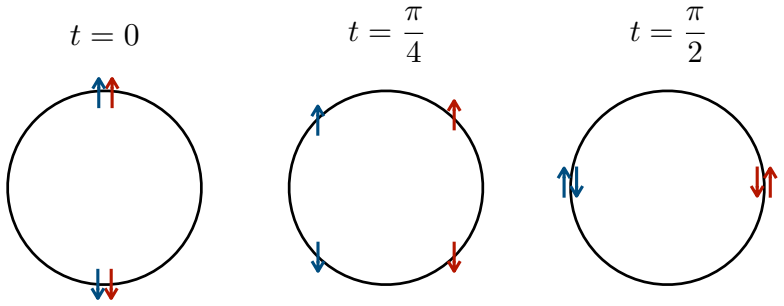
- The entanglement entropy evolves in time following a crosscap quench according to the computed correlation functions.
- The global Hilbert space of free QFT in elliptic dS is one-dimensional.
- Each observer's associated Hilbert space remains a nontrivial Fock space.
Where Pith is reading between the lines
- This framework may apply to other non-orientable spacetimes in quantum field theory on curved backgrounds.
- Computations of entanglement in such settings could inform models of quantum cosmology where time orientation is absent.
- Further study might reveal how this density matrix evolves under perturbations or couplings to gravity.
Load-bearing premise
That the Euclidean path integral over the elliptic de Sitter geometry can be directly interpreted as a density matrix without requiring extra structure to account for the lack of time orientation.
What would settle it
A direct computation showing that the proposed density matrix does not have unit trace or is not positive semi-definite would falsify the interpretation.
Figures


read the original abstract
Elliptic de Sitter (dS) spacetime dS$/\mathbb{Z}_2$ is a non-time-orientable spacetime obtained by imposing an antipodal identification to global dS. Unlike QFT on global dS, whose vacuum state can be prepared by a no-boundary Euclidean path integral, the Euclidean elliptic dS does not define a wavefunction in the usual sense. We propose instead that the path integral on the Euclidean elliptic dS defines a no-boundary density matrix. As an explicit example, we study the free Dirac fermion CFT in two-dimensional elliptic dS and analytically compute the von Neumann and the R\'enyi entropies of this density matrix. The calculation reduces to correlation functions of vertex operators on non-orientable surfaces. As a by-product, we compute the time evolution of entanglement entropy following a crosscap quench in free Dirac fermion CFT. We also comment on a striking feature of free QFT in elliptic dS: its global Hilbert space is one-dimensional, wheres the Hilbert space associated to each observer is a nontrivial Fock space.
Editorial analysis
A structured set of objections, weighed in public.
Referee Report
Summary. The paper proposes that the Euclidean path integral on non-time-orientable elliptic de Sitter space dS/ℤ₂ defines a no-boundary density matrix (rather than a wavefunction) for observers. As an explicit example in the free Dirac fermion CFT in two dimensions, the von Neumann and Rényi entropies of this density matrix are computed analytically by reducing the problem to correlation functions of vertex operators on non-orientable surfaces. The work also derives the time evolution of entanglement entropy after a crosscap quench and highlights that the global Hilbert space is one-dimensional while each observer's Hilbert space is a nontrivial Fock space.
Significance. If the central construction holds, the result supplies an explicit, analytically tractable model for a no-boundary density matrix in a non-orientable de Sitter background, together with closed-form entropy expressions obtained from standard CFT techniques on non-orientable surfaces. This provides a concrete bridge between the no-boundary proposal and entanglement measures in dS quantum gravity, and the crosscap-quench calculation offers a new solvable example of entanglement dynamics in free CFT. The observation that the global Hilbert space is one-dimensional while observer spaces remain nontrivial is a noteworthy structural feature of QFT on elliptic dS.
major comments (2)
- [Proposal of the no-boundary density matrix] The proposal that the Euclidean elliptic dS path integral directly yields a density operator ρ on the observer Fock space requires an explicit construction of the reduction step (tracing over antipodal/crosscap degrees of freedom) that demonstrates positivity, trace normalization, and compatibility with the non-time-orientable topology. Without this derivation the subsequent entropy extraction from vertex-operator correlators rests on an unverified assumption; this is load-bearing for the central claim.
- [Entropy computation via CFT correlators] The statement that the calculation 'reduces to known CFT correlators' on non-orientable surfaces is asserted in the abstract and introduction, but the explicit analytic continuation from the Euclidean elliptic geometry to the Lorentzian observer correlators, including the precise vertex-operator insertions and the handling of the crosscap, is not displayed in sufficient detail to verify the absence of additional phases or normalization factors.
minor comments (2)
- [Introduction] The notation distinguishing the global one-dimensional Hilbert space from the observer Fock space should be introduced with a short diagram or explicit basis choice early in the text to avoid confusion when the density-matrix reduction is discussed.
- A brief comparison table of the elliptic dS results with the corresponding quantities on global dS would help readers assess the effect of the ℤ₂ identification.
Simulated Author's Rebuttal
We thank the referee for their careful reading of our manuscript and for the constructive comments, which have helped us improve the clarity of the central construction. We address each major comment below and have revised the manuscript accordingly to provide the requested explicit derivations and details.
read point-by-point responses
-
Referee: [Proposal of the no-boundary density matrix] The proposal that the Euclidean elliptic dS path integral directly yields a density operator ρ on the observer Fock space requires an explicit construction of the reduction step (tracing over antipodal/crosscap degrees of freedom) that demonstrates positivity, trace normalization, and compatibility with the non-time-orientable topology. Without this derivation the subsequent entropy extraction from vertex-operator correlators rests on an unverified assumption; this is load-bearing for the central claim.
Authors: We agree that an explicit derivation of the reduction is necessary to make the proposal fully rigorous. In the revised manuscript we have added a new subsection (Section 2.2) that constructs the density matrix explicitly: the Euclidean path integral on the elliptic geometry with the crosscap identification is shown to compute matrix elements of the form Tr(ρ O), where O is any operator supported in a single observer patch. Positivity follows from the reflection positivity of the underlying Euclidean CFT, trace normalization is fixed by the partition function on the closed non-orientable surface, and compatibility with the topology is ensured because the antipodal identification is built into the manifold rather than imposed after the fact. This derivation justifies the subsequent reduction of the entropies to vertex-operator correlators on non-orientable surfaces. revision: yes
-
Referee: [Entropy computation via CFT correlators] The statement that the calculation 'reduces to known CFT correlators' on non-orientable surfaces is asserted in the abstract and introduction, but the explicit analytic continuation from the Euclidean elliptic geometry to the Lorentzian observer correlators, including the precise vertex-operator insertions and the handling of the crosscap, is not displayed in sufficient detail to verify the absence of additional phases or normalization factors.
Authors: We acknowledge that the original presentation was too terse on this technical step. In the revised version we have expanded Section 3 and added Appendix B, which now display the full analytic continuation: the Euclidean correlators on the non-orientable surface (RP² or Klein bottle) are continued to Lorentzian signature by rotating the crosscap coordinate, with vertex operators inserted at the entanglement cuts corresponding to the observer’s causal patch. We explicitly verify that the fermionic boundary conditions around the crosscap produce no extra phases beyond the standard spin-structure factors already accounted for in the literature on non-orientable CFT, and that the overall normalization is fixed by matching to the known two-point function on the sphere. The resulting closed-form expressions for the von Neumann and Rényi entropies are unchanged, but the intermediate steps are now fully written out. revision: yes
Circularity Check
No significant circularity; proposal and CFT computations are self-contained
full rationale
The paper's central move is an interpretive proposal that the Euclidean elliptic dS path integral defines a density matrix rather than a wavefunction. This is stated as a suggestion, not derived from prior equations within the paper. The entropy calculations are performed by reducing to standard vertex-operator correlators on non-orientable surfaces using free Dirac fermion CFT techniques, which are independent of the proposal itself. The observation that the global Hilbert space is one-dimensional while observer Hilbert spaces are nontrivial Fock spaces is presented as a feature of the background, not used to force or redefine the density matrix. No self-citations, fitted parameters renamed as predictions, or ansatzes smuggled via prior work appear in the load-bearing steps. The derivation chain does not reduce any claimed result to its own inputs by construction.
Axiom & Free-Parameter Ledger
axioms (2)
- domain assumption The Euclidean path integral over elliptic dS can be interpreted as a density matrix rather than a wavefunction due to the antipodal identification.
- standard math Free Dirac fermion CFT on non-orientable surfaces yields well-defined vertex-operator correlation functions that compute the entropies.
Forward citations
Cited by 1 Pith paper
-
A Tale of Two Hartle-Hawking Wave Functions: Fully Gravitational vs Partially Frozen
In AdS the fully gravitational Hartle-Hawking wave function acquires a nontrivial one-loop phase while the partially frozen version stays real and positive; a partially frozen de Sitter sphere shows phase cancellation.
Reference graph
Works this paper leans on
-
[1]
A. H. Guth,The Inflationary Universe: A Possible Solution to the Horizon and Flatness Problems,Phys. Rev. D23(1981) 347
work page 1981
-
[2]
A. D. Linde,A New Inflationary Universe Scenario: A Possible Solution of the Horizon, Flatness, Homogeneity, Isotropy and Primordial Monopole Problems,Phys. Lett. B108(1982) 389
work page 1982
-
[3]
Dimensional Reduction in Quantum Gravity
G. ’t Hooft,Dimensional reduction in quantum gravity,Conf. Proc.C930308(1993) 284 [gr-qc/9310026]
work page internal anchor Pith review Pith/arXiv arXiv 1993
-
[4]
L. Susskind,The World as a hologram,J. Math. Phys.36(1995) 6377 [hep-th/9409089]
work page internal anchor Pith review Pith/arXiv arXiv 1995
-
[5]
J. M. Maldacena,The Large N limit of superconformal field theories and supergravity, Int. J. Theor. Phys.38(1999) 1113 [hep-th/9711200]
work page internal anchor Pith review Pith/arXiv arXiv 1999
-
[6]
A. Strominger,The dS / CFT correspondence,JHEP10(2001) 034 [hep-th/0106113]
work page internal anchor Pith review Pith/arXiv arXiv 2001
-
[7]
C. M. Hull,Timelike T duality, de Sitter space, large N gauge theories and topological field theory,JHEP07(1998) 021 [hep-th/9806146]
work page internal anchor Pith review Pith/arXiv arXiv 1998
-
[8]
J. M. Maldacena,Non-Gaussian features of primordial fluctuations in single field inflationary models,JHEP05(2003) 013 [astro-ph/0210603]. 35
work page internal anchor Pith review Pith/arXiv arXiv 2003
-
[9]
Higher Spin Realization of the dS/CFT Correspondence
D. Anninos, T. Hartman and A. Strominger,Higher Spin Realization of the dS/CFT Correspondence,Class. Quant. Grav.34(2017) 015009 [1108.5735]
work page internal anchor Pith review Pith/arXiv arXiv 2017
- [10]
-
[11]
M. Alishahiha, A. Karch, E. Silverstein and D. Tong,The dS/dS correspondence,AIP Conf. Proc.743(2004) 393 [hep-th/0407125]
work page internal anchor Pith review Pith/arXiv arXiv 2004
-
[12]
X. Dong, E. Silverstein and G. Torroba,De Sitter Holography and Entanglement Entropy,JHEP07(2018) 050 [1804.08623]
work page internal anchor Pith review Pith/arXiv arXiv 2018
-
[13]
L. Susskind,De Sitter Holography: Fluctuations, Anomalous Symmetry, and Wormholes,Universe7(2021) 464 [2106.03964]
-
[14]
Susskind,Black Holes Hint towards De Sitter Matrix Theory,Universe9(2023) 368 [2109.01322]
L. Susskind,Black Holes Hint towards De Sitter Matrix Theory,Universe9(2023) 368 [2109.01322]
-
[15]
L. Susskind,Entanglement and Chaos in De Sitter Space Holography: An SYK Example,JHAP1(2021) 1 [2109.14104]
-
[16]
V. Narovlansky and H. Verlinde,Double-scaled SYK and de Sitter holography,JHEP 05(2025) 032 [2310.16994]
-
[17]
Verlinde,Double-scaled SYK, chords and de Sitter gravity,JHEP03(2025) 076 [2402.00635]
H. Verlinde,Double-scaled SYK, chords and de Sitter gravity,JHEP03(2025) 076 [2402.00635]
-
[18]
H. Verlinde and M. Zhang,SYK correlators from 2D Liouville-de Sitter gravity,JHEP 05(2025) 053 [2402.02584]
-
[19]
Schr¨ odinger,Expanding universe
E. Schr¨ odinger,Expanding universe. Cambridge University Press, 1956
work page 1956
-
[20]
M. K. Parikh, I. Savonije and E. P. Verlinde,Elliptic de Sitter space: dS/Z(2),Phys. Rev. D67(2003) 064005 [hep-th/0209120]
work page internal anchor Pith review Pith/arXiv arXiv 2003
-
[21]
Wei,Holographic dual of crosscap conformal field theory,JHEP03(2025) 086 [2405.03755]
Z. Wei,Holographic dual of crosscap conformal field theory,JHEP03(2025) 086 [2405.03755]
-
[22]
A. Blommaert, D. Tietto and H. Verlinde,SYK collective field theory as complex Liouville gravity,2509.18462. 36
-
[23]
T. S. Bunch and P. C. W. Davies,Quantum Field Theory in de Sitter Space: Renormalization by Point Splitting,Proc. Roy. Soc. Lond. A360(1978) 117
work page 1978
-
[24]
J. B. Hartle and S. W. Hawking,Wave Function of the Universe,Phys. Rev. D28 (1983) 2960
work page 1983
- [25]
-
[26]
P. Calabrese and J. Cardy,Entanglement entropy and quantum field theory,J. Stat. Mech.2004(2004) P06002
work page 2004
-
[27]
Les Houches Lectures on De Sitter Space
M. Spradlin, A. Strominger and A. Volovich,Les Houches lectures on de Sitter space, inLes Houches Summer School: Session 76: Euro Summer School on Unity of Fundamental Physics: Gravity, Gauge Theory and Strings, pp. 423–453, 10, 2001, hep-th/0110007
work page internal anchor Pith review Pith/arXiv arXiv 2001
-
[28]
N. A. Chernikov and E. A. Tagirov,Quantum theory of scalar field in de Sitter space-time,Ann. Inst. H. Poincare Phys. Theor. A9(1968) 109
work page 1968
-
[29]
Mottola,Particle Creation in de Sitter Space,Phys
E. Mottola,Particle Creation in de Sitter Space,Phys. Rev. D31(1985) 754
work page 1985
-
[30]
Allen,Vacuum States in de Sitter Space,Phys
B. Allen,Vacuum States in de Sitter Space,Phys. Rev. D32(1985) 3136
work page 1985
-
[31]
Conformal Vacua and Entropy in de Sitter Space
R. Bousso, A. Maloney and A. Strominger,Conformal vacua and entropy in de Sitter space,Phys. Rev. D65(2002) 104039 [hep-th/0112218]
work page internal anchor Pith review Pith/arXiv arXiv 2002
-
[32]
Miller,Path integral games with de Sitterα-vacua,JHEP10(2025) 097 [2503.13701]
N. Miller,Path integral games with de Sitterα-vacua,JHEP10(2025) 097 [2503.13701]
-
[33]
A. Blommaert, J. Kudler-Flam and E. Y. Urbach,Absolute entropy and the observer’s no-boundary state,JHEP11(2025) 113 [2505.14771]
-
[34]
Z. Wei,Observers and Timekeepers: From the Page-Wootters Mechanism to the Gravitational Path Integral,2506.21489
-
[35]
Measuring Black Hole Formations by Entanglement Entropy via Coarse-Graining
T. Takayanagi and T. Ugajin,Measuring Black Hole Formations by Entanglement Entropy via Coarse-Graining,JHEP11(2010) 054 [1008.3439]. 37
work page internal anchor Pith review Pith/arXiv arXiv 2010
-
[36]
Physics at the entangling surface
K. Ohmori and Y. Tachikawa,Physics at the entangling surface,J. Stat. Mech.1504 (2015) P04010 [1406.4167]
work page internal anchor Pith review Pith/arXiv arXiv 2015
-
[37]
J. Polchinski,String theory. Vol. 1: An introduction to the bosonic string, Cambridge Monographs on Mathematical Physics. Cambridge University Press, 12, 2007, 10.1017/CBO9780511816079
-
[38]
J. Polchinski,String theory. Vol. 2: Superstring theory and beyond, Cambridge Monographs on Mathematical Physics. Cambridge University Press, 12, 2007, 10.1017/CBO9780511618123
-
[39]
Universal entropy of conformal critical theories on a Klein bottle
H.-H. Tu,Universal entropy of conformal critical theories on a Klein bottle,Phys. Rev. Lett.119(2017) 261603 [1707.05812]
work page internal anchor Pith review Pith/arXiv arXiv 2017
- [40]
-
[41]
H. Shimizu and A. Ueda,Tensor network simulations for non-orientable surfaces, 2402.15507
-
[42]
Y. Chiba and Y. Yoneta,Exact Thermal Eigenstates of Nonintegrable Spin Chains at Infinite Temperature,Phys. Rev. Lett.133(2024) 170404 [2403.12330]
-
[43]
Y. Yoneta,Thermal pure states for systems with antiunitary symmetries and their tensor network representations,Phys. Rev. Res.6(2024) L042062 [2407.14454]
-
[44]
J. Caetano and S. Komatsu,Crosscap States in Integrable Field Theories and Spin Chains,J. Stat. Phys.187(2022) 30 [2111.09901]
- [45]
- [46]
-
[47]
Y. Zhang, Y.-H. Wu, L. Wang and H.-H. Tu,Crosscap states and duality of Ising field theory in two dimensions,2409.11046
- [48]
-
[49]
Ishibashi,The Boundary and Crosscap States in Conformal Field Theories,Mod
N. Ishibashi,The Boundary and Crosscap States in Conformal Field Theories,Mod. Phys. Lett.A4(1989) 251
work page 1989
-
[50]
J. L. Cardy,Boundary Conditions, Fusion Rules and the Verlinde Formula,Nucl. Phys.B324(1989) 581
work page 1989
-
[51]
R. Blumenhagen and E. Plauschinn,Introduction to Conformal Field Theory: With Applications to String Theory, Lecture Notes in Physics. Springer Berlin Heidelberg, 2009
work page 2009
- [52]
-
[53]
J. Cotler and A. Strominger,The Universe as a Quantum Encoder,2201.11658
-
[54]
Entanglement entropy in de Sitter space
J. Maldacena and G. L. Pimentel,Entanglement entropy in de Sitter space,JHEP02 (2013) 038 [1210.7244]
work page internal anchor Pith review Pith/arXiv arXiv 2013
- [55]
-
[56]
A. Mollabashi, N. Shiba, T. Takayanagi, K. Tamaoka and Z. Wei,Pseudo Entropy in Free Quantum Field Theories,Phys. Rev. Lett.126(2021) 081601 [2011.09648]
- [57]
- [58]
-
[59]
A. Milekhin, Z. Adamska and J. Preskill,Observable and computable entanglement in time,2502.12240
-
[60]
G. W. Gibbons,The elliptic interpretation of black holes and quantum mechanics, Nucl. Phys. B271(1986) 497. 39
work page 1986
-
[61]
N. G. Sanchez,Quantum Field Theory and the ’Elliptic Interpretation’ of De Sitter Space-time,Nucl. Phys. B294(1987) 1111
work page 1987
-
[62]
D. Marolf and H. Maxfield,Transcending the ensemble: baby universes, spacetime wormholes, and the order and disorder of black hole information,JHEP08(2020) 044 [2002.08950]
-
[63]
J. McNamara and C. Vafa,Baby Universes, Holography, and the Swampland, 2004.06738
-
[64]
M. Usatyuk, Z.-Y. Wang and Y. Zhao,Closed universes in two dimensional gravity, SciPost Phys.17(2024) 051 [2402.00098]
- [65]
- [66]
- [67]
-
[68]
Y. Nomura and T. Ugajin,Nonperturbative quantum gravity in a closed Lorentzian universe,JHEP10(2025) 166 [2505.20390]
- [69]
- [70]
-
[71]
Sewing Constraints and Non-Orientable Open Strings
D. Fioravanti, G. Pradisi and A. Sagnotti,Sewing constraints and nonorientable open strings,Phys. Lett. B321(1994) 349 [hep-th/9311183]
work page internal anchor Pith review Pith/arXiv arXiv 1994
-
[72]
Tsiares,Universal Dynamics in Non-Orientable CFT 2,2011.09250
I. Tsiares,Universal Dynamics in Non-Orientable CFT 2,2011.09250
-
[73]
Chen,Exact Quench Dynamics from Thermal Pure Quantum States, 2510.05346
H.-H. Chen,Exact Quench Dynamics from Thermal Pure Quantum States, 2510.05346. 40
- [74]
-
[75]
Evolution of Entanglement Entropy in One-Dimensional Systems
P. Calabrese and J. L. Cardy,Evolution of entanglement entropy in one-dimensional systems,J. Stat. Mech.0504(2005) P04010 [cond-mat/0503393]
work page internal anchor Pith review Pith/arXiv arXiv 2005
- [76]
-
[77]
Boundary States as Holographic Duals of Trivial Spacetimes
M. Miyaji, S. Ryu, T. Takayanagi and X. Wen,Boundary States as Holographic Duals of Trivial Spacetimes,JHEP05(2015) 152 [1412.6226]. 41
work page internal anchor Pith review Pith/arXiv arXiv 2015
discussion (0)
Sign in with ORCID, Apple, or X to comment. Anyone can read and Pith papers without signing in.