Are neutrinos Majorana? Fixed-target and high-energy astrophysical searches decide
Pith reviewed 2026-06-27 03:15 UTC · model grok-4.3
The pith
Heavy neutral leptons can reveal whether neutrinos are Majorana by inducing a detectable flavor shift in astrophysical neutrinos.
A machine-rendered reading of the paper's core claim, the machinery that carries it, and where it could break.
Core claim
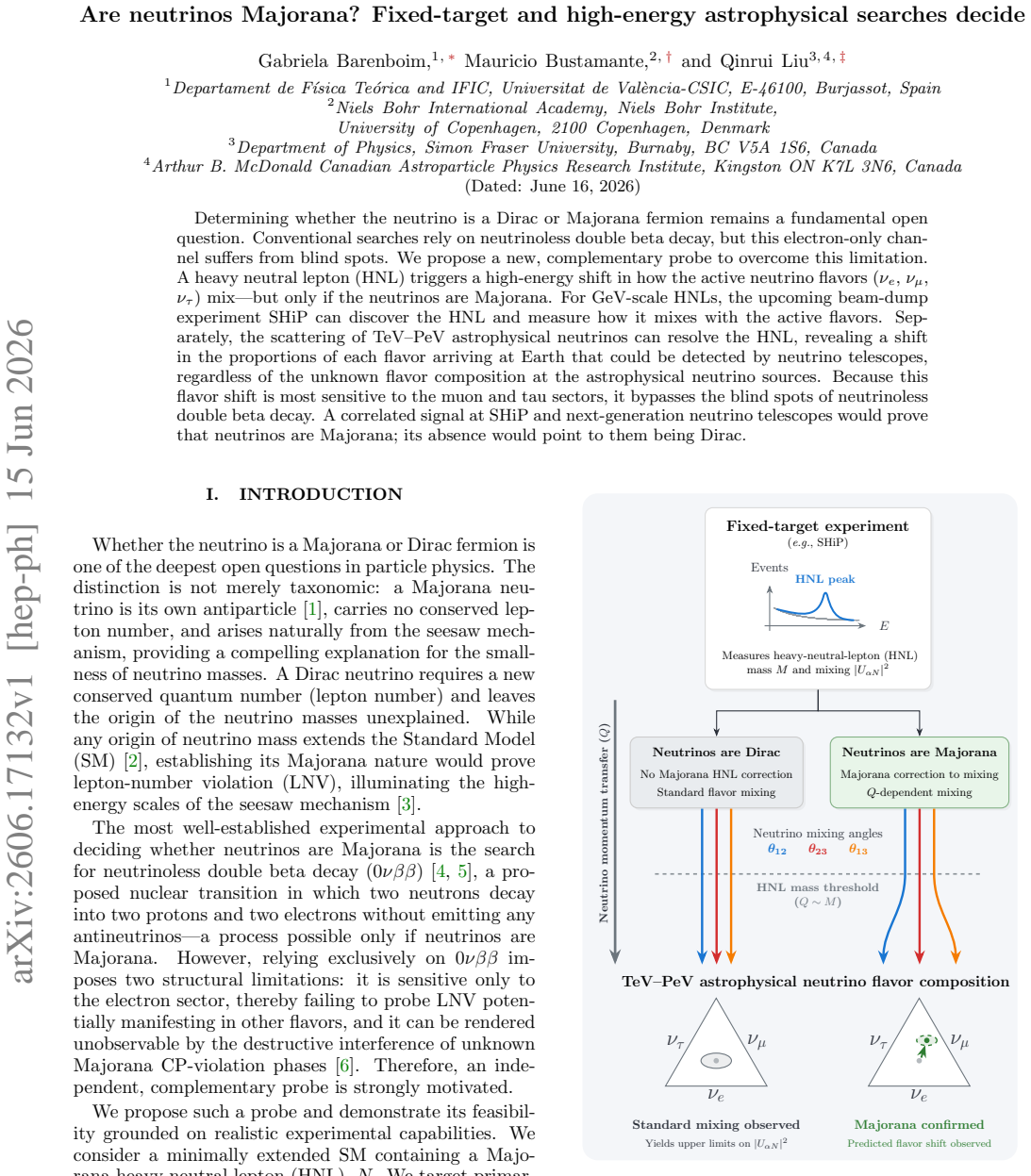
A heavy neutral lepton triggers a high-energy shift in active neutrino flavor mixing only if the neutrinos are Majorana. For GeV-scale HNLs, SHiP can discover the HNL and its mixing, while scattering of TeV-PeV astrophysical neutrinos reveals the resulting flavor shift at Earth, detectable regardless of source composition. This provides a probe sensitive to muon and tau sectors.
What carries the argument
Heavy neutral lepton (HNL) inducing high-energy shift in active neutrino flavor mixing, observable only for Majorana neutrinos.
If this is right
- Discovery of GeV-scale HNL at SHiP with measured mixing to active flavors.
- Detection of altered flavor ratios in astrophysical neutrinos by telescopes.
- The flavor shift bypasses electron-only blind spots of 0νββ decay.
- Correlated signals would establish neutrinos as Majorana particles.
- Lack of correlated signals would indicate Dirac neutrinos.
Where Pith is reading between the lines
- This method links laboratory fixed-target experiments with high-energy astrophysics in a new way.
- It could be extended to other high-energy neutrino sources or experiments.
- If neutrinos are Majorana, this might constrain the scale of new physics beyond the standard model.
- Future improvements in flavor resolution at telescopes would enhance the test.
Load-bearing premise
The high-energy flavor mixing shift triggered by the HNL occurs exclusively when neutrinos are Majorana and can be distinguished in astrophysical scattering despite unknown source flavors.
What would settle it
Finding an HNL at SHiP whose mixing would predict a flavor shift but observing no such shift in astrophysical neutrino data, or observing the shift without an HNL at SHiP.
Figures
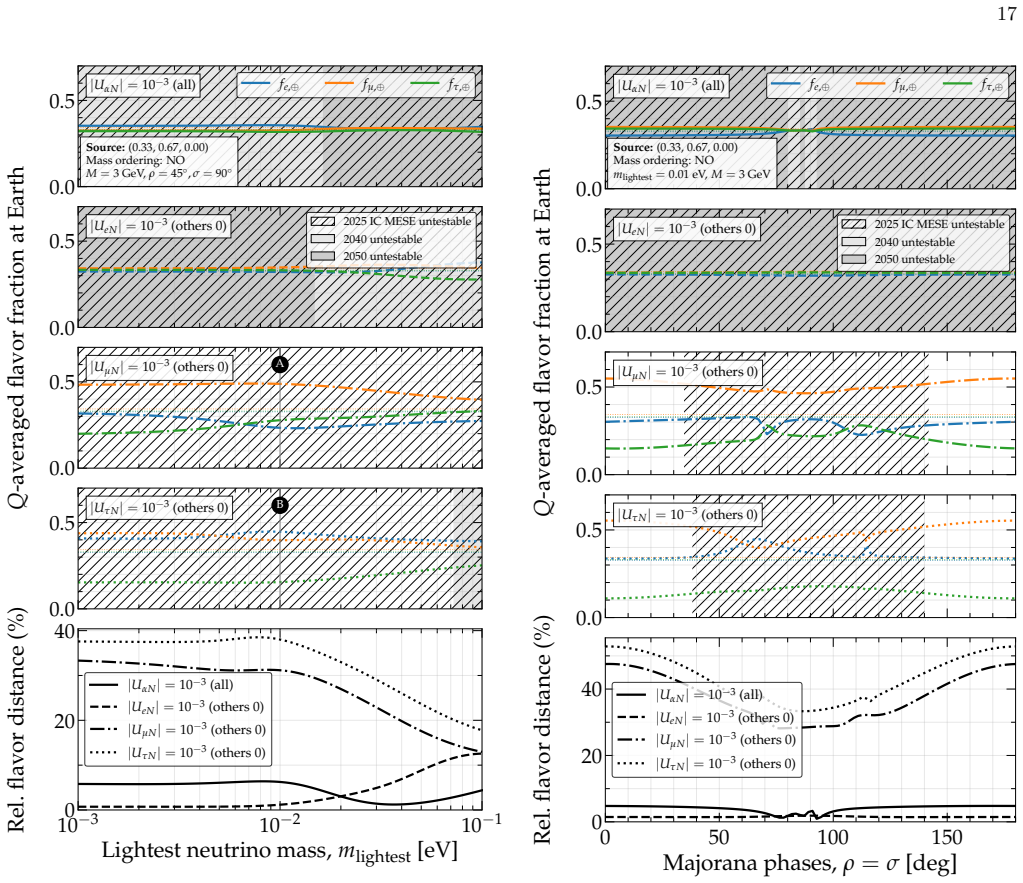
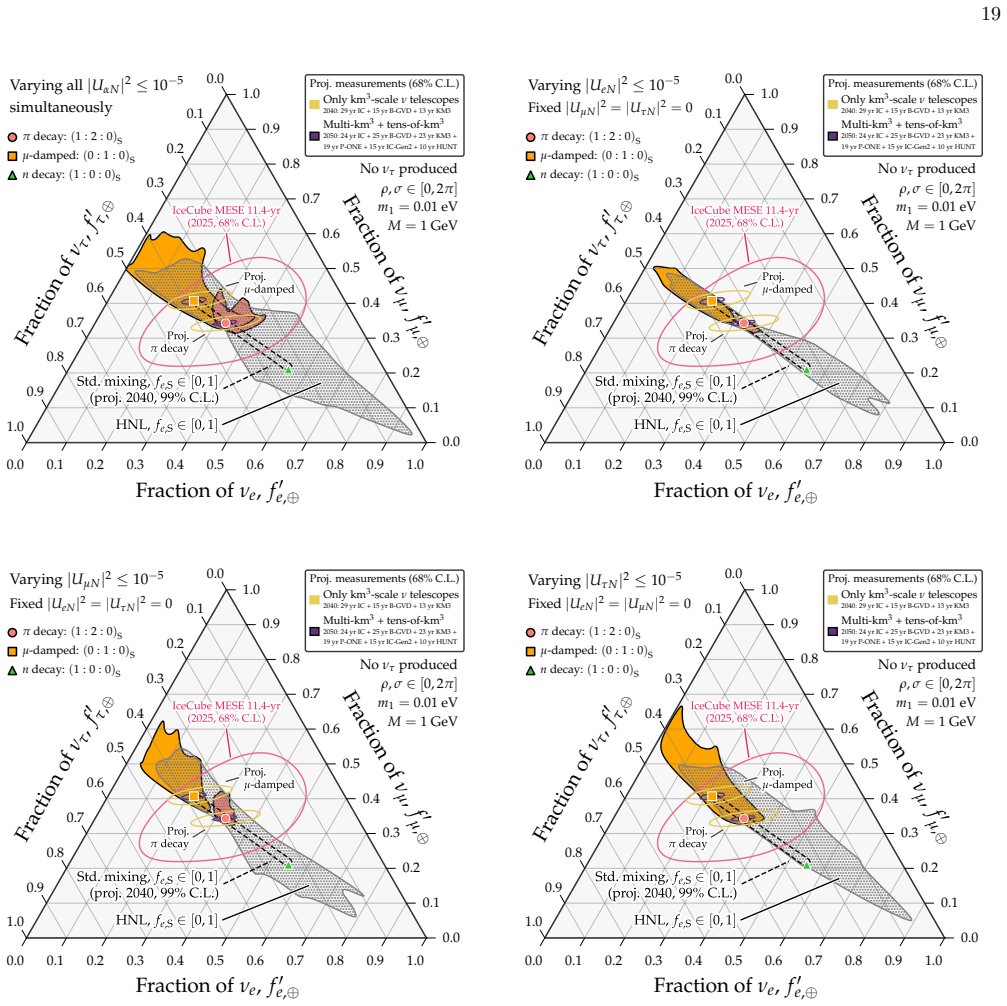
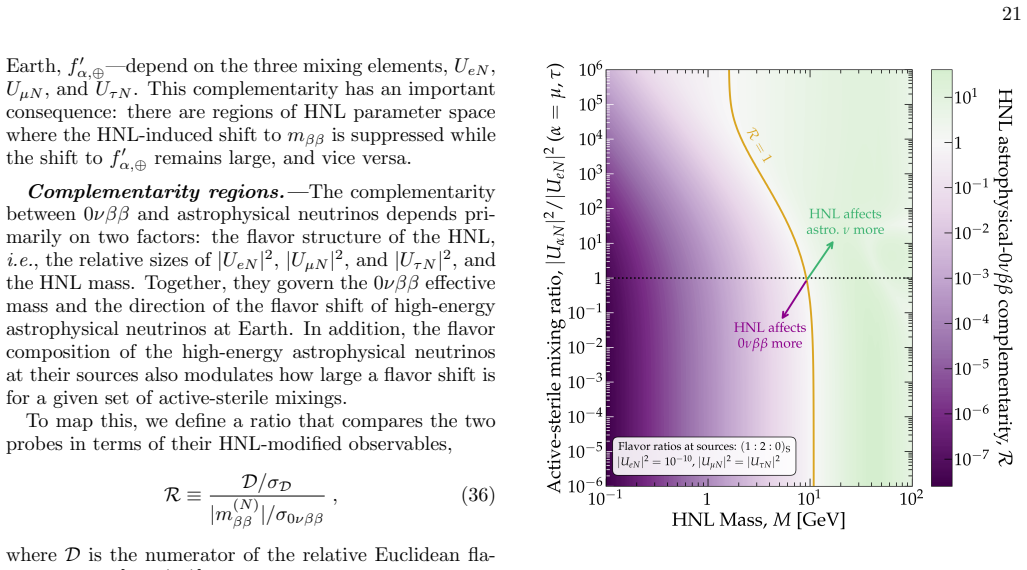
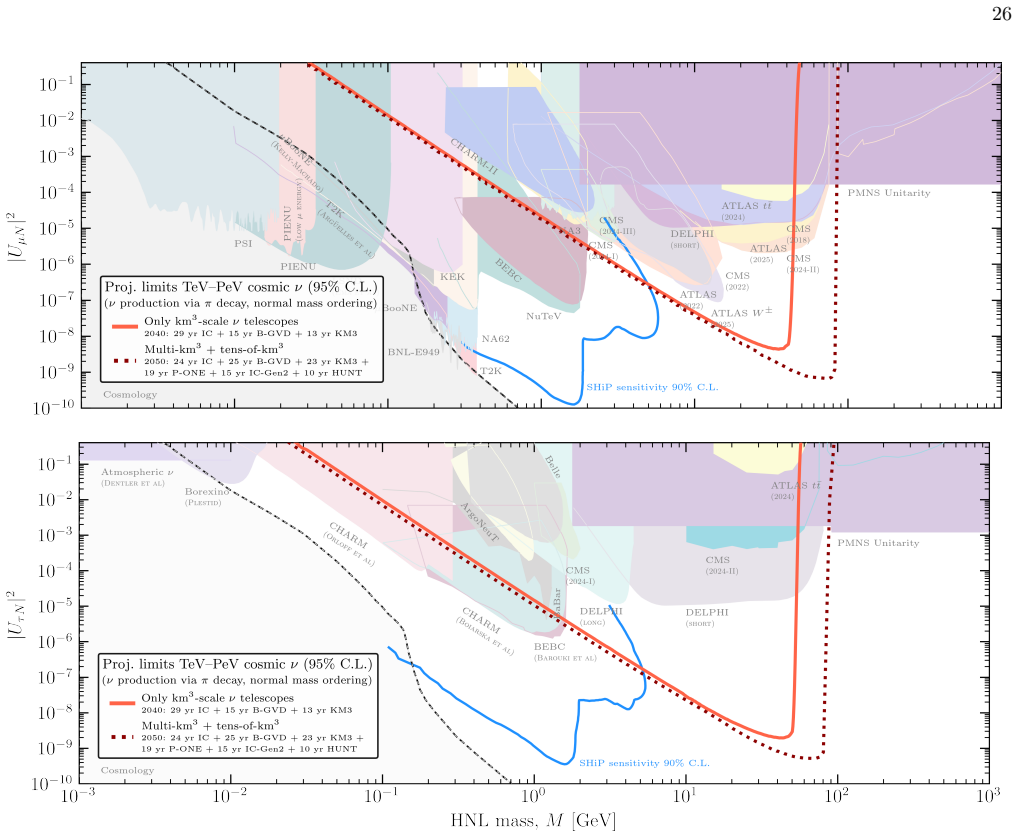
read the original abstract
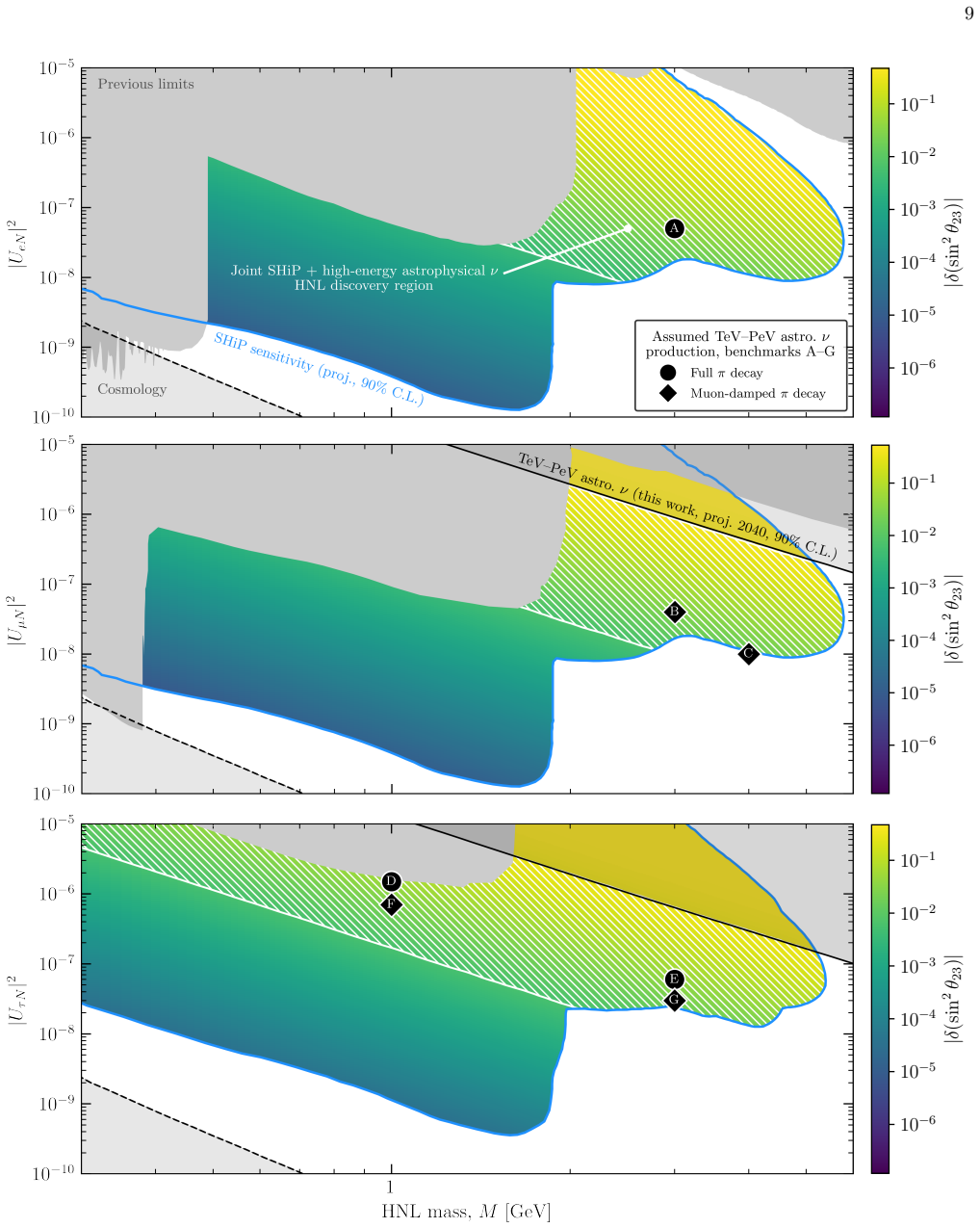
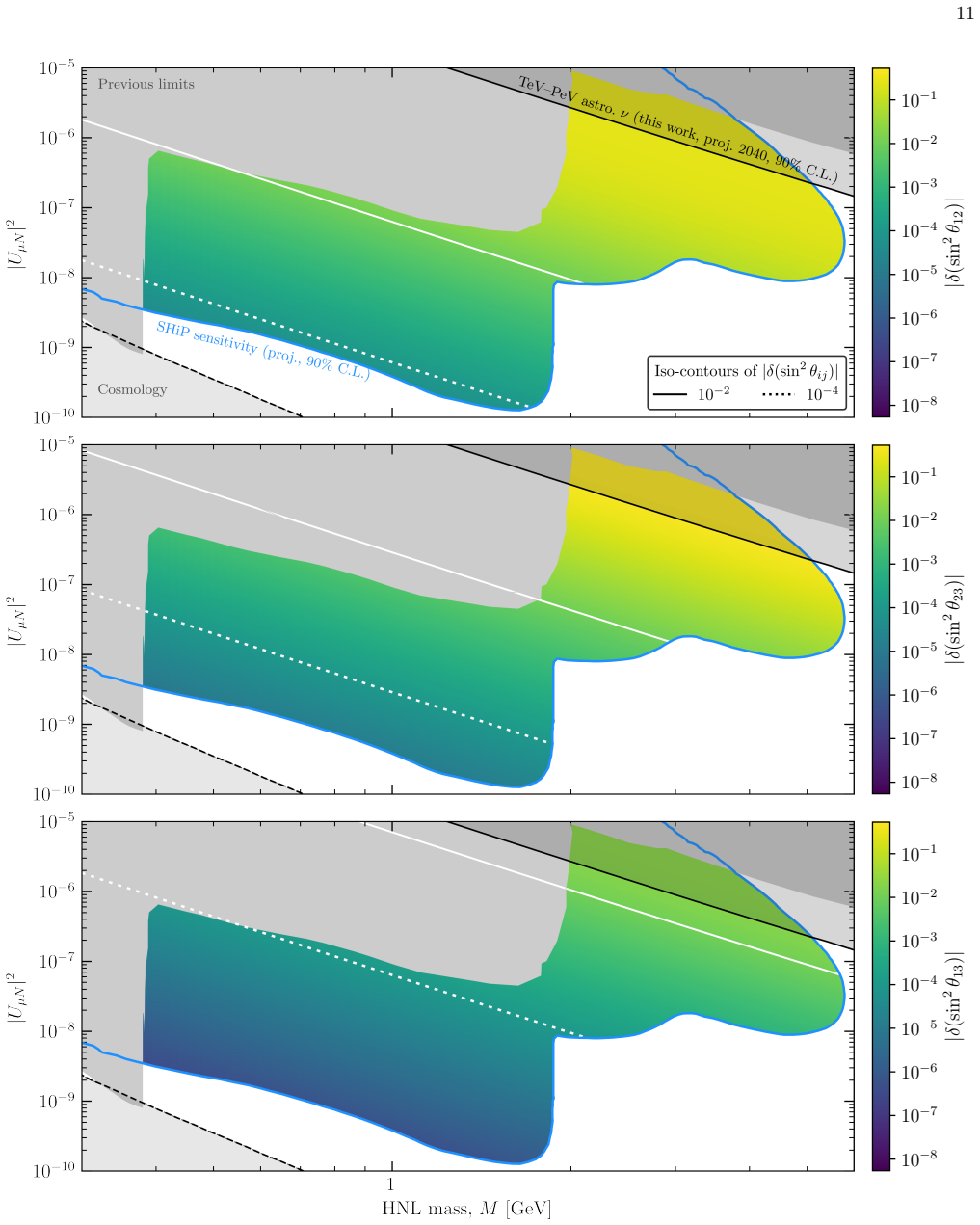
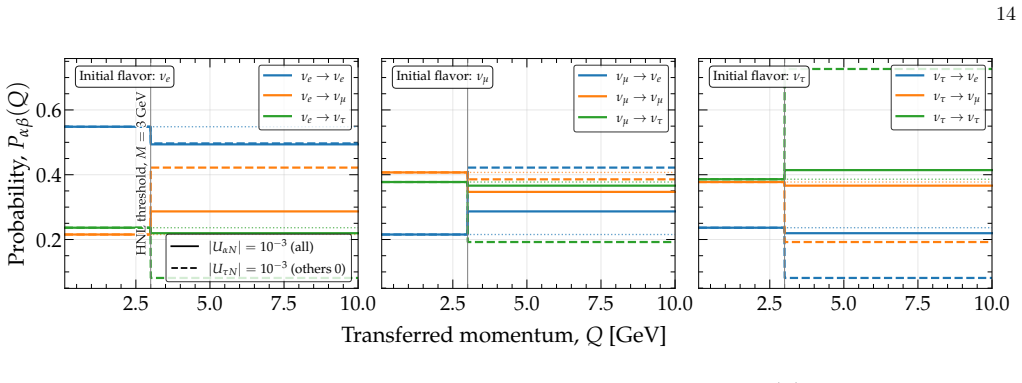
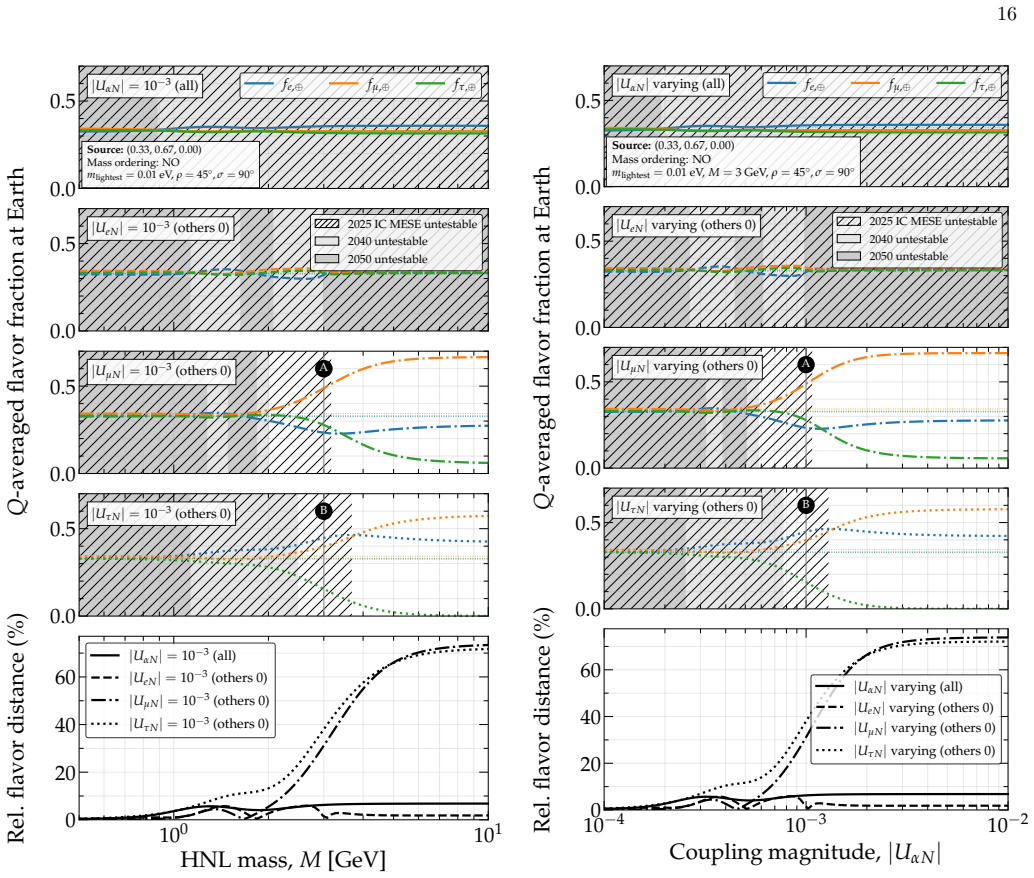
Determining whether the neutrino is a Dirac or Majorana fermion remains a fundamental open question. Conventional searches rely on neutrinoless double beta decay, but this electron-only channel suffers from blind spots. We propose a new, complementary probe to overcome this limitation. A heavy neutral lepton (HNL) triggers a high-energy shift in how the active neutrino flavors ($\nu_e$, $\nu_\mu$, $\nu_\tau$) mix -- but only if the neutrinos are Majorana. For GeV-scale HNLs, the upcoming beam-dump experiment SHiP can discover the HNL and measure how it mixes with the active flavors. Separately, the scattering of TeV--PeV astrophysical neutrinos can resolve the HNL, revealing a shift in the proportions of each flavor arriving at Earth that could be detected by neutrino telescopes, regardless of the unknown flavor composition at the astrophysical neutrino sources. Because this flavor shift is most sensitive to the muon and tau sectors, it bypasses the blind spots of neutrinoless double beta decay. A correlated signal at SHiP and next-generation neutrino telescopes would prove that neutrinos are Majorana; its absence would point to them being Dirac.
Editorial analysis
A structured set of objections, weighed in public.
Referee Report
Summary. The manuscript proposes that a GeV-scale heavy neutral lepton (HNL) induces a high-energy shift in active-neutrino flavor mixing only if neutrinos are Majorana. Discovery and mixing measurements of the HNL at the SHiP beam-dump experiment, combined with detection of the resulting shift in TeV–PeV astrophysical neutrino flavor ratios at next-generation telescopes, would establish the Majorana nature; absence of the correlated signal would indicate Dirac neutrinos. The effect is claimed to be observable in the muon and tau sectors and independent of unknown source flavor composition, thereby complementing neutrinoless double-beta decay.
Significance. If the central mechanism is quantitatively validated, the proposal supplies a genuinely new, multi-messenger test of the Dirac/Majorana question that is sensitive to flavor sectors inaccessible to 0νββ decay. The correlated-signal logic is falsifiable in principle and leverages existing or near-term experimental capabilities (SHiP and IceCube-Gen2/KM3NeT-class telescopes).
major comments (1)
- [Abstract / mechanism description] Abstract and mechanism section: the load-bearing claim that the HNL-induced flavor-ratio deviation remains detectable 'regardless of the unknown flavor composition at the astrophysical neutrino sources' requires explicit demonstration that the shift vector in (e:μ:τ) space lies outside the manifold spanned by all plausible source ratios (pion-decay, muon-damped, neutron-decay, etc.) after standard oscillations. No mixing-matrix calculation, deviation magnitude, or comparison against source-variation span is provided, leaving the independence assertion unverified.
Simulated Author's Rebuttal
We thank the referee for the careful reading, the positive assessment of the proposal's significance, and the constructive comment. We respond to the major comment below.
read point-by-point responses
-
Referee: [Abstract / mechanism description] Abstract and mechanism section: the load-bearing claim that the HNL-induced flavor-ratio deviation remains detectable 'regardless of the unknown flavor composition at the astrophysical neutrino sources' requires explicit demonstration that the shift vector in (e:μ:τ) space lies outside the manifold spanned by all plausible source ratios (pion-decay, muon-damped, neutron-decay, etc.) after standard oscillations. No mixing-matrix calculation, deviation magnitude, or comparison against source-variation span is provided, leaving the independence assertion unverified.
Authors: We agree that an explicit demonstration is required to substantiate the independence claim. In the revised manuscript we will add a dedicated calculation (in the mechanism section or a new appendix) that computes the HNL-induced shift vector in flavor space, quantifies its magnitude for GeV-scale HNL parameters, and explicitly compares it to the span of variations arising from standard source compositions (pion-decay, muon-damped, neutron-decay) after vacuum oscillations. This will verify that the shift lies outside the source-variation manifold and remains detectable. revision: yes
Circularity Check
No significant circularity; proposal is self-contained
full rationale
The paper proposes a new observational strategy that correlates HNL discovery at SHiP with high-energy astrophysical neutrino flavor measurements to distinguish Majorana from Dirac neutrinos. This relies on standard BSM extensions and external experimental capabilities rather than any internal fitting, self-referential definitions, or load-bearing self-citations. No equations or predictions in the provided text reduce to inputs by construction, and the central claim remains independent of the paper's own fitted values or prior author work invoked as an unverified uniqueness theorem.
Axiom & Free-Parameter Ledger
axioms (2)
- domain assumption Neutrinos can be either Dirac or Majorana fermions
- domain assumption Heavy neutral leptons mix with active neutrino flavors and induce flavor shifts only for Majorana neutrinos
Reference graph
Works this paper leans on
-
[1]
Majorana, Teoria simmetrica dell’elettrone e del positrone, Nuovo Cim.14, 171 (1937)
E. Majorana, Teoria simmetrica dell’elettrone e del positrone, Nuovo Cim.14, 171 (1937)
1937
-
[2]
R. N. Mohapatra and A. Y. Smirnov, Neutrino Mass and New Physics, Ann. Rev. Nucl. Part. Sci.56, 569 (2006), arXiv:hep-ph/0603118
work page internal anchor Pith review Pith/arXiv arXiv 2006
- [3]
-
[4]
W. H. Furry, On transition probabilities in double beta- disintegration, Phys. Rev.56, 1184 (1939)
1939
-
[5]
M. Agostini, G. Benato, J. A. Detwiler, J. Men´ endez, and F. Vissani, Toward the discovery of matter creation with neutrinolessββdecay, Rev. Mod. Phys.95, 025002 (2023), arXiv:2202.01787 [hep-ex]
-
[6]
Neutrino Masses, Mixing and Neutrinoless Double-Beta Decay
S. Pascoli and S. T. Petcov, Majorana neutrinos, neu- trino mass spectrum, CP violation and neutrinoless dou- ble beta decay. I. The three neutrino mixing case, Phys. Rev. D68, 093007 (2003), arXiv:hep-ph/0308034
work page internal anchor Pith review Pith/arXiv arXiv 2003
-
[7]
SHiP Collaboration, Sensitivity of the SHiP exper- iment to Heavy Neutral Leptons, JHEP04, 077, arXiv:1811.00930
work page internal anchor Pith review Pith/arXiv arXiv
-
[8]
W. Grimus and L. Lavoura, Renormalization of the neu- trino mass operators in the multi-Higgs-doublet stan- dard model, Eur. Phys. J. C39, 219 (2005), arXiv:hep- ph/0409231
-
[9]
On the importance of the 1-loop finite corrections to seesaw neutrino masses
D. Aristizabal Sierra and C. E. Yaguna, On the impor- tance of the 1-loop finite corrections to seesaw neutrino masses, JHEP08, 013, arXiv:1106.3587 [hep-ph]
work page internal anchor Pith review Pith/arXiv arXiv
-
[10]
R. Abbasiet al., Characterization of the Three- Flavor Composition of Cosmic Neutrinos with IceCube, (2025), arXiv:2510.24957 [astro-ph.HE]
- [11]
-
[12]
Astrophysical bounds on the high-energy evolution of neutrino mixing
M. Bustamante, Q. Liu, and G. Barenboim, Astrophys- ical bounds on the high-energy evolution of neutrino mixing, (2026), arXiv:2604.14409 [hep-ph]
work page internal anchor Pith review Pith/arXiv arXiv 2026
-
[13]
M. Bustamante, Q. Liu, and G. Barenboim, Measuring neutrino mixing above 1 TeV with astrophysical neutri- nos, (2026), arXiv:2602.14308 [hep-ph]
-
[14]
Weinberg, Baryon and Lepton Nonconserving Pro- cesses, Phys
S. Weinberg, Baryon and Lepton Nonconserving Pro- cesses, Phys. Rev. Lett.43, 1566 (1979)
1979
- [15]
-
[16]
Navaset al.(Particle Data Group), Review of particle physics, Phys
S. Navaset al.(Particle Data Group), Review of particle physics, Phys. Rev. D110, 030001 (2024)
2024
-
[17]
P. F. de Salas, D. V. Forero, S. Gariazzo, P. Mart´ ınez- Mirav´ e, O. Mena, C. A. Ternes, M. T´ ortola, and J. W. F. Valle, 2020 global reassessment of the neutrino oscillation picture, JHEP02, 071, arXiv:2006.11237 [hep-ph]
work page internal anchor Pith review Pith/arXiv arXiv 2020
-
[18]
F. Capozzi, E. Di Valentino, E. Lisi, A. Marrone, A. Melchiorri, and A. Palazzo, Unfinished fabric of the three neutrino paradigm, Phys. Rev. D104, 083031 (2021), arXiv:2107.00532 [hep-ph]
-
[19]
NuFit-6.0: Updated global analysis of three-flavor neutrino oscillations
I. Esteban, M. C. Gonz´ alez-Garc´ ıa, M. Maltoni, I. Mart´ ınez-Soler, J. P. Pinheiro, and T. Schwetz, Nu- Fit 6.0: updated global analysis of three-flavor neutrino oscillations, JHEP12, 216, arXiv:2410.05380 [hep-ph]
work page internal anchor Pith review Pith/arXiv arXiv
- [20]
-
[21]
Hyper-Kamiokande Design Report
K. Abeet al.(Hyper-Kamiokande), Hyper-Kamiokande Design Report, (2018), arXiv:1805.04163 [physics.ins- det]
work page internal anchor Pith review Pith/arXiv arXiv 2018
-
[22]
Phenomenology of GeV-scale Heavy Neutral Leptons
K. Bondarenko, A. Boyarsky, D. Gorbunov, and O. Ruchayskiy, Phenomenology of GeV-scale Heavy Neutral Leptons, JHEP11, 032, arXiv:1805.08567 [hep- ph]
work page internal anchor Pith review Pith/arXiv arXiv
-
[23]
Global Constraints on Lepton-Quark Contact Interactions
J. de Blas, M. Chala, and J. Santiago, Global Con- straints on Lepton-Quark Contact Interactions, Phys. Rev. D88, 095011 (2013), arXiv:1307.5068 [hep-ph]
work page internal anchor Pith review Pith/arXiv arXiv 2013
-
[24]
E. Fern´ andez-Mart´ ınez, M. Gonz´ alez-L´ opez, J. Hern´ andez-Garc´ ıa, M. Hostert, and J. L´ opez- Pav´ on, Effective portals to heavy neutral leptons, JHEP09, 001, arXiv:2304.06772 [hep-ph]
-
[25]
Fern´ andez-Mart´ ınez, M
E. Fern´ andez-Mart´ ınez, M. Gonz´ alez-L´ opez, J. Hern´ andez-Garc´ ıa, M. Hostert, and J. L´ opez- Pav´ on, Heavy-Neutrino-Limits,https://github.com/ mhostert/Heavy-Neutrino-Limits(2026)
2026
-
[26]
S. H. Margolis, D. N. Schramm, and R. Silberberg, Ultrahigh-Energy Neutrino Astronomy, Astrophys. J. 221, 990 (1978)
1978
-
[27]
F. W. Stecker, Diffuse Fluxes of Cosmic High-Energy Neutrinos, Astrophys. J.228, 919 (1979)
1979
- [28]
-
[29]
Monte-Carlo simulations of photohadronic processes in astrophysics
A. M¨ ucke, R. Engel, J. P. Rachen, R. J. Protheroe, and T. Stanev, SOPHIA: Monte Carlo simulations of photohadronic processes in astrophysics, Comput. Phys. Commun.124, 290 (2000), arXiv:astro-ph/9903478
work page internal anchor Pith review Pith/arXiv arXiv 2000
-
[30]
S. R. Kelner and F. A. Aharonian, Energy spectra of gamma-rays, electrons and neutrinos produced at in- teractions of relativistic protons with low energy ra- diation, Phys. Rev. D78, 034013 (2008), [Erratum: Phys. Rev. D 82, 099901 (2010)], arXiv:0803.0688 [astro-ph]
work page internal anchor Pith review Pith/arXiv arXiv 2008
-
[31]
Simplified models for photohadronic interactions in cosmic accelerators
S. H¨ ummer, M. Ruger, F. Spanier, and W. Win- ter, Simplified models for photohadronic interactions in cosmic accelerators, Astrophys. J.721, 630 (2010), arXiv:1002.1310 [astro-ph.HE]
work page internal anchor Pith review Pith/arXiv arXiv 2010
-
[32]
R. Abbasiet al.(IceCube), Observation of high-energy neutrinos from the Galactic plane, Science380, adc9818 (2023), arXiv:2307.04427 [astro-ph.HE]
-
[33]
Flavoring Astrophysical Neutrinos: Flavor Ratios Depend on Energy
T. Kashti and E. Waxman, Flavoring astrophysical neu- trinos: Flavor ratios depend on energy, Phys. Rev. Lett. 95, 181101 (2005), arXiv:astro-ph/0507599
work page internal anchor Pith review Pith/arXiv arXiv 2005
-
[34]
High energy neutrino yields from astrophysical sources II: Magnetized sources
M. Kachelrieß, S. Ostapchenko, and R. Tom` as, High energy neutrino yields from astrophysical sources. 2. Magnetized sources, Phys. Rev. D77, 023007 (2008), arXiv:0708.3047 [astro-ph]
work page internal anchor Pith review Pith/arXiv arXiv 2008
-
[35]
Flavor Composition and Energy Spectrum of Astrophysical Neutrinos
P. Lipari, M. Lusignoli, and D. Meloni, Flavor Compo- sition and Energy Spectrum of Astrophysical Neutrinos, Phys. Rev. D75, 123005 (2007), arXiv:0704.0718 [astro- ph]
work page internal anchor Pith review Pith/arXiv arXiv 2007
-
[36]
Photohadronic Origin of the TeV-PeV Neutrinos Observed in IceCube
W. Winter, Photohadronic Origin of the TeV-PeV Neu- trinos Observed in IceCube, Phys. Rev. D88, 083007 (2013), arXiv:1307.2793 [astro-ph.HE]
work page internal anchor Pith review Pith/arXiv arXiv 2013
-
[37]
M. Bustamante and I. Tamborra, Using high-energy neutrinos as cosmic magnetometers, Phys. Rev. D102, 123008 (2020), arXiv:2009.01306 [astro-ph.HE]
-
[38]
L. A. Anchordoqui, H. Goldberg, F. Halzen, and T. J. Weiler, Galactic point sources of TeV antineutrinos, Phys. Lett. B593, 42 (2004), arXiv:astro-ph/0311002
work page internal anchor Pith review Pith/arXiv arXiv 2004
-
[39]
Farzan, On theτflavor of the cosmic neutrino flux, JHEP07, 174, arXiv:2105.03272 [hep-ph]
Y. Farzan, On theτflavor of the cosmic neutrino flux, JHEP07, 174, arXiv:2105.03272 [hep-ph]
-
[40]
Neutrinos at IceCube from Heavy Decaying Dark Matter
B. Feldstein, A. Kusenko, S. Matsumoto, and T. T. Yanagida, Neutrinos at IceCube from Heavy Decay- 32 ing Dark Matter, Phys. Rev. D88, 015004 (2013), arXiv:1303.7320 [hep-ph]
work page internal anchor Pith review Pith/arXiv arXiv 2013
-
[41]
Are IceCube neutrinos unveiling PeV-scale decaying dark matter?
A. Esmaili and P. D. Serpico, Are IceCube neutrinos unveiling PeV-scale decaying dark matter?, JCAP11, 054, arXiv:1308.1105 [hep-ph]
work page internal anchor Pith review Pith/arXiv arXiv
-
[42]
Reconciling neutrino flux from heavy dark matter decay and recent events at IceCube
A. Bhattacharya, M. H. Reno, and I. Sarcevic, Reconcil- ing neutrino flux from heavy dark matter decay and re- cent events at IceCube, JHEP06, 110, arXiv:1403.1862 [hep-ph]
work page internal anchor Pith review Pith/arXiv arXiv
-
[43]
Superheavy Particle Origin of IceCube PeV Neutrino Events
V. Barger and W.-Y. Keung, Superheavy Particle Ori- gin of IceCube PeV Neutrino Events, Phys. Lett. B727, 190 (2013), arXiv:1305.6907 [hep-ph]
work page internal anchor Pith review Pith/arXiv arXiv 2013
- [44]
- [45]
-
[46]
O. Mena, I. Mocioiu, and S. Razzaque, Oscillation ef- fects on high-energy neutrino fluxes from astrophysi- cal hidden sources, Phys. Rev. D75, 063003 (2007), arXiv:astro-ph/0612325
work page internal anchor Pith review Pith/arXiv arXiv 2007
-
[47]
Flavor conversion of cosmic neutrinos from hidden jets
S. Razzaque and A. Y. Smirnov, Flavor conversion of cosmic neutrinos from hidden jets, JHEP03, 031, arXiv:0912.4028 [hep-ph]
work page internal anchor Pith review Pith/arXiv arXiv
-
[48]
Effect of Resonant Neutrino Oscillation on TeV Neutrino Flavor Ratio from Choked GRBs
S. Sahu and B. Zhang, Effect of Resonant Neu- trino Oscillation on TeV Neutrino Flavor Ratio from Choked GRBs, Res. Astron. Astrophys.10, 943 (2010), arXiv:1007.4582 [hep-ph]
work page internal anchor Pith review Pith/arXiv arXiv 2010
-
[49]
High energy neutrinos from choked GRBs and their flavor ratio measurement by the IceCube
K. Varela, S. Sahu, A. F. Osorio Oliveros, and J. C. Sanabria, High energy neutrinos from choked GRBs and their flavor ratio measurement by the IceCube, Eur. Phys. J. C75, 289 (2015), arXiv:1411.7992 [astro- ph.HE]
work page internal anchor Pith review Pith/arXiv arXiv 2015
-
[50]
TeV-PeV Neutrino Oscillation of Low-luminosity Gamma-ray Bursts
D. Xiao and Z. G. Dai, TeV-PeV Neutrino Oscillation of Low-luminosity Gamma-ray Bursts, Astrophys. J.805, 137 (2015), arXiv:1504.01603 [astro-ph.HE]
work page internal anchor Pith review Pith/arXiv arXiv 2015
- [51]
- [52]
-
[53]
B. Telalovic and M. Bustamante, Flavor anisotropy in the high-energy astrophysical neutrino sky, JCAP05, 013, arXiv:2310.15224 [astro-ph.HE]
-
[54]
B. Telalovic and M. Bustamante, No flavor anisotropy in the high-energy neutrino sky upholds Lorentz invari- ance, JHEP02, 024, arXiv:2503.15468 [hep-ph]
-
[55]
J. P. Rachen and P. M´ esz´ aros, Photohadronic neutrinos from transients in astrophysical sources, Phys. Rev. D 58, 123005 (1998), arXiv:astro-ph/9802280
work page internal anchor Pith review Pith/arXiv arXiv 1998
-
[56]
Effects of neutrino mixing on high-energy cosmic neutrino flux
H. Athar, M. Jezabek, and O. Yasuda, Effects of neu- trino mixing on high-energy cosmic neutrino flux, Phys. Rev. D62, 103007 (2000), arXiv:hep-ph/0005104
work page internal anchor Pith review Pith/arXiv arXiv 2000
- [57]
-
[58]
G. Barenboim and C. Quigg, Neutrino Observatories can Characterize Cosmic Sources and Neutrino Prop- erties, Phys. Rev. D67, 073024 (2003), arXiv:hep- ph/0301220
-
[59]
J. F. Beacom, N. F. Bell, D. Hooper, S. Pakvasa, and T. J. Weiler, Measuring Flavor Ratios of High-Energy Astrophysical Neutrinos, Phys. Rev. D68, 093005 (2003), [Erratum: Phys. Rev. D 72, 019901 (2005)], arXiv:hep-ph/0307025
work page internal anchor Pith review Pith/arXiv arXiv 2003
-
[60]
J. F. Beacom and J. Candia, Shower power: Isolat- ing the prompt atmospheric neutrino flux using electron neutrinos, JCAP11, 009, arXiv:hep-ph/0409046
work page internal anchor Pith review Pith/arXiv arXiv
-
[61]
M. Kachelrieß and R. Tom` as, High energy neutrino yields from astrophysical sources I: Weakly magnetized sources, Phys. Rev. D74, 063009 (2006), arXiv:astro- ph/0606406
-
[62]
An Analysis of Cosmic Neutrinos: Flavor Composition at Source and Neutrino Mixing Parameters
A. Esmaili and Y. Farzan, An Analysis of Cosmic Neu- trinos: Flavor Composition at Source and Neutrino Mixing Parameters, Nucl. Phys. B821, 197 (2009), arXiv:0905.0259 [hep-ph]
work page internal anchor Pith review Pith/arXiv arXiv 2009
-
[63]
Flavor Composition of UHE Neutrinos at Source and at Neutrino Telescopes
S. Choubey and W. Rodejohann, Flavor Composition of UHE Neutrinos at Source and at Neutrino Telescopes, Phys. Rev. D80, 113006 (2009), arXiv:0909.1219 [hep- ph]
work page internal anchor Pith review Pith/arXiv arXiv 2009
-
[64]
Energy dependent neutrino flavor ratios from cosmic accelerators on the Hillas plot
S. H¨ ummer, M. Maltoni, W. Winter, and C. Yaguna, Energy dependent neutrino flavor ratios from cosmic ac- celerators on the Hillas plot, Astropart. Phys.34, 205 (2010), arXiv:1007.0006 [astro-ph.HE]
work page internal anchor Pith review Pith/arXiv arXiv 2010
-
[65]
Which is the flavor of cosmic neutrinos seen by IceCube?
A. Palladino, G. Pagliaroli, F. L. Villante, and F. Vis- sani, What is the Flavor of the Cosmic Neutrinos Seen by IceCube?, Phys. Rev. Lett.114, 171101 (2015), arXiv:1502.02923 [astro-ph.HE]
work page internal anchor Pith review Pith/arXiv arXiv 2015
-
[66]
Theoretically palatable flavor combinations of astrophysical neutrinos
M. Bustamante, J. F. Beacom, and W. Winter, The- oretically palatable flavor combinations of astrophys- ical neutrinos, Phys. Rev. Lett.115, 161302 (2015), arXiv:1506.02645 [astro-ph.HE]
work page internal anchor Pith review Pith/arXiv arXiv 2015
-
[67]
Astrophysical Neutrino Production Diagnostics with the Glashow Resonance
D. Biehl, A. Fedynitch, A. Palladino, T. J. Weiler, and W. Winter, Astrophysical Neutrino Production Diag- nostics with the Glashow Resonance, JCAP01, 033, arXiv:1611.07983 [astro-ph.HE]
work page internal anchor Pith review Pith/arXiv arXiv
-
[68]
Inferring the flavor of high-energy astrophysical neutrinos at their sources
M. Bustamante and M. Ahlers, Inferring the flavor of high-energy astrophysical neutrinos at their sources, Phys. Rev. Lett.122, 241101 (2019), arXiv:1901.10087 [astro-ph.HE]
work page internal anchor Pith review Pith/arXiv arXiv 2019
-
[69]
Astrophysics Uniquely Enabled by Observations of High-Energy Cosmic Neutrinos
M. Ackermannet al., Astrophysics Uniquely Enabled by Observations of High-Energy Cosmic Neutrinos, Bull. Am. Astron. Soc.51, 185 (2019), arXiv:1903.04334 [astro-ph.HE]
work page internal anchor Pith review Pith/arXiv arXiv 2019
-
[70]
R. Alves Batistaet al., EuCAPT White Paper: Op- portunities and Challenges for Theoretical Astroparticle Physics in the Next Decade, (2021), arXiv:2110.10074 [astro-ph.HE]
- [71]
-
[72]
A. Bhattacharya, R. Enberg, M. H. Reno, and I. Sarce- vic, Energy-dependent flavour ratios in neutrino tele- scopes from charm, JCAP03, 057, arXiv:2309.09139 [astro-ph.HE]
- [73]
-
[74]
J. F. Beacom, N. F. Bell, D. Hooper, J. G. Learned, S. Pakvasa, and T. J. Weiler, PseudoDirac Neutrinos: A Challenge for Neutrino Telescopes, Phys. Rev. Lett. 92, 011101 (2004), arXiv:hep-ph/0307151
work page internal anchor Pith review Pith/arXiv arXiv 2004
-
[75]
J. F. Beacom, N. F. Bell, D. Hooper, S. Pakvasa, and T. J. Weiler, Sensitivity toθ13 andδin the Decaying As- trophysical Neutrino Scenario, Phys. Rev. D69, 017303 (2004), arXiv:hep-ph/0309267
work page internal anchor Pith review Pith/arXiv arXiv 2004
-
[76]
P. D. Serpico, Probing the 2-3 leptonic mixing at high- energy neutrino telescopes, Phys. Rev. D73, 047301 (2006), arXiv:hep-ph/0511313
work page internal anchor Pith review Pith/arXiv arXiv 2006
-
[77]
Flavor Ratios of Astrophysical Neutrinos: Implications for Precision Measurements
S. Pakvasa, W. Rodejohann, and T. J. Weiler, Flavor Ratios of Astrophysical Neutrinos: Implications for Pre- cision Measurements, JHEP02, 005, arXiv:0711.4517 [hep-ph]
work page internal anchor Pith review Pith/arXiv arXiv
-
[78]
Pseudo-Dirac Neutrino Scenario: Cosmic Neutrinos at Neutrino Telescopes
A. Esmaili, Pseudo-Dirac Neutrino Scenario: Cosmic Neutrinos at Neutrino Telescopes, Phys. Rev. D81, 013006 (2010), arXiv:0909.5410 [hep-ph]
work page internal anchor Pith review Pith/arXiv arXiv 2010
-
[79]
Diffuse Ultra-High Energy Neutrino Fluxes and Physics Beyond the Standard Model
A. Bhattacharya, S. Choubey, R. Gandhi, and A. Watanabe, Diffuse Ultra-High Energy Neutrino Fluxes and Physics Beyond the Standard Model, Phys. Lett. B690, 42 (2010), arXiv:0910.4396 [hep-ph]
work page internal anchor Pith review Pith/arXiv arXiv 2010
-
[80]
Ultra-high neutrino fluxes as a probe for non-standard physics
A. Bhattacharya, S. Choubey, R. Gandhi, and A. Watanabe, Ultra-high neutrino fluxes as a probe for non-standard physics, JCAP09, 009, arXiv:1006.3082 [hep-ph]
work page internal anchor Pith review Pith/arXiv arXiv
discussion (0)
Sign in with ORCID, Apple, or X to comment. Anyone can read and Pith papers without signing in.