Environmental effects vs. modified gravity in the LISA massive black hole binary population
Pith reviewed 2026-07-02 09:00 UTC · model grok-4.3
The pith
Environmental effects are unlikely to bias LISA tests of general relativity with massive black hole binaries.
A machine-rendered reading of the paper's core claim, the machinery that carries it, and where it could break.
Core claim
All three effects—accretion, viscous migration in a circumbinary disk, and a time-varying Newton constant—enter the waveform at the same negative post-Newtonian order and are described at leading order by a common phase-deformation parameter. Hierarchical nested-sampling analysis of synthetic catalogs drawn from astrophysically motivated population models shows that the population-level posteriors remain fully compatible with the vacuum case, even under extreme assumptions of a 50 percent active fraction and a super-Eddington accretion tail.
What carries the argument
The single common phase-deformation parameter that encodes the leading waveform effect of both environmental processes and modified gravity, together with hierarchical Bayesian population analysis that breaks the single-event degeneracy.
If this is right
- A hierarchical population-wide analysis can return a non-trivial upper limit on the fraction of binaries experiencing active environmental effects.
- The same analysis can produce a mild lower bound on the slope of the Eddington-ratio distribution.
- Single-event degeneracies between environment and modified gravity do not propagate to the population level under the modeled conditions.
- LISA tests of general relativity with massive black hole binaries remain robust against environmental contamination in astrophysically realistic scenarios.
Where Pith is reading between the lines
- The same hierarchical separation technique could be tested on other waveform degeneracies expected in future gravitational-wave catalogs.
- A detected population-level signal would favor modified gravity over the modeled environmental channels once the active fraction is marginalized.
- Extending the models to include additional environmental processes such as dynamical friction would provide a direct test of how sensitive the vacuum-compatible conclusion is to channel choice.
Load-bearing premise
That accretion, viscous migration, and a time-varying Newton constant all produce their leading effects through the same single phase-deformation parameter, so that population-level statistics can separate them from the vacuum case.
What would settle it
A statistically significant population-wide deviation from the vacuum waveform model in actual LISA data that persists after the hierarchical analysis has marginalized over the active fraction and Eddington-ratio distribution.
Figures
read the original abstract
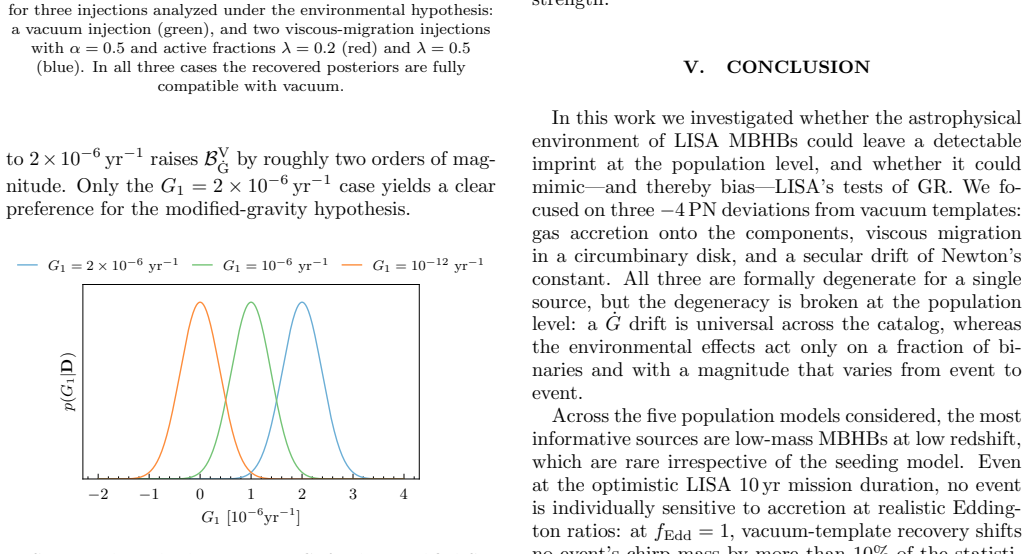
Gravitational-wave signals from massive black hole binaries observed by LISA can carry imprints of both the astrophysical environment of the source and possible deviations from general relativity. We investigate whether environmental effects leave a detectable imprint on the LISA binary population, and whether they can mimic modified-gravity effects with the same frequency dependence. As representative channels we adopt accretion and viscous migration in a circumbinary disk for the environmental sector, and a time-varying Newton constant $\dot G$ for the modified-gravity sector. All three effects enter the waveform at the same negative post-Newtonian order and are described, at leading order, by a common phase-deformation parameter, which makes them formally degenerate at the single-event level. Combining Fisher-matrix forecasts with a hierarchical nested-sampling analysis of synthetic catalogs from astrophysically motivated population models, we find that, even under extreme astrophysical assumptions -- an active fraction of $50\%$, together with a super-Eddington accretion tail -- the population-level posteriors remain fully compatible with vacuum. However, a hierarchical population-wide analysis may yield a non-trivial upper limit on the active fraction and a mild lower bound on the slope of the Eddington-ratio distribution. Environmental effects are therefore unlikely to bias LISA's tests of general relativity with massive black hole binaries in astrophysically realistic scenarios.
Editorial analysis
A structured set of objections, weighed in public.
Referee Report
Summary. The manuscript claims that environmental effects (accretion and viscous migration in circumbinary disks) and a modified-gravity effect (time-varying Newton constant) in LISA massive black hole binaries enter the waveform at the same negative post-Newtonian order and are captured by a single common phase-deformation parameter, rendering them degenerate at the single-event level. Using Fisher-matrix forecasts to construct individual-event likelihoods followed by hierarchical nested-sampling inference on synthetic catalogs drawn from astrophysically motivated population models, the authors find that even under extreme assumptions (50% active fraction with super-Eddington tail) the population-level posteriors remain compatible with vacuum general relativity. They additionally report that the hierarchical analysis can place a non-trivial upper limit on the active fraction and a mild lower bound on the Eddington-ratio slope, concluding that environmental effects are unlikely to bias LISA tests of GR.
Significance. If the central result holds, the work is significant because it supplies a quantitative population-level argument that a key class of potential systematics will not contaminate LISA's tests of general relativity with massive black hole binaries. The explicit combination of Fisher-matrix waveform forecasts with hierarchical nested sampling on synthetic catalogs generated from external astrophysical population models is a methodological strength that enables separation of formally degenerate effects; this framework and the reported upper limits on the two population hyperparameters constitute concrete, falsifiable outputs.
major comments (1)
- [Abstract] Abstract (and the modeling framework described therein): the central claim that population-level hierarchical analysis can separate environmental effects from modified gravity rests on the assumption that accretion, viscous migration, and ˙G are all captured by the identical leading-order phase-deformation parameter at the same negative PN order. The manuscript tests only this leading-order common-parameter case and does not quantify the sensitivity of the 'compatible with vacuum' posteriors when sub-leading terms introduce additional frequency dependence, amplitude corrections, or explicit scalings with mass ratio or disk viscosity. Because the single-event degeneracy is constructed by this modeling choice, relaxing it directly affects whether the hierarchical separation remains valid.
minor comments (1)
- The abstract refers to 'two population hyperparameters' without naming them; the main text should state explicitly which parameters (active fraction and Eddington-ratio slope) are varied and how their priors are chosen.
Simulated Author's Rebuttal
We thank the referee for their detailed review and for highlighting an important modeling assumption. We address the single major comment below.
read point-by-point responses
-
Referee: [Abstract] Abstract (and the modeling framework described therein): the central claim that population-level hierarchical analysis can separate environmental effects from modified gravity rests on the assumption that accretion, viscous migration, and ˙G are all captured by the identical leading-order phase-deformation parameter at the same negative PN order. The manuscript tests only this leading-order common-parameter case and does not quantify the sensitivity of the 'compatible with vacuum' posteriors when sub-leading terms introduce additional frequency dependence, amplitude corrections, or explicit scalings with mass ratio or disk viscosity. Because the single-event degeneracy is constructed by this modeling choice, relaxing it directly affects whether the hierarchical separation remains valid.
Authors: We agree that the analysis is performed at leading order in the common phase-deformation parameter, which is the order at which the three effects (accretion, viscous migration, and ˙G) produce identical frequency dependence and are therefore formally degenerate at the single-event level. This choice is deliberate: it isolates the strongest potential source of confusion between environmental and modified-gravity signals. Sub-leading corrections would generally carry distinct frequency scalings, mass-ratio dependence, or amplitude effects that could, in principle, break the degeneracy already at the individual-event stage and thereby strengthen (rather than weaken) the population-level separation. Because the leading term dominates the accumulated phase over the LISA band for the relevant binaries, we expect the reported population posteriors to remain qualitatively robust. Nevertheless, a quantitative assessment of sub-leading contributions would require extended waveform models that lie outside the present scope. We will add a concise paragraph in the discussion section acknowledging this limitation and stating that the current results apply strictly to the leading-order degeneracy case. revision: partial
Circularity Check
No significant circularity: central result follows from external population models and standard inference without reduction to inputs by construction
full rationale
The paper generates synthetic catalogs from independent astrophysical population models, applies Fisher-matrix forecasts for individual-event likelihoods, and performs hierarchical nested-sampling inference. The shared leading-order phase-deformation parameter is an explicit modeling assumption for the three effects at negative PN order, not a fitted quantity renamed as a prediction. No load-bearing self-citations, uniqueness theorems, or ansatzes imported from prior author work are invoked to force the compatibility-with-vacuum conclusion. The reported upper limits on active fraction and Eddington-ratio slope are outputs of the hierarchical analysis rather than reparameterizations of the input catalogs. This satisfies the criteria for a self-contained derivation against external benchmarks.
Axiom & Free-Parameter Ledger
free parameters (2)
- active fraction
- Eddington-ratio distribution slope
axioms (2)
- domain assumption All three effects (accretion, viscous migration, time-varying G) enter at the same negative post-Newtonian order and share a common phase-deformation parameter
- domain assumption Synthetic catalogs drawn from astrophysically motivated population models accurately represent the true LISA-detectable massive black hole binary population
Reference graph
Works this paper leans on
-
[1]
Making Sense of the Un- expected in the Gravitational-Wave Sky
The discarded events contribute the same multiplica- tive factor to the evidence of bothH V andH E within our priors, and therefore drop out of the Bayes factor. After this cut, no catalog retains usable events in the pure-accretion case, so we drop that comparison; for the viscous-migration injections most catalogs are left with fewer than 10 events over...
2024
-
[2]
B. P. Abbott et al. (LIGO Scientific, Virgo), Phys. Rev. Lett.116, 061102 (2016), 1602.03837
work page internal anchor Pith review Pith/arXiv arXiv 2016
-
[3]
R. Abbott et al. (KAGRA, VIRGO, LIGO Scientific), Phys. Rev. X13, 041039 (2023), 2111.03606
work page internal anchor Pith review Pith/arXiv arXiv 2023
-
[4]
A. G. Abac et al. (LIGO Scientific, VIRGO, KAGRA), arXiv e-prints (2025), 2508.18082
work page internal anchor Pith review Pith/arXiv arXiv 2025
-
[5]
The population of merging compact binaries inferred using gravitational waves through GWTC-3
R. Abbott et al. (KAGRA, VIRGO, LIGO Scientific), Phys. Rev. X13, 011048 (2023), 2111.03634
work page internal anchor Pith review Pith/arXiv arXiv 2023
-
[6]
B. P. Abbott et al. (LIGO Scientific, Virgo), Astrophys. J. Lett.818, L22 (2016), 1602.03846
work page internal anchor Pith review Pith/arXiv arXiv 2016
-
[7]
R. Abbott et al. (LIGO Scientific, Virgo), Astrophys. J. Lett.900, L13 (2020), 2009.01190
-
[8]
R. Abbott et al. (LIGO Scientific, Virgo), Phys. Rev. D 103, 122002 (2021), 2010.14529
work page internal anchor Pith review Pith/arXiv arXiv 2021
-
[9]
Tests of General Relativity with GWTC-3
R. Abbott et al. (LIGO Scientific, VIRGO, KAGRA), Phys. Rev. D112, 084080 (2025), 2112.06861
work page internal anchor Pith review Pith/arXiv arXiv 2025
-
[10]
A. G. Abac et al. (LIGO Scientific, VIRGO, KAGRA), arXiv e-prints (2026), 2603.19019
work page internal anchor Pith review Pith/arXiv arXiv 2026
-
[11]
A. G. Abac et al. (LIGO Scientific, VIRGO, KAGRA), arXiv e-prints (2026), 2603.19020
work page internal anchor Pith review Pith/arXiv arXiv 2026
-
[12]
A. G. Abac et al. (LIGO Scientific, VIRGO, KAGRA), arXiv e-prints (2026), 2603.19021
work page internal anchor Pith review Pith/arXiv arXiv 2026
-
[13]
M. Colpi et al.,LISA Definition Study Report(2024), URLhttps://arxiv.org/abs/2402.07571v1
work page internal anchor Pith review Pith/arXiv arXiv 2024
-
[14]
Amaro-Seoane et al., Living Reviews in Relativity 26, 2 (2023), ISSN 1433-8351, URLhttps://link
P. Amaro-Seoane et al., Living Reviews in Relativity 26, 2 (2023), ISSN 1433-8351, URLhttps://link. springer.com/10.1007/s41114-022-00041-y
-
[15]
Science with the space-based interferometer eLISA. I: Supermassive black hole binaries
A. Klein, E. Barausse, A. Sesana, A. Petiteau, E. Berti, S. Babak, J. Gair, S. Aoudia, I. Hinder, F. Ohme, et al., Physical Review D93, 024003 (2016), ISSN 2470- 0010, 2470-0029, arXiv:1511.05581 [astro-ph, physics:gr- qc], URLhttp://arxiv.org/abs/1511.05581
work page internal anchor Pith review Pith/arXiv arXiv 2016
-
[16]
The imprint of massive black hole formation models on the LISA data stream
A. Sesana, M. Volonteri, and F. Haardt, Mon. Not. Roy. Astron. Soc.377, 1711 (2007), astro-ph/0701556
work page internal anchor Pith review Pith/arXiv arXiv 2007
-
[17]
The evolution of massive black holes and their spins in their galactic hosts
E. Barausse, Mon. Not. Roy. Astron. Soc.423, 2533 (2012), 1201.5888
work page internal anchor Pith review Pith/arXiv arXiv 2012
-
[18]
M. Bonetti, A. Sesana, F. Haardt, E. Barausse, and M. Colpi, Mon. Not. Roy. Astron. Soc.486, 4044 (2019), 1812.01011
work page internal anchor Pith review Pith/arXiv arXiv 2019
-
[19]
E. Barausse, I. Dvorkin, M. Tremmel, M. Volonteri, and M. Bonetti, Astrophys. J.904, 16 (2020), 2006.03065
-
[20]
Science with the space-based interferometer LISA. V: Extreme mass-ratio inspirals
S. Babak, J. Gair, A. Sesana, E. Barausse, C. F. Sop- uerta, C. P. L. Berry, E. Berti, P. Amaro-Seoane, A. Pe- titeau, and A. Klein, Phys. Rev. D95, 103012 (2017), 1703.09722
work page internal anchor Pith review Pith/arXiv arXiv 2017
- [21]
-
[22]
The promise of multi-band gravitational wave astronomy
A. Sesana, Phys. Rev. Lett.116, 231102 (2016), 1602.06951
work page internal anchor Pith review Pith/arXiv arXiv 2016
-
[23]
L. Sberna et al., Phys. Rev. D106, 064056 (2022), 2205.08550
- [24]
-
[25]
The NANOGrav 15-year Data Set: Evidence for a Gravitational-Wave Background
G. Agazie et al. (NANOGrav), Astrophys. J. Lett.951, L8 (2023), 2306.16213
work page internal anchor Pith review Pith/arXiv arXiv 2023
-
[26]
J. Antoniadis et al. (EPTA, InPTA:), Astron. Astrophys. 678, A50 (2023), 2306.16214
work page internal anchor Pith review Pith/arXiv arXiv 2023
-
[27]
P. Tarafdar et al., Publ. Astron. Soc. Austral.39, e053 (2022), 2206.09289
-
[28]
D. J. Reardon et al., Astrophys. J. Lett.951, L6 (2023), 2306.16215. 11
work page internal anchor Pith review Pith/arXiv arXiv 2023
-
[29]
H. Xu et al., Res. Astron. Astrophys.23, 075024 (2023), 2306.16216
work page internal anchor Pith review Pith/arXiv arXiv 2023
-
[30]
The influence of the hydrodynamic drag from an accretion torus on extreme mass-ratio inspirals
E. Barausse and L. Rezzolla, Phys. Rev. D77, 104027 (2008), 0711.4558
work page internal anchor Pith review Pith/arXiv arXiv 2008
-
[31]
Can environmental effects spoil precision gravitational-wave astrophysics?
E. Barausse, V. Cardoso, and P. Pani, Physical Re- view D89, 104059 (2014), ISSN 1550-7998, 1550-2368, arXiv:1404.7149 [astro-ph, physics:gr-qc], URLhttp:// arxiv.org/abs/1404.7149
work page internal anchor Pith review Pith/arXiv arXiv 2014
- [32]
-
[33]
A. Toubiana et al., Phys. Rev. Lett.126, 101105 (2021), 2010.06056
-
[34]
Observable Signatures of EMRI Black Hole Binaries Embedded in Thin Accretion Disks
B. Kocsis, N. Yunes, and A. Loeb, Phys. Rev. D84, 024032 (2011), 1104.2322
work page internal anchor Pith review Pith/arXiv arXiv 2011
-
[35]
Imprint of Accretion Disk-Induced Migration on Gravitational Waves from Extreme Mass Ratio Inspirals
N. Yunes, B. Kocsis, A. Loeb, and Z. Haiman, Phys. Rev. Lett.107, 171103 (2011), 1103.4609
work page internal anchor Pith review Pith/arXiv arXiv 2011
- [36]
-
[37]
L. Copparoni, E. Barausse, L. Speri, L. Sberna, and A. Derdzinski, Phys. Rev. D111, 104079 (2025), 2502.10087
-
[38]
M. Bonetti, A. Sesana, E. Barausse, and F. Haardt, Mon. Not. Roy. Astron. Soc.477, 2599 (2018), 1709.06095
work page internal anchor Pith review Pith/arXiv arXiv 2018
- [39]
-
[40]
Zwick, arXiv e-prints (2026), 2601.06684
L. Zwick, arXiv e-prints (2026), 2601.06684
-
[41]
Constraining the evolutionary history of Newton's constant with gravitational wave observations
N. Yunes, F. Pretorius, and D. Spergel, Phys. Rev. D81, 064018 (2010), 0912.2724
work page internal anchor Pith review Pith/arXiv arXiv 2010
-
[42]
S. Tahura and K. Yagi, Physical Review D98, 084042 (2018), ISSN 2470-0010, 2470-0029, arXiv:1809.00259 [gr-qc], URLhttp://arxiv.org/abs/1809.00259
-
[43]
E. Barausse, N. Yunes, and K. Chamberlain, Phys. Rev. Lett.116, 241104 (2016), 1603.04075
work page internal anchor Pith review Pith/arXiv arXiv 2016
-
[44]
Bambi, M
C. Bambi, M. Giannotti, and F. L. Villante, Phys- ical Review D71, 123524 (2005), ISSN 1550-7998, 1550-2368, URLhttps://link.aps.org/doi/10.1103/ PhysRevD.71.123524
2005
-
[45]
Theoretical Physics Implications of the Binary Black-Hole Mergers GW150914 and GW151226
N. Yunes, K. Yagi, and F. Pretorius, Physical Re- view D94, 084002 (2016), ISSN 2470-0010, 2470-0029, arXiv:1603.08955 [gr-qc], URLhttp://arxiv.org/abs/ 1603.08955
work page internal anchor Pith review Pith/arXiv arXiv 2016
-
[46]
S. Kejriwal, E. Barausse, and A. J. K. Chua, Phys. Rev. D113, 064001 (2026), 2510.17398
-
[47]
A. Toubiana, K. W. K. Wong, S. Babak, E. Barausse, E. Berti, J. R. Gair, S. Marsat, and S. R. Taylor, Phys. Rev. D104, 083027 (2021), 2106.13819
-
[48]
E. Barausse, K. Dey, M. Crisostomi, A. Panayada, S. Marsat, and S. Basak, Physical Review D108, 103034 (2023), ISSN 2470-0010, 2470-0029, arXiv:2307.12245 [astro-ph], URLhttp://arxiv.org/abs/2307.12245
-
[49]
N. Yunes and F. Pretorius, Phys. Rev. D80, 122003 (2009), 0909.3328
work page internal anchor Pith review Pith/arXiv arXiv 2009
-
[50]
Varying constants, Gravitation and Cosmology
J.-P. Uzan, Living Rev. Rel.14, 2 (2011), 1009.5514
work page internal anchor Pith review Pith/arXiv arXiv 2011
-
[51]
Damour and K
T. Damour and K. Nordtvedt, Phys. Rev. Lett.70, 2217 (1993)
1993
-
[52]
Damour and K
T. Damour and K. Nordtvedt, Phys. Rev. D48, 3436 (1993)
1993
-
[53]
D. Anderson, N. Yunes, and E. Barausse, Phys. Rev. D 94, 104064 (2016), 1607.08888
work page internal anchor Pith review Pith/arXiv arXiv 2016
-
[54]
T. M. Heckman and P. Best, Ann. Rev. Astron. Astro- phys.52, 589 (2014), 1403.4620
work page internal anchor Pith review Pith/arXiv arXiv 2014
-
[55]
F. Shankar, D. H. Weinberg, and J. Miralda-Escude, As- trophys. J.690, 20 (2009), 0710.4488
work page internal anchor Pith review Pith/arXiv arXiv 2009
-
[56]
J. C. Mihos and L. Hernquist, Astrophys. J.464, 641 (1996), astro-ph/9512099
work page internal anchor Pith review Pith/arXiv arXiv 1996
-
[57]
J. E. Barnes and L. Hernquist, Astrophys. J.471, 115 (1996)
1996
-
[58]
P. F. Hopkins and E. Quataert, Mon. Not. Roy. Astron. Soc.407, 1529 (2010), 0912.3257
work page internal anchor Pith review Pith/arXiv arXiv 2010
-
[59]
Rapid Formation of Supermassive Black Hole Binaries in Galaxy Mergers with Gas
L. Mayer, S. Kazantzidis, P. Madau, M. Colpi, T. R. Quinn, and J. Wadsley, Science316, 1874 (2007), 0706.1562
work page internal anchor Pith review Pith/arXiv arXiv 2007
-
[60]
E. E. Salpeter, Astrophys. J.140, 796 (1964)
1964
- [61]
-
[62]
A. J. Dittmann and G. Ryan, Monthly Notices of the Royal Astronomical Society513, 6158 (2022), ISSN 0035-8711, https://academic.oup.com/mnras/article- pdf/513/4/6158/43913351/stac935.pdf, URL https://doi.org/10.1093/mnras/stac935
-
[63]
Linking the spin evolution of massive black holes to galaxy kinematics
A. Sesana, E. Barausse, M. Dotti, and E. M. Rossi, As- trophys. J.794, 104 (2014), 1402.7088
work page internal anchor Pith review Pith/arXiv arXiv 2014
-
[64]
Co-evolution of nuclear star clusters, massive black holes and their host galaxies
F. Antonini, E. Barausse, and J. Silk, Astrophys. J.812, 72 (2015), 1506.02050
work page internal anchor Pith review Pith/arXiv arXiv 2015
-
[65]
Barausse,Black holes across cosmic history(2023), URLhttps://people.sissa.it/ ~barausse/catalogs/ models_LISA_after_PTAs
E. Barausse,Black holes across cosmic history(2023), URLhttps://people.sissa.it/ ~barausse/catalogs/ models_LISA_after_PTAs
2023
-
[66]
The evolution of massive black hole seeds
M. Volonteri, G. Lodato, and P. Natarajan, Mon. Not. Roy. Astron. Soc.383, 1079 (2008), 0709.0529
work page internal anchor Pith review Pith/arXiv arXiv 2008
-
[67]
Massive Black Holes as Population III Remnants
P. Madau and M. J. Rees, Astrophys. J. Lett.551, L27 (2001), astro-ph/0101223
work page internal anchor Pith review Pith/arXiv arXiv 2001
-
[68]
Blossoms from black hole seeds: properties and early growth regulated by supernova feedback
M. Habouzit, M. Volonteri, and Y. Dubois, Mon. Not. Roy. Astron. Soc.468, 3935 (2017), 1605.09394
work page internal anchor Pith review Pith/arXiv arXiv 2017
-
[69]
Cutler and M
C. Cutler and M. Vallisneri, Phys. Rev. D76, 104018 (2007), URLhttps://link.aps.org/doi/10. 1103/PhysRevD.76.104018
2007
-
[70]
P. C. Duffell, D. D’Orazio, A. Derdzinski, Z. Haiman, A. MacFadyen, A. L. Rosen, and J. Zrake, Astrophys. J.901, 25 (2020), URLhttps://doi.org/10.3847/ 1538-4357/abab95
2020
-
[71]
M. L. Jones, R. C. Hickox, C. S. Black, K. N. Hainline, M. A. DiPompeo, and A. D. Goulding, The Astrophysi- cal Journal826, 12 (2016), URLhttps://doi.org/10. 3847/0004-637X/826/1/12
2016
-
[72]
Thrane and C
E. Thrane and C. Talbot, Publications of the Astronom- ical Society of Australia36, e010 (2019)
2019
-
[73]
Extracting distribution parameters from multiple uncertain observations with selection biases
I. Mandel, W. M. Farr, and J. R. Gair, Mon. Not. Roy. Astron. Soc.486, 1086 (2019), 1809.02063
work page internal anchor Pith review Pith/arXiv arXiv 2019
-
[74]
M. Fishbach, D. E. Holz, and W. M. Farr, The Astro- physical Journal Letters863, L41 (2018), URLhttps: //doi.org/10.3847/2041-8213/aad800
- [75]
-
[76]
Skilling, Bayesian Analysis1, 833 (2006)
J. Skilling, Bayesian Analysis1, 833 (2006)
2006
-
[77]
J. S. Speagle, Mon. Not. Roy. Astron. Soc.493, 3132 (2020), 1904.02180
work page internal anchor Pith review Pith/arXiv arXiv 2020
-
[78]
J. Tak´ atsy, L. Zwick, K. Hendriks, P. Saini, G. Fabj, and J. Samsing, Class. Quant. Grav.42, 215006 (2025), 2505.09513
- [79]
-
[80]
C. R. Harris, K. J. Millman, S. J. van der Walt, R. Gom- mers, P. Virtanen, D. Cournapeau, E. Wieser, J. Taylor, S. Berg, N. J. Smith, et al., Nature585, 357 (2020), ISSN 1476-4687
2020
discussion (0)
Sign in with ORCID, Apple, or X to comment. Anyone can read and Pith papers without signing in.