REVIEW 3 major objections 7 minor 1 cited by
Subsolar-mass binary mergers of strange stars and neutron stars: gravitational waves and ejecta
T0 review · 3 major / 7 minor · reviewed 2026-07-09 · glm-5.2
Pith's one-line read Ratio of two gravitational-wave frequencies cleanly separates strange stars from neutron stars
desk verdict First NR simulations of subsolar-mass binary strange star mergers; the f2/fcut discriminator is promising but the 'clean separation' claim rests on a case with non-monotonic convergence. read the letter →
The pith
A machine-rendered reading of the paper's core claim, the machinery that carries it, and where it could break.
The reading
What carries the argument
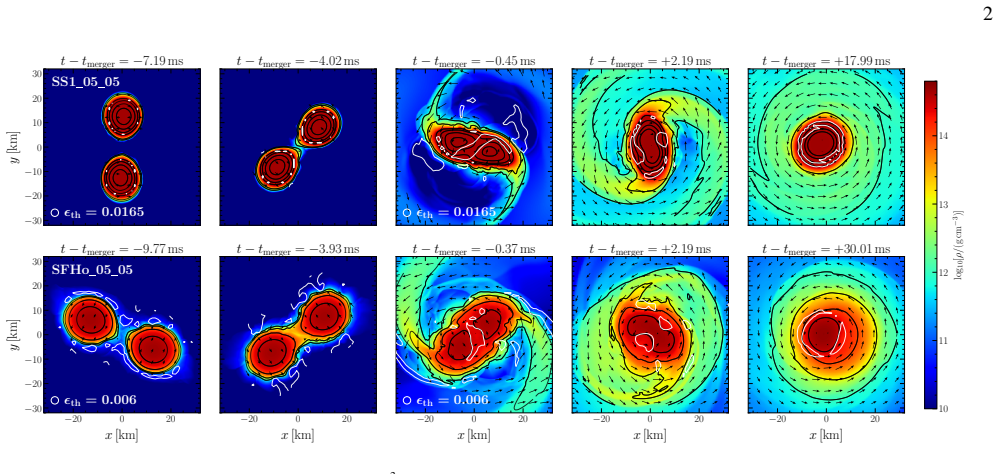
The central mechanism is the structural difference between self-bound strange stars (compact, sharp-surfaced, R ∝ M^{1/3}) and gravitationally bound neutron stars (extended, growing radius at low mass). This difference propagates through the merger in opposite directions for two frequencies: it raises f_cut for strange stars (less tidal deformation delays the inspiral breakdown to higher frequency) but lowers f_2 (the violent radial bounce and shock re-expansion lower the remnant density). The ratio f_2/f_cut compounds both shifts, producing the discriminant.
What would settle it
If a simulation with a different strange-star equation of state, a more extreme mass ratio, or rapidly spinning components produced f_2/f_cut above 2.5 — or if a neutron-star model produced it below 2.65 — the clean separation would break.
Extended reading notes
Core claim
The ratio f_2/f_cut of the post-merger peak frequency to the gravitational-wave cutoff frequency cleanly separates subsolar-mass binary strange star mergers (2.1-2.5) from binary neutron star mergers (2.65-2.97) with no overlap across the simulated grid of equations of state, masses, and mass ratios. This separation arises because the self-bound, compact strange star reaches a higher cutoff frequency (less tidal deformation during inspiral) but a lower post-merger frequency (violent shock and radial bounce lower the remnant's average density), and the two effects compound in the ratio. The paper establishes this by running the first numerical-relativity simulations of subsolar strange star二进
Load-bearing premise
The clean, non-overlapping separation rests on a grid of three strange-star equations of state and three neutron-star equations of state, with mass ratios up to 1.5 and no stellar rotation. Whether more extreme mass ratios, different equation-of-state parameterizations, or rapidly spinning configurations would bridge the gap between the two classes remains untested. The paper itself notes that the q=1.5 strange-star case already pushes f_2/f_cut to 2.48, approaching the NSs'
Editorial extensions
If this is right
- If a subsolar-mass compact-binary merger is detected by third-generation gravitational-wave detectors, measuring f_2/f_cut would allow a direct classification as either a strange star or neutron star binary, testing the Bodmer-Witten conjecture that strange quark matter is the true ground state of baryonic matter.
- The quasi-universal relations between characteristic frequencies and tidal deformability, if they hold beyond the simulated grid, could reduce the parameter space needed for waveform templates in subsolar-mass searches.
- The different ejecta composition — neutron-rich matter versus decompressed quark matter — means an electromagnetic counterpart (or its absence) to a subsolar merger would provide an independent test of the strange-star hypothesis, complementary to the gravitational-wave discriminant.
- The rapidly rotating remnant with ~10^52 erg of rotational energy could power a synchrotron transient from radio to X-ray, offering a third observational channel to distinguish the two classes.
Reading between the lines
- The discriminant's robustness against rapid stellar rotation is untested. If either class can be spun up before merger, centrifugal flattening could alter the effective compactness and tidal deformability enough to shift f_cut and f_2 in ways that might narrow or bridge the gap.
- If the f_2/f_cut separation holds for mixed binaries (one strange star, one neutron star), the ratio could also diagnose the composition of individual components, not just homogeneous binaries — though the paper does not simulate this case.
- The detectability of f_2 requires high signal-to-noise in the post-merger signal, which for subsolar masses at realistic distances likely demands third-generation detectors. The practical utility of the discriminant may therefore be gated by detector sensitivity rather than physics.
- If strange quark matter ejected from an SS merger does not fragment into electromagnetically dark nuggets but instead evaporates into neutron-rich nucleons, the kilonova signatures of the two classes could be more similar than expected, making the gravitational-wave discriminant the primary rather than complementary diagnostic.
Signed reviews
Editorial analysis
A structured set of objections, weighed in public.
Referee Report
Summary. This Letter presents the first numerical-relativity simulations of subsolar-mass binary strange star (SS) mergers, systematically comparing them with subsolar binary neutron star (NS) mergers across three equations of state (EOSs) per class, component masses 0.3–0.7 M⊙, and mass ratios q=1, 1.22, and 1.5. The simulations use established NR infrastructure (FUKA initial data, SACRA-K evolution, Z4c formulation, HLLC/HLLE solvers) with three grid resolutions per binary. The central claim is that the ratio f2/fcut of the post-merger peak frequency to the gravitational-wave cutoff frequency cleanly separates SS mergers (2.1–2.5) from NS mergers (2.65–2.97) with no overlap. The paper also reports ejecta properties and discusses electromagnetic counterpart prospects.
Significance. The paper is a genuine first: no prior NR simulations of subsolar-mass binary SS mergers exist. The f2/fcut discriminant is a falsifiable, parameter-free prediction derived from simulation dynamics rather than fitted to target frequencies. The quasi-universal relations are fitted to simulation outputs as functions of the tidal deformability Λ̃ computed from stellar models. The ejecta analysis, including the distinction between neutron-rich NS ejecta and decompressed quark-matter SS ejecta, adds astrophysical utility. The simulation grid spans a reasonable EOS range and multiple mass ratios, and the convergence assessment (half-spreads of 2.6–5% across resolutions) is reported transparently. These are substantial strengths for a Letter.
major comments (3)
- The central claim of 'clean' non-overlapping separation in f2/fcut rests disproportionately on the single extreme case SS1 0.4+0.6 (q=1.5), which yields f2/fcut = 2.48 at the finest resolution versus the NS minimum of 2.65 (WFF1 0.5+0.5). Table S1 reveals that this exact case shows strongly non-monotonic convergence: f2/fcut = 2.598, 2.567, and 2.484 from coarsest to finest. The finest-resolution value is the outlier on the low side, not a converged limit. If the true converged value lies closer to the coarser-resolution values (~2.57–2.60), the gap to the NS branch shrinks to ~0.05–0.08, comparable to the resolution-induced scatter the paper itself quotes (≲3.7% for f2/fcut). The paper uses the finest-resolution value as the headline number without Richardson extrapolation or a fourth resolution to confirm convergence direction. The authors should either (a) add a fourth resolution for,
- this case to establish convergence, or (b) reframe the claim from 'clean separation with no overlap' to 'suggestive separation with a thin margin whose convergence is uncertain for the most extreme case.' The current phrasing in the abstract ('cleanly separates') and the main text ('do not overlap across the numerical models') overstates what the data support given this single load-bearing data point.
- The quasi-universal relations and the f2/fcut discriminant are established on a grid of three SS EOSs and three NS EOSs. The paper itself notes that the q=1.5 SS case 'rises onto the NS relation' for f2, and the separation gap narrows to ~0.17 at the finest resolution (2.48 vs 2.65). Whether more extreme mass ratios (q>1.5), different SS EOS parameterizations (e.g., color-superconducting gaps, non-MIT-bag models), or rapidly spinning configurations would bridge this gap remains untested. The authors should explicitly acknowledge this limitation in the discussion of the discriminant's robustness, rather than stating it 'is a robust discriminant' without qualification. A brief statement that the claim is conditional on the simulated EOS and mass-ratio range would suffice.
minor comments (7)
- The abstract states f2/fcut 'cleanly separates the two classes'; given the convergence concern for the q=1.5 SS case, consider softening to 'separates the two classes across the simulated grid' or similar.
- In the description of Fig. 3 (lower panel), the shaded band is stated to be at f2/fcut = 2.5–2.6, but the q=1.5 SS data point at 2.48 falls below this band. Clarify whether the band represents the proposed classification threshold or simply marks the visual gap.
- The ejecta for the unequal-mass SS binaries (q=1.22 and 1.5) approaches the baryonic mass-conservation error level (M_ej < 2×10^{-4} M⊙), as noted in Fig. 4. Table S1 shows the Bernoulli-criterion ejecta for SS1 0.45+0.55 at the finest resolution is 1.50×10^{-2} M⊙, well above this floor, but the geodesic criterion gives 1.45×10^{-2}. The text should briefly comment on the consistency between the two criteria for the cases near the conservation floor.
- The thermal adiabatic indices differ between SS (Γ_th = 4/3) and NS (Γ_th = 1.75). A brief justification for these choices, or a reference to where they are validated, would help readers assess sensitivity.
- Reference [70] (SACRA-K) is listed as 'in preparation' (2026). If the code description is not yet available, the manuscript should provide enough detail in the Supplemental Material for reproducibility, which Table S2 partially addresses.
- The text mentions 'animations of the snapshots and corresponding GWs can be found at [42]' — ensure the linked URL is persistent and accessible at publication.
- Minor typographical issue: in the abstract and main text, 'cutofffrequencyfcut' appears to be missing a space (likely a LaTeX formatting artifact).
Simulated Author's Rebuttal
We thank the referee for a careful and constructive report. The two major comments are well-taken and we will revise the manuscript accordingly. Below we address each point.
read point-by-point responses
-
Referee: The central claim of 'clean' non-overlapping separation in f2/fcut rests disproportionately on the single extreme case SS1 0.4+0.6 (q=1.5), which shows strongly non-monotonic convergence. The finest-resolution value is the outlier on the low side. The paper uses the finest-resolution value as the headline number without Richardson extrapolation or a fourth resolution.
Authors: The referee is correct that the SS1 0.4+0.6 (q=1.5) case is the most marginal data point and that its convergence is non-monotonic. We have re-examined Table S1 carefully. The three-resolution sequence for f2/fcut is 2.598, 2.567, 2.484 (coarse to fine), so the finest value is indeed the lowest and the convergence direction is not established. We acknowledge that if the true converged value lies closer to the coarser-resolution values (~2.57–2.60), the gap to the NS minimum (2.65 at finest resolution for WFF1 0.5+0.5) narrows to ~0.05–0.08, which is comparable to the ~3.7% resolution half-spread we quote for f2/fcut. This is a fair concern. We do not currently have a fourth resolution for this case and cannot perform a reliable Richardson extrapolation given the non-monotonic trend. We will therefore revise the manuscript as follows: (1) We will soften the abstract from 'cleanly separates' to 'separates' and add a qualifier noting that the margin is thinnest for the most asymmetric SS case, whose convergence is not yet fully established. (2) In the main text, we will replace 'do not overlap across the numerical models' with a statement that the two branches are separated across our simulation grid, with the smallest margin (~0.16 at finest resolution, possibly as small as ~0.05 if the coarser-resolution values for the q=1.5 SS case are closer to convergence) occurring for the most asymmetric SS binary. (3) We will explicitly flag the non-monotonic convergence of the SS1 0.4+0.6 case in the text and note it as a limitation. We agree that 'clean separation with no overlap' overstates what the current data support for this single load-bearing data point. revision: yes
-
Referee: The quasi-universal relations and the f2/fcut discriminant are established on a grid of three SS EOSs and three NS EOSs. More extreme mass ratios, different SS EOS parameterizations, or rapidly spinning configurations could bridge the gap. The authors should explicitly acknowledge this limitation.
Authors: We agree. The claim of robustness is currently stated without sufficient qualification regarding the explored parameter space. We will add a sentence in the discussion of the discriminant explicitly noting that the separation is established within the simulated range of EOSs (three MIT-bag-family SS models and three nuclear NS models), mass ratios (q ≤ 1.5), and non-spinning configurations, and that its persistence under more extreme mass ratios, alternative SS EOS parameterizations (e.g., color-superconducting gap models or non-MIT-bag constructions), or rapidly spinning progenitors remains untested. We will also adjust the phrase 'is a robust discriminant' to 'is a promising discriminant within the simulated EOS and mass-ratio range.' This is an honest reflection of what the simulations cover. revision: yes
Circularity Check
No circularity found. The f2/fcut discriminant is computed directly from simulation outputs, not forced by fits or self-citation.
full rationale
The paper's central claim — that f2/fcut cleanly separates SS from NS mergers — is derived directly from numerical relativity simulation outputs. The characteristic frequencies f_cut, f_merger, and f_2 are extracted from the GW spectrum (broken power-law fit for f_cut, amplitude peak for f_merger, post-merger spectral peak for f_2) and are independent measurements from the simulation dynamics. The ratio f2/fcut is then computed directly from these independently measured quantities. The quasi-universal relations (Mf = A·Λ̃^p) are descriptive power-law fits to the simulation data points, but they are not used as inputs to compute the f2/fcut ratio — the paper explicitly states 'Markers use the finest-resolution value' (Fig. 3 caption), meaning the plotted ratio uses raw simulation outputs, not fitted values. The tidal deformability Λ̃ is computed from the stellar models (EOS + mass → R, k2, Λ), not fitted to the target frequencies. Self-citations (e.g., [63], [66], [70], [87]) are for methodology (SACRA-K code, FUKA initial data, self-bound surface solver) and prior context, none of which are load-bearing for the discriminant claim itself. The separation emerges from the physics of self-bound vs. gravitationally bound stars producing different merger dynamics, not from any definitional or fitted input-output equivalence. The derivation is self-contained against the simulation data.
Assumptions & free parameters
free parameters (5)
- SS EOS: bag constant B =
52.4, 75.0, 96.0 MeV/fm^3 (for SS1, SS2, SS3)
- SS EOS: coupling parameter λ² =
0, 38.9, 157.3 MeV/fm^3 (for SS1, SS2, SS3)
- Thermal Γ_th (SS) =
4/3
- Thermal Γ_th (NS) =
1.75
- Power-law fit parameters (A, p) =
NS: (2.2,-0.307), (4.1,-0.313), (3.7,-0.262); SS: (1.5,-0.272), (3.4,-0.292), (4.4,-0.296) for f_cut, f_merger, f_2
assumptions (4)
- domain assumption Strange quark matter may be the true ground state of baryonic matter (Bodmer-Witten conjecture)
- domain assumption The modified MIT bag model (Eq. S1) adequately describes cold, charge-neutral, beta-equilibrated three-flavor quark matter
- standard math Quasi-equilibrium initial data with iteratively reduced eccentricity (≲7×10^-4) adequately represents the late inspiral
- domain assumption The three NS EOSs (DD2, SFHo, WFF1) and three SS EOSs (SS1-SS3) span the relevant EOS diversity for establishing universal relations
Cite this review
Pith. "Pith review of Subsolar-mass binary mergers of strange stars and neutron stars: gravitational waves and ejecta." pith.science (2026). https://pith.science/paper/6475SCDY
@misc{pith2026260707668,
  author       = {Pith},
  title        = {Pith review of: Subsolar-mass binary mergers of strange stars and neutron stars: gravitational waves and ejecta},
  year         = {2026},
  howpublished = {\url{https://pith.science/paper/6475SCDY}},
  note         = {Machine review of arXiv:2607.07668}
}
abstract
We present the first numerical-relativity simulations of subsolar-mass binary strange star (SS) mergers and compare with binary neutron star (NS) mergers across equations of state, masses, and mass ratios. The self-bound nature of SSs makes them less deformed during the inspiral and keeps a sharp surface up to contact, driving strong shock heating and a large radial bounce that are far weaker in the NS. The more compact SS thus reaches a higher gravitational-wave cutoff frequency $f_\mathrm{cut}$ before contact but a lower post-merger peak frequency $f_2$. Within each class these frequencies follow quasi-universal relations with the tidal deformability, and their ratio $f_2/f_\mathrm{cut}$ cleanly separates the two classes. Both classes can eject $\sim10^{-2}\,M_\odot$ of material, neutron-rich for the NS and decompressed quark matter for the SS, a potential source of an electromagnetic counterpart whose observation could test the SS and NS hypotheses for subsolar-mass events.
Figures


Forward citations
Cited by 1 Pith paper
-
SACRA-K: A Performance-Portable Numerical Relativity Code with Kokkos
A Kokkos-based C++ port of the SACRA numerical relativity code achieves ~10x speedup on GPU/APU over the Fortran CPU version while preserving waveform accuracy, pi-symmetry, and second-order convergence.
Reference graph
Works this paper leans on
-
[1]
LIGO Scientific, Virgo, and KAGRA Collaborations, arXiv e- print (2026), arXiv:2605.27225 [gr-qc]
work page Pith review arXiv 2026
-
[2]
A. G. Abacet al.(LIGO Scientific, VIRGO, KAGRA), (2025), arXiv:2508.18082 [gr-qc]
work page Pith review arXiv 2025
-
[3]
B. P. Abbottet al.(LIGO Scientific, Virgo), Phys. Rev. Lett. 119, 161101 (2017), arXiv:1710.05832 [gr-qc]
work page Pith review arXiv 2017
-
[4]
B. P. Abbottet al., Astrophys. J. Lett.848, L12 (2017), arXiv:1710.05833 [astro-ph.HE]
work page Pith review arXiv 2017
-
[5]
Observation of gravitational waves from two neutron star-black hole coalescences
R. Abbottet al.(LIGO Scientific, KAGRA, VIRGO), As- trophys. J. Lett.915, L5 (2021), arXiv:2106.15163 [astro- ph.HE]
work page Pith review arXiv 2021
-
[6]
A. G. Abacet al.(LIGO Scientific, KAGRA, VIRGO), As- trophys. J. Lett.970, L34 (2024), arXiv:2404.04248 [astro- ph.HE]
work page Pith review arXiv 2024
-
[7]
R. Abbottet al.(LIGO Scientific, VIRGO, KAGRA), Phys. Rev. X13, 041039 (2023), arXiv:2111.03606 [gr-qc]
work page Pith review arXiv 2023
-
[8]
A. H. Nitz and Y .-F. Wang, Phys. Rev. D106, 023024 (2022), arXiv:2202.11024 [astro-ph.HE]
work page Pith review arXiv 2022
Show all 106 references
-
[9]
Kacanja, K
K. Kacanja, K. Soni, A. Aky ¨uz, and A. H. Nitz, arXiv e-print (2026), arXiv:2602.12115 [astro-ph.HE]
2026
-
[10]
A. G. Abacet al.(LIGO Scientific, VIRGO, KAGRA), arXiv e-print (2026), arXiv:2605.05444 [astro-ph.HE]
2026 arXiv
-
[11]
Niuet al., arXiv e-print (2025), arXiv:2509.09741 [astro- ph.HE]
W. Niuet al., arXiv e-print (2025), arXiv:2509.09741 [astro- ph.HE]
2025
-
[12]
GraceDB superevent S250818k,
LIGO Scientific Collaboration, Virgo Collaboration, and KAGRA Collaboration, “GraceDB superevent S250818k,” (2025),https://gracedb.ligo.org/superevents/ S250818k/
2025
-
[13]
GraceDB superevent S251112cm,
LIGO Scientific Collaboration, Virgo Collaboration, and KAGRA Collaboration, “GraceDB superevent S251112cm,” (2025),https://gracedb.ligo.org/superevents/ S251112cm/
2025
-
[14]
M. M. Kasliwalet al., Astrophys. J. Lett.995, L59 (2025), arXiv:2510.23732 [astro-ph.HE]
2025
-
[15]
X. J. Hallet al., arXiv e-print (2025), arXiv:2510.24620 [astro-ph.HE]
2025
-
[16]
Ackleyet al., arXiv e-print (2026), arXiv:2605.02639 [astro-ph.HE]
K. Ackleyet al., arXiv e-print (2026), arXiv:2605.02639 [astro-ph.HE]
2026 arXiv
-
[17]
Y . B. Zel’dovich and I. D. Novikov, Soviet Astronomy10, 602 (1967)
1967
-
[18]
B. J. Carr and S. W. Hawking, Mon. Not. Roy. Astron. Soc. 168, 399 (1974)
1974
-
[19]
Sasaki, T
M. Sasaki, T. Suyama, T. Tanaka, and S. Yokoyama, Class. Quant. Grav.35, 063001 (2018), arXiv:1801.05235 [astro- ph.CO]
2018 arXiv
-
[20]
T. W. Baumgarte and S. L. Shapiro, Phys. Rev. D113, 083008 (2026), arXiv:2601.22220 [astro-ph.HE]
2026 arXiv
-
[21]
M. R. Haque, F. Iocco, and L. Visinelli, arXiv e-print (2026), arXiv:2603.25795 [astro-ph.CO]
2026
-
[22]
Crescimbeni, G
F. Crescimbeni, G. Franciolini, P. Pani, and A. Riotto, Phys. Rev. D109, 124063 (2024), arXiv:2402.18656 [astro-ph.HE]
2024 arXiv
-
[23]
A. L. Miller, inPrimordial Black Holes, edited by C. Byrnes, G. Franciolini, T. Harada, P. Pani, and M. Sasaki (Springer,
-
[24]
arXiv:2404.11601 [gr-qc]
-
[25]
Y . Suwa, T. Yoshida, M. Shibata, H. Umeda, and K. Taka- hashi, Mon. Not. Roy. Astron. Soc.481, 3305 (2018), arXiv:1808.02328 [astro-ph.HE]
2018 arXiv
-
[26]
M ¨uller, A
B. M ¨uller, A. Heger, and J. Powell, Phys. Rev. Lett.134, 071403 (2025), arXiv:2407.08407 [astro-ph.HE]
2025 arXiv
-
[27]
J. G. Martinez, K. Stovall, P. C. C. Freire, J. S. Deneva, F. A. 6 Jenet, M. A. McLaughlin, M. Bagchi, S. D. Bates, and A. Ri- dolfi, Astrophys. J.812, 143 (2015), arXiv:1509.08805 [astro- ph.HE]
2015 arXiv
-
[28]
T. M. Tauris and H.-T. Janka, Astrophys. J. Lett.886, L20 (2019), arXiv:1909.12318 [astro-ph.SR]
2019 arXiv
-
[29]
Doroshenko, V
V . Doroshenko, V . Suleimanov, G. P¨uhlhofer, and A. Santan- gelo, Nature Astron.6, 1444 (2022)
2022
-
[30]
A. L. Piro and E. Pfahl, Astrophys. J.658, 1173 (2007), arXiv:astro-ph/0610696
2007 arXiv
-
[31]
B. D. Metzger, L. Hui, and M. Cantiello, Astrophys. J. Lett. 971, L34 (2024), arXiv:2407.07955 [astro-ph.HE]
2024 arXiv
- [32]
-
[33]
J. Wu, E. R. Most, N. L. Vu, N. Deppe, L. E. Kidder, K. C. Nelli, and W. Throwe, Astrophys. J. Lett.1004, L19 (2026), arXiv:2604.26912 [astro-ph.HE]
2026 arXiv
-
[34]
Nakamura, Prog
T. Nakamura, Prog. Theor. Phys.81, 1006 (1989)
1989
-
[35]
A. R. Bodmer, Phys. Rev. D4, 1601 (1971)
1971
-
[36]
Witten, Phys
E. Witten, Phys. Rev. D30, 272 (1984)
1984
-
[37]
Farhi and R
E. Farhi and R. L. Jaffe, Phys. Rev. D30, 2379 (1984)
1984
-
[38]
Alcock, E
C. Alcock, E. Farhi, and A. Olinto, Astrophys. J.310, 261 (1986)
1986
-
[39]
Shao and M
J. Shao and M. Huang, arXiv e-print (2025), arXiv:2510.06065 [hep-ph]
2025
-
[40]
Nakamura, arXiv eprint (2002), arXiv:astro-ph/0205526
T. Nakamura, arXiv eprint (2002), arXiv:astro-ph/0205526
2002 arXiv
-
[41]
R. X. Xu, Mon. Not. Roy. Astron. Soc.356, 359 (2005), arXiv:astro-ph/0402659
2005 arXiv
-
[42]
Di Clemente, A
F. Di Clemente, A. Drago, P. Char, and G. Pagliara, Astron. Astrophys.678, L1 (2023), arXiv:2207.08704 [astro-ph.SR]. [42]https://gravyong.github.io/subsolar/
2023
-
[43]
Hinderer, Astrophys
T. Hinderer, Astrophys. J.677, 1216 (2008), [Erratum: Astro- phys.J. 697, 964 (2009)], arXiv:0711.2420 [astro-ph]
2008 arXiv
-
[44]
Damour and A
T. Damour and A. Nagar, Phys. Rev. D80, 084035 (2009), arXiv:0906.0096 [gr-qc]
2009 arXiv
-
[45]
Li and B
L.-X. Li and B. Paczynski, Astrophys. J. Lett.507, L59 (1998), arXiv:astro-ph/9807272
1998 arXiv
-
[46]
B. D. Metzger, G. Martinez-Pinedo, S. Darbha, E. Quataert, A. Arcones, D. Kasen, R. Thomas, P. Nugent, I. V . Panov, and N. T. Zinner, Mon. Not. Roy. Astron. Soc.406, 2650 (2010), arXiv:1001.5029 [astro-ph.HE]
2010 arXiv
-
[47]
Shibata and K
M. Shibata and K. Hotokezaka, Ann. Rev. Nucl. Part. Sci.69, 41 (2019), arXiv:1908.02350 [astro-ph.HE]
2019 arXiv
-
[48]
B. D. Metzger, Living Rev. Rel.23, 1 (2020), arXiv:1910.01617 [astro-ph.HE]
2020 arXiv
-
[49]
E. E. Flanagan and T. Hinderer, Phys. Rev. D77, 021502 (2008), arXiv:0709.1915 [astro-ph]
2008 arXiv
- [50]
-
[51]
L. Wade, J. D. E. Creighton, E. Ochsner, B. D. Lackey, B. F. Farr, T. B. Littenberg, and V . Raymond, Phys. Rev. D89, 103012 (2014), arXiv:1402.5156 [gr-qc]
2014 arXiv
-
[52]
J. S. Read, L. Baiotti, J. D. E. Creighton, J. L. Friedman, B. Gi- acomazzo, K. Kyutoku, C. Markakis, L. Rezzolla, M. Shi- bata, and K. Taniguchi, Phys. Rev. D88, 044042 (2013), arXiv:1306.4065 [gr-qc]
2013 arXiv
-
[53]
Hotokezaka, K
K. Hotokezaka, K. Kyutoku, Y .-i. Sekiguchi, and M. Shibata, Phys. Rev. D93, 064082 (2016), arXiv:1603.01286 [gr-qc]
2016 arXiv
-
[54]
Hotokezaka, K
K. Hotokezaka, K. Kyutoku, and M. Shibata, Phys. Rev. D 87, 044001 (2013), arXiv:1301.3555 [gr-qc]
2013 arXiv
-
[55]
Hinderer, B
T. Hinderer, B. D. Lackey, R. N. Lang, and J. S. Read, Phys. Rev. D81, 123016 (2010), arXiv:0911.3535 [astro-ph.HE]
2010 arXiv
-
[56]
H. O. Silva, H. Sotani, and E. Berti, Mon. Not. Roy. Astron. Soc.459, 4378 (2016), arXiv:1601.03407 [astro-ph.HE]
2016 arXiv
-
[57]
Gao, X.-Y
Y . Gao, X.-Y . Lai, L. Shao, and R.-X. Xu, Mon. Not. Roy. Astron. Soc.509, 2758 (2021), arXiv:2109.13234 [gr-qc]
2021 arXiv
-
[58]
Bandopadhyay, B
A. Bandopadhyay, B. Reed, S. Padamata, E. Leon, C. J. Horowitz, D. A. Brown, D. Radice, F. J. Fattoyev, and J. Piekarewicz, Phys. Rev. D107, 103012 (2023), arXiv:2212.03855 [astro-ph.HE]
2023 arXiv
-
[59]
Corman, W
M. Corman, W. E. East, and J. S. Read, arXiv e-print (2026), arXiv:2603.25102 [astro-ph.HE]
2026
-
[60]
Crescimbeni, G
F. Crescimbeni, G. Franciolini, P. Pani, and M. Vaglio, Phys. Rev. D111, 083538 (2025), arXiv:2408.14287 [astro-ph.HE]
2025 arXiv
-
[61]
Z. Wang, Y . Gao, D. Liang, J. Zhao, and L. Shao, JCAP11, 038 (2024), arXiv:2409.11103 [astro-ph.HE]
2024 arXiv
-
[62]
Bauswein, R
A. Bauswein, R. Oechslin, and H. T. Janka, Phys. Rev. D81, 024012 (2010), arXiv:0910.5169 [astro-ph.SR]
2010 arXiv
-
[63]
E. Zhou, K. Kiuchi, M. Shibata, A. Tsokaros, and K. Uryu, Phys. Rev. D106, 103030 (2022), arXiv:2111.00958 [astro- ph.HE]
2022 arXiv
-
[64]
Zhu and L
Z. Zhu and L. Rezzolla, Phys. Rev. D104, 083004 (2021), arXiv:2102.07721 [astro-ph.HE]
2021 arXiv
-
[65]
Grippa, A
F. Grippa, A. Prakash, D. Logoteta, D. Radice, and I. Bom- baci, Phys. Rev. D111, 083009 (2025), arXiv:2407.11143 [astro-ph.HE]
2025 arXiv
-
[66]
E. Zhou, K. Kiuchi, M. Shibata, A. Tsokaros, and K. Uryu, Phys. Rev. D103, 123011 (2021), arXiv:2105.07498 [gr-qc]
2021 arXiv
-
[67]
Chen and L.-M
K. Chen and L.-M. Lin, Phys. Rev. D108, 064007 (2023), arXiv:2307.01598 [gr-qc]
2023 arXiv
-
[68]
Zhang and R
C. Zhang and R. B. Mann, Phys. Rev. D103, 063018 (2021), arXiv:2009.07182 [astro-ph.HE]
2021 arXiv
-
[69]
L. J. Papenfort, S. D. Tootle, P. Grandcl ´ement, E. R. Most, and L. Rezzolla, Phys. Rev. D104, 024057 (2021), arXiv:2103.09911 [gr-qc]
2021 arXiv
-
[70]
M.-Z. Han, K. Kiuchi, and M. Shibata, (2026), in preparation
2026
-
[71]
Yamamoto, M
T. Yamamoto, M. Shibata, and K. Taniguchi, Phys. Rev. D78, 064054 (2008), arXiv:0806.4007 [gr-qc]
2008 arXiv
-
[72]
Kiuchi, K
K. Kiuchi, K. Kawaguchi, K. Kyutoku, Y . Sekiguchi, M. Shi- bata, and K. Taniguchi, Phys. Rev. D96, 084060 (2017), arXiv:1708.08926 [astro-ph.HE]
2017 arXiv
-
[73]
Kiuchi, L
K. Kiuchi, L. E. Held, Y . Sekiguchi, and M. Shibata, Phys. Rev. D106, 124041 (2022), arXiv:2205.04487 [astro-ph.HE]
2022 arXiv
-
[74]
Shibata and T
M. Shibata and T. Nakamura, Phys. Rev. D52, 5428 (1995)
1995
-
[75]
T. W. Baumgarte and S. L. Shapiro, Phys. Rev. D59, 024007 (1998), arXiv:gr-qc/9810065
1998 arXiv
-
[76]
J. G. Baker, J. Centrella, D.-I. Choi, M. Koppitz, and J. van Meter, Phys. Rev. Lett.96, 111102 (2006), arXiv:gr- qc/0511103
2006
-
[77]
Campanelli, C
M. Campanelli, C. O. Lousto, P. Marronetti, and Y . Zlo- chower, Phys. Rev. Lett.96, 111101 (2006), arXiv:gr- qc/0511048
2006
-
[78]
Hilditch, S
D. Hilditch, S. Bernuzzi, M. Thierfelder, Z. Cao, W. Tichy, and B. Bruegmann, Phys. Rev. D88, 084057 (2013), arXiv:1212.2901 [gr-qc]
2013 arXiv
-
[79]
A magnetar formation in binary neutron star merger,
K. Kiuchi, A. Reboul-Salze, Y . Sekiguchi, and M. Shibata, “A magnetar formation in binary neutron star merger,” (2026), arXiv:2606.11299 [astro-ph.HE]
2026 arXiv
-
[80]
Kiuchi, Y
K. Kiuchi, Y . Sekiguchi, M. Shibata, and K. Taniguchi, Phys. Rev. Lett.104, 141101 (2010), arXiv:1002.2689 [astro- ph.HE]
2010 arXiv
-
[81]
Limousin, D
F. Limousin, D. Gondek-Rosinska, and E. Gourgoulhon, Phys. Rev. D71, 064012 (2005), arXiv:gr-qc/0411127
2005 arXiv
-
[82]
Gondek-Rosinska and F
D. Gondek-Rosinska and F. Limousin, (2008), arXiv:0801.4829 [gr-qc]
2008 arXiv
-
[83]
J. L. Friedman, K. Uryu, and M. Shibata, Phys. Rev. D65, 064035 (2002), [Erratum: Phys.Rev.D 70, 129904 (2004)], arXiv:gr-qc/0108070
2002 arXiv
-
[84]
Bauswein, N.-U
A. Bauswein, N.-U. F. Bastian, D. B. Blaschke, K. Chatziioan- 7 nou, J. A. Clark, T. Fischer, and M. Oertel, Phys. Rev. Lett. 122, 061102 (2019), arXiv:1809.01116 [astro-ph.HE]
2019 arXiv
-
[85]
L. R. Weih, M. Hanauske, and L. Rezzolla, Phys. Rev. Lett. 124, 171103 (2020), arXiv:1912.09340 [gr-qc]
2020 arXiv
-
[86]
E. R. Most, L. J. Papenfort, V . Dexheimer, M. Hanauske, S. Schramm, H. St ¨ocker, and L. Rezzolla, Phys. Rev. Lett. 122, 061101 (2019), arXiv:1807.03684 [astro-ph.HE]
2019 arXiv
-
[87]
A. T.-L. Lam, Y . Gao, H.-J. Kuan, M. Shibata, K. Van Aelst, and K. Kiuchi, Phys. Rev. Lett.134, 151402 (2025), arXiv:2410.00137 [astro-ph.HE]
2025 arXiv
-
[88]
Kiuchi, K
K. Kiuchi, K. Kawaguchi, K. Kyutoku, Y . Sekiguchi, and M. Shibata, Phys. Rev. D101, 084006 (2020), arXiv:1907.03790 [astro-ph.HE]
2020 arXiv
-
[89]
B. D. Metzger and R. Fern ´andez, Mon. Not. Roy. Astron. Soc. 441, 3444 (2014), arXiv:1402.4803 [astro-ph.HE]
2014 arXiv
-
[90]
Fujibayashi, K
S. Fujibayashi, K. Kiuchi, N. Nishimura, Y . Sekiguchi, and M. Shibata, Astrophys. J.860, 64 (2018), arXiv:1711.02093 [astro-ph.HE]
2018 arXiv
-
[91]
D. M. Siegel and B. D. Metzger, Phys. Rev. Lett.119, 231102 (2017), arXiv:1705.05473 [astro-ph.HE]
2017 arXiv
-
[92]
Fujibayashi, S
S. Fujibayashi, S. Wanajo, K. Kiuchi, K. Kyutoku, Y . Sekiguchi, and M. Shibata, Astrophys. J.901, 122 (2020), arXiv:2007.00474 [astro-ph.HE]
2020 arXiv
-
[93]
Kiuchi, S
K. Kiuchi, S. Fujibayashi, K. Hayashi, K. Kyutoku, Y . Sekiguchi, and M. Shibata, Phys. Rev. Lett.131, 011401 (2023), arXiv:2211.07637 [astro-ph.HE]
2023 arXiv
-
[94]
Kiuchi, A
K. Kiuchi, A. Reboul-Salze, M. Shibata, and Y . Sekiguchi, Nature Astron.8, 298 (2024), arXiv:2306.15721 [astro- ph.HE]
2024 arXiv
-
[95]
Kawaguchi, M
K. Kawaguchi, M. Shibata, and M. Tanaka, Astrophys. J.889, 171 (2020), arXiv:1908.05815 [astro-ph.HE]
2020 arXiv
-
[96]
Alcock and E
C. Alcock and E. Farhi, Phys. Rev. D32, 1273 (1985)
1985
-
[97]
Madsen, Lect
J. Madsen, Lect. Notes Phys.516, 162 (1999), arXiv:astro- ph/9809032
1999
-
[98]
Bucciantini, A
N. Bucciantini, A. Drago, G. Pagliara, S. Traversi, and A. Bauswein, Phys. Rev. D106, 103032 (2022), arXiv:1908.02501 [astro-ph.HE]
2022
-
[99]
Z. Miao, Z. Zhu, and D. Lai, Phys. Rev. Lett.135, 091402 (2025), arXiv:2411.09013 [astro-ph.HE]
2025
-
[100]
Price and S
D. Price and S. Rosswog, Science312, 719 (2006), arXiv:astro-ph/0603845 [astro-ph]
2006 arXiv
-
[101]
Kiuchi, P
K. Kiuchi, P. Cerd ´a-Dur´an, K. Kyutoku, Y . Sekiguchi, and M. Shibata, Phys. Rev. D92, 124034 (2015), arXiv:1509.09205 [astro-ph.HE]
2015 arXiv
-
[102]
B. D. Metzger and A. L. Piro, Mon. Not. Roy. Astron. Soc. 439, 3916 (2014), arXiv:1311.1519 [astro-ph.HE]
2014 arXiv
-
[103]
Hotokezaka and T
K. Hotokezaka and T. Piran, Mon. Not. Roy. Astron. Soc.450, 1430 (2015), arXiv:1501.01986 [astro-ph.HE]
2015 arXiv
-
[104]
Horesh, K
A. Horesh, K. Hotokezaka, T. Piran, E. Nakar, and P. Han- cock, Astrophys. J. Lett.819, L22 (2016), arXiv:1601.01692 [astro-ph.HE]
2016 arXiv
-
[105]
E.-P. Zhou, X. Zhou, and A. Li, Phys. Rev. D97, 083015 (2018), arXiv:1711.04312 [astro-ph.HE]
2018 arXiv
-
[106]
Alford, M
M. Alford, M. Braby, M. W. Paris, and S. Reddy, Astrophys. J.629, 969 (2005), arXiv:nucl-th/0411016. 8 6 8 10 12 14 16 R [km] 0.5 1.0 1.5 2.0 2.5 M [M⊙] 0.15 0.2 0.3 0.5 0.7 1 M [M⊙] 104 105 106 107 108 Λ Λ ∝ M □5 Λ ∝ M □4 NS DD2 SFHo WFF1 SS SS1 SS2 SS3 FIG. S1. Mass–radius r...
2005 arXiv
Reviewed July 9, 2026 · model on record in the stance chip above.
Discussion (0). Continue with ORCID to comment.