PaTaRM: Bridging Pairwise and Pointwise Signals via Preference-Aware Task-Adaptive Reward Modeling
Pith reviewed 2026-05-18 03:12 UTC · model grok-4.3
The pith
PaTaRM converts readily available pairwise preference data into pointwise reward scores for generative models without explicit ratings.
A machine-rendered reading of the paper's core claim, the machinery that carries it, and where it could break.
Core claim
PaTaRM enables robust pointwise training using readily available pairwise data via a novel Preference-Aware Reward (PAR) mechanism, eliminating the need for explicit rating labels. Furthermore, it incorporates a Task-Adaptive Rubric system that dynamically generates instance-specific criteria for precise evaluation.
What carries the argument
The Preference-Aware Reward (PAR) mechanism that converts pairwise signals into pointwise supervision, together with the Task-Adaptive Rubric system for dynamic, instance-specific criteria.
If this is right
- PaTaRM achieves an 8.7% average improvement on RewardBench and RMBench across Qwen3-8B/14B models.
- Downstream RLHF performance improves by an average relative 13.6% on IFEval and InFoBench.
- Generative reward models can be trained effectively from existing pairwise annotations alone.
Where Pith is reading between the lines
- The adaptive rubric may allow a single trained model to handle evaluation criteria that shift across tasks without retraining.
- If the conversion step generalizes, data collection for reward modeling could shift toward cheaper pairwise collection methods.
- The same bridging technique might be tested on preference data formats other than strict pairs.
Load-bearing premise
The Preference-Aware Reward mechanism converts pairwise signals into pointwise supervision without introducing systematic biases or training-inference mismatches that would undermine generalization.
What would settle it
A controlled experiment in which PaTaRM shows no gain or a loss in RewardBench accuracy relative to standard pairwise or pointwise baselines when trained on the same data.
Figures


read the original abstract
Reward models (RMs) are central to reinforcement learning from human feedback (RLHF), providing the critical supervision signals that align large language models (LLMs) with human preferences. Generative reward models (GRMs) provide greater interpretability than traditional scalar RMs, but they come with a critical trade-off: pairwise methods are hindered by a training-inference mismatch, while pointwise methods require expensive absolute annotations. To bridge this gap, we propose the Preference-aware Task-adaptive Reward Model (PaTaRM). Unlike prior approaches, PaTaRM enables robust pointwise training using readily available pairwise data via a novel Preference-Aware Reward (PAR) mechanism, eliminating the need for explicit rating labels. Furthermore, it incorporates a Task-Adaptive Rubric system that dynamically generates instance-specific criteria for precise evaluation. Extensive experiments demonstrate that PATRM achieves a 8.7% average improvement on RewardBench and RMBench across Qwen3-8B/14B models. Crucially, it boosts downstream RLHF performance by an average relative improvement of 13.6% across IFEval and InFoBench, validating its effectiveness for policy alignment. Our code is available at https://github.com/JaneEyre0530/PaTaRM.
Editorial analysis
A structured set of objections, weighed in public.
Referee Report
Summary. The paper introduces PaTaRM, a generative reward model that bridges pairwise preference data and pointwise supervision for RLHF. It proposes a Preference-Aware Reward (PAR) mechanism to derive pointwise training signals from readily available pairwise comparisons without explicit absolute ratings, combined with a Task-Adaptive Rubric system that generates instance-specific evaluation criteria. Experiments report an 8.7% average improvement on RewardBench and RMBench across Qwen3-8B/14B models and a 13.6% relative gain in downstream RLHF performance on IFEval and InFoBench, with code released at the provided GitHub link.
Significance. If the PAR mechanism and rubric system prove robust, the work addresses a practical trade-off in generative reward modeling by leveraging cheaper pairwise data for pointwise training, which could improve scalability of RLHF pipelines. The reported benchmark and downstream gains are potentially impactful for LLM alignment if they generalize. The code release supports reproducibility, which strengthens the contribution.
major comments (2)
- [Method (PAR mechanism)] Method section describing the PAR mechanism: The central claim that PAR successfully converts pairwise signals into unbiased pointwise supervision without training-inference mismatch or task-specific biases lacks an explicit validation, such as correlation with human absolute ratings on held-out data or a controlled comparison of training versus inference distributions. This verification is load-bearing for the generalization claims to new tasks and models.
- [Experiments] Experimental evaluation: The 8.7% average improvement on RewardBench/RMBench and 13.6% downstream RLHF lift are presented without reported details on statistical significance testing, variance across multiple seeds, or full baseline implementation protocols (e.g., how competing pointwise and pairwise methods were reimplemented). These omissions undermine assessment of whether the gains are robust or sensitive to post-hoc choices.
minor comments (2)
- [Abstract] Abstract: 'PATRM' appears as a typo and should be 'PaTaRM' to match the title and acronym definition.
- [Abstract] Abstract: 'achieves a 8.7%' should be corrected to 'achieves an 8.7%' for grammatical accuracy.
Simulated Author's Rebuttal
We thank the referee for the constructive feedback on our manuscript. We address each major comment below in detail. We propose targeted revisions to strengthen the validation of the PAR mechanism and the reporting of experimental results while maintaining the core contributions of PaTaRM.
read point-by-point responses
-
Referee: [Method (PAR mechanism)] Method section describing the PAR mechanism: The central claim that PAR successfully converts pairwise signals into unbiased pointwise supervision without training-inference mismatch or task-specific biases lacks an explicit validation, such as correlation with human absolute ratings on held-out data or a controlled comparison of training versus inference distributions. This verification is load-bearing for the generalization claims to new tasks and models.
Authors: We appreciate the referee's point on the need for explicit validation of the PAR mechanism. The PAR formulation derives pointwise reward signals directly from pairwise preference probabilities by modeling the likelihood that response A is preferred over B as a function of their individual scores (r_A - r_B), which aligns the training distribution with pointwise inference by construction and reduces task-specific biases through the task-adaptive rubric. The generalization claims are supported by consistent gains across RewardBench, RMBench, and downstream RLHF tasks on multiple model scales. However, our training data consists solely of pairwise comparisons without accompanying human absolute ratings, so a direct correlation analysis with absolute scores on held-out data is not possible with the available datasets. We will add a controlled comparison of the empirical distributions of derived pointwise scores at training and inference time in a new subsection of the revised manuscript to further substantiate the absence of mismatch. revision: partial
-
Referee: [Experiments] Experimental evaluation: The 8.7% average improvement on RewardBench/RMBench and 13.6% downstream RLHF lift are presented without reported details on statistical significance testing, variance across multiple seeds, or full baseline implementation protocols (e.g., how competing pointwise and pairwise methods were reimplemented). These omissions undermine assessment of whether the gains are robust or sensitive to post-hoc choices.
Authors: We agree that greater transparency in experimental reporting is important for assessing robustness. In the revised manuscript, we will include statistical significance testing (e.g., paired t-tests or Wilcoxon signed-rank tests with p-values for the reported improvements), report means and standard deviations across three random seeds for all main results, and expand the appendix with complete baseline reimplementation protocols. These will detail the exact hyperparameters, training procedures, and code references used for competing pointwise and pairwise methods to enable full reproducibility and evaluation of sensitivity to implementation choices. revision: yes
- Direct correlation of derived pointwise scores with human absolute ratings on held-out data, as the preference datasets used do not contain absolute rating annotations.
Circularity Check
No significant circularity; empirical claims rest on external benchmarks
full rationale
The paper introduces PaTaRM with a Preference-Aware Reward (PAR) mechanism and Task-Adaptive Rubric to convert pairwise data into pointwise supervision. No equations, derivations, or self-citations are presented that reduce the reported 8.7% RewardBench/RMBench gains or 13.6% RLHF improvements to fitted parameters or prior self-referential results by construction. Validation occurs via independent external suites (RewardBench, RMBench, IFEval, InFoBench) on Qwen3 models, making the central claims falsifiable outside any internal fitting loop. This is the standard case of a self-contained empirical contribution with no load-bearing circular steps.
Axiom & Free-Parameter Ledger
invented entities (2)
-
Preference-Aware Reward (PAR) mechanism
no independent evidence
-
Task-Adaptive Rubric system
no independent evidence
Lean theorems connected to this paper
-
IndisputableMonolith/Cost/FunctionalEquation.leanwashburn_uniqueness_aczel unclear?
unclearRelation between the paper passage and the cited Recognition theorem.
Preference-Aware Reward (PAR) mechanism transforms pairwise preferences into robust point-wise signals... RP AR(yc i ) =I[s c i >¯sr]·f(δ c i )
-
IndisputableMonolith/Foundation/RealityFromDistinction.leanreality_from_one_distinction unclear?
unclearRelation between the paper passage and the cited Recognition theorem.
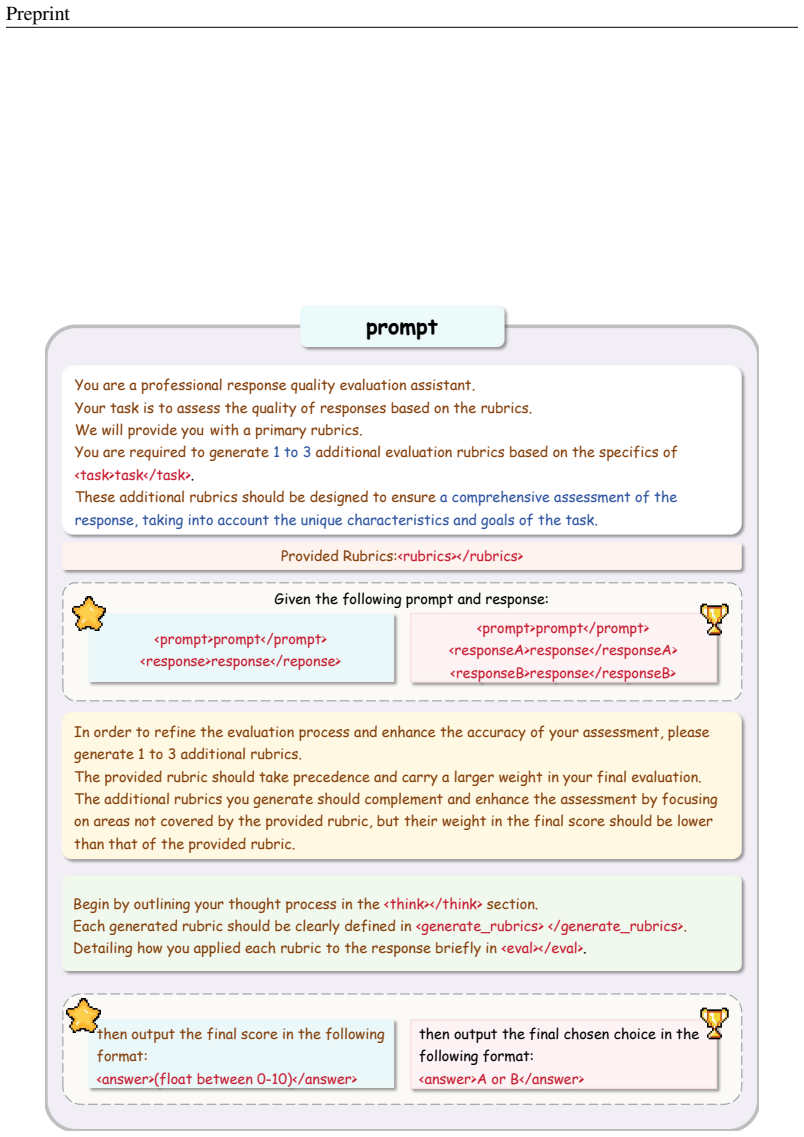
Task-Adaptive Rubric system that dynamically generates instance-specific criteria
What do these tags mean?
- matches
- The paper's claim is directly supported by a theorem in the formal canon.
- supports
- The theorem supports part of the paper's argument, but the paper may add assumptions or extra steps.
- extends
- The paper goes beyond the formal theorem; the theorem is a base layer rather than the whole result.
- uses
- The paper appears to rely on the theorem as machinery.
- contradicts
- The paper's claim conflicts with a theorem or certificate in the canon.
- unclear
- Pith found a possible connection, but the passage is too broad, indirect, or ambiguous to say the theorem truly supports the claim.
Reference graph
Works this paper leans on
-
[1]
URLhttps://arxiv. org/abs/2501.17195. Zachary Ankner, Mansheej Paul, Brandon Cui, Jonathan D. Chang, and Prithviraj Ammanabrolu. Critique-out-loud reward models,
-
[2]
David Anugraha, Zilu Tang, Lester James V
URLhttps://arxiv.org/abs/2408.11791. David Anugraha, Zilu Tang, Lester James V . Miranda, Hanyang Zhao, Mohammad Rifqi Farhan- syah, Garry Kuwanto, Derry Wijaya, and Genta Indra Winata. R3: Robust rubric-agnostic reward models,
-
[3]
Ralph Allan Bradley and Milton E
URLhttps://arxiv.org/abs/2505.13388. Ralph Allan Bradley and Milton E. Terry. Rank analysis of incomplete block designs: I. the method of paired comparisons.Biometrika, 39:324,
-
[4]
Judgelrm: Large reasoning models as a judge
Nuo Chen, Zhiyuan Hu, Qingyun Zou, Jiaying Wu, Qian Wang, Bryan Hooi, and Bingsheng He. Judgelrm: Large reasoning models as a judge, 2025a. URLhttps://arxiv.org/abs/ 2504.00050. Xiusi Chen, Gaotang Li, Ziqi Wang, Bowen Jin, Cheng Qian, Yu Wang, Hongru Wang, Yu Zhang, Denghui Zhang, Tong Zhang, Hanghang Tong, and Heng Ji. Rm-r1: Reward modeling as reason- ...
-
[5]
Rubrics as Rewards: Reinforcement Learning Beyond Verifiable Domains
URLhttps://arxiv. org/abs/2507.17746. Jiaxin Guo, Zewen Chi, Li Dong, Qingxiu Dong, Xun Wu, Shaohan Huang, and Furu Wei. Reward reasoning model,
work page internal anchor Pith review Pith/arXiv arXiv
-
[6]
Jian Hu, Jason Klein Liu, Haotian Xu, and Wei Shen
URLhttps://arxiv.org/abs/2505.14674. Jian Hu, Jason Klein Liu, Haotian Xu, and Wei Shen. Reinforce++: An efficient rlhf algorithm with robustness to both prompt and reward models,
-
[7]
REINFORCE++: Stabilizing Critic-Free Policy Optimization with Global Advantage Normalization
URLhttps://arxiv.org/abs/ 2501.03262. Dongfu Jiang, Xiang Ren, and Bill Yuchen Lin. Llm-blender: Ensembling large language models with pairwise ranking and generative fusion,
work page internal anchor Pith review Pith/arXiv arXiv
-
[8]
URLhttps://arxiv.org/abs/2306. 02561. Seungone Kim, Jamin Shin, Yejin Cho, Joel Jang, Shayne Longpre, Hwaran Lee, Sangdoo Yun, Seongjin Shin, Sungdong Kim, James Thorne, and Minjoon Seo. Prometheus: Inducing fine- grained evaluation capability in language models, 2024a. URLhttps://arxiv.org/abs/ 2310.08491. Seungone Kim, Juyoung Suk, Shayne Longpre, Bill ...
-
[9]
URLhttps://arxiv. org/abs/2406.18629. 11 Preprint Nathan Lambert, Valentina Pyatkin, Jacob Morrison, LJ Miranda, Bill Yuchen Lin, Khyathi Chandu, Nouha Dziri, Sachin Kumar, Tom Zick, Yejin Choi, Noah A. Smith, and Hannaneh Hajishirzi. Rewardbench: Evaluating reward models for language modeling,
-
[10]
Rewardbench: Evaluating reward models for language modeling.arXiv preprint arXiv:2403.13787,
URL https://arxiv.org/abs/2403.13787. Chris Yuhao Liu, Liang Zeng, Jiacai Liu, Rui Yan, Jujie He, Chaojie Wang, Shuicheng Yan, Yang Liu, and Yahui Zhou. Skywork-reward: Bag of tricks for reward modeling in llms, 2024a. URL https://arxiv.org/abs/2410.18451. Yantao Liu, Zijun Yao, Rui Min, Yixin Cao, Lei Hou, and Juanzi Li. Rm-bench: Benchmarking reward mod...
-
[11]
Inference-time scaling for generalist reward modeling
URLhttps://arxiv.org/ abs/2504.02495. Dakota Mahan, Duy Van Phung, Rafael Rafailov, Chase Blagden, Nathan Lile, Louis Castricato, Jan-Philipp Fr¨anken, Chelsea Finn, and Alon Albalak. Generative reward models,
- [12]
-
[13]
Yiwei Qin, Kaiqiang Song, and Yebowen et al Hu
An autoregressive omni model accepting text, vision, audio, and video input/output with structured multimodal evaluation and safety assessment. Yiwei Qin, Kaiqiang Song, and Yebowen et al Hu. InFoBench: Evaluating instruction following ability in large language models. In Lun-Wei Ku, Andre Martins, and Vivek Srikumar (eds.),Find- ings of the Association f...
work page 2024
-
[14]
Association for Computational Linguistics. doi: 10.18653/v1/2024. findings-acl.772. URLhttps://aclanthology.org/2024.findings-acl.772/. Qwen. Qwen2.5 technical report, 2025a. URLhttps://arxiv.org/abs/2412.15115. Qwen. Qwen3 technical report, 2025b. URLhttps://arxiv.org/abs/2505.09388. Rafael Rafailov, Archit Sharma, Eric Mitchell, Stefano Ermon, Christoph...
work page internal anchor Pith review Pith/arXiv arXiv doi:10.18653/v1/2024 2024
-
[15]
Direct Preference Optimization: Your Language Model is Secretly a Reward Model
URLhttps://arxiv.org/abs/2305.18290. Gemini Team. Gemini 1.5: Unlocking multimodal understanding across millions of tokens of con- text,
work page internal anchor Pith review Pith/arXiv arXiv
-
[16]
URLhttps://arxiv.org/abs/2403.05530. Vezora. Code-preference-pairs dataset.https://huggingface.co/datasets/Vezora/ Code-Preference-Pairs,
work page internal anchor Pith review Pith/arXiv arXiv
-
[17]
URL https://arxiv.org/abs/2507.18624. Chenglong Wang, Yang Gan, Yifu Huo, Yongyu Mu, Qiaozhi He, Murun Yang, Bei Li, Tong Xiao, Chunliang Zhang, Tongran Liu, and Jingbo Zhu. Gram: A generative foundation reward model for reward generalization,
-
[18]
URLhttps://arxiv.org/abs/2506.14175. Tianlu Wang, Ilia Kulikov, Olga Golovneva, Ping Yu, Weizhe Yuan, Jane Dwivedi-Yu, Richard Yuanzhe Pang, Maryam Fazel-Zarandi, Jason Weston, and Xian Li. Self-taught eval- uators.arXiv preprint arXiv:2408.02666,
-
[19]
Wenyuan Xu, Xiaochen Zuo, Chao Xin, Yu Yue, Lin Yan, and Yonghui Wu. A unified pairwise framework for rlhf: Bridging generative reward modeling and policy optimization.arXiv preprint arXiv:2504.04950,
-
[20]
Improving reward models with synthetic critiques
12 Preprint Zihuiwen Ye, Fraser David Greenlee, Max Bartolo, Phil Blunsom, Jon Ander Campos, and Matthias Gall´e. Improving reward models with synthetic critiques. In Luis Chiruzzo, Alan Ritter, and Lu Wang (eds.),Findings of the Association for Computational Linguistics: NAACL 2025, pp. 4506–4520, Albuquerque, New Mexico, April
work page 2025
-
[21]
DAPO: An Open-Source LLM Reinforcement Learning System at Scale
Association for Computational Linguis- tics. ISBN 979-8-89176-195-7. doi: 10.18653/v1/2025.findings-naacl.254. URLhttps: //aclanthology.org/2025.findings-naacl.254/. Qiying Yu, Zheng Zhang, Ruofei Zhu, and et al. Dapo: An open-source llm reinforcement learning system at scale, 2025a. URLhttps://arxiv.org/abs/2503.14476. Zhuohao Yu, Jiali Zeng, Weizheng Gu...
work page internal anchor Pith review Pith/arXiv arXiv doi:10.18653/v1/2025.findings-naacl.254 2025
-
[22]
URLhttps: //arxiv.org/abs/2404.02078. Lunjun Zhang, Arian Hosseini, Hritik Bansal, Mehran Kazemi, Aviral Kumar, and Rishabh Agarwal. Generative verifiers: Reward modeling as next-token prediction,
-
[23]
Generative verifiers: Reward modeling as next-token prediction.arXiv preprint arXiv:2408.15240,
URLhttps://arxiv. org/abs/2408.15240. Wenting Zhao, Xiang Ren, Jack Hessel, Claire Cardie, Yejin Choi, and Yuntian Deng. Wildchat: 1m chatgpt interaction logs in the wild,
-
[24]
WildChat: 1M ChatGPT Interaction Logs in the Wild
URLhttps://arxiv.org/abs/2405.01470. Jeffrey Zhou, Tianjian Lu, Swaroop Mishra, Siddhartha Brahma, Sujoy Basu, Yi Luan, Denny Zhou, and Le Hou. Instruction-following evaluation for large language models,
work page internal anchor Pith review Pith/arXiv arXiv
-
[25]
Instruction-Following Evaluation for Large Language Models
URLhttps: //arxiv.org/abs/2311.07911. 13 Preprint A LLM USAGE We only employed Large Language Models (LLMs) to assist with the linguistic refinement and polishing of this manuscript, elaborated as follows. • Specifically, the LLM was used for tasks such as sentence rephrasing, grammar correction, readability improvement, and enhancing the overall flow of ...
work page internal anchor Pith review Pith/arXiv arXiv
-
[26]
The tag must contain only numbers and no other text or characters
For your rating, only give a number between 1 and 10 (inclusive), directly output the number in the following format:<answer>5</answer>. The tag must contain only numbers and no other text or characters. B.2 PRIMARYRUBRICSACROSSDOMAINS Figure 5 presents the primary rubric for thechatdomain, which focuses onUsefulnessas the core evaluation criterion. This ...
work page 2024
discussion (0)
Sign in with ORCID, Apple, or X to comment. Anyone can read and Pith papers without signing in.