Recognition: 2 theorem links
· Lean TheoremParameterized Post-Newtonian Analysis of Quadratic Gravity and Solar System Constraints
Pith reviewed 2026-05-16 16:16 UTC · model grok-4.3
The pith
Quadratic gravity produces exponentially suppressed deviations from general relativity at solar system scales.
A machine-rendered reading of the paper's core claim, the machinery that carries it, and where it could break.
Core claim
In general quadratic gravity with Lagrangian density proportional to R minus lambda C squared plus mu R squared, the parameterized post-Newtonian parameters gamma of r and beta of r approach their general relativity values exponentially fast with distance. Specifically, gamma of r is identically one when the Ricci mass equals the Weyl mass, and the leading correction to beta of r has the form order r ln r times e to the minus m r. Solar system constraints require both masses to exceed 23 inverse AU, which translates to lambda less than or equal to 2.1 times 10 to the 19 square meters and mu less than or equal to 7.1 times 10 to the 18 square meters.
What carries the argument
The post-Newtonian expansion of the metric in the presence of massive scalar and ghost tensor modes generated by the quadratic curvature terms.
If this is right
- Gamma of r remains identically equal to 1 at all distances when the scalar and tensor masses are equal.
- Gravity stays attractive only when the Weyl mass exceeds one-quarter the Ricci mass.
- The leading correction to beta of r shows a characteristic r ln r exp(-m r) dependence.
- Solar system experiments bound the quadratic coefficients lambda and mu to the values given above.
Where Pith is reading between the lines
- Higher-precision observations such as pulsar timing arrays could detect the exponential tails if the masses are near the current lower bound.
- Short-range laboratory gravity experiments might see larger effects because the suppression weakens at small distances.
- The assumption that the ghost mode remains stable could be tested by looking for runaway behavior in strong-field or high-energy regimes.
Load-bearing premise
The post-Newtonian expansion remains valid for the quadratic gravity theory in the weak-field regime around solar-system sources without instabilities from the ghost tensor mode.
What would settle it
A solar-system measurement of light deflection or perihelion precession showing a deviation from general relativity larger than the predicted exponential suppression at those distances.
Figures
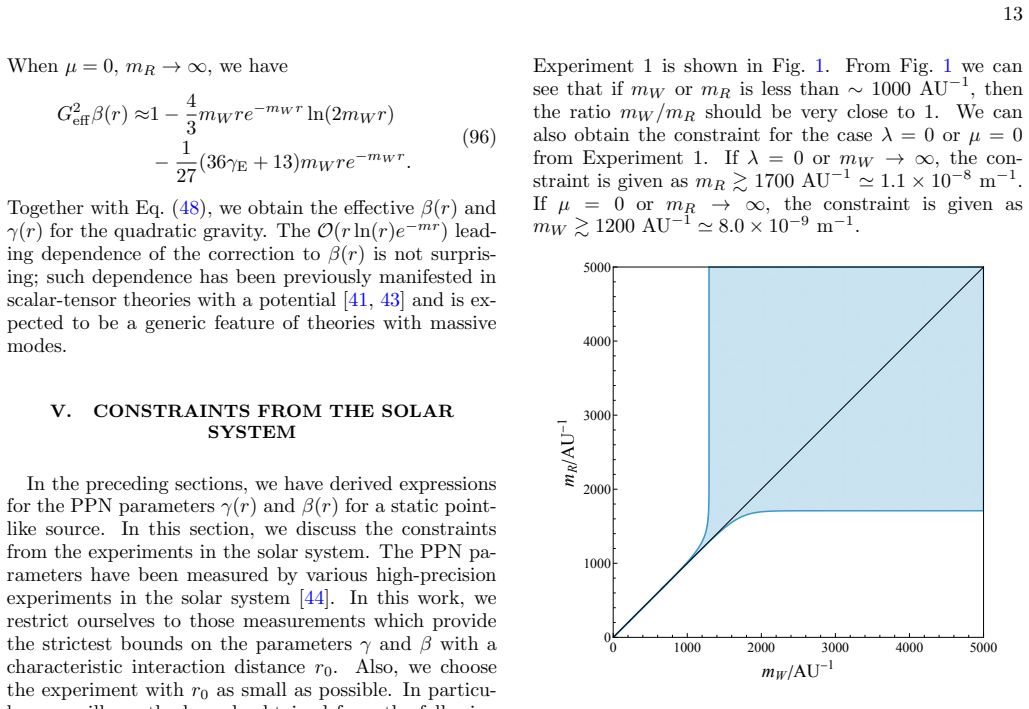


read the original abstract
This work systematically investigates the post-Newtonian behavior of general quadratic gravity in the weak-field regime. By extending the Einstein-Hilbert action to include quadratic curvature terms as $\mathcal{L}\propto R-\lambda C^2+\mu R^2$, the theory introduces two massive modes: a scalar mode and a ghost tensor mode. Using the post-Newtonian expansion method, we derive the explicit expressions for the metric for a general source up to 1.5PN order. Furthermore, for a point-mass source, we extend the solution to 2PN order and evaluate the effective Parameterized Post-Newtonian parameters $\gamma(r)$ and $\beta(r)$. The results show that deviations from General Relativity are exponentially suppressed. The theory has the feature $\gamma(r)\equiv 1$ when $m_R=m_W$, and to ensure that gravity remains attractive, we have $m_W>m_R/4$. The leading correction to $\beta(r)$ exhibiting a characteristic $\mathcal{O}(r \ln (r)e^{-mr})$ dependence. Based on the Solar System experiments, we derive preliminary constraints on the theory's parameters: $m_R,m_W\gtrsim23~\mathrm{AU}^{-1}$, corresponding to $\lambda\lesssim2.1\times10^{19}~\mathrm{m}^2$ and $\mu\lesssim 7.1\times 10^{18}~\mathrm{m}^2$. This study provides a theoretical foundation for future tests of quadratic gravity using pulsar timing arrays, gravitational-wave observations, and laboratory-scale short-range gravity experiments.
Editorial analysis
A structured set of objections, weighed in public.
Referee Report
Summary. The manuscript applies post-Newtonian methods to quadratic gravity with Lagrangian density proportional to R − λ C² + μ R², deriving the metric up to 1.5PN order for a general source and to 2PN order for a point mass. It obtains effective PPN parameters γ(r) and β(r) that deviate from their GR values only through exponentially suppressed Yukawa terms, notes that γ(r) ≡ 1 when m_R = m_W, requires m_W > m_R/4 for attractive gravity, and extracts preliminary solar-system bounds m_R, m_W ≳ 23 AU^{-1} (λ ≲ 2.1 × 10^{19} m², μ ≲ 7.1 × 10^{18} m²).
Significance. If the perturbative expansion remains valid, the explicit derivation of the r-dependent PPN parameters and the resulting solar-system bounds supply concrete, falsifiable limits on quadratic gravity that can be tested with existing data and extended to pulsar-timing arrays or short-range experiments. The identification of the m_R = m_W case where γ remains exactly unity is a useful structural result.
major comments (2)
- [Linearized field equations and mode analysis] The linearized spectrum contains a ghost tensor mode whose kinetic term has the wrong sign. The manuscript states the existence of this mode and imposes m_W > m_R/4 for attractive gravity, but does not demonstrate that Ostrogradsky instabilities are absent or that the negative-energy contributions remain unexcited in the 1.5PN–2PN metric around solar-system sources. This assumption is load-bearing for the claim that the derived metric and PPN parameters constitute a reliable classical solution (see the discussion of the massive modes and the metric expansion).
- [Solar-system constraints section] The translation from the exponentially suppressed corrections to the numerical bounds m_R, m_W ≳ 23 AU^{-1} is presented as preliminary. The manuscript should specify which solar-system observables (perihelion advance, light deflection, Shapiro delay, etc.) are used, at which PN order they enter, and how the 2PN O(r ln r e^{-mr}) term in β(r) propagates into the final limits.
minor comments (2)
- [Abstract and § on point-mass solution] The abstract states that the solution is extended to 2PN order for a point-mass source; the main text should clarify whether the 2PN terms modify the leading-order constraints or are used only for completeness.
- [Introduction and action definition] Notation for the two mass parameters (m_R, m_W) and the coupling constants (λ, μ) should be introduced once with explicit definitions from the action before being used in the PPN expressions.
Simulated Author's Rebuttal
We thank the referee for the careful reading and constructive comments on our manuscript. We address each major comment point by point below, indicating planned revisions where appropriate. Our responses focus on clarifying the scope of the perturbative analysis while acknowledging the limitations of the classical treatment.
read point-by-point responses
-
Referee: The linearized spectrum contains a ghost tensor mode whose kinetic term has the wrong sign. The manuscript states the existence of this mode and imposes m_W > m_R/4 for attractive gravity, but does not demonstrate that Ostrogradsky instabilities are absent or that the negative-energy contributions remain unexcited in the 1.5PN–2PN metric around solar-system sources. This assumption is load-bearing for the claim that the derived metric and PPN parameters constitute a reliable classical solution (see the discussion of the massive modes and the metric expansion).
Authors: We acknowledge that the ghost tensor mode introduces potential Ostrogradsky instabilities, a known feature of quadratic gravity. Our derivation is restricted to the perturbative weak-field regime, where we assume the classical metric solutions remain valid and that the ghost mode is not excited at the orders considered for solar-system sources. The condition m_W > m_R/4 is imposed to ensure attractive gravity within this framework. A complete non-perturbative demonstration of stability lies beyond the scope of this work. We will add explicit statements in the introduction and discussion sections clarifying this assumption and its limitations. revision: partial
-
Referee: The translation from the exponentially suppressed corrections to the numerical bounds m_R, m_W ≳ 23 AU^{-1} is presented as preliminary. The manuscript should specify which solar-system observables (perihelion advance, light deflection, Shapiro delay, etc.) are used, at which PN order they enter, and how the 2PN O(r ln r e^{-mr}) term in β(r) propagates into the final limits.
Authors: We agree that the solar-system constraints section requires greater specificity. The bounds are derived from Mercury's perihelion advance (probing β at 2PN order) and light deflection measurements (probing γ at 1PN order), using current observational accuracies. The exponentially suppressed terms, including the characteristic O(r ln r e^{-mr}) contribution to β(r), are incorporated by requiring that deviations remain below experimental thresholds at solar-system distances. We will revise the relevant section to explicitly list the observables, their PN orders, and the detailed propagation of the 2PN term into the quoted mass bounds. revision: yes
- A full non-perturbative demonstration that Ostrogradsky instabilities are absent and that negative-energy contributions from the ghost mode remain unexcited in the 1.5PN–2PN metric around solar-system sources.
Circularity Check
No significant circularity: standard derivation from action via post-Newtonian expansion
full rationale
The paper begins from the quadratic gravity Lagrangian L ∝ R − λ C² + μ R² and applies standard post-Newtonian expansion techniques to obtain the metric components and the effective PPN parameters γ(r), β(r) for a point-mass source. The reported features (exponential suppression of deviations, γ(r) ≡ 1 when m_R = m_W, and the condition m_W > m_R/4 for attractive gravity) are direct algebraic consequences of the linearized field equations and the resulting Yukawa-type propagators. Solar-system bounds on m_R, m_W are obtained by direct comparison with external observational data rather than by any internal fit or self-referential definition. No load-bearing step reduces to a self-citation, a fitted input renamed as prediction, or an ansatz smuggled via prior work by the same authors. The derivation chain is therefore self-contained against external benchmarks.
Axiom & Free-Parameter Ledger
axioms (2)
- domain assumption Post-Newtonian expansion is valid for quadratic gravity in the weak-field regime
- ad hoc to paper Ghost tensor mode does not invalidate the classical solution
Lean theorems connected to this paper
-
IndisputableMonolith/Foundation/AlexanderDuality.leanalexander_duality_circle_linking unclear?
unclearRelation between the paper passage and the cited Recognition theorem.
The action (1) introduces a massive spin-2 tensor mode with mass m_W² = 1/(2λ), and a massive scalar mode with mass m_R² = 1/(6μ) [7,23,24]... γ(r) ≡ 1 when m_R = m_W... m_W > m_R/4
-
IndisputableMonolith/Cost/FunctionalEquation.leanwashburn_uniqueness_aczel unclear?
unclearRelation between the paper passage and the cited Recognition theorem.
deviations from General Relativity are exponentially suppressed... O(r ln(r) e^{-mr}) dependence
What do these tags mean?
- matches
- The paper's claim is directly supported by a theorem in the formal canon.
- supports
- The theorem supports part of the paper's argument, but the paper may add assumptions or extra steps.
- extends
- The paper goes beyond the formal theorem; the theorem is a base layer rather than the whole result.
- uses
- The paper appears to rely on the theorem as machinery.
- contradicts
- The paper's claim conflicts with a theorem or certificate in the canon.
- unclear
- Pith found a possible connection, but the passage is too broad, indirect, or ambiguous to say the theorem truly supports the claim.
Reference graph
Works this paper leans on
-
[1]
C. M. Will, The Confrontation between General Rela- tivity and Experiment, Living Rev. Rel.17, 4 (2014), arXiv:1403.7377 [gr-qc]
work page internal anchor Pith review Pith/arXiv arXiv 2014
-
[2]
S. G. Turyshev, Experimental Tests of General Relativ- ity: Recent Progress and Future Directions, Usp. Fiz. Nauk179, 3034 (2009), arXiv:0809.3730 [gr-qc]
work page internal anchor Pith review Pith/arXiv arXiv 2009
-
[3]
Testing General Relativity with Present and Future Astrophysical Observations
E. Bertiet al., Testing General Relativity with Present and Future Astrophysical Observations, Class. Quant. Grav.32, 243001 (2015), arXiv:1501.07274 [gr-qc]
work page internal anchor Pith review Pith/arXiv arXiv 2015
-
[4]
B. P. Abbottet al.(LIGO Scientific, Virgo), Observation of Gravitational Waves from a Binary Black Hole Merger, Phys. Rev. Lett.116, 061102 (2016), arXiv:1602.03837 [gr-qc]
work page internal anchor Pith review Pith/arXiv arXiv 2016
-
[5]
First M87 Event Horizon Telescope Results. I. The Shadow of the Supermassive Black Hole
K. Akiyamaet al.(Event Horizon Telescope), First M87 Event Horizon Telescope Results. I. The Shadow of the Supermassive Black Hole, Astrophys. J. Lett.875, L1 (2019), arXiv:1906.11238 [astro-ph.GA]
work page internal anchor Pith review Pith/arXiv arXiv 2019
-
[6]
K. S. Stelle, Renormalization of Higher Derivative Quan- tum Gravity, Phys. Rev. D16, 953 (1977)
work page 1977
-
[7]
K. S. Stelle, Classical Gravity with Higher Derivatives, Gen. Rel. Grav.9, 353 (1978)
work page 1978
-
[8]
J. F. Donoghue, General relativity as an effective field theory: The leading quantum corrections, Phys. Rev. D 50, 3874 (1994), arXiv:gr-qc/9405057
work page internal anchor Pith review Pith/arXiv arXiv 1994
-
[9]
C. G. Callan, Jr., E. J. Martinec, M. J. Perry, and D. Friedan, Strings in Background Fields, Nucl. Phys. B262, 593 (1985)
work page 1985
-
[10]
D. J. Gross and J. H. Sloan, The Quartic Effective Action for the Heterotic String, Nucl. Phys. B291, 41 (1987)
work page 1987
-
[11]
Loop Quantum Cosmology: A Status Report
A. Ashtekar and P. Singh, Loop Quantum Cosmology: A Status Report, Class. Quant. Grav.28, 213001 (2011), arXiv:1108.0893 [gr-qc]
work page internal anchor Pith review Pith/arXiv arXiv 2011
-
[12]
A. A. Starobinsky, A New Type of Isotropic Cosmological Models Without Singularity, Phys. Lett. B91, 99 (1980)
work page 1980
-
[13]
V. F. Mukhanov, Quantum Theory of Cosmological Per- turbations in R(2) Gravity, Phys. Lett. B218, 17 (1989)
work page 1989
-
[14]
Whitt, Fourth Order Gravity as General Relativity Plus Matter, Phys
B. Whitt, Fourth Order Gravity as General Relativity Plus Matter, Phys. Lett. B145, 176 (1984)
work page 1984
-
[15]
Planck 2018 results. X. Constraints on inflation
Y. Akramiet al.(Planck), Planck 2018 results. X. Con- straints on inflation, Astron. Astrophys.641, A10 (2020), arXiv:1807.06211 [astro-ph.CO]
work page internal anchor Pith review Pith/arXiv arXiv 2018
-
[16]
Singularity-free cosmological solutions in quadratic gravity
P. Kanti, J. Rizos, and K. Tamvakis, Singularity free cos- mological solutions in quadratic gravity, Phys. Rev. D59, 083512 (1999), arXiv:gr-qc/9806085
work page internal anchor Pith review Pith/arXiv arXiv 1999
- [17]
-
[18]
F. Duplessis and D. A. Easson, Traversable worm- holes and non-singular black holes from the vacuum of quadratic gravity, Phys. Rev. D92, 043516 (2015), arXiv:1506.00988 [gr-qc]
work page internal anchor Pith review Pith/arXiv arXiv 2015
-
[19]
Regular black holes in quadratic gravity
W. Berej, J. Matyjasek, D. Tryniecki, and M. Woronow- icz, Regular black holes in quadratic gravity, Gen. Rel. Grav.38, 885 (2006), arXiv:hep-th/0606185
work page internal anchor Pith review Pith/arXiv arXiv 2006
-
[20]
H. Lu, A. Perkins, C. N. Pope, and K. S. Stelle, Black Holes in Higher-Derivative Gravity, Phys. Rev. Lett.114, 171601 (2015), arXiv:1502.01028 [hep-th]
work page internal anchor Pith review Pith/arXiv arXiv 2015
- [21]
-
[22]
K. Yagi, L. C. Stein, N. Yunes, and T. Tanaka, Post- Newtonian, Quasi-Circular Binary Inspirals in Quadratic Modified Gravity, Phys. Rev. D85, 064022 (2012), [Er- ratum: Phys.Rev.D 93, 029902 (2016)], arXiv:1110.5950 [gr-qc]
work page internal anchor Pith review Pith/arXiv arXiv 2012
- [23]
- [24]
-
[25]
Nordtvedt, Equivalence Principle for Massive Bodies
K. Nordtvedt, Equivalence Principle for Massive Bodies
- [26]
-
[27]
K. S. Thorne and C. M. Will, Theoretical Frameworks for Testing Relativistic Gravity. I. Foundations, Astrophys. J.163, 595 (1971)
work page 1971
-
[28]
C. M. Will, Theoretical Frameworks for Testing Rela- tivistic Gravity. 2. Parametrized Post-Newtonian Hydro- dynamics, and the Nordtvedt Effect, Astrophys. J.163, 611 (1971)
work page 1971
-
[29]
C. M. Will, THEORETICAL FRAMEWORKS FOR TESTING RELATIVISTIC GRAVITY. 3. CONSERVA- TION LAWS, LORENTZ INVARIANCE AND VALUES OF THE P P N PARAMETERS, Astrophys. J.169, 125 (1971)
work page 1971
-
[30]
C. M. Will,Theory and Experiment in Gravitational Physics(Cambridge University Press, 1993)
work page 1993
-
[31]
E. Poisson and C. M. Will,Gravity: Newtonian, Post- Newtonian, Relativistic(Cambridge University Press, Cambridge, UK, 2014)
work page 2014
-
[32]
Solar System constraints to general f(R) gravity
T. Chiba, T. L. Smith, and A. L. Erickcek, Solar Sys- tem constraints to general f(R) gravity, Phys. Rev. D75, 124014 (2007), arXiv:astro-ph/0611867
work page internal anchor Pith review Pith/arXiv arXiv 2007
-
[33]
PPN-limit of Fourth Order Gravity inspired by Scalar-Tensor Gravity
S. Capozziello and A. Troisi, PPN-limit of fourth order gravity inspired by scalar-tensor gravity, Phys. Rev. D 72, 044022 (2005), arXiv:astro-ph/0507545
work page internal anchor Pith review Pith/arXiv arXiv 2005
-
[34]
The Newtonian Limit of F(R) gravity
S. Capozziello, A. Stabile, and A. Troisi, The Newtonian Limit of f(R) gravity, Phys. Rev. D76, 104019 (2007), arXiv:0708.0723 [gr-qc]
work page internal anchor Pith review Pith/arXiv arXiv 2007
-
[35]
$f(R)$ gravity constrained by PPN parameters and stochastic background of gravitational waves
S. Capozziello, M. De Laurentis, S. Nojiri, and S. D. Odintsov, f(R) gravity constrained by PPN parameters and stochastic background of gravitational waves, Gen. Rel. Grav.41, 2313 (2009), arXiv:0808.1335 [hep-th]
work page internal anchor Pith review Pith/arXiv arXiv 2009
- [36]
- [37]
- [38]
-
[39]
A. I. Vainshtein, To the problem of nonvanishing gravi- tation mass, Phys. Lett. B39, 393 (1972)
work page 1972
-
[40]
The Parametrized Post-Newtonian-Vainshteinian Formalism
A. Avilez-Lopez, A. Padilla, P. M. Saffin, and C. Skordis, The Parametrized Post-Newtonian-Vainshteinian formal- ism, Journal of Cosmology and Astroparticle Physics06 (06), 044, arXiv:1501.01985 [gr-qc]
work page internal anchor Pith review Pith/arXiv arXiv
-
[41]
M. Hohmann, xPPN: an implementation of the parametrized post-Newtonian formalism using xAct for Mathematica, Eur. Phys. J. C81, 504 (2021), arXiv:2012.14984 [gr-qc]
-
[42]
Post-Newtonian parameters gamma and beta of scalar-tensor gravity with a general potential
M. Hohmann, L. Jarv, P. Kuusk, and E. Randla, Post- Newtonian parametersγandβof scalar-tensor grav- ity with a general potential, Phys. Rev. D88, 084054 (2013), [Erratum: Phys.Rev.D 89, 069901 (2014)], arXiv:1309.0031 [gr-qc]
work page internal anchor Pith review Pith/arXiv arXiv 2013
-
[43]
C. P. L. Berry and J. R. Gair, Linearized f(R) Gravity: Gravitational Radiation and Solar System Tests, Phys. Rev. D83, 104022 (2011), [Erratum: Phys.Rev.D 85, 089906 (2012)], arXiv:1104.0819 [gr-qc]
work page internal anchor Pith review Pith/arXiv arXiv 2011
-
[44]
M. Hohmann and A. Sch¨ arer, Post-Newtonian parame- tersγandβof scalar-tensor gravity for a homogeneous gravitating sphere, Phys. Rev. D96, 104026 (2017), arXiv:1708.07851 [gr-qc]
work page internal anchor Pith review Pith/arXiv arXiv 2017
- [45]
-
[46]
B. Bertotti, L. Iess, and P. Tortora, A test of general relativity using radio links with the Cassini spacecraft, Nature425, 374 (2003)
work page 2003
-
[47]
F. Hofmann, J. M¨ uller, and L. Biskupek, Lunar laser ranging test of the Nordtvedt parameter and a possible variation in the gravitational constant, Astronomy and Astrophysics522, L5 (2010)
work page 2010
-
[48]
E. G. Adelberger, J. H. Gundlach, B. R. Heckel, S. Hoedl, and S. Schlamminger, Torsion balance experiments: A low-energy frontier of particle physics, Prog. Part. Nucl. Phys.62, 102 (2009)
work page 2009
-
[49]
D. J. Kapner, T. S. Cook, E. G. Adelberger, J. H. Gund- lach, B. R. Heckel, C. D. Hoyle, and H. E. Swanson, Tests of the gravitational inverse-square law below the dark- energy length scale, Phys. Rev. Lett.98, 021101 (2007), arXiv:hep-ph/0611184
work page internal anchor Pith review Pith/arXiv arXiv 2007
-
[50]
Sub-millimeter Spatial Oscillations of Newton's Constant: Theoretical Models and Laboratory Tests
L. Perivolaropoulos, Submillimeter spatial oscillations of Newton’s constant: Theoretical models and laboratory tests, Phys. Rev. D95, 084050 (2017), arXiv:1611.07293 [gr-qc]
work page internal anchor Pith review Pith/arXiv arXiv 2017
- [51]
discussion (0)
Sign in with ORCID, Apple, or X to comment. Anyone can read and Pith papers without signing in.