Recognition: unknown
Disentangling cosmic distance tensions with early and late dark energy
Pith reviewed 2026-05-10 16:45 UTC · model grok-4.3
The pith
Early dark energy resolves the CMB-BAO tension by adjusting the sound horizon while thawing quintessence aligns supernova data without phantom crossing.
A machine-rendered reading of the paper's core claim, the machinery that carries it, and where it could break.
Core claim
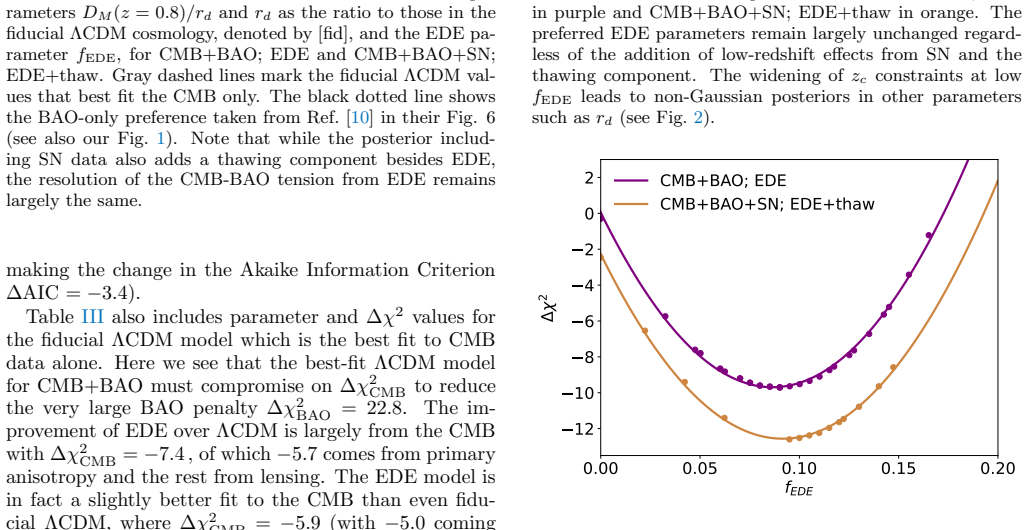
The BAO and SN sides of the tension can be treated independently. Early dark energy reduces the CMB-BAO tension by changing the calibration of the sound horizon at the drag epoch rd, with a Delta chi squared of -9.4 relative to Lambda CDM and raising H0 to 70.87 km s^-1 Mpc^-1. Combining this with a thawing-quintessence component of dark energy reduces tensions between CMB, BAO, and SN data with Delta chi squared of -12.6 without a phantom component, compared to -15.8 for w0wa with one, while reducing the Hubble tension with local measurements from 7 sigma to 2-3 sigma.
What carries the argument
Early dark energy that modifies the sound horizon rd at the drag epoch, paired with a thawing-quintessence late dark energy component.
If this is right
- EDE alone aligns CMB and BAO but requires the late-time component to fully reconcile all three datasets.
- The combined model improves the fit without entering the phantom equation-of-state regime.
- The inferred Hubble constant increases enough to reduce tension with local distance ladder measurements to 2-3 sigma.
- The EDE adjustment to rd remains stable across different supernova catalogs including DES Dovekie, DESY5, and Pantheon+.
Where Pith is reading between the lines
- Future surveys measuring the expansion rate at redshifts between the CMB and supernovae could directly test whether early and late modifications are independent.
- This separation suggests the tensions may arise from distinct physical mechanisms rather than a single dynamical dark energy field.
- Physical realizations of EDE, such as axion-like fields, could be checked for consistency with the required parameter values while avoiding instabilities.
Load-bearing premise
Early dark energy and thawing quintessence can be added independently without introducing new inconsistencies or instabilities in the joint cosmological evolution or in the supernova distance calibration.
What would settle it
A precise measurement of the sound horizon rd from independent early-universe probes that rules out the shift needed by the EDE model, or supernova distance data at intermediate redshifts that deviates from the expansion history predicted by thawing quintessence.
Figures




read the original abstract
Recent cosmological data reveal tension between parameters inferred from measurements of the cosmic microwave background (CMB), baryon acoustic oscillations (BAO), and supernovae (SN) under $\Lambda$CDM. Typical dynamical dark energy parameterizations (such as $w_0w_a$) that seek to jointly resolve these tensions have an equation of state parameter that crosses into the phantom regime, leading to potential instabilities for physical models. We show that the BAO (early-time) and SN (late-time) sides of the tension can instead be treated independently. Early dark energy (EDE) can reduce the tension between CMB-BAO data by changing the calibration of the sound horizon at the drag epoch $r_d$, with a $\Delta\chi^2 = -{9.4}$ relative to $\Lambda$CDM, raising $H_0$ to 70.87 $\rm km s^{-1}Mpc^{-1}$. EDE alone cannot bring consistency between CMB, BAO, and SN data, but combining with a thawing-quintessence component of dark energy reduces tensions between the three datasets, with $\Delta\chi^2=-12.6$ relative to $\Lambda$CDM without a phantom component, vs. $\Delta\chi^2=-15.8$ for $w_0 w_a$ with one. We consider different SN datasets, using the most recent DES Dovekie catalog as our default while assessing differences with the original DESY5 and Pantheon+ catalogs. While the significance of adding thawing quintessence changes, the EDE solution to the CMB-BAO tension remains nearly unaffected. Moreover, though we do not include direct Hubble constant measurements in these $\Delta\chi^2$ values, the EDE solution reduces the Hubble tension with the Local Distance Network value from $7\sigma$ in $\Lambda$CDM to $2-3\sigma$ depending on the SN dataset, nominally the equivalent of an extra $\Delta\chi^2 \sim -40$ or more.
Editorial analysis
A structured set of objections, weighed in public.
Referee Report
Summary. The paper claims that tensions between CMB, BAO, and SN datasets under ΛCDM can be disentangled by treating early and late dark energy separately: early dark energy (EDE) modifies the sound horizon rd to reconcile CMB-BAO, yielding H0 = 70.87 km s^{-1} Mpc^{-1} and Δχ² = -9.4 relative to ΛCDM; adding a thawing-quintessence component then addresses SN data without phantom crossing, for a combined Δχ² = -12.6 (vs. -15.8 for w0wa). The EDE improvement is robust across SN catalogs (DES Dovekie default, with comparisons to DESY5 and Pantheon+), and the model reduces the Hubble tension with local measurements to 2-3σ.
Significance. If the joint model proves internally consistent, the result would be significant for offering a physically motivated route to easing cosmological tensions via independent early (EDE) and late (thawing quintessence) modifications that avoid phantom instabilities. The explicit Δχ² comparisons, use of multiple SN datasets to test robustness of the EDE sector, and quantitative H0 tension reduction are strengths that could guide future model-building in dark energy phenomenology.
major comments (3)
- [Combined model results] Combined EDE + thawing quintessence fits (results section): the central claim that the two components can be added independently rests on the assumption of no cross-talk in background evolution or perturbations, yet no explicit validation is provided (e.g., total w(z) evolution, perturbation stability checks, or impact on SN distance moduli) that the joint model introduces neither new degeneracies nor instabilities across the full redshift range. This is load-bearing for the assertion that the tensions are disentangled rather than reparameterized.
- [Abstract and results tables] Δχ² reporting (abstract and results): the quoted improvements (Δχ² = -9.4 for EDE alone, -12.6 for the combination) are obtained by fitting the full set of EDE and quintessence parameters directly to the CMB+BAO+SN data; without reported Bayesian evidence, AIC/BIC comparisons, or effective parameter counts, it is unclear whether the gains exceed those expected from the added degrees of freedom, weakening the claim of an independent resolution relative to w0wa.
- [Abstract] Hubble tension reduction statement (abstract): the reduction from 7σ to 2-3σ is described as 'nominally the equivalent of an extra Δχ² ∼ -40', but direct local H0 measurements are excluded from the main fits; the specific local H0 value, uncertainty, and how the combined model's expansion history propagates to this tension metric must be stated explicitly to support the quantitative claim.
minor comments (3)
- [Abstract] The abstract refers to the 'DES Dovekie catalog' as default without a brief definition or reference; the methods section should clarify its relation to prior DES releases for readers unfamiliar with the update.
- [Methods and results] Notation for the thawing quintessence parameters (e.g., the specific w(a) form or potential) is introduced in the methods but should be cross-referenced in the abstract or results when quoting the combined Δχ² to improve readability.
- [Figures] Figure captions for the H0 posterior or w(z) evolution plots should explicitly note whether they include the joint EDE+quintessence case or only separate models.
Simulated Author's Rebuttal
We are grateful to the referee for the detailed and insightful comments on our manuscript. Below, we provide point-by-point responses to the major comments, outlining our clarifications and the revisions we will implement in the updated version.
read point-by-point responses
-
Referee: [Combined model results] Combined EDE + thawing quintessence fits (results section): the central claim that the two components can be added independently rests on the assumption of no cross-talk in background evolution or perturbations, yet no explicit validation is provided (e.g., total w(z) evolution, perturbation stability checks, or impact on SN distance moduli) that the joint model introduces neither new degeneracies nor instabilities across the full redshift range. This is load-bearing for the assertion that the tensions are disentangled rather than reparameterized.
Authors: Thank you for highlighting this important aspect. Our approach treats EDE and thawing quintessence as operating in distinct epochs: EDE influences the pre-recombination era to adjust the sound horizon, while thawing quintessence modifies the post-recombination expansion without phantom behavior. To explicitly validate the lack of cross-talk, we will include in the revised manuscript a figure showing the combined w(z) evolution across all redshifts, along with a section discussing the perturbation equations and confirming stability (no ghost or gradient instabilities). Additionally, we will report the impact on SN distance moduli and note that MCMC explorations show no unexpected degeneracies. These additions will reinforce that the tensions are addressed independently. revision: yes
-
Referee: [Abstract and results tables] Δχ² reporting (abstract and results): the quoted improvements (Δχ² = -9.4 for EDE alone, -12.6 for the combination) are obtained by fitting the full set of EDE and quintessence parameters directly to the CMB+BAO+SN data; without reported Bayesian evidence, AIC/BIC comparisons, or effective parameter counts, it is unclear whether the gains exceed those expected from the added degrees of freedom, weakening the claim of an independent resolution relative to w0wa.
Authors: We recognize the value of information criteria for model selection. While Δχ² provides a direct measure of fit quality commonly employed in this field, we agree that additional metrics would strengthen the presentation. In the revised manuscript, we will compute and report the Akaike Information Criterion (AIC) and Bayesian Information Criterion (BIC) for the models considered, including the effective number of parameters estimated from the posterior distributions. This will allow a clearer comparison to w0wa and better quantify whether the improvements justify the extra parameters, while emphasizing the physical benefit of avoiding phantom crossing. revision: yes
-
Referee: [Abstract] Hubble tension reduction statement (abstract): the reduction from 7σ to 2-3σ is described as 'nominally the equivalent of an extra Δχ² ∼ -40', but direct local H0 measurements are excluded from the main fits; the specific local H0 value, uncertainty, and how the combined model's expansion history propagates to this tension metric must be stated explicitly to support the quantitative claim.
Authors: We agree that greater specificity is needed here. The local Hubble constant value we reference is that from the Local Distance Network (specifically, the SH0ES measurement of H0 = 73.04 ± 1.04 km s^{-1} Mpc^{-1}). The tension is computed as the difference between this value and the H0 inferred from our CMB+BAO+SN fits, divided by the combined uncertainty, following standard practice. In the revised abstract and a new paragraph in the results section, we will explicitly state this value, its reference, and briefly describe how the modified expansion history (higher H0 from EDE, adjusted late-time from quintessence) leads to the reduced tension level of 2-3σ. This derived quantity illustrates the broader implications without being part of the primary likelihood. revision: yes
Circularity Check
No circularity: standard model fits to CMB-BAO-SN data
full rationale
The paper reports chi-squared improvements from fitting EDE parameters to CMB-BAO and then adding a thawing quintessence component for SN data, yielding Delta chi^2 values of -9.4 and -12.6 respectively. These are direct statistical results of parameter optimization against the same datasets, with no claimed first-principles derivation, prediction, or uniqueness theorem that reduces to the inputs by construction. No self-citations, ansatzes, or renamings appear as load-bearing steps in the abstract. The central claim of independent treatment is demonstrated empirically by the joint fit succeeding, which is self-contained and externally falsifiable via the reported chi^2 and H0 shifts.
Axiom & Free-Parameter Ledger
free parameters (2)
- EDE density and transition parameters
- Thawing quintessence equation-of-state parameters
axioms (2)
- domain assumption Standard flat FLRW background cosmology with standard recombination physics
- ad hoc to paper Thawing quintessence remains in the non-phantom regime and does not destabilize perturbations
Forward citations
Cited by 3 Pith papers
-
Double the axions, half the tension: multi-field early dark energy eases the Hubble tension
Two-field axion-like early dark energy reduces Hubble tension to 1.5 sigma residual and improves high-ell CMB fits over single-field models.
-
The End of the First Act: Spectral Running, Interacting Dark Radiation, and the Hubble Tension in Light of ACT DR6 Data
Including spectral running α_s, β_s and self-interacting dark radiation relaxes the ACT DR6 bound on ΔN_eff to <0.58 and lowers the Hubble tension to 2.2σ with three extra parameters.
-
Constraints on Coupled Dark Energy in the DESI Era
New cosmological data mildly favor a small coupling between dark matter and a scalar dark energy field at |β| ≈ 0.03 while allowing an effective phantom-crossing equation of state.
Reference graph
Works this paper leans on
-
[1]
weak-lensing amplitude parameter
for a pre-DESI exploration). Profile-likelihood studies are especially important for EDE models because they are susceptible to prior-volume effects [55, 106–108]: as the amount of EDE becomes neg- ligible, its other parameters become unconstrained by the data, leading to a large prior volume in the ΛCDM limit. This ballooning prior volume can pull Bayesi...
-
[2]
48) which increase the precision of Boltz- mann codes for comparing with high-resolution CMB sur- veys like ACT and SPT
(their Fig. 48) which increase the precision of Boltz- mann codes for comparing with high-resolution CMB sur- veys like ACT and SPT. We adopt a subset of these pa- rameters, balancing speed and accuracy, choosing higher accuracy only when the precision setting has a ∆χ2 >0.2 impact on the individual likelihoods considered here, checked at multiple points ...
-
[3]
fiducial ΛCDM,
as an independent dataset and neglect cross-correlations which are negligible due to the small but deep sky coverage [119]. •BAO: We use the DESI DR2 likelihood based on Table IV in Ref. [10] forD V /rd for the lowest redshift bin andD M /rd,D H /rd, and their cross- correlationr M,H for all other bins. 7 HereD X are BAO-measured distances andr d is the s...
2007
-
[4]
the maximum marginalized posterior probability value forf EDE is being pulled down (compared to the profile valuef EDE = 0.09±0.03 where±refer to ∆χ 2 =±1 as estimated from a quadratic fit to the profile, nominally a 3σpreference) by prior-volume effects, and 2) the pro- file likelihood is nearly quadratic, in contrast to the clear non-Gaussianity of the ...
2000
-
[5]
M. S. Turner 10.1146/annurev-nucl-111119-041046 (2022), arXiv:2201.04741 [astro-ph.CO]
-
[6]
N. Aghanimet al.(Planck), Astron. Astrophys.641, A1 (2020), arXiv:1807.06205 [astro-ph.CO]
- [7]
- [8]
-
[9]
E. Camphuiset al.(SPT-3G), (2025), arXiv:2506.20707 [astro-ph.CO]
work page internal anchor Pith review arXiv 2025
-
[10]
S. Casertanoet al.(H0DN), (2025), arXiv:2510.23823 [astro-ph.CO]
work page internal anchor Pith review Pith/arXiv arXiv 2025
-
[11]
A. G. Riesset al., Astrophys. J. Lett.934, L7 (2022), arXiv:2112.04510 [astro-ph.CO]
work page internal anchor Pith review arXiv 2022
- [12]
- [13]
-
[14]
DESI DR2 Results II: Measurements of Baryon Acoustic Oscillations and Cosmological Constraints
M. Abdul Karimet al.(DESI), (2025), arXiv:2503.14738 [astro-ph.CO]
work page Pith review arXiv 2025
- [15]
-
[16]
B. Popovicet al.(DES), (2025), arXiv:2511.07517 [astro-ph.CO]
work page internal anchor Pith review Pith/arXiv arXiv 2025
-
[17]
Accelerating Universes with Scaling Dark Matter
M. Chevallier and D. Polarski, Int. J. Mod. Phys. D10, 213 (2001), arXiv:gr-qc/0009008
work page Pith review arXiv 2001
-
[18]
E. V. Linder, Phys. Rev. Lett.90, 091301 (2003), arXiv:astro-ph/0208512
work page Pith review arXiv 2003
-
[19]
Can dark energy evolve to the Phantom?
A. Vikman, Phys. Rev. D71, 023515 (2005), arXiv:astro-ph/0407107
work page internal anchor Pith review arXiv 2005
- [20]
-
[21]
P. Creminelli, G. D’Amico, J. Norena, and F. Vernizzi, JCAP02, 018, arXiv:0811.0827 [astro-ph]
-
[22]
W. Fang, W. Hu, and A. Lewis, Phys. Rev. D78, 087303 (2008), arXiv:0808.3125 [astro-ph]
work page Pith review arXiv 2008
-
[23]
The Effective Field Theory of Dark Energy,
G. Gubitosi, F. Piazza, and F. Vernizzi, JCAP02, 032, arXiv:1210.0201 [hep-th]
- [24]
-
[25]
L. Amendola, Phys. Rev. D62, 043511 (2000), arXiv:astro-ph/9908023
work page Pith review arXiv 2000
- [26]
-
[27]
E. J. Copeland, M. Sami, and S. Tsujikawa, Int. J. Mod. Phys. D15, 1753 (2006), arXiv:hep-th/0603057
work page Pith review arXiv 2006
- [28]
- [29]
- [30]
- [31]
- [32]
-
[33]
A. Pourtsidou, (2025), arXiv:2509.15091 [astro-ph.CO]
-
[34]
Tsujikawa,Crossing the phantom divide in scalar-tensor and vector-tensor theories,Phys
S. Tsujikawa, (2025), arXiv:2508.17231 [astro-ph.CO]
- [35]
- [36]
-
[37]
M. H¨ og˚ as and E. M¨ ortsell, (2025), arXiv:2507.03743 [astro-ph.CO]
-
[38]
A. Paliathanasis, Phys. Dark Univ.49, 101993 (2025), arXiv:2504.11132 [gr-qc]
-
[39]
D. Andriot, Phys. Dark Univ.49, 102000 (2025), arXiv:2505.10410 [hep-th]
- [40]
- [41]
-
[42]
E. Silva, M. A. Sabogal, M. Scherer, R. C. Nunes, E. Di Valentino, and S. Kumar, Phys. Rev. D111, 123511 (2025), arXiv:2503.23225 [astro-ph.CO]
-
[43]
Non-Minimally Coupled Quintessence in Light of DESI,
S. S´ anchez L´ opez, A. Karam, and D. K. Hazra, (2025), arXiv:2510.14941 [astro-ph.CO]
-
[44]
M. Baryakhtar, O. Simon, and Z. J. Weiner, Phys. Rev. D110, 083505 (2024), arXiv:2405.10358 [astro-ph.CO]
-
[45]
S. Bottaro, E. Castorina, M. Costa, D. Redigolo, and E. Salvioni, Phys. Rev. D112, 023525 (2025), arXiv:2407.18252 [astro-ph.CO]
- [46]
-
[47]
J. Khoury, M.-X. Lin, and M. Trodden, (2025), arXiv:2503.16415 [astro-ph.CO]
-
[48]
Evolving Dark Sector and the Dark Dimension Scenario,
A. Bedroya, G. Obied, C. Vafa, and D. H. Wu, (2025), arXiv:2507.03090 [astro-ph.CO]
- [49]
- [50]
-
[51]
N. Sailer, G. S. Farren, S. Ferraro, and M. White, (2025), arXiv:2504.16932 [astro-ph.CO]
-
[52]
T. Jhaveri, T. Karwal, and W. Hu, Phys. Rev. D112, 043541 (2025), arXiv:2504.21813 [astro-ph.CO]
- [53]
-
[54]
O. Garcia-Gallego, V. Irˇ siˇ c, M. G. Haehnelt, and J. S. Bolton, (2025), arXiv:2510.00107 [astro-ph.CO]
-
[55]
It’s All Ok: Curvature in Light of BAO from DESI DR2
S.-F. Chen and M. Zaldarriaga, JCAP08, 014, arXiv:2505.00659 [astro-ph.CO]
- [56]
-
[57]
T. Karwal and M. Kamionkowski, Phys. Rev. D94, 103523 (2016), arXiv:1608.01309 [astro-ph.CO]
-
[58]
Early Dark Energy Can Resolve The Hubble Tension
V. Poulin, T. L. Smith, T. Karwal, and M. Kamionkowski, Phys. Rev. Lett.122, 221301 (2019), arXiv:1811.04083 [astro-ph.CO]
work page Pith review arXiv 2019
- [59]
-
[60]
M. Kamionkowski and A. G. Riess, Ann. Rev. Nucl. Part. Sci.73, 153 (2023), arXiv:2211.04492 [astro- ph.CO]
- [61]
-
[62]
P. Agrawal, F.-Y. Cyr-Racine, D. Pinner, and L. Randall, Phys. Dark Univ.42, 101347 (2023), arXiv:1904.01016 [astro-ph.CO]
- [63]
-
[64]
S. Alexander and E. McDonough, Phys. Lett. B797, 134830 (2019), arXiv:1904.08912 [astro-ph.CO]
-
[65]
J. Sakstein and M. Trodden, Phys. Rev. Lett.124, 161301 (2020), arXiv:1911.11760 [astro-ph.CO]
- [66]
-
[67]
F. Niedermann and M. S. Sloth, Phys. Rev. D103, L041303 (2021), arXiv:1910.10739 [astro-ph.CO]
-
[68]
F. Niedermann and M. S. Sloth, Phys. Rev. D102, 063527 (2020), arXiv:2006.06686 [astro-ph.CO]
-
[69]
F. Niedermann and M. S. Sloth, Phys. Rev. D105, 063509 (2022), arXiv:2112.00770 [hep-ph]
-
[70]
G. Ye and Y.-S. Piao, Phys. Rev. D101, 083507 (2020), arXiv:2001.02451 [astro-ph.CO]
- [71]
-
[72]
K. Freese and M. W. Winkler, Phys. Rev. D104, 083533 (2021), arXiv:2102.13655 [astro-ph.CO]
-
[73]
M. Braglia, W. T. Emond, F. Finelli, A. E. Gum- rukcuoglu, and K. Koyama, Phys. Rev. D102, 083513 (2020), arXiv:2005.14053 [astro-ph.CO]
- [74]
- [75]
-
[76]
A. G´ omez-Valent, Z. Zheng, L. Amendola, V. Pettorino, and C. Wetterich, Phys. Rev. D104, 083536 (2021), arXiv:2107.11065 [astro-ph.CO]
- [77]
-
[78]
E. Guendelman, R. Herrera, and D. Benisty, Phys. Rev. D105, 124035 (2022), arXiv:2201.06470 [gr-qc]
- [79]
-
[80]
E. McDonough, M.-X. Lin, J. C. Hill, W. Hu, and S. Zhou, Phys. Rev. D106, 043525 (2022), arXiv:2112.09128 [astro-ph.CO]
discussion (0)
Sign in with ORCID, Apple, or X to comment. Anyone can read and Pith papers without signing in.