Recognition: unknown
Holographic Stirling engines and the route to Carnot efficiency
Pith reviewed 2026-05-10 08:06 UTC · model grok-4.3
The pith
Stirling engines reach Carnot efficiency when the working substance has volume-independent heat capacity at fixed volume.
A machine-rendered reading of the paper's core claim, the machinery that carries it, and where it could break.
Core claim
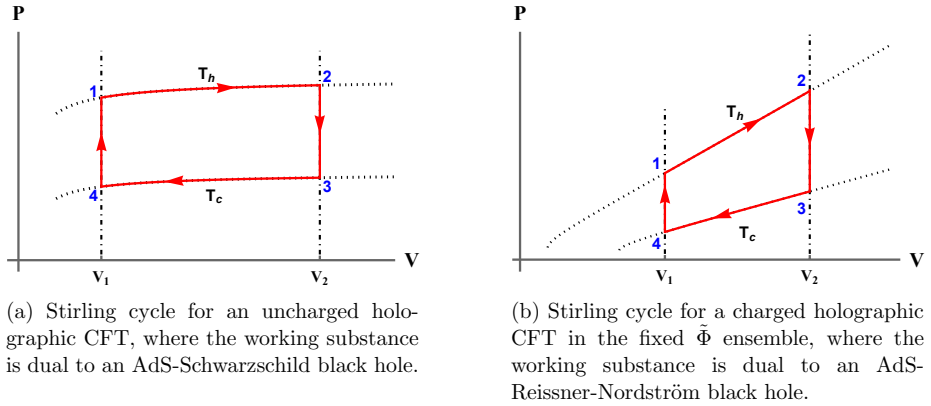
A sufficient condition for attaining Carnot efficiency in a reversible Stirling cycle, with or without regeneration, is that the fixed-volume heat capacity is independent of volume, which forces the isochoric heat mismatch to vanish. For thermal CFT states dual to AdS black holes, exact Stirling efficiencies are obtained, and in the fixed-potential ensemble these efficiencies asymptote to the Carnot value as the potential becomes large, with the approach becoming faster when regeneration is included.
What carries the argument
The isochoric heat mismatch, which measures the net heat that must be exchanged with external reservoirs after internal recycling and vanishes precisely when heat capacity at fixed volume is independent of volume.
If this is right
- Classical ideal gases and Van der Waals fluids achieve Carnot efficiency in both regenerative and non-regenerative Stirling cycles.
- Quantum ideal gases and CFT working substances have Stirling efficiencies strictly below Carnot because their heat capacities depend on volume.
- Exact Stirling efficiency expressions exist for holographic CFTs dual to AdS-Schwarzschild and AdS-Reissner-Nordström geometries.
- In the fixed-potential ensemble, regeneration reduces the gap to Carnot efficiency more rapidly than the non-regenerative case as potential grows.
- The large-potential limit provides a concrete regime in which holographic engines can be made arbitrarily close to the Carnot bound.
Where Pith is reading between the lines
- The volume-independence condition may serve as a diagnostic for whether other thermodynamic cycles can be engineered to reach their theoretical efficiency bounds.
- In analog gravity or condensed-matter systems that mimic holographic CFTs, one could test whether the approach to Carnot efficiency follows the same large-potential scaling.
- The result suggests that regeneration is especially valuable for working substances whose heat capacities vary with volume, offering a practical route to improve real engines.
Load-bearing premise
The thermodynamic description of the cycle, including heat capacities and work terms obtained from the AdS/CFT dictionary, remains valid for the chosen equilibrium states throughout the engine cycle.
What would settle it
A direct calculation for a thermal CFT dual to an AdS black hole showing that Stirling efficiency does not approach the Carnot value in the large-potential limit would falsify the asymptotic claim.
Figures




read the original abstract
We compute the efficiency of the reversible Stirling engine, with and without regeneration, for a broad class of working substances including Van der Waals fluids, quantum ideal gases (Bose and Fermi), Bose-Einstein condensates, thermal conformal field theories (CFTs), and holographic CFTs. Regeneration acts as an internal heat recycling mechanism that enhances efficiency by reducing the net heat exchange with external reservoirs. For regenerative Stirling cycles, a central role is played by the intrinsic heat mismatch between the two isochoric branches, which controls the deviation of the efficiency from the Carnot bound and quantifies the extent to which internally exchanged heat can be perfectly recycled. We identify a general sufficient condition for attaining Carnot efficiency, namely that the fixed-volume heat capacity is independent of the volume, ensuring that the isochoric heat mismatch vanishes. While this condition is satisfied for classical ideal gases and Van der Waals fluids, it is violated for quantum ideal gases and CFT working substances. For thermal CFT states dual to AdS-Schwarzschild and AdS-Reissner-Nordstr\"{o}m black holes we obtain exact expressions for the Stirling efficiency. In the fixed-potential ensemble, we show that the Stirling efficiency asymptotes to the Carnot value in the large-potential limit, with a faster approach in the presence of regeneration.
Editorial analysis
A structured set of objections, weighed in public.
Referee Report
Summary. The manuscript computes the efficiency of reversible Stirling engines (with and without regeneration) for classical fluids, quantum gases, Bose-Einstein condensates, and thermal CFTs dual to AdS-Schwarzschild and AdS-Reissner-Nordström black holes. It identifies a general sufficient condition for Carnot efficiency—volume-independent fixed-volume heat capacity that makes the isochoric heat mismatch vanish—and derives exact efficiency expressions for the holographic cases. In the fixed-potential ensemble these efficiencies are shown to approach the Carnot value in the large-potential limit, with regeneration producing a faster approach.
Significance. If the derivations hold, the work supplies a concrete holographic realization of a classical heat-engine cycle together with an explicit, falsifiable criterion (vanishing isochoric mismatch) for reaching the Carnot bound. The exact expressions for AdS black-hole duals and the controlled large-potential asymptotics constitute reproducible, parameter-free results that can be checked against standard black-hole thermodynamics; the regeneration mechanism is cleanly isolated as an internal heat-recycling effect.
minor comments (3)
- The abstract states that exact efficiency expressions are obtained for AdS-Schwarzschild and AdS-RN duals, yet the main text should include an explicit equation or subsection reference (e.g., §4.2, Eq. (27)) where these expressions are derived from the first law and the CFT equation of state.
- The fixed-potential ensemble is used for the asymptotic analysis; a brief remark clarifying how the chemical potential (or charge) is held fixed while the volume changes during the isochoric legs would remove any ambiguity in the cycle definition.
- A short table or plot comparing the Stirling efficiency versus the Carnot value for the listed working substances (ideal gas, Van der Waals, CFT) would make the central claim about the heat-mismatch mechanism immediately visible.
Simulated Author's Rebuttal
We thank the referee for their positive and constructive review of our manuscript. We appreciate the recognition of the significance of our results, including the general sufficient condition for Carnot efficiency via volume-independent fixed-volume heat capacity and the exact expressions for holographic CFTs. The recommendation for minor revision is noted.
Circularity Check
No significant circularity; derivation is self-contained from standard thermodynamics and AdS/CFT dictionary
full rationale
The paper applies the standard definitions of heat and work for a reversible Stirling cycle (with and without regeneration) to the thermodynamic potentials of various working substances. The sufficient condition for Carnot efficiency—that C_V independent of V implies vanishing isochoric heat mismatch—follows directly by integrating the heat capacity definitions over the isochoric legs; it is a mathematical identity, not a fitted or renamed result. Exact efficiency expressions for AdS-Schwarzschild and AdS-RN dual CFTs are obtained by substituting the known black-hole scaling relations (S ~ T^{d-1} or similar) into those cycle formulas. These scalings are prior, externally established results from black-hole thermodynamics and the AdS/CFT dictionary, not derived or fitted within the paper. No load-bearing step reduces a claimed prediction to a self-citation, an ansatz smuggled via citation, or a parameter fit renamed as output. The analysis therefore remains independent of the present work's own inputs.
Axiom & Free-Parameter Ledger
axioms (2)
- domain assumption Thermodynamic relations for heat, work, and efficiency hold for the listed working substances in reversible cycles.
- domain assumption AdS/CFT duality maps the thermodynamics of the boundary CFT to the bulk black-hole geometry for the engine states.
Reference graph
Works this paper leans on
-
[1]
Geroch,The physics of black holes,Colloquium at Princeton University on 4 November 1971
R. Geroch,The physics of black holes,Colloquium at Princeton University on 4 November 1971. Princeton Weekly Bulletin, Volume 41, Number 8, 30 October 1971
1971
-
[2]
J. D. Bekenstein,Black holes and the second law,Lett. Nuovo Cim.4(1972) 737–740
1972
-
[3]
J. D. Bekenstein,Black holes and entropy,Phys. Rev. D7(1973) 2333–2346
1973
- [4]
-
[5]
J. D. Bekenstein,Black-hole thermodynamics,Physics Today33(1980), no. 1 24–31
1980
-
[6]
J. D. Bekenstein,Generalized second law of thermodynamics in black hole physics, Phys. Rev. D9(1974) 3292–3300
1974
-
[7]
J. D. Bekenstein,A Universal Upper Bound on the Entropy to Energy Ratio for Bounded Systems,Phys. Rev. D23(1981) 287
1981
-
[8]
Casini,Relative entropy and the Bekenstein bound,Class
H. Casini,Relative entropy and the Bekenstein bound,Class. Quant. Grav.25(2008) 205021 [0804.2182]
- [9]
- [10]
-
[11]
W. G. Unruh and R. M. Wald,Acceleration Radiation and Generalized Second Law of Thermodynamics,Phys. Rev. D25(1982) 942–958
1982
-
[12]
W. G. Unruh and R. M. Wald,Entropy bounds, acceleration radiation, and the generalized second law,Phys. Rev. D27(May, 1983) 2271–2276
1983
-
[13]
J. D. Bekenstein,Entropy bounds and the second law for black holes,Phys. Rev. D 27(May, 1983) 2262–2270
1983
- [14]
- [15]
- [16]
-
[17]
Sciama,Black holes and their thermodynamics,Vistas in Astronomy19(1976) 385–401
D. Sciama,Black holes and their thermodynamics,Vistas in Astronomy19(1976) 385–401
1976
-
[18]
P. T. Landsberg,Thermodynamics and Black Holes, pp. 99–146. Springer Netherlands, Dordrecht, 1992
1992
- [19]
-
[20]
Anderson,Does the GSL imply an Entropy bound?, inMatters of Gravity (J
W. Anderson,Does the GSL imply an Entropy bound?, inMatters of Gravity (J. Pullin, ed.), no. 14. 1999.gr-qc/9909022
-
[21]
Kaburaki and I
O. Kaburaki and I. Okamoto,Kerr black holes as a carnot engine,Phys. Rev. D43 (Jan, 1991) 340–345
1991
-
[22]
Opatrn´ y and L
T. Opatrn´ y and L. Richterek,Black hole heat engine,American Journal of Physics80(01, 2012) 66–71 [https://pubs.aip.org/aapt/ajp/article-pdf/80/1/66/13118709/66 1 online.pdf]
2012
-
[23]
Curiel,Classical Black Holes Are Hot,1408.3691
E. Curiel,Classical Black Holes Are Hot,1408.3691
-
[24]
A. Bravetti, C. Gruber and C. S. Lopez-Monsalvo,Thermodynamic optimization of a Penrose process: An engineers’ approach to black hole thermodynamics,Phys. Rev. D93(2016), no. 6 064070 [1511.06801]
- [25]
-
[26]
Enthalpy and the Mechanics of AdS Black Holes
D. Kastor, S. Ray and J. Traschen,Enthalpy and the Mechanics of AdS Black Holes, Class. Quant. Grav.26(2009) 195011 [0904.2765]
work page Pith review arXiv 2009
- [27]
- [28]
-
[29]
Black Hole Enthalpy and an Entropy Inequality for the Thermodynamic Volume
M. Cvetic, G. W. Gibbons, D. Kubiznak and C. N. Pope,Black Hole Enthalpy and an Entropy Inequality for the Thermodynamic Volume,Phys. Rev. D84(2011) 024037 [1012.2888]
work page Pith review arXiv 2011
-
[30]
D. Kubiznak and R. B. Mann,Black hole chemistry,Can. J. Phys.93(2015), no. 9 999–1002 [1404.2126]. 46
- [31]
- [32]
-
[33]
A. Chakraborty and C. V. Johnson,Benchmarking black hole heat engines, I,Int. J. Mod. Phys. D27(2018), no. 16 1950012 [1612.09272]
- [34]
- [35]
- [36]
- [37]
-
[38]
J. M. Maldacena,The Large N limit of superconformal field theories and supergravity,Adv. Theor. Math. Phys.2(1998) 231–252 [hep-th/9711200]
work page internal anchor Pith review arXiv 1998
-
[39]
S. S. Gubser, I. R. Klebanov and A. M. Polyakov,Gauge theory correlators from noncritical string theory,Phys. Lett. B428(1998) 105–114 [hep-th/9802109]
work page internal anchor Pith review arXiv 1998
-
[40]
Anti De Sitter Space And Holography
E. Witten,Anti-de Sitter space and holography,Adv. Theor. Math. Phys.2(1998) 253–291 [hep-th/9802150]
work page internal anchor Pith review arXiv 1998
-
[41]
R. Mancilla,Generalized Euler Equation from Effective Action: Implications for the Smarr Formula in AdS Black Holes,2410.06605
-
[42]
S. Borsboom and M. R. Visser,Holographic pressure and volume for black holes, 2602.05130
-
[43]
N. Lilani and M. R. Visser,Heat engines for scale invariant systems dual to black holes,Commun. Phys.8(2025), no. 1 379 [2502.03363]
-
[44]
D. Kutasov and F. Larsen,Partition sums and entropy bounds in weakly coupled CFT,JHEP01(2001) 001 [hep-th/0009244]
-
[45]
Anti-de Sitter Space, Thermal Phase Transition, And Confinement In Gauge Theories
E. Witten,Anti-de Sitter space, thermal phase transition, and confinement in gauge theories,Adv. Theor. Math. Phys.2(1998) 505–532 [hep-th/9803131]. 47
work page Pith review arXiv 1998
- [46]
-
[47]
Walker,Stirling Engines
G. Walker,Stirling Engines. Clarendon Press, Oxford, 1980
1980
-
[48]
Urieli and D
I. Urieli and D. M. Berchowitz,Stirling Cycle Engine Analysis. Adam Hilger Ltd., Bristol, 1984
1984
-
[49]
Finkelstein and A
T. Finkelstein and A. J. Organ,Air Engines. Professional Engineering Publishing, 2001
2001
-
[50]
J. R. Senft,Mechanical Efficiency of Heat Engines. Cambridge University Press, Cambridge, 2007
2007
-
[51]
Stirling,Improvements for diminishing the consumption of fuel, and in particular an engine capable of being applied to the moving machinery on a principle entirely new, 1816
R. Stirling,Improvements for diminishing the consumption of fuel, and in particular an engine capable of being applied to the moving machinery on a principle entirely new, 1816. GB Patent: GB-181,604,081, granted 16 November 1816
-
[52]
Huang, X.-Y
X.-L. Huang, X.-Y. Niu, X.-M. Xiu and X.-X. Yi,Quantum stirling heat engine and refrigerator with single and coupled spin systems,The European Physical Journal D 68(2014), no. 2 32
2014
- [53]
-
[54]
Thermodynamic Cost of Regeneration in a Quantum Stirling Cycle
F. Altintas,Thermodynamic Cost of Regeneration in a Quantum Stirling Cycle, 2602.04538
work page internal anchor Pith review Pith/arXiv arXiv
-
[55]
Y. A. C ¸ engel and M. A. Boles,Thermodynamics: An Engineering Approach. McGraw-Hill Education, 8th ed., 2014
2014
-
[56]
Schroeder,An Introduction to Thermal Physics
D. Schroeder,An Introduction to Thermal Physics. Addison Wesley, 2000
2000
-
[57]
R. K. Pathria,Statistical Mechanics. Butterworth-Heinemann, 2nd ed. ed., 1996
1996
- [58]
- [59]
-
[60]
Viscosity in Strongly Interacting Quantum Field Theories from Black Hole Physics
P. Kovtun, D. T. Son and A. O. Starinets,Viscosity in strongly interacting quantum field theories from black hole physics,Phys. Rev. Lett.94(2005) 111601 [hep-th/0405231]. 48
work page internal anchor Pith review arXiv 2005
-
[61]
B. H. Lavenda,The thermodynamics of endoreversible engines,American Journal of Physics75(02, 2007) 169–175
2007
-
[62]
F. L. Curzon and B. Ahlborn,Efficiency of a carnot engine at maximum power output,American Journal of Physics43(01, 1975) 22–24. 49
1975
discussion (0)
Sign in with ORCID, Apple, or X to comment. Anyone can read and Pith papers without signing in.