Recognition: unknown
Testing ΛCDM versus dynamical dark energy in one year: A DESI spectroscopic follow-up program for Rubin supernovae
Pith reviewed 2026-05-10 03:04 UTC · model grok-4.3
The pith
Re-prioritizing DESI observations around Rubin supernova alerts can deliver a volume-limited sample that raises tension with Lambda CDM above 5 sigma in one year if current w0-wa fits hold.
A machine-rendered reading of the paper's core claim, the machinery that carries it, and where it could break.
Core claim
By triggering DESI observations from Rubin supernova alerts, the program secures 7500 near-peak transient spectra in one year, including a volume-limited sample of 2300 SNe Ia at z less than 0.3. When this subset is added to current SN, BAO, and CMB data, any persistence of the existing best-fit w0 and wa values pushes the deviation from Lambda CDM beyond 5 sigma. The forecast remains robust under varied uncertainty assumptions, and the same spectra open a route to machine-learning-based spectroscopic standardization that bypasses light-curve methods.
What carries the argument
Alert-driven re-prioritization of DESI tile visits to assemble a spectroscopically confirmed volume-limited supernova sample at z less than 0.3.
If this is right
- The new low-redshift SNe Ia raise tension with Lambda CDM above 5 sigma if current w0-wa best fits persist, across wide uncertainty assumptions.
- The full program reaches greater than 5 sigma sensitivity to dynamical dark energy using only one year of data starting in 2027.
- DESI spectra enable machine-learning standardization that could produce cosmology results independent of light-curve methods.
- Early results from the survey can directly inform the design of future dark energy experiments.
Where Pith is reading between the lines
- Coordinated alert-driven scheduling between optical surveys and spectroscopic facilities could be applied to other transient populations to accelerate parameter constraints.
- Emphasis on volume-limited samples at z less than 0.3 may become a standard strategy for testing dark energy evolution in upcoming facilities.
- If the program succeeds, it would illustrate how modest operational flexibility between existing telescopes can deliver high-impact cosmological tests without new hardware.
Load-bearing premise
That today's best-fit w0 and wa values will remain the same after the new data arrive and that the re-prioritized DESI observations will achieve the forecasted sample size with systematics held at the assumed levels.
What would settle it
A combined analysis in which the tension with Lambda CDM stays below 5 sigma after including the 2300 new low-redshift SNe Ia, or an operational failure to obtain the projected 7500 spectra because of scheduling conflicts.
Figures






read the original abstract
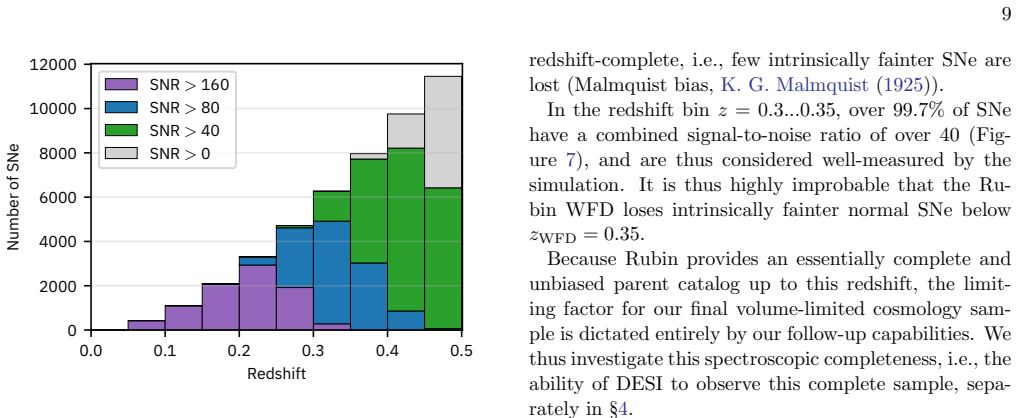
Combined cosmological probes currently indicate that best-fit values in the $w_0-w_a$ parametrization of dynamical dark energy deviate from $\Lambda$CDM by $\sim3\sigma$. In this work, we present a supernova survey capable of measuring dynamical dark energy at the $>5\sigma$ level with just one year of data, starting in 2027. We first show that with the present values of $w_0$ and $w_a$, new SNe Ia at redshifts $z\lesssim0.6$ near dark energy-matter equality would add the most constraining power. This is well within reach of the Vera C. Rubin Observatory and the Dark Energy Spectroscopic Instrument (DESI). Because cosmology measurements with SNe Ia quickly become systematics-limited, we focus on eliminating key systematics by using only a spectroscopically confirmed and volume-limited sample. In our proposed survey, SN alerts from Rubin would actively re-prioritize the scheduling of already-planned DESI tile visits. This would yield 7 500 near-peak transient spectra in one year without delaying DESI's primary survey. We forecast that if current best-fit $w_0-w_a$ values persist, combining just our volume-limited subset of 2 300 new SNe Ia at $z<0.3$ with current SN, BAO, and CMB data would push the tension with $\Lambda$CDM beyond $5\sigma$. This applies across a wide range of assumed uncertainties. To further circumvent systematics, we explore how DESI enables spectroscopic standardization via machine learning, offering a path toward a cosmology measurement independent of light-curve-based standardization. Finally, we discuss how early results from this program could inform future dark energy experiments.
Editorial analysis
A structured set of objections, weighed in public.
Referee Report
Summary. The manuscript proposes an alert-driven DESI spectroscopic follow-up program for Rubin-discovered supernovae, yielding 7500 near-peak spectra in one year without delaying the primary survey. It identifies that new SNe Ia at z ≲ 0.6 add the most constraining power for w0-wa and forecasts that a volume-limited, spectroscopically confirmed subset of 2300 SNe Ia at z < 0.3, when combined with existing SN, BAO, and CMB data, would drive tension with ΛCDM above 5σ if current best-fit w0-wa values persist. The work also explores an ML-based spectroscopic standardization path to reduce reliance on light-curve methods.
Significance. If the forecasts hold, the proposed program offers an efficient, low-systematics route to a decisive test of dynamical dark energy using only one year of data and existing facilities. The emphasis on volume-limited, spectroscopically confirmed low-z objects trades redshift leverage for control of key systematics, and the alert-triggered re-prioritization strategy demonstrates practical integration of Rubin and DESI. The ML standardization discussion provides a forward-looking alternative that could influence future survey design.
major comments (2)
- [Forecasting section] Forecasting section: the detailed error budgets, covariance assumptions, and simulation framework underlying the >5σ projection (and its claimed robustness across a wide range of uncertainties) are not presented with sufficient quantitative detail to allow independent verification of the result.
- [Survey yield section] Survey yield section: the mapping from 7500 spectra to the specific volume-limited sample of 2300 SNe Ia at z < 0.3 requires explicit justification of selection efficiency, completeness, and redshift distribution assumptions, as these directly determine the forecasted constraining power.
minor comments (2)
- [Abstract] The abstract and introduction could more precisely state the redshift range corresponding to 'near dark energy-matter equality' to aid readers unfamiliar with the w0-wa sensitivity peak.
- [Throughout] Notation for the w0-wa parametrization and the definition of tension with ΛCDM should be standardized between the text and any forecast figures.
Simulated Author's Rebuttal
We thank the referee for their positive evaluation of the manuscript's significance and for the constructive major comments. We address each point below and will revise the manuscript to incorporate additional quantitative details and justifications as requested.
read point-by-point responses
-
Referee: [Forecasting section] Forecasting section: the detailed error budgets, covariance assumptions, and simulation framework underlying the >5σ projection (and its claimed robustness across a wide range of uncertainties) are not presented with sufficient quantitative detail to allow independent verification of the result.
Authors: We agree that the forecasting section would benefit from expanded quantitative detail to facilitate independent verification. The >5σ projection is derived from a Fisher matrix forecast combining the proposed low-z SN sample with existing SN, BAO, and CMB constraints, using standard covariance assumptions for each probe and testing robustness by varying key systematics (e.g., SN intrinsic scatter, calibration uncertainties) over ranges informed by current data. In the revised manuscript, we will add an expanded methods subsection and appendix that explicitly tabulates the error budgets, full covariance matrices (including cross-probe terms), the simulation framework for generating mock samples, and the specific uncertainty ranges explored. This will include the impact of each variation on the final significance to demonstrate the claimed robustness. revision: yes
-
Referee: [Survey yield section] Survey yield section: the mapping from 7500 spectra to the specific volume-limited sample of 2300 SNe Ia at z < 0.3 requires explicit justification of selection efficiency, completeness, and redshift distribution assumptions, as these directly determine the forecasted constraining power.
Authors: We acknowledge that the transition from the total 7500 near-peak spectra to the volume-limited subset of 2300 SNe Ia at z < 0.3 requires more explicit justification. This subset is obtained by applying a strict volume-limited cut (z < 0.3) to the expected alert-triggered DESI follow-up yield, with selection efficiencies derived from DESI's fiber allocation efficiency for bright transients, alert prioritization logic, and estimated spectroscopic completeness (>90% for z < 0.3 events based on prior DESI SN programs). In the revised version, we will add a dedicated subsection in the survey yield section (with supporting figures) that details the selection criteria, completeness fractions as a function of redshift and magnitude, the resulting redshift distribution, and the assumptions used (including references to DESI observing simulations and similar low-z SN surveys). This will directly link the numbers to the forecasted constraining power. revision: yes
Circularity Check
No significant circularity in conditional forecast
full rationale
The paper's central claim is a conditional forecast: assuming the current external best-fit w0-wa values from existing SN+BAO+CMB data persist, the addition of a new volume-limited sample of 2300 spectroscopically confirmed SNe Ia at z<0.3 is projected to increase tension with ΛCDM above 5σ. This projection relies on standard cosmological forecasting methods (e.g., Fisher matrices or similar) applied to the proposed sample's expected constraining power, combined with existing constraints. No step reduces by construction to self-definition, renames a fit as a prediction, or depends on load-bearing self-citations whose content is unverified. The argument is explicitly forward-looking and trades on external benchmarks for current tensions plus stated assumptions about future systematics, rendering the derivation self-contained.
Axiom & Free-Parameter Ledger
free parameters (1)
- assumed systematic and statistical uncertainties for new SNe Ia
axioms (2)
- domain assumption Current best-fit w0 and wa values from existing SN+BAO+CMB data represent the true underlying cosmology
- domain assumption Re-prioritizing DESI tile visits can yield 7500 spectra without delaying the primary survey
Reference graph
Works this paper leans on
-
[1]
Survey and Other Telescope Technologies and Discoveries , year = 2002, editor =
Overview of the Nearby Supernova Factory. Survey and Other Telescope Technologies and Discoveries , year = 2002, editor =. doi:10.1117/12.458107 , adsurl =
-
[2]
The La Silla Schmidt Southern Survey. , keywords =. doi:10.1088/1538-3873/ae02c5 , archivePrefix =. 2503.14579 , primaryClass =
-
[3]
Hubble Residuals of Nearby Type Ia Supernovae are Correlated with Host Galaxy Masses. , keywords =. doi:10.1088/0004-637X/715/2/743 , archivePrefix =. 0912.0929 , primaryClass =
-
[4]
doi:10.1051/0004-6361/201322068 , Eid =. arXiv , Author =:1307.6212 , Journal =
-
[5]
The Astronomical Journal , author =
The Astropy Project: Building an Open-science Project and Status of the v2.0 Core Package. , keywords =. doi:10.3847/1538-3881/aabc4f , archivePrefix =. 1801.02634 , primaryClass =
-
[6]
The Astropy Project: Sustaining and Growing a Community-oriented Open-source Project and the Latest Major Release (v5.0) of the Core Package. , keywords =. doi:10.3847/1538-4357/ac7c74 , archivePrefix =. 2206.14220 , primaryClass =
work page internal anchor Pith review Pith/arXiv arXiv doi:10.3847/1538-4357/ac7c74
-
[7]
Using Supernovae to Determine the Equation of State of the Dark Energy: Is Shallow Better than Deep?. arXiv e-prints , keywords =. doi:10.48550/arXiv.astro-ph/0204089 , archivePrefix =. astro-ph/0204089 , primaryClass =
work page internal anchor Pith review doi:10.48550/arxiv.astro-ph/0204089
-
[8]
Measurements of the Cosmological Parameters and from the First Seven Supernovae at z >= 0.35. , keywords =. doi:10.1086/304265 , archivePrefix =. astro-ph/9608192 , primaryClass =
-
[9]
Philo- sophical Transactions of the Royal Society of London
On the Mathematical Foundations of Theoretical Statistics. Philosophical Transactions of the Royal Society of London Series A , year = 1922, month = jan, volume =. doi:10.1098/rsta.1922.0009 , adsurl =
-
[10]
2023, AJ, 165, 144, doi: 10.3847/1538-3881/acb212 18
The Spectroscopic Data Processing Pipeline for the Dark Energy Spectroscopic Instrument. , keywords =. doi:10.3847/1538-3881/acb212 , archivePrefix =. 2209.14482 , primaryClass =
-
[11]
Uniform Rolling: An LSST Observing Cadence Offering Sufficient Survey Uniformity for Comprehensive Cosmological Analysis. arXiv e-prints , keywords =. doi:10.48550/arXiv.2512.16478 , archivePrefix =. 2512.16478 , primaryClass =
-
[12]
Science-Driven Optimization of the LSST Observing Strategy. arXiv e-prints , keywords =. doi:10.48550/arXiv.1708.04058 , archivePrefix =. 1708.04058 , primaryClass =
-
[13]
Optimizing the LSST Observing Strategy for Dark Energy Science: DESC Recommendations for the Wide-Fast-Deep Survey. arXiv e-prints , keywords =. doi:10.48550/arXiv.1812.00515 , archivePrefix =. 1812.00515 , primaryClass =
-
[14]
2022, ApJS, 259, 58, doi: 10.3847/1538-4365/ac5033
The Impact of Observing Strategy on Cosmological Constraints with LSST. , keywords =. doi:10.3847/1538-4365/ac5033 , archivePrefix =. 2104.05676 , primaryClass =
-
[15]
Evaluation of probabilistic photometric redshift estimation approaches for The Rubin Observatory Legacy Survey of Space and Time (LSST). , keywords =. doi:10.1093/mnras/staa2799 , archivePrefix =. 2001.03621 , primaryClass =
-
[16]
The Dark Energy Survey Supernova Program: Cosmological Biases from Host Galaxy Mismatch of Type Ia Supernovae. , keywords =. doi:10.3847/1538-4357/ad251d , archivePrefix =. 2307.13696 , primaryClass =
-
[17]
Are light curve classification metrics good proxies for SN Ia cosmological constraining power?. , keywords =. doi:10.1051/0004-6361/202346891 , archivePrefix =. 2305.14421 , primaryClass =
-
[18]
ZTF SN Ia DR2: Overview. , keywords =. doi:10.1051/0004-6361/202450388 , archivePrefix =. 2409.04346 , primaryClass =
-
[19]
Charles R. Harris and K. Jarrod Millman and St. Array programming with. 2020 , month = sep, journal =. doi:10.1038/s41586-020-2649-2 , publisher =
-
[20]
Hunter, J. D. , Title =. Computing in Science & Engineering , Volume =
-
[21]
doi:10.5281/zenodo.168220 , version =
sncosmo/sncosmo: v1.4.0. doi:10.5281/zenodo.168220 , version =
-
[22]
Absolute-magnitude Distributions of Supernovae. , keywords =. doi:10.1088/0004-6256/147/5/118 , archivePrefix =. 1403.5755 , primaryClass =
-
[23]
The Rate of Core Collapse Supernovae to Redshift 2.5 from the CANDELS and CLASH Supernova Surveys. , keywords =. doi:10.1088/0004-637X/813/2/93 , archivePrefix =. 1509.06574 , primaryClass =
-
[24]
The dependence of Type Ia Supernovae luminosities on their host galaxies. , keywords =. doi:10.1111/j.1365-2966.2010.16731.x , archivePrefix =. 1003.5119 , primaryClass =
-
[25]
Probabilistic Autoencoder. arXiv e-prints , keywords =. doi:10.48550/arXiv.2006.05479 , archivePrefix =. 2006.05479 , primaryClass =
-
[26]
4MOST: Project overview and information for the First Call for Proposals. The Messenger , keywords =. doi:10.18727/0722-6691/5117 , archivePrefix =. 1903.02464 , primaryClass =
-
[27]
Report of the Dark Energy Task Force
Report of the Dark Energy Task Force. arXiv e-prints , keywords =. doi:10.48550/arXiv.astro-ph/0609591 , archivePrefix =. astro-ph/0609591 , primaryClass =
-
[28]
The Zwicky Transient Facility: System Overview, Performance, and First Results. , keywords =. doi:10.1088/1538-3873/aaecbe , archivePrefix =. 1902.01932 , primaryClass =
-
[29]
2014, , 568, A22, 10.1051/0004-6361/201423413
Improved cosmological constraints from a joint analysis of the SDSS-II and SNLS supernova samples. , keywords =. doi:10.1051/0004-6361/201423413 , archivePrefix =. 1401.4064 , primaryClass =
-
[30]
, archivePrefix = "arXiv", eprint =
Techniques and Review of Absolute Flux Calibration from the Ultraviolet to the Mid-Infrared. , keywords =. doi:10.1086/677655 , archivePrefix =. 1406.1707 , primaryClass =
-
[31]
The Twins Embedding of Type Ia Supernovae. I. The Diversity of Spectra at Maximum Light. , keywords =. doi:10.3847/1538-4357/abec3c , archivePrefix =. 2105.02676 , primaryClass =
-
[32]
The Twins Embedding of Type Ia Supernovae. II. Improving Cosmological Distance Estimates. , keywords =. doi:10.3847/1538-4357/abec3b , archivePrefix =. 2105.02204 , primaryClass =
-
[33]
Comparative Direct Analysis of Type Ia Supernova Spectra. II. Maximum Light. , keywords =. doi:10.1086/502778 , archivePrefix =. astro-ph/0601048 , primaryClass =
-
[34]
and Carr, Anthony and Zuntz, Joe and Kessler, Rick and Davis, Tamara M
The Pantheon+ Analysis: Cosmological Constraints. , keywords =. doi:10.3847/1538-4357/ac8e04 , archivePrefix =. 2202.04077 , primaryClass =
-
[35]
The Relationship between Infrared, Optical, and Ultraviolet Extinction. , keywords =. doi:10.1086/167900 , adsurl =
-
[36]
Characterizing the Roman Grism Redshift Efficiency of Type Ia Supernova Host Galaxies for the High-Latitude Time-Domain Survey. arXiv e-prints , keywords =. doi:10.48550/arXiv.2512.09993 , archivePrefix =. 2512.09993 , primaryClass =
-
[37]
Accelerating Universes with Scaling Dark Matter. International Journal of Modern Physics D , keywords =. doi:10.1142/S0218271801000822 , archivePrefix =. gr-qc/0009008 , primaryClass =
-
[38]
The Dark Energy Survey: Cosmology Results with 1500 New High-redshift Type Ia Supernovae Using the Full 5 yr Data Set. , keywords =. doi:10.3847/2041-8213/ad6f9f , archivePrefix =. 2401.02929 , primaryClass =
-
[39]
The DESI Experiment Part I: Science,Targeting, and Survey Design
The DESI Experiment Part I: Science,Targeting, and Survey Design. arXiv e-prints , keywords =. doi:10.48550/arXiv.1611.00036 , archivePrefix =. 1611.00036 , primaryClass =
work page internal anchor Pith review doi:10.48550/arxiv.1611.00036
-
[40]
DESI DR2 results. II. Measurements of baryon acoustic oscillations and cosmological constraints. , keywords =. doi:10.1103/tr6y-kpc6 , archivePrefix =. 2503.14738 , primaryClass =
-
[41]
Efstathiou, Evolving dark energy or supernovae systematics?, Mon
Evolving dark energy or supernovae systematics?. , keywords =. doi:10.1093/mnras/staf301 , archivePrefix =. 2408.07175 , primaryClass =
-
[42]
Improving Cosmological Distance Measurements Using Twin Type Ia Supernovae. , keywords =. doi:10.1088/0004-637X/815/1/58 , archivePrefix =. 1511.01102 , primaryClass =
-
[43]
, year = 1997, month = jan, volume =
Optical Spectra of Supernovae. , year = 1997, month = jan, volume =. doi:10.1146/annurev.astro.35.1.309 , adsurl =
-
[44]
1999, Publications of the Astronomical Society of the Pacific, 111, 63, doi: 10.1086/316293 33
Correcting for the Effects of Interstellar Extinction. , keywords =. doi:10.1086/316293 , archivePrefix =. astro-ph/9809387 , primaryClass =
-
[45]
The volumetric rate of normal type Ia supernovae in the local Universe discovered by the Palomar Transient Factory. , keywords =. doi:10.1093/mnras/stz807 , archivePrefix =. 1903.08580 , primaryClass =
-
[46]
TiDES: The 4MOST Time Domain Extragalactic Survey. , keywords =. doi:10.3847/1538-4357/adff4e , archivePrefix =. 2501.16311 , primaryClass =
-
[47]
ZTF-SEDm Type Ia supernova sample for Twins Embedding spectrophotometric standardisation. arXiv e-prints , keywords =. doi:10.48550/arXiv.2512.07696 , archivePrefix =. 2512.07696 , primaryClass =
-
[48]
ZTF SN Ia DR2: Colour standardisation of type Ia supernovae and its dependence on the environment. , keywords =. doi:10.1051/0004-6361/202450943 , archivePrefix =. 2406.02072 , primaryClass =
-
[49]
2007, , 466, 11, 10.1051/0004-6361:20066930
SALT2: using distant supernovae to improve the use of type Ia supernovae as distance indicators. , keywords =. doi:10.1051/0004-6361:20066930 , archivePrefix =. astro-ph/0701828 , primaryClass =
-
[50]
The DESI Transients Survey: Legacy Classifications and Methodology. arXiv e-prints , keywords =. doi:10.48550/arXiv.2601.12611 , archivePrefix =. 2601.12611 , primaryClass =
-
[51]
LSST: From Science Drivers to Reference Design and Anticipated Data Products. , keywords =. doi:10.3847/1538-4357/ab042c , archivePrefix =. 0805.2366 , primaryClass =
-
[52]
SALT3: An Improved Type Ia Supernova Model for Measuring Cosmic Distances. , keywords =. doi:10.3847/1538-4357/ac30d8 , archivePrefix =. 2104.07795 , primaryClass =
-
[53]
Cosmology Constraints from Type Ia Supernova Simulations of the Nancy Grace Roman Space Telescope Strategy Recommended by the High-Latitude Time Domain Survey Definition Committee. , keywords =. doi:10.3847/1538-4357/ae07c9 , archivePrefix =. 2506.04402 , primaryClass =
-
[54]
Correcting Type Ia Supernova Distances for Selection Biases and Contamination in Photometrically Identified Samples. , keywords =. doi:10.3847/1538-4357/836/1/56 , archivePrefix =. 1610.04677 , primaryClass =
-
[55]
Models and Simulations for the Photometric LSST Astronomical Time Series Classification Challenge (PLAsTiCC). , keywords =. doi:10.1088/1538-3873/ab26f1 , archivePrefix =. 1903.11756 , primaryClass =
-
[56]
Astroparticle Physics , keywords =
Optimal extraction of cosmological information from supernova data in the presence of calibration uncertainties. Astroparticle Physics , keywords =. doi:10.1016/j.astropartphys.2005.09.005 , archivePrefix =. astro-ph/0508252 , primaryClass =
-
[57]
Looking beyond lambda. Nature Astronomy , keywords =. doi:10.1038/s41550-025-02627-2 , archivePrefix =. 2509.00359 , primaryClass =
-
[58]
Exploring the expansion history of the universe
Exploring the Expansion History of the Universe. , keywords =. doi:10.1103/PhysRevLett.90.091301 , archivePrefix =. astro-ph/0208512 , primaryClass =
-
[59]
Lodhaet al.[DESI], Extended dark energy analysis using DESI DR2 BAO measure- ments, Phys
Extended dark energy analysis using DESI DR2 BAO measurements. , keywords =. doi:10.1103/w4c6-1r5j , archivePrefix =. 2503.14743 , primaryClass =
-
[60]
2018, arXiv e-prints, arXiv:1809.01669
The LSST Dark Energy Science Collaboration (DESC) Science Requirements Document. arXiv e-prints , keywords =. doi:10.48550/arXiv.1809.01669 , archivePrefix =. 1809.01669 , primaryClass =
-
[61]
LSST Science Book, Version 2.0
LSST Science Book, Version 2.0. arXiv e-prints , keywords =. doi:10.48550/arXiv.0912.0201 , archivePrefix =. 0912.0201 , primaryClass =
-
[62]
Meddelanden fran Lunds Astronomiska Observatorium Serie I , year = 1925, month = feb, volume =
A contribution to the problem of determining the distribution in space of the stars. Meddelanden fran Lunds Astronomiska Observatorium Serie I , year = 1925, month = feb, volume =
1925
-
[63]
Using Host Galaxy Photometric Redshifts to Improve Cosmological Constraints with Type Ia Supernovae in the LSST Era. , keywords =. doi:10.3847/1538-4357/acb057 , archivePrefix =. 2210.07560 , primaryClass =
-
[64]
arXiv e-prints , keywords =
A Fully Photometric Approach to Type Ia Supernova Cosmology in the LSST Era: Host Galaxy Redshifts and Supernova Classification. arXiv e-prints , keywords =
-
[65]
Understanding type Ia supernovae through their U-band spectra. , keywords =. doi:10.1051/0004-6361/201732137 , archivePrefix =. 1801.01834 , primaryClass =
-
[66]
1999, apj, 517, 565, doi: 10.1086/307221
Measurements of and from 42 High-Redshift Supernovae. , keywords =. doi:10.1086/307221 , archivePrefix =. astro-ph/9812133 , primaryClass =
work page internal anchor Pith review doi:10.1086/307221
-
[67]
SALT3-NIR: Taking the Open-source Type Ia Supernova Model to Longer Wavelengths for Next-generation Cosmological Measurements. , keywords =. doi:10.3847/1538-4357/ac93f9 , archivePrefix =. 2209.05594 , primaryClass =
-
[68]
Planck 2018 results. VI. Cosmological parameters. , keywords =. doi:10.1051/0004-6361/201833910 , archivePrefix =. 1807.06209 , primaryClass =
-
[69]
A Reassessment of the Pantheon+ and DES 5YR Calibration Uncertainties: Dovekie. arXiv e-prints , keywords =. doi:10.48550/arXiv.2506.05471 , archivePrefix =. 2506.05471 , primaryClass =
-
[70]
The Dark Energy Survey Supernova Program: A Reanalysis Of Cosmology Results And Evidence For Evolving Dark Energy With An Updated Type Ia Supernova Calibration. arXiv e-prints , keywords =. doi:10.48550/arXiv.2511.07517 , archivePrefix =. 2511.07517 , primaryClass =
work page internal anchor Pith review Pith/arXiv arXiv doi:10.48550/arxiv.2511.07517
-
[71]
Observational Evidence from Supernovae for an Accelerating Universe and a Cosmological Constant. , keywords =. doi:10.1086/300499 , archivePrefix =. astro-ph/9805201 , primaryClass =
-
[72]
Type Ia Supernova Rate Measurements to Redshift 2.5 from CANDELS: Searching for Prompt Explosions in the Early Universe. , keywords =. doi:10.1088/0004-6256/148/1/13 , archivePrefix =. 1401.7978 , primaryClass =
-
[73]
Synergies between Vera C. Rubin Observatory, Nancy Grace Roman Space Telescope, and Euclid Mission: Constraining Dark Energy with Type Ia Supernovae. arXiv e-prints , keywords =. doi:10.48550/arXiv.2104.01199 , archivePrefix =. 2104.01199 , primaryClass =
-
[74]
M., Baltay, C., Hounsell, R., et al
A Reference Survey for Supernova Cosmology with the Nancy Grace Roman Space Telescope. arXiv e-prints , keywords =. doi:10.48550/arXiv.2111.03081 , archivePrefix =. 2111.03081 , primaryClass =
-
[75]
Fishing for the Optimal Roman High Latitude Time Domain Survey: Cosmological Constraints for 1,000 Possible Surveys. arXiv e-prints , keywords =. doi:10.48550/arXiv.2506.04327 , archivePrefix =. 2506.04327 , primaryClass =
-
[76]
Union through UNITY: Cosmology with 2000 SNe Using a Unified Bayesian Framework. , keywords =. doi:10.3847/1538-4357/adc0a5 , archivePrefix =. 2311.12098 , primaryClass =
-
[77]
Banana Split: Improved Cosmological Constraints with Two Light-Curve-Shape and Color Populations Using Union3.1+UNITY1.8. arXiv e-prints , keywords =. doi:10.48550/arXiv.2601.19854 , archivePrefix =. 2601.19854 , primaryClass =
-
[78]
Survey Operations for the Dark Energy Spectroscopic Instrument. , keywords =. doi:10.3847/1538-3881/ad0832 , archivePrefix =. 2306.06309 , primaryClass =
-
[79]
A Probabilistic Autoencoder for Type Ia Supernova Spectral Time Series. , keywords =. doi:10.3847/1538-4357/ac7c08 , archivePrefix =. 2207.07645 , primaryClass =
-
[80]
, keywords =
A two-parameter luminosity correction for Type IA supernovae. , keywords =
discussion (0)
Sign in with ORCID, Apple, or X to comment. Anyone can read and Pith papers without signing in.