Recognition: unknown
CP-violating multi-field phase transitions and gravitational waves in a hidden NJL sector
Pith reviewed 2026-05-10 02:37 UTC · model grok-4.3
The pith
Rapid phase transitions in a hidden NJL sector suppress gravitational wave signals below future detector reach while an energy bias collapses domain walls promptly.
A machine-rendered reading of the paper's core claim, the machinery that carries it, and where it could break.
Core claim
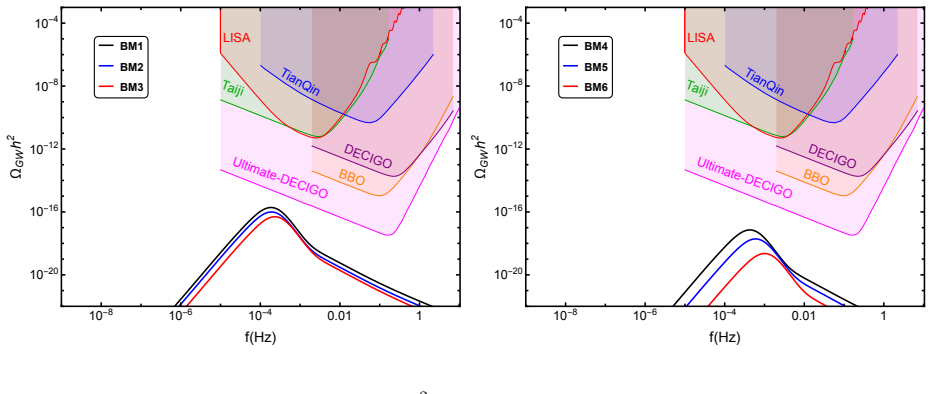
The central claim is that the intrinsically rapid transition rate characteristic of the NJL framework, with β/H ∼ O(10^4) in the considered regions, produces strong suppression of gravitational wave production so that the predicted stochastic background lies well below projected sensitivities of future detectors; simultaneously, the explicit symmetry-breaking mass creates an energy bias between vacua that triggers prompt collapse of transient domain walls and thereby ensures the cosmological viability of the setup.
What carries the argument
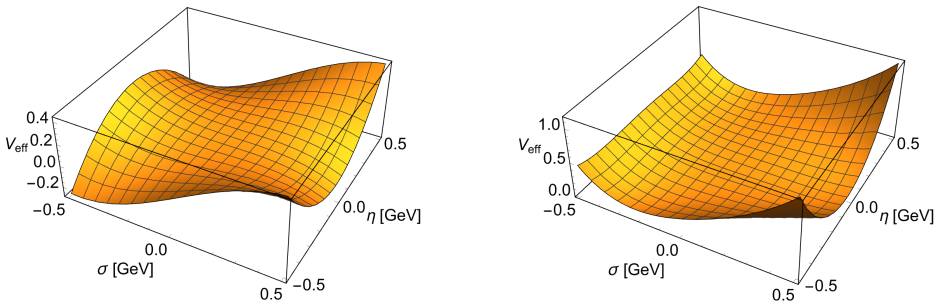
Multi-field tunneling dynamics driven by vacuum misalignment from the interplay of CP violation and explicit chiral symmetry breaking, which produces a curved tunneling path and the rapid β/H rate.
If this is right
- The stochastic gravitational wave background remains well below the reach of future space-based interferometers.
- Transient domain wall networks collapse promptly due to the vacuum energy bias and do not disrupt cosmology.
- The bubble wall carries a spatially varying CP-violating phase generated by the curved tunneling path.
- The eight-fermion operators prevent vacuum instabilities that would otherwise invalidate the model.
Where Pith is reading between the lines
- Analogous rapid transitions could appear in other strongly coupled hidden sectors and would likewise produce undetectable gravitational wave signals.
- Collider searches for composite states or new interactions could provide independent tests of the hidden NJL parameters.
- The curved tunneling path suggests that CP-violating effects might leave imprints in the particle spectra produced during the transition.
Load-bearing premise
The assumption that the eight-fermion operators stabilize the vacuum and that the transition rate reaches β/H ∼ O(10^4) in the parameter regions considered.
What would settle it
A computation of the bubble nucleation rate in the same parameter space that yields β/H substantially below 10,000, or a future detection of a stochastic gravitational wave background whose amplitude matches expectations for a slower transition, would falsify the suppression result.
Figures


read the original abstract
We investigate the dynamics of a cosmological first-order phase transition (FOPT) and the associated stochastic gravitational wave background (SGWB) in a hidden strongly coupled sector described by an extended Nambu--Jona-Lasinio (NJL) model with $N_f = 3$ fermion flavors. The model incorporates a CP-violating six-fermion 't Hooft interaction, an explicit chiral symmetry breaking mass term, and chirally symmetric eight-fermion operators that stabilize the vacuum. We perform a multi-field analysis of the tunneling dynamics, going beyond conventional single-field approximations. The interplay between explicit symmetry breaking and CP violation induces a vacuum misalignment, resulting in a curved tunneling path and a spatially varying CP-violating background across the bubble wall. Furthermore, the intrinsically rapid transition rate characteristic of the NJL framework ($\beta/H \sim \mathcal{O}(10^4)$ in the parameter regions considered) leads to a strong suppression of gravitational wave production. As a result, the predicted SGWB remains well below the projected sensitivities of future space-based interferometers. Finally, the explicit symmetry breaking mass introduces a crucial energy bias between competing vacua, triggering the prompt collapse of transient domain wall configurations and thereby ensuring the cosmological viability of the model.
Editorial analysis
A structured set of objections, weighed in public.
Referee Report
Summary. The paper investigates first-order phase transitions and associated stochastic gravitational waves in an extended Nambu-Jona-Lasinio model with N_f=3, incorporating a CP-violating six-fermion 't Hooft term, explicit chiral symmetry breaking mass, and stabilizing eight-fermion operators. It performs a multi-field tunneling analysis revealing a curved bounce path from vacuum misalignment, asserts an intrinsically rapid transition rate β/H ∼ O(10^4) that strongly suppresses the SGWB below future interferometer sensitivities, and argues that the explicit breaking mass bias ensures prompt domain wall collapse for cosmological viability.
Significance. If the multi-field bounce calculations and resulting β/H values hold, the work provides a concrete illustration of how strong dynamics plus CP violation and explicit breaking can yield fast, GW-suppressed transitions while resolving domain wall issues, with potential implications for hidden-sector model building and GW phenomenology constraints.
major comments (2)
- [Abstract and §4 (tunneling dynamics)] Abstract and tunneling section: the central claim that β/H ∼ O(10^4) follows from the NJL framework and leads to strong SGWB suppression is not supported by any explicit numerical values, plots, or tabulations of the multi-field Euclidean bounce action S_E, the bounce profile, or d(S_E/T)/dT in the presence of the CP-violating six-fermion term and eight-fermion stabilizers; without these the suppression conclusion cannot be verified.
- [§3 (effective potential)] §3 (effective potential): the assertion that eight-fermion operators stabilize the vacuum and enable the rapid transition rate is stated but lacks a quantitative scan showing how O(1) variations in their coefficients affect S_E or shift β/H below 10^3, which would remove the claimed suppression.
minor comments (2)
- [§2 (model definition)] The multi-field bounce path curvature is described qualitatively but the notation for the CP-violating phase and explicit mass term should be defined with explicit Lagrangian expressions to facilitate reproduction.
- [§4] No comparison is made to single-field approximations or standard NJL tunneling results in the literature; adding such a benchmark would clarify the impact of the curved path.
Simulated Author's Rebuttal
We thank the referee for the careful reading and constructive comments on our manuscript. We address the two major comments point by point below, agreeing that additional explicit numerical support will strengthen the presentation of the tunneling results and vacuum stabilization.
read point-by-point responses
-
Referee: Abstract and §4 (tunneling dynamics): the central claim that β/H ∼ O(10^4) follows from the NJL framework and leads to strong SGWB suppression is not supported by any explicit numerical values, plots, or tabulations of the multi-field Euclidean bounce action S_E, the bounce profile, or d(S_E/T)/dT in the presence of the CP-violating six-fermion term and eight-fermion stabilizers; without these the suppression conclusion cannot be verified.
Authors: We agree that the manuscript would benefit from explicit numerical support for the quoted β/H value. The order-of-magnitude result follows from our multi-field bounce calculations in the NJL framework, but the current text does not tabulate S_E, show profiles, or report d(S_E/T)/dT. We will revise §4 (and update the abstract if needed) to include benchmark values of the Euclidean action, representative bounce profiles, and the temperature derivative for the parameter points used, allowing direct verification of the rapid transition rate and SGWB suppression. revision: yes
-
Referee: §3 (effective potential): the assertion that eight-fermion operators stabilize the vacuum and enable the rapid transition rate is stated but lacks a quantitative scan showing how O(1) variations in their coefficients affect S_E or shift β/H below 10^3, which would remove the claimed suppression.
Authors: The eight-fermion operators are included to ensure the potential remains bounded and the broken minima exist in the presence of the six-fermion CP-violating term. While the manuscript demonstrates vacuum stability through the existence of these minima, it does not contain a scan over O(1) coefficient variations. We will add a brief quantitative discussion (or small table/figure) in §3 showing the effect of varying the eight-fermion coefficients by O(1) factors on S_E and confirming that β/H remains ≳ 10^3 in the relevant regions, thereby preserving the suppression conclusion. revision: yes
Circularity Check
No significant circularity: transition rate and GW suppression follow from explicit multi-field bounce calculation in the extended NJL potential
full rationale
The abstract and skeptic summary indicate that β/H ∼ O(10^4) is obtained by scanning the model's parameters (including eight-fermion stabilizers) and performing the multi-field Euclidean bounce analysis on the effective potential that includes the CP-violating six-fermion term and explicit breaking mass. The GW suppression is then a direct consequence of the standard SGWB amplitude formulas that depend on β/H, α, and v_w; these formulas are not fitted to the output spectrum. No equation reduces the claimed rate to a tautological redefinition of the input parameters, and the domain-wall collapse follows from the energy bias introduced by the explicit mass term. The derivation chain therefore remains self-contained against external benchmarks rather than closing on itself.
Axiom & Free-Parameter Ledger
free parameters (3)
- strength of six-fermion 't Hooft interaction
- explicit chiral symmetry breaking mass term
- couplings of eight-fermion operators
axioms (2)
- domain assumption The NJL model provides a valid effective description of the hidden strong sector at the relevant energy scales.
- standard math Multi-field bounce solutions can be reliably computed to determine the tunneling path and rate.
Reference graph
Works this paper leans on
-
[1]
Witten, Phys
E. Witten, Phys. Rev. D30, 272 (1984)
1984
-
[2]
C. Grojean and G. Servant, Phys. Rev. D75, 043507 (2007), hep-ph/0607107
-
[3]
C. Caprini et al., JCAP04, 001 (2016), 1512.06239
work page Pith review arXiv 2016
-
[4]
Planck 2018 results. VI. Cosmological parameters
N. Aghanim et al. (Planck), Astron. Astrophys.641, A6 (2020), [Erratum: Astron.Astrophys. 652, C4 (2021)], 1807.06209
work page internal anchor Pith review arXiv 2020
-
[5]
T. W. B. Kibble, Phys. Rept.67, 183 (1980)
1980
-
[6]
P. Auclair et al. (LISA Cosmology Working Group), Living Rev. Rel.26, 5 (2023), 2204.05434
-
[7]
Laser Interferometer Space Antenna
P. Amaro-Seoane et al. (LISA) (2017), 1702.00786
work page internal anchor Pith review Pith/arXiv arXiv 2017
-
[8]
The construction and use of LISA sensitivity curves
T. Robson, N. J. Cornish, and C. Liu, Class. Quant. Grav.36, 105011 (2019), 1803.01944
work page Pith review arXiv 2019
-
[9]
Science with the space-based interferometer LISA. V: Extreme mass-ratio inspirals
S. Babak, J. Gair, A. Sesana, E. Barausse, C. F. Sopuerta, C. P. L. Berry, E. Berti, P. Amaro- Seoane, A. Petiteau, and A. Klein, Phys. Rev. D95, 103012 (2017), 1703.09722
work page Pith review arXiv 2017
- [10]
-
[11]
M. Colpi et al. (LISA) (2024), 2402.07571
work page internal anchor Pith review arXiv 2024
-
[12]
Hu and Y.-L
W.-R. Hu and Y.-L. Wu, Natl. Sci. Rev.4, 685 (2017)
2017
-
[13]
TianQin: a space-borne gravitational wave detector
J. Luo et al. (TianQin), Class. Quant. Grav.33, 035010 (2016), 1512.02076
work page Pith review arXiv 2016
-
[14]
Detecting the Cosmic Gravitational Wave Background with the Big Bang Observer
V. Corbin and N. J. Cornish, Class. Quant. Grav.23, 2435 (2006), gr-qc/0512039. 24
work page Pith review arXiv 2006
-
[15]
J. Crowder and N. J. Cornish, Phys. Rev. D72, 083005 (2005), gr-qc/0506015
- [16]
-
[17]
Kawamura et al., PTEP2021, 05A105 (2021), arXiv:2006.13545 [gr-qc]
S. Kawamura et al., PTEP2021, 05A105 (2021), 2006.13545
-
[18]
Nambu and G
Y. Nambu and G. Jona-Lasinio, Phys. Rev.122, 345 (1961)
1961
-
[19]
Nambu and G
Y. Nambu and G. Jona-Lasinio, Phys. Rev.124, 246 (1961)
1961
-
[20]
Vogl and W
U. Vogl and W. Weise, Prog. Part. Nucl. Phys.27, 195 (1991)
1991
- [21]
- [22]
-
[23]
J.-E. Christian, I. A. Rather, H. Gholami, and M. Hofmann, Astron. Astrophys.701, A145 (2025), 2503.13626
- [24]
- [25]
- [26]
- [27]
-
[28]
K. Kashiwa, H. Kouno, M. Matsuzaki, and M. Yahiro, Phys. Lett. B662, 26 (2008), 0710.2180
- [29]
- [30]
-
[31]
Gravitational Waves From a Dark (Twin) Phase Transition
P. Schwaller, Phys. Rev. Lett.115, 181101 (2015), 1504.07263
work page Pith review arXiv 2015
- [32]
-
[33]
A. D. Sakharov, Pisma Zh. Eksp. Teor. Fiz.5, 32 (1967)
1967
-
[34]
D. E. Morrissey and M. J. Ramsey-Musolf, New J. Phys.14, 125003 (2012), 1206.2942
work page Pith review arXiv 2012
-
[35]
A. G. Cohen, D. B. Kaplan, and A. E. Nelson, Ann. Rev. Nucl. Part. Sci.43, 27 (1993), hep-ph/9302210
work page Pith review arXiv 1993
- [36]
-
[37]
R. J. Crewther, P. Di Vecchia, G. Veneziano, and E. Witten, Phys. Lett. B88, 123 (1979), [Erratum: Phys.Lett.B 91, 487 (1980)]
1979
-
[38]
Pich and E
A. Pich and E. de Rafael, Nucl. Phys. B367, 313 (1991)
1991
- [39]
- [40]
-
[41]
K. Kashiwa, H. Kouno, T. Sakaguchi, M. Matsuzaki, and M. Yahiro, Phys. Lett. B647, 446 (2007), nucl-th/0608078
- [42]
- [43]
-
[44]
Asakawa and K
M. Asakawa and K. Yazaki, Nucl. Phys. A504, 668 (1989)
1989
- [45]
- [46]
- [47]
- [48]
- [49]
-
[50]
Z. Zhang and Y.-X. Liu, Phys. Rev. C75, 064910 (2007), hep-ph/0610221
- [51]
- [52]
-
[53]
T. W. B. Kibble, J. Phys. A9, 1387 (1976)
1976
-
[54]
Y. B. Zeldovich, I. Y. Kobzarev, and L. B. Okun, Zh. Eksp. Teor. Fiz.67, 3 (1974)
1974
-
[55]
A review of gravitational waves from cosmic domain walls
K. Saikawa, Universe3, 40 (2017), 1703.02576
work page Pith review arXiv 2017
-
[56]
On the estimation of gravitational wave spectrum from cosmic domain walls
T. Hiramatsu, M. Kawasaki, and K. Saikawa, JCAP02, 031 (2014), 1309.5001
work page Pith review arXiv 2014
-
[57]
Gravitational Waves from Collapsing Domain Walls
T. Hiramatsu, M. Kawasaki, and K. Saikawa, JCAP05, 032 (2010), 1002.1555
work page Pith review arXiv 2010
-
[58]
Gravitational Waves from Collapsing Vacuum Domains
M. Gleiser and R. Roberts, Phys. Rev. Lett.81, 5497 (1998), astro-ph/9807260
work page Pith review arXiv 1998
-
[59]
C. Garc´ ıa-Cely, G. Landini, and´O. Zapata, Phys. Rev. D111, 063044 (2025), 2405.10367
- [60]
-
[61]
Particle Dark Matter: Evidence, Candidates and Constraints
G. Bertone, D. Hooper, and J. Silk, Phys. Rept.405, 279 (2005), hep-ph/0404175
work page Pith review arXiv 2005
- [62]
-
[63]
S. P. Klevansky, Rev. Mod. Phys.64, 649 (1992)
1992
-
[64]
T. Hatsuda and T. Kunihiro, Phys. Rept.247, 221 (1994), hep-ph/9401310
-
[65]
’t Hooft, Phys
G. ’t Hooft, Phys. Rev. Lett.37, 8 (1976). 26
1976
-
[66]
Kobayashi and T
M. Kobayashi and T. Maskawa, Prog. Theor. Phys.44, 1422 (1970)
1970
-
[67]
J. Moreira, B. Hiller, W. Broniowski, A. A. Osipov, and A. H. Blin, Phys. Rev. D89, 036009 (2014), 1312.4942
- [68]
-
[69]
Eguchi, Phys
T. Eguchi, Phys. Rev. D14, 2755 (1976)
1976
-
[70]
Hubbard, Phys
J. Hubbard, Phys. Rev. Lett.3, 77 (1959)
1959
- [71]
-
[72]
S. R. Coleman and E. J. Weinberg, Phys. Rev. D7, 1888 (1973)
1973
-
[73]
A. D. Linde, Nucl. Phys. B216, 421 (1983), [Erratum: Nucl.Phys.B 223, 544 (1983)]
1983
-
[74]
S. R. Coleman, Phys. Rev. D15, 2929 (1977), [Erratum: Phys.Rev.D 16, 1248 (1977)]
1977
- [75]
-
[76]
A. H. Guth and E. J. Weinberg, Phys. Rev. D23, 876 (1981)
1981
- [77]
-
[78]
Caprini et al., JCAP03, 024 (2020), arXiv:1910.13125 [astro-ph.CO]
C. Caprini et al., JCAP03, 024 (2020), 1910.13125
- [79]
-
[80]
E. W. Kolb and M. S. Turner,The Early Universe, vol. 69 (Taylor and Francis, 2019), ISBN 978-0-429-49286-0, 978-0-201-62674-2
2019
discussion (0)
Sign in with ORCID, Apple, or X to comment. Anyone can read and Pith papers without signing in.