Recognition: 2 theorem links
· Lean TheoremBB plot: A Tool for Accurate Model Selection Using Bayes factors
Pith reviewed 2026-05-12 05:20 UTC · model grok-4.3
The pith
The BB plot validates Bayes factor calculations by displaying the relationship between the factor and its distributions under competing hypotheses.
A machine-rendered reading of the paper's core claim, the machinery that carries it, and where it could break.
Core claim
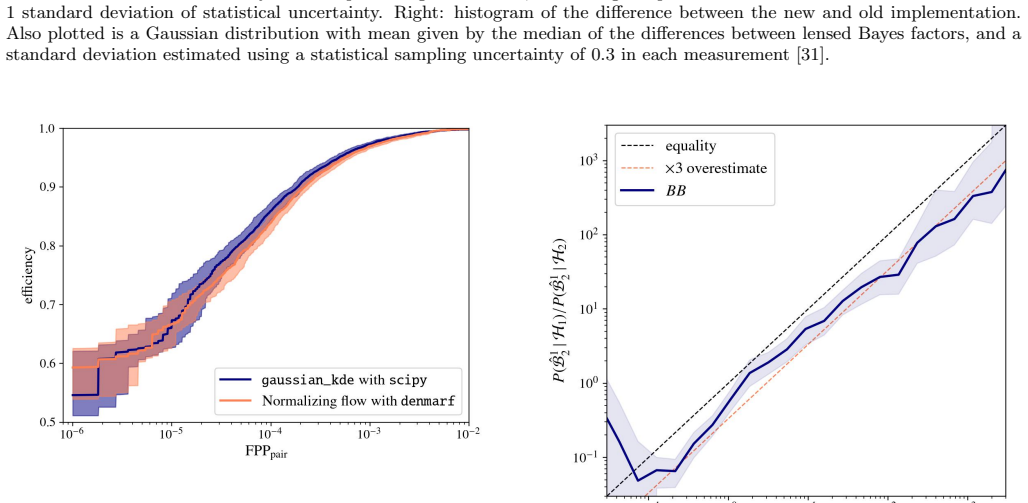
The BB relationship expresses the Bayes factor as a function of its distributions under the two hypotheses, forming a diagnostic plot that confirms the accuracy of Bayes factor computations between competing models and enables efficient estimation of background distributions, including analytic forms in certain cases, as shown in gravitational wave contexts.
What carries the argument
The BB plot, a diagnostic curve relating a Bayes factor value to the probability densities of the Bayes factor under each hypothesis.
If this is right
- The BB plot can confirm whether computed Bayes factors reliably rank competing models in gravitational wave analyses.
- Background distributions of Bayes factors can be estimated without extensive Monte Carlo simulations in many cases.
- The method provides a low-cost route to assigning statistical significance to candidate events such as lensed gravitational waves.
- It extrapolates from catalog data like GWTC4 to bound the significance of new events like GW231123.
Where Pith is reading between the lines
- If the BB relationship holds across waveform models, it could streamline model selection pipelines for large gravitational wave catalogs.
- The plot might be extended to other Bayesian inference problems where direct sampling of backgrounds is expensive, such as in cosmology parameter estimation.
- Analytic forms of the background in special cases could allow real-time significance assessment during ongoing observations.
- Systematic deviations in the BB plot for complex signals could indicate limitations in the likelihood or prior choices.
Load-bearing premise
The distributions of the Bayes factor under the two competing hypotheses are related in a way that yields a reliable and general diagnostic plot for real data.
What would settle it
Apply the BB plot to a controlled simulation of gravitational wave data where the Bayes factor is known to be miscalculated by a known error source; if the plot does not flag the inaccuracy or deviates from the expected diagnostic shape, the method fails.
Figures



read the original abstract
A common task in physics and astronomy is studying which of the competing hypotheses the data prefer. This is usually done by computing the Bayes factor between the two hypotheses, and either interpreting it in terms of the posterior odds or as a ranking statistic for a frequentist p-value test. Here we describe a relationship between the Bayes factor and its distributions under the two competing hypotheses, called the Bayes factor-Bayes factor (BB) relationship, expressed as a diagnostic plot. Using examples from gravitational wave (GW) astronomy, we demonstrate how the BB plot can validate the accuracy of Bayes factor calculations. The BB relationship may also be useful for estimating background distributions of the Bayes factor at low computational cost, even analytically in some cases. We apply this technique in the context of wave-optics lensing of GWs, extrapolating the background distribution from GWTC4 to put a rough bound of $\lesssim 4.1 \sigma$ on the statistical significance of GW231123.
Editorial analysis
A structured set of objections, weighed in public.
Referee Report
Summary. The paper introduces the Bayes factor-Bayes factor (BB) relationship, expressed as a diagnostic plot relating a computed Bayes factor to its expected distributions under each of two competing hypotheses. It demonstrates the plot's use for validating Bayes factor accuracy with gravitational-wave examples (wave-optics lensing versus no-lensing) drawn from GWTC4 data and applies the same construction to extrapolate a background distribution, placing a rough upper bound of ≲4.1σ on the statistical significance of event GW231123.
Significance. If the BB relationship can be shown to hold generally, the diagnostic would supply a low-cost method for checking numerical Bayes-factor calculations and for estimating background distributions (sometimes analytically). This would be a practical addition to Bayesian model-selection workflows in gravitational-wave astronomy and related fields.
major comments (3)
- [Abstract / BB-relationship description] Abstract and main text: no explicit functional form, derivation, or proof is supplied for the BB relationship; the manuscript states only that the relationship 'is derived from properties of Bayes factors' without showing the steps or the conditions under which the distributions under the two hypotheses are related by a fixed functional form.
- [GW lensing application] Application to GW231123: the ≲4.1σ bound is obtained by extrapolating the BB-derived background from GWTC4 events, yet no validation metrics, cross-checks against direct Monte-Carlo sampling, or sensitivity analysis to the assumed functional form are reported.
- [Discussion of generality] The claim that the BB plot works for 'arbitrary hypothesis pairs' is not supported; all demonstrations are restricted to the nested lensing/no-lensing case, leaving open whether the relation survives non-nested models, differing parameter spaces, or selection effects.
minor comments (2)
- [Abstract] The abstract asserts that analytic background estimation is possible 'in some cases' but does not state the conditions or give an example.
- [Introduction / Methods] Notation for the two hypotheses and the Bayes-factor distributions is introduced without a compact mathematical definition or reference to standard notation in the literature.
Simulated Author's Rebuttal
We thank the referee for their careful reading and valuable comments on our manuscript. We address each of the major comments below and have made revisions to the manuscript to incorporate the suggested improvements.
read point-by-point responses
-
Referee: Abstract and main text: no explicit functional form, derivation, or proof is supplied for the BB relationship; the manuscript states only that the relationship 'is derived from properties of Bayes factors' without showing the steps or the conditions under which the distributions under the two hypotheses are related by a fixed functional form.
Authors: We acknowledge that the original manuscript did not include an explicit derivation of the BB relationship. In the revised version, we have added a dedicated subsection deriving the relationship from the definition of the Bayes factor and the expected distributions under each hypothesis. The functional form is presented as the mapping between the observed Bayes factor and its expected value under H0 and H1, and we discuss the conditions (such as the models being well-defined and the evidence integrals being computable) under which this holds. This addresses the request for the steps and conditions. revision: yes
-
Referee: Application to GW231123: the ≲4.1σ bound is obtained by extrapolating the BB-derived background from GWTC4 events, yet no validation metrics, cross-checks against direct Monte-Carlo sampling, or sensitivity analysis to the assumed functional form are reported.
Authors: We agree that additional validation would strengthen the application. In the revision, we have included a new subsection with limited Monte Carlo cross-checks for a few events from GWTC4, comparing the BB-extrapolated background to direct sampling where feasible. We also perform a sensitivity analysis by considering alternative functional forms for the extrapolation (e.g., power-law vs. exponential tails) and report that the significance bound varies between 3.8σ and 4.3σ, confirming the rough upper bound of ≲4.1σ. We emphasize that this remains an approximate estimate due to the limited sample size. revision: yes
-
Referee: The claim that the BB plot works for 'arbitrary hypothesis pairs' is not supported; all demonstrations are restricted to the nested lensing/no-lensing case, leaving open whether the relation survives non-nested models, differing parameter spaces, or selection effects.
Authors: The manuscript claims generality based on the derivation from properties of Bayes factors, which in principle applies to any pair of hypotheses. However, we recognize that the demonstrations are limited to the nested case. In the revised manuscript, we have added a discussion section clarifying the assumptions and potential limitations for non-nested models and selection effects. We also include a brief example with non-nested models in an appendix to illustrate the applicability, though we note that further validation in other contexts would be beneficial. revision: partial
Circularity Check
BB relationship introduced from Bayes factor properties; no reduction to fitted input or self-definition by construction.
full rationale
The paper describes the BB relationship as arising from properties of Bayes factor distributions under competing hypotheses and demonstrates its use as a diagnostic plot on specific GW examples (wave-optics lensing vs. no-lensing) with GWTC4 data. No quoted equation or step shows the central diagnostic reducing to a parameter fit, self-citation chain, or input-by-construction; the claim retains independent empirical content for validation and low-cost background estimation. This aligns with a low circularity finding per the guidelines, as the derivation is self-contained against the external GW data benchmarks used.
Axiom & Free-Parameter Ledger
Lean theorems connected to this paper
-
IndisputableMonolith/Cost/FunctionalEquation.leanwashburn_uniqueness_aczel echoes?
echoesECHOES: this paper passage has the same mathematical shape or conceptual pattern as the Recognition theorem, but is not a direct formal dependency.
P(B12 | H1) = B12 P(B12 | H2) (Eq. 8), obtained by substituting the definition of the Bayes factor into the marginal density and using the sifting property of the delta function.
-
IndisputableMonolith/Foundation/LogicAsFunctionalEquation.leanSatisfiesLawsOfLogic unclear?
unclearRelation between the paper passage and the cited Recognition theorem.
The BB plot is presented as a diagnostic that validates approximate Bayes-factor calculations without ground truth.
What do these tags mean?
- matches
- The paper's claim is directly supported by a theorem in the formal canon.
- supports
- The theorem supports part of the paper's argument, but the paper may add assumptions or extra steps.
- extends
- The paper goes beyond the formal theorem; the theorem is a base layer rather than the whole result.
- uses
- The paper appears to rely on the theorem as machinery.
- contradicts
- The paper's claim conflicts with a theorem or certificate in the canon.
- unclear
- Pith found a possible connection, but the passage is too broad, indirect, or ambiguous to say the theorem truly supports the claim.
Reference graph
Works this paper leans on
-
[1]
Using the definition in Eq. (3), we can substitute P(d| H 1) byb(d)·P(d| H 2) P(B 1 2 | H 1) = Z dd b(d)P(d| H 2)δ B1 2 −b(d) .(6) The Dirac delta function restricts the integral to those data realizations for whichb(d) =B 1
-
[2]
On this support, b(d) can therefore be treated as a constant within the integral. This gives P(B 1 2 | H 1) =B 1 2 Z dd P(d| H 2)δ B1 2 −b(d) .(7) The integral is analogous to Eq. (5), only in this case it gives the distribution of Bayes factors under the hypoth- esisH 2, resulting in P(B 1 2 | H 1) =B 1 2 P(B 1 2 | H 2),(8) which is identical to Eq. (4)....
-
[3]
Ratio of maximum likelihoods ˆB1 2 = P(d| ⃗θML 1 ) P(d| ⃗θML 2 ) .(14)
-
[4]
Ratio of posteriors at maximum likelihood points ˆB1 2 = P(d| ⃗θML 1 ) P(d| ⃗θML 2 ) P( ⃗θML 1 | H 1) P( ⃗θML 2 | H 2) .(15)
-
[5]
Gaussian approximation (also known as Laplace’s approximation) ˆB1 2 = √ 2π P(d| ⃗θML 1 ) P(d| ⃗θML 2 ) P( ⃗θML 1 | H 1) P( ⃗θML 2 | H 2) |Σ1|1/2 |Σ2|1/2 .(16)
-
[6]
Gaussian approximation with edge corrections ˆB1 2 = √ 2π P(d| ⃗θML 1 ) P(d| ⃗θML 2 ) |Σ1|1/2 |Σ2|1/2 × D P( ⃗θ1,k | H 1) E ⃗θ1,k∼G1 D P( ⃗θ2,k | H 2) E ⃗θ2,k∼G2 f1 f2 .(17) where, fori∈ {1,2},G i are multivariate Gaussians with mean ⃗θML i and covariance Σi, ⃗θi,k are samples from these Gaussians, andf i is the fraction of those samples that lie within t...
-
[7]
However, since samples of the lensedB 1 2’s are available, the same can be achieved more robustly by reweighting each sample by its inverse, leading to (pairwise) FPP 1−C(B 1 2 | H 2)≈ 1 Nℓ NℓX k=1 Θ(B1 2 k ≥ B 1 2) B1 2 k (20) whereN ℓ is the number of samples{B 1 2 k}available from the foregroundP(B 1 2 | H 1) and Θ is the Heaviside step function. Figur...
-
[8]
A semi-empirical approach Here, we show that it is possible to obtain a deep back- ground semi-empirically, using a smaller background or foreground. The idea is as follows: there exist theoreti- cal or empirically observed correlations between the fore- ground Bayes factor and certain properties of the signals (for eg, the SNR). It is easy to obtain the ...
-
[9]
toP(B 1 2)) P(B 1 2 | H 2) = P(log 10 B1 2 | H 1) B1 2 2 .(24) At largeB 1 2, the erf term is insignificant, implying that the background, and consequently the FPP in strong GW lensing, is a power law inB 1 2 1−C(B 1 2 | H 2)∝ B 1 2 1−α−D D .(25) While these formulae are completely analytical, the parametersα, ρ th, D, µ, σmust be anchored to data by fitt...
-
[10]
B. P. Abbott, R. Abbott, T. D. Abbott, M. R. Aber- nathy, F. Acernese, K. Ackley, C. Adams, T. Adams, P. Addesso, R. X. Adhikari,et al., Observation of gravi- tational waves from a binary black hole merger, Physical review letters116, 061102 (2016)
work page 2016
-
[11]
Observation of a new boson at a mass of 125 GeV with the CMS experiment at the LHC
C. Collaborationet al., Observation of a new boson at 14 a mass of 125 gev with the cms experiment at the lhc, arXiv preprint arXiv:1207.7235 (2012)
work page Pith review arXiv 2012
-
[12]
B. P. Abbott, R. Abbott, T. D. Abbott, F. Acernese, K. Ackley, C. Adams, T. Adams, P. Addesso, R. X. Ad- hikari, V. B. Adya,et al., Gw170817: observation of grav- itational waves from a binary neutron star inspiral, Phys- ical review letters119, 161101 (2017)
work page 2017
-
[13]
Stochastic gravitational-wave background search using data from five pulsar timing arrays
W.-W. Yu and B. Allen, Stochastic gravitational-wave background search using data from five pulsar timing ar- rays, arXiv preprint arXiv:2512.08666 (2025)
work page internal anchor Pith review Pith/arXiv arXiv 2025
-
[14]
A. G. Riess, A. V. Filippenko, P. Challis, A. Clocchi- atti, A. Diercks, P. M. Garnavich, R. L. Gilliland, C. J. Hogan, S. Jha, R. P. Kirshner,et al., Observational ev- idence from supernovae for an accelerating universe and a cosmological constant, The astronomical journal116, 1009 (1998)
work page 1998
-
[15]
A. Adame, J. Aguilar, S. Ahlen, S. Alam, D. Alexander, M. Alvarez, O. Alves, A. Anand, U. Andrade, E. Armen- gaud,et al., Desi 2024 vi: cosmological constraints from the measurements of baryon acoustic oscillations, Jour- nal of Cosmology and Astroparticle Physics2025(02), 021
work page 2024
-
[16]
Jeffreys, Theory of probability, with corrections (1939)
H. Jeffreys, Theory of probability, with corrections (1939)
work page 1939
-
[17]
J. Neyman and E. S. Pearson, Ix. on the problem of the most efficient tests of statistical hypotheses, Philosophi- cal Transactions of the Royal Society of London. Series A, Containing Papers of a Mathematical or Physical Char- acter231, 289 (1933)
work page 1933
-
[18]
Skilling, Nested sampling for general bayesian compu- tation, (2006)
J. Skilling, Nested sampling for general bayesian compu- tation, (2006)
work page 2006
-
[19]
D. Sivia and J. Skilling,Data analysis: a Bayesian tuto- rial(OUP Oxford, 2006)
work page 2006
-
[20]
I. J. Good, A list of properties of bayes-turing factors, NSA Technical Journal10, 1 (1965)
work page 1965
-
[21]
N. Sekulovski, M. Marsman, and E.-J. Wagenmakers, A good check on the bayes factor, Behavior Research Meth- ods56, 8552 (2024)
work page 2024
-
[22]
K. Okada, Optimality of the half-order exponent in the turing-good identities for bayes factors, arXiv preprint arXiv:2602.19838 (2026)
-
[23]
M. Modr´ ak, A. H. Moon, S. Kim, P. B¨ urkner, N. Huurre, K. Faltejskov´ a, A. Gelman, and A. Vehtari, Simulation- based calibration checking for bayesian computation: The choice of test quantities shapes sensitivity, Bayesian Analysis20, 461 (2023)
work page 2023
-
[24]
M. Modr´ ak, S. Stroppel, and P.-C. B¨ urkner, Simulation- based validation of bayes factor computation, arXiv preprint arXiv:2508.11814 (2025)
-
[25]
A. Barsode, K. Maity, and P. Ajith, Lensing, not luck! detection prospects of strongly lensed gravitational waves, ApJ998, 294 (2026), arXiv:2510.23238 [gr-qc]
-
[26]
A. Abac, I. Abouelfettouh, F. Acernese, K. Ackley, C. Adamcewicz, S. Adhicary, D. Adhikari, N. Adhikari, R. Adhikari, V. Adkins,et al., Gw231123: a binary black hole merger with total mass 190–265 msun, The Astro- physical Journal Letters993, L25 (2025)
work page 2025
-
[27]
N. Cornish, L. Sampson, N. Yunes, and F. Pretorius, Gravitational wave tests of general relativity with the parameterized¡? format?¿ post-einsteinian framework, Physical Review D—Particles, Fields, Gravitation, and Cosmology84, 062003 (2011)
work page 2011
-
[28]
J. Lawrence, Focusing of gravitational radiation by inte- rior gravitational fields, Il Nuovo Cimento B (1971-1996) 6, 225 (1971)
work page 1971
-
[29]
R. Takahashi and T. Nakamura, Wave effects in the grav- itational lensing of gravitational waves from chirping bi- naries, ApJ595, 1039 (2003)
work page 2003
- [30]
-
[31]
J. U. Lange, nautilus: boosting Bayesian impor- tance nested sampling with deep learning, Monthly Notices of the Royal Astronomical Society525, 3181 (2023), https://academic.oup.com/mnras/article- pdf/525/2/3181/51331635/stad2441.pdf
work page 2023
-
[32]
C. Cutler and E. E. Flanagan, Gravitational waves from merging compact binaries: How accurately can one ex- tract the binary’s parameters from the inspiral wave- form?, PRD49, 2658 (1994)
work page 1994
- [33]
- [34]
-
[35]
C. R. Harris, K. J. Millman, S. J. van der Walt, R. Gom- mers, P. Virtanen, D. Cournapeau, E. Wieser, J. Tay- lor, S. Berg, N. J. Smith, R. Kern, M. Picus, S. Hoyer, M. H. van Kerkwijk, M. Brett, A. Haldane, J. F. del R´ ıo, M. Wiebe, P. Peterson, P. G´ erard-Marchant, K. Shep- pard, T. Reddy, W. Weckesser, H. Abbasi, C. Gohlke, and T. E. Oliphant, Array ...
work page 2020
-
[36]
J. Janquart, O. A. Hannuksela, K. Haris, and C. Van Den Broeck, A fast and precise methodology to search for and analyse strongly lensed gravitational-wave events, MNRAS506, 5430 (2021)
work page 2021
-
[37]
R. K. Lo and I. Maga˜ na Hernandez, Bayesian statistical framework for identifying strongly lensed gravitational- wave signals, PRD107, 123015 (2023)
work page 2023
- [38]
-
[39]
J. Janquart, K. Haris, O. A. Hannuksela, and C. Van Den Broeck, The return of golum: improving distributed joint parameter estimation for strongly lensed gravita- tional waves, MNRAS526, 3088 (2023)
work page 2023
-
[40]
A. Barsode, S. Goyal, and P. Ajith, Fast and efficient bayesian method to search for strongly lensed gravita- tional waves, ApJ980, 258 (2025)
work page 2025
-
[41]
O. A. Hannuksela, K. Haris, J. Janquart, H. Narola, H. Phurailatpam, J. D. Creighton, and C. V. den Broeck, Strong gravitational-wave lensing posterior odds (2025)
work page 2025
- [42]
-
[43]
M. Wright, J. Janquart, P. Cremonese, J. C. L. Chan, A. K. Y. Li, O. A. Hannuksela, R. K. L. Lo, J. M. Ezquiaga, D. Williams, M. Williams, G. Ash- ton, R. Udall, A. More, L. Uronen, A. Barsode, E. Seo, D. Keitel, S. Goyal, J. Heynen, A. Liu, and P. Pankunni, Lensingflow: an automated work- flow for gravitational wave lensing analyses, RASTI5, rzag003 (202...
work page doi:10.1093/rasti/rzag003/66395542/rzag003.pdf 2026
-
[44]
LIGO-Virgo-KAGRA Collaboration, Gravitational-wave candidate event database (gracedb) (2024)
work page 2024
- [45]
- [46]
-
[47]
GW231123: A Possible Primordial Black Hole Origin
V. De Luca, G. Franciolini, and A. Riotto, Gw231123: A possible primordial black hole origin, arXiv preprint arXiv:2508.09965 (2025)
work page internal anchor Pith review Pith/arXiv arXiv 2025
-
[48]
C. Yuan, Z.-C. Chen, and L. Liu, Gw231123 mass gap event and the primordial black hole scenario, Physical Review D112, L081306 (2025)
work page 2025
- [49]
- [50]
-
[51]
A. Chakraborty and S. Mukherjee, The first model- independent upper bound on micro-lensing signature of the highest mass binary black hole event gw231123, arXiv preprint arXiv:2512.19077 (2025)
work page internal anchor Pith review Pith/arXiv arXiv 2025
- [52]
-
[53]
GW231123: False Massive Graviton Signatures from Unmodeled Point-Mass Lensing
B. Wang and T. Yang, Gw231123: False massive gravi- ton signatures from unmodeled point-mass lensing, arXiv preprint arXiv:2604.08179 (2026)
work page internal anchor Pith review Pith/arXiv arXiv 2026
-
[54]
M. Vallisneri, Testing general relativity with grav- itational waves: A reality check, Physical Review D—Particles, Fields, Gravitation, and Cosmology86, 082001 (2012)
work page 2012
-
[55]
W. D. Pozzo, K. Grover, I. Mandel, and A. Vecchio, Test- ing general relativity with compact coalescing binaries: comparing exact and predictive methods to compute the bayes factor, Classical and Quantum Gravity31, 205006 (2014)
work page 2014
-
[56]
S. Bini, K. Kr´ ol, K. Chatziioannou, and M. Isi, Impact of waveform systematics and gaussian noise on the inter- pretation of gw231123, Physical Review D113, 083036 (2026)
work page 2026
-
[57]
C. Chatterjee, K. McGowan, S. Deshmukh, N. Tyler- Howard, and K. Jani, Machine learning confirms gw231123 is a “lite” intermediate mass black hole merger, The Astrophysical Journal Letters995, L6 (2025)
work page 2025
- [58]
- [59]
-
[60]
J. C. Chan, E. Seo, A. K. Li, H. Fong, and J. M. Ezquiaga, Detectability of lensed gravitational waves in matched-filtering searches, PRD111, 084019 (2025)
work page 2025
-
[61]
J. C. Chan, L. M. Zertuche, J. M. Ezquiaga, R. K. Lo, L. Vujeva, and J. Bowman, Identification and character- ization of distorted gravitational waves by lensing using deep learning, Physical Review D113, 024041 (2026)
work page 2026
- [62]
-
[63]
P. Virtanen, R. Gommers, T. E. Oliphant, M. Haber- land, T. Reddy, D. Cournapeau, E. Burovski, P. Pe- terson, W. Weckesser, J. Bright, S. J. van der Walt, M. Brett, J. Wilson, K. J. Millman, N. Mayorov, A. R. J. Nelson, E. Jones, R. Kern, E. Larson, C. J. Carey, ˙I. Po- lat, Y. Feng, E. W. Moore, J. VanderPlas, D. Laxalde, J. Perktold, R. Cimrman, I. Henr...
work page 2020
-
[64]
A. Abac, I. Abouelfettouh, F. Acernese, K. Ackley, C. Adamcewicz, S. Adhicary, D. Adhikari, N. Adhikari, R. Adhikari, V. Adkins,et al., Gwtc-4.0: Population properties of merging compact binaries, arXiv preprint arXiv:2508.18083 (2025)
work page internal anchor Pith review Pith/arXiv arXiv 2025
-
[65]
P. Madau and M. Dickinson, Cosmic star-formation his- tory, Annual Review of Astronomy and Astrophysics52, 415 (2014)
work page 2014
-
[66]
T. E. Collett, The population of galaxy–galaxy strong lenses in forthcoming optical imaging surveys, ApJ811, 20 (2015)
work page 2015
-
[67]
R. Kormann, P. Schneider, and M. Bartelmann, Isother- mal elliptical gravitational lens models, Astronomy and Astrophysics (ISSN 0004-6361), vol. 284, no. 1, p. 285- 299284, 285 (1994)
work page 1994
-
[68]
M. Fukugita and E. L. Turner, Gravitational lensing frequencies-galaxy cross-sections and selection effects, MNRAS253, 99 (1991)
work page 1991
-
[69]
LIGO-Virgo Collaboration, Noise curves used for simu- lations in the update of the observing scenarios paper (2020), LIGO Document T2000012-v1
work page 2020
-
[70]
G. Pratten, C. Garc´ ıa-Quir´ os, M. Colleoni, A. Ramos- Buades, H. Estell´ es, M. Mateu-Lucena, R. Jaume, M. Haney, D. Keitel, J. E. Thompson,et al., Computa- tionally efficient models for the dominant and subdom- inant harmonic modes of precessing binary black holes, Physical Review D103, 104056 (2021)
work page 2021
discussion (0)
Sign in with ORCID, Apple, or X to comment. Anyone can read and Pith papers without signing in.