Recognition: 2 theorem links
· Lean TheoremThe Amplitude-Growth Degeneracy and Implied A_s Diagnostic for Background-Inert Modified Gravity
Pith reviewed 2026-05-15 02:44 UTC · model grok-4.3
The pith
Background-inert f(Q) gravity couplings degenerate with σ80 through a deeper As-D0(λ) link when CMB distance priors are used.
A machine-rendered reading of the paper's core claim, the machinery that carries it, and where it could break.
Core claim
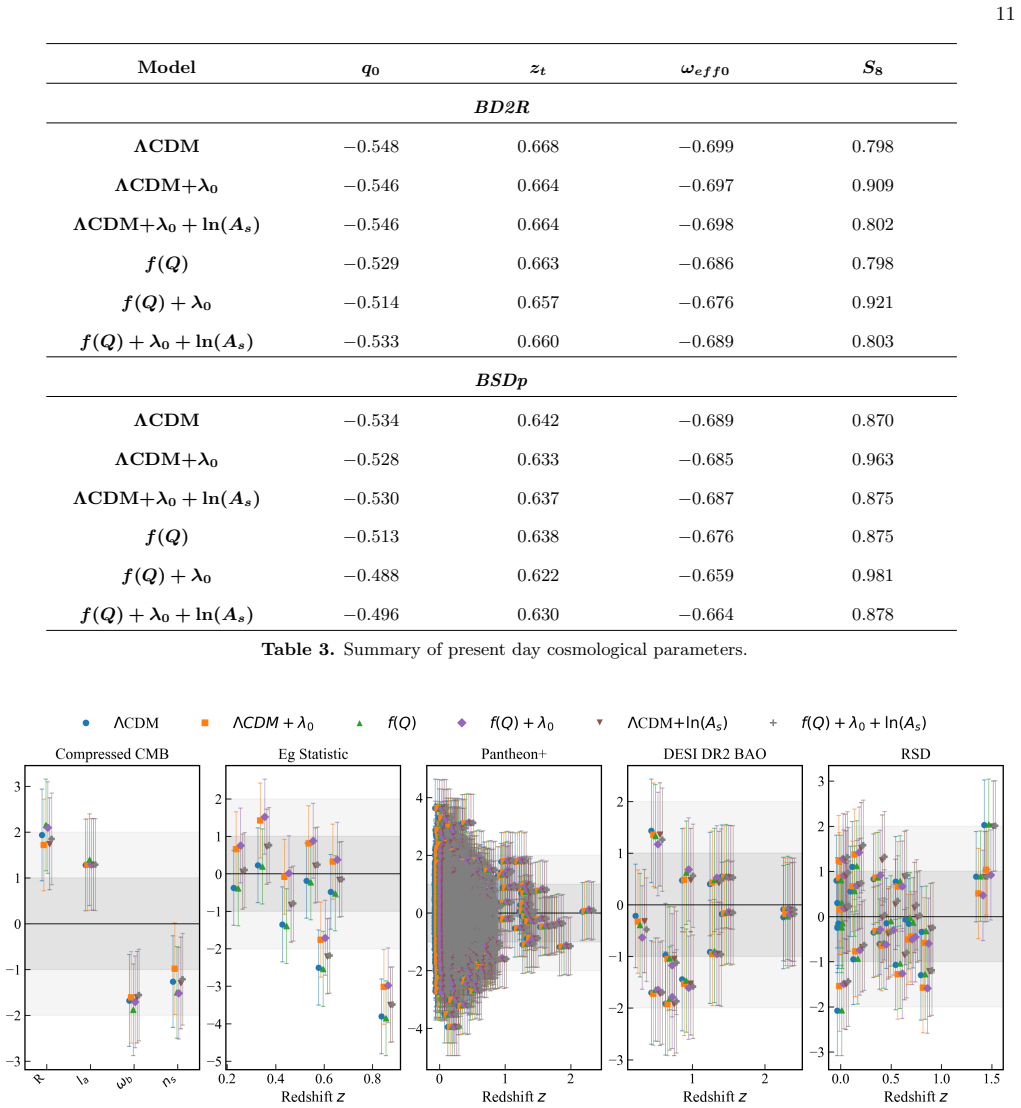
Any background-inert λ in coincident f(Q) gravity exhibits a degeneracy with σ80 under compressed CMB distance priors; this is the direct manifestation of an As-D0(λ) degeneracy. The consistency check computes the As needed to match the sampler’s σ80 prediction. Inclusion of the λ0√(QQ0) correction inflates σ80 and raises As by 20-30 percent into 1.7-2.2σ tension with Planck. Fixing ln(As) to its Planck 1σ range returns all parameters to baseline values, with each extended model penalized by about two units per extra parameter.
What carries the argument
The As-D0(λ) degeneracy, which links the primordial power-spectrum amplitude directly to the present-day growth factor produced by a background-inert perturbative coupling.
If this is right
- Adding the λ0√(QQ0) term inflates σ80 to unphysical values unless As is increased by 20-30 percent.
- The increase in As places the models in 1.7-2.2σ tension with Planck constraints.
- Imposing Planck 1σ priors on ln(As) returns all other parameters to their baseline values.
- Each extended model is penalized by roughly two units per extra parameter in model-selection statistics.
- The ΛCDM+λ0+ln(As) combination with SDSS DR16 data shows a weak preference over vanilla ΛCDM.
Where Pith is reading between the lines
- The same As-D0(λ) degeneracy is likely to appear in any modified-gravity model whose linear growth is altered while the background expansion remains unchanged.
- The proposed As diagnostic offers a quick consistency test that can be applied to growth-rate data sets before running expensive full likelihood chains.
- Future surveys that tighten both σ8 and As measurements independently could break or confirm the degeneracy without relying on compressed CMB priors.
- Analyses that combine growth data with distance priors should routinely check whether an inferred rise in σ80 is actually an artifact of an unadjusted As.
Load-bearing premise
The perturbative coupling stays strictly background-inert and the compressed CMB distance priors contain enough information to reveal the degeneracy without a full likelihood analysis.
What would settle it
A full MCMC run with complete Planck likelihoods (instead of compressed distance priors) that shows no upward shift in As and no unphysical inflation in σ80 when the λ0√(QQ0) term is added.
Figures



read the original abstract
We prove that any background-inert perturbative coupling $ \lambda $ in coincident $ f(Q) $ gravity exhibits a degeneracy with the clustering amplitude $ \sigma_{80} $, when using compressed CMB distance priors. This degeneracy is, in fact, a direct materialization of a more deeper $ A_s-D_0(\lambda) $ degeneracy between the primordial amplitude $ A_s $ and the present day growth factor $ D_0(\lambda) $. We outline a consistency check scheme, applicable to models even outside the $ f(Q) $ class, by computing $ A_s $ needed to reproduce the $ \sigma_{80} $ predicted by the sampler. We perform our analysis with two dataset pipelines, based on the coupled/decoupled $ f\sigma_8(z) $ data. To ensure theoretical diversity, we include $ \Lambda $CDM and the Hybrid model in the $ f(Q) $ framework. Our results illustrate that adding the $ \lambda_0\sqrt{QQ_0} $ correction to the models inflates $ \sigma_{80} $ to unphysical values, while showing moderate evidence in favor of the said models. However, this results in an increase of $ 20\%-30\% $ in $ A_s $ in $ 1.7\sigma-2.2\sigma $ tension with Planck values. We utilize the $ 1\sigma $ $ \ln(A_s) $ constraints from Planck as priors in order to fix the artificial increase in $ \sigma_{80} $ and find that all the constrained parameters return to their baseline values. Each model is penalized by around $ 2 $ units per extra parameter. Interestingly, the $ \Lambda $CDM$ +\lambda_0+\ln(A_s) $ + SDSS DR16 combination shows a weak preference over the vanilla $ \Lambda $CDM model, validated by the values of $ \log\mathcal{Z},\;AIC,\;DIC, $ and BIC.
Editorial analysis
A structured set of objections, weighed in public.
Referee Report
Summary. The paper proves that any background-inert perturbative coupling λ in coincident f(Q) gravity exhibits a degeneracy with the clustering amplitude σ80 when using compressed CMB distance priors; this is presented as a direct consequence of a deeper As-D0(λ) degeneracy. It introduces a consistency-check scheme that recomputes the As value needed to reproduce the sampler's σ80 prediction, applies the analysis to ΛCDM and a Hybrid f(Q) model using two fσ8 pipelines (coupled/decoupled), reports that the λ0√(QQ0) correction inflates σ80 to unphysical values while producing 20-30% As shifts in 1.7-2.2σ tension with Planck, and shows that imposing 1σ ln(As) priors restores baseline parameter values. Model-selection metrics (logZ, AIC, DIC, BIC) penalize each model by ~2 units per extra parameter, with a weak preference noted for one ΛCDM+λ0+ln(As)+SDSS DR16 combination.
Significance. If the degeneracy proof and consistency check hold under the stated priors, the work supplies a practical diagnostic for As-related degeneracies in background-inert modified-gravity models and a reusable scheme applicable beyond the f(Q) class. The explicit demonstration that ln(As) priors can restore baseline σ80 values, together with the quantitative model-selection penalties, provides falsifiable guidance for future analyses. The limitation to compressed CMB priors, however, restricts the generality of the central claim.
major comments (3)
- [Degeneracy proof] The proof that the λ-σ80 degeneracy is a direct materialization of the As-D0(λ) degeneracy (abstract and §3) is stated but not accompanied by the explicit algebraic steps linking D0(λ) to the growth equation under strictly background-inert conditions; without these steps the claim cannot be verified from the given information.
- [Consistency check] The consistency check recomputes As to match the sampled σ80 (abstract and results section); this procedure must be shown to be independent of the original fit rather than tautological, especially given the post-hoc imposition of ln(As) priors that restores baseline values.
- [CMB priors and data pipelines] All numerical results (σ80 inflation, 20-30% As shift, model-selection outcomes) are obtained exclusively with compressed CMB distance priors; the manuscript does not test or discuss whether the full Planck likelihood supplies additional growth or correlation information that would lift the degeneracy.
minor comments (2)
- The abstract contains the phrasing 'a more deeper'; this should be corrected to 'a deeper'.
- [Model selection] The exact numerical values of logZ, AIC, DIC and BIC for each model combination are summarized but not tabulated; a table would improve clarity and allow direct comparison of the ~2-unit penalty per extra parameter.
Simulated Author's Rebuttal
We thank the referee for the thorough and insightful report. We address each of the major comments point by point below, providing clarifications and indicating where revisions will be made to the manuscript.
read point-by-point responses
-
Referee: [Degeneracy proof] The proof that the λ-σ80 degeneracy is a direct materialization of the As-D0(λ) degeneracy (abstract and §3) is stated but not accompanied by the explicit algebraic steps linking D0(λ) to the growth equation under strictly background-inert conditions; without these steps the claim cannot be verified from the given information.
Authors: We acknowledge that the explicit algebraic steps were not provided in the original manuscript. In the revised version, we will expand §3 to include the detailed derivation. Starting from the linear growth equation in the background-inert coincident f(Q) framework, we will show how the present-day growth factor D0(λ) modifies the normalization of σ80, leading directly to the degeneracy with As when using compressed CMB priors. This will allow verification of the claim. revision: yes
-
Referee: [Consistency check] The consistency check recomputes As to match the sampled σ80 (abstract and results section); this procedure must be shown to be independent of the original fit rather than tautological, especially given the post-hoc imposition of ln(As) priors that restores baseline values.
Authors: The consistency check is designed as an independent diagnostic tool. After performing the MCMC fit allowing both As and σ80 to vary freely, we use the sampled σ80 value to back-calculate the As that would be required to match it given the model's D0(λ). This is not tautological because it highlights the implied shift in As due to the degeneracy. The subsequent imposition of ln(As) priors is a separate analysis to test the impact on parameter recovery. We will add explicit equations and a description in the revised manuscript to clarify this independence and avoid any perception of circularity. revision: yes
-
Referee: [CMB priors and data pipelines] All numerical results (σ80 inflation, 20-30% As shift, model-selection outcomes) are obtained exclusively with compressed CMB distance priors; the manuscript does not test or discuss whether the full Planck likelihood supplies additional growth or correlation information that would lift the degeneracy.
Authors: This is a valid point regarding the scope of our analysis. We chose compressed CMB distance priors to focus on the background-inert effects in a controlled setting, consistent with many prior studies on modified gravity. We will revise the manuscript to include a discussion of this limitation, noting that the full Planck likelihood may include additional constraints from growth and cross-correlations that could potentially break the degeneracy. We suggest this as an avenue for future investigation but do not perform the full likelihood analysis here, as it would require significant additional computational resources. revision: partial
Circularity Check
No significant circularity: degeneracy shown via MCMC under compressed priors; As diagnostic is post-hoc and independent
full rationale
The central claim is established by running MCMC samplers on two fσ8 pipelines with compressed CMB distance priors, demonstrating that background-inert λ inflates σ80 and requires a compensating 20-30% shift in As to match the sampled growth. The consistency check recomputes the As value needed to reproduce the sampler's σ80 prediction using the growth factor D0(λ); this is presented as a diagnostic applicable beyond f(Q) and does not reduce the sampled posterior to its inputs by construction. No equations equate the prediction to the fit parameters tautologically, no self-citations carry the uniqueness or ansatz load, and the numerical results (inflation of σ80, return to baseline under ln(As) prior, information criteria) are obtained from standard sampling rather than renaming or self-definition. The derivation remains self-contained against the stated priors and datasets.
Axiom & Free-Parameter Ledger
free parameters (1)
- λ0
axioms (2)
- domain assumption The perturbative coupling λ is background-inert
- domain assumption Compressed CMB distance priors suffice to reveal the degeneracy
Lean theorems connected to this paper
-
IndisputableMonolith/Foundation/RealityFromDistinction.leanreality_from_one_distinction unclear?
unclearRelation between the paper passage and the cited Recognition theorem.
We prove that any background-inert perturbative coupling λ in coincident f(Q) gravity exhibits a degeneracy with the clustering amplitude σ80 ... direct materialization of a more deeper As−D0(λ) degeneracy ... σ²80 = As D²0(λ) I
-
IndisputableMonolith/Cost/FunctionalEquation.leanwashburn_uniqueness_aczel unclear?
unclearRelation between the paper passage and the cited Recognition theorem.
μG(z,λ) = Geff(z,λ)/GN ... μG(z≫1,λ)=1 ... growth equation δ''m + δ'm(2+H'/H) − (3/2)Ωm μG(z,λ)δm =0
What do these tags mean?
- matches
- The paper's claim is directly supported by a theorem in the formal canon.
- supports
- The theorem supports part of the paper's argument, but the paper may add assumptions or extra steps.
- extends
- The paper goes beyond the formal theorem; the theorem is a base layer rather than the whole result.
- uses
- The paper appears to rely on the theorem as machinery.
- contradicts
- The paper's claim conflicts with a theorem or certificate in the canon.
- unclear
- Pith found a possible connection, but the passage is too broad, indirect, or ambiguous to say the theorem truly supports the claim.
Reference graph
Works this paper leans on
-
[1]
Big Bang Nucleosynthesis: 2015
Cyburt, Richard H. and Fields, Brian D. and Olive, Keith A. and Yeh, Tsung-Han. Big Bang Nucleosynthesis: 2015. Rev. Mod. Phys. 2016. doi:10.1103/RevModPhys.88.015004. arXiv:1505.01076
work page internal anchor Pith review Pith/arXiv arXiv doi:10.1103/revmodphys.88.015004 2015
-
[2]
Planck 2018 results. VI. Cosmological parameters
Aghanim, N. and others. Planck 2018 results. VI. Cosmological parameters. Astron. Astrophys. 2020. doi:10.1051/0004-6361/201833910. arXiv:1807.06209
work page internal anchor Pith review Pith/arXiv arXiv doi:10.1051/0004-6361/201833910 2018
-
[3]
Riess, Adam G. and Casertano, Stefano and Yuan, Wenlong and Macri, Lucas M. and Scolnic, Dan. Large Magellanic Cloud Cepheid Standards Provide a 1 \. Astrophys. J. 2019. doi:10.3847/1538-4357/ab1422. arXiv:1903.07603
work page internal anchor Pith review Pith/arXiv arXiv doi:10.3847/1538-4357/ab1422 2019
-
[4]
2021, prd, 103, 083533, doi: 10.1103/PhysRevD.103.083533
Alam, Shadab and others. Completed SDSS-IV extended Baryon Oscillation Spectroscopic Survey: Cosmological implications from two decades of spectroscopic surveys at the Apache Point Observatory. Phys. Rev. D. 2021. doi:10.1103/PhysRevD.103.083533. arXiv:2007.08991
-
[5]
Heymans, Catherine and others. KiDS-1000 Cosmology: Multi-probe weak gravitational lensing and spectroscopic galaxy clustering constraints. Astron. Astrophys. 2021. doi:10.1051/0004-6361/202039063. arXiv:2007.15632
-
[6]
Riess, Adam G. and others. Observational evidence from supernovae for an accelerating universe and a cosmological constant. Astron. J. 1998. doi:10.1086/300499. arXiv:astro-ph/9805201
work page internal anchor Pith review Pith/arXiv arXiv doi:10.1086/300499 1998
-
[7]
1999, apj, 517, 565, doi: 10.1086/307221
Perlmutter, S. and others. Measurements of and from 42 High Redshift Supernovae. Astrophys. J. 1999. doi:10.1086/307221. arXiv:astro-ph/9812133
work page internal anchor Pith review Pith/arXiv arXiv doi:10.1086/307221 1999
-
[8]
1989, Reviews of Modern Physics, 61, 1, doi: 10.1103/RevModPhys.61.1
Weinberg, Steven. The Cosmological Constant Problem. Rev. Mod. Phys. 1989. doi:10.1103/RevModPhys.61.1
-
[9]
Ade, P. A. R. and others. Planck 2013 results. XX. Cosmology from Sunyaev Zeldovich cluster counts. Astron. Astrophys. 2014. doi:10.1051/0004-6361/201321521. arXiv:1303.5080
work page internal anchor Pith review Pith/arXiv arXiv doi:10.1051/0004-6361/201321521 2013
-
[10]
Symmetric teleparallel general relativity
Nester, James M. and Yo, Hwei-Jang. Symmetric teleparallel general relativity. Chin. J. Phys. 1999. arXiv:gr-qc/9809049
work page internal anchor Pith review Pith/arXiv arXiv 1999
-
[11]
Beltr \'a n Jim \'e nez, Jose and Heisenberg, Lavinia and Koivisto, Tomi. Coincident General Relativity. Phys. Rev. D. 2018. doi:10.1103/PhysRevD.98.044048. arXiv:1710.03116
work page internal anchor Pith review Pith/arXiv arXiv doi:10.1103/physrevd.98.044048 2018
-
[12]
The Geometrical Trinity of Gravity
Beltr\'an Jim\'enez, Jose and Heisenberg, Lavinia and Koivisto, Tomi S. The Geometrical Trinity of Gravity. Universe. 2019. doi:10.3390/universe5070173. arXiv:1903.06830
work page internal anchor Pith review Pith/arXiv arXiv doi:10.3390/universe5070173 2019
-
[13]
Heisenberg, Lavinia. Review on f(Q) gravity. Phys. Rept. 2024. doi:10.1016/j.physrep.2024.02.001. arXiv:2309.15958
-
[14]
Teleparallel Palatini theories
Beltr\'an Jim\'enez, Jose and Heisenberg, Lavinia and Koivisto, Tomi S. Teleparallel Palatini theories. JCAP. 2018. doi:10.1088/1475-7516/2018/08/039. arXiv:1803.10185
work page internal anchor Pith review Pith/arXiv arXiv doi:10.1088/1475-7516/2018/08/039 2018
-
[15]
Cosmology in symmetric teleparallel gravity and its dynamical system
Lu, Jianbo and Zhao, Xin and Chee, Guoying. Cosmology in symmetric teleparallel gravity and its dynamical system. Eur. Phys. J. C. 2019. doi:10.1140/epjc/s10052-019-7038-3. arXiv:1906.08920
work page internal anchor Pith review Pith/arXiv arXiv doi:10.1140/epjc/s10052-019-7038-3 2019
-
[16]
Mandal, Sanjay and Wang, Deng and Sahoo, P. K. Cosmography in f(Q) gravity. Phys. Rev. D. 2020. doi:10.1103/PhysRevD.102.124029. arXiv:2011.00420
-
[17]
Mandal, Sanjay and Sahoo, P. K. and Santos, J. R. L. Energy conditions in f(Q) gravity. Phys. Rev. D. 2020. doi:10.1103/PhysRevD.102.024057. arXiv:2008.01563
-
[18]
and Barreiro, Tiago and Koivisto, Tomi and Nunes, Nelson J
Barros, Bruno J. and Barreiro, Tiago and Koivisto, Tomi and Nunes, Nelson J. Testing F(Q) gravity with redshift space distortions. Phys. Dark Univ. 2020. doi:10.1016/j.dark.2020.100616. arXiv:2004.07867
-
[19]
Spherically symmetric configuration in f(Q) gravity
Lin, Rui-Hui and Zhai, Xiang-Hua. Spherically symmetric configuration in f(Q) gravity. Phys. Rev. D. 2021. doi:10.1103/PhysRevD.103.124001. arXiv:2105.01484
-
[20]
Dimakis, N. and Paliathanasis, A. and Christodoulakis, T. Quantum cosmology in f(Q) theory. Class. Quant. Grav. 2021. doi:10.1088/1361-6382/ac2b09. arXiv:2108.01970
-
[21]
Hassan, Zinnat and Mandal, Sanjay and Sahoo, P. K. Traversable Wormhole Geometries in Gravity. Fortsch. Phys. 2021. doi:10.1002/prop.202100023. arXiv:2102.00915
-
[22]
Can f(Q) gravity challenge CDM?
Atayde, Lu\' s and Frusciante, Noemi. Can f(Q) gravity challenge CDM?. Phys. Rev. D. 2021. doi:10.1103/PhysRevD.104.064052. arXiv:2108.10832
-
[23]
Signatures of f(Q) -gravity in cosmology
Frusciante, Noemi. Signatures of f(Q) -gravity in cosmology. Phys. Rev. D. 2021. doi:10.1103/PhysRevD.103.044021. arXiv:2101.09242
-
[24]
Hassan, Zinnat and Ghosh, Sayantan and Sahoo, P. K. and Bamba, Kazuharu. Casimir wormholes in modified symmetric teleparallel gravity. Eur. Phys. J. C. 2022. doi:10.1140/epjc/s10052-022-11107-0. arXiv:2207.09945
-
[25]
Sokoliuk, Oleksii and Arora, Simran and Praharaj, Subhrat and Baransky, Alexander and Sahoo, P. K. On the impact of f(Q) gravity on the large scale structure. Mon. Not. Roy. Astron. Soc. 2023. doi:10.1093/mnras/stad968. arXiv:2303.17341
-
[26]
and Kolhatkar, Ameya and Mandal, Sanjay and Sahoo, P
Gadbail, Gaurav N. and Kolhatkar, Ameya and Mandal, Sanjay and Sahoo, P. K. Correction to Lagrangian for bouncing cosmologies in f(Q) gravity. Eur. Phys. J. C. 2023. doi:10.1140/epjc/s10052-023-11798-z. arXiv:2304.10245
-
[27]
f(Q) gravity and neutrino physics
Atayde, Lu\' s and Frusciante, Noemi. f(Q) gravity and neutrino physics. Phys. Rev. D. 2023. doi:10.1103/PhysRevD.107.124048. arXiv:2306.03015
-
[28]
Cosmology of f(Q) gravity in non-flat Universe
Shabani, Hamid and De, Avik and Loo, Tee-How and Saridakis, Emmanuel N. Cosmology of f(Q) gravity in non-flat Universe. Eur. Phys. J. C. 2024. doi:10.1140/epjc/s10052-024-12582-3. arXiv:2306.13324
-
[29]
Mishra, Sai Swagat and Bhat, Aaqid and Sahoo, P. K. Probing baryogenesis in f(Q) gravity. EPL. 2024. doi:10.1209/0295-5075/ad329b. arXiv:2404.00577
-
[30]
Gravitational waves in f(Q) non-metric gravity via geodesic deviation
Capozziello, Salvatore and Capriolo, Maurizio and Nojiri, Shin'ichi. Gravitational waves in f(Q) non-metric gravity via geodesic deviation. Phys. Lett. B. 2024. doi:10.1016/j.physletb.2024.138510. arXiv:2401.06424
-
[31]
Gravitational waves in f(Q) non-metric gravity without gauge fixing
Capozziello, Salvatore and Capriolo, Maurizio. Gravitational waves in f(Q) non-metric gravity without gauge fixing. Phys. Dark Univ. 2024. doi:10.1016/j.dark.2024.101548. arXiv:2405.16163
-
[32]
Mishra, Sai Swagat and Kavya, N. S. and Sahoo, P. K. and Venkatesha, V. Chebyshev cosmography in the framework of extended symmetric teleparallel theory. Phys. Dark Univ. 2025. doi:10.1016/j.dark.2024.101759. arXiv:2412.03065
-
[33]
and Petronikolou, Maria and Bouhmadi-L \'o pez, Mariam and Saridakis, Emmanuel N
Boiza, Carlos G. and Petronikolou, Maria and Bouhmadi-L \'o pez, Mariam and Saridakis, Emmanuel N. Addressing H_0 and S_8 tensions within f(Q) cosmology. arXiv e-prints. 2025. arXiv:2505.18264
-
[34]
Kolhatkar, Ameya and Mishra, Sai Swagat and Sahoo, P. K. Implications of cosmological perturbations of Q in STEGR. Eur. Phys. J. C. 2025. doi:10.1140/epjc/s10052-025-14384-7
-
[35]
Extended geometric trinity of gravity
Capozziello, Salvatore and Cesare, Sara and Ferrara, Carmen. Extended geometric trinity of gravity. Eur. Phys. J. C. 2025. doi:10.1140/epjc/s10052-025-14440-2. arXiv:2503.08167
-
[36]
Kavya, N. S. and Swagat Mishra, Sai and Sahoo, P. K. f(Q) gravity as a possible resolution of the H0 and S8 tensions with DESI DR2. Sci. Rep. 2025. doi:10.1038/s41598-025-23502-0
-
[37]
Li, Chunyu and Ren, Xin and Yang, Yuhang and Saridakis, Emmanuel N. and Cai, Yi-Fu. Decoupling perturbations from background in f(Q) gravity: the square-root correction and the alleviation of the _8 tension. arXiv e-prints. 2025. arXiv:2512.16551
-
[38]
Kolhatkar, Ameya and Dalal, Preet and Sahoo, P. K. Structural constraints on interacting dark sector in CDM-mimicking f(Q) gravity. Phys. Lett. B. 2026. doi:10.1016/j.physletb.2026.140397
-
[39]
Kolhatkar, Ameya and Sahoo, P. K. Beyond the Cosmological Constant: Breaking the Geometric Degeneracy of f(Q) cosmology via Redshift-Space Distortions. arXiv e-prints. 2026. arXiv:2604.11865
work page internal anchor Pith review Pith/arXiv arXiv 2026
-
[40]
Beltr \'a n Jim \'e nez, Jose and Heisenberg, Lavinia and Koivisto, Tomi Sebastian and Pekar, Simon. Cosmology in f(Q) geometry. Phys. Rev. D. 2020. doi:10.1103/PhysRevD.101.103507. arXiv:1906.10027
-
[41]
Rana, Dheeraj Singh and Solanki, Raja and Sahoo, P. K. Phase-space analysis of the viscous fluid cosmological models in the coincident f(Q) gravity. Phys. Dark Univ. 2024. doi:10.1016/j.dark.2024.101421. arXiv:2401.05448
-
[42]
Kolhatkar, Ameya and Mishra, Sai Swagat and Sahoo, P. K. Investigating early and late-time epochs in f(Q) gravity. Eur. Phys. J. C. 2024. doi:10.1140/epjc/s10052-024-13237-z. arXiv:2409.01538
-
[43]
Inverse non-metricity in f(Q) gravity: cosmology and observational constraints
Atayde, Lu \' s and Nunes, Sim \ a o Marques and Frusciante, Noemi. Inverse non-metricity in f(Q) gravity: cosmology and observational constraints. 2026. arXiv:2603.27428
-
[44]
Ortin, Tomas. Gravity and Strings. 2015. doi:10.1017/CBO9781139019750
-
[45]
Robust and model-independent cosmological constraints from distance measurements
Zhai, Zhongxu and Wang, Yun. Robust and model-independent cosmological constraints from distance measurements. JCAP. 2019. doi:10.1088/1475-7516/2019/07/005. arXiv:1811.07425
work page internal anchor Pith review Pith/arXiv arXiv doi:10.1088/1475-7516/2019/07/005 2019
-
[46]
Zhai, Zhongxu and Park, Chan-Gyung and Wang, Yun and Ratra, Bharat. CMB distance priors revisited: effects of dark energy dynamics, spatial curvature, primordial power spectrum, and neutrino parameters. JCAP. 2020. doi:10.1088/1475-7516/2020/07/009. arXiv:1912.04921
-
[47]
The Pantheon+ Analysis: Cosmological Constraints
Brout, Dillon and others. The Pantheon+ Analysis: Cosmological Constraints. Astrophys. J. 2022. doi:10.3847/1538-4357/ac8e04. arXiv:2202.04077
work page internal anchor Pith review Pith/arXiv arXiv doi:10.3847/1538-4357/ac8e04 2022
-
[48]
The Pantheon+ Analysis: The Full Dataset and Light-Curve Release
Scolnic, Dan and others. The Pantheon+ Analysis: The Full Data Set and Light-curve Release. Astrophys. J. 2022. doi:10.3847/1538-4357/ac8b7a. arXiv:2112.03863
work page internal anchor Pith review Pith/arXiv arXiv doi:10.3847/1538-4357/ac8b7a 2022
-
[49]
DESI DR2 Results II: Measurements of Baryon Acoustic Oscillations and Cosmological Constraints
Abdul Karim, M. and others. DESI DR2 Results II: Measurements of Baryon Acoustic Oscillations and Cosmological Constraints. arXiv e-prints. 2025. arXiv:2503.14738
work page internal anchor Pith review Pith/arXiv arXiv 2025
-
[50]
Alestas, George and Kazantzidis, Lavrentios and Nesseris, Savvas. Machine learning constraints on deviations from general relativity from the large scale structure of the Universe. Phys. Rev. D. 2022. doi:10.1103/PhysRevD.106.103519. arXiv:2209.12799
-
[51]
A discriminating probe of gravity at cosmological scales
Zhang, Pengjie and Liguori, Michele and Bean, Rachel and Dodelson, Scott. Probing Gravity at Cosmological Scales by Measurements which Test the Relationship between Gravitational Lensing and Matter Overdensity. Phys. Rev. Lett. 2007. doi:10.1103/PhysRevLett.99.141302. arXiv:0704.1932
work page internal anchor Pith review Pith/arXiv arXiv doi:10.1103/physrevlett.99.141302 2007
-
[52]
The observable $E_g$ statistics
Ghosh, Basundhara and Durrer, Ruth. The observable E_g statistics. JCAP. 2019. doi:10.1088/1475-7516/2019/06/010. arXiv:1812.09546
work page internal anchor Pith review Pith/arXiv arXiv doi:10.1088/1475-7516/2019/06/010 2019
-
[53]
dynesty: a dynamic nested sampling package for estimating Bayesian posteriors and evidences
Speagle, Joshua S. dynesty: a dynamic nested sampling package for estimating Bayesian posteriors and evidences. Mon. Not. Roy. Astron. Soc. 2020. doi:10.1093/mnras/staa278. arXiv:1904.02180
-
[54]
GetDist: a Python package for analysing Monte Carlo samples
Lewis, Antony. GetDist: a Python package for analysing Monte Carlo samples. JCAP. 2025. doi:10.1088/1475-7516/2025/08/025. arXiv:1910.13970
work page internal anchor Pith review Pith/arXiv arXiv doi:10.1088/1475-7516/2025/08/025 2025
-
[55]
doi:10.5281/zenodo.19791571 , url =
Kolhatkar, Ameya , title =. doi:10.5281/zenodo.19791571 , url =
-
[56]
Bayes in the sky: Bayesian inference and model selection in cosmology
Trotta, Roberto. Bayes in the sky: Bayesian inference and model selection in cosmology. Contemp. Phys. 2008. doi:10.1080/00107510802066753. arXiv:0803.4089
work page internal anchor Pith review Pith/arXiv arXiv doi:10.1080/00107510802066753 2008
-
[57]
Baryonic Features in the Matter Transfer Function
Eisenstein, Daniel J. and Hu, Wayne. Baryonic features in the matter transfer function. Astrophys. J. 1998. doi:10.1086/305424. arXiv:astro-ph/9709112
work page internal anchor Pith review Pith/arXiv arXiv doi:10.1086/305424 1998
discussion (0)
Sign in with ORCID, Apple, or X to comment. Anyone can read and Pith papers without signing in.