Recognition: 2 theorem links
· Lean TheoremProbing the IMF in the Early Universe -- Direct measurements in the Bo\"otes I UFD with JWST/NIRCam
Pith reviewed 2026-05-15 03:15 UTC · model grok-4.3
The pith
The initial mass function measured in the ultra-faint dwarf Boötes I matches the Milky Way form at metallicities as low as one-hundredth solar.
A machine-rendered reading of the paper's core claim, the machinery that carries it, and where it could break.
Core claim
The best-fit broken power-law and lognormal IMF parameters in Boötes I are consistent with those of the Milky Way within 68 percent confidence level, indicating that star formation at metallicities around [Fe/H] ≈ -2.4 produces a stellar mass distribution similar to the present-day Milky Way.
What carries the argument
Forward modeling of synthetic color-magnitude diagrams combined with simulation-based inference to constrain the parameters of broken power-law and lognormal initial mass functions against the observed stellar luminosity function.
If this is right
- Star formation in early-universe conditions with low metallicity yields the same distribution of stellar masses as in the Milky Way.
- Ultra-faint dwarfs provide a usable local laboratory for the initial mass function at redshifts greater than or equal to 6.
- Galaxy formation models at high redshift can adopt the standard Milky Way IMF without metallicity-dependent adjustments.
Where Pith is reading between the lines
- If the IMF remains universal, the predicted number of ionizing photons from the first galaxies stays consistent with local calibrations.
- Similar JWST observations of additional ultra-faint dwarfs would test whether IMF consistency holds across galaxies with different merger histories.
Load-bearing premise
Boötes I can be treated as a direct local relic whose resolved stars faithfully record the initial mass function from high-redshift star formation without major later alteration by dynamics or binaries.
What would settle it
A deeper luminosity function measurement in Boötes I that lies outside the 68 percent confidence region of the Milky Way IMF parameters at the low-mass end.
Figures
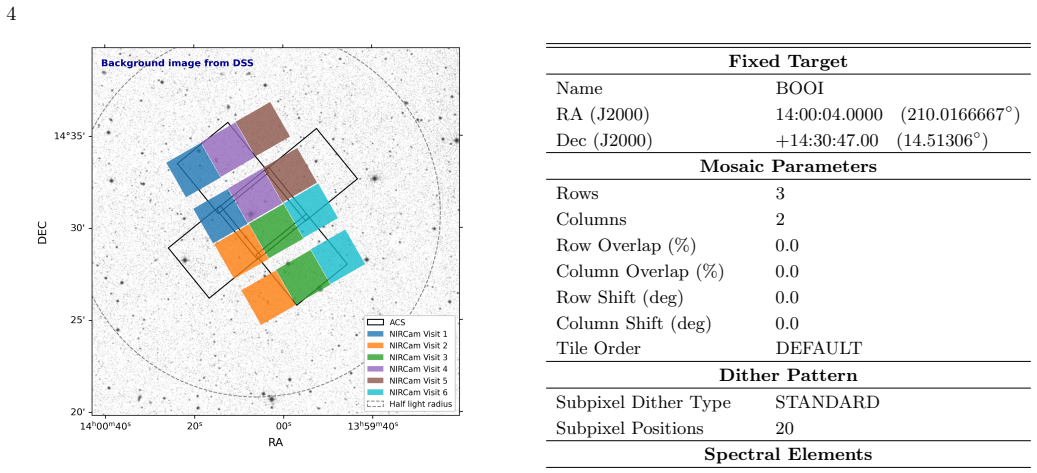


read the original abstract
The dependence of the stellar initial mass function (IMF) on star-formation environment, particularly at low metallicities and high redshifts, remains poorly constrained. Ultra-faint dwarf galaxies (UFDs) are local fossils of high-redshift galaxies hosting old, metal-poor populations, and their resolved stellar populations provide unique pathways to constrain the sub-solar IMF. We investigate the low-mass IMF in the Bo\"otes I (Boo I) UFD with JWST/NIRCam, leveraging its capability to resolve over 10,000 stars reaching $\lesssim0.15 M_{\odot}$, obtaining one of the largest, deepest resolved stellar samples for UFDs. We explore three different functional forms of the IMF with machine learning and statistical techniques, combining forward modeling of synthetic color-magnitude diagrams with simulation-based inference. We find that a single power-law IMF fails to reproduce the observed luminosity function and also deviates from the canonical Salpeter IMF. Our best-fit broken power-law and lognormal IMF parameters are consistent with the Milky Way within 68% confidence level, providing evidence that star formation at metallicities as low as [Fe/H]$\approx-2.4$ follows a similar IMF as in the Milky Way. By treating Boo I as a local relic analogous to a high-redshift galaxy with a stellar mass of $\lesssim10^5 M_{\odot}$ at $z\gtrsim6$, our results provide evidence for the universality of the IMF across both local and high-redshift environments.
Editorial analysis
A structured set of objections, weighed in public.
Referee Report
Summary. This manuscript reports JWST/NIRCam observations of the Boötes I ultra-faint dwarf galaxy, resolving over 10,000 stars down to ≲0.15 M⊙. Using forward modeling of synthetic color-magnitude diagrams combined with simulation-based inference, the authors fit single power-law, broken power-law, and lognormal IMF forms. They find the single power-law inadequate while the best-fit broken power-law and lognormal parameters are consistent with Milky Way values within 68% CL, concluding that star formation at [Fe/H]≈−2.4 follows a similar IMF and treating Boötes I as a local analog to high-redshift galaxies with stellar mass ≲10^5 M⊙ at z≳6 to argue for IMF universality.
Significance. If the result holds, the work supplies one of the deepest resolved low-mass IMF constraints in a metal-poor UFD, bridging local fossils to high-redshift star formation. The use of simulation-based inference for forward modeling of the luminosity function is a clear methodological strength, allowing direct comparison to external data without circularity in the fitting. This has potential implications for star-formation physics across metallicities and epochs.
major comments (2)
- [Abstract] Abstract: the central claim that best-fit broken power-law and lognormal parameters are consistent with the Milky Way at 68% CL is load-bearing for the universality conclusion, yet the abstract provides no details on how systematic uncertainties (binary fractions, completeness corrections, or dynamical processing) enter the simulation-based inference; these effects could shift the posteriors and undermine the reported consistency.
- [Abstract] Abstract (final paragraph): the extension to high-redshift universality rests on Boötes I being an unaltered relic with negligible mass segregation or binary disruption relative to a z≳6 galaxy of similar mass; without direct constraints on these processes from the data, the low-mass IMF inference risks being biased toward Milky Way values even if the true primordial IMF differed.
minor comments (1)
- [Abstract] The abstract refers to 'machine learning and statistical techniques' without naming the specific SBI implementation or priors; adding a brief methods reference would improve clarity for readers.
Simulated Author's Rebuttal
We thank the referee for the constructive and detailed review. We address the two major comments point by point below, clarifying how the simulation-based inference framework handles the relevant systematics and justifying the high-redshift analogy while acknowledging its assumptions. Revisions will be made to the abstract as indicated.
read point-by-point responses
-
Referee: [Abstract] Abstract: the central claim that best-fit broken power-law and lognormal parameters are consistent with the Milky Way at 68% CL is load-bearing for the universality conclusion, yet the abstract provides no details on how systematic uncertainties (binary fractions, completeness corrections, or dynamical processing) enter the simulation-based inference; these effects could shift the posteriors and undermine the reported consistency.
Authors: We agree that the abstract would benefit from explicit mention of how systematics are treated. The full manuscript describes a forward-modeling approach in which synthetic CMDs are generated with a fixed binary fraction and mass-ratio distribution drawn from Milky Way observations, completeness and photometric errors are injected via artificial-star tests performed on the actual JWST images, and dynamical processing is incorporated by adopting the observed structural parameters of Boötes I (which imply long relaxation times at the low-mass end). These ingredients are propagated through the simulation-based inference so that the reported 68 % CL consistency already reflects the modeled uncertainties. We will revise the abstract to include a concise clause stating that binary fractions, completeness corrections, and dynamical effects are included in the forward modeling. revision: yes
-
Referee: [Abstract] Abstract (final paragraph): the extension to high-redshift universality rests on Boötes I being an unaltered relic with negligible mass segregation or binary disruption relative to a z≳6 galaxy of similar mass; without direct constraints on these processes from the data, the low-mass IMF inference risks being biased toward Milky Way values even if the true primordial IMF differed.
Authors: We acknowledge that the JWST data do not furnish direct, independent constraints on mass segregation or binary disruption. The manuscript instead relies on Boötes I’s low stellar mass (≲10^5 M⊙), low central density, and long two-body relaxation time (estimated from its structural parameters and compared with N-body simulations in the literature) to argue that dynamical processing has not significantly altered the low-mass end of the present-day mass function. Binary populations are modeled with a standard fraction and mass-ratio distribution; any residual bias would therefore be common to both the Boötes I and Milky Way analyses. We will expand the final sentence of the abstract to reference these supporting arguments from the main text, making the analogy more transparent while preserving the cautious wording already present. revision: partial
Circularity Check
No significant circularity: IMF fit derived from independent Boötes I observations
full rationale
The paper performs forward modeling of synthetic CMDs against the observed JWST luminosity function in Boötes I using simulation-based inference to constrain broken power-law and lognormal IMF parameters. These parameters are then compared post-hoc to Milky Way values at 68% CL. No step reduces by construction to prior fits, self-citations, or ansatzes; the central result is a data-driven consistency check rather than a tautology. The analog treatment of Boötes I as a high-z relic is an interpretive framing, not a load-bearing derivation that forces the outcome.
Axiom & Free-Parameter Ledger
free parameters (2)
- IMF power-law slopes and break mass
- Lognormal characteristic mass and dispersion
axioms (2)
- domain assumption Stellar evolution isochrones accurately predict luminosities and colors for low-mass stars at [Fe/H] ≈ -2.4.
- domain assumption Distance, age, and reddening of Boötes I are known to sufficient precision.
Lean theorems connected to this paper
-
IndisputableMonolith/Cost/FunctionalEquation.leanwashburn_uniqueness_aczel unclear?
unclearRelation between the paper passage and the cited Recognition theorem.
We use Starwave... Simulation-based Inference (SBI... SNPE) to perform Bayesian parameter estimation... three different IMF parameterizations, including a single power law (SPL), a broken power law (BPL), and a log-normal function (LN)
-
IndisputableMonolith/Foundation/AlphaCoordinateFixation.leanJ_uniquely_calibrated_via_higher_derivative unclear?
unclearRelation between the paper passage and the cited Recognition theorem.
Our best-fit broken power-law and lognormal IMF parameters are consistent with the Milky Way within 68% confidence level
What do these tags mean?
- matches
- The paper's claim is directly supported by a theorem in the formal canon.
- supports
- The theorem supports part of the paper's argument, but the paper may add assumptions or extra steps.
- extends
- The paper goes beyond the formal theorem; the theorem is a base layer rather than the whole result.
- uses
- The paper appears to rely on the theorem as machinery.
- contradicts
- The paper's claim conflicts with a theorem or certificate in the canon.
- unclear
- Pith found a possible connection, but the passage is too broad, indirect, or ambiguous to say the theorem truly supports the claim.
Reference graph
Works this paper leans on
-
[1]
Astropy Collaboration, Robitaille, T. P., Tollerud, E. J., et al. 2013, A&A, 558, A33, doi: 10.1051/0004-6361/201322068 Astropy Collaboration, Price-Whelan, A. M., Sip˝ ocz, B. M., et al. 2018, AJ, 156, 123, doi: 10.3847/1538-3881/aabc4f Astropy Collaboration, Price-Whelan, A. M., Lim, P. L., et al. 2022, ApJ, 935, 167, doi: 10.3847/1538-4357/ac7c74
-
[2]
Bastian, N., Covey, K. R., & Meyer, M. R. 2010, ARA&A, 48, 339, doi: 10.1146/annurev-astro-082708-101642
-
[3]
Bate, M. R. 2014, MNRAS, 442, 285, doi: 10.1093/mnras/stu795
-
[4]
Bate, M. R. 2019, MNRAS, 484, 2341, doi: 10.1093/mnras/stz103
-
[5]
2022, MNRAS, 510, 3531, doi: 10.1093/mnras/stab3629
Baumgardt, H., Faller, J., Meinhold, N., McGovern-Greco, C., & Hilker, M. 2022, MNRAS, 510, 3531, doi: 10.1093/mnras/stab3629
-
[6]
Belokurov, V., Zucker, D. B., Evans, N. W., et al. 2006, ApJL, 647, L111, doi: 10.1086/507324
-
[7]
2019, ApJ, 881, 160, doi: 10.3847/1538-4357/ab2fd1
Bialy, S., & Sternberg, A. 2019, ApJ, 881, 160, doi: 10.3847/1538-4357/ab2fd1
-
[8]
Bovill, M. S., & Ricotti, M. 2009, ApJ, 693, 1859, doi: 10.1088/0004-637X/693/2/1859
-
[9]
Bovill, M. S., & Ricotti, M. 2011, ApJ, 741, 17, doi: 10.1088/0004-637X/741/1/17
-
[10]
M., Tumlinson, J., Geha, M., et al
Brown, T. M., Tumlinson, J., Geha, M., et al. 2014, ApJ, 796, 91, doi: 10.1088/0004-637X/796/2/91
-
[11]
2020, A&A Rv, 28, 5, doi: 10.1007/s00159-020-00127-y
Cassisi, S., & Salaris, M. 2020, A&A Rv, 28, 5, doi: 10.1007/s00159-020-00127-y
-
[12]
Chabrier, G. 2003, PASP, 115, 763, doi: 10.1086/376392
work page internal anchor Pith review doi:10.1086/376392 2003
-
[13]
2021, in American Astronomical Society Meeting Abstracts, Vol
Chandra, V., & Gennaro, M. 2021, in American Astronomical Society Meeting Abstracts, Vol. 237, American Astronomical Society Meeting Abstracts #237, 329.02
work page 2021
-
[14]
E., Gennaro, M., Correnti, M., McQuinn, K
Cohen, R. E., Gennaro, M., Correnti, M., McQuinn, K. B. W., & Chandra, V. 2026, ApJ, 1000, 151, doi: 10.3847/1538-4357/ae4720
-
[15]
2020, Proceedings of the National Academy of Science, 117, 30055, doi: 10.1073/pnas.1912789117
Cranmer, K., Brehmer, J., & Louppe, G. 2020, Proceedings of the National Academy of Science, 117, 30055, doi: 10.1073/pnas.1912789117
-
[16]
Dolphin, A. 2016, DOLPHOT: Stellar photometry,, Astrophysics Source Code Library, record ascl:1608.013 http://ascl.net/1608.013
work page 2016
-
[17]
Dolphin, A. E. 2000, PASP, 112, 1383, doi: 10.1086/316630
-
[18]
J., Choi, Y., Savino, A., et al
Durbin, M. J., Choi, Y., Savino, A., et al. 2025, ApJ, 992, 106, doi: 10.3847/1538-4357/ae00c8
-
[19]
El-Badry, K., Weisz, D. R., & Quataert, E. 2017, MNRAS, 468, 319, doi: 10.1093/mnras/stx436
-
[20]
Filion, C., Platais, I., Wyse, R. F. G., & Kozhurina-Platais, V. 2022, ApJ, 939, 38, doi: 10.3847/1538-4357/ac9383
-
[21]
Filion, C., Wyse, R. F. G., Richstein, H., et al. 2024, ApJ, 967, 165, doi: 10.3847/1538-4357/ad4020
-
[22]
2010, Astronomische Nachrichten, 331, 474, doi: 10.1002/asna.201011362
Frebel, A. 2010, Astronomische Nachrichten, 331, 474, doi: 10.1002/asna.201011362
-
[23]
Frebel, A., Norris, J. E., Gilmore, G., & Wyse, R. F. G. 2016, ApJ, 826, 110, doi: 10.3847/0004-637X/826/2/110
-
[24]
Geha, M., Pelliccia, D., Prochaska, J. X., et al. 2026, arXiv e-prints, arXiv:2602.10200, doi: 10.48550/arXiv.2602.10200
-
[25]
Geha, M., Brown, T. M., Tumlinson, J., et al. 2013, ApJ, 771, 29, doi: 10.1088/0004-637X/771/1/29
-
[26]
2026, starwave, v0.0 Zenodo, doi: 10.5281/zenodo.19863170
Gennaro, M., Ding, K., & Chandra, V. 2026, starwave, v0.0 Zenodo, doi: 10.5281/zenodo.19863170
-
[27]
Gennaro, M., Tchernyshyov, K., Brown, T. M., et al. 2018a, ApJ, 855, 20, doi: 10.3847/1538-4357/aaa973
-
[28]
2018b, ApJ, 863, 38, doi: 10.3847/1538-4357/aaceff
Gennaro, M., Geha, M., Tchernyshyov, K., et al. 2018b, ApJ, 863, 38, doi: 10.3847/1538-4357/aaceff
-
[29]
Girardi, L., Barbieri, M., Groenewegen, M. A. T., et al. 2012, in Astrophysics and Space Science Proceedings, Vol. 26, Red Giants as Probes of the Structure and Evolution of the Milky Way, ed. A. Miglio, J. Montalb´ an, & A. Noels, 165, doi: 10.1007/978-3-642-18418-5 17
-
[30]
Automatic Posterior Transformation for Likelihood-Free Inference
Greenberg, D. S., Nonnenmacher, M., & Macke, J. H. 2019, arXiv e-prints, arXiv:1905.07488, doi: 10.48550/arXiv.1905.07488
work page internal anchor Pith review Pith/arXiv arXiv doi:10.48550/arxiv.1905.07488 2019
-
[31]
2008, A&A, 486, 951, doi: 10.1051/0004-6361:200809724
Gustafsson, B., Edvardsson, B., Eriksson, K., et al. 2008, A&A, 486, 951, doi: 10.1051/0004-6361:200809724
-
[32]
Harris, C. R., Millman, K. J., van der Walt, S. J., et al. 2020, Nature, 585, 357, doi: 10.1038/s41586-020-2649-2
-
[33]
, archivePrefix = "arXiv", eprint =
Hopkins, P. F., Quataert, E., & Murray, N. 2011, MNRAS, 417, 950, doi: 10.1111/j.1365-2966.2011.19306.x
-
[34]
Hunter, J. D. 2007, Computing in Science & Engineering, 9, 90, doi: 10.1109/MCSE.2007.55
-
[35]
S., Anderson, J., Dotter, A., et al
Kalirai, J. S., Anderson, J., Dotter, A., et al. 2013, ApJ, 763, 110, doi: 10.1088/0004-637X/763/2/110
-
[36]
Klessen, R. S., & Glover, S. C. O. 2023, ARA&A, 61, 65, doi: 10.1146/annurev-astro-071221-053453
-
[37]
2001, MNRAS, 322, 231, doi: 10.1046/j.1365-8711.2001.04022.x
Kroupa, P. 2001, MNRAS, 322, 231, doi: 10.1046/j.1365-8711.2001.04022.x
-
[38]
2013, in Planets, Stars and Stellar Systems
Kroupa, P., Weidner, C., Pflamm-Altenburg, J., et al. 2013, in Planets, Stars and Stellar Systems. Volume 5: Galactic Structure and Stellar Populations, ed. T. D. Oswalt & G. Gilmore, Vol. 5, 115, doi: 10.1007/978-94-007-5612-0 4
-
[39]
Legnardi, M. V., Muratore, F., Milone, A. P., et al. 2025, A&A, 702, A180, doi: 10.1051/0004-6361/202556239
-
[40]
Lemaire, L., Jay, F., Lee, I.-H., Csill´ ery, K., & Blum, M. G. B. 2016, arXiv e-prints, arXiv:1601.04096, doi: 10.48550/arXiv.1601.04096 26
work page internal anchor Pith review Pith/arXiv arXiv doi:10.48550/arxiv.1601.04096 2016
-
[41]
Lueckmann, J.-M., Goncalves, P. J., Bassetto, G., et al. 2017, in Advances in Neural Information Processing Systems, ed. I. Guyon, U. V. Luxburg, S. Bengio, H. Wallach, R. Fergus, S. Vishwanathan, & R. Garnett, Vol. 30 (Curran Associates, Inc.). https://proceedings.neurips.cc/paper files/paper/2017/ file/addfa9b7e234254d26e9c7f2af1005cb-Paper.pdf Mu˜ noz,...
-
[42]
Myers, A. T., Krumholz, M. R., Klein, R. I., & McKee, C. F. 2011, ApJ, 735, 49, doi: 10.1088/0004-637X/735/1/49
-
[43]
Offner, S. S. R., Clark, P. C., Hennebelle, P., et al. 2014, in Protostars and Planets VI, ed. H. Beuther, R. S. Klessen, C. P. Dullemond, & T. Henning, 53–75, doi: 10.2458/azu uapress 9780816531240-ch003
work page doi:10.2458/azu 2014
-
[44]
2012, ApJ, 744, 96, doi: 10.1088/0004-637X/744/2/96
Okamoto, S., Arimoto, N., Yamada, Y., & Onodera, M. 2012, ApJ, 744, 96, doi: 10.1088/0004-637X/744/2/96
-
[45]
Pacifici, C., Charlot, S., Blaizot, J., & Brinchmann, J. 2012, MNRAS, 421, 2002, doi: 10.1111/j.1365-2966.2012.20431.x
-
[46]
Gardner, J. P. 2013, ApJL, 762, L15, doi: 10.1088/2041-8205/762/1/L15
-
[47]
2016, in Advances in Neural Information Processing Systems, ed
Papamakarios, G., & Murray, I. 2016, in Advances in Neural Information Processing Systems, ed. D. Lee, M. Sugiyama, U. Luxburg, I. Guyon, & R. Garnett, Vol. 29 (Curran Associates, Inc.). https://proceedings.neurips.cc/paper files/paper/2016/ file/6aca97005c68f1206823815f66102863-Paper.pdf
work page 2016
-
[48]
2021, ApJ, 908, 102, doi: 10.3847/1538-4357/abd4d5
Pietrinferni, A., Hidalgo, S., Cassisi, S., et al. 2021, ApJ, 908, 102, doi: 10.3847/1538-4357/abd4d5
-
[49]
Ricotti, M., & Gnedin, N. Y. 2005, ApJ, 629, 259, doi: 10.1086/431415
-
[50]
Rocha, M., Peter, A. H. G., & Bullock, J. 2012, MNRAS, 425, 231, doi: 10.1111/j.1365-2966.2012.21432.x
-
[51]
Safarzadeh, M., Simon, J. D., & Loeb, A. 2022, ApJ, 930, 54, doi: 10.3847/1538-4357/ac626e
-
[52]
Salpeter, E. E. 1955, ApJ, 121, 161, doi: 10.1086/145971
-
[53]
Sandford, N. R., Li, T. S., Koposov, S. E., et al. 2026, ApJ, 998, 47, doi: 10.3847/1538-4357/ae2fe5
-
[54]
Maps of Dust IR Emission for Use in Estimation of Reddening and CMBR Foregrounds
Schlegel, D. J., Finkbeiner, D. P., & Davis, M. 1998, ApJ, 500, 525, doi: 10.1086/305772
work page internal anchor Pith review doi:10.1086/305772 1998
-
[55]
Sharda, P., & Krumholz, M. R. 2022, MNRAS, 509, 1959, doi: 10.1093/mnras/stab2921
-
[56]
2025, PASP, 137, 104103, doi: 10.1088/1538-3873/ae11d2
Shariat, C., El-Badry, K., Gennaro, M., et al. 2025, PASP, 137, 104103, doi: 10.1088/1538-3873/ae11d2
-
[57]
Sitnova, T. M., Mashonkina, L. I., Tatarnikov, A. M., et al. 2021, MNRAS, 504, 1183, doi: 10.1093/mnras/stab786 STScI Development Team. 2018, synphot: Synthetic photometry using Astropy,, Astrophysics Source Code Library, record ascl:1811.001 http://ascl.net/1811.001
-
[58]
Sunnquist, B., Boyer, M., Brooks, B., et al. 2025, Version 4 of the NIRCam Wisp Templates: Wisp Characterization, Stability, and Validation Testing, Tech. Rep. Technical Report JWST-STScI-009225, STScI
work page 2025
-
[59]
Tanvir, T. S., & Krumholz, M. R. 2024, MNRAS, 527, 7306, doi: 10.1093/mnras/stad3581
-
[60]
2020, Journal of Open Source Software, 5, 2505, doi: 10.21105/joss.02505
Tejero-Cantero, A., Boelts, J., Deistler, M., et al. 2020, Journal of Open Source Software, 5, 2505, doi: 10.21105/joss.02505
-
[61]
VandenBerg, D. A. 2023, MNRAS, 518, 4517, doi: 10.1093/mnras/stac3270
-
[62]
2014, ApJ, 794, 72, doi: 10.1088/0004-637X/794/1/72
Edvardsson, B. 2014, ApJ, 794, 72, doi: 10.1088/0004-637X/794/1/72
-
[63]
Ferguson, J. W. 2022, MNRAS, 509, 4189, doi: 10.1093/mnras/stab2996
-
[64]
Virtanen, P., Gommers, R., Oliphant, T. E., et al. 2020, Nature Methods, 17, 261, doi: 10.1038/s41592-019-0686-2
-
[65]
T., Richstein, H., Kallivayalil, N., et al
Warfield, J. T., Richstein, H., Kallivayalil, N., et al. 2023, Research Notes of the American Astronomical Society, 7, 23, doi: 10.3847/2515-5172/acbb72
-
[66]
C., Fragione, G., Kremer, K., et al
Weatherford, N. C., Fragione, G., Kremer, K., et al. 2021, ApJL, 907, L25, doi: 10.3847/2041-8213/abd79c
-
[67]
Weisz, D. R., Dolphin, A. E., Skillman, E. D., et al. 2015, ApJ, 804, 136, doi: 10.1088/0004-637X/804/2/136
-
[68]
Weisz, D. R., Dolphin, A. E., Savino, A., et al. 2024, ApJS, 271, 47, doi: 10.3847/1538-4365/ad2600
-
[69]
2000, in Advances in Neural Information Processing Systems, ed
Williams, C., & Seeger, M. 2000, in Advances in Neural Information Processing Systems, ed. T. Leen, T. Dietterich, & V. Tresp, Vol. 13 (MIT Press). https://proceedings.neurips.cc/paper files/paper/2000/ file/19de10adbaa1b2ee13f77f679fa1483a-Paper.pdf
work page 2000
-
[70]
Wyse, R. F. G., Gilmore, G., Houdashelt, M. L., et al. 2002, NewA, 7, 395, doi: 10.1016/S1384-1076(02)00156-2
-
[71]
2023, A&A, 670, A151, doi: 10.1051/0004-6361/202244919
Yan, Z., Jerabkova, T., & Kroupa, P. 2023, A&A, 670, A151, doi: 10.1051/0004-6361/202244919
-
[72]
2024, ApJ, 975, 152, doi: 10.3847/1538-4357/ad73a2
Yasui, C., Izumi, N., Saito, M., et al. 2024, ApJ, 975, 152, doi: 10.3847/1538-4357/ad73a2
discussion (0)
Sign in with ORCID, Apple, or X to comment. Anyone can read and Pith papers without signing in.