pop-cosmos: Disentangling galaxy properties from observables using data-driven approaches
Pith reviewed 2026-06-27 12:32 UTC · model grok-4.3
The pith
Five independent dimensions describe the essential information in galaxy rest-frame optical spectra.
A machine-rendered reading of the paper's core claim, the machinery that carries it, and where it could break.
Core claim
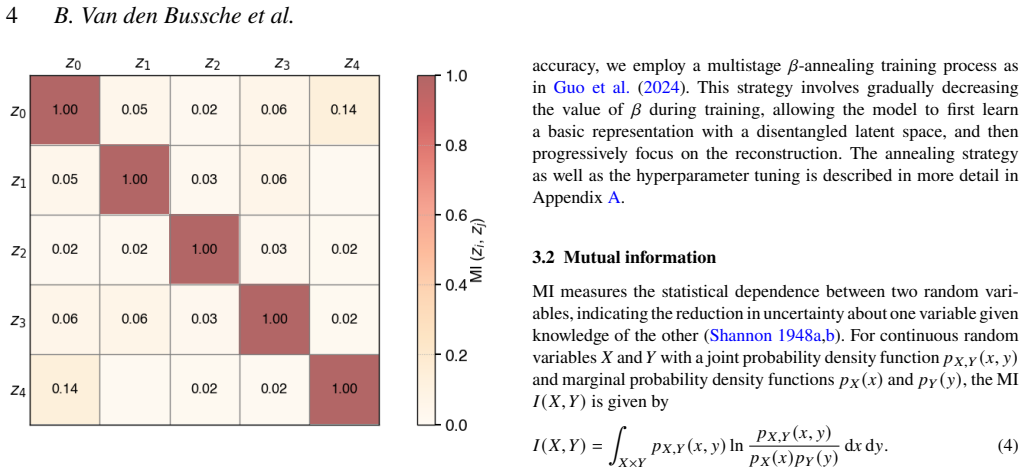
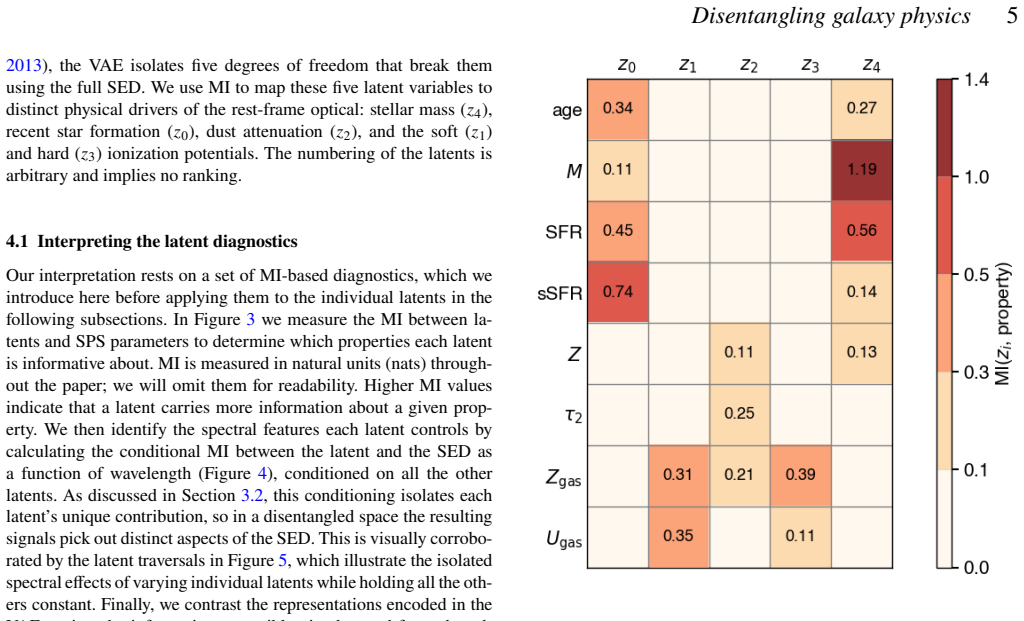
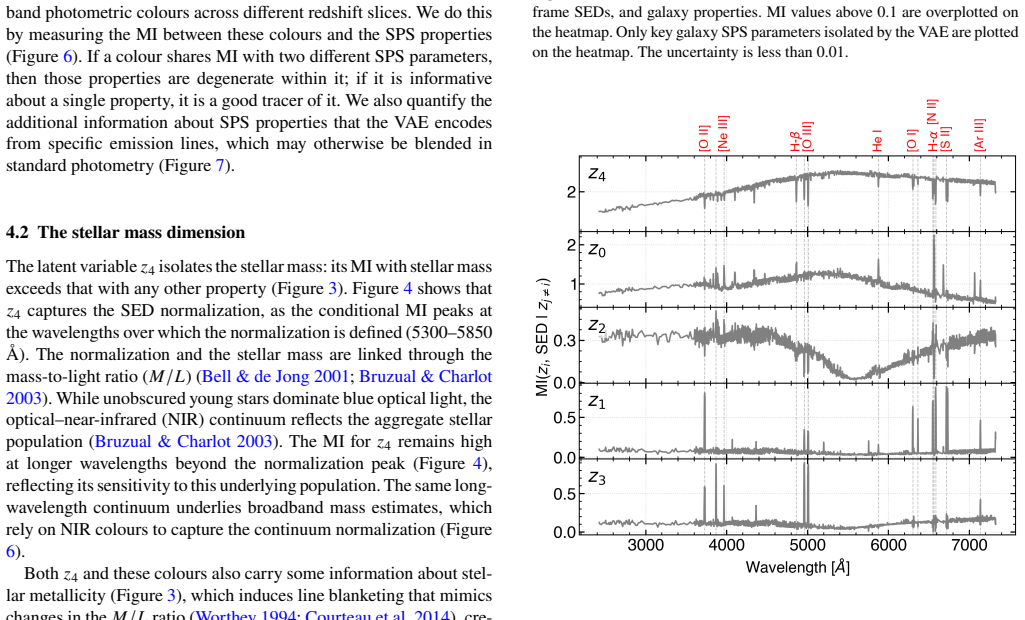
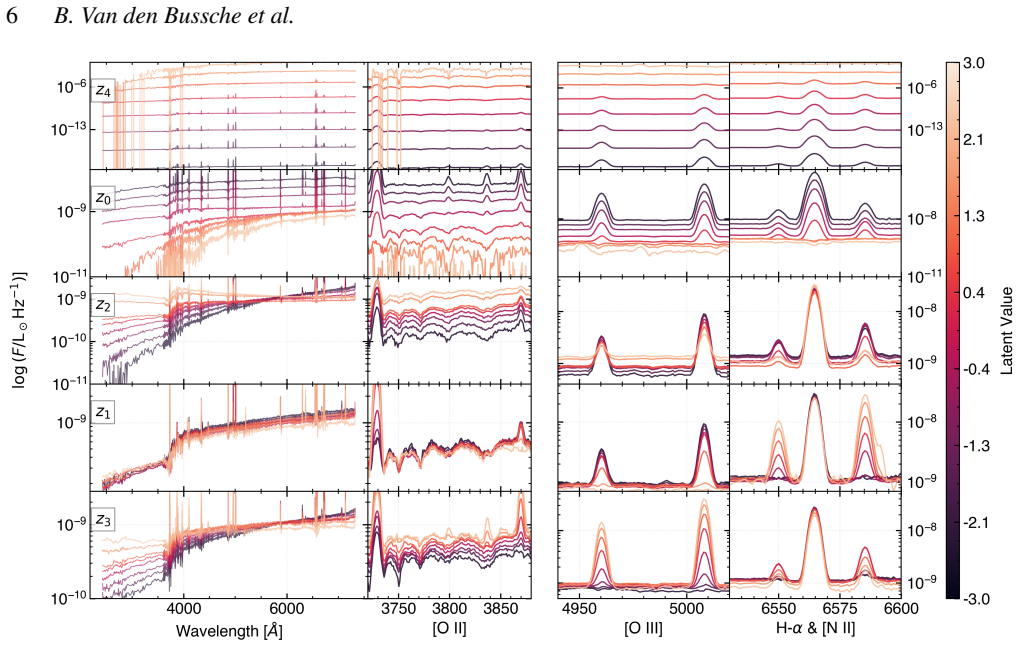
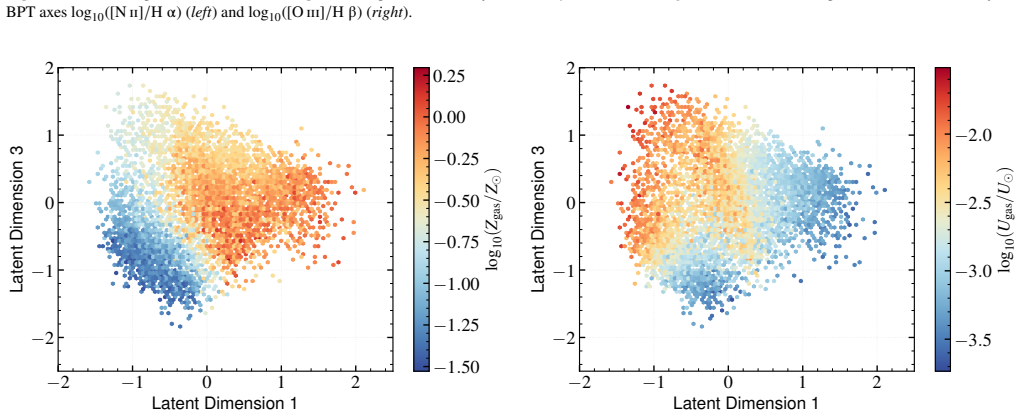
A beta variational autoencoder compresses a 16-parameter stellar population synthesis description into a disentangled latent representation whose dimensions are interpreted through mutual information. Five independent dimensions suffice to describe the rest-frame optical SED and map to stellar mass, recent star formation, dust, and two degrees of freedom in the ionization state of the gas. Stellar metallicity and stellar age are not among these primary drivers because their spectral effects are distributed across the others rather than independently encoded.
What carries the argument
A beta variational autoencoder that compresses 16 stellar population synthesis parameters into a disentangled latent space, with each dimension validated by mutual information against physical quantities.
If this is right
- Stellar metallicity and age effects are absorbed into the five primary dimensions rather than requiring separate ones.
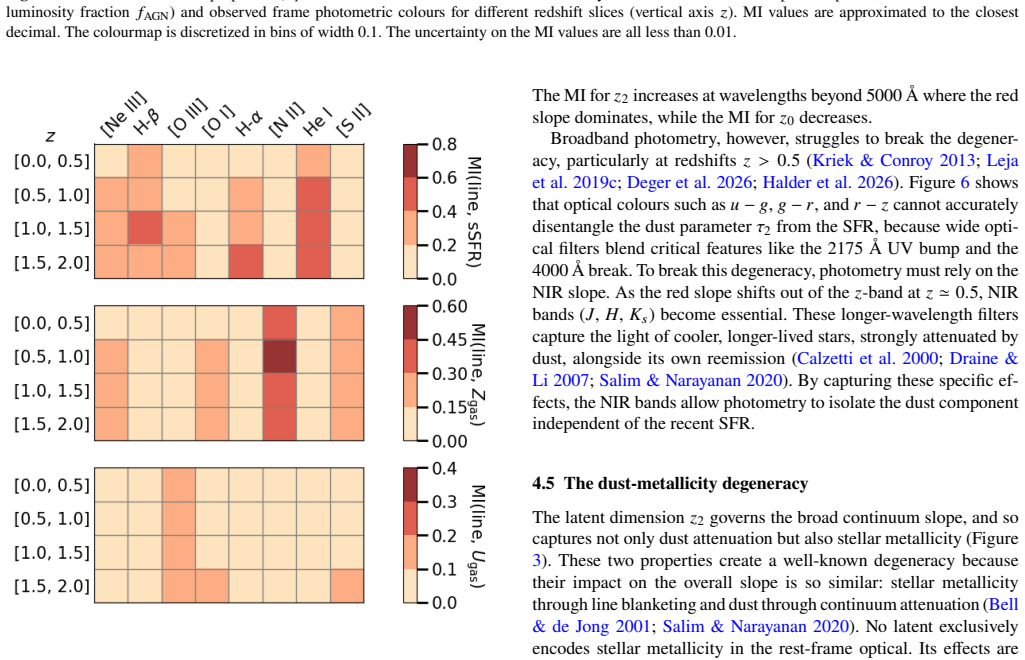
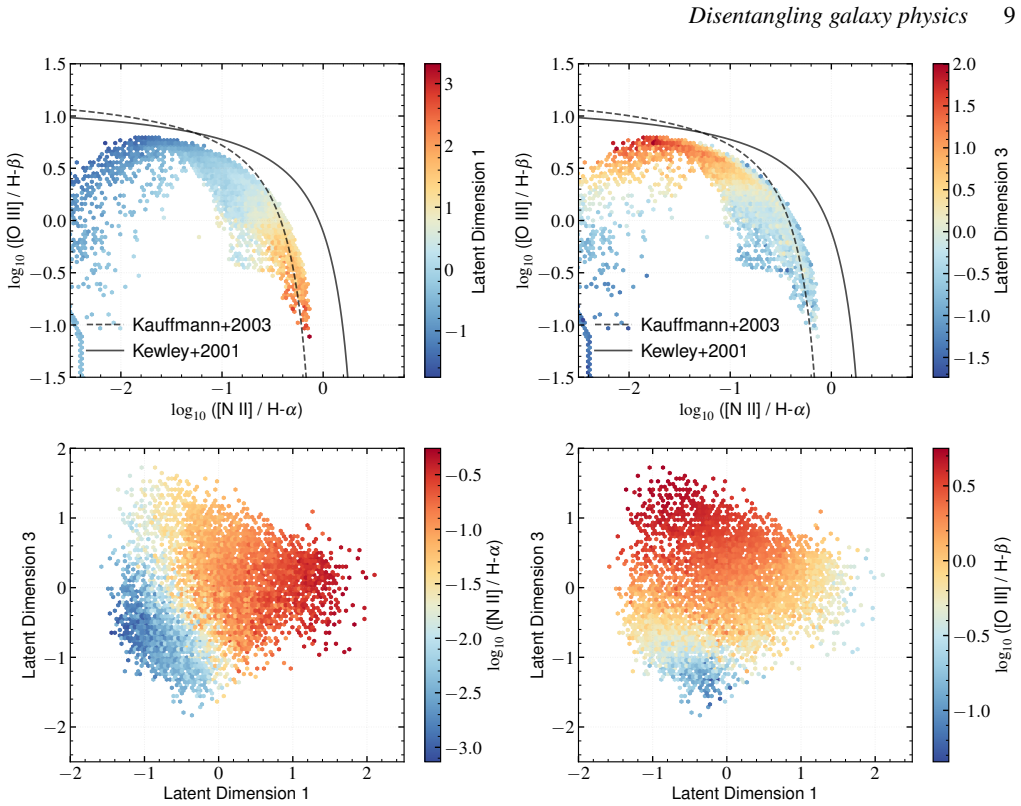
- Only two degrees of freedom are required to describe gas ionization conditions, fewer than the three or four assumed in standard nebular models.
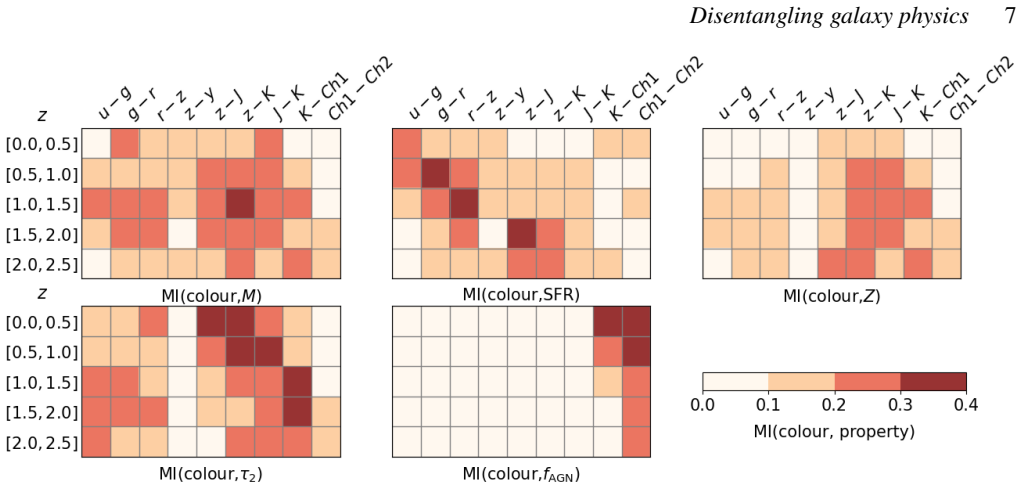
- Each dimension can be tied to specific spectral features, which breaks the star-formation, dust, and metallicity degeneracies that affect broadband photometry.
- Physical conditions of the gas are recovered more cleanly than is possible with conventional line-ratio diagnostics.
Where Pith is reading between the lines
- The five-dimensional structure could be tested by projecting real survey spectra onto the same latent space and measuring reconstruction accuracy.
- Parameter spaces in galaxy evolution simulations might be reduced to these core dimensions while retaining the main observable variations.
- Survey strategies could prioritize wavelength coverage around the spectral features associated with each dimension to improve efficiency of property estimation.
Load-bearing premise
The generative galaxy population model used to produce the training data accurately represents the physical processes and degeneracies present in real observations.
What would settle it
Extracting independent components directly from a large set of real galaxy spectra observed by spectroscopic surveys and checking whether five dimensions reproduce the observed variations as well as the model-derived dimensions do.
Figures
read the original abstract
The physical processes that shape a galaxy's spectrum are strongly degenerate in observations, obscuring which processes act independently. Leveraging the pop-cosmos generative galaxy population model, we investigate how many independent degrees of freedom the rest-frame optical SED contains. We use a $\beta$-variational autoencoder (VAE) to compress a 16-parameter stellar population synthesis (SPS) description into a disentangled latent representation interpreted through mutual information (MI). We find that five independent dimensions suffice, corresponding to stellar mass, recent star formation, dust, and two -- not the three or four assumed by standard nebular models -- degrees of freedom in the ionization state of the gas. Stellar metallicity and stellar age are not among these primary drivers; their spectral effects are distributed across the others rather than independently encoded. By tying each dimension to specific spectral features, this decomposition breaks the star-formation--dust--metallicity degeneracies that limit broadband photometry, and recovers the physical conditions of the gas more cleanly than the line-ratio diagnostics in standard use.
Editorial analysis
A structured set of objections, weighed in public.
Referee Report
Summary. The paper claims that a β-variational autoencoder trained on synthetic rest-frame optical SEDs from the pop-cosmos 16-parameter SPS generative model compresses the data into five independent latent dimensions. These map via mutual information to stellar mass, recent star formation, dust, and two (rather than three or four) degrees of freedom in gas ionization state; stellar metallicity and age effects are distributed across the others. The decomposition is presented as breaking star-formation–dust–metallicity degeneracies that affect broadband photometry and as recovering gas conditions more cleanly than standard line-ratio diagnostics.
Significance. If the result holds and generalizes, the work would supply a data-driven route to identify the minimal independent physical drivers encoded in galaxy SEDs and a practical compression that could reduce degeneracies in photometric and spectroscopic inference for large surveys.
major comments (2)
- [Abstract] Abstract: the claim that the five dimensions correspond to the independent physical drivers 'present in the rest-frame optical SED' and that the method 'breaks the star-formation–dust–metallicity degeneracies that limit broadband photometry' rests entirely on synthetic SEDs generated inside pop-cosmos; no external validation against real survey spectra or comparison of joint distributions is shown, so the mapping to real-galaxy degeneracies remains untested.
- [Abstract] Abstract: the assertion that the decomposition 'recovers the physical conditions of the gas more cleanly than the line-ratio diagnostics in standard use' is not accompanied by any quantitative metric, baseline comparison, or test on held-out synthetic or real data that would establish superiority.
minor comments (1)
- The abstract refers to mutual-information attribution but supplies no description of how MI is computed, normalized, or thresholded, which is needed to assess the robustness of the dimension-to-feature mapping.
Simulated Author's Rebuttal
We thank the referee for their careful reading and constructive feedback on our manuscript. We respond to the major comments below.
read point-by-point responses
-
Referee: [Abstract] Abstract: the claim that the five dimensions correspond to the independent physical drivers 'present in the rest-frame optical SED' and that the method 'breaks the star-formation–dust–metallicity degeneracies that limit broadband photometry' rests entirely on synthetic SEDs generated inside pop-cosmos; no external validation against real survey spectra or comparison of joint distributions is shown, so the mapping to real-galaxy degeneracies remains untested.
Authors: We agree that the entire analysis, including the identification of five latent dimensions and their physical mappings via mutual information, is performed on synthetic rest-frame optical SEDs generated from the pop-cosmos 16-parameter model. The manuscript does not include external validation on real survey spectra or direct comparisons of joint distributions with observed data. The pop-cosmos model is constructed to reproduce key observed galaxy population statistics, so the degeneracies identified are those present under the model's assumptions; however, we do not claim that the mapping has been tested on real galaxies. We will revise the abstract to make the synthetic nature of the data and the scope of the claims explicit. revision: partial
-
Referee: [Abstract] Abstract: the assertion that the decomposition 'recovers the physical conditions of the gas more cleanly than the line-ratio diagnostics in standard use' is not accompanied by any quantitative metric, baseline comparison, or test on held-out synthetic or real data that would establish superiority.
Authors: The abstract statement is grounded in the mutual information results showing that two latent dimensions isolate distinct ionization-state degrees of freedom, whereas standard line-ratio diagnostics (e.g., BPT diagrams) entangle multiple parameters. Nevertheless, the manuscript does not present a quantitative metric (such as predictive accuracy or reconstruction error on held-out synthetic SEDs) or explicit baseline comparison against line-ratio methods. We will add such a quantitative comparison on the held-out synthetic test set to support the claim. revision: yes
Circularity Check
No significant circularity; derivation is a direct compression of the input model outputs.
full rationale
The paper trains a β-VAE on synthetic SEDs generated from its own 16-parameter pop-cosmos SPS model and interprets the resulting latent dimensions via mutual information. This process directly extracts effective degrees of freedom present in the model's parameter space and degeneracy structure by construction, but the provided text contains no self-definitional loop, no fitted parameter renamed as an independent prediction, and no load-bearing self-citation that justifies a uniqueness theorem. The central result (five dimensions suffice, with specific physical mappings) is an empirical outcome of the VAE training rather than a tautological re-expression of the inputs. The assumption that pop-cosmos faithfully represents real galaxies is stated explicitly as a modeling choice, not smuggled in via prior self-citation.
Axiom & Free-Parameter Ledger
Reference graph
Works this paper leans on
-
[1]
and Ralchenko,
Kramida, A. and Ralchenko,. 2024 , month = nov, doi =
2024
-
[2]
Discovering the building blocks of dark matter halo density profiles with neural networks. , keywords =. doi:10.1103/PhysRevD.105.103533 , archivePrefix =. 2203.08827 , primaryClass =
-
[3]
Representation learning approach to probe for dynamical dark energy in matter power spectra. , keywords =. doi:10.1103/PhysRevD.110.023514 , archivePrefix =. 2310.10717 , primaryClass =
-
[4]
CDM and early dark energy in latent space: A data-driven parametrization of the CMB temperature power spectrum. , keywords =. doi:10.1103/PhysRevD.111.083537 , archivePrefix =. 2502.09810 , primaryClass =
-
[5]
Proceedings of the 9th Python in Science Conference , title =
McKinney, Wes , doi =. Proceedings of the 9th Python in Science Conference , title =. 2010 , publisher =
2010
-
[6]
Eliminating error in the chemical abundance scale for extragalactic H II regions. , keywords =. doi:10.1111/j.1365-2966.2012.21145.x , archivePrefix =. 1203.5021 , primaryClass =
-
[7]
Monthly Notices of the Royal Astronomical Society , author=
Inferring physical properties of galaxies from their emission-line spectra , volume=. Monthly Notices of the Royal Astronomical Society , author=. 2017 , month=feb, pages=. doi:10.1093/mnras/stw2836 , number=
-
[8]
Color and Stellar Population Gradients in Passively Evolving Galaxies at z -0.5ex 2 from HST/WFC3 Deep Imaging in the Hubble Ultra Deep Field. , keywords =. doi:10.1088/0004-637X/735/1/18 , archivePrefix =. 1101.0843 , primaryClass =
work page internal anchor Pith review Pith/arXiv arXiv doi:10.1088/0004-637x/735/1/18
-
[9]
The Effects of Dust on Broadband Color Gradients in Elliptical Galaxies. , keywords =. doi:10.1086/177044 , adsurl =
-
[10]
Galaxy masses. Rev.\ Modern Phys. , keywords =. doi:10.1103/RevModPhys.86.47 , archivePrefix =. 1309.3276 , primaryClass =
work page internal anchor Pith review Pith/arXiv arXiv doi:10.1103/revmodphys.86.47
-
[11]
Spectral Classification of Emission-Line Galaxies. , keywords =. doi:10.1086/191166 , adsurl =
-
[12]
Theoretical Evolution of Optical Strong Lines across Cosmic Time
Theoretical Evolution of Optical Strong Lines across Cosmic Time. , keywords =. doi:10.1088/0004-637X/774/2/100 , archivePrefix =. 1307.0508 , primaryClass =
work page internal anchor Pith review Pith/arXiv arXiv doi:10.1088/0004-637x/774/2/100
-
[13]
doi:10.1111/j.1365-2966.2004.07545.x , eprint =
[OIII]/[NII] as an abundance indicator at high redshift. , keywords =. doi:10.1111/j.1365-2966.2004.07591.x , archivePrefix =. astro-ph/0401128 , primaryClass =
-
[14]
De-noising of galaxy optical spectra with autoencoders. , keywords =. doi:10.1093/mnras/stad2709 , archivePrefix =. 2309.02315 , primaryClass =
-
[15]
Measuring the Physical Conditions in High-Redshift Star-Forming Galaxies: Insights from KBSS-MOSFIRE
Measuring the Physical Conditions in High-redshift Star-forming Galaxies: Insights from KBSS-MOSFIRE. , keywords =. doi:10.3847/1538-4357/aae1a5 , archivePrefix =. 1711.08820 , primaryClass =
work page internal anchor Pith review Pith/arXiv arXiv doi:10.3847/1538-4357/aae1a5
-
[16]
Characterizing Extreme Emission-line Galaxies. I. A Four-zone Ionization Model for Very High-ionization Emission. , keywords =. doi:10.3847/1538-4357/ac141b , archivePrefix =. 2105.12765 , primaryClass =
-
[17]
Starbursts in barred spiral galaxies. IV. On young bars and the formation of abundance gradients. , keywords =. doi:10.48550/arXiv.astro-ph/0001286 , archivePrefix =. astro-ph/0001286 , primaryClass =
work page internal anchor Pith review Pith/arXiv arXiv doi:10.48550/arxiv.astro-ph/0001286
-
[18]
The impact of the nitrogen-to-oxygen ratio on ionized nebula diagnostics based on [NII] emission lines. , keywords =. doi:10.1111/j.1365-2966.2009.15145.x , archivePrefix =. 0905.4621 , primaryClass =
-
[19]
Mapping the Diversity of Galaxy Spectra with Deep Unsupervised Machine Learning. , keywords =. doi:10.3847/1538-3881/ac4039 , archivePrefix =. 2112.03425 , primaryClass =
-
[20]
Interpreting the detection of anomalies in SDSS spectra. , keywords =. doi:10.1051/0004-6361/202556339 , archivePrefix =. 2510.05235 , primaryClass =
-
[21]
Identifying Anomalous DESI Galaxy Spectra with a Variational Autoencoder. , keywords =. doi:10.1093/mnras/stag010 , archivePrefix =. 2506.17376 , primaryClass =
-
[22]
Very Strong Emission-Line Galaxies in the WISP Survey and Implications for High-Redshift Galaxies
Very Strong Emission-line Galaxies in the WFC3 Infrared Spectroscopic Parallel Survey and Implications for High-redshift Galaxies. , keywords =. doi:10.1088/0004-637X/743/2/121 , archivePrefix =. 1109.0639 , primaryClass =
work page internal anchor Pith review Pith/arXiv arXiv doi:10.1088/0004-637x/743/2/121
-
[23]
The Stellar Populations and Evolution of Lyman Break Galaxies
The Stellar Populations and Evolution of Lyman Break Galaxies. , keywords =. doi:10.1086/322412 , archivePrefix =. astro-ph/0105087 , primaryClass =
work page internal anchor Pith review Pith/arXiv arXiv doi:10.1086/322412
-
[24]
Improving the full spectrum fitting method: accurate convolution with Gauss-Hermite functions
Improving the full spectrum fitting method: accurate convolution with Gauss-Hermite functions. , keywords =. doi:10.1093/mnras/stw3020 , archivePrefix =. 1607.08538 , primaryClass =
work page internal anchor Pith review Pith/arXiv arXiv doi:10.1093/mnras/stw3020
-
[25]
Optical-IR Spectral Energy Distributions of z>2 Lyman Break Galaxies
Optical-Infrared Spectral Energy Distributions of Z > 2 Lyman Break Galaxies. , keywords =. doi:10.1086/300291 , archivePrefix =. astro-ph/9712216 , primaryClass =
work page internal anchor Pith review Pith/arXiv arXiv doi:10.1086/300291
-
[26]
The BPT Diagram in Cosmological Galaxy Formation Simulations: Understanding the Physics Driving Offsets at High Redshift. , keywords =. doi:10.3847/1538-4357/ac43b8 , archivePrefix =. 2201.03564 , primaryClass =
-
[27]
Quantifying correlations between galaxy emission lines and stellar continua
Quantifying correlations between galaxy emission lines and stellar continua. , keywords =. doi:10.1093/mnras/stv2986 , archivePrefix =. 1601.02417 , primaryClass =
work page internal anchor Pith review Pith/arXiv arXiv doi:10.1093/mnras/stv2986
-
[28]
The Journal of Open Source Software , keywords =
pysersic: A Python package for determining galaxy structural properties via Bayesian inference, accelerated with jax. J.\ Open Source Software , keywords =. doi:10.21105/joss.05703 , archivePrefix =. 2306.05454 , primaryClass =
-
[29]
An ultra-deep near-infrared spectrum of a compact quiescent galaxy at z=2.2
An Ultra-Deep Near-Infrared Spectrum of a Compact Quiescent Galaxy at z = 2.2. , keywords =. doi:10.1088/0004-637X/700/1/221 , archivePrefix =. 0905.1692 , primaryClass =
work page internal anchor Pith review Pith/arXiv arXiv doi:10.1088/0004-637x/700/1/221
-
[30]
MegaMorph - multiwavelength measurement of galaxy structure. S \'e rsic profile fits to galaxies near and far. , keywords =. doi:10.1093/mnras/stt1320 , archivePrefix =. 1307.4996 , primaryClass =
work page internal anchor Pith review Pith/arXiv arXiv doi:10.1093/mnras/stt1320
-
[31]
MegaMorph - multiwavelength measurement of galaxy structure: complete S \'e rsic profile information from modern surveys. , keywords =. doi:10.1093/mnras/sts633 , archivePrefix =. 1212.3332 , primaryClass =
work page internal anchor Pith review Pith/arXiv arXiv doi:10.1093/mnras/sts633
-
[32]
GALAPAGOS-2/GALFITM/GAMA - Multi-wavelength measurement of galaxy structure: Separating the properties of spheroid and disk components in modern surveys. , keywords =. doi:10.1051/0004-6361/202142935 , archivePrefix =. 2204.05907 , primaryClass =
-
[33]
Detailed Structural Decomposition of Galaxy Images
Detailed Structural Decomposition of Galaxy Images. , keywords =. doi:10.1086/340952 , archivePrefix =. astro-ph/0204182 , primaryClass =
work page internal anchor Pith review Pith/arXiv arXiv doi:10.1086/340952
-
[34]
J.\ Open Source Software , keywords =
PyAutoGalaxy: Open-Source Multiwavelength Galaxy Structure & Morphology. J.\ Open Source Software , keywords =. doi:10.21105/joss.04475 , adsurl =
-
[35]
Distributions of Galaxy Spectral Types in the Sloan Digital Sky Survey
Distributions of Galaxy Spectral Types in the Sloan Digital Sky Survey. , keywords =. doi:10.1086/422429 , archivePrefix =. astro-ph/0407061 , primaryClass =
work page internal anchor Pith review Pith/arXiv arXiv doi:10.1086/422429
-
[36]
Optical spectra of IRAS ``warm'' galaxies. , keywords =. doi:10.1086/131676 , adsurl =
-
[37]
Using Strong Lines to Estimate Abundances in Extragalactic HII Regions and Starburst Galaxies
Using Strong Lines to Estimate Abundances in Extragalactic H II Regions and Starburst Galaxies. , keywords =. doi:10.1086/341326 , archivePrefix =. astro-ph/0206495 , primaryClass =
work page internal anchor Pith review Pith/arXiv arXiv doi:10.1086/341326
-
[38]
The host galaxies and classification of active galactic nuclei. , keywords =. doi:10.1111/j.1365-2966.2006.10859.x , archivePrefix =. astro-ph/0605681 , primaryClass =
-
[39]
Theoretical Modeling of Starburst Galaxies
Theoretical Modeling of Starburst Galaxies. , keywords =. doi:10.1086/321545 , archivePrefix =. astro-ph/0106324 , primaryClass =
work page internal anchor Pith review Pith/arXiv arXiv doi:10.1086/321545
-
[40]
Classification parameters for the emission-line spectra of extragalactic objects. , keywords =. doi:10.1086/130766 , adsurl =
-
[41]
Galaxy morphology in rich clusters: implications for the formation and evolution of galaxies. , journal =. doi:10.1086/157753 , adsurl =
-
[42]
Dust Absorption and the Ultraviolet Luminosity Density at z -0.5ex 3 as Calibrated by Local Starburst Galaxies. , keywords =. doi:10.1086/307523 , archivePrefix =. astro-ph/9903054 , primaryClass =
work page internal anchor Pith review Pith/arXiv arXiv doi:10.1086/307523
-
[43]
Distribution of mutual information from complete and incomplete data , url =
Marcus Hutter and Marco Zaffalon , doi =. Distribution of mutual information from complete and incomplete data , url =. Comput.\ Statistics Data Analysis , keywords =
-
[44]
Classification of radio sources through self-supervised learning. , keywords =. doi:10.1051/0004-6361/202554735 , archivePrefix =. 2503.19111 , primaryClass =
-
[45]
Kingma, Diederik P. and Welling, Max , title =. 2019 , volume =. doi:10.1561/2200000056 , journal =
-
[46]
Bengio, Yoshua and Courville, Aaron and Vincent, Pascal , title =. 2013 , issue_date =. doi:10.1109/TPAMI.2013.50 , journal =
-
[47]
doi:10.1038/323533a0 , adsurl =
Learning representations by back-propagating errors , journal =. doi:10.1038/323533a0 , adsurl =
-
[48]
Dimensionality Reduction of SDSS Spectra with Variational Autoencoders. , keywords =. doi:10.3847/1538-3881/ab9644 , archivePrefix =. 2002.10464 , primaryClass =
-
[49]
A Physics-Informed Variational Autoencoder for Rapid Galaxy Inference and Anomaly Detection. ArXiv e-prints , keywords =. doi:10.48550/arXiv.2312.16687 , archivePrefix =. 2312.16687 , primaryClass =
-
[50]
Autoencoding Galaxy Spectra. II. Redshift Invariance and Outlier Detection. , keywords =. doi:10.3847/1538-3881/ace100 , archivePrefix =. 2302.02496 , primaryClass =
-
[51]
Machine-assisted discovery of relationships in astronomy
Machine-assisted discovery of relationships in astronomy. , keywords =. doi:10.1093/mnras/stt329 , archivePrefix =. 1302.5129 , primaryClass =
work page internal anchor Pith review Pith/arXiv arXiv doi:10.1093/mnras/stt329
-
[52]
Differential Galaxy Evolution in Cluster and Field Galaxies at z=0.3
Differential Galaxy Evolution in Cluster and Field Galaxies at z -0.5ex 0.3. , keywords =. doi:10.1086/308056 , archivePrefix =. astro-ph/9906470 , primaryClass =
work page internal anchor Pith review Pith/arXiv arXiv doi:10.1086/308056
-
[53]
Wilk, M. B. and Gnanadesikan, R. , title = ". Biometrika , volume =. 1968 , month =. doi:10.1093/biomet/55.1.1 , url =
-
[54]
Analysis of a complex of statistical variables into principal components , volume =
Harold Hotelling , journal =. Analysis of a complex of statistical variables into principal components , volume =. 1933 , doi =
1933
-
[55]
Relations Between Two Sets of Variates , urldate =
Harold Hotelling , journal =. Relations Between Two Sets of Variates , urldate =. 1936 , doi =
1936
-
[56]
, journal =
Kolmogorov, A.N. , journal =
-
[57]
Smirnov , title =
N. Smirnov , title =. Ann.\ Math.\ Statistics , number =. 1948 , doi =
1948
-
[58]
Scandinavian Actuarial J
Harald Cram\'er , title =. Scandinavian Actuarial J. , volume =. 1928 , publisher =
1928
-
[59]
Practical Guidance for Bayesian Inference in Astronomy. arXiv e-prints , keywords =. doi:10.48550/arXiv.2302.04703 , archivePrefix =. 2302.04703 , primaryClass =
-
[60]
Testing the consistency of dust laws in SN Ia host galaxies: a BAYESN examination of Foundation DR1. , keywords =. doi:10.1093/mnras/stab2849 , archivePrefix =. 2102.05678 , primaryClass =
-
[61]
A hierarchical Bayesian SED model for Type Ia supernovae in the optical to near-infrared. , keywords =. doi:10.1093/mnras/stab3496 , archivePrefix =. 2008.07538 , primaryClass =
-
[62]
Type Ia Supernova Light Curve Inference: Hierarchical Bayesian Analysis in the Near Infrared
Type Ia Supernova Light-Curve Inference: Hierarchical Bayesian Analysis in the Near-Infrared. , keywords =. doi:10.1088/0004-637X/704/1/629 , archivePrefix =. 0908.0536 , primaryClass =
work page internal anchor Pith review Pith/arXiv arXiv doi:10.1088/0004-637x/704/1/629
-
[63]
Type Ia Supernova Light Curve Inference: Hierarchical Models in the Optical and Near Infrared
Type Ia Supernova Light Curve Inference: Hierarchical Models in the Optical and Near-infrared. , keywords =. doi:10.1088/0004-637X/731/2/120 , archivePrefix =. 1011.5910 , primaryClass =
work page internal anchor Pith review Pith/arXiv arXiv doi:10.1088/0004-637x/731/2/120
-
[64]
Do spectra improve distance measurements of Type Ia supernovae?
Do spectra improve distance measurements of Type Ia supernovae?. , keywords =. doi:10.1051/0004-6361/201015792 , archivePrefix =. 1012.0005 , primaryClass =
work page internal anchor Pith review Pith/arXiv arXiv doi:10.1051/0004-6361/201015792
-
[65]
On the Application of Bayesian Leave-one-out Cross-validation to Exoplanet Atmospheric Analysis. , keywords =. doi:10.3847/1538-3881/acab67 , archivePrefix =. 2212.03872 , primaryClass =
-
[66]
First semi-empirical test of the white dwarf mass-radius relationship using a single white dwarf via astrometric microlensing. , keywords =. doi:10.1093/mnras/stac3532 , archivePrefix =. 2206.01814 , primaryClass =
-
[67]
Methods for Incorporating Model Uncertainty into Exoplanet Atmospheric Analysis. arXiv e-prints , keywords =. doi:10.48550/arXiv.2310.03713 , archivePrefix =. 2310.03713 , primaryClass =
-
[68]
Bringing 2D Eclipse Mapping out of the Shadows with Leave-one-out Cross-validation. arXiv e-prints , keywords =. doi:10.48550/arXiv.2310.03733 , archivePrefix =. 2310.03733 , primaryClass =
-
[69]
Pareto Smoothed Importance Sampling. arXiv e-prints , keywords =. doi:10.48550/arXiv.1507.02646 , archivePrefix =. 1507.02646 , primaryClass =
-
[70]
Practical Bayesian model evaluation using leave-one-out cross-validation and WAIC
Practical Bayesian model evaluation using leave-one-out cross-validation and WAIC. Statistics & Computing , keywords =. doi:10.1007/s11222-016-9696-4 , archivePrefix =. 1507.04544 , primaryClass =
work page internal anchor Pith review Pith/arXiv arXiv doi:10.1007/s11222-016-9696-4
-
[71]
Prospects for resolving the Hubble constant tension with standard sirens
Prospects for Resolving the Hubble Constant Tension with Standard Sirens. , keywords =. doi:10.1103/PhysRevLett.122.061105 , archivePrefix =. 1802.03404 , primaryClass =
work page internal anchor Pith review Pith/arXiv arXiv doi:10.1103/physrevlett.122.061105
-
[72]
Dark Energy Survey year 1 results: Joint analysis of galaxy clustering, galaxy lensing, and CMB lensing two-point functions. , keywords =. doi:10.1103/PhysRevD.100.023541 , archivePrefix =. 1810.02322 , primaryClass =
-
[73]
General framework for cosmological dark matter bounds using N -body simulations. , keywords =. doi:10.1103/PhysRevD.103.043526 , archivePrefix =. 2007.13751 , primaryClass =
-
[74]
Forward Modeling of Galaxy Populations for Cosmological Redshift Distribution Inference. , keywords =. doi:10.3847/1538-4365/ac9583 , archivePrefix =. 2207.05819 , primaryClass =
-
[75]
Hierarchical Bayesian Inference of Photometric Redshifts with Stellar Population Synthesis Models. , keywords =. doi:10.3847/1538-4365/ac9d99 , archivePrefix =. 2207.07673 , primaryClass =
-
[76]
PopSED: Population-level Inference for Galaxy Properties from Broadband Photometry with Neural Density Estimation. , keywords =. doi:10.3847/1538-3881/ad0be4 , archivePrefix =. 2309.16958 , primaryClass =
-
[77]
Charles R. Harris and K. Jarrod Millman and St. Array programming with. 2020 , month = sep, journal =. doi:10.1038/s41586-020-2649-2 , publisher =
-
[78]
and Haberland, Matt and Reddy, Tyler and Cournapeau, David and Burovski, Evgeni and Peterson, Pearu and Weckesser, Warren and Bright, Jonathan and
Virtanen, Pauli and Gommers, Ralf and Oliphant, Travis E. and Haberland, Matt and Reddy, Tyler and Cournapeau, David and Burovski, Evgeni and Peterson, Pearu and Weckesser, Warren and Bright, Jonathan and. Nature Methods , year =
-
[79]
Hunter, J. D. , Title =. Comput.\ Sci.\ Eng. , Volume =
-
[80]
Statistical Aspects of X-ray Spectral Analysis. arXiv e-prints , keywords =. doi:10.48550/arXiv.2309.05705 , archivePrefix =. 2309.05705 , primaryClass =
discussion (0)
Sign in with ORCID, Apple, or X to comment. Anyone can read and Pith papers without signing in.