Transit Timing Variations in TESS: A Catalog from the First Five Years
Pith reviewed 2026-06-27 02:42 UTC · model grok-4.3
The pith
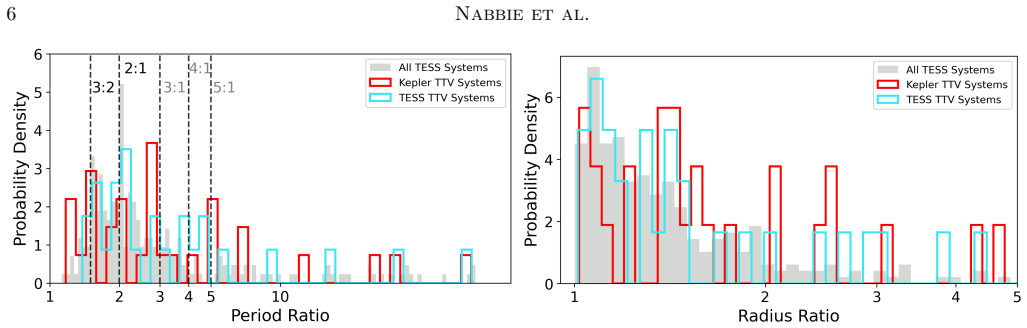
TESS transit timing variation systems pile up at the 2:1 resonance, unlike the 3:2 preference in Kepler catalogs.
A machine-rendered reading of the paper's core claim, the machinery that carries it, and where it could break.
Core claim
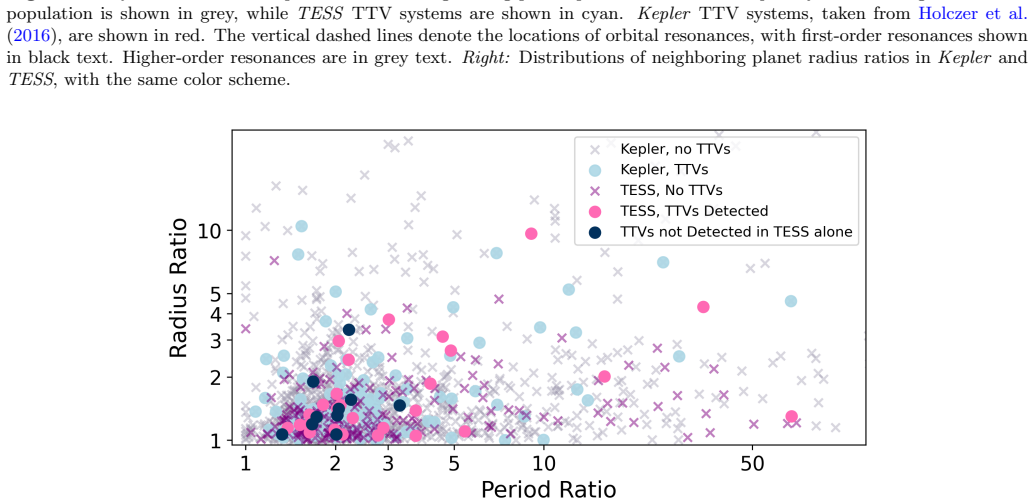
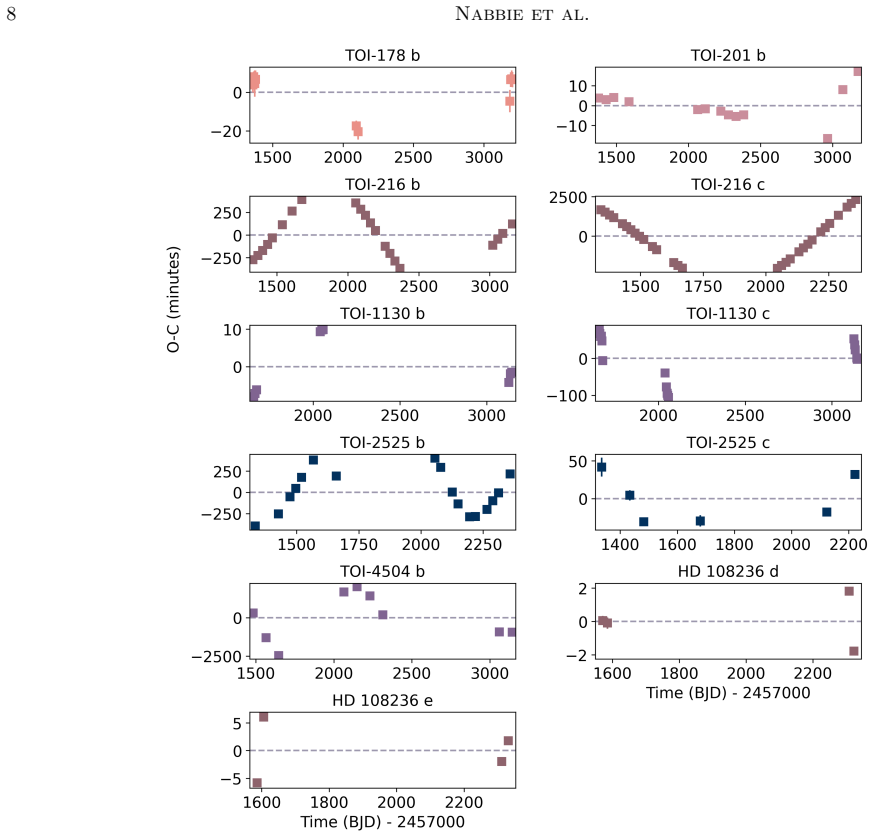
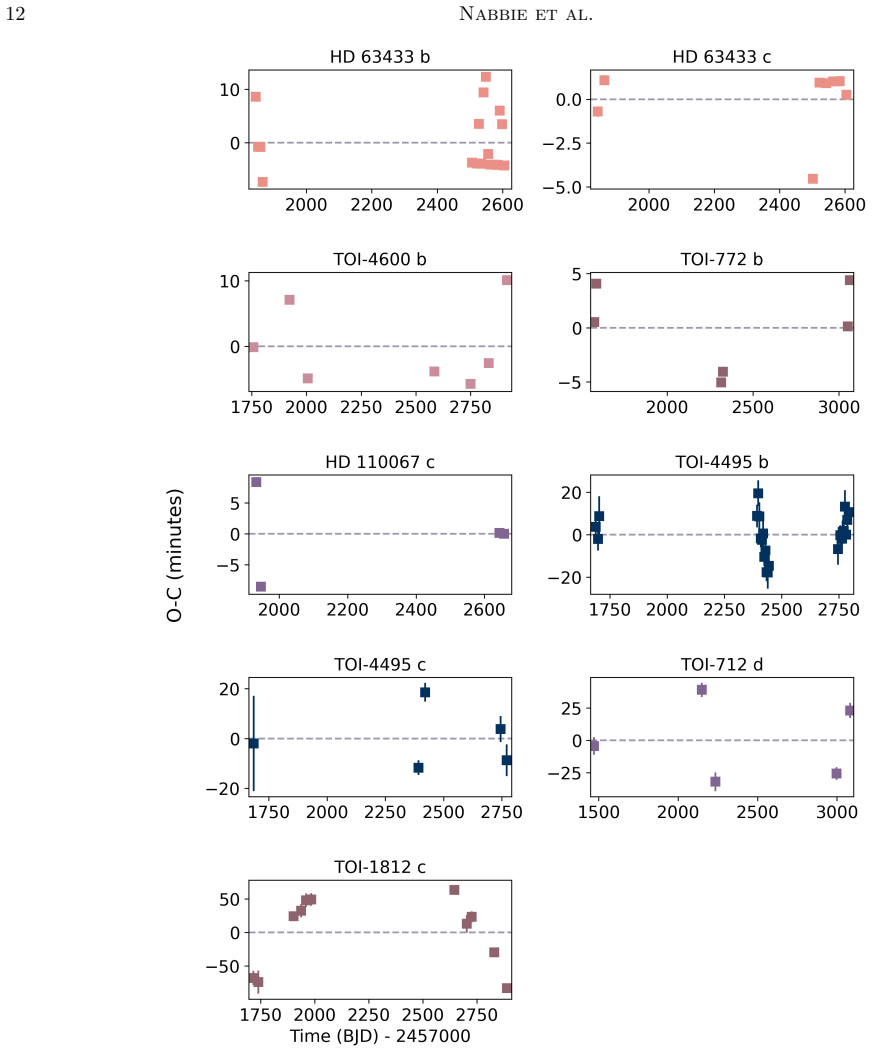
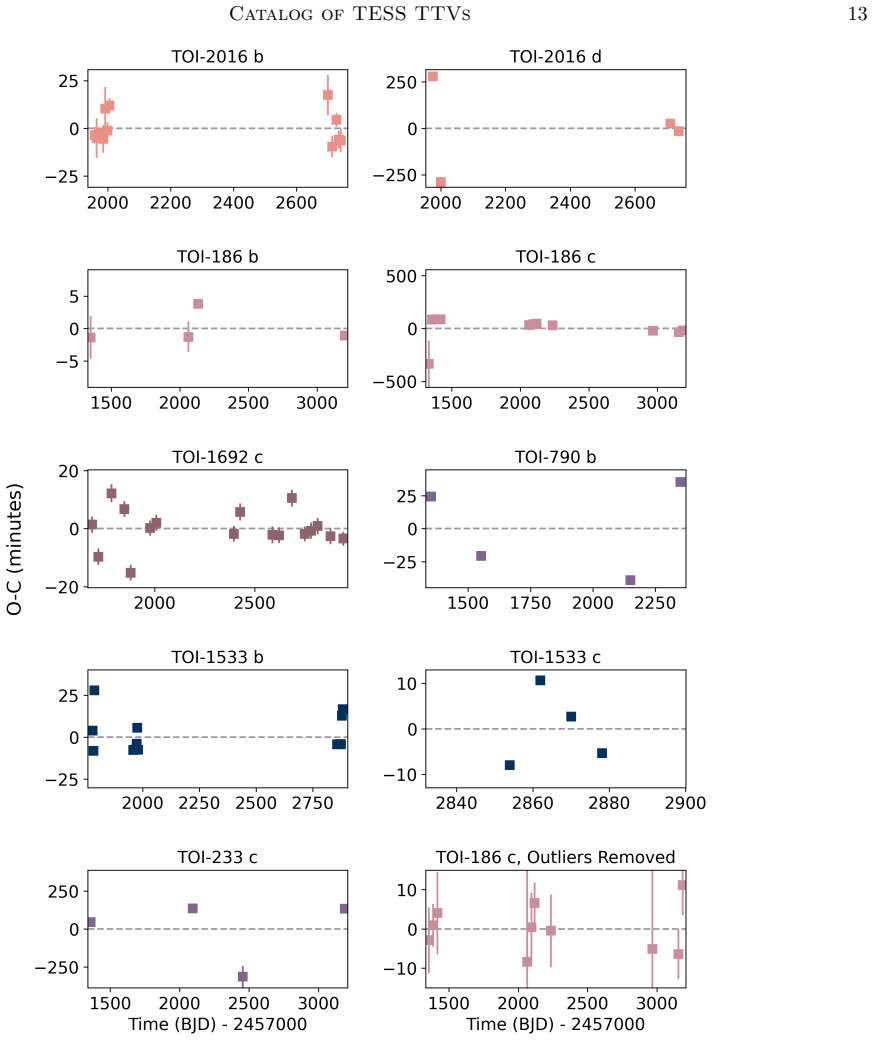
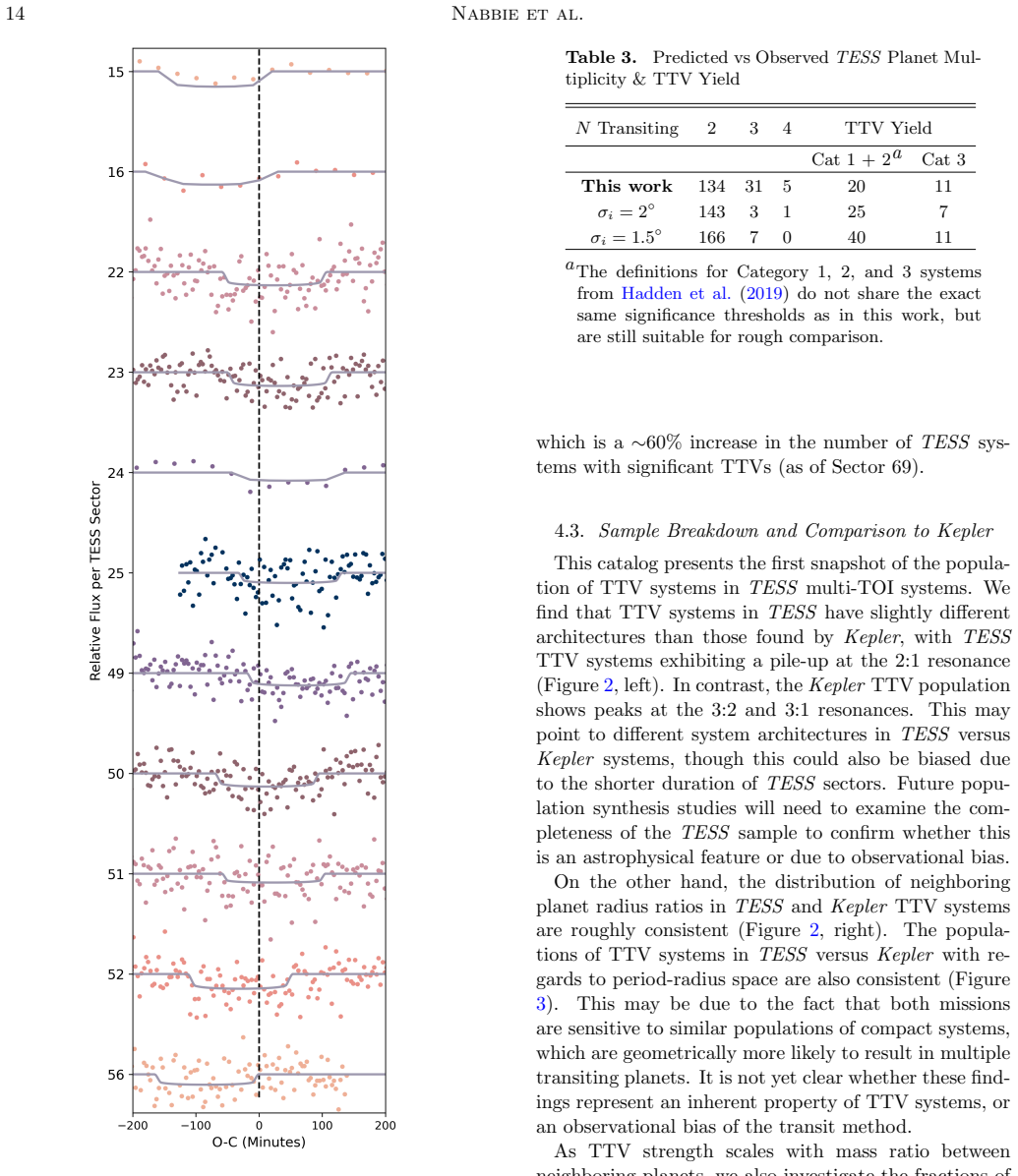
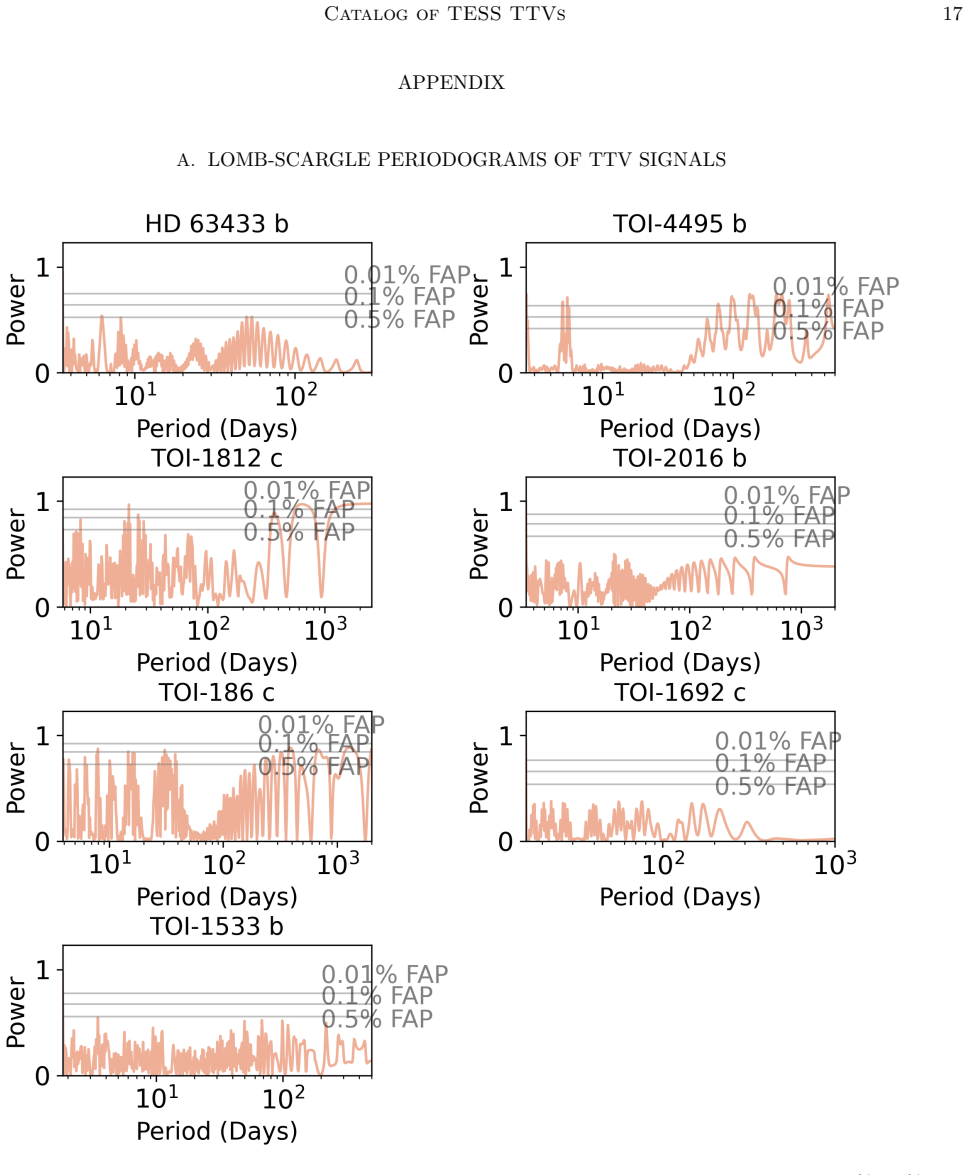
We present the first catalog of transit timing variations (TTVs) in TESS systems with multiple TESS Objects of Interest (TOIs) using data from Sector 1 to Sector 69, spanning the first five years of mission operations. With an initial sample of 175 multi-TOI systems, we find significant TTVs in 20 systems, 13 of which had not been previously detected. Our results are generally consistent with the findings of previous Kepler TTV catalogs, with compact systems more likely to have detectable TTVs. However, the TTV systems in TESS exhibit a pile-up at the 2:1 orbital period resonance, in contrast to the pile-up near the 3:2 resonance from previous Kepler catalogs. This provides a tentative indic
What carries the argument
The catalog of TTV detections across 175 multi-TOI systems, followed by analysis of their orbital period ratios to identify resonance pile-ups.
If this is right
- Compact multi-planet systems remain more likely to produce detectable TTVs than wider systems.
- The 20 TTV systems form a ready list of high-impact targets for intensive follow-up observations.
- Different resonance occupations may trace distinct disk migration histories between the TESS and Kepler populations.
- The catalog marks a first step toward determining which orbital resonances migrating planets occupy at the end of formation.
Where Pith is reading between the lines
- The resonance difference could trace TESS's preference for brighter or later-type host stars compared with Kepler.
- Radial-velocity follow-up on the new TTV systems would provide independent mass constraints and test interaction models.
- If the pattern persists, it would motivate disk models that produce resonance capture outcomes dependent on disk mass or lifetime.
Load-bearing premise
The sample of 175 multi-TOI systems is free of major selection biases and the detected TTV signals arise from planet-planet interactions.
What would settle it
A bias-corrected analysis of a larger TESS TTV sample that recovers the same 3:2 resonance pile-up reported for Kepler would falsify the claimed difference in migration preferences.
Figures
read the original abstract
We present the first catalog of transit timing variations (TTVs) in TESS systems with multiple TESS Objects of Interest (TOIs) using data from Sector 1 to Sector 69, spanning the first five years of mission operations. With an initial sample of 175 multi-TOI systems, we find significant TTVs in 20 systems, 13 of which had not been previously detected. Our results are generally consistent with the findings of previous Kepler TTV catalogs, with compact systems more likely to have detectable TTVs. However, the TTV systems in TESS exhibit a pile-up at the 2:1 orbital period resonance, in contrast to the pile-up near the 3:2 resonance from previous Kepler catalogs. This provides a tentative indicator that there may be different disk migration recipes that Kepler systems favor versus TESS systems. This catalog is a vital first step in determining which orbital resonances migrating planets tend to occupy at the end of formation, and aims to provide a list of high-impact targets for future in-depth follow up.
Editorial analysis
A structured set of objections, weighed in public.
Referee Report
Summary. The manuscript presents the first catalog of transit timing variations (TTVs) from TESS data (Sectors 1–69) for an initial sample of 175 multi-TOI systems. Significant TTVs are reported in 20 systems (13 previously undetected). Results are stated to be consistent with prior Kepler catalogs regarding the preference for TTVs in compact systems, but the TTV subsample shows a pile-up at the 2:1 period ratio in contrast to the 3:2 pile-up in Kepler samples; this is interpreted as a tentative indicator of differing disk migration pathways. The work supplies a list of high-impact targets for follow-up.
Significance. If the reported resonance contrast survives bias corrections, the catalog would enlarge the sample of characterized TTV systems and supply evidence that migration outcomes may differ between the Kepler and TESS stellar populations. Even without that interpretation, the list of 20 systems with measured TTVs constitutes a practical resource for dynamical studies.
major comments (2)
- [Abstract] Abstract: the central claim of a 2:1 resonance pile-up (contrasting Kepler’s 3:2) is load-bearing for the migration-recipe interpretation, yet the abstract supplies detection counts without quantitative thresholds, error budgets, or resonance-dependent completeness. This leaves the contrast vulnerable to the selection bias raised in the stress-test note.
- [Methods / Results] The manuscript does not demonstrate that the 20 TTV detections constitute an unbiased draw from the parent population with respect to period ratio. Without explicit completeness simulations or false-alarm-rate maps versus commensurability (e.g., with TESS sector length), the observed 2:1 excess cannot be distinguished from detection efficiency variations.
minor comments (1)
- [Abstract] The phrase “first five years of mission operations” should be reconciled with the exact sector range (1–69) and any gaps in coverage.
Simulated Author's Rebuttal
We thank the referee for their careful reading and constructive feedback. We address the two major comments below, agreeing that the resonance contrast requires stronger qualification and that potential selection effects merit explicit discussion. We plan targeted revisions to the abstract and main text while preserving the catalog's primary value as a resource of detected systems.
read point-by-point responses
-
Referee: [Abstract] Abstract: the central claim of a 2:1 resonance pile-up (contrasting Kepler’s 3:2) is load-bearing for the migration-recipe interpretation, yet the abstract supplies detection counts without quantitative thresholds, error budgets, or resonance-dependent completeness. This leaves the contrast vulnerable to the selection bias raised in the stress-test note.
Authors: We agree that the abstract should more clearly signal the preliminary character of the resonance contrast. In revision we will replace the current phrasing with language that explicitly labels the 2:1 feature as an observed excess in the detected TTV sample and notes that bias corrections remain to be performed. The main text already qualifies the result as tentative; the abstract will be brought into alignment with that caution. revision: partial
-
Referee: [Methods / Results] The manuscript does not demonstrate that the 20 TTV detections constitute an unbiased draw from the parent population with respect to period ratio. Without explicit completeness simulations or false-alarm-rate maps versus commensurability (e.g., with TESS sector length), the observed 2:1 excess cannot be distinguished from detection efficiency variations.
Authors: This limitation is correctly identified. The present work is a detection catalog rather than a population study; we therefore did not perform the full set of completeness simulations required to convert the observed period-ratio distribution into an unbiased occurrence rate. In the revised manuscript we will add a dedicated limitations paragraph that (i) states the absence of resonance-dependent completeness maps, (ii) notes that TESS sector length and sampling can affect sensitivity near low-order commensurabilities, and (iii) frames the 2:1 excess as a target for future dedicated bias analyses rather than a confirmed population signature. revision: yes
Circularity Check
No circularity: purely observational catalog
full rationale
The paper reports an empirical catalog of TTV detections from TESS photometry across 175 multi-TOI systems, identifying 20 with significant signals and noting their period-ratio distribution. No mathematical derivation, model fitting, or self-citation chain is present that reduces the resonance pile-up claim to a fitted parameter or input by construction. The contrast with Kepler is stated as an observational finding, not a prediction derived from the paper's own definitions or prior self-citations. This is the expected self-contained outcome for a data-release catalog.
Axiom & Free-Parameter Ledger
Reference graph
Works this paper leans on
-
[1]
Astropy Collaboration , Price-Whelan , A. M., Lim , P. L., et al. 2022, , 935, 167, 10.3847/1538-4357/ac7c74
work page internal anchor Pith review doi:10.3847/1538-4357/ac7c74 2022
-
[2]
2024, , 689, A52, 10.1051/0004-6361/202450974
Borsato , L., Degen , D., Leleu , A., et al. 2024, , 689, A52, 10.1051/0004-6361/202450974
-
[3]
K., Soares-Furtado , M., Vanderburg , A., et al
Capistrant , B. K., Soares-Furtado , M., Vanderburg , A., et al. 2024, , 167, 54, 10.3847/1538-3881/ad1039
-
[4]
Dawson , R. I., Huang , C. X., Brahm , R., et al. 2021, , 161, 161, 10.3847/1538-3881/abd8d0
-
[5]
Demory , B. O., Pozuelos , F. J., G \'o mez Maqueo Chew , Y., et al. 2020, , 642, A49, 10.1051/0004-6361/202038616
-
[6]
Dragomir , D., Teske , J., G \"u nther , M. N., et al. 2019, , 875, L7, 10.3847/2041-8213/ab12ed
-
[7]
Fairnington , T. R., Nabbie , E., Huang , C. X., et al. 2024, , 527, 8768, 10.1093/mnras/stad3036
-
[8]
Foreman-Mackey , D., Hogg , D. W., Lang , D., & Goodman , J. 2013, , 125, 306, 10.1086/670067
-
[9]
Ginsburg , A., Sip o cz , B. M., Brasseur , C. E., et al. 2019, , 157, 98, 10.3847/1538-3881/aafc33
-
[10]
Greklek-McKeon , M., Vissapragada , S., Knutson , H. A., et al. 2025, , 169, 292, 10.3847/1538-3881/adc0fe
-
[11]
G \"u nther , M. N., Pozuelos , F. J., Dittmann , J. A., et al. 2019, Nature Astronomy, 3, 1099, 10.1038/s41550-019-0845-5
-
[12]
Hadden , S., Barclay , T., Payne , M. J., & Holman , M. J. 2019, , 158, 146, 10.3847/1538-3881/ab384c
-
[13]
Hawthorn , F., Bayliss , D., Wilson , T. G., et al. 2023, , 520, 3649, 10.1093/mnras/stad306
-
[14]
2016, , 225, 9, 10.3847/0067-0049/225/1/9
Holczer , T., Mazeh , T., Nachmani , G., et al. 2016, , 225, 9, 10.3847/0067-0049/225/1/9
-
[15]
Hord , B. J., Kempton , E. M.-R., Evans-Soma , T. M., et al. 2024, , 167, 233, 10.3847/1538-3881/ad3068
-
[16]
Horner , J., Wittenmyer , R. A., Kane , S. R., & Holt , T. R. 2025, , 169, 8, 10.3847/1538-3881/ad8e3a
-
[17]
2022, , 668, A117, 10.1051/0004-6361/202243720
Hoyer , S., Bonfanti , A., Leleu , A., et al. 2022, , 668, A117, 10.1051/0004-6361/202243720
-
[18]
X., Vanderburg , A., P \'a l , A., et al
Huang , C. X., Vanderburg , A., P \'a l , A., et al. 2020 a , Research Notes of the American Astronomical Society, 4, 206, 10.3847/2515-5172/abca2d
-
[19]
Huang , C. X., Quinn , S. N., Vanderburg , A., et al. 2020 b , , 892, L7, 10.3847/2041-8213/ab7302
-
[20]
Hunter, J. D. 2007, Computing in Science & Engineering, 9, 90, 10.1109/MCSE.2007.55
-
[21]
Ioannidis , P., Huber , K. F., & Schmitt , J. H. M. M. 2016, , 585, A72, 10.1051/0004-6361/201527184
-
[22]
Jenkins , J. M., Twicken , J. D., McCauliff , S., et al. 2016, in , Vol. 9913, Software and Cyberinfrastructure for Astronomy IV, 99133E, 10.1117/12.2233418
-
[23]
2019, , 486, 4980, 10.1093/mnras/stz1141
Kipping , D., Nesvorn \'y , D., Hartman , J., et al. 2019, , 486, 4980, 10.1093/mnras/stz1141
-
[24]
Kipping , D. M. 2013, , 435, 2152, 10.1093/mnras/stt1435
-
[25]
2023, , 675, A115, 10.1051/0004-6361/202244617
Korth , J., Gandolfi , D., S ubjak , J., et al. 2023, , 675, A115, 10.1051/0004-6361/202244617
-
[27]
2015, PASP, 127, 1161, doi: 10.1086/683602
---. 2015 b , , 127, 1161, 10.1086/683602
work page internal anchor Pith review doi:10.1086/683602 2015
-
[28]
Leleu , A., Alibert , Y., Hara , N. C., et al. 2021, , 649, A26, 10.1051/0004-6361/202039767
-
[29]
2024, , 688, A211, 10.1051/0004-6361/202450212
Leleu , A., Delisle , J.-B., Delrez , L., et al. 2024, , 688, A211, 10.1051/0004-6361/202450212
-
[30]
Lightkurve Collaboration , Cardoso , J. V. d. M., Hedges , C., et al. 2018, Lightkurve: Kepler and TESS time series analysis in Python , Astrophysics Source Code Library. 1812.013
2018
-
[31]
2012, , 761, 122, 10.1088/0004-637X/761/2/122
Lithwick , Y., Xie , J., & Wu , Y. 2012, , 761, 122, 10.1088/0004-637X/761/2/122
-
[32]
Lomb , N. R. 1976, , 39, 447, 10.1007/BF00648343
-
[33]
Lopez Murillo , A. I., Mann , A. W., Barber , M. G., et al. 2026, , 171, 63, 10.3847/1538-3881/ae231a
-
[34]
Luque , R., Osborn , H. P., Leleu , A., et al. 2023, , 623, 932, 10.1038/s41586-023-06692-3
-
[35]
2025, arXiv e-prints, arXiv:2507.11504, 10.48550/arXiv.2507.11504
Maciejewski , G., & oboda , W. 2025, arXiv e-prints, arXiv:2507.11504, 10.48550/arXiv.2507.11504
-
[36]
1993, , 365, 819, 10.1038/365819a0
Malhotra , R. 1993, , 365, 819, 10.1038/365819a0
-
[37]
Mann , A. W., Johnson , M. C., Vanderburg , A., et al. 2020, , 160, 179, 10.3847/1538-3881/abae64
-
[38]
2024, Astronomy and Astrophysics, 682, A129, doi: 10.1051/0004-6361/202347472
Mantovan , G., Malavolta , L., Desidera , S., et al. 2024, , 682, A129, 10.1051/0004-6361/202347472
-
[39]
2013, , 208, 16, 10.1088/0067-0049/208/2/16
Mazeh , T., Nachmani , G., Holczer , T., et al. 2013, , 208, 16, 10.1088/0067-0049/208/2/16
-
[40]
McKee , B. J., & Montet , B. T. 2023, , 165, 236, 10.3847/1538-3881/accd66
-
[41]
2010, in Proceedings of the 9th Python in Science Conference, ed
McKinney, W. 2010, in Proceedings of the 9th Python in Science Conference, ed. S. van der Walt & J. Millman, 51 -- 56
2010
-
[42]
Mireles , I., Dragomir , D., Osborn , H. P., et al. 2023, , 954, L15, 10.3847/2041-8213/aceb69
-
[43]
Orbital motion monitoring of A-type star multiples
Mustill , A. J., & Wyatt , M. C. 2011, , 413, 554, 10.1111/j.1365-2966.2011.18201.x
-
[44]
2025, arXiv e-prints, arXiv:2511.16504, 10.48550/arXiv.2511.16504
Naponiello , L. 2025, arXiv e-prints, arXiv:2511.16504, 10.48550/arXiv.2511.16504
-
[45]
NExScI . 2022, Exoplanet Follow-up Observing Program Web Service, IPAC, 10.26134/EXOFOP5
-
[46]
2013, , 775, 34, 10.1088/0004-637X/775/1/34
Ogihara , M., & Kobayashi , H. 2013, , 775, 34, 10.1088/0004-637X/775/1/34
-
[47]
Osborn , H. P., Bonfanti , A., Gandolfi , D., et al. 2022, , 664, A156, 10.1051/0004-6361/202243065
-
[48]
Paegert , M., Stassun , K. G., Collins , K. A., et al. 2021, arXiv e-prints, arXiv:2108.04778, 10.48550/arXiv.2108.04778
-
[49]
2014, , 786, 101, 10.1088/0004-637X/786/2/101
Petrovich , C., Tremaine , S., & Rafikov , R. 2014, , 786, 101, 10.1088/0004-637X/786/2/101
-
[50]
2018, Celestial Mechanics and Dynamical Astronomy, 130, 54, 10.1007/s10569-018-9848-2
Pichierri , G., Morbidelli , A., & Crida , A. 2018, Celestial Mechanics and Dynamical Astronomy, 130, 54, 10.1007/s10569-018-9848-2
-
[51]
Journal of Astronomical Telescopes, Instruments, and Systems , year = 2015, month = jan, volume =
Ricker , G. R., Winn , J. N., Vanderspek , R., et al. 2015, Journal of Astronomical Telescopes, Instruments, and Systems, 1, 014003, 10.1117/1.JATIS.1.1.014003
work page internal anchor Pith review doi:10.1117/1.jatis.1.1.014003 2015
-
[52]
Rodriguez , J. E., Becker , J. C., Eastman , J. D., et al. 2018, , 156, 245, 10.3847/1538-3881/aae530
-
[53]
Rowe , J. F., Coughlin , J. L., Antoci , V., et al. 2015, , 217, 16, 10.1088/0067-0049/217/1/16
-
[54]
Scargle , J. D. 1982, , 263, 835, 10.1086/160554
-
[55]
Shallue , C. J., & Vanderburg , A. 2018, , 155, 94, 10.3847/1538-3881/aa9e09
-
[56]
Stassun , K. G., Oelkers , R. J., Paegert , M., et al. 2019, , 158, 138, 10.3847/1538-3881/ab3467
-
[57]
Terquem , C., & Papaloizou , J. C. B. 2007, , 654, 1110, 10.1086/509497
-
[58]
2019, , 622, L7, 10.1051/0004-6361/201834817
Trifonov , T., Rybizki , J., & K \"u rster , M. 2019, , 622, L7, 10.1051/0004-6361/201834817
-
[59]
2023, The Astronomical Journal, 165, 179, doi: 10.3847/1538-3881/acba9b
Trifonov , T., Brahm , R., Jord \'a n , A., et al. 2023, , 165, 179, 10.3847/1538-3881/acba9b
-
[60]
Vach , S., Quinn , S. N., Vanderburg , A., et al. 2022, , 164, 71, 10.3847/1538-3881/ac7954
-
[61]
Vanderburg , A., & Johnson , J. A. 2014, , 126, 948, 10.1086/678764
-
[62]
Virtanen , P., Gommers , R., Oliphant , T. E., et al. 2020, Nature Methods, 17, 261, 10.1038/s41592-019-0686-2
-
[63]
2025, , 978, L22, 10.3847/2041-8213/ad9a53
V \' tkov \'a , M., Brahm , R., Trifonov , T., et al. 2025, , 978, L22, 10.3847/2041-8213/ad9a53
-
[64]
2014, , 795, 85, 10.1088/0004-637X/795/1/85
Wang , S., & Ji , J. 2014, , 795, 85, 10.1088/0004-637X/795/1/85
-
[65]
2017, , 154, 236, 10.3847/1538-3881/aa9216
---. 2017, , 154, 236, 10.3847/1538-3881/aa9216
-
[66]
Weiss , L. M., Marcy , G. W., Rowe , J. F., et al. 2013, , 768, 14, 10.1088/0004-637X/768/1/14
-
[67]
2025, , 695, A273, 10.1051/0004-6361/202451180
Zingales , T., Malavolta , L., Borsato , L., et al. 2025, , 695, A273, 10.1051/0004-6361/202451180
discussion (0)
Sign in with ORCID, Apple, or X to comment. Anyone can read and Pith papers without signing in.