REVIEW 2 major objections 7 minor 88 references
Reviewed by Pith at T0; open to challenge.
T0 means a machine referee read the full paper against a public rubric. The mark states how deep the mechanical check went, never who wrote it. the ladder, T0–T4 →
T0 review · glm-5.2
Quantum Environment Reshapes Inflation's Gravitational Wave Signal
2026-07-09 05:18 UTC pith:TLBN3KOD
load-bearing objection Real new result: first computation of P_ζ and SIGW from an open quantum system in USR. The headline LISA claims rest on a strong-coupling regime (λ/H=5) where the Gaussian truncation may not be self-consistent. the 2 major comments →
When the Environment Speaks: Quantum Signatures in Non-Attractor Inflation
The pith
A machine-rendered reading of the paper's core claim, the machinery that carries it, and where it could break.
Core claim
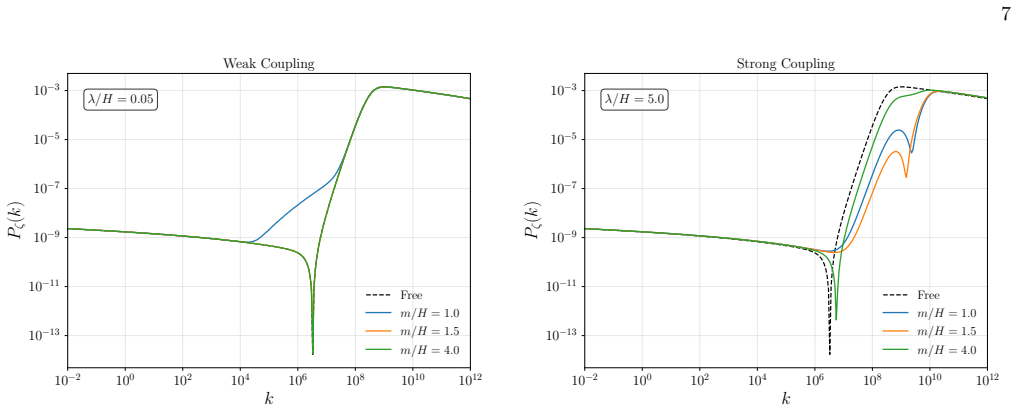
The paper establishes that when an entropic environment with mass near the Hubble scale (m/H ≈ 1) interacts with curvature perturbations during a transient USR phase, the resulting rapid decoherence erases the characteristic interference dip in the primordial power spectrum—a feature that is robust in single-field models. This erasure, along with modified growth slopes and strong-coupling-induced oscillatory ringing, propagates quadratically into the scalar-induced gravitational wave background, producing spectral signatures (altered infrared scaling, suppressed peaks, frequency shifts, high-frequency modulations) that are distinguishable from single-field predictions and potentially detect-
What carries the argument
The Transport Equations Method (TEM) for the covariance matrix of a Gaussian two-field system, evolved with exact SR-USR-SR background kinematics; the bilinear interaction ζ'F between the adiabatic curvature perturbation and the entropic environment; the quadratic propagation of scalar power spectrum distortions into the scalar-induced gravitational wave background via second-order cosmological perturbation theory.
Load-bearing premise
The entire analysis rests on a Gaussian two-field effective Lagrangian with a purely bilinear interaction and a Born-Oppenheimer assumption that the environment is a stationary reservoir, meaning the results capture only two-point-level effects and cannot self-consistently predict primordial black hole formation, which depends on non-Gaussian statistics.
What would settle it
If future observations of the stochastic gravitational wave background by LISA or comparable instruments show the standard single-field USR interference dip preserved (rather than erased) in the relevant frequency band, or if they show no oscillatory modulations or altered infrared scalings in the strong-coupling regime, the environmental coupling scenarios predicted here would be constrained or ruled out.
If this is right
- If the predicted dip erasure and oscillatory features are observed in the gravitational wave background by LISA or similar instruments, they would simultaneously constrain the mass and coupling of hidden environmental fields active during inflation, providing a direct observational window into the quantum-to-classical transition.
- The correlation between maximal decoherence rate (at m/H ≈ 1) and dip erasure suggests that the presence or absence of the interference dip in the power spectrum could serve as a diagnostic for whether decoherence occurred during the USR phase, linking quantum information properties to spectral shape observables.
- The suppressed peak amplitudes under strong coupling would directly modify the predicted primordial black hole mass fraction and formation thresholds, potentially easing or tightening PBH dark matter constraints—though the paper notes this requires non-Gaussian extensions to fully quantify.
- The finding that modes crossing during USR undergo violent, irreversible decoherence (except for very heavy environments that partially recohere) implies that the quantum state of perturbations relevant for structure formation is not a universal feature but depends critically on the timing of horizon crossing relative to the non-attractor phase.
Where Pith is reading between the lines
- The Born-Oppenheimer assumption that the environment is stationary (footnote 3) means the environment does not back-react on the background dynamics. If the environment were dynamically coupled to the inflaton trajectory rather than treated as a reservoir, the SR-USR-SR transition itself could be modified, potentially altering the decoherence-spectral feature correspondence the paper establishes.
- The strong-coupling regime λ/H = 5 is explored without discussion of whether the effective field theory remains valid at this coupling. If the EFT truncation breaks down for large λ, the oscillatory ringing and peak suppression predictions in this regime could be artifacts of the Lagrangian rather than physical effects, though the qualitative weak-coupling results (dip erasure at m/H ≈ 1) would re
- The paper's Gaussian interaction closes the transport hierarchy at two-point level, but the PBH-relevant conclusions (suppressed peaks altering mass fractions) implicitly require non-Gaussian statistics. Extending to cubic interactions would not only open the bispectrum transport but could also feed back into the power spectrum through loop corrections, potentially modifying the very spectral feat
Editorial analysis
A structured set of objections, weighed in public.
Referee Report
Summary. This manuscript studies the open quantum dynamics of the adiabatic curvature perturbation coupled to a massive entropic scalar environment during an inflationary background featuring a transient Ultra-Slow-Roll (USR) phase. The authors employ the exact Transport Equations Method (TEM) to evolve the full covariance matrix of a Gaussian two-field system across the SR-USR-SR transition, tracking quantum purity and von Neumann entropy. They find that environmental coupling modifies the primordial scalar power spectrum — erasing the pre-growth interference dip for m/H ~ 1, altering growth slopes, and inducing oscillatory ringing under strong coupling — and propagate these distortions to the scalar-induced gravitational wave (SIGW) background, claiming detectability with LISA. The transport equations for the 11-dimensional covariance system are derived in Appendix A from the quadratic Hamiltonian (Eq. 10), and the SIGW computation uses standard formulas via the public package SIGWfast.
Significance. The paper addresses a timely question at the intersection of quantum information theory and early-universe cosmology. The use of the exact transport equations method for a Gaussian system is a legitimate and well-implemented technical approach, and the exact treatment of the background kinematics across the SR-USR-SR transition is a genuine improvement over constant-H approximations. The identification of a correlation between rapid decoherence (m/H = 1) and dip erasure in the weak-coupling regime is an interesting physical observation. The SIGW computation is reproducible in principle via the cited public package. However, the observational significance of the headline results — order-1 spectral modifications, oscillatory ringing, and LISA-band detectability — rests almost entirely on the strong-coupling regime (λ/H = 5), which raises a self-consistency concern that is not addressed in the manuscript (see Major Comments).
major comments (2)
- §II.B, Eq. (6) and §IV.B (Fig. 3, right panel): The most observationally significant results — order-1 modifications to P_ζ, oscillatory ringing near the peak, and the LISA-detectability claim — are obtained in the strong-coupling regime λ/H = 5. The effective Lagrangian (Eq. 6) is a quadratic truncation of the full two-field action; the coupling λ enters both the bilinear mixing term (Eq. 10, Eq. A3) and the effective environmental mass M² = m² + λ² (Eq. A3). At λ/H = 5, the dimensionless coupling is not perturbatively small. During USR, the curvature perturbation reaches P_ζ ~ 10⁻² (ζ_rms ~ 0.1). Cubic interactions — present in any non-trivial two-field UV completion and neglected by the Gaussian closure — would generate loop corrections to the two-point function scaling roughly as (λ/H)² × P_ζ ~ 25 × 10⁻² ~ 0.25, which is not parametrically suppressed relative to the tree-level O(1)修改
- §IV.C, Fig. 4 (right panel) and Abstract: The LISA-detectability claim is the headline observational result of the paper. It depends on the strong-coupling results (λ/H = 5), which as noted above may not be self-consistent within the Gaussian truncation. The weak-coupling results (λ/H = 0.05), where the truncation is reliable, show only a highly localized spike in ΔΩ_GW at k ~ 10⁵ Mpc⁻¹ for m/H = 1 (Fig. 4, left panel), with the GW spectrum otherwise indistinguishable from the free case. The paper should either (i) provide a parametric estimate or explicit check that loop corrections remain subdominant at λ/H = 5, or (ii) qualify the LISA-detectability claim to reflect that it rests on a regime where the truncation has not been validated. Without this, the central observational claim is not adequately supported.
minor comments (7)
- §II.B, Eq. (6): The parameter λ is described as 'dimensionful' in the text following Eq. (6), but the ratio λ/H is used throughout as a dimensionless coupling. The dimensionality of λ and its relation to the dimensionless ratio λ/H should be clarified.
- §II.B, footnote 3: The Born-Oppenheimer assumption that the environment is stationary is stated but not justified quantitatively. A brief comment on the timescale separation argument would strengthen this assumption.
- §IV.B, Fig. 3: The y-axis label 'P_ζ(k)' lacks units or normalization annotation. The caption mentions CMB normalization P_ζ ~ 2.1 × 10⁻⁹ but the figure itself would benefit from explicit annotation.
- §IV.C, Eq. (23)-(24): The SIGW formula assumes a radiation-dominated universe at horizon reentry. The paper does not discuss whether the USR-enhanced modes reenter during radiation domination; a brief statement confirming this would be appropriate.
- Appendix A, Eq. (A4): The notation θ_N ≡ d ln z/dN is introduced but the relation z'/z = aH(1 + ε₂/2) is stated without derivation. A reference or one-line derivation would help the reader.
- §V: The paper acknowledges that non-Gaussian correlators are needed for PBH formation predictions but does not discuss whether the suppressed peak amplitudes in the strong-coupling regime (Fig. 3, right) could qualitatively change PBH formation prospects. A brief qualitative statement would be welcome.
- References: Several arXiv references use future-dated submissions (e.g., [44] arXiv:2607.00636, [57] arXiv:2606.07663, [58] arXiv:2512.01932, [47] arXiv:2512.14204). These should be verified for correctness.
Simulated Author's Rebuttal
We thank the referee for a careful and constructive report. The core technical methodology — exact transport equations for a Gaussian two-field system across the SR-USR-SR transition — is acknowledged as legitimate and well-implemented. The referee's major concern is that the most observationally significant results arise in the strong-coupling regime (λ/H = 5), where the quadratic (Gaussian) truncation of the effective Lagrangian may not be self-consistent due to neglected loop corrections from cubic interactions. We address this concern below and agree that the manuscript requires revision to qualify the observational claims accordingly.
read point-by-point responses
-
Referee: §II.B, Eq. (6) and §IV.B (Fig. 3, right panel): The most observationally significant results — order-1 modifications to P_ζ, oscillatory ringing near the peak, and the LISA-detectability claim — are obtained in the strong-coupling regime λ/H = 5. The effective Lagrangian (Eq. 6) is a quadratic truncation of the full two-field action; the coupling λ enters both the bilinear mixing term (Eq. 10, Eq. A3) and the effective environmental mass M² = m² + λ² (Eq. A3). At λ/H = 5, the dimensionless coupling is not perturbatively small. During USR, the curvature perturbation reaches P_ζ ~ 10⁻² (ζ_rms ~ 0.1). Cubic interactions — present in any non-trivial two-field UV completion and neglected by the Gaussian closure — would generate loop corrections to the two-point function scaling roughly as (λ/H)² × P_ζ ~ 25 × 10⁻² ~ 0.25, which is not parametrically suppressed relative to the tree-level O(1) [
Authors: The referee raises a valid and important point about the EFT validity of our quadratic truncation in the strong-coupling regime. We address it on two levels. First, a clarification of what is and is not exact in our calculation. Second, an acknowledgment of the genuine limitation. On the first point: the interaction Lagrangian (Eq. 6) contains a bilinear derivative mixing term λ a³ √(2ε) M_Pl ζ'F. The resulting Hamiltonian (Eq. 10) is exactly quadratic in the phase-space variables, and the transport equations (Appendix A) solve the full Gaussian dynamics without any perturbative expansion in λ. Within this specific quadratic theory, our results are exact — there are no loop corrections to the two-point function because the theory contains no cubic vertices. The Gaussian closure is not an approximation applied to a more general theory; it is a property of the specific Lagrangian we wrote down. On the second point: the referee is correct that any non-trivial UV completion of this two-field system would generically contain cubic and higher-order interactions (from the field-space metric, the potential, and the measure factor) that are absent from our quadratic truncation. At λ/H = 5 with P_ζ ~ 10⁻² during USR, the referee's parametric estimate of loop corrections ~(λ/H)² × P_ζ ~ O(0.1–1) is reasonable, and we cannot rule out that such corrections would quantitatively modify our strong-coupling spectra. We note that the parameter λ in our Lagrangian is dimensionful (it carries dimensions of mass), so λ/H = 5 does not correspond to a large dimensionless coupling per se; the relevant question is whether the omitted cubic vertices, whose coefficients depend on the UV completion, produce loop corrections comparable to the tree-level effects we compute. Without specifying a UV完成 revision: partial
-
Referee: §IV.C, Fig. 4 (right panel) and Abstract: The LISA-detectability claim is the headline observational result of the paper. It depends on the strong-coupling results (λ/H = 5), which as noted above may not be self-consistent within the Gaussian truncation. The weak-coupling results (λ/H = 0.05), where the truncation is reliable, show only a highly localized spike in ΔΩ_GW at k ~ 10⁵ Mpc⁻¹ for m/H = 1 (Fig. 4, left panel), with the GW spectrum otherwise indistinguishable from the free case. The paper should either (i) provide a parametric estimate or explicit check that loop corrections remain subdominant at λ/H = 5, or (ii) qualify the LISA-detectability claim to reflect that it rests on a regime where the truncation has not been validated. Without this, the central observational claim is not adequately supported.
Authors: The referee is correct that the LISA-detectability claim rests on the strong-coupling regime, and that the weak-coupling results — where the Gaussian truncation is most reliable — produce only a highly localized and modest feature in the GW spectrum. We agree that option (i), an explicit check that loop corrections remain subdominant at λ/H = 5, cannot be honestly provided within the current framework, as it would require extending the transport equations to the three-point function and coupling it back to the two-point system — a significant computational undertaking that we explicitly identify as future work in Section V. We therefore adopt option (ii): we will revise the manuscript to clearly qualify the LISA-detectability claim. Specifically, we will: (a) add a dedicated paragraph in Section IV.C (and a corresponding note in the Abstract) stating that the dramatic GW signatures and their potential LISA detectability arise in the strong-coupling regime (λ/H = 5), where the quadratic truncation has not been validated against loop corrections from cubic interactions that would be present in a UV completion; (b) add a parametric estimate of the expected loop corrections following the referee's scaling argument, explicitly stating the regime of validity; (c) emphasize that the weak-coupling results (λ/H = 0.05), which are robust within the Gaussian truncation, still produce a distinctive physical signature — the dip erasure for m/H = 1 and its corresponding localized GW feature — even if this feature is more modest in amplitude. We believe the weak-coupling dip-erasure result and its correlation with rapid decoherence is a robust and physically interesting finding that stands independently of the strong-coupling regime. revision: yes
Circularity Check
No significant circularity found; derivation is self-contained with minor non-load-bearing self-citations.
full rationale
The paper's derivation chain is self-contained. The background potential (Eq. 5) uses fixed parameter values from the literature [20, 67, 71] to produce the SR-USR-SR transition — these are model inputs, not fitted to the paper's predictions. The two-field effective Lagrangian (Eq. 6) is cited to [52] (Assassi, Baumann, Green, McAllister — external authors). The transport equations (Eqs. 16, A1–A5) are derived from the Hamiltonian (Eq. 10) via standard Heisenberg-picture differentiation; the method is cited to [38, 53, 81, 82], none of which are self-citations. The power spectrum P_ζ = Σ₁₁/z² (Eq. 22) is a direct readout of the covariance matrix element produced by solving the transport equations — it is not a fit to data, and the environmental parameters m/H and λ/H are scanned over fixed values (1.0, 1.5, 4.0 and 0.05, 5.0), not fitted to observations. The SIGW spectrum (Eqs. 23–24) is computed via the standard second-order integral using the external package SIGWfast [88], with P_ζ as input — the quadratic dependence is physical (second-order perturbation theory), not circular. The two self-citations present ([29] by Cielo, Mangano, Pisanti, Wands; [58] by Cielo, Scarlatella, Mangano, Pisanti, Hamaide) appear in the literature review for related USR/decoherence work but are not load-bearing for the central derivation: removing them would not affect any equation or result. No uniqueness theorem is invoked, no ansatz is smuggled via self-citation, and no prediction reduces to its inputs by construction. The score of 1 reflects the presence of minor self-citations that are non-load-bearing.
Axiom & Free-Parameter Ledger
free parameters (6)
- λ (inflaton self-coupling) =
1.86×10⁻⁶
- ν (potential scale) =
0.196
- a (potential shape) =
0.7071
- b (potential shape) =
1.5
- m/H (environmental mass ratio) =
1.0, 1.5, 4.0
- λ/H (interaction coupling ratio) =
0.05, 5.0
axioms (4)
- domain assumption Born-Oppenheimer approximation: the environment is stationary and acts as a reservoir
- domain assumption The two-field effective Lagrangian (Eq. 6) with bilinear ζ'F coupling captures the relevant system-environment interaction
- standard math Bunch-Davies vacuum initial conditions deep inside the horizon
- domain assumption Radiation-dominated universe for the SIGW computation
invented entities (1)
-
Massive entropic scalar environment field F
no independent evidence
read the original abstract
We study the open quantum dynamics of the adiabatic curvature perturbation interacting with a massive entropic scalar environment during an inflationary scenario featuring a transient Ultra-Slow-Roll phase. Working within a Gaussian two-field effective Lagrangian, we employ the exact Transport Equations Method to track the full non-unitary, non-Markovian evolution of the system's covariance matrix across the SR-USR-SR transition. We find that the efficiency of decoherence is sensitive to the background kinematics at horizon crossing. Most importantly, the interaction with the environment leaves distinct observable imprints on the primordial scalar power spectrum: the characteristic interference dip preceding the USR-driven enhancement can be partially or completely erased, the growth slope modified, and oscillatory features induced near the peak. Propagated to second order, these distortions further imprint on the stochastic background of Scalar-Induced Gravitational Waves, breaking single-field predictions and yielding unique spectral signatures potentially accessible to LISA. Our results demonstrate that the quantum environment is not a passive spectator during inflation, but an active agent whose imprint on the primordial universe may be within reach of the next generation of cosmological observations.
Figures



Reference graph
Works this paper leans on
-
[1]
A. H. Guth, Phys. Rev. D23, 347 (1981)
work page 1981
-
[2]
A. A. Starobinsky, Phys. Lett. B91, 99 (1980)
work page 1980
-
[3]
A. D. Linde, Phys. Lett. B108, 389 (1982)
work page 1982
-
[4]
A. R. Liddle, P. Parsons, and J. D. Barrow, Physical 11 Review D50, 7222–7232 (1994)
work page 1994
-
[5]
V. F. Mukhanov and G. V. Chibisov, Sov. Phys. - JETP (Engl. Transl.); (United States)56:2(1982)
work page 1982
- [6]
-
[7]
V. Mukhanov, H. Feldman, and R. Brandenberger, Physics Reports215, 203 (1992)
work page 1992
-
[8]
The Effective Field Theory of Inflation
C. Cheung, P. Creminelli, A. L. Fitzpatrick, J. Kaplan, and L. Senatore, J. High Energy Phys.2008, 014 (2008), arXiv:0709.0293 [hep-th]
work page internal anchor Pith review Pith/arXiv arXiv 2008
- [9]
-
[10]
Inflation, Cosmic Perturbations and Non-Gaussianities
Y. Wang, Commun. Theor. Phys.62, 109 (2014), arXiv:1303.1523 [hep-th]
work page internal anchor Pith review Pith/arXiv arXiv 2014
-
[11]
Baumann,Cosmology(Cambridge University Press, 2022)
D. Baumann,Cosmology(Cambridge University Press, 2022)
work page 2022
-
[12]
B. Carr, F. K¨ uhnel, and M. Sandstad, Physical Review D94(2016), 10.1103/physrevd.94.083504
-
[13]
B. Carr and F. K¨ uhnel, Annual Review of Nuclear and Particle Science70, 355–394 (2020)
work page 2020
-
[14]
B. Carr, K. Kohri, Y. Sendouda, and J. Yokoyama, Re- ports on Progress in Physics84, 116902 (2021)
work page 2021
-
[15]
Primordial Black Hole Formation in Starobinsky's Linear Potential Model
S. Pi and J. Wang, J. Cosmol. Astropart. Phys.2023, 018 (2023), arXiv:2209.14183 [astro-ph.CO]
work page internal anchor Pith review Pith/arXiv arXiv 2023
-
[16]
J. Garc´ ıa-Bellido and E. Ruiz Morales, Physics of the Dark Universe18, 47 (2017)
work page 2017
-
[17]
Density Perturbations and Black Hole Formation in Hybrid Inflation
J. Garcia-Bellido, A. D. Linde, and D. Wands, Phys. Rev. D54, 6040 (1996), arXiv:astro-ph/9605094
work page internal anchor Pith review Pith/arXiv arXiv 1996
-
[18]
Quantum diffusion during inflation and primordial black holes
C. Pattison, V. Vennin, H. Assadullahi, and D. Wands, J. Cosmol. Astropart. Phys.2017, 046 (2017), arXiv:1707.00537 [hep-th]
work page internal anchor Pith review Pith/arXiv arXiv 2017
-
[19]
Seven Hints for Primordial Black Hole Dark Matter
S. Clesse and J. Garc´ ıa-Bellido, Phys. Dark Univ.22, 137 (2018), arXiv:1711.10458 [astro-ph.CO]
work page internal anchor Pith review Pith/arXiv arXiv 2018
-
[20]
J. M. Ezquiaga and J. Garc´ ıa-Bellido, Journal of Cosmol- ogy and Astroparticle Physics2018, 018–018 (2018)
work page 2018
-
[21]
The Primordial Black Hole Dark Matter - LISA Serendipity
N. Bartolo, V. De Luca, G. Franciolini, A. Lewis, M. Peloso, and A. Riotto, Phys. Rev. Lett.122, 211301 (2019), arXiv:1810.12218 [astro-ph.CO]
work page internal anchor Pith review Pith/arXiv arXiv 2019
-
[22]
Primordial black holes and their gravitational-wave signatures
E. Baguiet al.(LISA Cosmology Working Group), Living Rev. Rel.28, 1 (2025), arXiv:2310.19857 [astro-ph.CO]
work page internal anchor Pith review Pith/arXiv arXiv 2025
-
[23]
Inflation and Primordial Black Holes
O. ¨Ozsoy and G. Tasinato, Universe9, 203 (2023), arXiv:2301.03600 [astro-ph.CO]
work page internal anchor Pith review Pith/arXiv arXiv 2023
-
[24]
Primordial black hole dark matter from single field inflation
G. Ballesteros and M. Taoso, Phys. Rev. D97, 023501 (2018), arXiv:1709.05565 [hep-ph]
work page internal anchor Pith review Pith/arXiv arXiv 2018
-
[25]
S. M. Leach, M. Sasaki, D. Wands, and A. R. Liddle, Phys. Rev. D64, 023512 (2001), arXiv:astro-ph/0101406
work page internal anchor Pith review Pith/arXiv arXiv 2001
- [26]
-
[27]
C. T. Byrnes, P. S. Cole, and S. P. Patil, J. Cosmol. As- tropart. Phys.2019, 028 (2019), arXiv:1811.11158 [astro- ph.CO]
work page internal anchor Pith review Pith/arXiv arXiv 2019
-
[28]
R. N. Raveendran, K. Parattu, and L. Sriramku- mar, General Relativity and Gravitation54(2022), 10.1007/s10714-022-02974-9
-
[29]
Steepest Growth in the Primordial Power Spectrum from Excited States at a Sudden Transition
M. Cielo, G. Mangano, O. Pisanti, and D. Wands, J. Cosmol. Astropart. Phys.2025, 007 (2025), arXiv:2410.22154 [astro-ph.CO]
work page internal anchor Pith review Pith/arXiv arXiv 2025
-
[30]
R. H. Brandenberger, R. Laflamme, and M. Mijic, Mod. Phys. Lett. A5, 2311 (1990)
work page 1990
-
[31]
Semiclassicality and Decoherence of Cosmological Perturbations
D. Polarski and A. A. Starobinsky, Class. Quant. Grav. 13, 377 (1996), arXiv:gr-qc/9504030
work page internal anchor Pith review Pith/arXiv arXiv 1996
-
[32]
Quantum-to-classical transition for fluctuations in the early Universe
C. Kiefer, D. Polarski, and A. A. Starobinsky, Int. J. Mod. Phys. D7, 455 (1998), arXiv:gr-qc/9802003
work page internal anchor Pith review Pith/arXiv arXiv 1998
-
[33]
C. P. Burgess, R. Holman, and D. Hoover, Phys. Rev. D77, 063534 (2008), arXiv:astro-ph/0601646
work page internal anchor Pith review Pith/arXiv arXiv 2008
- [34]
- [35]
-
[36]
J. Martin, A. Micheli, and V. Vennin, JCAP04, 051 (2022), arXiv:2112.05037 [quant-ph]
work page internal anchor Pith review Pith/arXiv arXiv 2022
-
[37]
C. P. Burgess, R. Holman, G. Kaplanek, J. Martin, and V. Vennin, J. Cosmol. Astropart. Phys.2023, 022 (2023), arXiv:2211.11046 [hep-th]
work page internal anchor Pith review Pith/arXiv arXiv 2023
-
[38]
Quantum recoherence in the early universe
T. Colas, J. Grain, and V. Vennin, EPL142, 69002 (2023), arXiv:2212.09486 [gr-qc]
work page internal anchor Pith review Pith/arXiv arXiv 2023
- [39]
- [40]
-
[41]
Quantum signatures and decoherence during inflation from deep subhorizon perturbations
F. Lopez and N. Bartolo, “Quantum signatures and de- coherence during inflation from deep subhorizon pertur- bations,” (2025), arXiv:2503.23150 [astro-ph.CO]
work page internal anchor Pith review Pith/arXiv arXiv 2025
- [42]
-
[43]
Is the CMB revealing signs of pre-inflationary physics?
S. Brahma and J. Calder´ on-Figueroa, “Is the CMB revealing signs of pre-inflationary physics?” (2025), arXiv:2504.02746 [astro-ph.CO]
work page internal anchor Pith review Pith/arXiv arXiv 2025
-
[44]
Hidden quantum-informatic symmetries of quasi-de Sitter backgrounds
S. Brahma, J. Calderon-Figueroa, X. Luo, and V. Ven- nin, “Hidden quantum-informatic symmetries of quasi-de Sitter backgrounds,” (2026), arXiv:2607.00636 [hep-th]
work page internal anchor Pith review Pith/arXiv arXiv 2026
-
[45]
Quantum cosmological gravitational waves?
A. Micheli and P. Peter, “Quantum cosmological gravi- tational waves?” (2022), arXiv:2211.00182 [gr-qc]
work page internal anchor Pith review Pith/arXiv arXiv 2022
-
[46]
M. P. Blencowe, Phys. Rev. Lett.111, 021302 (2013), arXiv:1211.4751 [quant-ph]
work page internal anchor Pith review Pith/arXiv arXiv 2013
-
[47]
Cosmic Lockdown: When Decoherence Saves the Universe from Tunneling,
R. Christie, J. b. Joo, G. Kaplanek, V. Vennin, and D. Wands, “Cosmic Lockdown: When Decoherence Saves the Universe from Tunneling,” (2025), arXiv:2512.14204 [hep-th]
-
[48]
T. J. Hollowood and J. I. McDonald, Phys. Rev. D95, 103521 (2017), arXiv:1701.02235 [gr-qc]
work page internal anchor Pith review Pith/arXiv arXiv 2017
-
[49]
Benchmarking the cosmological master equations
T. Colas, J. Grain, and V. Vennin, Eur. Phys. J. C82, 1085 (2022), arXiv:2209.01929 [hep-th]
work page internal anchor Pith review Pith/arXiv arXiv 2022
-
[50]
Gauging Open EFTs from the top down
G. Kaplanek, M. Mylova, and A. J. Tolley, “Gaug- ing Open EFTs from the top down,” (2025), arXiv:2512.17089 [hep-th]
work page internal anchor Pith review Pith/arXiv arXiv 2025
-
[51]
S. Brahma, A. Berera, and J. Calder´ on-Figueroa, JHEP 2022(2022), 10.1007/jhep08(2022)225
-
[52]
V. Assassi, D. Baumann, D. Green, and L. McAl- lister, J. Cosmol. Astropart. Phys.2014, 033 (2014), arXiv:1304.5226 [hep-th]
work page internal anchor Pith review Pith/arXiv arXiv 2014
-
[53]
S. Brahma, J. Calder´ on-Figueroa, X. Luo, and D. Seery, J. Cosmol. Astropart. Phys.2025, 050 (2025), arXiv:2411.08632 [hep-th]
work page internal anchor Pith review Pith/arXiv arXiv 2025
-
[54]
Boyanovsky, Physical Review D98(2018), 10.1103/physrevd.98.023515
D. Boyanovsky, Physical Review D98(2018), 10.1103/physrevd.98.023515
-
[55]
Boyanovsky, Physical Review D92(2015), 10.1103/physrevd.92.023527
D. Boyanovsky, Physical Review D92(2015), 10.1103/physrevd.92.023527
-
[56]
C. P. Burgess, T. Colas, R. Holman, G. Kaplanek, and V. Vennin, JCAP08, 042 (2024), arXiv:2403.12240 [gr- qc]
work page internal anchor Pith review Pith/arXiv arXiv 2024
-
[57]
A Landscape of Cosmological Decoherence
S. S. Haque and B. Underwood, “A Landscape of Cosmo- logical Decoherence,” (2026), arXiv:2606.07663 [gr-qc]
work page internal anchor Pith review Pith/arXiv arXiv 2026
-
[58]
Quantum recoherence in presence of excited states in the early universe,
M. Cielo, S. Scarlatella, G. Mangano, O. Pisanti, and L. Hamaide, “Quantum recoherence in presence of excited states in the early universe,” (2025), arXiv:2512.01932 [gr-qc]
-
[59]
Cosmology with the Laser Interferometer Space Antenna
P. Auclairet al.(LISA Cosmology Working Group), Living Rev. Rel.26, 5 (2023), arXiv:2204.05434 [astro- ph.CO]. 12
work page internal anchor Pith review Pith/arXiv arXiv 2023
-
[60]
Probing Cosmic Inflation with the LiteBIRD Cosmic Microwave Background Polarization Survey
E. Allyset al.(LiteBIRD), PTEP2023, 042F01 (2023), arXiv:2202.02773 [astro-ph.IM]
work page internal anchor Pith review Pith/arXiv arXiv 2023
-
[61]
Measuring the spectrum of primordial gravitational waves with CMB, PTA and Laser Interferometers
P. Campeti, E. Komatsu, D. Poletti, and C. Baccigalupi, JCAP01, 012 (2021), arXiv:2007.04241 [astro-ph.CO]
work page internal anchor Pith review Pith/arXiv arXiv 2021
-
[62]
M. C. Guzzetti, N. Bartolo, M. Liguori, and S. Matar- rese, Riv. Nuovo Cim.39, 399 (2016), arXiv:1605.01615 [astro-ph.CO]
work page internal anchor Pith review Pith/arXiv arXiv 2016
- [63]
-
[64]
J. E. Gammalet al.(LISA Cosmology Working Group), J. Cosmol. Astropart. Phys.2025, 062 (2025), arXiv:2501.11320 [astro-ph.CO]
work page internal anchor Pith review Pith/arXiv arXiv 2025
-
[65]
Exploring cosmological gravitational wave backgrounds through the synergy of LISA and ET
A. Marriott-Best, D. Chowdhury, A. Ghoshal, and G. Tasinato, Phys. Rev. D111, 103001 (2025), arXiv:2409.02886 [astro-ph.CO]
work page internal anchor Pith review Pith/arXiv arXiv 2025
-
[66]
Ultra slow-roll inflation demystified
K. Dimopoulos, Phys. Lett. B775, 262 (2017), arXiv:1707.05644 [hep-ph]
work page internal anchor Pith review Pith/arXiv arXiv 2017
-
[67]
S.-L. Cheng, D.-S. Lee, and K.-W. Ng, Physics Letters B827, 136956 (2022)
work page 2022
-
[68]
A large $|\eta|$ approach to single field inflation
G. Tasinato, Phys. Rev. D108, 043526 (2023), arXiv:2305.11568 [hep-th]
work page internal anchor Pith review Pith/arXiv arXiv 2023
-
[69]
F. Bezrukov and M. Shaposhnikov, Physics Letters B 659, 703–706 (2008)
work page 2008
-
[70]
J. Garc´ ıa-Bellido, D. G. Figueroa, and J. Rubio, Physical Review D79(2009), 10.1103/physrevd.79.063531
-
[71]
Primordial black holes from single field models of inflation
J. Garcia-Bellido and E. Ruiz Morales, Phys. Dark Univ. 18, 47 (2017), arXiv:1702.03901 [astro-ph.CO]
work page internal anchor Pith review Pith/arXiv arXiv 2017
-
[72]
Planck 2018 results. VI. Cosmological parameters
N. Aghanimet al.(Planck), Astron. Astrophys.641, A6 (2020), [Erratum: Astron.Astrophys. 652, C4 (2021)], arXiv:1807.06209 [astro-ph.CO]
work page internal anchor Pith review Pith/arXiv arXiv 2020
- [73]
-
[74]
The Atacama Cosmology Telescope: DR6 Constraints on Extended Cosmological Models
E. C. et al., “The atacama cosmology telescope: Dr6 constraints on extended cosmological models,” (2025), arXiv:2503.14454 [astro-ph.CO]
work page internal anchor Pith review Pith/arXiv arXiv 2025
-
[75]
A. A. Starobinsky, JETP Lett.55, 489 (1992)
work page 1992
-
[76]
S. Brahma, J. Calder´ on-Figueroa, and X. Luo, J. Cosmol. Astropart. Phys.2025, 019 (2025), arXiv:2407.12091 [hep-th]
work page internal anchor Pith review Pith/arXiv arXiv 2025
-
[77]
V. Mukhanov and S. Winitzki,Introduction to quantum effects in gravity(Cambridge University Press, 2007)
work page 2007
-
[78]
M. Maggiore,Gravitational Waves. Vol. 2: Astrophysics and Cosmology(Oxford University Press, 2018)
work page 2018
-
[79]
P. Peter and J.-P. Uzan,Primordial Cosmology, Oxford Graduate Texts (Oxford University Press, 2013)
work page 2013
- [80]
discussion (0)
Sign in with ORCID, Apple, or X to comment. Anyone can read and Pith papers without signing in.