REVIEW 3 major objections 67 references
A VLM robot planner that mixes language with imagined future scenes succeeds more on constrained long-horizon kitchen tasks and learns when each mode is worth using.
Reviewed by Pith at T0; open to challenge. T0 means a machine referee read the full paper against a public rubric. the ladder, T0–T4 →
T0 review · grok-4.5
2026-07-10 13:32 UTC pith:UKEQIJM2
load-bearing objection Solid embodied-planning methods paper: adaptive latent visual thoughts inside the planner’s own trace beat strong VLM and TAMP baselines on KitchenWorlds, with the biggest gains under tight free space; the adaptive story is real but tightly coupled to heuristic labels. the 3 major comments →
APIVOT: Adaptive Planning with Interleaved Vision-Language Thoughts
The pith
A machine-rendered reading of the paper's core claim, the machinery that carries it, and where it could break.
Core claim
APIVOT claims that adaptively interleaving language for semantic reasoning with visual thoughts as imagined future states for internal geometric verification improves long-horizon planning success and efficiency, outperforming language-centric VLMs and prior planning frameworks especially when spatial constraints are tight, and that the model learns to invoke visual thoughts selectively rather than uniformly.
What carries the argument
Visual thoughts: fixed-length latent visual token spans whose decoder hidden states are aligned, via a cosine loss, to features of ground-truth future RGB observations. They are taught by a three-stage supervised curriculum—comprehend provided thoughts, generate them, then select modality adaptively from heuristic-labeled traces.
Load-bearing premise
The method assumes that supervised traces whose image-use labels and future-scene targets come from simulator geometry heuristics plus an LLM rewrite will teach latent visual states that truly verify geometry and transfer beyond that labeled distribution.
What would settle it
Train a matched text-only fine-tune on the same tasks and expert plans; if it matches APIVOT under high occupancy, or if ablating visual alignment leaves success and selective image use unchanged on the same KitchenWorlds suites, the claim that imagined visual states drive the gains fails.
If this is right
- Internal geometric checks via imagined futures can beat external-verifier and language-only VLM planners on packing-style long-horizon tasks.
- Selective visual-thought use can retain most of always-image success at much lower token cost.
- Relative gains grow as occupancy and placement tightness increase.
- Planning strategies learned on containment and sorting can transfer to a held-out compositional leftover-storage task.
- Visual thoughts can encode spatial layout more compactly than long language descriptions of free space and collisions.
Where Pith is reading between the lines
- If latent visual thoughts scale past simulation, high-level planners may need fewer early calls to external motion planners for geometric pruning.
- The same learn-when-to-switch-modality idea may apply to other dual-mode reasoning (when to sketch a layout versus write a rule).
- Premature episode termination and missed obstacle-clearing failures suggest progress tracking and geometric-precondition detection remain separate bottlenecks.
- Sparse labels for when to use images can collapse visual use at inference, so modality selection may need denser or success-driven training signals.
Editorial analysis
A structured set of objections, weighed in public.
Referee Report
Summary. The paper proposes APIVOT, a VLM-based long-horizon planner that interleaves language reasoning with latent visual thoughts (fixed-length image-pad hidden states aligned to ground-truth future RGB via cosine loss). A three-stage SFT curriculum teaches comprehension of provided visual thoughts, generation of latent visual states, and adaptive modality selection. On KitchenWorlds CONTAINMENT, SORTING, and held-out STORING LEFTOVERS, APIVOT reports average success 0.419 (about 8–9 points above the strongest VLM and planning baselines), with larger gains at high occupancy, better token-budget efficiency than language-only VLMs, and adaptive use retaining ~91% of always-image success at ~39% lower token cost. Ablations cover text-only SFT, training stages, train/inference modality, and heuristic vs random modality labeling.
Significance. If the results hold, the work is a clear contribution to multimodal robot planning: it internalizes geometric verification as imagined future states inside the planner’s trace rather than relying only on external TAMP/verifiers, and it treats modality choice as a learned, task-grounded decision. Strengths include a coherent three-stage curriculum, multiple complementary ablations (text-only SFT, stage removal, always/no/adaptive image, oracle GT images), occupancy-stratified analysis, token-budget curves, a held-out compositional task, and explicit efficiency–performance trade-offs. These make the paper more than a single-number leaderboard entry and give the community a concrete recipe for interleaved vision–language planning traces.
major comments (3)
- Table 1 and Figures 4–6 report single-point success rates with no seeds, confidence intervals, or statistical tests, despite modest eval sets (100 episodes per family). The headline 8.1/9.0-point gains and the occupancy gap widening from ~0.07 to ~0.17 are load-bearing for the central claim; without variance it is hard to judge robustness, especially given the large ID–OOD drops in Appendix Table 2 (relative gaps ~0.19–0.20 for APIVOT). Please report multi-seed means±std (or bootstrap CIs) for main tables and key ablations, or justify why single-run estimates are sufficient.
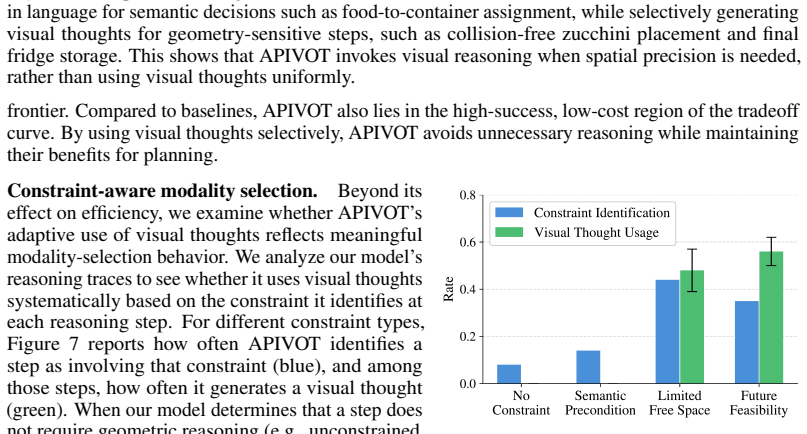
- Sections 3.2–3.3 and Appendix A.2 define Stage-3 modality labels and visual targets from the same simulator free-space / footprint / tightness heuristics that also define occupancy and constraint types used in evaluation (Fig. 4, Fig. 7). Appendix D.5 already shows heuristic 75% labeling beats random 75% (0.419 vs 0.371) and that sparser heuristics collapse visual-thought usage. This couples the “meaningful modality selection” narrative to the labeling rule rather than independently demonstrated geometric verification. The adaptive-efficiency claim (Fig. 6: 91% of Always-Image at 39% lower tokens) therefore needs stronger support: e.g., held-out labeling rules, analysis of whether latent states encode free-space/collision structure beyond RGB reconstruction, or RL/test-time selection optimized for success rather than SFT mimicry of the heuristic.
- Appendix D.4 Table 4 shows a persistent gap between generated visual thoughts (adaptive 0.419 / always-image 0.459) and GT-oracle images (0.482). Combined with the OOD hypothesis in D.1 that denser scenes hurt visual-thought generation, this suggests latent visual states may be imperfect geometric verifiers. The paper’s claim that visual thoughts enable “internal verification of geometric feasibility” (Abstract, §1, §5) would be more convincing with a direct diagnostic: when does attending to Hj change placement parameters or avert collisions versus merely correlating with heuristic-labeled steps? Without that, the geometric-verification interpretation remains partly inferential.
Circularity Check
Empirical SFT planner with external simulator success; only mild tautology in supervised modality-selection analysis, not in the main performance claims.
specific steps
-
other
[Sec. 3.2–3.3, Fig. 7, App. A.2 / D.5]
"We assign modality labels based on simulator-derived geometric heuristics that identify subgoals constrained by limited free space, collision-sensitive placements, or downstream feasibility dependencies. ... When our model determines that a step does not require geometric reasoning ... it does not produce visual thoughts. On the other hand, it uses visual thoughts for 48.4% of steps involving limited free space and 56.2% of steps involving downstream feasibility constraints."
Modality supervision is defined by the same free-space/tightness heuristics later used to stratify and interpret constraint-aware visual-thought use. Reporting that the model emits visual thoughts more on geometric steps partly restates the Stage-3 labeling rule rather than an independently discovered selection policy. This is a mild analysis tautology only; task success remains measured by simulator execution, not by reconstructing the heuristic labels.
full rationale
APIVOT’s load-bearing results are task success under closed-loop KitchenWorlds execution on held-out instances (Table 1, Fig. 4–6), compared to independent VLM and planning baselines. Success is not a fitted constant renamed as a prediction, nor is it defined in terms of the training modality labels. Reference traces are built from PDDLStream demos plus simulator geometric heuristics and LLM expansion (Sec. 3.2–3.3, App. A.2); that is standard imitation supervision, not a self-definitional derivation. Occupancy ratio is computed from object/target areas independently of the plan score. Always-Image vs Adaptive is an inference-time ablation of the same model, so the 91%/39% efficiency claim is an empirical tradeoff, not forced by construction. The only mild circularity is interpretive: Stage-3 SFT explicitly labels visual thoughts on geometrically tight steps, then Fig. 7 reports that the model uses visual thoughts more on geometric constraints—partly reproducing the supervised labeling rule. Appendix D.5’s heuristic-vs-random gap further shows coupling to the labeling policy, but that weakens the “discovered meaningful selection” narrative, not the external success metric. No self-citation uniqueness theorem, no ansatz smuggled as theorem, no renaming of a known closed-form result. Score 1 for that minor supervised-analysis tautology; main claims remain externally benchmarked.
Axiom & Free-Parameter Ledger
free parameters (5)
- visual thought length K =
16
- visual loss weight λ_vis =
5.0
- geometric tightness threshold for modality labels =
pre-defined threshold (value not numerically reported)
- LoRA rank and learning rate =
r=16, lr=4e-5
- Stage-3 visual-thought usage rate in reference data =
75%
axioms (5)
- domain assumption Parameterized skills open/pick/place with image-space (u,v) placements lifted via depth and known camera extrinsics are a sufficient action interface for the tasks.
- ad hoc to paper Cosine alignment of decoder hidden states at image-pad tokens to average-pooled frozen vision-encoder features of ground-truth future RGB yields latent states that subsequent tokens can use for geometric planning.
- ad hoc to paper Simulator-derived free-space margins and future-feasibility metrics correctly identify steps that benefit from visual thoughts.
- domain assumption High-capacity LLM expansion of annotated skeletons produces reasoning traces that are valid SFT targets for the VLM’s natural style.
- domain assumption KitchenWorlds + PDDLStream successful trajectories are representative enough that measured success rates support claims about long-horizon geometric planning.
invented entities (2)
-
Latent visual thought (Hj span of K image-pad hidden states)
no independent evidence
-
Three-stage adaptive modality curriculum
no independent evidence
read the original abstract
Long-horizon robot planning requires jointly reasoning over semantic task structure and geometric feasibility. To successfully execute a task, a robot must decompose goals, select task-relevant objects, and sequence actions, while ensuring that plans satisfy spatial constraints such as limited free space and object collisions. In this work, we propose APIVOT, a VLM-based planner that adaptively interleaves language and visual thoughts for long-horizon planning. APIVOT learns to leverage language for semantic reasoning, while using visual thoughts as imagined future states for internal verification of geometric feasibility. On long-horizon kitchen tasks, APIVOT outperforms general-purpose VLMs and prior planning frameworks, achieving the largest gains in spatially constrained settings. We find that APIVOT learns meaningful modality selection behavior, demonstrating that adaptive interleaving of vision-language thoughts improves both planning success and reasoning efficiency.
Figures




Reference graph
Works this paper leans on
-
[1]
Michael Ahn, Anthony Brohan, Noah Brown, Yevgen Chebotar, Omar Cortes, Byron David, Chelsea Finn, Chuyuan Fu, Keerthana Gopalakrishnan, Karol Hausman, Alex Herzog, Daniel Ho, Jasmine Hsu, Julian Ibarz, Brian Ichter, Alex Irpan, Eric Jang, Rosario Jauregui Ruano, Kyle Jeffrey, Sally Jesmonth, Nikhil J. Joshi, Ryan Julian, Dmitry Kalashnikov, Yuheng Kuang, ...
work page internal anchor Pith review Pith/arXiv arXiv 2022
-
[2]
Language Models as Zero-Shot Planners: Extracting Actionable Knowledge for Embodied Agents
Wenlong Huang, Pieter Abbeel, Deepak Pathak, and Igor Mordatch. Language Models as Zero-Shot Planners: Extracting Actionable Knowledge for Embodied Agents, March 2022. arXiv:2201.07207 [cs]
work page internal anchor Pith review Pith/arXiv arXiv 2022
-
[3]
Inner Monologue: Embodied Reasoning through Planning with Language Models
Wenlong Huang, Fei Xia, Ted Xiao, Harris Chan, Jacky Liang, Pete Florence, Andy Zeng, Jonathan Tompson, Igor Mordatch, Yevgen Chebotar, Pierre Sermanet, Noah Brown, Tomas Jackson, Linda Luu, Sergey Levine, Karol Hausman, and Brian Ichter. Inner Monologue: Embodied Reasoning through Planning with Language Models, July 2022. arXiv:2207.05608 [cs]
work page internal anchor Pith review Pith/arXiv arXiv 2022
-
[4]
LLM+P: Empowering Large Language Models with Optimal Planning Proficiency
Bo Liu, Yuqian Jiang, Xiaohan Zhang, Qiang Liu, Shiqi Zhang, Joydeep Biswas, and Peter Stone. LLM+P: Empowering Large Language Models with Optimal Planning Proficiency, September 2023. arXiv:2304.11477 [cs]
work page internal anchor Pith review Pith/arXiv arXiv 2023
-
[5]
Ishika Singh, Valts Blukis, Arsalan Mousavian, Ankit Goyal, Danfei Xu, Jonathan Tremblay, Dieter Fox, Jesse Thomason, and Animesh Garg. Progprompt: Program generation for situated robot task planning using large language models.Autonomous Robots, 47(8):999–1012, 2023
work page 2023
-
[6]
Code as policies: Language model programs for embodied control
Jacky Liang, Wenlong Huang, Fei Xia, Peng Xu, Karol Hausman, Brian Ichter, Pete Florence, and Andy Zeng. Code as policies: Language model programs for embodied control. In2023 IEEE International conference on robotics and automation (ICRA), pages 9493–9500. IEEE, 2023
work page 2023
-
[7]
Llm-planner: Few-shot grounded planning for embodied agents with large language models
Chan Hee Song, Jiaman Wu, Clayton Washington, Brian M Sadler, Wei-Lun Chao, and Yu Su. Llm-planner: Few-shot grounded planning for embodied agents with large language models. In Proceedings of the IEEE/CVF international conference on computer vision, pages 2998–3009, 2023
work page 2023
-
[8]
Embodied Task Planning with Large Language Models
Zhenyu Wu, Ziwei Wang, Xiuwei Xu, Jiwen Lu, and Haibin Yan. Embodied task planning with large language models.arXiv preprint arXiv:2307.01848, 2023
work page internal anchor Pith review Pith/arXiv arXiv 2023
-
[9]
CoPAL: Corrective Planning of Robot Actions with Large Language Models
Frank Joublin, Antonello Ceravola, Pavel Smirnov, Felix Ocker, Joerg Deigmoeller, Anna Belardinelli, Chao Wang, Stephan Hasler, Daniel Tanneberg, and Michael Gienger. CoPAL: Corrective Planning of Robot Actions with Large Language Models. In2024 IEEE International Conference on Robotics and Automation (ICRA), pages 8664–8670, May 2024
work page 2024
-
[10]
Guiding Long-Horizon Task and Motion Planning with Vision Language Models
Zhutian Yang, Caelan Garrett, Dieter Fox, Tomás Lozano-Pérez, and Leslie Pack Kaelbling. Guiding Long-Horizon Task and Motion Planning with Vision Language Models, October 2024. arXiv:2410.02193 [cs]
work page internal anchor Pith review Pith/arXiv arXiv 2024
-
[11]
LLM3:Large Language Model-based Task and Motion Planning with Motion Failure Reasoning
Shu Wang, Muzhi Han, Ziyuan Jiao, Zeyu Zhang, Ying Nian Wu, Song-Chun Zhu, and Hangxin Liu. LLM3:Large Language Model-based Task and Motion Planning with Motion Failure Reasoning, August 2024. arXiv:2403.11552 [cs]. 10
work page internal anchor Pith review Pith/arXiv arXiv 2024
-
[12]
RePLan: Robotic Replanning with Perception and Language Models
Marta Skreta, Zihan Zhou, Jia Lin Yuan, Kourosh Darvish, Alán Aspuru-Guzik, and Animesh Garg. RePLan: Robotic Replanning with Perception and Language Models, February 2024. arXiv:2401.04157 [cs]
work page internal anchor Pith review Pith/arXiv arXiv 2024
-
[13]
Reflective Planning: Vision-Language Models for Multi-Stage Long-Horizon Robotic Manipulation
Yunhai Feng, Jiaming Han, Zhuoran Yang, Xiangyu Yue, Sergey Levine, and Jianlan Luo. Reflective Planning: Vision-Language Models for Multi-Stage Long-Horizon Robotic Manipu- lation, February 2025. arXiv:2502.16707 [cs]
work page internal anchor Pith review Pith/arXiv arXiv 2025
-
[14]
Robotic Control via Embodied Chain-of-Thought Reasoning
Michał Zawalski, William Chen, Karl Pertsch, Oier Mees, Chelsea Finn, and Sergey Levine. Robotic Control via Embodied Chain-of-Thought Reasoning, March 2025. arXiv:2407.08693 [cs]
work page internal anchor Pith review Pith/arXiv arXiv 2025
-
[15]
CoT-VLA: Visual Chain-of-Thought Reasoning for Vision-Language-Action Models
Qingqing Zhao, Yao Lu, Moo Jin Kim, Zipeng Fu, Zhuoyang Zhang, Yecheng Wu, Zhaoshuo Li, Qianli Ma, Song Han, Chelsea Finn, Ankur Handa, Ming-Yu Liu, Donglai Xiang, Gordon Wetzstein, and Tsung-Yi Lin. CoT-VLA: Visual Chain-of-Thought Reasoning for Vision- Language-Action Models, March 2025. arXiv:2503.22020 [cs]
work page internal anchor Pith review Pith/arXiv arXiv 2025
-
[16]
Yucheng Hu, Jianke Zhang, Yuanfei Luo, Yanjiang Guo, Xiaoyu Chen, Xinshu Sun, Kun Feng, Qingzhou Lu, Sheng Chen, Yangang Zhang, Wei Li, and Jianyu Chen. BagelVLA: Enhancing long-horizon manipulation via interleaved vision-language-action generation, February 2026. arXiv:2602.09849 [cs.RO]
-
[17]
EO-1: An open unified embodied foundation model for general robot control, August 2025
Delin Qu, Haoming Song, Qizhi Chen, Zhaoqing Chen, Xianqiang Gao, Dong Wang, Xinyi Ye, Qi Lv, Modi Shi, Guanghui Ren, Cheng Ruan, Maoqing Yao, Haoran Yang, Jiacheng Bao, Bin Zhao, and Xuelong Li. EO-1: An open unified embodied foundation model for general robot control, August 2025. arXiv:2508.21112 [cs.RO]
-
[18]
From Seeing to Doing: Bridging Reasoning and Decision for Robotic Manipulation
Yifu Yuan, Haiqin Cui, Yibin Chen, Zibin Dong, Fei Ni, Longxin Kou, Jinyi Liu, Pengyi Li, Yan Zheng, and Jianye Hao. From seeing to doing: Bridging reasoning and decision for robotic manipulation, May 2025. arXiv:2505.08548 [cs.RO]
work page internal anchor Pith review Pith/arXiv arXiv 2025
-
[19]
${\pi}_{0.7}$: a Steerable Generalist Robotic Foundation Model with Emergent Capabilities
Physical Intelligence, Bo Ai, Ali Amin, Raichelle Aniceto, Ashwin Balakrishna, Greg Balke, Kevin Black, George Bokinsky, Shihao Cao, Thomas Charbonnier, Vedant Choudhary, Foster Collins, Ken Conley, Grace Connors, James Darpinian, Karan Dhabalia, Maitrayee Dhaka, Jared DiCarlo, Danny Driess, et al. π0.7: A steerable generalist robotic foundation model wit...
work page internal anchor Pith review Pith/arXiv arXiv 2026
-
[20]
Caelan Reed Garrett, Rohan Chitnis, Rachel Holladay, Beomjoon Kim, Tom Silver, Leslie Pack Kaelbling, and Tomás Lozano-Pérez. Integrated Task and Motion Planning.Annual Review of Control, Robotics, and Autonomous Systems, 4(1):265–293, May 2021
work page 2021
-
[21]
PDDLStream: Integrating Symbolic Planners and Blackbox Samplers via Optimistic Adaptive Planning
Caelan Reed Garrett, Tomás Lozano-Pérez, and Leslie Pack Kaelbling. PDDLStream: Integrat- ing Symbolic Planners and Blackbox Samplers via Optimistic Adaptive Planning, March 2020. arXiv:1802.08705 [cs]
work page internal anchor Pith review Pith/arXiv arXiv 2020
-
[22]
Pddl—the planning domain definition language.Technical Report, Tech
Constructions Aeronautiques, Adele Howe, Craig Knoblock, ISI Drew McDermott, Ashwin Ram, Manuela Veloso, Daniel Weld, David Wilkins Sri, Anthony Barrett, Dave Christianson, et al. Pddl—the planning domain definition language.Technical Report, Tech. Rep., 1998
work page 1998
-
[23]
M. Helmert. The Fast Downward Planning System.Journal of Artificial Intelligence Research, 26:191–246, July 2006. arXiv:1109.6051 [cs]
work page internal anchor Pith review Pith/arXiv arXiv 2006
- [24]
-
[25]
Muyang Yan, Miras Mengdibayev, Ardon Floros, Weihang Guo, Lydia E. Kavraki, and Zachary Kingston. Using VLM Reasoning to Constrain Task and Motion Planning, March 2026. arXiv:2510.25548 [cs]
-
[26]
Shuai Bai, Yuxuan Cai, Ruizhe Chen, Keqin Chen, Xionghui Chen, Zesen Cheng, Lianghao Deng, Wei Ding, Chang Gao, Chunjiang Ge, Wenbin Ge, Zhifang Guo, Qidong Huang, Jie Huang, Fei Huang, Binyuan Hui, Shutong Jiang, Zhaohai Li, Mingsheng Li, Mei Li, Kaixin 11 Li, Zicheng Lin, Junyang Lin, Xuejing Liu, Jiawei Liu, Chenglong Liu, Yang Liu, Dayiheng Liu, Shixu...
work page internal anchor Pith review Pith/arXiv arXiv 2025
-
[27]
Gemini Robotics ER 1.6 Model Card
-
[28]
Emerging Properties in Unified Multimodal Pretraining
Chaorui Deng, Deyao Zhu, Kunchang Li, Chenhui Gou, Feng Li, Zeyu Wang, Shu Zhong, Weihao Yu, Xiaonan Nie, Ziang Song, Guang Shi, and Haoqi Fan. Emerging properties in unified multimodal pretraining, 2025. arXiv:2505.14683 [cs.CV]
work page internal anchor Pith review Pith/arXiv arXiv 2025
-
[29]
Show-o2: Improved Native Unified Multimodal Models
Jinheng Xie, Zhenheng Yang, and Mike Zheng Shou. Show-o2: Improved native unified multimodal models, 2025. arXiv:2506.15564 [cs.CV]
work page internal anchor Pith review Pith/arXiv arXiv 2025
-
[30]
TUNA: Taming unified visual representations for native unified multimodal models, 2025
Zhiheng Liu, Weiming Ren, Haozhe Liu, Zijian Zhou, Shoufa Chen, Haonan Qiu, Xiaoke Huang, Zhaochong An, Fanny Yang, Aditya Patel, Viktar Atliha, Tony Ng, Xiao Han, Chuyan Zhu, Chenyang Zhang, Ding Liu, Juan-Manuel Perez-Rua, Sen He, Jürgen Schmidhuber, Wenhu Chen, Ping Luo, Wei Liu, Tao Xiang, Jonas Schult, and Yuren Cong. TUNA: Taming unified visual repr...
-
[31]
Tuna-2: Pixel Embeddings Beat Vision Encoders for Multimodal Understanding and Generation
Zhiheng Liu, Weiming Ren, Xiaoke Huang, Shoufa Chen, Tianhong Li, Mengzhao Chen, Yatai Ji, Sen He, Jonas Schult, Belinda Zeng, Tao Xiang, Wenhu Chen, Ping Luo, Luke Zettlemoyer, and Yuren Cong. Tuna-2: Pixel embeddings beat vision encoders for multimodal understanding and generation, April 2026. arXiv:2604.24763 [cs.CV]
work page internal anchor Pith review Pith/arXiv arXiv 2026
-
[32]
Beyond language modeling: An exploration of multimodal pretraining, March 2026
Shengbang Tong, David Fan, John Nguyen, Ellis Brown, Gaoyue Zhou, Shengyi Qian, Boyang Zheng, Théophane Vallaeys, Junlin Han, Rob Fergus, Naila Murray, Marjan Ghazvininejad, Mike Lewis, Nicolas Ballas, Amir Bar, Michael Rabbat, Jakob Verbeek, Luke Zettlemoyer, Koustuv Sinha, Yann LeCun, and Saining Xie. Beyond language modeling: An exploration of multimod...
-
[33]
Zhaochen Su, Peng Xia, Hangyu Guo, Zhenhua Liu, Yan Ma, Xiaoye Qu, Jiaqi Liu, Yanshu Li, Kaide Zeng, Zhengyuan Yang, Linjie Li, Yu Cheng, Heng Ji, Junxian He, and Yi R. Fung. Thinking with Images for Multimodal Reasoning: Foundations, Methods, and Future Frontiers, July 2025. arXiv:2506.23918 [cs]
work page internal anchor Pith review Pith/arXiv arXiv 2025
-
[34]
Zebra-CoT: A dataset for interleaved vision language reasoning, July 2025
Ang Li, Charles Wang, Deqing Fu, Kaiyu Yue, Zikui Cai, Wang Bill Zhu, Ollie Liu, Peng Guo, Willie Neiswanger, Furong Huang, Tom Goldstein, and Micah Goldblum. Zebra-CoT: A dataset for interleaved vision language reasoning, July 2025. arXiv:2507.16746 [cs.CV]
-
[35]
Imagine while Reasoning in Space: Multimodal Visualization-of-Thought, January
Chengzu Li, Wenshan Wu, Huanyu Zhang, Yan Xia, Shaoguang Mao, Li Dong, Ivan Vuli´c, and Furu Wei. Imagine while Reasoning in Space: Multimodal Visualization-of-Thought, January
-
[36]
arXiv:2501.07542 [cs]
work page internal anchor Pith review Pith/arXiv arXiv
-
[37]
Yiming Qin, Bomin Wei, Jiaxin Ge, Konstantinos Kallidromitis, Stephanie Fu, Trevor Darrell, and Xudong Wang. Chain-of-Visual-Thought: Teaching VLMs to See and Think Better with Continuous Visual Tokens, November 2025. arXiv:2511.19418 [cs]
-
[38]
Machine Mental Imagery: Empower Multimodal Reasoning with Latent Visual Tokens
Zeyuan Yang, Xueyang Yu, Delin Chen, Maohao Shen, and Chuang Gan. Machine Mental Imagery: Empower Multimodal Reasoning with Latent Visual Tokens, June 2025. arXiv:2506.17218 [cs]
work page internal anchor Pith review Pith/arXiv arXiv 2025
-
[39]
ThinkMorph: Emergent Properties in Multimodal Interleaved Chain-of-Thought Reasoning, February 2026
Jiawei Gu, Yunzhuo Hao, Huichen Will Wang, Linjie Li, Michael Qizhe Shieh, Yejin Choi, Ranjay Krishna, and Yu Cheng. ThinkMorph: Emergent Properties in Multimodal Interleaved Chain-of-Thought Reasoning, February 2026. arXiv:2510.27492 [cs]
-
[40]
LATTE: Learning to Think with Vision Specialists, September 2025
Zixian Ma, Jianguo Zhang, Zhiwei Liu, Jieyu Zhang, Juntao Tan, Manli Shu, Juan Carlos Niebles, Shelby Heinecke, Huan Wang, Caiming Xiong, Ranjay Krishna, and Silvio Savarese. LATTE: Learning to Think with Vision Specialists, September 2025. arXiv:2412.05479 [cs]. 12
-
[41]
Haozhe Wang, Alex Su, Weiming Ren, Fangzhen Lin, and Wenhu Chen. Pixel Reasoner: Incentivizing Pixel-Space Reasoning with Curiosity-Driven Reinforcement Learning, October
-
[42]
arXiv:2505.15966 [cs]
work page internal anchor Pith review Pith/arXiv arXiv
-
[43]
Plummer, Kate Saenko, Ranjay Krishna, Leonidas Guibas, and Wen-Sheng Chu
Arijit Ray, Ahmed Abdelkader, Chengzhi Mao, Bryan A. Plummer, Kate Saenko, Ranjay Krishna, Leonidas Guibas, and Wen-Sheng Chu. Mull-tokens: Modality-agnostic latent thinking,
-
[44]
arXiv:2512.10941 [cs.CV]
work page internal anchor Pith review Pith/arXiv arXiv
-
[45]
Thinking with visual primitives, 2026
Ruijie Lu, Yiyang Ma, Xiaokang Chen, Lingxiao Luo, Zhiyu Wu, Zizheng Pan, Xingchao Liu, Yutong Lin, Hao Li, Wen Liu, Zhewen Hao, Xi Gao, Shaoheng Nie, Yixuan Wei, Zhenda Xie, Ting Chen, and Gang Zeng. Thinking with visual primitives, 2026. Technical report
work page 2026
-
[46]
AdaCoT: Pareto-Optimal Adaptive Chain-of-Thought Triggering via Reinforcement Learning
Chenwei Lou, Zewei Sun, Xinnian Liang, Meng Qu, Wei Shen, Wenqi Wang, Yuntao Li, Qing- ping Yang, and Shuangzhi Wu. AdaCoT: Pareto-optimal adaptive chain-of-thought triggering via reinforcement learning, 2025. arXiv:2505.11896 [cs.LG]
work page internal anchor Pith review Pith/arXiv arXiv 2025
-
[47]
Training Strategies for Efficient Embodied Reasoning
William Chen, Suneel Belkhale, Suvir Mirchandani, Oier Mees, Danny Driess, Karl Pertsch, and Sergey Levine. Training strategies for efficient embodied reasoning, 2025. arXiv:2505.08243 [cs.RO]
work page internal anchor Pith review Pith/arXiv arXiv 2025
-
[48]
Large Language Models Can Be Easily Distracted by Irrelevant Context
Freda Shi, Xinyun Chen, Kanishka Misra, Nathan Scales, David Dohan, Ed Chi, Nathanael Schärli, and Denny Zhou. Large Language Models Can Be Easily Distracted by Irrelevant Context, June 2023. arXiv:2302.00093 [cs]
work page internal anchor Pith review Pith/arXiv arXiv 2023
-
[49]
Liu, Kevin Lin, John Hewitt, Ashwin Paranjape, Michele Bevilacqua, Fabio Petroni, and Percy Liang
Nelson F. Liu, Kevin Lin, John Hewitt, Ashwin Paranjape, Michele Bevilacqua, Fabio Petroni, and Percy Liang. Lost in the Middle: How Language Models Use Long Contexts, November
-
[50]
arXiv:2307.03172 [cs]
work page internal anchor Pith review Pith/arXiv arXiv
-
[51]
How Easily do Irrelevant Inputs Skew the Responses of Large Language Models?
Siye Wu, Jian Xie, Jiangjie Chen, Tinghui Zhu, Kai Zhang, and Yanghua Xiao. How Eas- ily do Irrelevant Inputs Skew the Responses of Large Language Models?, September 2024. arXiv:2404.03302 [cs]
work page internal anchor Pith review Pith/arXiv arXiv 2024
-
[52]
Richard S Sutton, Doina Precup, and Satinder Singh. Between mdps and semi-mdps: A framework for temporal abstraction in reinforcement learning.Artificial intelligence, 112(1- 2):181–211, 1999
work page 1999
-
[53]
Constrained model predictive control: Stability and optimality.Automatica, 36(6):789–814, 2000
David Q Mayne, James B Rawlings, Christopher V Rao, and Pierre OM Scokaert. Constrained model predictive control: Stability and optimality.Automatica, 36(6):789–814, 2000
work page 2000
-
[54]
Learning compositional behaviors from demonstration and language
Weiyu Liu, Neil Nie, Ruohan Zhang, Jiayuan Mao, and Jiajun Wu. Learning compositional behaviors from demonstration and language. In8th Annual Conference on Robot Learning, 2024. 13 Supplementary for APIVOT: Adaptive Planning with Interleaved Vision-Language Thoughts The appendix is organized as follows: In Appendix A, we include details about the task sui...
-
[55]
State what the action does in the context of the task
-
[56]
Identify the key constraint that matters at this step
-
[57]
Explain why the selected modality (text or text_image_post) is appropriate. At the end, indicating that the task is complete and that it will output the final answer. Do NOT add this earlier. The reasoning should sound like a planner thinking through the decision, not like metadata description. Reasoning style requirements: - Write in natural reasoning st...
-
[60]
You should aim to achieve the goal with the minimum number of actions. Answer Format: You must output exactly two sections: <think>...</think> <answer>...</answer> ––––––––––––––––
-
[61]
Each step should describe the next planning subgoal required to complete the task
<think>section: In the <think>section, you must produce a structured planning trace as an ordered sequence of reasoning steps written in the format: Step k: ... Each step should describe the next planning subgoal required to complete the task. Each step should include reasoning about the following:
-
[62]
Planning intention: State what must be decided or done next and how it contributes to achieving the goal
-
[63]
Examples include: - spatial capacity - object accessibility - ordering dependencies - none
Key constraint: Identify the most important constraint affecting this step. Examples include: - spatial capacity - object accessibility - ordering dependencies - none
-
[64]
Modality decision: Decide whether this step requires visual verification or whether text reasoning is sufficient
-
[65]
Justification: Explain WHY that modality choice is appropriate. –––––––––––––––– Image representation rule: If visual verification is required for a step, you must emit an image representation immediately after the reasoning for that step. Correct structure example: Step 2: I need to determine whether the container still has enough space for the remaining...
-
[66]
<answer>section: Output the final plan as a list of primitive actions. Requirements: - One action per line - Use only the formal primitive action language - Do not include reasoning here - The plan must be consistent with the reasoning in <think> –––––––––––––––– Final rules: - Your output must follow EXACTLY this structure: <think>...</think> <answer>......
-
[67]
You must have at least one empty hand before you can pick up an object
-
[68]
You can only take actions on objects listed above
-
[69]
You should aim to achieve the goal with the minimum number of actions. Output Format: First, write step-by-step reasoning about how to complete the task, including task decomposition, subgoal setting, and action sequencing. Each step should focus on planning the next planning subgoal required to complete the task, and reasoning about what must be decided ...
discussion (0)
Sign in with ORCID, Apple, or X to comment. Anyone can read and Pith papers without signing in.