REVIEW 3 major objections 7 minor 133 references
Reviewed by Pith at T0; open to challenge.
T0 means a machine referee read the full paper against a public rubric. The mark states how deep the mechanical check went, never who wrote it. the ladder, T0–T4 →
T0 review · glm-5.2
Native video-action pretraining lets robots learn control from web video
2026-07-10 03:52 UTC pith:RNHARHC7
load-bearing objection Real-world claims lack statistical support; simulation gains over prior generation are marginal. But the system integration is genuine and the engineering is serious. the 3 major comments →
Native Video-Action Pretraining for Generalizable Robot Control
The pith
A machine-rendered reading of the paper's core claim, the machinery that carries it, and where it could break.
Core claim
The paper's central claim is that pretraining a video-action model natively for embodiment—using a semantic visual-action tokenizer that jointly learns visual latents and latent actions from unlabeled web video, combined with a causal architecture trained from scratch—produces a control representation that generalizes better and faster than repurposing generic video generators. The semantic tokenizer is the load-bearing piece: by aligning visual latents to foundation-model semantics and extracting latent actions through self-supervised transition prediction, it converts passive web video into supervision for physical control without requiring robot demonstrations at pretraining scale. The ab
What carries the argument
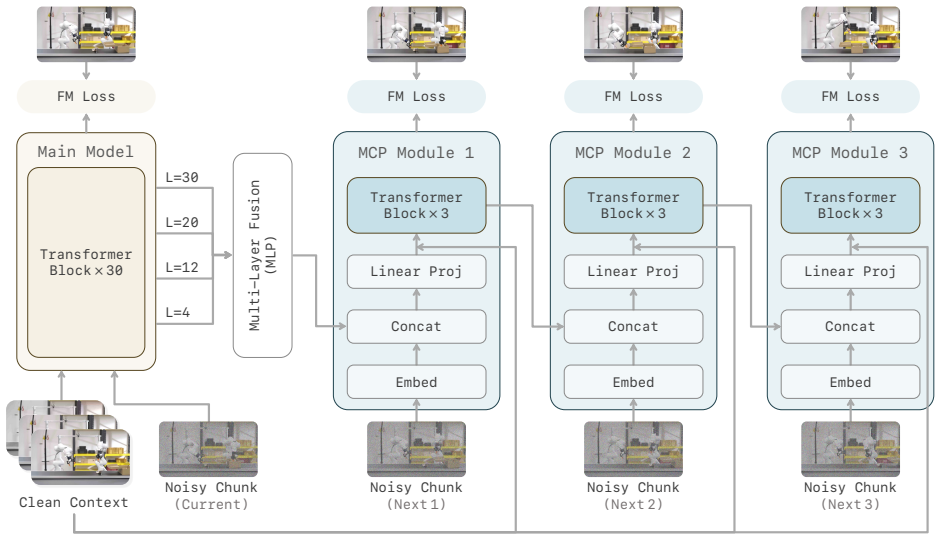
The semantic visual-action tokenizer (Sec. 2.2) is the central mechanism. It augments a ViT autoencoder with two objectives: (1) semantic alignment, which pulls visual latents toward a frozen Perception Encoder's features via temporal average pooling (Eq. 10), and (2) latent action tokenization, which trains an inverse dynamics model q_phi to predict a compact transition variable l_t between consecutive latents (Eq. 12) and a forward dynamics model f_psi to reconstruct the next latent via a transport map and residual (Eq. 13). The resulting paired visual-action latents serve as training targets for a causal DiT with a sparse MoE video stream (128 routed experts, top-8 routing, loss-free load
Load-bearing premise
The entire architecture rests on the semantic visual-action tokenizer: if the latent actions extracted by self-supervised inverse and forward dynamics on passive web video do not capture control-relevant structure for physical manipulation, then the shared latent space that the causal DiT and downstream policy depend on is misaligned from the start.
What would settle it
Train the semantic visual-action tokenizer on web video alone, then freeze it and train the downstream policy on real-robot tasks. If the resulting policy fails to generalize from 10-15 demonstrations or underperforms a model using a reconstruction-only VAE on real-world manipulation (not just simulation), the claim that self-supervised latent actions from passive video provide control-relevant supervision is not supported.
If this is right
- If self-supervised latent actions from passive web video genuinely capture control-relevant dynamics, then the bottleneck of robot data collection shifts: web-scale video becomes the primary training signal, and robot demonstrations are needed only for fine-tuning rather than for learning dynamics.
- The causal-from-scratch pretraining route implies that bidirectional video generators pretrained on web data may be the wrong starting point for control, and that the field's common practice of adapting off-the-shelf generators carries a structural tax that native pretraining avoids.
- The Foresight Reasoning scheme, which predicts future latents in parallel with action execution and re-grounds on real observations, suggests that the serial bottleneck between model inference and robot execution can be broken without losing closed-loop feedback, potentially changing how real-time robot control systems are architected.
- The human-robot co-training approach, which maps hand poses into a shared action space with robot grippers, implies that egocentric human video can directly improve robot policies during pretraining rather than only during adaptation, if the action-space mismatch is handled at the representation level.
Where Pith is reading between the lines
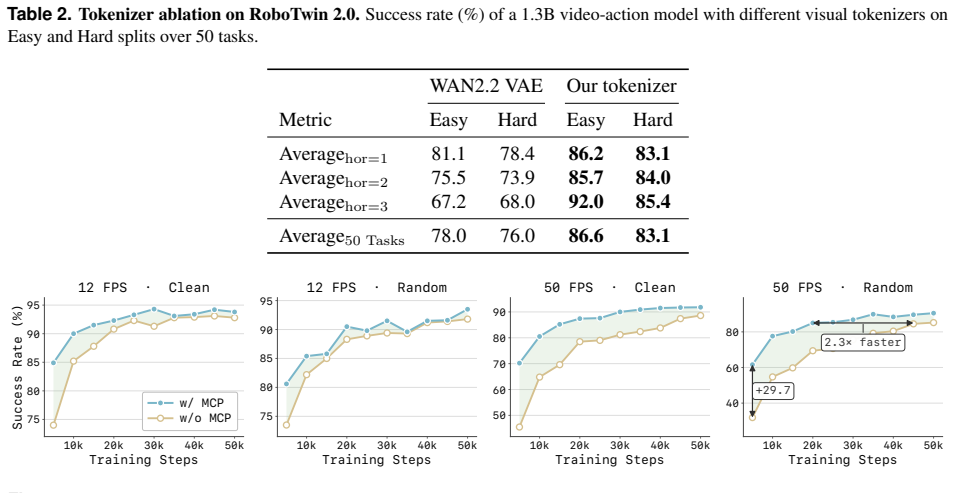
- The semantic tokenizer's latent actions are learned from passive video where no physical embodiment is present; whether these abstract transition variables capture the same control structure that a physical gripper's actions impose on the world is an empirical question the paper does not fully resolve, since the tokenizer ablation (Table 2) is conducted only in simulation.
- If the native pretraining route is correct, then scaling the web-video corpus further should monotonically improve downstream robot performance without additional robot data—a testable prediction that the paper's scaling experiments do not yet push to the regime where this would be the dominant factor.
- The Foresight Reasoning re-grounding step assumes the learned forward dynamics can correct imagined latents fast enough to prevent drift; the paper does not report how prediction error accumulates over long horizons without real observations, which would determine the scheme's limits in tasks with infrequent visual feedback.
Editorial analysis
A structured set of objections, weighed in public.
Referee Report
Summary. The paper presents LingBot-VA 2.0, a video-action foundation model for robot manipulation that is pretrained from scratch rather than adapted from generic video generators. The architecture comprises four components: (1) a semantic visual-action tokenizer that aligns visual latents with a frozen foundation model and extracts latent actions via self-supervised inverse/forward dynamics on unlabeled video; (2) a causal diffusion transformer (DiT) with a sparse Mixture-of-Experts (MoE) video stream, trained natively in a causal regime; (3) multi-chunk prediction (MCP), in-context learning (ICL), and human-robot co-training as auxiliary objectives; and (4) Foresight Reasoning, an asynchronous inference scheme that predicts future latents in parallel with action execution and re-grounds on real observations. The system is evaluated on RoboTwin simulation and four real-world manipulation tasks, reporting improvements over π0.5 and the prior LingBot-VA, with a peak asynchronous execution frequency of 225 Hz.
Significance. The paper addresses a well-motivated problem: the mismatch between bidirectional video generators (designed for content creation) and the causal, closed-loop demands of robot control. The native pretraining route—building a semantic tokenizer and causal DiT from scratch rather than retrofitting an off-the-shelf backbone—is a coherent response to this mismatch. The engineering scope is substantial: a 15.3B-parameter model with sparse MoE, consistency distillation, FP8 TensorRT compilation, and paged KV-cache attention optimization, all contributing to a measurable 6.5× end-to-end speedup (Table 3). The Foresight Reasoning scheme (Sec. 2.3.7), which overlaps prediction with execution while re-grounding on real observations, is a concrete and falsifiable contribution to closed-loop control latency. The in-context learning demonstration (Fig. 9) and the human-robot co-training recipe (Sec. 2.3.5) add practical value. However, the central empirical claim—that native pretraining outperforms adapting generic video generators—rests on evaluation evidence that is not yet sufficient in rigor or scale, as detailed below.
major comments (3)
- §4.2.1, Figure 8: The real-world evaluation reports success rates and task progress for four tasks but provides no number of evaluation rollouts, no confidence intervals, and no statistical significance tests. Several reported differences between VA 2.0 and VA 1.0 are small (e.g., Pen Collection success rate: 77% vs. 75%; Plate Handover progress: 90% vs. 89%). Without variance estimates or episode counts, it is impossible to determine whether these differences reflect genuine improvement or sampling noise. This is load-bearing because the paper's central claim is that native pretraining outperforms the prior adapted approach. At minimum, the number of rollouts per task and bootstrap or binomial confidence intervals should be reported for all conditions in Figure 8.
- Table 1: The simulation improvement over LingBot-VA (the most direct comparison for the native-vs-adapted thesis) is 93.6% vs. 92.2% average, a 1.4 percentage-point difference. The paper does not report the number of evaluation episodes or variance for RoboTwin. A 1.4 pp difference on a benchmark with 50 tasks could be within noise. The paper should either (a) report per-task variance and episode counts to establish that this difference is statistically meaningful, or (b) acknowledge that the simulation gain over the prior generation is marginal and reframe the contribution accordingly. The claim of 'substantial margin' improvement (end of Sec. 1) is not supported by this table alone.
- §4.4, Table 2: The tokenizer ablation—the most direct test of the semantic visual-action tokenizer, which is the foundation of the entire architecture—is conducted only in simulation (RoboTwin) and only on a 1.3B model, not the 15.3B deployed system. The MCP ablation (Fig. 10) uses a 5B model. The few-shot and real-world generalization claims (Sec. 4.2) are made for the full-scale system in the real-world domain, but no ablation bridges the gap between the ablated small-model/simulation setting and the full-scale/real-world setting. The paper should either run the tokenizer ablation at or near the deployed scale, or on at least one real-world task, or explicitly discuss the risk that the tokenizer's benefit does not transfer to the full-scale real-world setting.
minor comments (7)
- §2.2.2, Eq. (13): The transport map K_t is described as moving information across spatial latent tokens, but its dimensionality and parameterization are not specified. Is K_t a full attention matrix, a per-token linear map, or something else? A brief clarification would help reproducibility.
- §2.3.2, Eq. (19): The load-balancing bias update uses a sign function on (c_i - c̄), which zeroes out the mean-centered component. The choice of η_lb and its interaction with training stability is not discussed. A sentence on the range of η_lb used and whether it was tuned would help.
- §2.3.7, Eq. (29): The notation v^vid_θ is used both for the video expert's velocity field (Eq. 6) and for the integrated latent obtained from it (Eq. 8, with the noted abuse of notation). In Eq. (29), it is unclear whether FDM_θ denotes the velocity field or the integrated latent. The authors should clarify which quantity is meant, as the reader may confuse the two.
- §4.1.1: The model has approximately 15.3B trained parameters with 2.5B active per token. The ratio of MCP heads (1.7B) to the total is notable. It would help to state whether MCP heads are included in the 15.3B count and whether they are discarded at inference (stated in Sec. 2.3.3 but not cross-referenced in the parameter table).
- Figure 8: The y-axis labels ('Success Rate' and 'Progress Rate') appear twice with different ranges, and the legend is small. Consider consolidating into a single panel per metric with clearer labeling.
- §2.3.5: The hand-to-gripper mapping φ is described qualitatively but the quantile normalization per dataset is not formalized. A brief equation or reference to the normalization procedure would improve reproducibility.
- The paper builds on several closely related prior works by the same group (LingBot-VA [50], RepWAM [98], Next Forcing [111], Zero-WAM [60], LingBot-Video [70]). While each is cited, the paper would benefit from a clearer statement of which components are novel vs. inherited, to help readers assess the incremental contribution.
Circularity Check
Multiple self-citations for methodological components, but none are load-bearing for the central claim in a circular way; the thesis is tested through experiments against external baselines.
full rationale
The paper builds on several prior works by overlapping authors: the semantic visual-action tokenizer follows RepWAM [98] (Sec. 2.2), multi-chunk prediction follows Next Forcing [111] (Sec. 2.3.3), and in-context learning follows Zero-WAM [60] (Sec. 2.3.4). However, these are methodological adoptions, not circular derivations. Each component is described in sufficient technical detail within this paper (with explicit equations: Eq. 9–14 for the tokenizer, Eq. 21–23 for MCP, Eq. 24 for ICL) and is independently ablated (Table 2 for the tokenizer, Figure 10 for MCP). The central thesis — that native from-scratch causal video-action pretraining outperforms adapting generic bidirectional video generators — is tested through direct experimental comparison against external baselines (π0.5 [77]) and the prior generation (LingBot-VA [50]) in both simulation (Table 1) and real-world deployment (Figure 8). No 'prediction' or 'result' reduces by construction to its inputs. The latent action tokenizer (Eq. 12–14) defines latent actions as compact transition variables learned via self-supervised forward/backward consistency — this is a standard autoencoder-style objective, not a self-definitional loop. The Foresight Reasoning scheme (Eq. 29–30) trains the video expert as a forward-dynamics predictor with an explicit loss; it does not define the prediction as the input. The self-citations are normal methodological lineage, not a chain where the central claim is justified only by citing the authors' own unverified prior work. The derivation is self-contained against external benchmarks.
Axiom & Free-Parameter Ledger
free parameters (7)
- λ_align =
Not specified
- λ_act =
Not specified
- MCP loss weights (w1, w2, w3) =
(0.5, 0.2, 0.1)
- Task mixing distribution π(τ) =
Coarse-to-fine schedule
- MoE routing: Ne, k, γ =
Ne=128, k=8, γ not specified
- Context noise augmentation probability =
0.5
- Timestep shifts =
image=2, web/video=2, robot=5, MCP=10, action=1
axioms (4)
- domain assumption Latent actions extracted from passive video via inverse/forward dynamics capture control-relevant information transferable to robot manipulation.
- domain assumption Causal pretraining from scratch avoids catastrophic forgetting better than bidirectional-to-causal finetuning.
- domain assumption The frozen Perception Encoder [10] provides semantic features suitable for aligning robot control representations.
- domain assumption Human hand motion retargeted to gripper apertures provides useful action supervision for robot policies.
invented entities (3)
-
Semantic visual-action tokenizer
independent evidence
-
Foresight Reasoning
no independent evidence
-
Latent action token (a_t ≡ ℓ_t)
independent evidence
read the original abstract
The advent of video-action models offers a promising path for robot control. Nevertheless, we argue that repurposing video generative models designed for digital content creation is inherently inadequate for physical environments. To bridge this gap, we present LingBot-VA 2.0, a video-action foundation model built from the ground up for embodiment. Four core design principles showcase its evolution from LingBot-VA. (1) Departing from traditional reconstruction-focused VAEs, we introduce a semantic visual-action tokenizer, which aligns visual representations with both semantics and actions, improving instruction following and action precision in subsequent policy learning. (2) Given the strictly causal nature of temporal dynamics, we adopt a causal pretraining paradigm, training from scratch to circumvent the catastrophic forgetting that frequently occurs when adapting bidirectional architectures. (3) To meet the demands of high-frequency inference, our model employs a sparse MoE backbone, expanding model capacity without compromising efficiency. (4) Real-time closed-loop control is realized through an enhanced asynchronous inference scheme, which predicts future latents in parallel with action execution while re-grounding each rollout on the latest observation via learned forward dynamics. Real-world deployment validates LingBot-VA 2.0 as a robust foundation model, as evidenced by its few-shot generalization across complex manipulation tasks.
Figures





Reference graph
Works this paper leans on
-
[1]
1x world model: From video to action
1X Technologies. 1x world model: From video to action. https://www.1x.tech/discover/world-model-self-learning,
-
[2]
AgiBot-World-Contributors, Qingwen Bu, Jisong Cai, Li Chen, Xiuqi Cui, Yan Ding, Siyuan Feng, Shenyuan Gao, Xindong He, Xuan Hu, Xu Huang, Shu Jiang, Yuxin Jiang, Cheng Jing, Hongyang Li, et al. Agibot world colosseo: A large-scale manipulation platform for scalable and intelligent embodied systems.arXiv preprint arXiv:2503.06669, 2025
work page internal anchor Pith review Pith/arXiv arXiv 2025
-
[3]
Video pretraining (vpt): Learning to act by watching unlabeled online videos
Bowen Baker, Ilge Akkaya, Peter Zhokov, Joost Huizinga, Jie Tang, Adrien Ecoffet, Brandon Houghton, Raul Sampedro, and Jeff Clune. Video pretraining (vpt): Learning to act by watching unlabeled online videos. InAdv. Neural Inform. Process. Syst., 2022
work page 2022
-
[4]
One transformer fits all distributions in multi-modal diffusion at scale
Fan Bao, Shen Nie, Kaiwen Xue, Chongxuan Li, Shi Pu, Yaole Wang, Gang Yue, Yue Cao, Hang Su, and Jun Zhu. One transformer fits all distributions in multi-modal diffusion at scale. InInt. Conf. Mach. Learn., 2023
work page 2023
-
[5]
Amir Bar, Gaoyue Zhou, Danny Tran, Trevor Darrell, and Yann LeCun. Navigation world models. InIEEE Conf. Comput. Vis. Pattern Recog., 2025
work page 2025
-
[6]
A Careful Examination of Large Behavior Models for Multitask Dexterous Manipulation
Jose Barreiros, Andrew Beaulieu, Aditya Bhat, Rick Cory, Eric Cousineau, Hongkai Dai, Ching-Hsin Fang, Kunimatsu Hashimoto, Muhammad Zubair Irshad, Masha Itkina, et al. A careful examination of large behavior models for multitask dexterous manipulation.arXiv preprint arXiv:2507.05331, 2025
work page internal anchor Pith review Pith/arXiv arXiv 2025
-
[7]
Gen2act: Human video generation in novel scenarios enables generalizable robot manipulation
Homanga Bharadhwaj, Debidatta Dwibedi, Abhinav Gupta, Shubham Tulsiani, Carl Doersch, Ted Xiao, Dhruv Shah, Fei Xia, Dorsa Sadigh, and Sean Kirmani. Gen2act: Human video generation in novel scenarios enables generalizable robot manipulation. InConference on Robot Learning (CoRL), 2024
work page 2024
-
[8]
Motus: A Unified Latent Action World Model
Hongzhe Bi, Hengkai Tan, Shenghao Xie, Zeyuan Wang, Shuhe Huang, Haitian Liu, Ruowen Zhao, Yao Feng, Chendong Xiang, Yinze Rong, Hongyan Zhao, Hanyu Liu, Zhizhong Su, Lei Ma, Hang Su, et al. Motus: A unified latent action world model.arXiv preprint arXiv:2512.13030, 2025
work page internal anchor Pith review Pith/arXiv arXiv 2025
-
[9]
π0: A vision- language-action flow model for general robot control
Kevin Black, Noah Brown, Danny Driess, Adnan Esmail, Michael Equi, Chelsea Finn, Niccolo Fusai, Lachy Groom, Karol Hausman, Brian Ichter, Szymon Jakubczak, Tim Jones, Liyiming Ke, Sergey Levine, Adrian Li-Bell, et al. π0: A vision- language-action flow model for general robot control. InRobotics: Science and Systems, 2025
work page 2025
-
[10]
Perception encoder: The best visual embeddings are not at the output of the network
Daniel Bolya, Po-Yao Huang, Peize Sun, Jang Hyun Cho, Andrea Madotto, Chen Wei, Tengyu Ma, Jiale Zhi, Jathushan Rajasegaran, Hanoona Bangalath, et al. Perception encoder: The best visual embeddings are not at the output of the network. InNeurIPS, 2025
work page 2025
-
[11]
Rt-2: Vision-language-action models transfer web knowledge to robotic control
Anthony Brohan, Noah Brown, Justice Carbajal, Yevgen Chebotar, Xi Chen, Krzysztof Choromanski, Tianli Ding, Danny Driess, Avinava Dubey, Chelsea Finn, Pete Florence, Chuyuan Fu, Montse Gonzalez Arenas, Keerthana Gopalakrishnan, Kehang Han, et al. Rt-2: Vision-language-action models transfer web knowledge to robotic control. InConference on Robot Learning ...
work page 2023
-
[12]
Rt-1: Robotics transformer for real-world control at scale
Anthony Brohan, Noah Brown, Justice Carbajal, Yevgen Chebotar, Joseph Dabis, Chelsea Finn, Keerthana Gopalakrishnan, Karol Hausman, Alex Herzog, Jasmine Hsu, Julian Ibarz, Brian Ichter, Alex Irpan, Tomas Jackson, Sally Jesmonth, et al. Rt-1: Robotics transformer for real-world control at scale. InRobotics: Science and Systems, 2023. 23
work page 2023
-
[13]
Genie: Generative interactive environments
Jake Bruce, Michael Dennis, Ashley Edwards, Jack Parker-Holder, Yuge Shi, Edward Hughes, Matthew Lai, Aditi Mavalankar, Richie Steigerwald, Chris Apps, Yusuf Aytar, Sarah Bechtle, Feryal Behbahani, Stephanie Chan, Nicolas Heess, et al. Genie: Generative interactive environments. InInt. Conf. Mach. Learn., 2024
work page 2024
-
[14]
Univla: Learning to act anywhere with task-centric latent actions
Qingwen Bu, Yanting Yang, Jisong Cai, Shenyuan Gao, Guanghui Ren, Maoqing Yao, Ping Luo, and Hongyang Li. Univla: Learning to act anywhere with task-centric latent actions. InRobotics: Science and Systems, 2025
work page 2025
-
[15]
WorldVLA: Towards Autoregressive Action World Model
Jun Cen, Chaohui Yu, Hangjie Yuan, Yuming Jiang, Siteng Huang, Jiayan Guo, Xin Li, Yibing Song, Hao Luo, Fan Wang, Deli Zhao, and Hao Chen. Worldvla: Towards autoregressive action world model.arXiv preprint arXiv:2506.21539, 2025
work page internal anchor Pith review Pith/arXiv arXiv 2025
-
[16]
Gamegen-x: Interactive open-world game video generation
Haoxuan Che, Xuanhua He, Quande Liu, Cheng Jin, and Hao Chen. Gamegen-x: Interactive open-world game video generation. InInt. Conf. Learn. Represent., 2025
work page 2025
-
[17]
GR-2: A Generative Video-Language-Action Model with Web-Scale Knowledge for Robot Manipulation
Chi-Lam Cheang, Guangzeng Chen, Ya Jing, Tao Kong, Hang Li, Yifeng Li, Yuxiao Liu, Hongtao Wu, Jiafeng Xu, Yichu Yang, Hanbo Zhang, and Minzhao Zhu. Gr-2: A generative video-language-action model with web-scale knowledge for robot manipulation.arXiv preprint arXiv:2410.06158, 2024
work page internal anchor Pith review Pith/arXiv arXiv 2024
-
[18]
Diffusion forcing: Next-token prediction meets full-sequence diffusion
Boyuan Chen, Diego Marti Monso, Yilun Du, Max Simchowitz, Russ Tedrake, and Vincent Sitzmann. Diffusion forcing: Next-token prediction meets full-sequence diffusion. InAdv. Neural Inform. Process. Syst., 2024
work page 2024
-
[19]
Tianxing Chen, Zanxin Chen, Baijun Chen, Zijian Cai, Yibin Liu, Zixuan Li, Qiwei Liang, Xianliang Lin, Yiheng Ge, Zhenyu Gu, Weiliang Deng, Yubin Guo, Tian Nian, Xuanbing Xie, Qiangyu Chen, et al. Robotwin 2.0: A scalable data generator and benchmark with strong domain randomization for robust bimanual robotic manipulation.arXiv preprint arXiv:2506.18088, 2025
work page internal anchor Pith review Pith/arXiv arXiv 2025
-
[20]
Moto: Latent motion token as the bridging language for learning robot manipulation from videos
Yi Chen, Yuying Ge, Weiliang Tang, Yizhuo Li, Yixiao Ge, Mingyu Ding, Ying Shan, and Xihui Liu. Moto: Latent motion token as the bridging language for learning robot manipulation from videos. InInt. Conf. Comput. Vis., 2025
work page 2025
-
[21]
Diffusion policy: Visuomotor policy learning via action diffusion
Cheng Chi, Siyuan Feng, Yilun Du, Zhenjia Xu, Eric Cousineau, Benjamin Burchfiel, and Shuran Song. Diffusion policy: Visuomotor policy learning via action diffusion. InRobotics: Science and Systems, 2023
work page 2023
-
[22]
Universal manipulation interface: In-the-wild robot teaching without in-the-wild robots
Cheng Chi, Zhenjia Xu, Chuer Pan, Eric Cousineau, Benjamin Burchfiel, Siyuan Feng, Russ Tedrake, and Shuran Song. Universal manipulation interface: In-the-wild robot teaching without in-the-wild robots. InRobotics: Science and Systems, 2024
work page 2024
-
[23]
Damai Dai, Chengqi Deng, Chenggang Zhao, R. X. Xu, Huazuo Gao, Deli Chen, Jiashi Li, Wangding Zeng, Xingkai Yu, Y . Wu, Zhenda Xie, Y . K. Li, Panpan Huang, Fuli Luo, Chong Ruan, Zhifang Sui, and Wenfeng Liang. DeepSeekMoE: Towards ultimate expert specialization in mixture-of-experts language models. InProceedings of the Annual Meeting of the Association ...
work page 2024
-
[24]
DeepSeek-AI. DeepSeek-V3 technical report.arXiv preprint arXiv:2412.19437, 2024
work page internal anchor Pith review Pith/arXiv arXiv 2024
-
[25]
An image is worth 16x16 words: Transformers for image recognition at scale
Alexey Dosovitskiy, Lucas Beyer, Alexander Kolesnikov, Dirk Weissenborn, Xiaohua Zhai, Thomas Unterthiner, Mostafa Dehghani, Matthias Minderer, Georg Heigold, Sylvain Gelly, Jakob Uszkoreit, and Neil Houlsby. An image is worth 16x16 words: Transformers for image recognition at scale. InInt. Conf. Learn. Represent., 2021
work page 2021
-
[26]
Tenenbaum, Dale Schuurmans, and Pieter Abbeel
Yilun Du, Mengjiao Yang, Bo Dai, Hanjun Dai, Ofir Nachum, Joshua B. Tenenbaum, Dale Schuurmans, and Pieter Abbeel. Learning universal policies via text-guided video generation. InAdv. Neural Inform. Process. Syst., 2023
work page 2023
-
[27]
Yilun Du, Sherry Yang, Bo Dai, Hanjun Dai, Ofir Nachum, Josh Tenenbaum, Dale Schuurmans, and Pieter Abbeel. Learning universal policies via text-guided video generation.Advances in neural information processing systems, 36:9156–9172, 2023
work page 2023
-
[28]
Adaworld: Learning adaptable world models with latent actions
Shenyuan Gao, Siyuan Zhou, Yilun Du, Jun Zhang, and Chuang Gan. Adaworld: Learning adaptable world models with latent actions. InInt. Conf. Mach. Learn., 2025
work page 2025
-
[29]
Infinite Worlds with Versatile Interactions
Zelin Gao, Qiuyu Wang, Jiapeng Zhu, Jingye Chen, Zichen Liu, Qingyan Bai, et al. Infinite worlds with versatile interactions. arXiv preprint arXiv:2607.07534, 2026
work page internal anchor Pith review Pith/arXiv arXiv 2026
-
[30]
Gemini Robotics: Bringing AI into the Physical World
Gemini Robotics Team. Gemini robotics: Bringing ai into the physical world.arXiv preprint arXiv:2503.20020, 2025
work page internal anchor Pith review Pith/arXiv arXiv 2025
-
[31]
Gen-0: Embodied foundation models that scale with physical interaction
Generalist AI. Gen-0: Embodied foundation models that scale with physical interaction. https://generalistai.com/blog/ nov-04-2025-GEN-0, 2025. Built on Harmonic Reasoning
work page 2025
-
[32]
Veo: A text-to-video generation system.Google DeepMind Technical Report, 2025
Google DeepMind. Veo: A text-to-video generation system.Google DeepMind Technical Report, 2025
work page 2025
-
[33]
Mastering diverse control tasks through world models
Danijar Hafner, Jurgis Pasukonis, Jimmy Ba, and Timothy Lillicrap. Mastering diverse control tasks through world models. Nature, 2025. 24
work page 2025
-
[34]
Td-mpc2: Scalable, robust world models for continuous control
Nicklas Hansen, Hao Su, and Xiaolong Wang. Td-mpc2: Scalable, robust world models for continuous control. InInt. Conf. Learn. Represent., 2024
work page 2024
-
[35]
Video prediction policy: A generalist robot policy with predictive visual representations
Yucheng Hu, Yanjiang Guo, Pengchao Wang, Xiaoyu Chen, Yen-Jen Wang, Jianke Zhang, Koushil Sreenath, Chaochao Lu, and Jianyu Chen. Video prediction policy: A generalist robot policy with predictive visual representations. InInt. Conf. Mach. Learn., 2025
work page 2025
-
[36]
Siyuan Huang, Liliang Chen, Pengfei Liu, Yue Hu, Shengyu Zhang, Peng Gao, Hongsheng Li, Maoqing Yao, and Guanghui Ren. Enerverse: Envisioning embodied future space for robotics manipulation.arXiv preprint arXiv:2501.01895, 2025
-
[37]
Self Forcing: Bridging the Train-Test Gap in Autoregressive Video Diffusion
Xun Huang, Zhengqi Li, Guande He, Mingyuan Zhou, and Eli Shechtman. Self forcing: Bridging the train-test gap in autoregressive video diffusion.arXiv preprint arXiv:2506.08009, 2025
work page internal anchor Pith review Pith/arXiv arXiv 2025
-
[38]
NORA: A Small Open-Sourced Generalist Vision Language Action Model for Embodied Tasks
Chia-Yu Hung, Qi Sun, Pengfei Hong, Amir Zadeh, Chuan Li, U-Xuan Tan, Navonil Majumder, and Soujanya Poria. Nora: A small open-sourced generalist vision language action model for embodied tasks.arXiv preprint arXiv:2504.19854, 2025
work page internal anchor Pith review Pith/arXiv arXiv 2025
-
[39]
Dreamgen: Unlocking generalization in robot learning through video world models
Joel Jang, Seonghyeon Ye, Zongyu Lin, et al. Dreamgen: Unlocking generalization in robot learning through video world models. InConference on Robot Learning (CoRL), 2025
work page 2025
-
[40]
EgoMimic: Scaling Imitation Learning via Egocentric Video
Simar Kareer, Dhruv Patel, Ryan Punamiya, Pranay Mathur, Shuo Cheng, Chen Wang, Judy Hoffman, and Danfei Xu. Egomimic: Scaling imitation learning via egocentric video.arXiv preprint arXiv:2410.24221, 2024
work page internal anchor Pith review Pith/arXiv arXiv 2024
-
[41]
Droid: A large-scale in-the-wild robot manipulation dataset
Alexander Khazatsky, Karl Pertsch, Suraj Nair, Ashwin Balakrishna, Sudeep Dasari, Siddharth Karamcheti, Soroush Nasiriany, Mohan Kumar Srirama, Lawrence Yunliang Chen, Kirsty Ellis, Peter David Fagan, Joey Hejna, Masha Itkina, Marion Lepert, Yecheng Jason Ma, et al. Droid: A large-scale in-the-wild robot manipulation dataset. InRobotics: Science and Systems, 2024
work page 2024
-
[42]
Cosmos Policy: Fine-Tuning Video Models for Visuomotor Control and Planning
Moo Jin Kim, Yihuai Gao, Tsung-Yi Lin, Yen-Chen Lin, Yunhao Ge, Grace Lam, Percy Liang, Shuran Song, Ming-Yu Liu, Chelsea Finn, et al. Cosmos policy: Fine-tuning video models for visuomotor control and planning.arXiv preprint arXiv:2601.16163, 2026
work page internal anchor Pith review Pith/arXiv arXiv 2026
-
[43]
Openvla: An open-source vision-language-action model
Moo Jin Kim, Karl Pertsch, Siddharth Karamcheti, Ted Xiao, Ashwin Balakrishna, Suraj Nair, Rafael Rafailov, Ethan Foster, Grace Lam, Pannag Sanketi, Quan Vuong, Thomas Kollar, Benjamin Burchfiel, Russ Tedrake, Dorsa Sadigh, et al. Openvla: An open-source vision-language-action model. InConference on Robot Learning (CoRL), 2024
work page 2024
-
[44]
Auto-Encoding Variational Bayes
Diederik P Kingma and Max Welling. Auto-encoding variational bayes.arXiv preprint arXiv:1312.6114, 2013
work page internal anchor Pith review Pith/arXiv arXiv 2013
- [45]
- [46]
-
[47]
Deformnet: Latent space modeling and dynamics prediction for deformable object manipulation
Chenchang Li, Zihao Ai, Tong Wu, Xiaosa Li, Wenbo Ding, and Huazhe Xu. Deformnet: Latent space modeling and dynamics prediction for deformable object manipulation. In2024 IEEE International Conference on Robotics and Automation (ICRA), pages 14770–14776. IEEE, 2024
work page 2024
-
[48]
Cronusvla: Transferring latent motion across time for multi-frame prediction in manipulation,
Hao Li, Shuai Yang, Yilun Chen, Yang Tian, Xiaoda Yang, Xinyi Chen, Hanqing Wang, Tai Wang, Feng Zhao, Dahua Lin, et al. Cronusvla: Transferring latent motion across time for multi-frame prediction in manipulation.arXiv preprint arXiv:2506.19816, 2025
-
[49]
Jiacheng Li, Mengzhou Sun, Bowen Zhang, Zhe Zhao, Xiu Liu, et al. Gr-3 technical report.arXiv preprint arXiv:2507.15493, 2025
work page internal anchor Pith review Pith/arXiv arXiv 2025
-
[50]
Causal World Modeling for Robot Control
Lin Li, Qihang Zhang, Yiming Luo, Shuai Yang, Ruilin Wang, Fei Han, Mingrui Yu, Zelin Gao, Nan Xue, Xing Zhu, Yujun Shen, and Yinghao Xu. Causal world modeling for robot control.arXiv preprint arXiv:2601.21998, 2026
work page internal anchor Pith review Pith/arXiv arXiv 2026
-
[51]
Qixiu Li, Yaobo Liang, Zeyu Wang, Lin Luo, Xi Chen, Mozheng Liao, Fangyun Wei, Yu Deng, Sicheng Xu, Yizhong Zhang, Xiaofan Wang, Bei Liu, Jianlong Fu, Jianmin Bao, Dong Chen, Yuanchun Shi, Jiaolong Yang, and Baining Guo. Cogact: A foundational vision-language-action model for synergizing cognition and action in robotic manipulation.arXiv preprint arXiv:24...
work page internal anchor Pith review Pith/arXiv arXiv 2024
-
[52]
What Matters When Cotraining Robot Manipulation Policies on Everyday Human Videos?
Richard Li, Aditya Prakash, Andrew Wen, Saurabh Gupta, Yilun Du, and Pulkit Agrawal. What matters when cotraining robot manipulation policies on everyday human videos?arXiv preprint arXiv:2606.06627, 2026
work page internal anchor Pith review Pith/arXiv arXiv 2026
-
[53]
WALL-WM: Carving World Action Modeling at the Event Joints
Shalfun Li, Victor Yao, Charles Yang, Truth Qu, Regis Cheng, Ryan Yu, Howard Lu, Newton V on, Vincent Chen, Yohann Tang, et al. Wall-wm: Carving world action modeling at the event joints.arXiv preprint arXiv:2606.01955, 2026
work page internal anchor Pith review Pith/arXiv arXiv 2026
-
[54]
Shuang Li, Yihuai Gao, Dorsa Sadigh, and Shuran Song. Unified video action model. InRobotics: Science and Systems, 2025. 25
work page 2025
-
[55]
Vision-language foundation models as effective robot imitators
Xinghang Li, Minghuan Liu, Hanbo Zhang, Cunjun Yu, Jie Xu, Hongtao Wu, Chilam Cheang, Ya Jing, Weinan Zhang, Huaping Liu, Hang Li, and Tao Kong. Vision-language foundation models as effective robot imitators. InInt. Conf. Learn. Represent., 2024
work page 2024
-
[56]
Propagation networks for model-based control under partial observation
Yunzhu Li, Jiajun Wu, Jun-Yan Zhu, Joshua B Tenenbaum, Antonio Torralba, and Russ Tedrake. Propagation networks for model-based control under partial observation. In2019 International Conference on Robotics and Automation (ICRA), pages 1205–1211. IEEE, 2019
work page 2019
-
[57]
Dreamitate: Real-world visuomotor policy learning via video generation
Junbang Liang, Ruoshi Liu, Ege Ozguroglu, Sruthi Sudhakar, Achal Dave, Pavel Tokmakov, Shuran Song, and Carl V ondrick. Dreamitate: Real-world visuomotor policy learning via video generation. InConference on Robot Learning (CoRL), 2024
work page 2024
-
[58]
Weixin Liang, LILI YU, Liang Luo, Srini Iyer, Ning Dong, Chunting Zhou, Gargi Ghosh, Mike Lewis, Wen tau Yih, Luke Zettlemoyer, and Xi Victoria Lin. Mixture-of-transformers: A sparse and scalable architecture for multi-modal foundation models.Transactions on Machine Learning Research, 2025
work page 2025
-
[59]
Genie Envisioner: A Unified World Foundation Platform for Robotic Manipulation
Yue Liao, Pengfei Zhou, Siyuan Huang, Donglin Yang, Shengcong Chen, Yuxin Jiang, Yue Hu, Jingbin Cai, Si Liu, Jianlan Luo, Liliang Chen, Shuicheng Yan, Maoqing Yao, and Guanghui Ren. Genie envisioner: A unified world foundation platform for robotic manipulation.arXiv preprint arXiv:2508.05635, 2025
work page internal anchor Pith review Pith/arXiv arXiv 2025
-
[60]
Zero-wam: In-context world modeling for zero-shot task generalization
LingBot-V A Team, RobbyAnt. Zero-wam: In-context world modeling for zero-shot task generalization. https://github. com/jiaming-zhou/Zero-W AM, 2026
work page 2026
-
[61]
Yaron Lipman, Ricky T. Q. Chen, Heli Ben-Hamu, Maximilian Nickel, and Matt Le. Flow matching for generative modeling. InInt. Conf. Learn. Represent., 2023
work page 2023
-
[62]
Efficient robotic policy learning via latent space backward planning
Dongxiu Liu, Haoyi Niu, Zhihao Wang, Jinliang Zheng, Yinan Zheng, Zhonghong Ou, Jianming Hu, Jianxiong Li, and Xianyuan Zhan. Efficient robotic policy learning via latent space backward planning. InInt. Conf. Mach. Learn., 2025
work page 2025
-
[63]
HybridVLA: Collaborative Diffusion and Autoregression in a Unified Vision-Language-Action Model
Jiaming Liu, Hao Chen, Pengju An, Zhuoyang Liu, Renrui Zhang, Chenyang Gu, Xiaoqi Li, Ziyu Guo, Sixiang Chen, Mengzhen Liu, Chengkai Hou, Mengdi Zhao, KC alex Zhou, Pheng-Ann Heng, and Shanghang Zhang. Hybridvla: Collaborative diffusion and autoregression in a unified vision-language-action model.arXiv preprint arXiv:2503.10631, 2025
work page internal anchor Pith review Pith/arXiv arXiv 2025
-
[64]
Muon is Scalable for LLM Training
Jingyuan Liu, Jianlin Su, Xingcheng Yao, Zhejun Jiang, Guokun Lai, Yulun Du, Yidao Qin, Weixin Xu, Enzhe Lu, Junjie Yan, Yanru Chen, Huabin Zheng, Yibo Liu, Shaowei Liu, Bohong Yin, Weiran He, Han Zhu, Yuzhi Wang, Jianzhou Wang, Mengnan Dong, Zheng Zhang, Yongsheng Kang, Hao Zhang, Xinran Xu, Yutao Zhang, Yuxin Wu, Xinyu Zhou, and Zhilin Yang. Muon is sca...
work page internal anchor Pith review Pith/arXiv arXiv 2025
-
[65]
Rdt-1b: a diffusion foundation model for bimanual manipulation
Songming Liu, Lingxuan Wu, Bangguo Li, Hengkai Tan, Huayu Chen, Zhengyi Wang, Ke Xu, Hang Su, and Jun Zhu. Rdt-1b: a diffusion foundation model for bimanual manipulation. InInt. Conf. Learn. Represent., 2025
work page 2025
-
[66]
Being-H0: Vision-Language-Action Pretraining from Large-Scale Human Videos
Hao Luo, Yicheng Feng, Wanpeng Zhang, Sipeng Zheng, Ye Wang, Haoqi Yuan, Jiazheng Liu, Chaoyi Xu, Qin Jin, and Zongqing Lu. Being-h0: Vision-language-action pretraining from large-scale human videos.arXiv preprint arXiv:2507.15597, 2025
work page internal anchor Pith review Pith/arXiv arXiv 2025
-
[67]
Being-H0.7: A Latent World-Action Model from Egocentric Videos
Hao Luo, Wanpeng Zhang, Yicheng Feng, Sipeng Zheng, Haiweng Xu, Chaoyi Xu, Ziheng Xi, Yuhui Fu, and Zongqing Lu. Being-h0.7: A latent world-action model from egocentric videos.arXiv preprint arXiv:2605.00078, 2026
work page internal anchor Pith review Pith/arXiv arXiv 2026
-
[68]
Deep learning for universal linear embeddings of nonlinear dynamics
Bethany Lusch, J Nathan Kutz, and Steven L Brunton. Deep learning for universal linear embeddings of nonlinear dynamics. Nature communications, 9(1):4950, 2018
work page 2018
-
[69]
F1: A Vision-Language-Action Model Bridging Understanding and Generation to Actions
Qi Lv, Weijie Kong, Hao Li, Jia Zeng, Zherui Qiu, Delin Qu, Haoming Song, Qizhi Chen, Xiang Deng, and Jiangmiao Pang. F1: A vision-language-action model bridging understanding and generation to actions.arXiv preprint arXiv:2509.06951, 2025
work page internal anchor Pith review Pith/arXiv arXiv 2025
-
[70]
Scaling Mixture-of-Experts Video Pretraining for Embodied Intelligence
Shuailei Ma, Jiaqi Liao, Xinyang Wang, Jingjing Wang, Chaoran Feng, Zijing Hu, Chong Bao, Zichen Xi, Yuqi Gan, Weisen Wang, Yanhong Zeng, Qin Zhao, Zifan Shi, Wei Wu, Hao Ouyang, Qiuyu Wang, Shangzhan Zhang, Jiahao Shao, Yipengjing Sun, Liangxiao Hu, Lunke Pan, Nan Xue, Kecheng Zheng, Yinghao Xu, Xing Zhu, Yujun Shen, and Ka Leong Cheng. Scaling mixture-o...
work page internal anchor Pith review Pith/arXiv arXiv 2026
-
[71]
GR00T N1: An Open Foundation Model for Generalist Humanoid Robots
NVIDIA. Gr00t n1: An open foundation model for generalist humanoid robots.arXiv preprint arXiv:2503.14734, 2025
work page internal anchor Pith review Pith/arXiv arXiv 2025
-
[72]
Octo: An open-source generalist robot policy
Octo Model Team, Dibya Ghosh, Homer Walke, Karl Pertsch, et al. Octo: An open-source generalist robot policy. In Conference on Robot Learning (CoRL), 2024
work page 2024
-
[73]
Open x-embodiment: Robotic learning datasets and rt-x models
Open X-Embodiment Collaboration. Open x-embodiment: Robotic learning datasets and rt-x models. InIEEE International Conference on Robotics and Automation (ICRA), 2024
work page 2024
-
[74]
Video generation models as world simulators.OpenAI Technical Report, 2024
OpenAI. Video generation models as world simulators.OpenAI Technical Report, 2024. 26
work page 2024
-
[75]
Genie 2: A large-scale foundation world model
Jack Parker-Holder, Philip Ball, Jake Bruce, Vibhavari Dasagi, Kristian Holsheimer, Christos Kaplanis, Alexandre Moufarek, Guy Scully, Jeremy Shar, Jimmy Shi, Stephen Spencer, Jessica Yung, Michael Dennis, Sultan Kenjeyev, Shangbang Long, et al. Genie 2: A large-scale foundation world model. https://deepmind.google/discover/blog/ genie-2-a-large-scale-fou...
work page 2024
-
[76]
${\pi}_{0.7}$: a Steerable Generalist Robotic Foundation Model with Emergent Capabilities
Physical Intelligence. π0.7: a steerable generalist robotic foundation model with emergent capabilities.arXiv preprint arXiv:2604.15483, 2026
work page internal anchor Pith review Pith/arXiv arXiv 2026
-
[77]
Physical Intelligence, Kevin Black, Noah Brown, James Darpinian, Karan Dhabalia, Danny Driess, Adnan Esmail, Michael Equi, Chelsea Finn, Niccolo Fusai, Manuel Y . Galliker, Dibya Ghosh, Lachy Groom, Karol Hausman, Brian Ichter, Szymon Jakubczak, Tim Jones, Liyiming Ke, Devin LeBlanc, Sergey Levine, Adrian Li-Bell, Mohith Mothukuri, Suraj Nair, Karl Pertsc...
work page 2025
-
[78]
Omar Rayyan, John Abanes, Mahmoud Hafez, Anthony Tzes, and Fares Abu-Dakka. Mv-umi: A scalable multi-view interface for cross-embodiment learning.arXiv preprint arXiv:2509.18757, 2025
-
[79]
Advancing Open-source World Models
Robbyant Team, Zelin Gao, Qiuyu Wang, Yanhong Zeng, Jiapeng Zhu, Ka Leong Cheng, et al. Advancing open-source world models.arXiv preprint arXiv:2601.20540, 2026
work page internal anchor Pith review Pith/arXiv arXiv 2026
-
[80]
Learning to act without actions
Dominik Schmidt and Minqi Jiang. Learning to act without actions. InInt. Conf. Learn. Represent., 2024
work page 2024
discussion (0)
Sign in with ORCID, Apple, or X to comment. Anyone can read and Pith papers without signing in.