REVIEW 2 major objections 10 minor 1 cited by
Reviewed by Pith at T0; open to challenge.
T0 means a machine referee read the full paper against a public rubric. The mark states how deep the mechanical check went, never who wrote it. the ladder, T0–T4 →
T0 review · glm-5.2
Sparse Experts Cut Video Model Costs While Learning Physics
2026-07-09 02:42 UTC pith:XLYQWTD2
load-bearing objection Open-source 120B MoE video DiT for embodied AI; SOTA claim needs stronger evaluation evidence the 2 major comments →
Scaling Mixture-of-Experts Video Pretraining for Embodied Intelligence
The pith
A machine-rendered reading of the paper's core claim, the machinery that carries it, and where it could break.
Core claim
The paper's central finding is that sparse MoE routing in video diffusion transformers achieves capacity-compute decoupling: a 30B-parameter model with 3B active parameters matches or approaches the performance of a 14B dense model while running 2.59x faster at 1M-token sequence lengths. Fine-grained expert segmentation (128 small experts, 8 routed per token) outperforms coarse routing (64 larger experts, 4 routed per token) despite lower active FLOPs, because the larger combinatorial routing space reduces gradient conflicts across heterogeneous tasks and noise levels. When combined with robot-augmented data and physics-aware RL rewards, this architecture produces a model that scores 40.4 on
What carries the argument
Sparse Mixture-of-Experts (MoE) routing with fine-grained expert segmentation and shared experts, integrated into a single-stream diffusion transformer. The MoE layer replaces the dense feed-forward network, routing each token to Kr routed experts plus Ns shared experts. Load balancing uses auxiliary-loss-free online bias correction and sequence-wise balance loss. The multi-dimensional reward system includes six specialized reward models: vision quality, text-video alignment, dynamic degree, motion coherence, human-motion consistency, and physical plausibility. GRPO with single-step stochastic exploration (Flash-GRPO style) and coefficients-preserving sampling handles the RL post-training. A
Load-bearing premise
The internal benchmark used for the primary quality and embodied-domain comparisons is unbiased and evaluates competing models under identical, fair conditions. The methodology for prompt selection, scoring, and baseline configuration in this benchmark is not described in the paper.
What would settle it
If the internal benchmark prompts overlap with or resemble the model's robot-augmented training data distribution, the embodied-domain superiority over baselines would be an artifact of data leakage rather than genuine physical understanding.
If this is right
- If the capacity-compute decoupling claim holds at scale, video diffusion models for robotics can continue growing in total parameters without proportional increases in inference cost, making real-time world simulation tractable.
- The multi-dimensional reward system—particularly the physical plausibility evaluator—suggests that explicitly decomposing reward signals into physics, motion, and task-completion axes is more effective than holistic preference scores for training physically grounded video models.
- The action-to-video post-training (LingBot-Video-A2V) demonstrates that a video foundation model pretrained on mixed internet and robot data can be adapted into an action-conditioned world simulator, potentially serving as a data engine, policy evaluator, or planner for embodied AI.
- The fine-grained routing result implies that the optimal MoE configuration for video diffusion favors many small experts over fewer large ones, which has direct implications for how future video MoE models should be architected.
Where Pith is reading between the lines
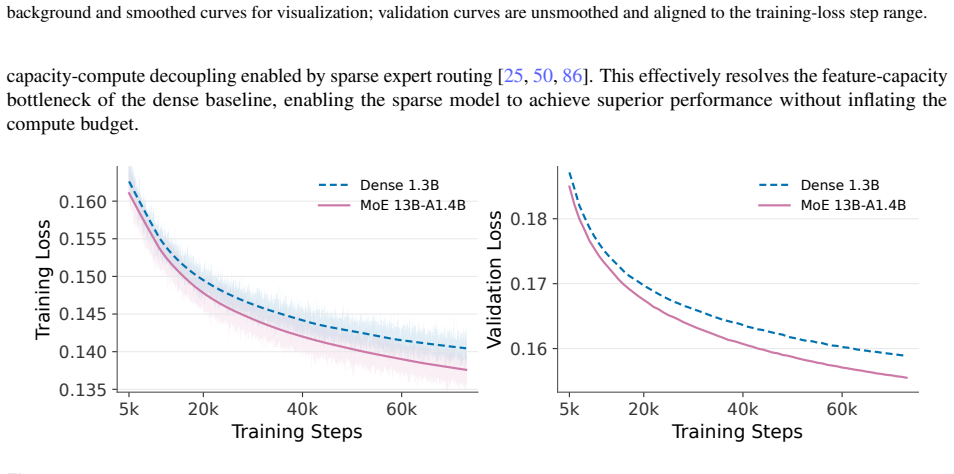
- The claim that MoE 30B-A3B 'closely approaches' Dense 14B performance is based on training-loss curves, not final converged evaluation metrics. If the gap does not close with further training, the cross-compute dominance claim weakens for production-scale deployments.
- The physical plausibility reward model is itself a learned system, not a ground-truth physics engine. Its alignment with real physical laws is not independently validated, so the model may be optimizing for the reward model's notion of plausibility rather than true physical correctness.
- The action-to-video results are shown on two evaluation datasets (EgoDex Eval, DreamDojo-HV Eval) but without quantitative metrics in the main text—only qualitative comparisons—making it difficult to assess how well the world simulation generalizes beyond the GR-1 training distribution.
- If the internal benchmark (Fig. 15) used for primary comparisons is biased toward the model's training distribution, the claimed superiority over Cosmos 3 and Wan 2.2 on embodied domain scores may not transfer to held-out evaluation sets.
Editorial analysis
A structured set of objections, weighed in public.
Referee Report
Summary. This paper presents LingBot-Video, a Mixture-of-Experts (MoE) video diffusion foundation model designed for embodied intelligence. The work makes three main contributions: (1) a sparse MoE DiT architecture scaled up to 120B total parameters with ~3B active parameters, achieving favorable capacity-compute trade-offs; (2) a data profiling engine and curriculum that augments internet video with 70,000+ hours of robot manipulation, navigation, and egocentric footage; and (3) a multi-dimensional RL post-training system with six specialized reward models targeting physical plausibility, motion coherence, and task completion. The paper also introduces an action-to-video (A2V) post-training variant for world simulation. Evaluations include an internal benchmark, two public benchmarks (RBench, Physics-IQ Verified), a user study, and qualitative A2V results. The model and checkpoints are released as open-source.
Significance. The paper ships several valuable artifacts: open-source model checkpoints, a Diffusers-compatible serving package, and an SGLang-native runtime. The MoE scaling experiments (Figs. 3-7) provide useful empirical evidence for capacity-compute decoupling in video diffusion, with controlled training/validation loss comparisons and latency benchmarks up to 1M-token sequences. The multi-reward RL framework (Sec. 5.2) with decoupled per-reward normalization and the DiffusionNFT-based real-video preference optimization are technically detailed. The progressive five-stage pre-training curriculum and the data profiling engine represent substantial engineering contributions. The open-source release of a large-scale MoE video model for embodied AI is a genuine community contribution.
major comments (2)
- §6.1, Fig. 15: The internal benchmark used for the primary 'General Quality' and 'Embodied Domain' comparisons is entirely undescribed. There is no information on prompt selection methodology, the number of prompts, scoring procedure (automated vs. human), or how competing models (Cosmos 3, Wan 2.2, LongCat-Video, HunyuanVideo 1.5, LTX-2.3) were configured and evaluated. Without this information, the SOTA claims based on Fig. 15 cannot be independently assessed. The paper must either (a) fully describe the benchmark protocol, prompt set composition, and evaluation methodology, or (b) clearly label these results as internal and de-emphasize the SOTA claim accordingly, relying instead on the public benchmarks.
- Table 1 and §6.2: The RBench results show LingBot-Video at 0.620 vs. Wan 2.6 at 0.607 (closed-source) — a margin of 0.013. The Physics-IQ Verified results show 40.4 vs. Cosmos 3 at 39.5 — a margin of 0.9. No significance testing, error bars, confidence intervals, or multiple-seed results are reported for either benchmark. Additionally, Table 1 notes 'scores of some models are sourced from RBench [22],' but does not specify which models were re-run by the authors versus taken from the leaderboard. If LingBot-Video was evaluated under different conditions (prompt subsets, inference settings, caption rewriting via the two-stage Caption Rewriter) than the sourced baselines, the small margins could reflect evaluation asymmetry. The authors should clarify which models were re-run under identical conditions, report variance or confidence intervals, and confirm that the Caption Rewriter was (or,
minor comments (10)
- §2.1: 'frameword' appears to be a typo for 'framework' in the second paragraph.
- §2.2, Eq. (4): The route scaling factor γ is introduced but its default value and sensitivity are not reported in the MoE recipe exploration (§2.3). Consider adding the value used.
- §3.4: The Caption Rewriter references 'Qwen3.6-27B [72]' — the reference [72] points to a blog post URL. Consider citing a more permanent source if available.
- §5.2.1: The six reward models are described qualitatively but their architectures, training data sizes, and validation performance are not specified. A brief table or appendix entry summarizing these would strengthen reproducibility.
- §5.2.2, Eq. (17): The reward weights w_r are listed as free parameters but their values are not reported. Consider adding a table with the final weights used.
- §5.2.3, Eq. (24): The KL regularization weight λ_KL is mentioned but its value is not specified.
- Fig. 15: The radar charts are difficult to read due to overlapping labels and small font sizes. Consider enlarging or providing a tabular companion.
- §6.3: The user study reports 400 prompts per comparison pair but does not specify the number of raters, rater qualifications, or inter-rater agreement. Adding these details would improve credibility.
- §6.4: The A2V evaluation (Fig. 18) is purely qualitative. Quantitative metrics (e.g., action following accuracy, frame consistency) on EgoDex Eval and DreamDojo-HV Eval would strengthen this section.
- Table 1: The 'Type' column labels are inconsistent — 'open-source' and 'closed-source' are used, but Wan 2.6, Seedance 1.5 pro, and Veo 3 are all closed-source. Consider using 'open' and 'closed' consistently.
Simulated Author's Rebuttal
We thank the referee for the careful and constructive review. The referee raises two major concerns, both centered on evaluation rigor: (1) the internal benchmark (Fig. 15) lacks sufficient methodological detail for independent assessment, and (2) the public benchmark results (Table 1, Physics-IQ) report small margins without significance testing, and the provenance of baseline scores is unclear. We agree with both points and will revise the manuscript accordingly. Below we address each comment in detail.
read point-by-point responses
-
Referee: §6.1, Fig. 15: The internal benchmark used for the primary 'General Quality' and 'Embodied Domain' comparisons is entirely undescribed. There is no information on prompt selection methodology, the number of prompts, scoring procedure (automated vs. human), or how competing models were configured and evaluated. Without this information, the SOTA claims based on Fig. 15 cannot be independently assessed. The paper must either (a) fully describe the benchmark protocol, prompt set composition, and evaluation methodology, or (b) clearly label these results as internal and de-emphasize the SOTA claim accordingly, relying instead on the public benchmarks.
Authors: The referee is correct that the internal benchmark description in the current manuscript is insufficient for independent assessment. We will address this by expanding Section 6.1 to include: (i) the total number of evaluation prompts and their category distribution across the General Quality and Embodied Domain dimensions; (ii) the prompt selection methodology, including how prompts were sourced and curated for each sub-category (Motion Quality, Prompt Following, Visual Consistency, Aesthetic Quality, Human Interaction, Physical Simulation, Robotics, Egocentric Perspective, Navigation); (iii) the scoring procedure, specifying whether each sub-dimension was evaluated via automated metrics, human raters, or a combination; (iv) the inference configuration used for each competing model (resolution, number of denoising steps, CFG scale, etc.); and (v) an explicit statement that this is an internal benchmark not publicly available. We will also moderate the SOTA language in the main text and abstract to make clear that the internal benchmark results are supplementary to the public benchmark results (RBench, Physics-IQ Verified), which are independently reproducible. We believe option (a) is achievable and preferable, as full transparency about the protocol will allow readers to contextualize the results even if the prompt set itself is not publicly released. revision: yes
-
Referee: Table 1 and §6.2: The RBench results show LingBot-Video at 0.620 vs. Wan 2.6 at 0.607 (closed-source) — a margin of 0.013. The Physics-IQ Verified results show 40.4 vs. Cosmos 3 at 39.5 — a margin of 0.9. No significance testing, error bars, confidence intervals, or multiple-seed results are reported for either benchmark. Additionally, Table 1 notes 'scores of some models are sourced from RBench [22],' but does not specify which models were re-run by the authors versus taken from the leaderboard. If LingBot-Video was evaluated under different conditions (prompt subsets, inference settings, caption rewriting via the two-stage Caption Rewriter) than the sourced baselines, the small margins could reflect evaluation asymmetry. The authors should clarify which models were re-run under identical conditions, report variance or confidence intervals, and confirm that the Caption Rewriter was (or,
Authors: The referee raises a valid and important concern about evaluation symmetry and statistical rigor. We will make the following revisions: (1) We will clarify in Table 1 and Section 6.2 exactly which models were re-run by us under identical conditions versus which scores were sourced from the RBench leaderboard. Specifically, we re-ran all open-source models (Cosmos 3, LongCat-Video, Wan 2.2 A14B, HunyuanVideo 1.5) ourselves; the closed-source model scores (Wan 2.6, Seedance 1.5 pro, Veo 3) were sourced from the RBench leaderboard. (2) We will add a sentence confirming that the Caption Rewriter was applied uniformly to all models we evaluated, including baselines, so that no model received preferential prompt treatment. (3) We will report multi-seed or multi-run variance for LingBot-Video and the open-source baselines on both RBench and Physics-IQ Verified. We note that RBench uses an automated evaluation pipeline, so per-run variance arises from stochasticity in the generation process; we will report standard deviations across at least three runs. For Physics-IQ Verified, we will similarly report variance across multiple runs. (4) We will add a caveat in the text that the margins over Wan 2.6 on RBench and Cosmos 3 on Physics-IQ are small and that we are not claiming statistical significance at a specific confidence level; rather, the results are consistent with competitive performance among the top-tier models. We agree that the current presentation overstates the significance of these small margins, and we will adjust the language accordingly. revision: yes
Circularity Check
No circularity found: derivations are standard, self-citations are to external methods, and SOTA claims rest on public benchmarks.
full rationale
The paper's core derivations—MoE routing (Eqs. 1–11), flow-matching for the refiner (Eq. 12), GRPO post-training (Eqs. 13–18), and DiffusionNFT (Eqs. 19–24)—are all standard formulations adopted from external prior work (DeepSeek-V3, Flash-GRPO, DiffusionNFT, DMD2). No equation reduces to its inputs by construction. The SOTA claims are supported by public benchmarks (RBench, Physics-IQ Verified) and a user study, not by a self-citation chain. While the internal benchmark (Fig. 15) is proprietary and its methodology is undescribed, this is a benchmarking transparency risk, not a circular derivation. The paper's self-citations (e.g., to DeepSeekMoE, Flash-GRPO, CPS) reference methods that are independently reproducible and not defined in terms of the present paper's results. No fitted parameter is renamed as a prediction, and no ansatz is smuggled through a self-citation.
Axiom & Free-Parameter Ledger
free parameters (7)
- MoE expert count (E) =
128
- Active experts (Kr) =
8
- Route scaling factor (γ) =
Not specified
- Auxiliary loss weight (λ_aux) =
Not specified
- RL exploration strength (η) =
0.7
- NFT regularization weight (λ_KL) =
Not specified
- Reward weights (wr) =
Not specified
axioms (3)
- domain assumption Sparse MoE provides capacity-compute decoupling beneficial for video diffusion.
- domain assumption VLM-based reward models can reliably assess physical plausibility.
- ad hoc to paper The internal benchmark is a fair representation of general and embodied video quality.
invented entities (2)
-
World-Knowledge Topological Graph
no independent evidence
-
ActionEmbedder
independent evidence
read the original abstract
Despite the recent promise in robot control, video generative models suffer from a domain mismatch due to their primary focus on content creation. For example, their design inherently prioritizes visual fidelity and creativity over computational efficiency and physical realism. In this work, we present LingBot-Video, a DiT-based video pretraining paradigm specifically tailored for embodied intelligence. From the architecture perspective, we adopt the Mixture-of-Experts (MoE), instead of dense, framework to achieve a better trade-off between modeling capacity and inference efficiency, and manage to scale it up from scratch. From the data perspective, we construct a data profiling engine that augments standard internet videos with extensive robot-oriented footage, encompassing manipulation, navigation, and egocentric perspectives, to equip the base model with an intrinsic understanding of actions and world dynamics. From the training perspective, we develop a multi-dimensional reward system to enforce the alignment regarding physical rationality and task completion, going beyond standard criteria such as aesthetics, prompt-following, and motion consistency. Comprehensive evaluations validate its performance and efficiency as a video foundation model. We contribute LingBot-Video as the inaugural large-scale, open-source MoE video foundation model to the community, in a pioneering effort to bridge digital creativity and physical actuation.
Figures




Forward citations
Cited by 1 Pith paper
-
Native Video-Action Pretraining for Generalizable Robot Control
A video-action foundation model pretrained natively for embodiment achieves few-shot generalization and 225 Hz real-time closed-loop robot control.
Reference graph
Works this paper leans on
-
[1]
Josh Achiam, Steven Adler, Sandhini Agarwal, Lama Ahmad, Ilge Akkaya, Florencia Leoni Aleman, Diogo Almeida, Janko Altenschmidt, Sam Altman, Shyamal Anadkat, et al. Gpt-4 technical report.arXiv preprint arXiv:2303.08774, 2023
work page internal anchor Pith review Pith/arXiv arXiv 2023
-
[2]
Cosmos 3: Omnimodal World Models for Physical AI
Niket Agarwal, Arslan Ali, Jon Allen, Martin Antolini, Adeline Aubame, Alisson Azzolini, Junjie Bai, Maciej Bala, Yogesh Balaji, Josh Bapst, et al. Cosmos 3: Omnimodal world models for physical ai.arXiv preprint arXiv:2606.02800, 2026
work page internal anchor Pith review Pith/arXiv arXiv 2026
-
[3]
Jason Ansel, Edward Yang, Horace He, Natalia Gimelshein, Animesh Jain, et al. Pytorch 2: Faster machine learning through dynamic python bytecode transformation and graph compilation. InProceedings of the 29th ACM International Conference on Architectural Support for Programming Languages and Operating Systems, Volume 2, pages 929–947, 2024
work page 2024
-
[4]
V-JEPA 2: Self-Supervised Video Models Enable Understanding, Prediction and Planning
Mido Assran, Adrien Bardes, David Fan, Quentin Garrido, Russell Howes, Matthew Muckley, Ammar Rizvi, Claire Roberts, Koustuv Sinha, Artem Zholus, et al. V-jepa 2: Self-supervised video models enable understanding, prediction and planning. arXiv preprint arXiv:2506.09985, 2025. 36
work page internal anchor Pith review Pith/arXiv arXiv 2025
-
[5]
Jinze Bai, Shuai Bai, Yunfei Chu, Zeyu Cui, Kai Dang, Xiaodong Deng, Yang Fan, Wenbin Ge, Yu Han, Fei Huang, et al. Qwen technical report.arXiv preprint arXiv:2309.16609, 2023
work page internal anchor Pith review Pith/arXiv arXiv 2023
-
[6]
Shuai Bai, Yuxuan Cai, Ruizhe Chen, Keqin Chen, Xionghui Chen, Zesen Cheng, Lianghao Deng, Wei Ding, Chang Gao, Chunjiang Ge, Wenbin Ge, Zhifang Guo, Qidong Huang, Jie Huang, Fei Huang, Binyuan Hui, Shutong Jiang, Zhaohai Li, Mingsheng Li, Mei Li, Kaixin Li, Zicheng Lin, Junyang Lin, Xuejing Liu, Jiawei Liu, Chenglong Liu, Yang Liu, Dayiheng Liu, Shixuan ...
work page internal anchor Pith review Pith/arXiv arXiv 2025
-
[7]
Lumiere: A space-time diffusion model for video generation
Omer Bar-Tal, Hila Chefer, Omer Tov, Charles Herrmann, Roni Paiss, Shiran Zada, Ariel Ephrat, Junhwa Hur, Guanghui Liu, Amit Raj, et al. Lumiere: A space-time diffusion model for video generation. InSIGGRAPH Asia 2024 Conference Papers, pages 1–11, 2024
work page 2024
-
[8]
DeepSeek LLM: Scaling Open-Source Language Models with Longtermism
Xiao Bi, Deli Chen, Guanting Chen, Shanhuang Chen, Damai Dai, Chengqi Deng, Honghui Ding, Kai Dong, Qiushi Du, Zhe Fu, et al. Deepseek llm: Scaling open-source language models with longtermism.arXiv preprint arXiv:2401.02954, 2024
work page internal anchor Pith review Pith/arXiv arXiv 2024
-
[9]
Stable Video Diffusion: Scaling Latent Video Diffusion Models to Large Datasets
Andreas Blattmann, Tim Dockhorn, Sumith Kulal, Daniel Mendelevitch, Maciej Kilian, Dominik Lorenz, Yam Levi, Zion English, Vikram V oleti, Adam Letts, et al. Stable video diffusion: Scaling latent video diffusion models to large datasets. arXiv preprint arXiv:2311.15127, 2023
work page internal anchor Pith review Pith/arXiv arXiv 2023
-
[10]
Genie: Generative interactive environments
Jake Bruce, Michael D Dennis, Ashley Edwards, Jack Parker-Holder, Yuge Shi, Edward Hughes, Matthew Lai, Aditi Mavalankar, Richie Steigerwald, Chris Apps, et al. Genie: Generative interactive environments. InForty-first International Conference on Machine Learning, pages 4603–4623, 2024
work page 2024
-
[11]
Z-Image: An Efficient Image Generation Foundation Model with Single-Stream Diffusion Transformer
Huanqia Cai, Sihan Cao, Ruoyi Du, Peng Gao, Steven Hoi, Zhaohui Hou, Shijie Huang, Dengyang Jiang, Xin Jin, Liangchen Li, et al. Z-image: An efficient image generation foundation model with single-stream diffusion transformer.arXiv preprint arXiv:2511.22699, 2025
work page internal anchor Pith review Pith/arXiv arXiv 2025
-
[12]
Longcat-video technical report.arXiv preprint arXiv:2510.22200,
Xunliang Cai, Qilong Huang, Zhuoliang Kang, Hongyu Li, Shijun Liang, Liya Ma, Siyu Ren, Xiaoming Wei, Rixu Xie, and Tong Zhang. Longcat-video technical report.arXiv preprint arXiv:2510.22200, 2025
-
[13]
Pixart- alpha: Fast training of diffusion transformer for photorealistic text-to-image synthesis
Junsong Chen, Jincheng Yu, Chongjian Ge, Lewei Yao, Enze Xie, Zhongdao Wang, James Kwok, Ping Luo, Huchuan Lu, and Zhenguo Li. Pixart- alpha: Fast training of diffusion transformer for photorealistic text-to-image synthesis. InInternational conference on learning representations, volume 2024, pages 57611–57640, 2024
work page 2024
-
[14]
Training Deep Nets with Sublinear Memory Cost
Tianqi Chen, Bing Xu, Chiyuan Zhang, and Carlos Guestrin. Training deep nets with sublinear memory cost.arXiv preprint arXiv:1604.06174, 2016
work page internal anchor Pith review Pith/arXiv arXiv 2016
-
[15]
Realdpo: Real or not real, that is the preference
Guo Cheng, Danni Yang, Ziqi Huang, Jianlou Si, Chenyang Si, and Ziwei Liu. Realdpo: Real or not real, that is the preference. arXiv preprint arXiv:2510.14955, 2025
-
[16]
Local all-pair correspondence for point tracking
Seokju Cho, Jiahui Huang, Jisu Nam, Honggyu An, Seungryong Kim, and Joon-Young Lee. Local all-pair correspondence for point tracking. InEuropean conference on computer vision, pages 306–325. Springer, 2024
work page 2024
-
[17]
Aakanksha Chowdhery, Sharan Narang, Jacob Devlin, Maarten Bosma, Gaurav Mishra, Adam Roberts, Paul Barham, Hyung Won Chung, Charles Sutton, Sebastian Gehrmann, et al. Palm: Scaling language modeling with pathways.Journal of machine learning research, 24(240):1–113, 2023
work page 2023
-
[18]
Deepseekmoe: Towards ultimate expert specialization in mixture-of-experts language models
Damai Dai, Chengqi Deng, Chenggang Zhao, RX Xu, Huazuo Gao, Deli Chen, Jiashi Li, Wangding Zeng, Xingkai Yu, Yu Wu, et al. Deepseekmoe: Towards ultimate expert specialization in mixture-of-experts language models. InProceedings of the 62nd Annual Meeting of the Association for Computational Linguistics (Volume 1: Long Papers), pages 1280–1297, 2024
work page 2024
-
[19]
Fu, Stefano Ermon, Atri Rudra, and Christopher Ré
Tri Dao, Daniel Y . Fu, Stefano Ermon, Atri Rudra, and Christopher Ré. Flashattention: Fast and memory-efficient exact attention with io-awareness. InAdvances in Neural Information Processing Systems, volume 35, pages 16344–16359, 2022
work page 2022
-
[20]
Deepep: An efficient expert-parallel communication library
DeepSeek-AI. Deepep: An efficient expert-parallel communication library. https://github.com/deepseek-ai/DeepEP,
-
[21]
Accessed: 2026-07-08
work page 2026
-
[22]
Scaling vision transformers to 22 billion parameters
Mostafa Dehghani, Alexey Gritsenko, Aurelien Sun, Sherjil Uesato, Yi Tay, Basil Mustafa, Joao Carreira, Christian Szegedy, and Xiaohua Zhai. Scaling vision transformers to 22 billion parameters. InInternational Conference on Machine Learning, pages 7480–7512, 2023. 37
work page 2023
-
[23]
Rethinking video generation model for the embodied world
Yufan Deng, Zilin Pan, Hongyu Zhang, Xiaojie Li, Ruoqing Hu, Yufei Ding, Yiming Zou, Yan Zeng, and Daquan Zhou. Rethinking video generation model for the embodied world. InForty-third International Conference on Machine Learning, 2026
work page 2026
-
[24]
Structure and content- guided video synthesis with diffusion models
Patrick Esser, Johnathan Chiu, Parmida Atighehchian, Jonathan Granskog, and Anastasis Germanidis. Structure and content- guided video synthesis with diffusion models. InProceedings of the IEEE/CVF international conference on computer vision, pages 7346–7356, 2023
work page 2023
-
[25]
Scaling rectified flow transformers for high-resolution image synthesis
Patrick Esser, Sumith Kulal, Andreas Blattmann, Rahim Entezari, Jonas Müller, Harry Saini, Yam Levi, Dominik Lorenz, Axel Sauer, Frederic Boesel, et al. Scaling rectified flow transformers for high-resolution image synthesis. InForty-first international conference on machine learning, pages 12606–12633, 2024
work page 2024
-
[26]
William Fedus, Barret Zoph, and Noam Shazeer. Switch transformers: Scaling to trillion parameter models with simple and efficient sparsity.Journal of Machine Learning Research, 23(120):1–39, 2022
work page 2022
-
[27]
DreamDojo: A Generalist Robot World Model from Large-Scale Human Videos
Shenyuan Gao, William Liang, Kaiyuan Zheng, Ayaan Malik, Seonghyeon Ye, Sihyun Yu, Wei-Cheng Tseng, Yuzhu Dong, Kaichun Mo, Chen-Hsuan Lin, et al. Dreamdojo: A generalist robot world model from large-scale human videos.arXiv preprint arXiv:2602.06949, 2026
work page internal anchor Pith review Pith/arXiv arXiv 2026
-
[28]
Xiangbo Gao, Mingyang Wu, Siyuan Yang, Jiongze Yu, Pardis Taghavi, Fangzhou Lin, and Zhengzhong Tu. The pulse of motion: Measuring physical frame rate from visual dynamics.arXiv preprint arXiv:2603.14375, 2026
-
[29]
Yanjiang Guo, Tony Lee, Lucy Xiaoyang Shi, Jianyu Chen, Percy Liang, and Chelsea Finn. Vlaw: Iterative co-improvement of vision-language-action policy and world model.arXiv preprint arXiv:2602.12063, 2026
-
[30]
Ctrl-World: A Controllable Generative World Model for Robot Manipulation
Yanjiang Guo, Lucy Xiaoyang Shi, Jianyu Chen, and Chelsea Finn. Ctrl-world: A controllable generative world model for robot manipulation.arXiv preprint arXiv:2510.10125, 2025
work page internal anchor Pith review Pith/arXiv arXiv 2025
-
[31]
OmniAID: Decoupling Semantic and Artifacts for Universal AI-Generated Image Detection in the Wild
Yuncheng Guo, Junyan Ye, Chenjue Zhang, Hengrui Kang, Haohuan Fu, Conghui He, and Weijia Li. Omniaid: Decoupling semantic and artifacts for universal ai-generated image detection in the wild.arXiv preprint arXiv:2511.08423, 2025
work page internal anchor Pith review Pith/arXiv arXiv 2025
-
[32]
Animatediff: Animate your personalized text-to-image diffusion models without specific tuning
Yuwei Guo, Ceyuan Yang, Anyi Rao, Zhengyang Liang, Yaohui Wang, Yu Qiao, Maneesh Agrawala, Dahua Lin, and Bo Dai. Animatediff: Animate your personalized text-to-image diffusion models without specific tuning. InThe Twelfth International Conference on Learning Representations, 2024
work page 2024
-
[33]
Photorealistic video generation with diffusion models
Agrim Gupta, Lijun Yu, Kihyuk Sohn, Xiuye Gu, Meera Hahn, Fei-Fei Li, Irfan Essa, Lu Jiang, and José Lezama. Photorealistic video generation with diffusion models. InEuropean Conference on Computer Vision, pages 393–411. Springer, 2024
work page 2024
-
[34]
Eyal Gutflaish, Eliran Kachlon, Hezi Zisman, Tal Hacham, Nimrod Sarid, Alexander Visheratin, Saar Huberman, Gal Davidi, Guy Bukchin, Kfir Goldberg, and Ron Mokady. Generating an image from 1,000 words: Enhancing text-to-image with structured captions.arXiv preprint arXiv:2511.06876, 2025
-
[35]
Flash-GRPO: Efficient Alignment for Video Diffusion via One-Step Policy Optimization
Xiaoxuan He, Siming Fu, Zeyue Xue, Weijie Wang, Ruizhe He, Yuming Li, Dacheng Yin, Shuai Dong, Haoyang Huang, Hongfa Wang, et al. Flash-grpo: Efficient alignment for video diffusion via one-step policy optimization.arXiv preprint arXiv:2605.15980, 2026
work page internal anchor Pith review Pith/arXiv arXiv 2026
-
[36]
TempFlow-GRPO: When Timing Matters for GRPO in Flow Models
Xiaoxuan He, Siming Fu, Yuke Zhao, Wanli Li, Jian Yang, Dacheng Yin, Fengyun Rao, and Bo Zhang. Tempflow-grpo: When timing matters for grpo in flow models.arXiv preprint arXiv:2508.04324, 2025
work page internal anchor Pith review Pith/arXiv arXiv 2025
-
[37]
Imagen Video: High Definition Video Generation with Diffusion Models
Jonathan Ho, William Chan, Chitwan Saharia, Jay Whang, Ruiqi Gao, Alexey Gritsenko, Diederik P Kingma, Ben Poole, Mohammad Norouzi, David J Fleet, et al. Imagen video: High definition video generation with diffusion models.arXiv preprint arXiv:2210.02303, 2022
work page internal anchor Pith review Pith/arXiv arXiv 2022
-
[38]
Video diffusion models.Advances in neural information processing systems, 35:8633–8646, 2022
Jonathan Ho, Tim Salimans, Alexey Gritsenko, William Chan, Mohammad Norouzi, and David J Fleet. Video diffusion models.Advances in neural information processing systems, 35:8633–8646, 2022
work page 2022
-
[39]
Rae, Oriol Vinyals, and Laurent Sifre
Jordan Hoffmann, Sebastian Borgeaud, Arthur Mensch, Elena Buchatskaya, Trevor Cai, Eliza Rutherford, Diego de Las Casas, Lisa Anne Hendricks, Johannes Welbl, Aidan Clark, Tom Hennigan, Eric Noland, Katie Millican, George van den Driessche, Bogdan Damoc, Aurelia Guy, Simon Osindero, Karen Simonyan, Erich Elsen, Jack W. Rae, Oriol Vinyals, and Laurent Sifre...
work page 2022
-
[40]
Hu, Yelong Shen, Phillip Wallis, Zeyuan Allen-Zhu, Yuanzhi Li, Shean Wang, Lu Wang, and Weizhu Chen
Edward J. Hu, Yelong Shen, Phillip Wallis, Zeyuan Allen-Zhu, Yuanzhi Li, Shean Wang, Lu Wang, and Weizhu Chen. Lora: Low-rank adaptation of large language models. InThe Tenth International Conference on Learning Representations, 2022
work page 2022
-
[41]
OpenRLHF: An Easy-to-use, Scalable and High-performance RLHF Framework
Jian Hu, Xibin Wu, Zilin Zhu, Weixun Wang, Dehao Zhang, Yu Cao, et al. Openrlhf: An easy-to-use, scalable and high- performance rlhf framework.arXiv preprint arXiv:2405.11143, 6, 2024. 38
work page internal anchor Pith review Pith/arXiv arXiv 2024
-
[42]
Tutel: Adaptive mixture-of-experts at scale
Changho Hwang, Wei Cui, Yifan Xiong, Ziyue Yang, Ze Liu, Han Hu, Zilong Wang, Rafael Salas, Jithin Jose, Prabhat Ram, et al. Tutel: Adaptive mixture-of-experts at scale. InProceedings of Machine Learning and Systems, pages 269–287, 2023
work page 2023
-
[43]
Robert A. Jacobs, Michael I. Jordan, Steven J. Nowlan, and Geoffrey E. Hinton. Adaptive mixtures of local experts.Neural Computation, 3(1):79–87, 1991
work page 1991
-
[44]
Sam Ade Jacobs, Masahiro Tanaka, Chengming Zhang, Minjia Zhang, Shuaiwen Leon Song, Samyam Rajbhandari, and Yuxiong He. Deepspeed ulysses: System optimizations for enabling training of extreme long sequence transformer models. arXiv preprint arXiv:2309.14509, 2023
work page internal anchor Pith review Pith/arXiv arXiv 2023
-
[45]
WoVR: World Models as Reliable Simulators for Post-Training VLA Policies with RL
Zhennan Jiang, Shangqing Zhou, Yutong Jiang, Zefang Huang, Mingjie Wei, Yuhui Chen, Tianxing Zhou, Zhen Guo, Hao Lin, Quanlu Zhang, et al. Wovr: World models as reliable simulators for post-training vla policies with rl.arXiv preprint arXiv:2602.13977, 2026
work page internal anchor Pith review Pith/arXiv arXiv 2026
-
[46]
Hierarchical mixtures of experts and the em algorithm.Neural computation, 6(2):181– 214, 1994
Michael I Jordan and Robert A Jacobs. Hierarchical mixtures of experts and the em algorithm.Neural computation, 6(2):181– 214, 1994
work page 1994
-
[47]
Scaling Laws for Neural Language Models
Jared Kaplan, Sam McCandlish, Tom Henighan, Tom B. Brown, Benjamin Chess, Rewon Child, Scott Gray, Alec Radford, Jeffrey Wu, and Dario Amodei. Scaling laws for neural language models.arXiv preprint arXiv:2001.08361, 2020
work page internal anchor Pith review Pith/arXiv arXiv 2001
-
[48]
Yuval Kirstain, Adam Polyak, Uriel Singer, Shahbuland Matiana, Joe Penna, and Omer Levy. Pick-a-pic: An open dataset of user preferences for text-to-image generation.Advances in neural information processing systems, 36:36652–36663, 2023
work page 2023
-
[49]
Reducing activation recomputation in large transformer models
Vijay Korthikanti, Jared Casper, Sangkug Lym, Lawrence McAfee, Michael Andersch, Mohammad Shoeybi, and Bryan Catanzaro. Reducing activation recomputation in large transformer models. InProceedings of Machine Learning and Systems, pages 341–353, 2023
work page 2023
-
[50]
Mario Michael Krell, Matej Kosec, Sergio P. Perez, and Andrew Fitzgibbon. Efficient sequence packing without cross- contamination: Accelerating large language models without impacting performance.arXiv preprint arXiv:2107.02027, 2021
work page internal anchor Pith review Pith/arXiv arXiv 2021
-
[51]
Gshard: Scaling giant models with conditional computation and automatic sharding
Dmitry Lepikhin, HyoukJoong Lee, Yuanzhong Xu, Dehao Chen, Orhan Firat, Yanping Huang, Maxim Krikun, Noam Shazeer, and Zhifeng Chen. Gshard: Scaling giant models with conditional computation and automatic sharding. InThe Ninth International Conference on Learning Representations, 2021
work page 2021
-
[52]
MixGRPO: Unlocking Flow-based GRPO Efficiency with Mixed ODE-SDE
Junzhe Li, Yutao Cui, Tao Huang, Yinping Ma, Chun Fan, Yiming Cheng, Miles Yang, Zhao Zhong, and Liefeng Bo. Mixgrpo: Unlocking flow-based grpo efficiency with mixed ode-sde.arXiv preprint arXiv:2507.21802, 2025
work page internal anchor Pith review Pith/arXiv arXiv 2025
-
[53]
Causal World Modeling for Robot Control
Lin Li, Qihang Zhang, Yiming Luo, Shuai Yang, Ruilin Wang, Fei Han, Mingrui Yu, Zelin Gao, Nan Xue, Xing Zhu, et al. Causal world modeling for robot control.arXiv preprint arXiv:2601.21998, 2026
work page internal anchor Pith review Pith/arXiv arXiv 2026
-
[54]
Shen Li, Yanli Zhao, Rohan Varma, Omkar Salpekar, Pieter Noordhuis, Teng Li, Adam Paszke, Jeff Smith, Brian Vaughan, Pritam Damania, and Soumith Chintala. Pytorch distributed: Experiences on accelerating data parallel training.Proceedings of the VLDB Endowment, 13(12):3005–3018, 2020
work page 2020
-
[55]
Torchtitan: One-stop pytorch native solution for production ready LLM pretraining
Wanchao Liang, Tianyu Liu, Less Wright, Will Constable, Andrew Gu, Chien-Chin Huang, Iris Zhang, Wei Feng, Howard Huang, Junjie Wang, Sanket Purandare, Gokul Nadathur, and Stratos Idreos. Torchtitan: One-stop pytorch native solution for production ready LLM pretraining. InThe Thirteenth International Conference on Learning Representations, 2025
work page 2025
-
[56]
Genie Envisioner: A Unified World Foundation Platform for Robotic Manipulation
Yue Liao, Pengfei Zhou, Siyuan Huang, Donglin Yang, Shengcong Chen, Yuxin Jiang, Yue Hu, Jingbin Cai, Si Liu, Jianlan Luo, et al. Genie envisioner: A unified world foundation platform for robotic manipulation.arXiv preprint arXiv:2508.05635, 2025
work page internal anchor Pith review Pith/arXiv arXiv 2025
-
[57]
Flow matching for generative modeling
Yaron Lipman, Ricky TQ Chen, Heli Ben-Hamu, Maximilian Nickel, and Matt Le. Flow matching for generative modeling. In The Eleventh International Conference on Learning Representations, 2023
work page 2023
-
[58]
Aixin Liu, Bei Feng, Bing Xue, Bingxuan Wang, Bochao Wu, Chengda Lu, Chenggang Zhao, Chengqi Deng, Chenyu Zhang, Chong Ruan, et al. Deepseek-v3 technical report.arXiv preprint arXiv:2412.19437, 2024
work page internal anchor Pith review Pith/arXiv arXiv 2024
-
[59]
Flow-grpo: Training flow matching models via online rl
Jie Liu, Gongye Liu, Jiajun Liang, Yangguang Li, Jiaheng Liu, Xintao Wang, Pengfei Wan, Di Zhang, and Wanli Ouyang. Flow-grpo: Training flow matching models via online rl. InAdvances in neural information processing systems, pages 40783–40818, 2026
work page 2026
-
[60]
GDPO: Group reward-Decoupled Normalization Policy Optimization for Multi-reward RL Optimization
Shih-Yang Liu, Xin Dong, Ximing Lu, Shizhe Diao, Peter Belcak, Mingjie Liu, Min-Hung Chen, Hongxu Yin, Yu-Chiang Frank Wang, Kwang-Ting Cheng, et al. Gdpo: Group reward-decoupled normalization policy optimization for multi-reward rl optimization.arXiv preprint arXiv:2601.05242, 2026
work page internal anchor Pith review Pith/arXiv arXiv 2026
-
[61]
Flow straight and fast: Learning to generate and transfer data with rectified flow
Xingchao Liu, Chengyue Gong, and Qiang Liu. Flow straight and fast: Learning to generate and transfer data with rectified flow. InThe Eleventh International Conference on Learning Representations, 2023. 39
work page 2023
-
[62]
VeOmni: Scaling Any Modality Model Training with Model-Centric Distributed Recipe Zoo
Qianli Ma, Yaowei Zheng, Zhelun Shi, Zhongkai Zhao, Bin Jia, Ziyue Huang, Zhiqi Lin, Youjie Li, Jiacheng Yang, Yanghua Peng, Zhi Zhang, and Xin Liu. Veomni: Scaling any modality model training with model-centric distributed recipe zoo.arXiv preprint arXiv:2508.02317, 2025
work page internal anchor Pith review Pith/arXiv arXiv 2025
-
[63]
Hpsv3: Towards wide-spectrum human preference score
Yuhang Ma, Xiaoshi Wu, Keqiang Sun, and Hongsheng Li. Hpsv3: Towards wide-spectrum human preference score. In Proceedings of the IEEE/CVF International Conference on Computer Vision, pages 15086–15095, 2025
work page 2025
-
[64]
Real: Efficient rlhf training of large language models with parameter reallocation
Zhiyu Mei, Wei Fu, Kaiwei Li, Guangju Wang, Huanchen Zhang, and Yi Wu. Real: Efficient rlhf training of large language models with parameter reallocation. InProceedings of Machine Learning and Systems, 2025
work page 2025
-
[65]
Ray: A distributed framework for emerging {AI} applications
Philipp Moritz, Robert Nishihara, Stephanie Wang, Alexey Tumanov, Richard Liaw, Eric Liang, Melih Elibol, Zongheng Yang, William Paul, Michael I Jordan, et al. Ray: A distributed framework for emerging {AI} applications. In13th USENIX symposium on operating systems design and implementation (OSDI 18), pages 561–577, 2018
work page 2018
-
[66]
Saman Motamed, Laura Culp, Kevin Swersky, Priyank Jaini, and Robert Geirhos. Do generative video models understand physical principles? InProceedings of the IEEE/CVF Winter Conference on Applications of Computer Vision (WACV), 2026
work page 2026
-
[67]
Efficient large-scale language model training on gpu clusters using megatron-lm
Deepak Narayanan, Mohammad Shoeybi, Jared Casper, Patrick LeGresley, Mostofa Patwary, Vijay Korthikanti, Dmitri Vainbrand, Prethvi Kashinkunti, Julie Bernauer, Bryan Catanzaro, Amar Phanishayee, and Matei Zaharia. Efficient large-scale language model training on gpu clusters using megatron-lm. InProceedings of the International Conference for High Perform...
work page 2021
-
[68]
Steven J. Nowlan and Geoffrey E. Hinton. Evaluation of adaptive mixtures of competing experts. InAdvances in Neural Information Processing Systems 3 (NIPS 1990), pages 774–780. Morgan Kaufmann, 1990
work page 1990
-
[69]
The pagerank citation ranking : Bringing order to the web
Lawrence Page, Sergey Brin, Rajeev Motwani, and Terry Winograd. The pagerank citation ranking : Bringing order to the web. InThe Web Conference, 1999
work page 1999
-
[70]
Switch diffusion transformer: Synergizing denoising tasks with sparse mixture-of-experts
Byeongjun Park, Hyojun Go, Jin-Young Kim, Sangmin Woo, Seokil Ham, and Changick Kim. Switch diffusion transformer: Synergizing denoising tasks with sparse mixture-of-experts. InEuropean Conference on Computer Vision, pages 461–477. Springer, 2024
work page 2024
-
[71]
Scalable diffusion models with transformers
William Peebles and Saining Xie. Scalable diffusion models with transformers. InProceedings of the IEEE/CVF International Conference on Computer Vision, pages 4195–4205, 2023
work page 2023
-
[72]
Lumina- image 2.0: A unified and efficient image generative framework
Qi Qin, Le Zhuo, Yi Xin, Ruoyi Du, Zhen Li, Bin Fu, Yiting Lu, Xinyue Li, Dongyang Liu, Xiangyang Zhu, et al. Lumina- image 2.0: A unified and efficient image generative framework. InProceedings of the IEEE/CVF International Conference on Computer Vision, pages 20031–20042, 2025
work page 2025
-
[73]
Qwen3.6-27B: Flagship-level coding in a 27B dense model
Qwen Team. Qwen3.6-27B: Flagship-level coding in a 27B dense model. https://qwen.ai/blog?id=qwen3.6-27b, 2026. Accessed: 2026-07-08
work page 2026
-
[74]
Tim Rädsch, Yuki M Asano, Hilde Kuehne, Stefan Bauer, Priyank Jaini, Robert Geirhos, and Carsten T Lüth. Physics-iq verified.arXiv preprint arXiv:2606.18943, 2026
work page internal anchor Pith review Pith/arXiv arXiv 2026
-
[75]
Rafael Rafailov, Archit Sharma, Eric Mitchell, Stefano Ermon, Christopher D. Manning, and Chelsea Finn. Direct preference optimization: Your language model is secretly a reward model. InAdvances in Neural Information Processing Systems, pages 53728–53741, 2023
work page 2023
-
[76]
Deepspeed-moe: Advancing mixture-of-experts inference and training to power next-generation ai scale
Samyam Rajbhandari, Conglong Li, Zhewei Yao, Minjia Zhang, Reza Yazdani Aminabadi, Ammar Ahmad Awan, Jeff Rasley, and Yuxiong He. Deepspeed-moe: Advancing mixture-of-experts inference and training to power next-generation ai scale. In International Conference on Machine Learning, pages 18332–18346. PMLR, 2022
work page 2022
-
[77]
Zero: Memory optimizations toward training trillion parameter models
Samyam Rajbhandari, Jeff Rasley, Olatunji Ruwase, and Yuxiong He. Zero: Memory optimizations toward training trillion parameter models. InSC20: International Conference for High Performance Computing, Networking, Storage and Analysis, pages 1–16, 2020
work page 2020
-
[78]
Cosmos-Drive-Dreams: Scalable Synthetic Driving Data Generation with World Foundation Models
Xuanchi Ren, Yifan Lu, Tianshi Cao, Ruiyuan Gao, Shengyu Huang, Amirmojtaba Sabour, Tianchang Shen, Tobias Pfaff, Jay Zhangjie Wu, Runjian Chen, et al. Cosmos-drive-dreams: Scalable synthetic driving data generation with world foundation models.arXiv preprint arXiv:2506.09042, 2025
work page internal anchor Pith review Pith/arXiv arXiv 2025
-
[79]
GAIA-2: A Controllable Multi-View Generative World Model for Autonomous Driving
Lloyd Russell, Anthony Hu, Lorenzo Bertoni, George Fedoseev, Jamie Shotton, Elahe Arani, and Gianluca Corrado. Gaia-2: A controllable multi-view generative world model for autonomous driving.arXiv preprint arXiv:2503.20523, 2025
work page internal anchor Pith review Pith/arXiv arXiv 2025
-
[80]
Chitwan Saharia, Jonathan Ho, William Chan, Tim Salimans, David J Fleet, and Mohammad Norouzi. Image super-resolution via iterative refinement.IEEE transactions on pattern analysis and machine intelligence, 45(4):4713–4726, 2022. 40
work page 2022
discussion (0)
Sign in with ORCID, Apple, or X to comment. Anyone can read and Pith papers without signing in.