Artificial Intelligence · arXiv:2608.22610 v1 · submitted 23 Aug 2026 · 70 references
Coalition-Aware Skill Reliability for Self-Evolving Agents
The paper says
“Agent skills, structured artifacts distilled from interaction trajectories and dynamically reused from skill banks, have become a central mechanism for enabling large language model (LLM)-based self-evolving agents to learn from past experience.”
more of the abstract
Yet existing work has largely focused on the operational aspects of skills, such as acquisition, evolution, and retrieval, while leaving a more fundamental reliability question unresolved: Do accumulated skills in an agent's skill bank actually make positive mechanistic contributions? We investigate this question through systematic skill-bank audits across alternative bank compositions and deployment domains, measuring the resulting changes in agent behavior. These audits reveal two recurring reliability failures: coalition pollution, where bank-level gains conceal negative coalition-level skill contributions, and cross-domain utility reversal, where source-beneficial skills reverse their effects after transfer. These findings motivate two reliability interventions: coalition-aware skill selection during skill accumulation and label-free skill masking after transfer. Coalition-Aware Skill Selection (CASS) selects more reliable candidate skills for the current bank using sampled Shapley marginals. Unsupervised Skill-Masked Coalition Optimizer (u-SMCO) masks transferred skills whose exclusion improves retrieval quality on unlabeled target-domain data. Agentic experiments on LoCoMo, LongMemEval, HotpotQA, and ALFWorld show that CASS and u-SMCO consistently improve task performance and cross-domain generalization over strong skill-based self-evolving agent baselines. Beyond accuracy, coalition-conditioned reliability modeling reduces sensitivity to noisy outcome-reward fluctuations during reinforcement learning and exposes the limits of isolation-based skill evaluation.
from the abstract
Pith says
Machine review · deepseek-v4-flash · 27 Aug 2026 · what was read was not recorded · not checked by a person
It can be wrong. Challenge this review or reply to it.
Holds up, with conditions. Genuinely useful reframing of skill reliability as coalition- and domain-dependent, but the headline failure modes rest on effect sizes within the paper's own stated noise floor. This line is wrong
4 major objections · 5 minor
How often objections from reviews like this one are right: not yet measured
Not checked: figures, code, what the 70 references say.
The paper says, at §3.2, Eqs. (1)–(2), Theorem 1
The review did not quote this passage.
Pith says: Objection 1 of 4 · major
The claimed 'coalition pollution' example is not statistically supported, and Theorem 1 does not establish the claimed blindness. Equations (1) and (2) together imply G_e = V(B_{e+1}) - V(B_e) = Δ_{s_new}(B_{e+1}), which the paper itself states when it says a noise-free gate reads exactly the candidate's own marginal.
more of objection 1
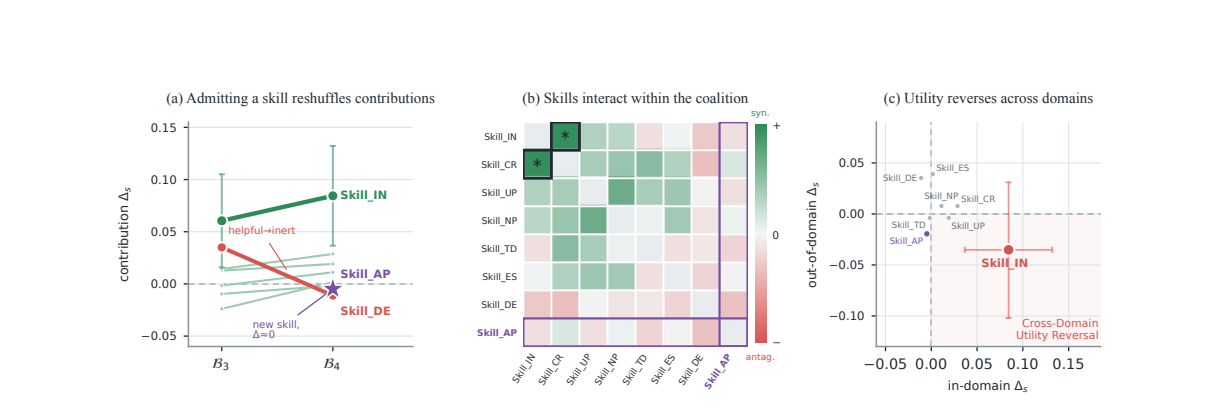
A noiseless outcome-only gate therefore cannot accept a skill whose full-bank marginal is negative. The reported gate margin +0.006 and the audit value Δ_AP(B_4) = -0.005 for the admitted skill differ by 0.011, below the stated single-skill audit resolution of ±0.04 and within the ±1 SE error bars of Figure 3(a). The example is thus indistinguishable from measurement noise in r_out or V_D. Theorem 1 proves only that a positive gain does not identify whether some bank member has negative contribution; it does not cover the candidate's own full-bank marginal, so it cannot make the Table 1 estimates consistent. To support the coalition-pollution failure mode, the authors should either demonstrate a case where the admitted skill's audit value is significantly negative while the exact-value gain is positive, or re-frame the failure as one of attribution to the wrong skill and support that re-framing with a suitable statistic.
The paper says, at §3.3, Fig. 3(c)
The review did not quote this passage.
Pith says: Objection 2 of 4 · major
The cross-domain utility reversal is only a directional effect. The target-domain point estimate for Skill_IN is Δ = -0.035 with a 95% confidence interval that includes zero, as the paper concedes. Given the stated audit resolution of ±0.04, this estimate cannot distinguish reversal from no effect.
more of objection 2
The u-SMCO results in Table 4 provide circumstantial support, but the direct audit evidence for the reversal failure mode should be strengthened, for example by increasing the number of paired queries or reporting a significant negative target-domain marginal for at least one skill.
The paper says, at §5.2, Table 2
The review did not quote this passage.
Pith says: Objection 3 of 4 · major
The main results omit the standard deviations promised in Section 5.1. For example, the F1 gain over MemSkill on LongMemEval is 0.01 percentage points (30.03 vs. 30.02), which is well within any plausible seed variance, yet no variance or significance test is reported. The claim of 'consistently improve' across benchmarks cannot be reliably assessed without per-seed numbers or confidence intervals for the headline comparisons.
The paper says, at §5, Tables 3–4
The review did not quote this passage.
Pith says: Objection 4 of 4 · major
There is no end-to-end ablation that isolates CASS and u-SMCO separately on the full set of benchmarks. Table 2 compares the combined system against baselines; Table 3 evaluates CASS with a K-controlled setup on one protocol, and Table 4 evaluates u-SMCO on six trained banks on HP-50.
more of objection 4
The relative contribution of each intervention to the Table 2 gains, and any interaction between them, is therefore not identified. An ablation matrix (MemSkill, MemSkill+u-SMCO, MemSkill+CASS, MemSkill+CASS+u-SMCO) on at least the main benchmarks would be needed to support the stated attributions.
5 minor objections
The paper says, at §4.1, Eq. (6), Algorithm 1
Pith says: minor objection 1 of 5
The choices λ=0.2, the number of sampled coalitions N (apparently 8 from the cost statement in Section 5.5), the masking threshold τ, and the 20-query probe size used in Table 4 are introduced without justification or sensitivity analysis. Please add ablations for these choices or state explicitly how they were selected.
The paper says, at §3.1, Eq. (3)
Pith says: minor objection 2 of 5
The Shapley value definition is standard, but the paper should state explicitly whether ϕ is ever computed exactly in the experiments or used only as motivation for CASS's coalition sampling; the current text leaves this ambiguous.
show 3 more
The paper says, at §5.3, Fig. 5
Pith says: minor objection 3 of 5
CASS accepts 1 of 12 candidates, but no analysis is provided of whether any of the 11 rejected candidates would have been beneficial; the low acceptance rate may be over-conservatism. Reporting the audit marginals of the rejected candidates would strengthen the claim.
The paper says, at Algorithm 1, Table 4
Pith says: minor objection 4 of 5
The stop threshold τ is never given a numerical value or a sensitivity analysis; without it the masking procedure is not fully specified.
The paper says, at Abstract and §1
Pith says: minor objection 5 of 5
The statement that the audit toolkit, method code, and trained checkpoints 'will be released' appears without a release link or appendix; please provide an availability statement with a URL or state that code is included in the supplementary material.
What would settle it
Re-run the B3→B4 SMRA audit on a single enlarged paired sample, roughly 4,000 queries (extrapolating the stated 314-query ±0.04 resolution to ±0.01), using the identical query set and judge for both the gate reward r_out and the audit value V. Test whether G = V(B4)−V(B3) is positive while Δ_AP(B4) = V(B4)−V(B4\{AP}) is negative on that same sample at p<0.01. If the two estimates converge to the same sign or to zero, the observed coalition pollution is measurement noise; if they diverge as reported with p<0.01, the phenomenon is a genuine structural gate failure. The same enlarged sample should also be used to compute the Shapley value of AP, since a positive full-bank marginal with negative Shapley would support the paper's structural claim but has not yet been measured.
from the skeptic's reading
How the review went
4 readings by deepseek-v4-flash · 27 Aug 2026
- Reader holds up, with conditions
- Skeptic partly agrees
- Editor wrote the verdict above
- Referee major revision: 4 major objections, 5 minor
Not run on this paper: the simulated authors' defence.
Pith did not check this review's objections against the paper.
The review in full
The review in brief, machine-written
Two things to know. First, the paper's central reframing—that skill reliability is a joint property of the skill, the surrounding bank, and the deployment domain—is genuinely useful and not something I've seen in the cited prior work. Second, the two headline failure modes (coalition pollution and cross-domain utility reversal) are demonstrated with effect sizes that are within the paper's own stated measurement resolution, so the empirical proof is weaker than the abstract implies.
What's new: SMRA as a skill-bank audit using paired knockouts, the two failure-mode concepts, and two cheap interventions (CASS with sampled Shapley marginals, u-SMCO with unlabeled retrieval quality). The interventions are simple and clearly described. The matched-protocol comparison against MemSkill is the right way to evaluate them, and the consistent gains across four domains are a real plus.
Where it's soft: The coalition pollution example in §3.2 hinges on a gate margin of +0.006 and an audited contribution of −0.005, a gap of 0.011, which is below the paper's own ±0.04 single-skill audit resolution. That specific case is statistically indistinguishable from noise. The cross-domain reversal for Skill_IN on HotpotQA has a 95% CI that includes zero; the paper calls it "directional," which is honest but means the reversal is not established. Theorem 1 is true but weaker than the paper's framing: it shows endpoint ambiguity, not that the candidate's own marginal is unknowable. The Table 2 main results omit the standard deviations the text says are reported. There is also no full ablation separating CASS and u-SMCO on all benchmarks. None of these are fatal to the conceptual story, but they mean the evidence fits the theory rather than proves it.
The citation pattern looks fine; the related work is appropriate and the distinction from SkillLens is fair. No code or data yet, though the release announcement is good.
Bottom line: this deserves a serious referee. The ideas are worth developing and the interventions are cheap enough that others will try them. I'd want the authors to release the audit code and either tighten the audit resolution or weaken the causal claims before acceptance. But this is not a desk reject.
The strongest objection
The load-bearing weakness is that the signature 'coalition pollution' example is not a consequence of the paper's structural theorem, and its magnitude is inside the stated measurement noise. If V is taken as the true value, the outcome gate's gain G_e = V(B∪{s_new}) − V(B) is definitionally the candidate's own full-bank marginal Δ_snew(B∪{s_new}). A noiseless outcome-only gate therefore cannot accept a skill whose post-admission full-bank marginal is negative. Section 3.2 nevertheless presents gate margin +0.006 and audit Δ_AP(B4) = −0.005 as the same event; the difference (0.011) is far below the paper's own single-skill audit resolution of ±0.04 and within the ±1 SE margins of Figure 3a. The apparent pollution is thus statistically indistinguishable from noise in r_out or V_D, not a demonstrated structural failure. Theorem 1 proves only that endpoints leave incumbents' signs unconstrained; it does not cover the candidate's own full-bank marginal, and it cannot make the Table 1 estimates consistent. The cross-domain reversal is similarly a point estimate (−0.035) whose 95% CI includes zero, as the paper concedes in §3.3. Both headline failure modes therefore currently rest on effects whose noise is comparable to their size.
The reader's weakest assumption—that V_D is a faithful measure of downstream contribution—is the right locus, and my analysis sharpens it: the problem is not merely that the reversal CI includes zero; the coalition pollution example is internally inconsistent with the paper's own definition of the gate once V is faithful. Given G_e = V(B∪{s_new})−V(B), a noiseless gate would observe the candidate's positive full-bank marginal and would not accept a candidate whose audit Δ is negative. The observed mismatch can only arise from using different noisy estimators, and the reported difference is well within the noise floor. This means the paper's most concrete evidence for its central failure mode is underpowered, and the structural theorem does not repair the gap. The proposed enlarged paired-sample test would settle whether the phenomenon survives. Because the conceptual claim remains plausible and the theorem is correct as far as it goes, the verdict should stay CONDITIONAL rather than moving to ACCEPT or REJECT, so I recommend UNCHANGED relative to the reader's conditional verdict.
The referee's report
If the empirical failure modes were cleanly established, the paper would make an important contribution: it would shift skill evaluation from isolation-based scores to coalition- and domain-conditioned reliability, and it proposes two concrete, label-light interventions. The paired knockout audit design is a principled way to measure mechanistic contributions, and the paper is transparent about the uncertainty in its reversal example. CASS and u-SMCO are well-motivated and evaluated across four benchmarks, and the u-SMCO result that a label-free retrieval signal can anti-correlate with the training reward channel is suggestive. However, the headline audit findings currently rest on effects whose magnitudes are comparable to the stated measurement noise, so the empirical basis for the central claim needs strengthening.
Pith's reading of the paper (a machine's summary, not the authors')
Self-evolving agents accumulate reusable skills by accepting candidates whose addition raises aggregate task reward. This paper argues that such outcome-only gates are structurally blind to which skill actually caused the gain, and that a skill's reliability is not an intrinsic attribute: it shifts with the surrounding skill bank and with the deployment domain. Through paired knockout audits, the authors identify two recurring failures—coalition pollution, where an admitted skill contributes near zero while an incumbent carries the bank, and cross-domain utility reversal, where a source-beneficial skill harms after transfer. They then show that replacing the scalar gate with coalition-aware selection (CASS), and masking transferred skills with a label-free retrieval-quality signal (u-SMCO), improves task performance and cross-domain generalization on conversational and embodied benchmarks. If correct, the paper establishes skill coalitions, not individual skills, as the unit of reliable skill evolution.
What carries the argument. The central object is the coalition-conditioned reliability profile $R(s;B,D)$: a skill's contribution measured in a specific bank $B$ and domain $D$. The audit computes full-bank knockout marginals $\Delta_s^D(B)=V_D(B)-V_D(B\setminus\{s\})$ and, for composition dependence, the Shapley value $\phi_s^D(B)$—the expected marginal contribution over all subsets of the other skills. Theorem 1 (outcome-only non-identifiability) carries the argument: a positive bank-level gain $V(\tilde B_{e+1})-V(B_e)>0$ does not identify whether the new bank contains a negatively contributing skill. Two mechanisms implement the coalition view online. CASS samples $N$ coalitions, scores each by the normalized knockout margin $\Delta_S(B)=[V(B)-V(B\setminus S)]/|S|$, and ranks candidate banks by $\sigma(B)=\bar\Delta_N(B)+\lambda r_{\rm out}(B)$. u-SMCO scores each skill by its retrieval-quality knockout $\psi(s)=RQ(B)-RQ(B\setminus\{s\})$ on unlabeled target queries and greedily masks the worst scorer. Together they turn the audit's counterfactual into a gate and a mask.
Core claim. The central claim, stated in Section 3.4, is that skill reliability is a joint property of the skill, the surrounding skill bank, and the deployment domain, and not an intrinsic attribute of the individual skill. The Skill Mechanistic Reliability Audit (SMRA) measures each skill's contribution by paired knockout: $\Delta_s^D(B) = V_D(B) - V_D(B\setminus\{s\})$, where $V_D(C)$ is the downstream value of a coalition $C$ on domain $D$. Auditing a baseline self-evolving agent's bank across compositions exposes coalition pollution—the admitted skill contributes $\approx 0$ while an incumbent's marginal carries the bank—and auditing the same bank across source and target domains exposes utility reversal, e.g. `insert` is significantly positive on LoCoMo ($\Delta=+0.084$) but its point estimate reverses on HotpotQA to $\Delta=-0.035$ with a 95% confidence interval that still includes zero. The paper proves (Theorem 1) that a gate observing only the endpoints $V(B_e)$ and $V(\tilde B_{e+1})$ cannot identify whether the enlarged bank contains a negatively contributing skill. CASS augments the acceptance criterion with Monte Carlo sampled Shapley marginals, and u-SMCO greedily masks the transferred skills whose removal improves retrieval quality on unlabeled target queries; both improve task performance and cross-domain generalization over the baseline.
The premise it rests on. The diagnosis rests on treating the measured change in task performance when a skill is removed as an accurate signal of that skill's contribution; on the key reversal example, the 95% confidence interval still includes zero, so the signal is about as large as the noise.
If the paper is right (Pith's inferences, not the authors')
Skill-evolution gates that rely on aggregate reward alone should be replaced or augmented by coalition-conditioned signals; otherwise they will keep retaining non-contributing or harmful skills.
After a skill bank is transferred to a new domain, it should be re-audited under target-domain queries before deployment; source-domain usefulness is not evidence of target-domain usefulness.
Coalition-level reliability modeling reduces sensitivity to noisy outcome-reward fluctuations during reinforcement learning, so training decisions can trust the bank's composition rather than a single noisy scalar.
On the four tested benchmarks (LoCoMo, LongMemEval, HotpotQA, ALFWorld), both interventions improve task performance and cross-domain generalization over strong skill-based baselines.
The two failure modes are structural, not statistical: no amount of additional outcome sampling lets an endpoint-only gate separate a bank that improved from one that only appeared to.
If the reversal phenomenon replicates across other banks and target domains, then cross-domain transfer of skill banks should include an unsupervised masking step as a standard deployment phase, not an optional repair.
The non-identifiability theorem suggests that any skill-evolution method relying on scalar reward deltas—even with a less noisy reward estimator—cannot attribute gains to specific skills without changing what it measures; adding coalition probes is an architectural change, not a statistical refinement.
A natural stress test is to run CASS with the same number of coalition evaluations but an aggregate-reward-only ranking rule; if performance matches, the gain comes from extra compute, and if it drops, the coalition signal is the active ingredient.
Because the audit resolves a single skill only to about $\pm0.04$ on 314 paired queries, practical deployments should spend additional paired queries on borderline skills whose measured marginal falls inside that band.
Check this review
Pith stored no record of this review's passes and took no fingerprint of it. Reviews made by code from 13 Nov 2026 on carry both.
How often reviews like this one are right
Reviews like this one: written by deepseek-v4-flash, where what was read was not recorded.
How often objections from reviews like this one are right: not yet measured
Reviews by people
This review was written by a machine. No person has reviewed this paper on Pith yet. A scientist listed on Pith can review it for a fee, and their review is published here whatever it concludes.
The paper
Abstract
Agent skills, structured artifacts distilled from interaction trajectories and dynamically reused from skill banks, have become a central mechanism for enabling large language model (LLM)-based self-evolving agents to learn from past experience. Yet existing work has largely focused on the operational aspects of skills, such as acquisition, evolution, and retrieval, while leaving a more fundamental reliability question unresolved: Do accumulated skills in an agent's skill bank actually make positive mechanistic contributions? We investigate this question through systematic skill-bank audits across alternative bank compositions and deployment domains, measuring the resulting changes in agent behavior. These audits reveal two recurring reliability failures: coalition pollution, where bank-level gains conceal negative coalition-level skill contributions, and cross-domain utility reversal, where source-beneficial skills reverse their effects after transfer. These findings motivate two reliability interventions: coalition-aware skill selection during skill accumulation and label-free skill masking after transfer. Coalition-Aware Skill Selection (CASS) selects more reliable candidate skills for the current bank using sampled Shapley marginals. Unsupervised Skill-Masked Coalition Optimizer (u-SMCO) masks transferred skills whose exclusion improves retrieval quality on unlabeled target-domain data. Agentic experiments on LoCoMo, LongMemEval, HotpotQA, and ALFWorld show that CASS and u-SMCO consistently improve task performance and cross-domain generalization over strong skill-based self-evolving agent baselines. Beyond accuracy, coalition-conditioned reliability modeling reduces sensitivity to noisy outcome-reward fluctuations during reinforcement learning and exposes the limits of isolation-based skill evaluation.
The paper's own sentences, arranged, kept beside the review and separate from it. Each label is drawn from a closed vocabulary; the number beside it is the probability the classifier gave that label. No sentence in this record was written by a model.
abstract compiled · 2026-09-23
The authors' main claim, as the classifier picked it out 0.63
“Agentic experiments on LoCoMo, LongMemEval, HotpotQA, and ALFWorld show that CASS and u-SMCO consistently improve task performance and cross-domain generalization over strong skill-based self-evolving agent baselines.”
How the main claim is stated: asserted 1.00
What the abstract itself states, as probabilities: claims first 0.07 · states limitation 0.31 · human participants 0.05 · controlled comparison 0.91 · randomized assignment 0.03 · states quantitative result 0.06 · compares with prior results 0.95 · mentions code or data availability 0.03
The abstract, sentence by sentence
This table labels the abstract only (arXiv listing abstract v1). The number is the probability the classifier gave the label.
| Sentence | Role | The authors' own work | States the main conclusion | Strength |
|---|---|---|---|---|
| Agent skills, structured artifacts distilled from interaction trajectories and dynamically reused from skill banks, have become a central mechanism for enabling large language model (LLM)-based self-evolving agents to learn from past experience. | background 1.00 | 0.04 | 0.02 | asserted 1.00 |
| Yet existing work has largely focused on the operational aspects of skills, such as acquisition, evolution, and retrieval, while leaving a more fundamental reliability question unresolved: Do accumulated skills in an agent's skill bank actually make positive mechanistic contributions? | gap 1.00 | 0.04 | 0.04 | asserted 0.96 |
| We investigate this question through systematic skill-bank audits across alternative bank compositions and deployment domains, measuring the resulting changes in agent behavior. | method 0.83 | 0.96 | 0.03 | asserted 0.98 |
| These audits reveal two recurring reliability failures: coalition pollution, where bank-level gains conceal negative coalition-level skill contributions, and cross-domain utility reversal, where source-beneficial skills reverse their effects after transfer. | result 1.00 | 0.96 | 0.41 | asserted 1.00 |
| These findings motivate two reliability interventions: coalition-aware skill selection during skill accumulation and label-free skill masking after transfer. | contribution 0.68 | 0.67 | 0.19 | asserted 0.94 |
| Coalition-Aware Skill Selection (CASS) selects more reliable candidate skills for the current bank using sampled Shapley marginals. | method 0.95 | 0.89 | 0.06 | asserted 1.00 |
| Unsupervised Skill-Masked Coalition Optimizer (u-SMCO) masks transferred skills whose exclusion improves retrieval quality on unlabeled target-domain data. | method 0.96 | 0.89 | 0.05 | asserted 0.92 |
| Agentic experiments on LoCoMo, LongMemEval, HotpotQA, and ALFWorld show that CASS and u-SMCO consistently improve task performance and cross-domain generalization over strong skill-based self-evolving agent baselines. | result 1.00 | 0.96 | 0.59 | asserted 1.00 |
| Beyond accuracy, coalition-conditioned reliability modeling reduces sensitivity to noisy outcome-reward fluctuations during reinforcement learning and exposes the limits of isolation-based skill evaluation. | result 0.60 | 0.91 | 0.24 | asserted 1.00 |
What kind of paper the classifier reports this is: method or tool 0.85 · evidence from observation or experiment 1.00
What was examined, and what was not
Sources read
- arXiv listing abstract v1
Not examined
- full text
- figures and tables
- references and citing sentences
- relations to other papers
Levels run
- P abstract
Not run
- S sections
- T body sentences
- C citations
- R cross-paper relations
How the labels were made
Compiled by classifier-1.13.0 via TypeSafe API, question bank abstract-p1-20260923, 2026-09-23: 1 request, 7,068 input tokens.
Every quoted sentence on this record is the authors'. Every label is from Pith's closed vocabulary, with the probability shown beside it. This record as JSON
Figures (6)



Figures are the authors', reproduced from the paper.
References (70)
- [1] A systematic survey of self-evolving agents: From model-centric to environment-driven co-evolution , author=. TechRxiv preprint , year= on Pith
- [2] Agent skills for large language models: Architecture, acquisition, security, and the path forward , author=. arXiv preprint arXiv:2602.12430 , year= on PithPith's reviewarXiv
- [3] Large language model agent: A survey on methodology, applications and challenges , author=. arXiv preprint arXiv:2503.21460 , year= on PithPith's reviewarXiv
- [4] Skillrl: Evolving agents via recursive skill-augmented reinforcement learning , author=. arXiv preprint arXiv:2602.08234 , year= on PithPith's reviewarXiv
- [5] MemSkill: Learning and Evolving Memory Skills for Self-Evolving Agents , author=. arXiv preprint arXiv:2602.02474 , year= on PithPith's reviewarXiv
- [6] Skillopt: Executive strategy for self-evolving agent skills , author=. arXiv preprint arXiv:2605.23904 , year= on PithPith's reviewarXiv
- [7] Skill1: Unified evolution of skill-augmented agents via reinforcement learning , author=. arXiv preprint arXiv:2605.06130 , year= on PithPith's reviewarXiv
- [8] Skillos: Learning skill curation for self-evolving agents , author=. arXiv preprint arXiv:2605.06614 , year= on PithPith's reviewarXiv
- [9] Skill Neologisms: Towards Skill-based Continual Learning , author=. Forty-third International Conference on Machine Learning , year= on Pith
- [10] SkillsBench: Benchmarking how well agent skills work across diverse tasks , author=. arXiv preprint arXiv:2602.12670 , year= on PithPith's reviewarXiv
- [11] From raw experience to skill consumption: A systematic study of model-generated agent skills , author=. arXiv preprint arXiv:2605.23899 , year= on PithPith's reviewarXiv
- [12] AutoRefine: From Trajectories to Reusable Expertise for Continual LLM Agent Refinement , author=. arXiv preprint arXiv:2601.22758 , year= on PithPith's reviewarXiv
- [13] Trace2skill: Distill trajectory-local lessons into transferable agent skills , author=. arXiv preprint arXiv:2603.25158 , year= on PithPith's reviewarXiv
- [14] Coevoskills: Self-evolving agent skills via co-evolutionary verification , author=. arXiv preprint arXiv:2604.01687 , year= on PithPith's reviewarXiv
- [15] Skillcraft: Can LLM agents learn to use tools skillfully? , author=. arXiv preprint arXiv:2603.00718 , year= on PitharXiv
- [16] SkillGraph: Skill-Augmented Reinforcement Learning for Agents via Evolving Skill Graphs , author=. arXiv preprint arXiv:2605.12039 , year= on PithPith's reviewarXiv
- [17] Skill retrieval augmentation for agentic ai , author=. arXiv preprint arXiv:2604.24594 , year= on PithPith's reviewarXiv
- [18] Skillfoundry: Building self-evolving agent skill libraries from heterogeneous scientific resources , author=. arXiv preprint arXiv:2604.03964 , year= on PithPith's reviewarXiv
- [19] Agentic reasoning for large language models , author=. arXiv preprint arXiv:2601.12538 , year= on PithPith's reviewarXiv
- [20] Swe-bench: Can language models resolve real-world github issues? , author=. International Conference on Learning Representations , volume= on Pith
show 50 more
- [21] Voyager: An open-ended embodied agent with large language models , author=. arXiv preprint arXiv:2305.16291 , year= on PithPith's reviewarXiv
- [22] gpt-oss-120b & gpt-oss-20b model card , author=. arXiv preprint arXiv:2508.10925 , year= on PithPith's reviewarXiv
- [23] Qwen3 technical report , author=. arXiv preprint arXiv:2505.09388 , year= on PithPith's reviewarXiv
- [24] The llama 3 herd of models , author=. preprint , year= on Pith
- [25] Group-in-group policy optimization for llm agent training , author=. Advances in Neural Information Processing Systems , volume= on Pith
- [26] Learning to self-verify makes language models better reasoners , author=. arXiv preprint arXiv:2602.07594 , year= on PitharXiv
- [27] Dapo: An open-source llm reinforcement learning system at scale , author=. Advances in Neural Information Processing Systems , volume= on Pith
- [28] Evaluating very long-term conversational memory of llm agents , author=. Proceedings of the 62nd Annual Meeting of the Association for Computational Linguistics (Volume 1: Long Papers) , pages= on Pith
- [29] LongMemEval: Benchmarking Chat Assistants on Long-Term Interactive Memory , author=. The Thirteenth International Conference on Learning Representations , year= on Pith
- [30] HotpotQA: A dataset for diverse, explainable multi-hop question answering , author=. Proceedings of the 2018 conference on empirical methods in natural language processing , pages= on Pith
- [31] Alfworld: Aligning text and embodied environments for interactive learning , author=. arXiv preprint arXiv:2010.03768 , year= on PithPith's reviewarXiv
- [32] Autogen: Enabling next-gen llm applications via multi-agent conversation , author=. arXiv preprint arXiv:2308.08155 , year= on PithPith's reviewarXiv
- [33] A survey on in-context learning , author=. Proceedings of the 2024 conference on empirical methods in natural language processing , pages= on Pith
- [34] A-mem: Agentic memory for llm agents , author=. Advances in Neural Information Processing Systems , volume= on Pith
- [35] Mirix: Multi-agent memory system for llm-based agents , author=. arXiv preprint arXiv:2507.07957 , year= on PithPith's reviewarXiv
- [36] Memory intelligence agent , author=. arXiv preprint arXiv:2604.04503 , year= on PithPith's reviewarXiv
- [37] Memory in the age of ai agents , author=. arXiv preprint arXiv:2512.13564 , year= on PithPith's reviewarXiv
- [38] Expel: Llm agents are experiential learners , author=. Proceedings of the AAAI Conference on Artificial Intelligence , volume= on Pith
- [39] Mem0: Building production-ready ai agents with scalable long-term memory , author=. arXiv preprint arXiv:2504.19413 , year= on PithPith's reviewarXiv
- [40] Memgen: Weaving generative latent memory for self-evolving agents , author=. arXiv preprint arXiv:2509.24704 , year= on PitharXiv
- [41] Reasoningbank: Scaling agent self-evolving with reasoning memory , author=. arXiv preprint arXiv:2509.25140 , year= on PithPith's reviewarXiv
- [42] Evo-memory: Benchmarking llm agent test-time learning with self-evolving memory , author=. arXiv preprint arXiv:2511.20857 , year= on PithPith's reviewarXiv
- [43] Organizing, orchestrating, and benchmarking agent skills at ecosystem scale , author=. arXiv preprint arXiv:2603.02176 , year= on PitharXiv
- [44] Openclaw as language infrastructure: A case-centered survey of a public agent ecosystem in the wild , author=. 2026 , publisher= on Pith
- [45] Skillnet: Create, evaluate, and connect ai skills , author=. arXiv preprint arXiv:2603.04448 , year= on PithPith's reviewarXiv
- [46] ProcMEM: Learning Reusable Procedural Memory from Experience via Non-Parametric PPO for LLM Agents , author=. arXiv preprint arXiv:2602.01869 , year= on PithPith's reviewarXiv
- [47] Evoskill: Automated skill discovery for multi-agent systems , author=. arXiv preprint arXiv:2603.02766 , year= on PithPith's reviewarXiv
- [48] Memp: Exploring agent procedural memory , author=. Findings of the Association for Computational Linguistics: ACL 2026 , pages= on Pith
- [49] Reinforcement learning for self-improving agent with skill library , author=. Proceedings of the 64th Annual Meeting of the Association for Computational Linguistics (Volume 1: Long Papers) , pages= on Pith
- [50] Skill0: In-context agentic reinforcement learning for skill internalization , author=. arXiv preprint arXiv:2604.02268 , year= on PithPith's reviewarXiv
- [51] Skill-R1: Agent skill evolution via reinforcement learning , author=. arXiv preprint arXiv:2605.09359 , year= on PithPith's reviewarXiv
- [52] Skill0. 5: Joint Skill Internalization and Utilization for Out-of-Distribution Generalization in Agentic Reinforcement Learning , author=. arXiv preprint arXiv:2605.28424 , year= on PithPith's reviewarXiv
- [53] Dynamic skill lifecycle management for agentic reinforcement learning , author=. arXiv preprint arXiv:2605.10923 , year= on PithPith's reviewarXiv
- [54] Dynamic Dual-Granularity Skill Bank for Agentic RL , author=. arXiv preprint arXiv:2603.28716 , year= on PithPith's reviewarXiv
- [55] Skill Reuse as Compression in Agentic RL , author=. arXiv preprint arXiv:2605.31509 , year= on PithPith's reviewarXiv
- [56] A value for n-person games , author=. Contributions to the Theory of Games , year= on Pith
- [57] A unified approach to interpreting model predictions , author=. Advances in neural information processing systems , volume= on Pith
- [58] The many Shapley values for model explanation , author=. International conference on machine learning , pages=. 2020 , organization= on Pith
- [59] Set functions, games and capacities in decision making , author=. 2016 , publisher= on Pith
- [60] Tent: Fully test-time adaptation by entropy minimization , author=. arXiv preprint arXiv:2006.10726 , year= on PithPith's reviewarXiv
- [61] Test-time classifier adjustment module for model-agnostic domain generalization , author=. Advances in Neural Information Processing Systems , volume= on Pith
- [62] Wilds: A benchmark of in-the-wild distribution shifts , author=. International conference on machine learning , pages=. 2021 , organization= on Pith
- [63] The many faces of robustness: A critical analysis of out-of-distribution generalization , author=. Proceedings of the IEEE/CVF international conference on computer vision , pages= on Pith
- [64] Bandit based monte-carlo planning , author=. European conference on machine learning , pages=. 2006 , organization= on Pith
- [65] Rota, Gian-Carlo , booktitle=. On the foundations of combinatorial theory: I. Theory of M. 1964 , publisher= on Pith
- [66] Probability inequalities for sums of bounded random variables , author=. Journal of the American statistical association , volume=. 1963 , publisher= on Pith
- [67] Chain-of-note: Enhancing robustness in retrieval-augmented language models , author=. Proceedings of the 2024 conference on empirical methods in natural language processing , pages= on Pith
- [68] A human-inspired reading agent with gist memory of very long contexts , author=. Proceedings of the 41st International Conference on Machine Learning , pages= on Pith
- [69] Memorybank: Enhancing large language models with long-term memory , author=. Proceedings of the AAAI conference on artificial intelligence , volume= on Pith
- [70] Memory os of ai agent , author=. Proceedings of the 2025 Conference on Empirical Methods in Natural Language Processing , pages= on Pith
Cited by 3 Pith papers
Reviewed papers on Pith that cite this one. The full citation record
How the literature uses it
What this paper does with the arXiv papers it cites
What it cites · 22 sentences without a confident label
Uses the method or tool of 1 paper
-
Our base self-evolving agent framework is MemSkill [ref] , whose skill-extraction policy agent is Llama-3.3-70B-Instruct [ref] , matching the original; all experiments run on 8$×$H20 GPUs.
MemSkill: Learning and Evolving Memory Skills for Self-Evolving Agents · Setup · 0.97
Compares with 2 papers
-
We compare our method against state-of-the-art agents: CoN [ref] , ReadAgent [ref] , MemoryBank [ref] , A-MEM [ref] , Mem0 [ref] , MemoryOS [ref] and MemSkill [ref] ; see Table [ref].
Mem0: Building Production-Ready AI Agents with Scalable Long-Term Memory · Main Results · 1.00
-
We compare our method against state-of-the-art agents: CoN [ref] , ReadAgent [ref] , MemoryBank [ref] , A-MEM [ref] , Mem0 [ref] , MemoryOS [ref] and MemSkill [ref] ; see Table [ref].
MemSkill: Learning and Evolving Memory Skills for Self-Evolving Agents · Main Results · 1.00
Cites as background 26 papers
-
Most existing work focuses on operations along the skill lifecycle, particularly skill acquisition [ref] , evolution [ref] , and retrieval [ref] .
SkillRL: Evolving Agents via Recursive Skill-Augmented Reinforcement Learning · Introduction · 0.91
-
Most existing work focuses on operations along the skill lifecycle, particularly skill acquisition [ref] , evolution [ref] , and retrieval [ref] .
CoEvoSkills: Self-Evolving Agent Skills via Co-Evolutionary Verification · Introduction · 0.91
-
Most existing work focuses on operations along the skill lifecycle, particularly skill acquisition [ref] , evolution [ref] , and retrieval [ref] .
AutoRefine: Compiling Trajectories into Validated Typed Agent Artifacts · Introduction · 0.91
Challenges and discussion
Disagree with the review, or know something it missed? Leave a comment, or challenge this review formally: a challenge becomes a permanent entry in this paper's record, and its decision is published here.
Come back by email
A short list of the week's newly reviewed papers. Nothing is sent until you confirm from your inbox, and every email has a link that stops it. No account.
No comments yet.
Sign in to comment