Artificial Intelligence · arXiv:2609.02371 v1 · submitted 2 Sep 2026 · 16 references
Diagnosing with Insights: Structured Analysis of Agent Failures via Behavioral Abstractions
The paper says
“With the proliferation of LLM agents, the ability to understand and diagnose failures in agents is essential to achieving superior effectiveness and trustworthiness.”
more of the abstract
As agent failures often manifest via long and complex trajectories, manually finding the needles in the haystack is untenable. However, traditional diagnosis techniques for software bugs can hardly address LLM agent failures, while completely relying on LLMs as the judge yields unreliable diagnosis results. To overcome these challenges, this paper presents AGENTSCOPE, a new neuro-symbolic approach for agent failure mode diagnosis. The key principle of AGENTSCOPE is to abstract agent behavior, based on its trajectories, into structured representations. Furthermore, AGENTSCOPE introduces the concept of neural invariants to specify agent behavior properties. AGENTSCOPE leverages LLM-guided reasoning atop the structured representation against neural invariants to pinpoint both the failure step and its type in the trajectory. We show the effectiveness of AGENTSCOPE on publicly available agent failure datasets (Who&When) and a more comprehensive dataset created by us (AgentErrata), where AGENTSCOPE significantly outperforms the current state of the art in fault localization and attribution accuracy. Our work shows that integrating structured abstractions with LLM-guided reasoning enables effective, reliable, and interpretable diagnosis for agent failures.
from the abstract
Pith says
Machine review · deepseek-v4-flash · 8 Sep 2026 · what was read was not recorded · not checked by a person
It can be wrong. Challenge this review or reply to it.
Holds up, with conditions. A well-motivated neuro-symbolic diagnosis pipeline for LLM agents with strong empirical results, but the claim rests on uncalibrated LLM-based invariant judges—real progress if that weakness is addressed, not yet a definitive contribution. This line is wrong
3 major objections · 5 minor
How often objections from reviews like this one are right: not yet measured
Not checked: figures, code, what the 16 references say.
The paper says, at Section 3.2 (Neural Invariants) and Appendix A
The review did not quote this passage.
Pith says: Objection 1 of 3 · major
The neural invariant judges are implemented as LLM prompts (e.g., Figure 1 for Action Mismatch) without any quantitative validation of their reliability. The paper states only that 'manual verification to ensure their effectiveness' was performed, but does not provide inter-rater reliability against human labels, consistency across LLM seeds or runs, or calibration analysis.
more of objection 1
Since the entire pipeline's failure detection and attribution depend on these judges, the magnitude of the reported improvements (8–16×) could be inflated if the judges are noisy or biased relative to the baselines. The authors should supply a reliability study (e.g., agreement with human annotators on a held-out sample, agreement between different LLM instances, or a sensitivity analysis showing how performance changes with judge accuracy).
The paper says, at Section 5, Tables 2–4
The review did not quote this passage.
Pith says: Objection 2 of 3 · major
All reported metrics are point estimates without confidence intervals or statistical significance tests. Given the modest dataset sizes (Who&When: 126/58, AgentErrata: 303), it is not clear whether the observed differences are statistically significant. For example, on Who&When Algo-Generated with GPT-5.1 (Table 4), AGENTSCOPE achieves 25.40% SLA, identical to the Step-by-step baseline.
more of objection 2
The authors attribute this to annotation policy, but no quantitative support is provided. The authors should report bootstrap confidence intervals or perform significance tests (e.g., McNemar's test) to substantiate the claimed improvements.
The paper says, at Sections 5.1 and Appendix C
The review did not quote this passage.
Pith says: Objection 3 of 3 · major
The explanation that AGENTSCOPE's lower performance on Who&When (relative to AgentErrata) is due to the dataset's annotation of 'first mistake' rather than 'decisive error' is plausible but not directly validated. The authors should provide an empirical analysis on the Who&When trajectories: for each case, state whether AGENTSCOPE's predicted step corresponds to the annotated first mistake or to a later decisive error, and quantify how often these diverge.
more of objection 3
This would clarify whether the gap is a dataset artifact or a genuine limitation of the method.
5 minor objections
The paper says, at Figure 1
Pith says: minor objection 1 of 5
The prompt template uses the JSON field "action_mismatch" while the text defines the neural function as "aligned()". Clarify the relationship between the binary output and the invariant definition.
The paper says, at Table 3
Pith says: minor objection 2 of 5
The baselines are reported only with SLA values; their CA (classification accuracy) is not shown. Since CA is a key metric, providing it for the baselines (if measurable) would give a more complete comparison.
show 3 more
The paper says, at Section 5.4 (Runtime)
Pith says: minor objection 3 of 5
The runtime analysis is based on only 20 trajectories and shows high variance (from 25 s to 750 s). The authors should more explicitly state that this is a preliminary characterization and discuss how the small sample size limits generalizability.
The paper says, at Appendix C
Pith says: minor objection 4 of 5
The case study uses a reference (Zhang et al., 2025b) that does not appear in the main text. Ensure all references are consistently cited.
The paper says, at General
Pith says: minor objection 5 of 5
The abstract uses the phrase 'neural invariants' but the concept is not formally introduced until Section 3.2. Consider defining it earlier to improve readability. Also, the term 'neural invariants' is used interchangeably with 'invariant violations'; please keep the terminology consistent throughout.
What would settle it
Sample 100 trajectories from AgentErrata (stratified by failure mode). For each invariant (e.g., Action Mismatch, Instruction Unfollowing), have two independent human experts label whether the invariant is violated at each relevant step. Run the LLM judge (with temperature=0.01) and compute Cohen's kappa between the LLM judgment and the human majority label for each invariant. Also compute the LLM judge's self-agreement across 5 runs with temperature=0.01. If any invariant has kappa < 0.6 or self-agreement < 0.8, then the reliability of the invariant judges is insufficient to support the claimed accuracy improvements.
from the skeptic's reading
How the review went
4 readings by deepseek-v4-flash · 8 Sep 2026
- Reader holds up, with conditions
- Skeptic agrees
- Editor wrote the verdict above
- Referee major revision: 3 major objections, 5 minor
Not run on this paper: the simulated authors' defence.
Pith did not check this review's objections against the paper.
The review in full
The review in brief, machine-written
This paper has real meat. AGENTSCOPE combines behavioral abstraction (ReAG) with neural invariants to localize and classify agent failures, and it beats the LLM-as-judge baselines by a wide margin on both Who&When and their own AgentErrata dataset. The structured graph representation and staged pipeline (construction, detection, decisive judgment) are well thought out. The cross-model invariance (GPT-4o, GPT-5.1, DeepSeek) is a nice sanity check. The runtime analysis is honest. If this method holds up, it will be a practical tool for debugging complex agent trajectories.
The main soft spot is the one flagged by the stress test: the neural invariants are implemented as LLM prompts, and there is no quantitative validation of their consistency, calibration, or inter-rater reliability. The paper says 'manual verification to ensure their effectiveness' but gives no numbers. Since the entire pipeline depends on these judges, that’s a load-bearing gap. The 8–16× improvement in step-level accuracy is impressive, but it comes from a baseline that scores 2–4%—so the absolute numbers are still low (30% SLA on AgentErrata). The dataset AgentErrata is self-created via fault injection and not yet released, which makes independent replication hard. There are no error bars or significance tests across runs. The ReAG construction itself also uses LLMs for parsing, adding another layer of potential noise.
These issues are addressable. A revised version that reports judge calibration, releases the dataset, and adds basic statistical rigor would make this a solid contribution. As it stands, the core claim—that structured abstraction plus invariant checking beats monolithic LLM judges—is believable but not fully secured.
Who this is for: researchers building agent debugging tools, practitioners deploying LLM agents, and anyone working on interpretability of agent failures. Worth a serious referee; I’d accept it with a request for stronger validation of the invariant judges.
The strongest objection
The core detection mechanism in AGENTSCOPE is the set of neural invariants (Section 3.2, Appendix A), each checked by a dedicated LLM prompt (e.g., Figure 1 for Action Mismatch). The paper provides only a brief mention of 'manual verification to ensure their effectiveness' but no quantitative validation: no inter-rater reliability, no calibration against human labels, no analysis of disagreement between runs or across backbone LLMs. Since the entire pipeline's failure localization and attribution depend on whether these LLM-based judges correctly flag violations, any systematic noise or bias in the judges would directly degrade the pipeline's performance. Moreover, the reported 8–16× improvements over the LLM-as-judge baseline could be partially attributable to the fact that the invariant judges are more constrained and thus less noisy than a holistic judge, but without validation it is unclear whether the gains are robust or dataset-specific.
The reader's weakest_assumption correctly identifies that the neural invariants, implemented via LLM prompts, are not validated for consistency or calibration. This is the most load-bearing concern because the entire diagnostic pipeline (ReAG construction → invariant checking → decisive error selection) relies on the invariant judges being accurate. If the judges are noisy or biased, the reported gains over holistic LLM-as-judge baselines could be inflated or not robust to different distributions. The concrete test I propose directly measures the reliability of the invariant judges using human-labeled data and self-consistency, which would settle the concern. I recommend the reader's CONDITIONAL verdict remain unchanged because the paper has other merits (structured representation, staged design) and the concern is addressable with additional experiments. The paper already acknowledges the need for validation in future work, but does not provide it. Hence, UNCHANGED is appropriate.
The referee's report
If the claimed results hold, AGENTSCOPE offers a principled improvement over standard LLM-as-judge approaches for agent failure diagnosis. The structured representation (ReAG) and neural invariants provide a way to decompose a complex diagnosis task into localized checks, which reduces context fragmentation and yields more accurate and interpretable results. The approach is orthogonal to fine-tuning and can be built on any backbone LLM. The availability of the AgentErrata dataset also provides a benchmark for future work. The paper is timely given the increasing complexity of LLM-based agent systems and the need for automated diagnostic tools.
Pith's reading of the paper (a machine's summary, not the authors')
This paper tries to establish that the reliable way to find out why an LLM agent failed is not to ask an LLM to judge the raw trajectory in one pass, but to first abstract the trajectory into a structured graph whose steps carry semantic annotations, then check the graph against a set of "neural invariants"—correctness conditions that an LLM evaluates per failure mode—and finally select the failure whose downstream impact best explains the bad outcome. The authors argue that failure localization is a structured multi-stage inference problem, not step-wise anomaly detection, and that this decomposition is what makes diagnosis accurate, interpretable, and stable across different backbone models. If the claim holds, it matters because agent trajectories are long and failure-prone, and a method that pinpoints both the failing step and the failure type gives agent developers an auditable debugging path instead of a black-box verdict.
What carries the argument. The Reasoning-Action Graph (ReAG) is the central object: a directed acyclic graph whose vertices are trajectory steps, each annotated with an Intermediate Semantic Representation (ISR) that splits the step into intent/context, reasoning/action, and signal/validation components, with edges for control and data dependencies. The companion concept is the neural invariant—a correctness condition stated in the style of a program invariant but evaluated by a neural function, in practice a task-specific LLM judge—whose violation signals a specific failure mode. This pair does the work: the graph hands the judges stable, aligned, step-indexed inputs instead of raw text; the invariants split an open-ended "find the bug" question into independent per-mode checks over restricted context windows; and the third stage, decisive error judgment, keeps candidate violations alive until global trajectory evidence resolves which one most explains the failed outcome. The third load-bearing artifact is AgentErrata, a fault-injection benchmark built by replaying successful trajectories from three agent frameworks and three public benchmarks into failures guaranteed to break task completion, each labeled with its step and failure mode.
Core claim. On its own terms, the discovery is that agent-failure diagnosis should be treated as a structured multi-stage inference problem rather than step-wise anomaly spotting or a single holistic judgment. The paper converts a trajectory into a Reasoning-Action Graph (ReAG), a directed acyclic graph of steps each annotated with an Intermediate Semantic Representation (intent/context, reasoning/action, signal/validation), then checks the graph against neural invariants—formal conditions, one per failure mode, evaluated by task-specific LLM judges—retains every violated candidate, and finally selects the decisive error whose downstream impact best explains the degraded outcome. On AgentErrata, its new fault-injection benchmark of 303 trajectories labeled by step and failure type, this pipeline reaches step-level localization accuracy of 28.38–31.35% across backbone models against 1.98–3.63% for the LLM-as-judge baselines, an 8–16× gain, and more than doubles classification accuracy to 41.58–45.87%. On the public Who&When benchmark the gains are substantial but smaller, and on GPT-5.1 the two methods tie on exact step accuracy because Who&When annotates the first mistake while AGENTSCOPE deliberately selects the most outcome-relevant failure.
The premise it rests on. The pipeline stands or falls on the assumption that each neural invariant, realized as a prompted LLM judging a small piece of the graph, reliably detects the failure mode it encodes; the paper publishes prompt templates but no calibration or consistency data for these judges, and noisy or biased verdicts would corrupt detection, attribution, and final selection alike.
If the paper is right (Pith's inferences, not the authors')
Every diagnosis becomes auditable: the final verdict traces back to a specific invariant violation, the graph steps involved, and the evidence the judge cited, rather than to an opaque model opinion.
Diagnostic accuracy largely decouples from the backbone model: on AgentErrata, step-level accuracy stays within about five percentage points across GPT-4o, GPT-5.1, and DeepSeek-V3.2, while the baselines swing much more widely.
Because one trajectory can contain several genuine failures along a single propagation chain, the decisive-error stage can be reconfigured to report the first mistake, the first unrecoverable step, or the final outcome-committing step, depending on the debugging goal.
New failure modes enter the system by adding one invariant violation each, so a growing failure taxonomy extends AGENTSCOPE without redesigning the pipeline.
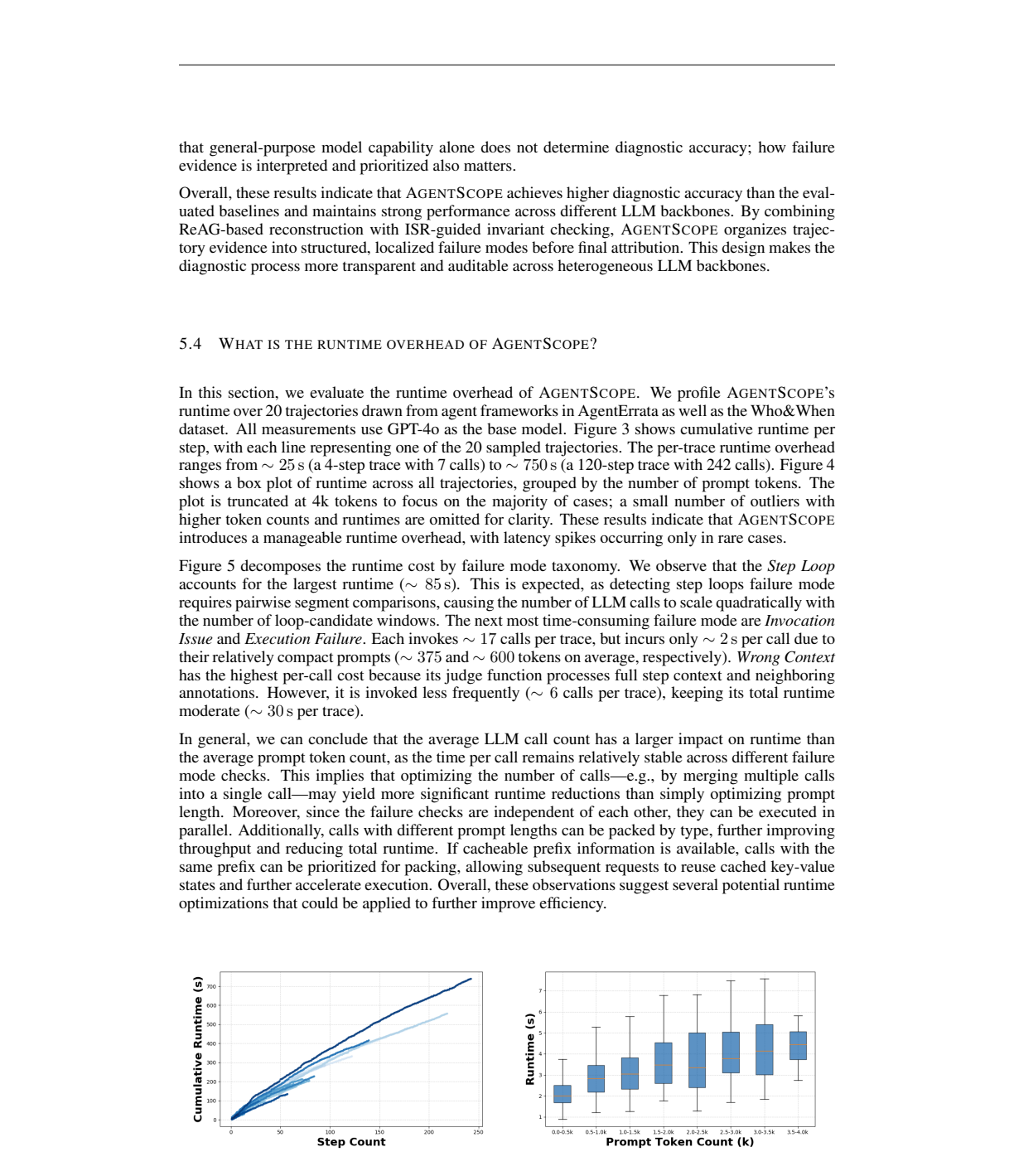
Offline diagnosis is practical in cost: measured runtime spans roughly 25 seconds for a short trace to about 12 minutes for a 120-step trace, with loop detection as the dominant cost and independent checks available for parallel execution.
The benchmark construction may tilt the comparison: AgentErrata only admits failures that are decisive for the outcome, so production failures that are latent or entangled might shrink the measured gap—or widen it, if the decisive-selection stage is what really sorts cascades.
The invariant machinery could be turned into an online guardrail: firing a neural invariant mid-trajectory to halt a looping or hallucinating agent would convert diagnosis into prevention, which the paper notes as possible but does not test.
Calibrating the unvalidated LLM judges is the most direct hardening step; per-mode agreement against human labels, across backbones and temperatures, would both quantify reliability and enable confidence-weighted decisive selection.
Who&When's first-mistake annotation policy may systematically penalize methods that correctly spot a later, more causal failure; a re-annotation study that labels entire failure chains would separate attribution skill from annotation mismatch.
Check this review
Pith stored no record of this review's passes and took no fingerprint of it. Reviews made by code from 13 Nov 2026 on carry both.
How often reviews like this one are right
Reviews like this one: written by deepseek-v4-flash, where what was read was not recorded.
How often objections from reviews like this one are right: not yet measured
Reviews by people
This review was written by a machine. No person has reviewed this paper on Pith yet. A scientist listed on Pith can review it for a fee, and their review is published here whatever it concludes.
The paper
Abstract
With the proliferation of LLM agents, the ability to understand and diagnose failures in agents is essential to achieving superior effectiveness and trustworthiness. As agent failures often manifest via long and complex trajectories, manually finding the needles in the haystack is untenable. However, traditional diagnosis techniques for software bugs can hardly address LLM agent failures, while completely relying on LLMs as the judge yields unreliable diagnosis results. To overcome these challenges, this paper presents AGENTSCOPE, a new neuro-symbolic approach for agent failure mode diagnosis. The key principle of AGENTSCOPE is to abstract agent behavior, based on its trajectories, into structured representations. Furthermore, AGENTSCOPE introduces the concept of neural invariants to specify agent behavior properties. AGENTSCOPE leverages LLM-guided reasoning atop the structured representation against neural invariants to pinpoint both the failure step and its type in the trajectory. We show the effectiveness of AGENTSCOPE on publicly available agent failure datasets (Who&When) and a more comprehensive dataset created by us (AgentErrata), where AGENTSCOPE significantly outperforms the current state of the art in fault localization and attribution accuracy. Our work shows that integrating structured abstractions with LLM-guided reasoning enables effective, reliable, and interpretable diagnosis for agent failures.
The paper's own sentences, arranged, kept beside the review and separate from it. Each label is drawn from a closed vocabulary; the number beside it is the probability the classifier gave that label. No sentence in this record was written by a model.
abstract compiled · 2026-09-23
The authors' main claim, as the classifier picked it out 0.99
“Our work shows that integrating structured abstractions with LLM-guided reasoning enables effective, reliable, and interpretable diagnosis for agent failures.”
How the main claim is stated: asserted 1.00
What the abstract itself states, as probabilities: claims first 0.09 · states limitation 0.09 · human participants 0.04 · controlled comparison 0.72 · randomized assignment 0.01 · states quantitative result 0.08 · compares with prior results 0.96 · mentions code or data availability 0.08
The abstract, sentence by sentence
This table labels the abstract only (arXiv listing abstract v1). The number is the probability the classifier gave the label.
| Sentence | Role | The authors' own work | States the main conclusion | Strength |
|---|---|---|---|---|
| With the proliferation of LLM agents, the ability to understand and diagnose failures in agents is essential to achieving superior effectiveness and trustworthiness. | background 1.00 | 0.05 | 0.03 | asserted 1.00 |
| As agent failures often manifest via long and complex trajectories, manually finding the needles in the haystack is untenable. | background 0.92 | 0.08 | 0.02 | asserted 1.00 |
| However, traditional diagnosis techniques for software bugs can hardly address LLM agent failures, while completely relying on LLMs as the judge yields unreliable diagnosis results. | gap 0.89 | 0.08 | 0.03 | asserted 0.99 |
| To overcome these challenges, this paper presents AGENTSCOPE, a new neuro-symbolic approach for agent failure mode diagnosis. | contribution 0.99 | 0.81 | 0.05 | asserted 0.99 |
| The key principle of AGENTSCOPE is to abstract agent behavior, based on its trajectories, into structured representations. | method 0.92 | 0.79 | 0.04 | asserted 1.00 |
| Furthermore, AGENTSCOPE introduces the concept of neural invariants to specify agent behavior properties. | method 0.76 | 0.80 | 0.04 | asserted 1.00 |
| AGENTSCOPE leverages LLM-guided reasoning atop the structured representation against neural invariants to pinpoint both the failure step and its type in the trajectory. | method 1.00 | 0.71 | 0.08 | asserted 1.00 |
| We show the effectiveness of AGENTSCOPE on publicly available agent failure datasets (Who&When) and a more comprehensive dataset created by us (AgentErrata), where AGENTSCOPE significantly outperforms the current state of the art in fault localization and attribution accuracy. | result 1.00 | 0.96 | 0.20 | asserted 1.00 |
| Our work shows that integrating structured abstractions with LLM-guided reasoning enables effective, reliable, and interpretable diagnosis for agent failures. | interpretation 0.98 | 0.91 | 0.91 | asserted 1.00 |
What kind of paper the classifier reports this is: method or tool 1.00 · evidence from observation or experiment 0.90
What was examined, and what was not
Sources read
- arXiv listing abstract v1
Not examined
- full text
- figures and tables
- references and citing sentences
- relations to other papers
Levels run
- P abstract
Not run
- S sections
- T body sentences
- C citations
- R cross-paper relations
How the labels were made
Compiled by classifier-1.13.0 via TypeSafe API, question bank abstract-p1-20260923, 2026-09-23: 1 request, 6,931 input tokens.
Every quoted sentence on this record is the authors'. Every label is from Pith's closed vocabulary, with the probability shown beside it. This record as JSON
Figures (7)




Showing 6 of the paper's 7 figures. Figures are the authors', reproduced from the paper.
References (16)
- [5] Difei Gao, Lei Ji, Luowei Zhou, Kevin Qinghong Lin, Joya Chen, Zihan Fan, and Mike Zheng Shou. Assistgpt: A general multi-modal assistant that can plan, execute, inspect, and learn.arXiv preprint arXiv:2306.08640, on PithPith's reviewarXiv
- [6] Jiawei Gu, Xuhui Jiang, Zhichao Shi, Hexiang Tan, Xuehao Zhai, Chengjin Xu, Wei Li, Ying- han Shen, Shengjie Ma, Honghao Liu, et al. A survey on llm-as-a-judge.arXiv preprint arXiv:2411.15594, on PithPith's reviewarXiv
- [7] URLhttps://arxiv.org/abs/2505.23885. Aaron Hurst, Adam Lerer, Adam P Goucher, Adam Perelman, Aditya Ramesh, Aidan Clark, AJ Os- trow, Akila Welihinda, Alan Hayes, Alec Radford, et al. Gpt-4o system card.arXiv preprint arXiv:2410.21276, on PithPith's reviewarXiv
- [9] URLhttps: //doi.org/10.5281/zenodo.15186407. Aixin Liu, Bei Feng, Bing Xue, Bingxuan Wang, Bochao Wu, Chengda Lu, Chenggang Zhao, Chengqi Deng, Chenyu Zhang, Chong Ruan, et al. Deepseek-v3 technical report.arXiv preprint arXiv:2412.19437, on PithPith's reviewarXiv
- [10] URLhttps://azure.microsoft.com/en-us/products/ ai-foundry. Accessed: 2025-09-24. Xiang (Jenny) Ren, Sitao Wang, Zhuqi Jin, David Lion, Adrian Chiu, Tianyin Xu, and Ding Yuan. Relational Debugging — Pinpointing Root Causes of Performance Problems. InProceedings of the 17th USEN... on Pith
- [11] Significant Gravitas. AutoGPT. URLhttps://github.com/Significant-Gravitas/ AutoGPT. Aaditya Singh, Adam Fry, Adam Perelman, Adam Tart, Adi Ganesh, Ahmed El-Kishky, Aidan McLaughlin, Aiden Low, AJ Ostrow, Akhila Ananthram, et al. Openai gpt-5 system card.arXiv preprint arXiv:26... on PithPith's reviewarXiv
- [12] Guanzhi Wang, Yuqi Xie, Yunfan Jiang, Ajay Mandlekar, Chaowei Xiao, Yuke Zhu, Linxi Fan, and Anima Anandkumar. V oyager: An open-ended embodied agent with large language models. arXiv preprint arXiv:2305.16291, on PithPith's reviewarXiv
- [13] URLhttps://arxiv.org/abs/2504. 12516. An Yang, Anfeng Li, Baosong Yang, Beichen Zhang, Binyuan Hui, Bo Zheng, Bowen Yu, Chang Gao, Chengen Huang, Chenxu Lv, et al. Qwen3 technical report.arXiv preprint arXiv:2505.09388, on PithPith's reviewarXiv
- [14] URL https://arxiv.org/abs/2405.15793. Ding Yuan, Haohui Mai, Weiwei Xiong, Lin Tan, Yuanyuan Zhou, and Shankar Pasupathy. Sher- Log: Error Diagnosis by Connecting Clues from Run-Time Logs. InProceedings of the 15th International Conference on Architecture Support for Programmi... on PithPith's reviewarXiv
- [16] URLhttps://arxiv.org/abs/ 2307.13854. Chenyang Zhu, Spencer Hong, Jingyu Wu, Kushal Chawla, Charlotte Tang, Youbing Yin, Nathan Wolfe, Erin Babinsky, and Daben Liu. Raffles: Reasoning-based attribution of faults for llm systems.arXiv preprint arXiv:2509.06822, on PithPith's reviewarXiv
- [2009] 16 Guibin Zhang, Junhao Wang, Junjie Chen, Wangchunshu Zhou, Kun Wang, and Shuicheng Yan. Agentracer: Who is inducing failure in the llm agentic systems?arXiv preprint arXiv:2509.03312, 2025a. Shaokun Zhang, Ming Yin, Jieyu Zhang, Jiale Liu, Zhiguang Han, Jingyang Zhang, Beibi... on PithPith's reviewarXiv
- [2010] Bowen Baker, Joost Huizinga, Leo Gao, Zehao Dou, Melody Y Guan, Aleksander Madry, Wojciech Zaremba, Jakub Pachocki, and David Farhi. Monitoring reasoning models for misbehavior and the risks of promoting obfuscation.arXiv preprint arXiv:2503.11926, on PithPith's reviewarXiv
- [2022] Guiming Hardy Chen, Shunian Chen, Ziche Liu, Feng Jiang, and Benyou Wang. Humans or llms as the judge? a study on judgement biases.arXiv preprint arXiv:2402.10669, on PithPith's reviewarXiv
- [2023] URLhttps:// github.com/dlshriver/intercepts. Accessed: 2025-09-23. Tingchen Fu, Jiawei Gu, Yafu Li, Xiaoye Qu, and Yu Cheng. Scaling reasoning, losing control: Evaluating instruction following in large reasoning models.arXiv preprint arXiv:2505.14810, on PithPith's reviewarXiv
- [2024] URL https://arxiv.org/abs/2310.06770. 15 Dawei Li, Bohan Jiang, Liangjie Huang, Alimohammad Beigi, Chengshuai Zhao, Zhen Tan, Amrita Bhattacharjee, Yuxuan Jiang, Canyu Chen, Tianhao Wu, et al. From generation to judgment: Opportunities and challenges of llm-as-a-judge.arXiv pr... on PithPith's reviewarXiv
- [2025] URLhttps://cdn-dynmedia-1.microsoft.com/is/ content/microsoftcorp/microsoft/final/en-us/microsoft-brand/documents/ Taxonomy-of-Failure-Mode-in-Agentic-AI-Systems-Whitepaper.pdf. Mert Cemri, Melissa Z Pan, Shuyi Yang, Lakshya A Agrawal, Bhavya Chopra, Rishabh Tiwari, Kurt Keutz... on PithPith's reviewarXiv
Cited by 1 Pith paper
Reviewed papers on Pith that cite this one. The full citation record
- CoEvo-RSI: When Harnesses Evolve, Which Models Should Follow? cs.LG · Oct 2026
Challenges and discussion
Disagree with the review, or know something it missed? Leave a comment, or challenge this review formally: a challenge becomes a permanent entry in this paper's record, and its decision is published here.
Come back by email
A short list of the week's newly reviewed papers. Nothing is sent until you confirm from your inbox, and every email has a link that stops it. No account.
No comments yet.
Sign in to comment