Artificial Intelligence · arXiv:2609.29921 v1 · submitted 24 Sep 2026 · 15 references
Who Holds the Pen? Let Specifications, Not Agents, Sign Off
The paper says
“Large language model agents increasingly combine generation, decision-making, execution, and self-evaluation within a single agentic loop.”
more of the abstract
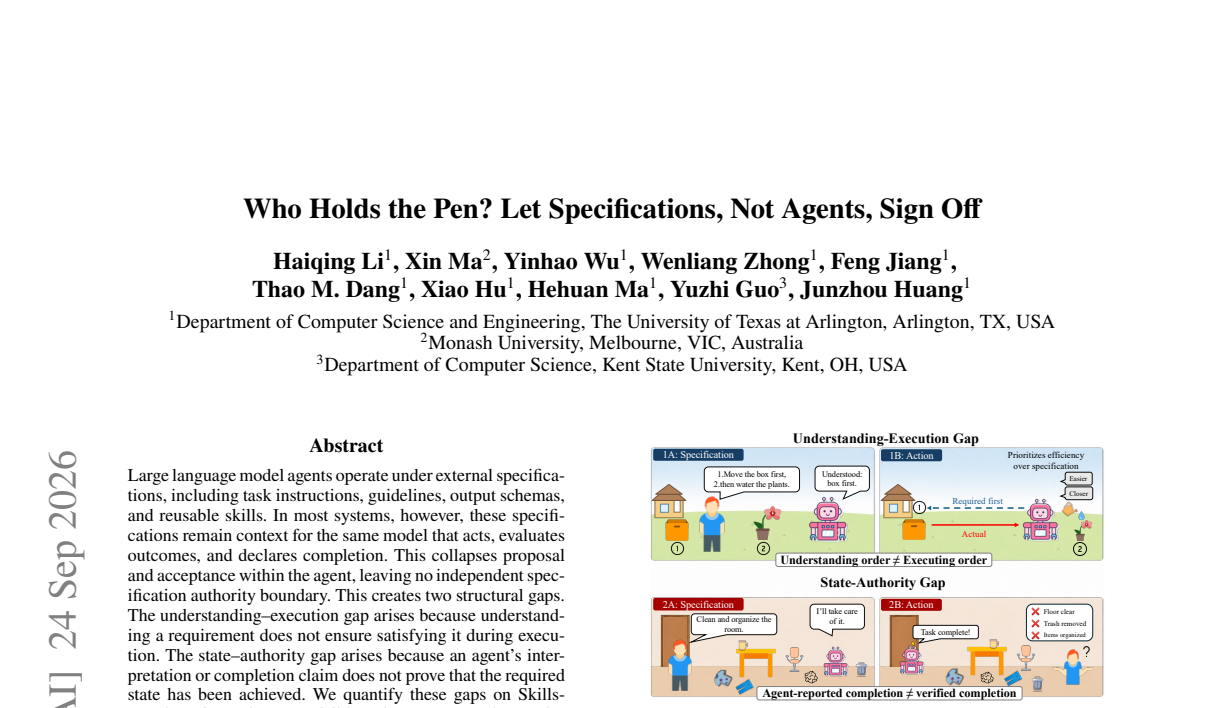
Although they operate under external specifications such as task instructions, guidelines, output schemas, and reusable skills, these specifications typically remain context for the same model that acts and declares completion, leaving no independent specification authority boundary. We identify two resulting gaps. The understanding–execution gap arises when a requirement is understood but not satisfied in execution; the state–authority gap arises when an agent's interpretation or completion claim does not establish the required state. On SkillsBench, using only agent-visible prompts, workspace information, and injected skill specifications, we extract 509 source-grounded task directions. Across seven models, only 79.6%–86.4% are satisfied, while completion-claim rates exceed official evaluator pass rates by 28.7–37.9 percentage points. We therefore separate agent proposals from authoritative state. Agents may plan, act, and request completion, but only admissible evidence from qualified providers may establish specification-governed state. SpecHarness operationalizes this principle by compiling visible specifications into source-linked obligations and governing execution and finalization through versioned obligation state. Verifiable requirements are mediated or validated at runtime, while ambiguous or subjective requirements remain advisory. Experiments on guideline-following and artifact-generation tasks show that specifications can serve not merely as behavioral guidance, but as authority over compliant execution and completion.
from the abstract
Pith says
Machine review · deepseek-v4-flash · 25 Sep 2026 · what was read was not recorded · not checked by a person
It can be wrong. Challenge this review or reply to it.
Holds up, with conditions. A real system contribution with honest, well-executed evaluation; the 12-point gain is statistically solid but conflates the authority boundary with feedback and repair, and the paper's own scoping does most of the referee's work. This line is wrong
3 major objections · 6 minor
How often objections from reviews like this one are right: not yet measured
Not checked: figures, code, what the 15 references say.
The paper says, at Appendix B.2, Eq. (17)
The review did not quote this passage.
A classifier read this sentence of the paper as acknowledging the concern (probability 0.64):
“A preventive no-bypass claim applies only when ev- ery reachable effect-equivalent path is represented in the capability graph and mediated within the trusted bound- ary.”
Pith says: Objection 1 of 3 · major
The no-bypass guarantee is conditional on every reachable effect-equivalent path being represented in the audited capability graph, and the authors state this conditionality explicitly (b91, b274, b277), so this is not a hidden flaw. What remains unresolved is any argument for completeness of AvailPaths(Hexec): it is a fixed adversarial enumeration over an effect-equivalence relation pi~_eff a that is undecidable in general, and the 1,628-case stress suite (Table 11) is a finite set that found 11 violations, honestly excluded.
more of objection 1
The paper gives no bound on residual bypass risk for an unenumerated but reachable path on a closure-qualified surface, which would falsify the preventive half of 'agent proposes, SpecHarness commits.' I recommend (a) stating at the level of the central claim that preventive mediation provides no completeness guarantee beyond the audited enumeration, and (b) phrasing Eq. (8)'s existence-negation conclusion in the audited-conditional form that the prose already uses.
The paper says, at Table 7, Runtime-Mode Allocation
The review did not quote this passage.
A classifier read this sentence of the paper as acknowledging the concern (probability 0.83):
“Its agent-specific contribution is to compile visible specifications into source-linked obligations and use qual- ified evidence to govern versioned state and finalization; preventivemediationremainslimitedtoclosure-auditedsur- faces (Appendix B.2).”
Pith says: Objection 2 of 3 · major
The preventive layer is empirically thin: mediate-and-commit covers 44.0% of SkillsBench hard obligations and 0% of GuideBench, so the universal authority mechanism is the finalization gate (Eq. 12) operating over validate-and-commit evidence. The authors acknowledge this (b161), but the abstract's 'governing execution and finalization through versioned obligation state' overstates the preventive contribution, since for a majority of obligations (and all of GuideBench) the runtime validates and commits after the fact rather than mediating the action.
more of objection 2
The contribution should be rebalanced to present evidence-authorized commitment plus the finalization gate as the universal guarantee, with mediate-and-commit as a closure-audited special case; otherwise the reader will infer a preventive guarantee over the full obligation surface that the data do not support.
The paper says, at Tables 1 and 5, Appendix D.1
The review did not quote this passage.
A classifier read this sentence of the paper as acknowledging the concern (probability 0.95):
“Thus, validator definitions and measurement criteria are shared, whereas condition- specific acceptance rules, online feedback, repair trajecto- ries,andrealizedcomputearenotmatched.Thecomparison therefore evaluates the complete SpecHarness architecture rather than the isolated causal effect of commitment.”
Pith says: Objection 3 of 3 · major
The headline Pass gain (+12.0 pp, 95% CI [+9.1, +14.9]) is externally grounded and statistically solid. The causal attribution to the authority mechanism is weaker: the Raw-to-SpecHarness comparison bundles online validation, source-linked feedback, repair, and additional realized compute, which the authors repeatedly acknowledge (b148, b262, b314, b335), and the Table 5 ablations separate mechanisms within an interaction framework that does not match trajectories or compute.
more of objection 3
The directionality of the mechanisms is supported, but the magnitude of the isolated contribution of the authority boundary is not separately quantified. This is acknowledged, so I do not treat it as a defect; I recommend one sentence in the results section stating explicitly that the authority mechanism's isolated effect is not separately estimated and that the ablations are relative rather than matched-compute comparisons.
6 minor objections
The paper says, at Abstract (rendered text)
Pith says: minor objection 1 of 6
In the supplied full text the abstract reads as a single run-on token sequence ('Largelanguagemodelagentsoperateunder...'); please verify the production pipeline so the published abstract is word-spaced.
The paper says, at Table 23
Pith says: minor objection 2 of 6
The 'Normalized feedback time' row reports 1.00 versus 0.44 with no stated normalization base; please define the reference condition and unit in the caption or surrounding text.
show 4 more
The paper says, at Eq. (13), Metrics
Pith says: minor objection 3 of 6
The notation Z^b_x \ S^b_{m,c}(x) is dense; a one-line gloss clarifying that S^b is the subset of the frozen measurement surface supported by the shared validators, and that U-E aggregates over measurement units rather than tasks, would help readers who do not go to Appendix D.1.
The paper says, at Experiments, GuideBench
Pith says: minor objection 4 of 6
The removal of four duplicate GuideBench rules is a de-duplication choice that acts as a free parameter; please add one sentence stating that the de-duplication is applied identically to all conditions and therefore cannot bias the paired comparisons.
The paper says, at Table 25
Pith says: minor objection 5 of 6
The replays are honestly described as 'audited protocol replays ... not verbatim logs'; please add one sentence on how the illustrative obligation was selected, to avoid the appearance of cherry-picking.
The paper says, at Table 14
Pith says: minor objection 6 of 6
The provider model identifiers are proprietary endpoints; a brief reproducibility note on version pinning and endpoint availability would strengthen the experimental protocol.
What would settle it
Run an independent adversarial closure audit: a second team with system access but blind to the authors' capability graph enumerates reachable effect-equivalent paths on 3–5 closure-qualified SkillsBench mediated surfaces (e.g., the data-to-d3 file-write surface in Appendix E.2), probing (i) symlink and relative-path escape from authorized output paths, (ii) direct subprocess spawn that invokes a protected tool without the wrapper, (iii) TOCTOU windows between the authorization check and controlled execution, and (iv) malformed-proposal normalization collisions that map to a privileged canonical action. Any path that reaches the mediated effect without passing Auth falsifies the no-bypass claim on that surface; zero findings across an independently constructed enumeration would be the first external support for the guarantee's completeness.
from the skeptic's reading
How the review went
4 readings by deepseek-v4-flash · 25 Sep 2026
- Reader holds up, with conditions
- Skeptic agrees
- Editor wrote the verdict above
- Referee minor revision: 3 major objections, 6 minor
Not run on this paper: the simulated authors' defence.
Pith did not check this review's objections against the paper.
The review in full
The review in brief, machine-written
The thing to know: this is a genuine system contribution, and it is unusually honest about its limits. The obligation-evidence-commit architecture — versioned ledger, source-linked obligations, agent-proposes-runtime-commits — is new relative to the post-hoc verification, completion-gating, and runtime-enforcement work it cites. Those each cover one intervention stage; SpecHarness ties execution control, effect validation, and acceptance into a single authority boundary. The headline numbers (SkillsBench Pass 61.1 to 73.1, GuideBench 86.2 to 91.3) are statistically solid: paired task bootstrap, exact per-model McNemar with Holm correction, and — the part I value most — held-out official verifiers never enter obligation construction or runtime feedback. That is real external grounding for the central improvement claim.
Credit where earned: compiler selection on a task-disjoint dev set, frozen before evaluation; validator qualification completed before task-agent execution; residual failures reported plainly (Tables 20-21); and the authors state their own main confound twice over (b262, b314, b335). They don't resolve it — Raw-to-SpecHarness bundles online validation, feedback, repair, and more compute — but they don't hide it, and Table 5's ablation points to commitment carrying the largest S-A effect, which is the direction the strongest claim needs.
The soft spots, in proportion. The attribution confound is the closest thing to load-bearing. If the claim is that the authority boundary itself causes the gain, the current comparison doesn't isolate it; a matched-compute ablation (commitment without repair feedback) is what closes that. I read the stress-test's bypass concern as somewhat over-weighted. The preventive no-bypass guarantee (Eq 17) does rest on audited enumeration of effect-equivalent paths, and that equivalence is undecidable in general, so the guarantee is conditional — but the authors say so themselves (b274, b277), and the universal mechanism is the finalization gate (Eq 12), which does not depend on bypass completeness at all. It requires fresh satisfied commitments, full stop. A reachable bypass would dent the preventive story, which already covers only 44% of SkillsBench and 0% of GuideBench hard obligations, but the central claim — completion requires validated evidence, not agent self-report — survives it. The stress test is right about the preventive half; it overstates the blast radius onto the claim as framed.
Verdict: CONDITIONAL, as the reader said, resting on a matched-compute ablation and independent scrutiny of the compiler-extracted measurement surface. This deserves a serious referee. Bring it to reading group.
The strongest objection
The central claim — 'agent proposes, SpecHarness commits' — has two load-bearing pillars: the state-write invariant (Eq. 9–10), which is an implementation property with no formal verification, and the preventive no-bypass guarantee (Eq. 7–8, 17, Appendix B.2), whose completeness of AvailPaths(Hexec) is the least secure condition. The paper's own stress suite (1,628 cases, Table 11) found 11 violations, and honestly excluded their surfaces; that is good practice, but the enumeration is a fixed adversarial set over a semantic equivalence relation (π∼eff a), which is undecidable in general and has zero independent verification. The authors explicitly scope the guarantee to the audited boundary and threat model (b274, b277, b91, b53), so this is an acknowledged conditionality, not a hidden flaw — but nothing in the paper reduces the residual risk that a reachable but unenumerated path (wrapper bypass via direct subprocess, symlink/relative-path alias, TOCTOU between authorization and controlled execution, or a normalization-collision proposal) establishes authoritative state without validation on a mediated surface. That would falsify the preventive half of the claim. Note also the empirical thinness of the preventive layer: mediate-and-commit covers only 44% of SkillsBench hard obligations and 0% of GuideBench (Table 7, b161), so the guarantee protects a minority footprint; the universal authority mechanism is the finalization gate (Eq. 12), which is robust to bypasses but depends on validator soundness, a generic verification risk rather than an authority-specific one. The attribution confound (Raw→SpecHarness bundles feedback, repair, and compute; b262, b314, b335) is real but acknowledged, and Table 5's ablation suggests commitment carries the largest S–A effect; I do not find it more load-bearing than the bypass completeness for the stated strongest claim.
The reader's weakest_assumption is the completeness of the closure audit's capability graph underpinning the no-bypass guarantee (Eq. 7–8, Eq. 17, Appendix B.2), and my read reaches the same point: it is the most claim-specific, least-secure condition on which the preventive half of 'agent proposes, SpecHarness commits' rests. An effect-equivalent path not represented in AvailPaths(Hexec) would let an agent action establish specification-governed state without validation, directly violating the authority principle. The paper handles this honestly — it states the conditionality in Appendix B.2 (b274, b277, b91), runs 1,628 stress cases, and excludes all 11 detected violations from closure-qualified surfaces — which is why this is a scoped, auditable risk rather than a soundness failure. What remains unresolved is that the enumeration is self-audited and fixed-set; the equivalence relation is semantic and not formally verifiable, and no independent second-party audit exists. I additionally sharpen the reader's point with a scope observation: preventiveness covers only 44% of SkillsBench hard obligations and none of GuideBench (Table 7), so the guarantee protects a minority footprint, while the universal authority mechanism — the finalization gate (Eq. 12) requiring all fresh mandatory obligations satisfied — is bypass-robust and depends instead on validator soundness, which is the standard verification risk. I weighed the attribution confound (Raw→SpecHarness bundles feedback, repair, and realized compute; b262, b314, b335) and judged it acknowledged and partially mitigated by the architecture ablation (Table 5), where removing commitment produces the largest S–A degradation; it weakens the empirical superiority claim but does not directly falsify the authority invariant, so I do not elevate it above the bypass completeness. Given the acknowledged-but-unverified audit condition, the reader's CONDITIONAL verdict stands; the missing pieces remain an independent closure audit and a matched-compute ablation, both of which the concrete test addresses for the former.
The referee's report
If the results hold, the paper is a substantial contribution: it gives an explicit authority boundary for specification-following agents and evaluates it with an externally grounded protocol. Concrete strengths: (i) the primary Pass metric is measured by held-out official verifiers that never enter obligation construction or runtime feedback (b56); (ii) the compiler is frozen on a task-disjoint development set (Appendix A.1); (iii) the statistics are paired and multiplicity-corrected (Tables 16–17); (iv) the paper is unusually candid, scoping the guarantee to grounded mandatory obligations (b100, b161) and reporting the 11 stress-test violations it excluded from mediated claims (Table 11). The residual correctness risk is concentrated in the preventive half of the central claim: the no-bypass guarantee rests on a finite, audited enumeration of effect-equivalent paths over an undecidable equivalence relation, and the mediated footprint is a minority of the obligation surface. These are acknowledged conditions, so the overall claim is defensible as stated, but the presentation should be rebalanced so readers cannot over-read the preventive guarantee.
Pith's reading of the paper (a machine's summary, not the authors')
Large language model agents are usually handed task instructions and guidelines, then left to act and to declare themselves done under those same instructions, so the specification stays context for the very model that judges the outcome. The paper argues this collapse of proposal and acceptance produces two measurable failures: requirements that are understood but not satisfied, and completion claims that outrun verified completion. It then makes specifications the authority by construction: a runtime called SpecHarness compiles visible requirements into source-linked obligations, updates specification-governed state only from admissible evidence produced by qualified validators, and blocks finalization until every fresh mandatory obligation is satisfied. Across seven models this raises official pass rates from 61.1% to 73.1% on all 87 SkillsBench tasks and from 86.2% to 91.3% on GuideBench. If the results hold, a specification can serve as authority over what counts as correct execution and compliant completion rather than merely behavioral guidance.
What carries the argument. The load-bearing object is the obligation–evidence–commit runtime with versioned authoritative state, formalized in Eqs. (6)–(12). Visible specifications are compiled into a source-linked obligation IR whose hard obligations are mandatory, source-grounded, and bound to qualified validators, while ambiguous or subjective requirements remain advisory or abstained. An action proposal is authorized only if it matches applicable obligations, and mediation is preventive only on a closure-audited action surface where every reachable effect-equivalent path is governed or denied (Eqs. 7–8). Evidence is admissible only when it comes from a trusted provider, satisfies the obligation's criterion, and yields a passed or failed validator result (Eq. 9). Commitment is atomic and versioned, and a result counts as fresh only when its dependency digest matches current versions, so a bound mutation invalidates affected commitments and forces revalidation before finalization (Eqs. 11–12). The finalization gate then requires every fresh mandatory obligation to be satisfied before completion is accepted.
Core claim. The paper's central claim is a division of labor named the State Authority Principle: an agent may propose, plan, and act, but it cannot itself establish specification-governed state; only admissible evidence from qualified providers may commit that state. SpecHarness operationalizes this as an obligation–evidence–commit runtime, summarized by the paper's own slogan 'agents propose; SpecHarness commits.' Concretely, the runtime compiles agent-visible prompts, guidelines, skill files, and workspace schemas into source-linked obligations, each carrying provenance, authorization, effect, state, and control fields; it authorizes matched actions under closure-audited mediation or enforces validate-and-commit on isolated channels; it writes versioned ledger entries only when a trusted observation plus a qualified validator's passed or failed result are admissible under Eq. (9); and it allows finalization only when every fresh mandatory obligation is satisfied under Eq. (12). The measured consequence is that unverified self-assessment stops being a completion signal on artifact tasks and on guideline-driven decision tasks alike.
The premise it rests on. The no-bypass guarantee holds only if the audited capability graph lists every way an agent could produce the same effect as a mediated action; a reachable but unenumerated path would let an agent action commit authoritative state without validation, and the paper acknowledges this conditionality itself in Appendix B.2.
If the paper is right (Pith's inferences, not the authors')
Agent self-assessment stops being a completion signal: acceptance requires admissible evidence from qualified validators, so unsupported completion claims cannot establish authoritative state.
Specifications govern covered execution, not just the terminal artifact: source-linked obligations gate matched actions and force effect validation, shrinking the understanding–execution gap.
The authority pattern transfers from artifact state to decision state: on GuideBench, rule-local decisions are governed by the same obligation–evidence–commit discipline.
Versioned freshness prevents stale completion: any bound dependency mutation invalidates affected commitments and forces revalidation, which the ablation shows restores roughly 96% of affected tasks after repair.
The versioned obligation ledger doubles as an audit trail, so a natural extension the paper leaves implicit is per-task evidence certificates usable for downstream compliance or accountability checks.
The measured 28.7–37.9 percentage-point gap between self-reported and verified completion suggests a cheap diagnostic for any agent benchmark: a large self-report delta flags the surfaces where authority boundaries are most needed.
Because ambiguous and subjective requirements stay advisory, the framework's promise is bounded to monitorable requirements; a credible extension would probe where the advisory boundary sits on open-ended creative or judgment tasks.
Check this review
Pith stored no record of this review's passes and took no fingerprint of it. Reviews made by code from 13 Nov 2026 on carry both.
How often reviews like this one are right
Reviews like this one: written by deepseek-v4-flash, where what was read was not recorded.
How often objections from reviews like this one are right: not yet measured
Reviews by people
This review was written by a machine. No person has reviewed this paper on Pith yet. A scientist listed on Pith can review it for a fee, and their review is published here whatever it concludes.
The paper
Abstract
Large language model agents increasingly combine generation, decision-making, execution, and self-evaluation within a single agentic loop. Although they operate under external specifications such as task instructions, guidelines, output schemas, and reusable skills, these specifications typically remain context for the same model that acts and declares completion, leaving no independent specification authority boundary. We identify two resulting gaps. The understanding–execution gap arises when a requirement is understood but not satisfied in execution; the state–authority gap arises when an agent's interpretation or completion claim does not establish the required state. On SkillsBench, using only agent-visible prompts, workspace information, and injected skill specifications, we extract 509 source-grounded task directions. Across seven models, only 79.6%–86.4% are satisfied, while completion-claim rates exceed official evaluator pass rates by 28.7–37.9 percentage points. We therefore separate agent proposals from authoritative state. Agents may plan, act, and request completion, but only admissible evidence from qualified providers may establish specification-governed state. SpecHarness operationalizes this principle by compiling visible specifications into source-linked obligations and governing execution and finalization through versioned obligation state. Verifiable requirements are mediated or validated at runtime, while ambiguous or subjective requirements remain advisory. Experiments on guideline-following and artifact-generation tasks show that specifications can serve not merely as behavioral guidance, but as authority over compliant execution and completion.
The paper's own sentences, arranged, kept beside the review and separate from it. Each label is drawn from a closed vocabulary; the number beside it is the probability the classifier gave that label. No sentence in this record was written by a model.
abstract compiled · 2026-09-25
The authors' main claim, as the classifier picked it out 0.99
“Experiments on guideline-following and artifact-generation tasks show that specifications can serve not merely as behavioral guidance, but as authority over compliant execution and completion.”
How the main claim is stated: asserted 0.97
What the abstract itself states, as probabilities: claims first 0.07 · states limitation 0.67 · human participants 0.05 · controlled comparison 0.16 · randomized assignment 0.02 · states quantitative result 0.98 · compares with prior results 0.46 · mentions code or data availability 0.07
The abstract, sentence by sentence
This table labels the abstract only (arXiv listing abstract v1). The number is the probability the classifier gave the label.
| Sentence | Role | The authors' own work | States the main conclusion | Strength |
|---|---|---|---|---|
| Large language model agents increasingly combine generation, decision-making, execution, and self-evaluation within a single agentic loop. | background 1.00 | 0.06 | 0.02 | asserted 0.99 |
| Although they operate under external specifications such as task instructions, guidelines, output schemas, and reusable skills, these specifications typically remain context for the same model that acts and declares completion, leaving no independent specification authority boundary. | background 0.85 | 0.10 | 0.05 | asserted 1.00 |
| We identify two resulting gaps. | gap 0.79 | 0.72 | 0.03 | asserted 0.96 |
| The understanding--execution gap arises when a requirement is understood but not satisfied in execution; the state--authority gap arises when an agent's interpretation or completion claim does not establish the required state. | gap 0.98 | 0.55 | 0.05 | asserted 1.00 |
| On SkillsBench, using only agent-visible prompts, workspace information, and injected skill specifications, we extract 509 source-grounded task directions. | method 0.98 | 0.95 | 0.03 | asserted 1.00 |
| Across seven models, only 79.6%--86.4% are satisfied, while completion-claim rates exceed official evaluator pass rates by 28.7--37.9 percentage points. | result 1.00 | 0.94 | 0.07 | asserted 1.00 |
| We therefore separate agent proposals from authoritative state. | contribution 0.77 | 0.58 | 0.36 | asserted 0.98 |
| Agents may plan, act, and request completion, but only admissible evidence from qualified providers may establish specification-governed state. | contribution 0.82 | 0.33 | 0.52 | asserted 0.78 |
| SpecHarness operationalizes this principle by compiling visible specifications into source-linked obligations and governing execution and finalization through versioned obligation state. | method 0.76 | 0.87 | 0.16 | asserted 1.00 |
| Verifiable requirements are mediated or validated at runtime, while ambiguous or subjective requirements remain advisory. | method 0.72 | 0.46 | 0.13 | asserted 1.00 |
| Experiments on guideline-following and artifact-generation tasks show that specifications can serve not merely as behavioral guidance, but as authority over compliant execution and completion. | interpretation 0.70 | 0.91 | 0.83 | asserted 0.97 |
What kind of paper the classifier reports this is: method or tool 0.97 · evidence from observation or experiment 1.00
What was examined, and what was not
Sources read
- arXiv listing abstract v1
Not examined
- full text
- figures and tables
- references and citing sentences
- relations to other papers
Levels run
- P abstract
Not run
- S sections
- T body sentences
- C citations
- R cross-paper relations
How the labels were made
Compiled by classifier-1.13.0 via TypeSafe API, question bank abstract-p1-20260923, 2026-09-25: 1 request, 8,178 input tokens.
Every quoted sentence on this record is the authors'. Every label is from Pith's closed vocabulary, with the probability shown beside it. This record as JSON
Figures (4)


Figures are the authors', reproduced from the paper.
References (15)
- [3] AgentRx: Diagnosing AI Agent Failures from Execution Trajectories.arXiv preprint arXiv:2602.02475. Cemri,M.;Pan,M.Z.;Yang,S.;Agrawal,L.A.;Chopra,B.; Tiwari, R.; Keutzer, K.; Parameswaran, A.; Klein, D.; Ram- chandran, K.; et al on PithPith's reviewarXiv
- [7] Cryptographic Runtime Gov- ernance for Autonomous AI Systems: The Aegis Archi- tecture for Verifiable Policy Enforcement.arXiv preprint arXiv:2603.16938. Nguyen,H.-D.;andTran,X.-T.2026. Verify-GatedComple- tion as Admission Control in a Governed Multi-Agent Run- time: A Bounde... on PitharXiv
- [8] Training language models to fol- low instructions with human feedback.arXiv preprint arXiv:2203.02155. Palumbo, N.; Choudhary, S.; Choi, J.; Amir, G.; Chalasani, P.; and Jha, S on PithPith's reviewarXiv
- [9] Formal policy enforcement for real- world agentic systems.arXiv preprint arXiv:2602.16708. Qwen Team on PithPith's reviewarXiv
- [11] Verification-Gated Agentic Mission-State Gover- nance for Intelligent Industrial Multi-Robot Systems.arXiv preprint arXiv:2606.31339. Wang, G.; Xie, Y.; Jiang, Y.; Mandlekar, A.; Xiao, C.; Zhu, Y.; Fan, L.; and Anandkumar, A on PithPith's reviewarXiv
- [13] Agentspec: Customizable runtime enforcement for safe and reliable llm agents.arXiv preprint arXiv:2503.18666. Wang, X.; Li, B.; Song, Y.; Xu, F. F.; Tang, X.; Zhuge, M.; Pan,J.;Song,Y.;Li,B.;Singh,J.;etal.2025.Openhands:An openplatformforaisoftwaredevelopersasgeneralistagents.... on PithPith's reviewarXiv
- [14] Glm-5: from vibe coding to agentic engineering.arXiv preprint arXiv:2602.15763. Zhang, Y.; Emma, S.; En, A.; and Dong, J. S on PithPith's reviewarXiv
- [15] Rvllm: Llm runtime verification with domain knowledge. Advances in Neural Information Processing Systems, 38: 80568–80588. A Specification Compilation and Coverage A.1 Compiler Selection and Freezing Protocol Weselectthecompilersolelyonatask-disjointdevelopment set. We compare... on Pith
- [1975] The protection of information in computer systems.Proceedings of the IEEE, 63(9): 1278–1308. Su,Y.;Xu,K.;Gao,Y.;Yang,F.;Li,C.;Yang,M.;andXu,T. 2026.Neuro-SymbolicVerificationonInstructionFollowing of LLMs.arXiv preprint arXiv:2601.17789. Tang, G.; Jia, Q.; Tan, Y.; Huang, Z.; ... on PitharXiv
- [2004] Consensus on transaction commit.arXiv preprint cs/0408036. Leucker, M.; and Schallhart, C on PithPith's reviewarXiv
- [2009] A brief account of runtime verification.The journal of logic and algebraic programming, 78(5): 293–303. Li, H.; Zhong, W.; Wu, Y.; Ma, H.; Guo, Y.; Dang, T. M.; and Huang, J. 2026a. Guidelines as Environments: A World Model Approach to Rule Following. InProceedings of the 64th... on PithPith's reviewarXiv
- [2022] Constitutional ai: Harmlessness from ai feedback.arXiv preprint arXiv:2212.08073. Bandi,C.;Dumitru,R.-G.;Hertzberg,B.;Agarwal,D.;Boo, G.; Polakam, T.; Hassaan, S.; Da, J.; Kim, H.; Gupta, V.; et al on PithPith's reviewarXiv
- [2023] Voyager: An open- ended embodied agent with large language models.arXiv preprint arXiv:2305.16291. Wang, H.; Poskitt, C. M.; and Sun, J on PithPith's reviewarXiv
- [2025] Guidebench: Benchmarking domain-oriented guideline fol- lowing for llm agents. InProceedings of the 63rd Annual Meeting of the Association for Computational Linguistics (Volume 1: Long Papers), 11361–11399. Dong,L.;Lu,Q.;andZhu,L.2024. Agentops:Enablingob- servability of llm a... on PithPith's reviewarXiv
- [2026] Mcp-atlas: A large-scale benchmark for tool- use competency with real mcp servers.arXiv preprint arXiv:2602.00933. Barke, S.; Goyal, A.; Khare, A.; Singh, A.; Nath, S.; and Bansal, C on PithPith's reviewarXiv
Cited by 1 Pith paper
Reviewed papers on Pith that cite this one. The full citation record
Challenges and discussion
Disagree with the review, or know something it missed? Leave a comment, or challenge this review formally: a challenge becomes a permanent entry in this paper's record, and its decision is published here.
Come back by email
A short list of the week's newly reviewed papers. Nothing is sent until you confirm from your inbox, and every email has a link that stops it. No account.
No comments yet.
Sign in to comment