Computer Vision and Pattern Recognition · arXiv:2609.35743 v1 · submitted 28 Sep 2026 · 19 references
InfiniHand: Streaming World-Space Hand Motion Estimation from Egocentric Video
The paper says
“World-space hand motion estimation from egocentric video requires recovering 3D articulated hand geometry while tracking camera egomotion. Existing approaches heavily rely on cascading independent hand pose estimators and SLAM systems, resulting in error accumulation, complex pipelines, and severe computational overhead.”
more of the abstract
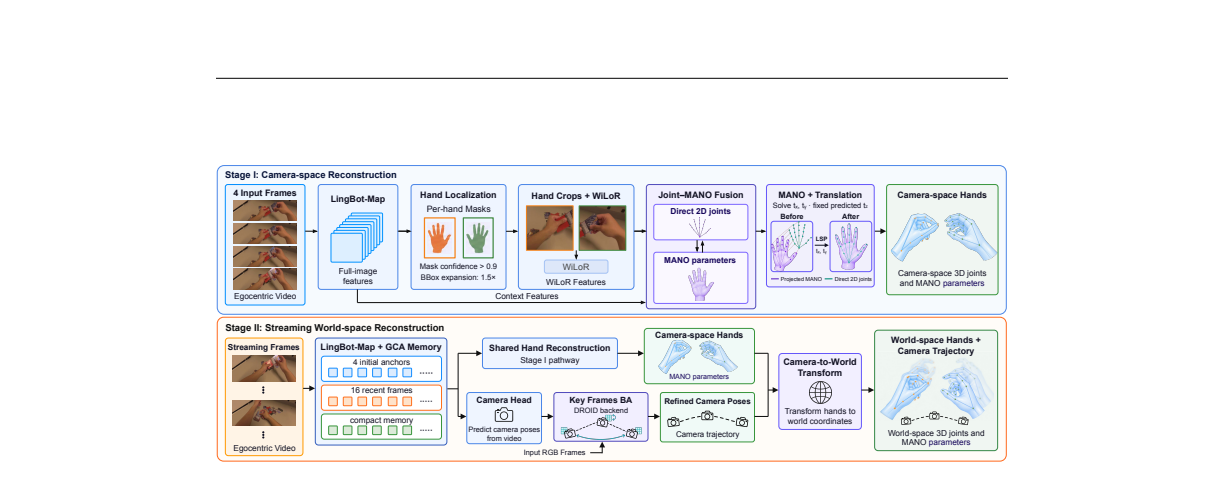
To address these limitations, we present InfiniHand, an end-to-end streaming feed-forward framework that jointly estimates MANO parameters, camera trajectories, and hand locations directly from uncalibrated egocentric video. InfiniHand integrates persistent spatiotemporal memory with hand-centered visual features, explicitly coupling camera motion with local hand geometry within a unified architecture. We train InfiniHand in two progressive stages by first learning robust camera-space hand priors and then extending to streaming world-space reconstruction. To support this process, we aggregate a pretraining corpus of approximately 5,000 hours of egocentric data across multiple public datasets. Extensive evaluations demonstrate that InfiniHand outperforms state-of-the-art baselines on in-domain benchmarks, achieving a 21.4% reduction in ARCTIC PA-p compared to ViDiHand while substantially mitigating world-space drift. Furthermore, InfiniHand generalizes robustly to in-the-wild videos and operates at 11.19 FPS, delivering more than twice the throughput of HaWoR.
from the abstract
Pith says
Machine review · deepseek-v4-flash · 29 Sep 2026 · what was read was not recorded · not checked by a person
It can be wrong. Challenge this review or reply to it.
Holds up, with conditions. A solid systems paper whose genuinely new joint-training contribution is supported by clean ablations, but the unstated exclusion of evaluation test scenes from the 5,000-hour training corpus must be resolved before the world-space claims are taken at face value. This line is wrong
3 major objections · 5 minor
How often objections from reviews like this one are right: not yet measured
Not checked: figures, code, what the 19 references say.
The paper says, at Sec 3.1 / Sec 4.1 (training-data holdout)
The review did not quote this passage.
Pith says: Objection 1 of 3 · major
The nine-dataset training aggregation in Sec 3.1 includes ARCTIC, HOT3D, and EgoDex, and the world-space evaluation in Sec 4.1 uses test scenes from exactly those three datasets (34, 10, and 100 scenes), yet the paper never states that the evaluation sequences were excluded from the corpus.
more of objection 1
Because W-MPJPE and W A-MPJPE are reported only on these three datasets, the absence of an explicit holdout statement is load-bearing for the world-space claims (b117, b118). The concern is aggravated by two details: the EgoDex W-MPJPE of 28.77 mm is a 3.3x gap over WiLoR-SLAM's 96.02 mm while the ARCTIC margin is only about 10%, and Sec 3.1 singles out EgoDex as the dataset requiring the most aggressive cleaning (30-40% of candidate data removed). The authors must either state explicitly that the evaluation test splits were excluded from training (with cleaning applied only to training splits), or re-run the world-space evaluation on truly held-out sequences; the fact that HOI4D is out-of-corpus does not resolve this because HOI4D only supports camera-space metrics.
The paper says, at Table 2, HOT3D row
The review did not quote this passage.
Pith says: Objection 2 of 3 · major
The sentence in Sec 4.3 that lower W A-MPJPE scores confirm trajectory fidelity after sequence-level alignment is contradicted on HOT3D, where InfiniHand's W A-MPJPE of 35.76 mm is higher than HaWoR's 35.02 mm. The 'lowest world-space' claim is therefore valid for W-MPJPE (59.21 / 87.37 / 28.77 mm) but not uniformly across the sequence-aligned metric; the text should be qualified, and the authors should discuss what the HOT3D W A-MPJPE result implies about absolute-scale placement versus shape and trajectory fidelity.
The paper says, at Tables 1-3 (statistical support)
The review did not quote this passage.
Pith says: Objection 3 of 3 · major
No error bars, per-scene standard deviations, or significance tests are reported for any metric. Several headline margins are small, including PA-p 7.72 vs 9.82 mm over ViDiHand on ARCTIC and W-MPJPE 59.21 vs 65.86 mm over WiLoR-SLAM on ARCTIC, and given the scene-level variability typical of hand benchmarks, the reported rankings could be within noise. At minimum, per-scene spreads or a paired test over the 34 ARCTIC test scenes should be provided for the headline camera-space and world-space numbers.
5 minor objections
The paper says, at Table 1, ARCTIC row
Pith says: minor objection 1 of 5
InfiniHand's EPE-p on ARCTIC is 23.13 mm, nearly double ViDiHand's 12.41 mm, even though PA-p improves (7.72 vs 9.82 mm); the qualitative claim of accurate image alignment (b116) should be reconciled with this 2D projection metric and the discrepancy briefly explained.
The paper says, at Sec 3.1, cleaning paragraph
Pith says: minor objection 2 of 5
The phrase 'Prior to evaluation, low-confidence detections, invalid hand associations, and anatomically implausible poses are filtered out' is ambiguous about whether the filtering applies to evaluation; since the cleaning is described as a training-corpus step, the wording should be scoped to the training splits to avoid implying evaluation-time filtering.
show 3 more
The paper says, at Sec 3.3 / Appendix C
Pith says: minor objection 3 of 5
The sparse-BA pool capacity N and sampling stride K are exposed free parameters, and BA is one of the headline contributors in Table 3 (59.21 to 80.48 mm W-MPJPE when removed), but no sensitivity analysis over N and K is given; a short ablation or a statement of the chosen values would strengthen the claim.
The paper says, at Sec 5 / Table 2
Pith says: minor objection 4 of 5
Since W-MPJPE and W A-MPJPE measure absolute world placement, the acknowledged external-scale caveat (b133) should be restated next to Table 2 so that readers do not over-interpret the absolute world-space numbers, whose uncertainty is inherited from the auxiliary scale alignment model.
The paper says, at Abstract / Sec 4.3
Pith says: minor objection 5 of 5
The abstract's 'substantially mitigating world-space drift' is broader than what the tables support; the claim should be scoped to W-MPJPE, or the HOT3D W A-MPJPE exception (35.76 vs HaWoR 35.02) should be mentioned where the world-space results are summarized.
What would settle it
Two concrete checks would settle the claim. First, run InfiniHand with the external metric-scale alignment module removed or with the scale deliberately perturbed: if world-space W-MPJPE collapses toward the baselines, the reported EgoDex and ARCTIC gains reflect the alignment model, not the network itself. Second, audit the ~5,000-hour training corpus for overlap with the ARCTIC, HOT3D, and EgoDex test scenes: the paper never states these were excluded, and any significant overlap would weaken the generalization and benchmark claims.
from Pith's summary of the paper
How the review went
4 readings by deepseek-v4-flash · 29 Sep 2026
- Reader holds up, with conditions
- Skeptic partly agrees
- Editor wrote the verdict above
- Referee major revision: 3 major objections, 5 minor
Not run on this paper: the simulated authors' defence.
Pith did not check this review's objections against the paper.
The review in full
The review in brief, machine-written
InfiniHand is a competent assembly of borrowed parts — LingBot-Map backbone, WiLoR encoder, ViDiHand's LSP trick, DROID-SLAM BA — and the honest question is whether anything new survives the integration. I think something does. The Stage II joint training that couples localization, MANO recovery, and camera pose in one streaming network is the real contribution, and the ablation makes it convincingly: drop Stage II and ARCTIC W-MPJPE goes from 59.21 to 185.76 mm. That is a large, clean signal that the joint training, not any single module, is doing the work. The other ablations are informative too (sparse BA: 59.21 to 80.48; appearance features roughly double MP-p). The paper credits its sources and acknowledges its own scale limitation in Sec 5, which I am glad is in the main text rather than buried.
Soft spots, in order. First is benchmark hygiene, and here the stress-test note lands. The training corpus aggregates ARCTIC, HOT3D, and EgoDex among its nine datasets (Sec 3.1), and the paper never states that the evaluation test scenes were excluded from the aggregation. That is a one-sentence fix, but it is the difference between an EgoDex W-MPJPE of 28.77 mm — a 3.3x gap over the best baseline — and a number that cannot be trusted. The shape is suspicious: a modest 10% margin on ARCTIC yet a 3.3x gap on EgoDex, exactly the pattern leakage would produce. I am not accusing anyone of cheating; pretraining on these datasets is routine. But for a paper whose headline is world-space SOTA, the exclusion has to be stated explicitly and preferably verified. This is the issue that separates conditional from full acceptance.
Second, no error bars or significance tests anywhere. For the 10% ARCTIC margin this matters; the EgoDex margin would survive noise, which happens to be the number most exposed to the contamination question. Third, the scale dependence the authors flag: real, but symmetric — WiLoR-SLAM and HaWoR also rely on external metric scale — so I weight it below the hygiene issue.
Novelty is moderate, as the reader says: a systems paper, honest about borrowing, with no code or weights released, which makes the corpus-built EgoDex result unverifiable by anyone else.
This is for anyone in egocentric 3D hand estimation or human-to-robot transfer. It deserves a serious referee: conditional acceptance hinging on the test-scene exclusion, error bars for the close margins, and a release commitment. I would want those resolved before citing the EgoDex number, but the Stage II finding is useful regardless.
The strongest objection
The central claim — a single streaming network replaces cascaded hand-plus-SLAM pipelines and reaches world-space SOTA — requires that the ARCTIC, HOT3D, and EgoDex test scenes were excluded from the ~5,000-hour training aggregation. The paper aggregates exactly those three datasets among its nine (Sec 3.1), then reports W-MPJPE on the 34 ARCTIC, 10 HOT3D, and 100 EgoDex test scenes (Sec 4.1), yet never states that the evaluation sequences were held out from the corpus. This omission is more load-bearing than the metric-scale limitation the authors acknowledge (b133), for three reasons. First, scale error affects the baselines symmetrically — WiLoR-SLAM and HaWoR also rely on external scale from Metric3D — whereas test-set leakage would invalidate every benchmark claim in the paper, camera-space and world-space alike. Second, the Sapiens-based cleaning step removes 30–40% of candidate data (Sec 3.1), so it is genuinely ambiguous whether a leaked test scene would retain annotations identical to those used at evaluation or be partially cleaned, changing the comparison's meaning. Third, the EgoDex result is anomalously large — 28.77 vs 96.02 mm for WiLoR-SLAM, a 3.3x gap — while on ARCTIC the margin over WiLoR-SLAM is only 10% (59.21 vs 65.86 mm); that is exactly the pattern one would expect if evaluation sequences appeared in training. Also, HOT3D WA-MPJPE (35.76) is slightly worse than HaWoR (35.02), so the 'lowest world-space' claim does not survive sequence-level alignment there, leaving the W-MPJPE headline resting on the less stable absolute metric.
The reader identified metric scale from the auxiliary alignment model as the primary weakest assumption and the train/test exclusion as a secondary premise. I partially agree: the scale limitation is real, but the authors acknowledge it (b133) and it affects the baselines symmetrically since WiLoR-SLAM and HaWoR also depend on external Metric3D scale, so it weakens rather than collapses the comparison. The train/test separation, by contrast, is never acknowledged, threatens every empirical claim in the paper (camera-space PA-p and F1 included, which are scale-independent), and is precisely testable. I therefore elevate contamination to the single most load-bearing concern. Evidence weighing in the paper's favor: the ablations are informative and internally consistent — disabling SSparse BA raises ARCTIC W-MPJPE from 59.21 to 80.48 mm and removing Stage II raises it to 185.76 mm (Table 3), which shows world-space accuracy is genuinely driven by the joint hand-camera training and BA rather than by trivial scale matching; and the camera-space SOTA (PA-p 7.72 on ARCTIC) is independent of the world-scale question. But the anomaly on EgoDex (28.77 vs 96.02 mm for WiLoR-SLAM, a 3.3x gap, versus only 10% on ARCTIC) combined with the silent aggregation of evaluation datasets keeps the contamination premise genuinely unresolved, and the absence of released code or weights means the reader cannot check the manifest. There is also a minor internal tension in the world-space narrative: on HOT3D, WA-MPJPE (sequence-level aligned, the closest measure to 'drift') is slightly worse than HaWoR (35.76 vs 35.02), so the 'substantially mitigating world-space drift' claim is not uniformly supported. None of this is fatal on the evidence — the findings are plausible and well-ablated — so the reader's CONDITIONAL verdict stands, conditioned on the split-exclusion verification and on releasing the data-manifest/code for independent confirmation. Hence UNCHANGED.
The referee's report
The contribution is potentially significant: if the reported numbers hold, InfiniHand would be the first single-network streaming alternative to cascaded hand-plus-SLAM pipelines for world-space egocentric hand estimation. The paper ships checkable metric definitions (Appendix A) and loss formulations (Appendix B), and Table 3 cleanly separates component contributions, most notably the 3.1x W-MPJPE jump without Stage II joint training and the 36% jump without sparse BA. The camera-space result is supported by a genuinely held-out control, HOI4D, which is not among the nine training datasets and where InfiniHand still attains the best PA-p (12.11 mm). The authors also acknowledge the metric-scale limitation of the backbone (b133), a caveat that applies symmetrically to the baselines. The decisive qualification for the world-space headline is the training/evaluation overlap: ARCTIC, HOT3D, and EgoDex appear in the training aggregation (Sec 3.1) and are also the only datasets used for world-space evaluation (Sec 4.1), with no explicit holdout statement, which must be resolved before the SOTA claims can be taken at face value.
Pith's reading of the paper (a machine's summary, not the authors')
The paper proposes InfiniHand, an end-to-end streaming framework that jointly estimates MANO hand parameters, camera trajectories, and hand locations from uncalibrated egocentric video, collapsing the hand-localization, hand-reconstruction, and SLAM cascade into one network. It reports the lowest camera-space PA-p on all four benchmarks (7.72 mm on ARCTIC, a 21.4% reduction over ViDiHand) and the lowest world-space W-MPJPE on ARCTIC, HOT3D, and EgoDex, including a 63.3% cut versus Dyn-HaMR on EgoDex. It runs at 11.19 FPS, more than twice the throughput of HaWoR. Powered by roughly 5,000 hours of cleaned egocentric data and a two-stage training scheme, the claim is that a single streaming model can match or beat cascaded systems at both accuracy and speed.
What carries the argument. The architecture builds on the LingBot-Map streaming 3D foundation model, whose Geometric Context Attention (GCA) memory -- anchor features, a recent dense-feature window, and compressed trajectory tokens -- provides the shared spatiotemporal representation coupling global camera motion with local hand articulation. Hand crops are processed by dual streams: a geometric adapter that re-embeds backbone patch features and a WiLoR appearance encoder, fused by a 1x1 convolution before the MANO head. Lateral translation in the hand frame is recovered by differentiable least-squares projection (LSP), which aligns projected MANO joints with predicted 2D landmarks while keeping root depth fixed, preserving a feed-forward path. A DROID bundle-adjustment backend over a binary keyframe pool corrects long-term camera drift and supplies the poses used to transform hand predictions into world coordinates.
Core claim. The central claim is that a unified streaming network with persistent spatiotemporal memory can couple camera egomotion with local hand geometry well enough to outperform cascaded hand-reconstruction-plus-SLAM systems in both camera-space and world-space accuracy while running faster. The decisive ingredients are joint hand-camera training and sparse drift correction: ablations on ARCTIC show that omitting Stage II joint training raises W-MPJPE from 59.21 to 185.76 mm, while disabling the sparse bundle-adjustment backend raises it from 59.21 to 80.48 mm. The authors conclude that scaling diverse egocentric supervision, rather than chaining independent estimators, is the path to rapid, robust world-space hand motion reconstruction.
The premise it rests on. The world-space accuracy claim depends on metric scale being correct, yet the underlying backbone has no inherent metric scale and relies on an external post-processing alignment model whose errors propagate into hand positions and trajectories.
If the paper is right (Pith's inferences, not the authors')
A single streaming network can replace cascaded hand-plus-SLAM pipelines, removing the error accumulation that detection jitter, camera tracking drift, and scale inconsistencies introduce.
World-space drift over extended sequences is substantially mitigated through joint hand-camera training plus the sparse bundle-adjustment backend, which selectively revisits past keyframes without full-history optimization.
The aggregated, cleaned ~5,000-hour egocentric corpus is a reusable training resource for future hand-scene reconstruction models.
At 11.19 FPS the framework can annotate egocentric video at scale, supporting downstream human-to-robot motion transfer and dexterous manipulation policy learning.
Because metric scale comes from an external post-processing alignment model, the headline world-space numbers are partly a statement about that alignment model's accuracy; an honest comparison would isolate its contribution or match scale handling across all baselines.
The paper never states that ARCTIC, HOT3D, and EgoDex test scenes were excluded from the ~5,000-hour training corpus; if test sequences overlap the training data, the benchmark gains could in part reflect memorization rather than generalization.
The recipe -- streaming geometric memory plus keyframe-sampled bundle adjustment -- is generic and could plausibly extend to full-body pose, hands-plus-object tracking, or multi-agent egocentric reconstruction, though the paper does not demonstrate this.
Check this review
Pith stored no record of this review's passes and took no fingerprint of it. Reviews made by code from 13 Nov 2026 on carry both.
How often reviews like this one are right
Reviews like this one: written by deepseek-v4-flash, where what was read was not recorded.
How often objections from reviews like this one are right: not yet measured
Reviews by people
This review was written by a machine. No person has reviewed this paper on Pith yet. A scientist listed on Pith can review it for a fee, and their review is published here whatever it concludes.
The paper
Abstract
World-space hand motion estimation from egocentric video requires recovering 3D articulated hand geometry while tracking camera egomotion. Existing approaches heavily rely on cascading independent hand pose estimators and SLAM systems, resulting in error accumulation, complex pipelines, and severe computational overhead. To address these limitations, we present InfiniHand, an end-to-end streaming feed-forward framework that jointly estimates MANO parameters, camera trajectories, and hand locations directly from uncalibrated egocentric video. InfiniHand integrates persistent spatiotemporal memory with hand-centered visual features, explicitly coupling camera motion with local hand geometry within a unified architecture. We train InfiniHand in two progressive stages by first learning robust camera-space hand priors and then extending to streaming world-space reconstruction. To support this process, we aggregate a pretraining corpus of approximately 5,000 hours of egocentric data across multiple public datasets. Extensive evaluations demonstrate that InfiniHand outperforms state-of-the-art baselines on in-domain benchmarks, achieving a 21.4% reduction in ARCTIC PA-p compared to ViDiHand while substantially mitigating world-space drift. Furthermore, InfiniHand generalizes robustly to in-the-wild videos and operates at 11.19 FPS, delivering more than twice the throughput of HaWoR.
The paper's own sentences, arranged, kept beside the review and separate from it. Each label is drawn from a closed vocabulary; the number beside it is the probability the classifier gave that label. No sentence in this record was written by a model.
abstract compiled · 2026-09-29
The authors' main claim, as the classifier picked it out 0.97
“Extensive evaluations demonstrate that InfiniHand outperforms state-of-the-art baselines on in-domain benchmarks, achieving a 21.4% reduction in ARCTIC PA-p compared to ViDiHand while substantially mitigating world-space drift.”
How the main claim is stated: asserted 1.00
What the abstract itself states, as probabilities: claims first 0.06 · states limitation 0.09 · human participants 0.32 · controlled comparison 0.91 · randomized assignment 0.01 · states quantitative result 0.99 · compares with prior results 0.98 · mentions code or data availability 0.04
The abstract, sentence by sentence
This table labels the abstract only (arXiv listing abstract v1). The number is the probability the classifier gave the label.
| Sentence | Role | The authors' own work | States the main conclusion | Strength |
|---|---|---|---|---|
| World-space hand motion estimation from egocentric video requires recovering 3D articulated hand geometry while tracking camera egomotion. | background 1.00 | 0.07 | 0.03 | asserted 0.99 |
| Existing approaches heavily rely on cascading independent hand pose estimators and SLAM systems, resulting in error accumulation, complex pipelines, and severe computational overhead. | background 0.53 | 0.05 | 0.03 | asserted 1.00 |
| To address these limitations, we present InfiniHand, an end-to-end streaming feed-forward framework that jointly estimates MANO parameters, camera trajectories, and hand locations directly from uncalibrated egocentric video. | contribution 0.98 | 0.91 | 0.19 | asserted 1.00 |
| InfiniHand integrates persistent spatiotemporal memory with hand-centered visual features, explicitly coupling camera motion with local hand geometry within a unified architecture. | method 0.94 | 0.88 | 0.07 | asserted 1.00 |
| We train InfiniHand in two progressive stages by first learning robust camera-space hand priors and then extending to streaming world-space reconstruction. | method 0.99 | 0.95 | 0.04 | asserted 1.00 |
| To support this process, we aggregate a pretraining corpus of approximately 5,000 hours of egocentric data across multiple public datasets. | method 0.99 | 0.93 | 0.02 | asserted 1.00 |
| Extensive evaluations demonstrate that InfiniHand outperforms state-of-the-art baselines on in-domain benchmarks, achieving a 21.4% reduction in ARCTIC PA-p compared to ViDiHand while substantially mitigating world-space drift. | result 1.00 | 0.96 | 0.55 | asserted 1.00 |
| Furthermore, InfiniHand generalizes robustly to in-the-wild videos and operates at 11.19 FPS, delivering more than twice the throughput of HaWoR. | result 1.00 | 0.95 | 0.21 | asserted 1.00 |
What kind of paper the classifier reports this is: method or tool 1.00 · evidence from observation or experiment 0.96
What was examined, and what was not
Sources read
- arXiv listing abstract v1
Not examined
- full text
- figures and tables
- references and citing sentences
- relations to other papers
Levels run
- P abstract
Not run
- S sections
- T body sentences
- C citations
- R cross-paper relations
How the labels were made
Compiled by classifier-1.13.0 via TypeSafe API, question bank abstract-p1-20260923, 2026-09-29: 1 request, 6,373 input tokens.
Every quoted sentence on this record is the authors'. Every label is from Pith's closed vocabulary, with the probability shown beside it. This record as JSON
Figures (6)



Figures are the authors', reproduced from the paper.
References (19)
- [6] Baoyu Li, Xinchen Yin, Mengying Lin, Yixin Zhang, and Danfei Xu. EgoW AM: World action models beyond pixels with in-the-wild egocentric human data.arXiv preprint arXiv:2607.08436, 2026a. Yihang Li, Xuelong Wei, Jingzhou Luo, Yingjing Xiao, Yibo Bai, Guangyuan Zhou, Teng Zou, C... on PithPith's reviewarXiv
- [8] 11 Gyeongsik Moon. Bringing Inputs to Shared Domains for 3D Interacting Hands Recovery in the Wild.arXiv preprint arXiv:2303.13652, on PithPith's reviewarXiv
- [10] Rolandos Alexandros Potamias, Jinglei Zhang, Jiankang Deng, and Stefanos Zafeiriou. WiLoR: End-to-end 3d hand localization and reconstruction in the wild.arXiv preprint arXiv:2409.12259, on PithPith's reviewarXiv
- [11] Aditya Prakash, Ruisen Tu, Matthew Chang, and Saurabh Gupta. 3D Hand Pose Estimation in Everyday Egocentric Images.arXiv preprint arXiv:2312.06583, on PithPith's reviewarXiv
- [13] Kerui Ren, Guanghao Li, Changjian Jiang, Yingxiang Xu, Tao Lu, Linning Xu, Junting Dong, Jiangmiao Pang, Mulin Yu, and Bo Dai. M 3: Dense Matching Meets Multi-View Foundation Models for Monocular Gaussian Splatting SLAM.arXiv preprint arXiv:2603.16844, on PitharXiv
- [14] Yuxi Wang, Chengkai Jin, Yufei Liu, Wenqi Ouyang, Tianyi Wei, Zhiwei Zeng, Siyuan Huang, Zhiqi Shen, and Xingang Pan. The surprising effectiveness of video diffusion models for hand motion reconstruction.arXiv preprint arXiv:2606.30308, on PithPith's reviewarXiv
- [15] Wei Yin, Chi Zhang, Hao Chen, Zhipeng Cai, Gang Yu, Kaixuan Wang, Xiaozhi Chen, and Chunhua Shen. Metric3D: Towards Zero-shot Metric 3D Prediction from A Single Image.arXiv preprint arXiv:2307.10984, on PithPith's reviewarXiv
- [16] Jinglei Zhang, Jiankang Deng, Chao Ma, and Rolandos Alexandros Potamias. HaWoR: World-space hand motion reconstruction from egocentric videos.arXiv preprint arXiv:2501.02973, on PithPith's reviewarXiv
- [17] 12 Junyi Zhang, Charles Herrmann, Junhwa Hur, Chen Sun, Ming-Hsuan Yang, Forrester Cole, Trevor Darrell, and Deqing Sun. LoGeR: Long-context geometric reconstruction with hybrid memory. arXiv preprint arXiv:2603.03269, on PithPith's reviewarXiv
- [18] for prediction–target association. Projected MANO mesh boxes are matched greedily in descending IoU order, requiring identical handedness and IoU>0.1after enlarging target boxes by10%. Matching is one-to-one. Predic- tions with an available presence score must exceed0.5; uncon... on Pith
- [19] first refines the selected camera poses. We then toggle the selected entries’ bits and remove every entry whose updated bit is zero: b+ i =b i⊕1[fi∈S],P + ={(f i,b + i )|(f i,bi)∈P, b + i = 1},(35) where⊕denotes binary exclusive-or. A newly selected frame changes from0to1and r... on Pith
- [2017] Riku Murai, Eric Dexheimer, and Andrew J. Davison. MASt3R-SLAM: Real-Time Dense SLAM with 3D Reconstruction Priors.arXiv preprint arXiv:2412.12392, on PithPith's reviewarXiv
- [2019] Dominic Maggio, Hyungtae Lim, and Luca Carlone. VGGT-SLAM: Dense RGB SLAM Optimized on the SL(4) Manifold.arXiv preprint arXiv:2505.12549, on PithPith's reviewarXiv
- [2021] Lin-Zhuo Chen, Jian Gao, Shangzhan Zhang, Yihang Chen, Ka Leong Cheng, Yipengjing Sun, Liangxiao Hu, Nan Xue, Xing Zhu, Yujun Shen, Yao Yao, and Yinghao Xu. LingBot-Map: Geometric context transformer for streaming 3d reconstruction.arXiv preprint arXiv:2604.14141, on PithPith's reviewarXiv
- [2022] Ryan Hoque, Peide Huang, David J. Yoon, Mouli Sivapurapu, and Jian Zhang. EgoDex: Learn- ing dexterous manipulation from large-scale egocentric video.arXiv preprint arXiv:2505.11709, on PithPith's reviewarXiv
- [2023] Ryan Punamiya, Simar Kareer, Zeyi Liu, Josh Citron, Ri-Zhao Qiu, Xiongyi Cai, Alexey Gavryushin, Jiaqi Chen, Davide Liconti, Lawrence Y . Zhu, Patcharapong Aphiwetsa, Baoyu Li, Aniketh Cheluva, Pranav Kuppili, Yangcen Liu, Dhruv Patel, Aidan Gao, Hye-Young Chung, Ryan Co, Rene... on PithPith's reviewarXiv
- [2024] Rawal Khirodkar, He Wen, Julieta Martinez, Yuan Dong, Zhaoen Su, and Shunsuke Saito. Sapiens2. arXiv preprint arXiv:2604.21681, on PithPith's reviewarXiv
- [2025] Mu Hu, Wei Yin, Chi Zhang, Zhipeng Cai, Xiaoxiao Long, Kaixuan Wang, Hao Chen, Gang Yu, Chunhua Shen, and Shaojie Shen. Metric3Dv2: A Versatile Monocular Geometric Foun- dation Model for Zero-shot Metric Depth and Surface Normal Estimation.arXiv preprint arXiv:2404.15506, on PithPith's reviewarXiv
- [2026] Haoye Dong, Aviral Chharia, Wenbo Gou, Francisco Vicente Carrasco, and Fernando De la Torre. Hamba: Single-view 3D Hand Reconstruction with Graph-guided Bi-Scanning Mamba.arXiv preprint arXiv:2407.09646, on PitharXiv
Cited by 1 Pith paper
Reviewed papers on Pith that cite this one. The full citation record
- HandRSI: Recursive Self-Improvement for Hand Pose Estimation cs.CV · Nov 2026
Challenges and discussion
Disagree with the review, or know something it missed? Leave a comment, or challenge this review formally: a challenge becomes a permanent entry in this paper's record, and its decision is published here.
Come back by email
A short list of the week's newly reviewed papers. Nothing is sent until you confirm from your inbox, and every email has a link that stops it. No account.
No comments yet.
Sign in to comment