REVIEW 2 major objections 6 minor 73 references
Predicting how the scene evolves, not just what to do, lets robots learn from messy egocentric human video that action cloning cannot use.
Reviewed by Pith at T0; open to challenge. T0 means a machine referee read the full paper against a public rubric. the ladder, T0–T4 →
T0 review · grok-4.5
2026-07-10 18:38 UTC pith:QB3QE52M
load-bearing objection Clean controlled real-robot study: WAM co-training with DINO/3D-flow targets extracts more from wild egocentric human data than strong BC, with a useful ranking of world targets. the 2 major comments →
EgoWAM: World Action Models Beyond Pixels with In-the-Wild Egocentric Human Data
The pith
A machine-rendered reading of the paper's core claim, the machinery that carries it, and where it could break.
Core claim
World Action Model co-training transfers large-scale in-the-wild egocentric human data to robot manipulation more effectively than behavior cloning. Under a matched backbone and data mixture, pixel reconstruction transfers weakly, while DINO features improve out-of-distribution object and scene generalization by up to 4× and camera-stabilized 3D motion flow improves in-domain performance by 20–30%.
What carries the argument
EgoWAM: a single shared transformer trunk with a fixed action head and a swappable world-model head, so only the future-state target (pixel VAE latents, DINO patch features, or ego-motion-factored 3D flow) changes. Joint training supervises the trunk through both action loss and world prediction; at inference only the action head runs.
Load-bearing premise
The claim rests on the idea that predicting how the scene evolves from human video shapes a shared representation that helps robot actions even when human motions themselves cannot be executed.
What would settle it
Hold backbone, action head, and human–robot data mix fixed; compare behavior-cloning co-training against the same setup with DINO or 3D-flow world heads on the three bimanual tasks. If the world-head runs do not beat cloning on the reported in-domain and OOD success and sub-task scores, the transfer claim fails.
If this is right
- Large natural human video can improve robot policies without careful viewpoint, speed, or style alignment when supervision is dynamics-based rather than action-based.
- Semantic feature targets are the better world choice when the goal is object and scene generalization.
- Camera-stabilized 3D-flow targets are the better world choice when the goal is precise in-domain spatial control.
- Deployment cost can stay at ordinary behavior-cloning latency because the world head is training-only.
- World targets that abstract appearance, keep physical effects agent-invariant, and factor out ego-motion should be preferred over raw pixel reconstruction for cross-embodiment transfer.
Where Pith is reading between the lines
- A hybrid world target that combines DINO-style semantics with 3D-flow geometry could capture the complementary OOD and spatial strengths the paper reports separately.
- Because world-only supervision on human batches already beat action-only in the ablations, pure human video without hand-action labels may deliver much of the scaling benefit.
- The same controlled swappable-head design could test object-centric or language-conditioned latents as further world targets under identical co-training.
- Multi-task policies trained this way on mixed human corpora may inherit the context-level transfer shown here per task, which the authors flag as open.
Editorial analysis
A structured set of objections, weighed in public.
Referee Report
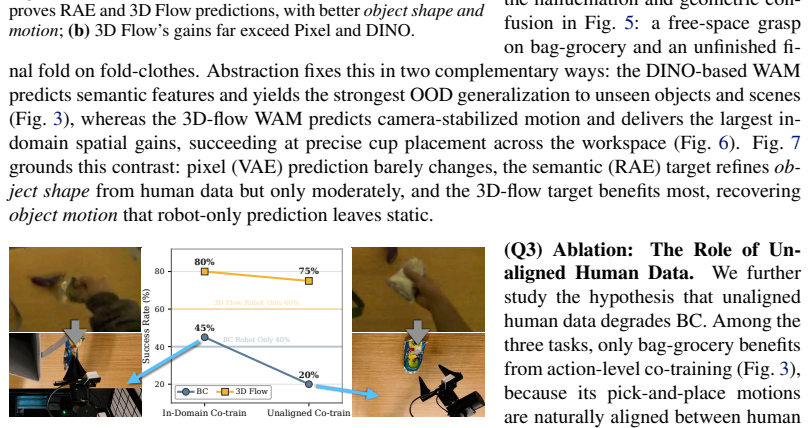
Summary. The paper studies human-to-robot transfer for bimanual manipulation via World Action Models (WAMs). It argues that behavior cloning co-training entangles transferable scene/task content with non-transferable morphology, head motion, and style, and that an auxiliary future-prediction head can transfer task-relevant dynamics even when human actions do not. EgoWAM freezes the HPT backbone, action head, and data mixture and varies only the world target among pixel VAE latents, DINO features, and camera-stabilized 3D motion flow, motivated by three desiderata (appearance abstraction, cross-embodiment consistency, ego-motion factoring). On three real-world bimanual tasks with in-domain and OOD splits (~1800 rollouts), WAM co-training scales better with in-the-wild EgoVerse human data than BC; pixels transfer weakly, DINO drives the largest OOD object/scene gains (up to ~4×), and 3D flow the largest in-domain spatial gains (20–30%). Ablations cover aligned/unaligned human data, world-only vs action+world human supervision, and a robot-to-robot RoboTwin simulation check.
Significance. If the controlled comparison holds, the paper supplies a concrete, falsifiable design axis for scaling robot learning from large-scale egocentric human video: train with a world target that abstracts appearance, keeps physical effects agent-invariant, and factors ego-motion, then discard the world head at inference. Strengths include a clean isolation of the world representation (fixed backbone/action head/data mixture), substantial real-robot evaluation with ID/OOD splits and confidence intervals, qualitative failure analysis, and ablations showing world-only human supervision already beats action-only human supervision. The complementary DINO vs 3D-flow pattern and the RoboTwin replication make the result useful beyond a single system. Limitations on motion-primitive transfer, multi-task scaling, and absolute success rates are stated and do not erase the comparative claim.
major comments (2)
- §5.2 / Fig. 3 and App. A.2: the central claim is comparative (WAM vs BC under matched mixture; DINO/3D-flow vs pixel), but absolute success rates remain modest on several OOD splits and on fine-grained insertion (RoboTwin hanging-mug ≤1%). The manuscript should state more explicitly that the contribution is the controlled transfer comparison, not a new SOTA absolute policy, and report robot-only baselines next to every co-train bar so readers can separate “human data helps WAM” from “WAM is simply a stronger architecture.”
- §4.2 and §7: the three desiderata (D1–D3) are treated as the design axis, yet only three discrete targets are compared, and 3D flow depends on Aria VIO plus a pretrained tracker with embodiment-specific movement thresholds. A short sensitivity analysis (e.g., flow without VIO stabilization, or DINO with a different frozen encoder) would strengthen the claim that the desiderata—not the particular tracker/encoder—drive the gains. Without that, the “recipe” in the conclusion is still partly tied to these instantiations.
minor comments (6)
- Fig. 3: normalized score and success rate panels are dense; consider a compact table of mean±CI for ID/OOD per task so the 4× and 20–30% claims can be checked without reading bar heights.
- Eq. (3) and §4.3: λ=1 is fixed with no sweep; a one-sentence note on sensitivity (or that λ was not tuned per target) would help reproducibility.
- §3.1: the embodiment-specific windows TH=1s / TR=1.5s and k=100 are reasonable but should be listed once in the main text or Table 2 with a brief justification that they match task progress rather than wall-clock only.
- App. A.3 / Fig. 12: the Pixel-PT bag-opening hallucination is a useful failure mode; a pointer in the main §5.2 would help readers who skip the appendix.
- Typos/notation: “W AMs” spacing is inconsistent; “bitter lesson” is informal for a journal abstract; ensure SE(3) and T_device notation are defined before first use in §3.1.
- Code/data: the project page is linked; a short statement on what will be released (checkpoints, flow preprocessing, evaluation seeds) would improve long-term value.
Circularity Check
Empirical co-training study; world targets and success metrics are independent, with only minor non-load-bearing self-citation of data/backbone infrastructure.
specific steps
-
self citation load bearing
[§3.1, §5.1 Data; citations [7], [16]]
"EGOWAM builds on a Heterogeneous Pretrained Transformer backbone [16, 7]. ... Human data spans two regimes ... (2) EgoVerse (∼10:1): the full EgoVerse-A flagship split per task [7]"
Data corpus and HPT backbone are taken from overlapping-author prior work. This is ordinary infrastructure reuse, not a load-bearing uniqueness or derivation step: the paper’s claim is the controlled comparison of world targets under that fixed stack, measured on external robot rollouts. Does not force DINO/3D-flow superiority by construction.
full rationale
EgoWAM’s central claims are experimental comparisons under a fixed backbone, action head, and data mixture, varying only the world prediction target (Pixel VAE, DINO, 3D flow). World targets are defined from external pretrained modules (Wan VAE, DINOv2, Track4World + Aria VIO) and are not functions of the robot success metric. Gains are measured by held-out real-world rollouts (normalized sub-task score and success rate on ID/OOD splits), not by re-reporting the training world loss as a “prediction.” The core hypothesis—that task-relevant dynamics transfer more readily than actions—is tested rather than assumed (BC often degrades under natural/unaligned human data while WAM gains; world-only human supervision beats action-only; UMAP trunk alignment; improved 3D-flow prediction under co-training). Self-citations to EgoVerse and HPT supply the human dataset and transformer backbone infrastructure; they do not force the comparative ranking of world targets by construction, uniqueness theorem, or fitted-input-as-prediction. No self-definitional loop, no uniqueness imported from the authors, and no renaming of a known result as a derivation. Residual limitations (motion-primitive transfer, multi-task scaling) are acknowledged and do not create circularity. Score 1 only for ordinary infrastructure self-citation that is not load-bearing for the result.
Axiom & Free-Parameter Ledger
free parameters (4)
- world-loss weight λ =
1.0
- embodiment-specific prediction horizons TH, TR =
1.0s / 1.5s
- flow-matching τ prior Beta(1.5, 1.0) and sampling steps =
Beta(1.5,1.0), 50 steps
- 3D-flow movement thresholds and anchor grid =
2mm/10mm, 28×40
axioms (4)
- domain assumption Task-relevant scene dynamics transfer across human and robot embodiments more readily than low-level actions.
- ad hoc to paper An effective world target should abstract appearance (D1), capture agent-invariant physical effects (D2), and factor ego-motion (D3).
- domain assumption Training-time world prediction shapes a useful shared trunk even when the world head is discarded at inference.
- domain assumption Cross-embodiment actions can be sufficiently aligned into a shared 14-D camera-frame end-effector space via FK, VIO poses, and quantile normalization.
invented entities (2)
-
EgoWAM controlled co-training framework
independent evidence
-
Three world-representation desiderata (D1–D3)
no independent evidence
read the original abstract
Egocentric human data offers scalable supervision for robot manipulation. However, behavior cloning entangles transferable content like objects, scenes, and task semantics, with non-transferable factors like human morphology, head motion, and behavioral style. We study whether World Action Models (WAMs) provide a better training signal by requiring policies to predict not only actions, but also how the scene evolves. The central question is what world representation best enables human-to-robot transfer. We hypothesize that an effective world target should abstract appearance, capture agent-invariant physical effects, and separate camera motion from environment change. We introduce EgoWAM, a controlled human-robot co-training framework that fixes the policy backbone, action head, and data mixture while varying only the world prediction target, comparing Pixel, DINO, and 3D motion flow. Across three real-world bimanual tasks, WAM co-training scales more effectively with in-the-wild egocentric human data than behavior cloning. Pixel-based prediction transfers weakly, while DINO and 3D flow yield substantial gains: DINO improves out-of-distribution object and scene generalization by up to 4x, and 3D flow improves in-domain performance by 20-30%. More details: https://gatech-rl2.github.io/egowam.github.io
Figures




Reference graph
Works this paper leans on
-
[1]
EgoDex: Learning Dexterous Manipulation from Large-Scale Egocentric Video
R. Hoque, P. Huang, D. J. Yoon, M. Sivapurapu, and J. Zhang. EgoDex: Learning Dexterous Manipulation from Large-Scale Egocentric Video.arXiv preprint arXiv:2505.11709, 2026
work page internal anchor Pith review Pith/arXiv arXiv 2026
-
[2]
Ego-Exo4D: Understanding Skilled Human Activity from First- and Third-Person Perspectives
K. Grauman, A. Westbury, L. Torresani, K. Kitani, J. Malik, T. Afouras, K. Ashutosh, V . Baiyya, S. Bansal, B. Boote, E. Byrne, Z. Chavis, J. Chen, F. Cheng, F.-J. Chu, S. Crane, A. Dasgupta, J. Dong, M. Escobar, C. Forigua, A. Gebreselasie, S. Haresh, J. Huang, M. M. Islam, S. Jain, R. Khirodkar, D. Kukreja, K. J. Liang, J.-W. Liu, S. Majumder, Y . Mao, ...
work page internal anchor Pith review Pith/arXiv arXiv 2024
- [3]
-
[4]
EgoMimic: Scaling Imitation Learning via Egocentric Video
S. Kareer, D. Patel, R. Punamiya, P. Mathur, S. Cheng, C. Wang, J. Hoffman, and D. Xu. EgoMimic: Scaling Imitation Learning via Egocentric Video.arXiv preprint arXiv:2410.24221, 2024
work page internal anchor Pith review Pith/arXiv arXiv 2024
- [5]
-
[6]
Egoscale: Scaling dexterous manipulation with diverse egocentric human data, 2026
R. Zheng, D. Niu, Y . Xie, J. Wang, M. Xu, Y . Jiang, F. Casta ˜neda, F. Hu, Y . L. Tan, L. Fu, T. Darrell, F. Huang, Y . Zhu, D. Xu, and L. Fan. EgoScale: Scaling Dexterous Manipulation with Diverse Egocentric Human Data.arXiv preprint arXiv:2602.16710, 2026
-
[7]
EgoVerse: An Egocentric Human Dataset for Robot Learning from Around the World
R. Punamiya, S. Kareer, Z. Liu, J. Citron, R.-Z. Qiu, X. Cai, A. Gavryushin, J. Chen, D. Li- conti, L. Y . Zhu, P. Aphiwetsa, B. Li, A. Cheluva, P. Kuppili, Y . Liu, D. Patel, A. Gao, H.-Y . Chung, R. Co, R. Zbizika, J. Liu, X. Xu, H. Xiong, G. Chen, S. Oliani, C. Yang, X. Wang, J. Fort, R. Newcombe, J. Gao, J. Chong, G. Matsuda, A. Doriwala, M. Pollefeys...
work page internal anchor Pith review Pith/arXiv arXiv 2026
-
[8]
S. Ye, Y . Ge, K. Zheng, S. Gao, S. Yu, G. Kurian, S. Indupuru, Y . L. Tan, C. Zhu, J. Xi- ang, A. Malik, K. Lee, W. Liang, N. Ranawaka, J. Gu, Y . Xu, G. Wang, F. Hu, A. Narayan, J. Bjorck, J. Wang, G. Kim, D. Niu, R. Zheng, Y . Xie, J. Wu, Q. Wang, R. Julian, D. Xu, Y . Du, Y . Chebotar, S. Reed, J. Kautz, Y . Zhu, L. J. Fan, and J. Jang. World Action M...
work page internal anchor Pith review Pith/arXiv arXiv 2026
-
[9]
M. J. Kim, Y . Gao, T.-Y . Lin, Y .-C. Lin, Y . Ge, G. Lam, P. Liang, S. Song, M.-Y . Liu, C. Finn, and J. Gu. Cosmos Policy: Fine-Tuning Video Models for Visuomotor Control and Planning. arXiv preprint arXiv:2601.16163, 2026
work page internal anchor Pith review Pith/arXiv arXiv 2026
-
[10]
S. Li, Y . Gao, D. Sadigh, and S. Song. Unified Video Action Model.arXiv preprint arXiv:2503.00200, 2025
work page internal anchor Pith review Pith/arXiv arXiv 2025
-
[11]
C. Zhu, R. Yu, S. Feng, B. Burchfiel, P. Shah, and A. Gupta. Unified World Models: Cou- pling Video and Action Diffusion for Pretraining on Large Robotic Datasets.arXiv preprint arXiv:2504.02792, 2025
work page internal anchor Pith review Pith/arXiv arXiv 2025
-
[12]
M. Oquab, T. Darcet, T. Moutakanni, H. V . V o, M. Szafraniec, V . Khalidov, P. Fernandez, D. Haziza, F. Massa, A. El-Nouby, R. Howes, P.-Y . Huang, H. Xu, V . Sharma, S.-W. Li, W. Galuba, M. Rabbat, M. Assran, N. Ballas, G. Synnaeve, I. Misra, H. Jegou, J. Mairal, P. Labatut, A. Joulin, and P. Bojanowski. Dinov2: Learning robust visual features without s...
work page 2023
-
[13]
Diffusion Transformers with Representation Autoencoders
B. Zheng, N. Ma, S. Tong, and S. Xie. Diffusion Transformers with Representation Autoen- coders.arXiv preprint arXiv:2510.11690, 2025
work page internal anchor Pith review Pith/arXiv arXiv 2025
-
[14]
Y . Xiao, J. Wang, N. Xue, N. Karaev, Y . Makarov, B. Kang, X. Zhu, H. Bao, Y . Shen, and X. Zhou. SpatialTrackerV2: 3D Point Tracking Made Easy.arXiv preprint arXiv:2507.12462, 2025
work page internal anchor Pith review Pith/arXiv arXiv 2025
- [15]
-
[16]
L. Wang, X. Chen, J. Zhao, and K. He. Scaling Proprioceptive-Visual Learning with Hetero- geneous Pre-trained Transformers.arXiv preprint arXiv:2409.20537, 2024
work page internal anchor Pith review Pith/arXiv arXiv 2024
-
[17]
S. Nair, A. Rajeswaran, V . Kumar, C. Finn, and A. Gupta. R3M: A Universal Visual Repre- sentation for Robot Manipulation.arXiv preprint arXiv:2203.12601, 2022
work page internal anchor Pith review Pith/arXiv arXiv 2022
-
[18]
V-JEPA 2: Self-Supervised Video Models Enable Understanding, Prediction and Planning
M. Assran, A. Bardes, D. Fan, Q. Garrido, R. Howes, Mojtaba, Komeili, M. Muckley, A. Rizvi, C. Roberts, K. Sinha, A. Zholus, S. Arnaud, A. Gejji, A. Martin, F. R. Hogan, D. Dugas, P. Bojanowski, V . Khalidov, P. Labatut, F. Massa, M. Szafraniec, K. Krishnakumar, Y . Li, X. Ma, S. Chandar, F. Meier, Y . LeCun, M. Rabbat, and N. Ballas. V-jepa 2: Self-super...
work page internal anchor Pith review Pith/arXiv arXiv 2025
-
[19]
D. Niu, Y . Sharma, H. Xue, G. Biamby, J. Zhang, Z. Ji, T. Darrell, and R. Herzig. Pre-training auto-regressive robotic models with 4d representations.arXiv preprint arXiv:2502.13142, 2025
work page internal anchor Pith review Pith/arXiv arXiv 2025
-
[20]
Y . Bai, D. Tran, A. Bar, Y . LeCun, T. Darrell, and J. Malik. Whole-body conditioned egocentric video prediction, 2025. URLhttps://arxiv.org/abs/2506.21552
work page internal anchor Pith review Pith/arXiv arXiv 2025
-
[21]
R. Yang, Q. Yu, Y . Wu, R. Yan, B. Li, A.-C. Cheng, X. Zou, Y . Fang, X. Cheng, R.-Z. Qiu, H. Yin, S. Liu, S. Han, Y . Lu, and X. Wang. EgoVLA: Learning Vision-Language-Action Models from Egocentric Human Videos.arXiv preprint arXiv:2507.12440, 2025
work page internal anchor Pith review Pith/arXiv arXiv 2025
-
[22]
H. Bi, L. Wu, T. Lin, H. Tan, Z. Su, H. Su, and J. Zhu. H-RDT: Human Manipulation Enhanced Bimanual Robotic Manipulation.arXiv preprint arXiv:2507.23523, 2025
work page internal anchor Pith review Pith/arXiv arXiv 2025
- [23]
-
[24]
Q. Li, Y . Deng, Y . Liang, L. Luo, L. Zhou, C. Yao, L. Zeng, Z. Feng, H. Liang, S. Xu, Y . Zhang, X. Chen, H. Chen, L. Sun, D. Chen, J. Yang, and B. Guo. Scalable Vision-Language-Action Model Pretraining for Robotic Manipulation with Real-Life Human Activity Videos.arXiv preprint arXiv:2510.21571, 2025
- [25]
-
[26]
B. Hou, G. Li, J. Jia, T. An, X. Guo, S. Leng, H. Geng, Y . Ze, T. Harada, P. Torr, O. Mees, M. Pollefeys, Z. Liu, J. Wu, P. Abbeel, J. Malik, Y . Du, and J. Yang. World model for robot learning: A comprehensive survey. 2026
work page 2026
-
[27]
Structured World Models from Human Videos
R. Mendonca, S. Bahl, and D. Pathak. Structured World Models from Human Videos.arXiv preprint arXiv:2308.10901, 2023
work page internal anchor Pith review Pith/arXiv arXiv 2023
- [28]
-
[29]
Y . Liu, W. C. Shin, Y . Han, Z. Chen, H. Ravichandar, and D. Xu. ImMimic: Cross-Domain Im- itation from Human Videos via Mapping and Interpolation.arXiv preprint arXiv:2509.10952, 2025
work page internal anchor Pith review Pith/arXiv arXiv 2025
-
[30]
R. Punamiya, D. Patel, P. Aphiwetsa, P. Kuppili, L. Y . Zhu, S. Kareer, J. Hoffman, and D. Xu. EgoBridge: Domain Adaptation for Generalizable Imitation from Egocentric Human Data. In Advances in Neural Information Processing Systems, 2025
work page 2025
- [31]
-
[32]
C. Wen, X. Lin, J. So, K. Chen, Q. Dou, Y . Gao, and P. Abbeel. Any-point Trajectory Modeling for Policy Learning.arXiv preprint arXiv:2401.00025, 2024
work page internal anchor Pith review Pith/arXiv arXiv 2024
-
[33]
M. Xu, Z. Xu, Y . Xu, C. Chi, G. Wetzstein, M. Veloso, and S. Song. Flow as the Cross-Domain Manipulation Interface.arXiv preprint arXiv:2407.15208, 2024
work page internal anchor Pith review Pith/arXiv arXiv 2024
- [34]
-
[35]
Point Policy: Unifying Observations and Actions with Key Points for Robot Manipulation
S. Haldar and L. Pinto. Point Policy: Unifying Observations and Actions with Key Points for Robot Manipulation.arXiv preprint arXiv:2502.20391, 2025
work page internal anchor Pith review Pith/arXiv arXiv 2025
- [36]
-
[37]
J. A. Collins, L. Cheng, K. Aneja, A. Wilcox, B. Joffe, and A. Garg. Amplify: Actionless motion priors for robot learning from videos, 2025. URLhttps://arxiv.org/abs/2506. 14198
work page 2025
-
[38]
A. Hung, B. P. Duisterhof, and J. Ichnowski. 3PoinTr: 3D Point Tracks for Robot Manipulation Pretraining from Casual Videos.arXiv preprint arXiv:2603.08485, 2026
work page internal anchor Pith review Pith/arXiv arXiv 2026
- [39]
-
[40]
Z.-H. Yin, S. Yang, and P. Abbeel. Object-centric 3D Motion Field for Robot Learning from Human Videos.arXiv preprint arXiv:2506.04227, 2025
work page internal anchor Pith review Pith/arXiv arXiv 2025
- [41]
-
[42]
K. Dharmarajan, W. Huang, J. Wu, L. Fei-Fei, and R. Zhang. Dream2flow: Bridging video gen- eration and open-world manipulation with 3d object flow.arXiv preprint arXiv:2512.24766, 2025
-
[43]
D. Ha and J. Schmidhuber. World models.arXiv preprint arXiv:1803.10122, 2018
work page internal anchor Pith review Pith/arXiv arXiv 2018
-
[44]
Training Agents Inside of Scalable World Models
D. Hafner, W. Yan, and T. Lillicrap. Training agents inside of scalable world models.arXiv preprint arXiv:2509.24527, 2025
work page internal anchor Pith review Pith/arXiv arXiv 2025
-
[45]
B. Ai, S. Tian, H. Shi, Y . Wang, T. Pfaff, C. Tan, H. I. Christensen, H. Su, J. Wu, and Y . Li. A review of learning-based dynamics models for robotic manipulation.Science Robotics, 10 (106):eadt1497, 2025
work page 2025
-
[46]
A. Bar, G. Zhou, D. Tran, T. Darrell, and Y . LeCun. Navigation world models, 2024. URL https://arxiv.org/abs/2412.03572
work page internal anchor Pith review Pith/arXiv arXiv 2024
-
[47]
J. Pai, L. Achenbach, V . Montesinos, B. Forrai, O. Mees, and E. Nava. mimic-video: Video-Action Models for Generalizable Robot Control Beyond VLAs.arXiv preprint arXiv:2512.15692, 2025
work page internal anchor Pith review Pith/arXiv arXiv 2025
- [48]
-
[49]
B. Chen, T. Zhang, H. Geng, K. Song, C. Zhang, P. Li, W. T. Freeman, J. Malik, P. Abbeel, R. Tedrake, V . Sitzmann, and Y . Du. Large Video Planner Enables Generalizable Robot Con- trol.arXiv preprint arXiv:2512.15840, 2025
work page internal anchor Pith review Pith/arXiv arXiv 2025
-
[50]
S. Gao, W. Liang, K. Zheng, A. Malik, S. Ye, S. Yu, W.-C. Tseng, Y . Dong, K. Mo, C.-H. Lin, Q. Ma, S. Nah, L. Magne, J. Xiang, Y . Xie, R. Zheng, D. Niu, Y . L. Tan, K. R. Zentner, G. Kurian, S. Indupuru, P. Jannaty, J. Gu, J. Zhang, J. Malik, P. Abbeel, M.-Y . Liu, Y . Zhu, J. Jang, and L. J. Fan. DreamDojo: A Generalist Robot World Model from Large-Sca...
work page internal anchor Pith review Pith/arXiv arXiv 2026
- [51]
- [52]
-
[53]
G. Zhou, H. Pan, Y . LeCun, and L. Pinto. DINO-WM: World Models on Pre-trained Visual Features enable Zero-shot Planning.arXiv preprint arXiv:2411.04983, 2025
work page internal anchor Pith review Pith/arXiv arXiv 2025
-
[54]
Nilaksh, S. Jha, A. Zholus, and S. Chandar. Reconstruction or semantics? what makes a latent space useful for robotic world models. 2026. URLhttps://arxiv.org/abs/2605.06388
work page internal anchor Pith review Pith/arXiv arXiv 2026
- [55]
- [56]
-
[57]
W. Huang, Y .-W. Chao, A. Mousavian, M.-Y . Liu, D. Fox, K. Mo, and F.-F. Li. Point- world: Scaling 3d world models for in-the-wild robotic manipulation.arXiv preprint arXiv:2601.03782, 2026
-
[58]
T. Yuan, Z. Dong, Y . Liu, and H. Zhao. Fast-W AM: Do World Action Models Need Test-time Future Imagination?arXiv preprint arXiv:2603.16666, 2026
work page internal anchor Pith review Pith/arXiv arXiv 2026
-
[59]
T. Wan, A. Wang, B. Ai, B. Wen, C. Mao, C.-W. Xie, D. Chen, F. Yu, H. Zhao, J. Yang, J. Zeng, J. Wang, J. Zhang, J. Zhou, J. Wang, J. Chen, K. Zhu, K. Zhao, K. Yan, L. Huang, M. Feng, N. Zhang, P. Li, P. Wu, R. Chu, R. Feng, S. Zhang, S. Sun, T. Fang, T. Wang, T. Gui, T. Weng, T. Shen, W. Lin, W. Wang, W. Wang, W. Zhou, W. Wang, W. Shen, W. Yu, X. Shi, X....
work page internal anchor Pith review Pith/arXiv arXiv 2025
-
[60]
Improved Baselines with Representation Autoencoders
J. Singh, B. Zheng, Z. Wu, R. Zhang, E. Shechtman, and S. Xie. Improved baselines with representation autoencoders.arXiv preprint arXiv:2605.18324, 2026
work page internal anchor Pith review Pith/arXiv arXiv 2026
-
[61]
O. Sim ´eoni, H. V . V o, M. Seitzer, F. Baldassarre, M. Oquab, C. Jose, V . Khalidov, M. Szafraniec, S. Yi, M. Ramamonjisoa, F. Massa, D. Haziza, L. Wehrstedt, J. Wang, T. Darcet, T. Moutakanni, L. Sentana, C. Roberts, A. Vedaldi, J. Tolan, J. Brandt, C. Cou- prie, J. Mairal, H. J ´egou, P. Labatut, and P. Bojanowski. DINOv3, 2025. URLhttps: //arxiv.org/...
work page internal anchor Pith review Pith/arXiv arXiv 2025
-
[62]
Project Aria: A New Tool for Egocentric Multi-Modal AI Research
J. Engel, K. Somasundaram, M. Goesele, A. Sun, A. Gamino, A. Turner, A. Talattof, A. Yuan, B. Souti, B. Meredith, C. Peng, C. Sweeney, C. Wilson, D. Barnes, D. DeTone, D. Caruso, D. Valleroy, D. Ginjupalli, D. Frost, E. Miller, E. Mueggler, E. Oleinik, F. Zhang, G. Soma- sundaram, G. Solaira, H. Lanaras, H. Howard-Jenkins, H. Tang, H. J. Kim, J. Rivera, J...
work page internal anchor Pith review Pith/arXiv arXiv 2023
-
[63]
K. He, X. Zhang, S. Ren, and J. Sun. Deep residual learning for image recognition. InPro- ceedings of the IEEE Conference on Computer Vision and Pattern Recognition (CVPR), pages 770–778, 2016. 13
work page 2016
- [64]
- [65]
-
[66]
J. A. Vincent, H. Nishimura, M. Itkina, P. Shah, M. Schwager, and T. Kollar. How gen- eralizable is my behavior cloning policy? a statistical approach to trustworthy perfor- mance evaluation.IEEE Robotics and Automation Letters, 9(10):8619–8626, 2024. doi: 10.1109/LRA.2024.3445635
-
[67]
S. Wang, Z. Tian, W. Huang, and L. Wang. DDT: Decoupled diffusion transformer.arXiv preprint arXiv:2504.05741, 2025
work page internal anchor Pith review Pith/arXiv arXiv 2025
-
[68]
J. Orbik and F. Ebert. Oculus reader: Robotic teleoperation interface.https://github.com/ rail-berkeley/oculus_reader, 2021
work page 2021
-
[69]
K. Zakka. Mink: Python inverse kinematics based on MuJoCo.https://github.com/ kevinzakka/mink, 2025
work page 2025
-
[70]
T. Chen, Z. Chen, B. Chen, Z. Cai, Y . Liu, Q. Liang, Z. Li, X. Lin, Y . Ge, Z. Gu, et al. RoboTwin 2.0: A Scalable Data Generator and Benchmark with Strong Domain Randomiza- tion for Robust Bimanual Robotic Manipulation.arXiv preprint arXiv:2506.18088, 2025
work page internal anchor Pith review Pith/arXiv arXiv 2025
-
[71]
F. Xiang, Y . Qin, K. Mo, Y . Xia, H. Zhu, F. Liu, M. Liu, H. Jiang, Y . Yuan, H. Wang, L. Yi, A. X. Chang, L. J. Guibas, and H. Su. SAPIEN: A simulated part-based interactive environ- ment. InProceedings of the IEEE/CVF Conference on Computer Vision and Pattern Recogni- tion (CVPR), 2020
work page 2020
-
[72]
T. Z. Zhao, V . Kumar, S. Levine, and C. Finn. Learning fine-grained bimanual manipulation with low-cost hardware. InRobotics: Science and Systems (RSS), 2023
work page 2023
-
[73]
C. Chi, S. Feng, Y . Du, Z. Xu, E. Cousineau, B. Burchfiel, and S. Song. Diffusion policy: Visuomotor policy learning via action diffusion. InRobotics: Science and Systems (RSS), 2023. 14 Supplementary Materials Contents AAdditional Real-World Experiment Results and Analysis . . . . . . . . . . . . . . . . . . . . . . . . . . . . . . . .15 A.1 Ablation on...
work page 2023
discussion (0)
Sign in with ORCID, Apple, or X to comment. Anyone can read and Pith papers without signing in.