Artificial Intelligence · arXiv:2610.26071 v1 · submitted 19 Oct 2026 · 47 references
CUA-Lite: An Open Platform for Computer Use Agents
The paper says
“Open resources for computer use agents (CUAs) – environments, datasets, and models – remain scattered: without a standard, these resources cannot be integrated and scaled; additionally, evaluation, RL, and SFT cannot share one infrastructure.”
more of the abstract
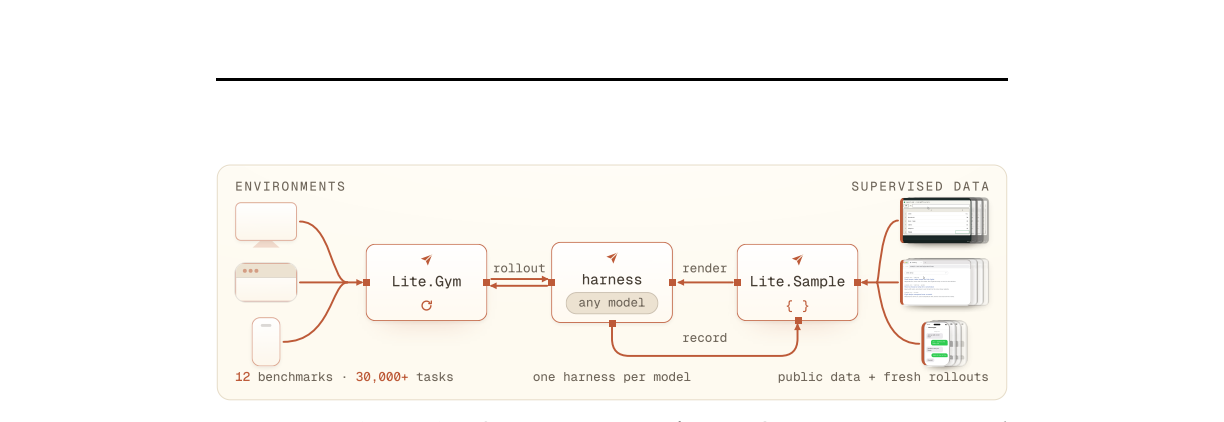
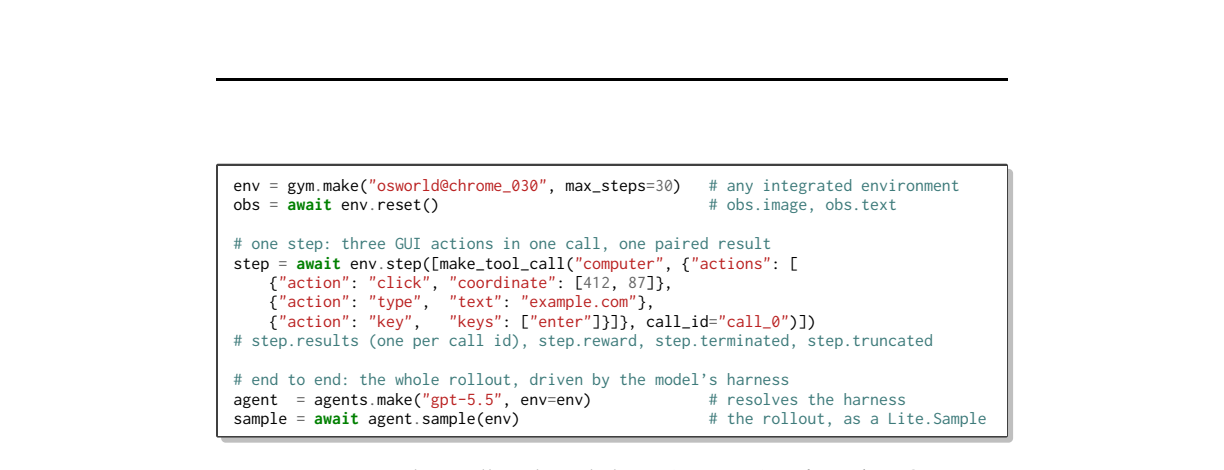
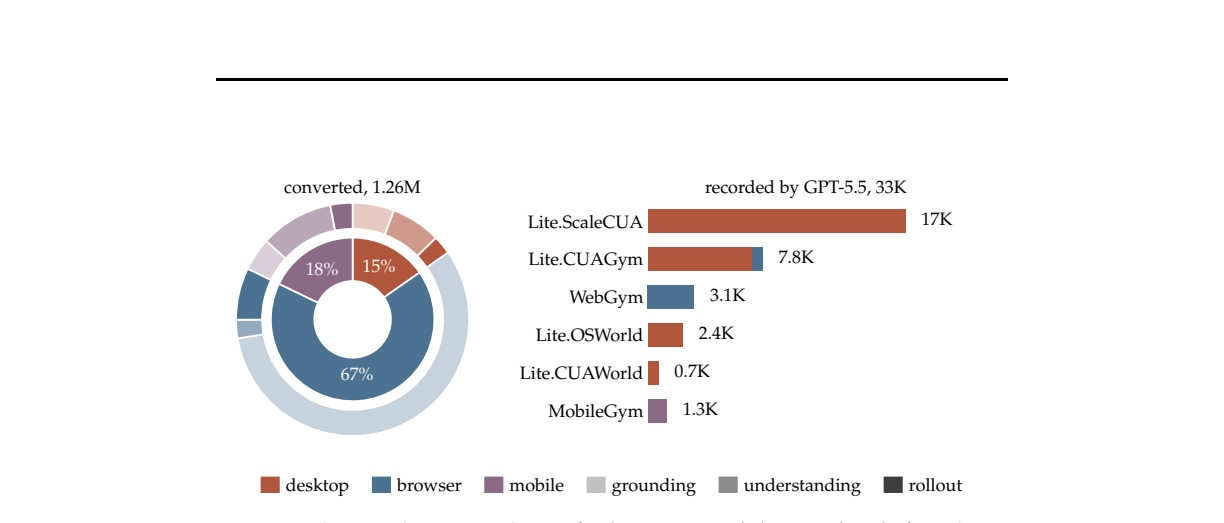
We present CUA-Lite, an open platform for developing CUAs, built around three standardized abstractions: (1) Unified environment interface, under which we integrate 12 benchmarks across desktop, browser, and mobile, plus lightweight VM-free sandboxes that replicate OSWorld's desktop at much lower cost, providing over 30,000 verifiable tasks. (2) Unified supervised data format, into which we convert the major public CUA datasets, from GUI grounding and understanding to full rollouts, and record our fresh rollouts from frontier CUAs on these verifiable environments. (3) Model harnesses shared across evaluation, RL, and SFT, one per model and implemented for 14 model families. Each harness runs its model in these computer environments, producing the rollouts that evaluation and RL consume, or renders stored supervised data into the model's own training format for SFT. We release reference scores across the integrated benchmarks, and show that RL and SFT through the same harness improve open-weight models. We release our dataset, code, and models, and the platform is open to contributions.
from the abstract
Pith says
Machine review · deepseek-v4-flash · 20 Oct 2026 · what was read was not recorded · not checked by a person
It can be wrong. Challenge this review or reply to it.
Holds up. Well-engineered platform paper that standardizes CUA development; the training results are a demo, not the main event, and the verifier limitation is real but acknowledged. This line is wrong
1 major objection · 4 minor
How often objections from reviews like this one are right: not yet measured
Not checked: figures, code, what the 47 references say.
The paper says, at §4, Appendix G
The review did not quote this passage.
A classifier read this sentence of the paper as acknowledging the concern (probability 0.88):
“We do not fully audit the training verifiers, and a model judge scores some tasks in Lite.CUAGym and Lite.CUAWorld, so SFT data and RL rewards can include rollouts that did not solve their task.”
Pith says: Objection 1 of 1 · major
The training demonstration (SFT and RL) depends critically on verifiers for data filtering and reward signals, but the accuracy of these verifiers is not quantified for the environments actually used in §4 (Lite.OSWorld synthesized tasks, Lite.ScaleCUA, WebGym, MobileGym). The paper acknowledges not fully auditing the training verifiers and that model judges score some tasks (sentence b117), but for WebGym the …
more of objection 1
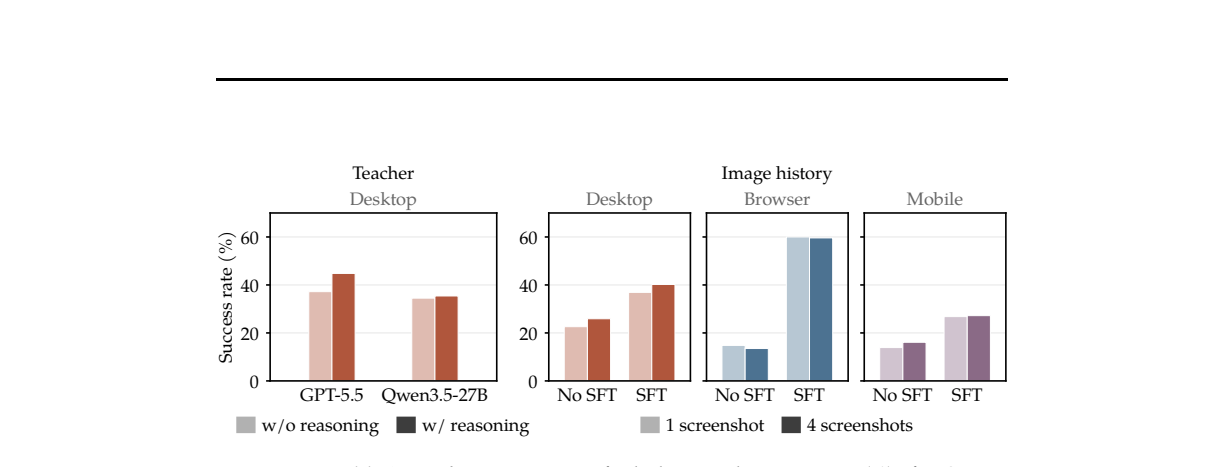
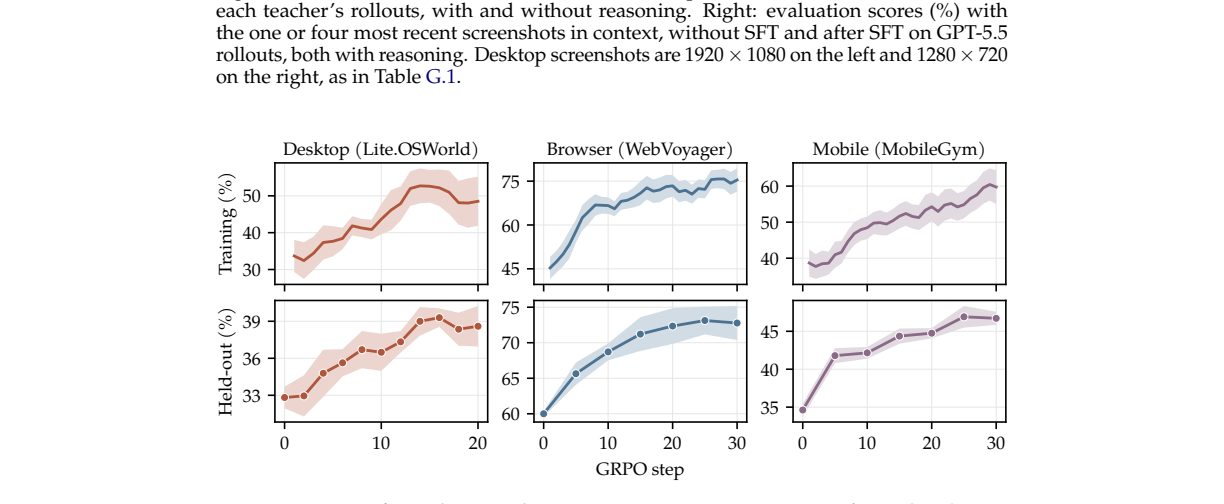
… reward explicitly uses a GPT-4.1 judge (Appendix G), and for Lite.ScaleCUA and Lite.OSWorld synthesized tasks the nature of verifiers is not detailed beyond 'reuse OSWorld evaluator functions' (Appendix D). Without a measurement of verifier precision/recall against human judgment, the reported SFT gains (up to +55.6 points on browser) and RL gains (up to +12.1 points) rest on uncertain footing. The authors should either (a) provide a small human audit of verifier accuracy for a sample of the training tasks, (b) bound the potential impact of verifier noise on the reported improvements, or (c) remove or explicitly qualify the most quantitative claims (e.g., in Table 4 and Figure 7). This concern is load-bearing for the training demonstration but does not undermine the platform contribution; it can be addressed with additional analysis or explicit caveats.
4 minor objections
The paper says, at Table 3
Pith says: minor objection 1 of 4
The column headers 'Grounding', 'Desktop', 'Browser', 'Mobile' span multiple sub-benchmarks each. Adding subtle vertical dividers or distinct shading between platform groups would help readers quickly see which benchmarks belong to which platform.
The paper says, at Figure 5 and Figure F.1
Pith says: minor objection 2 of 4
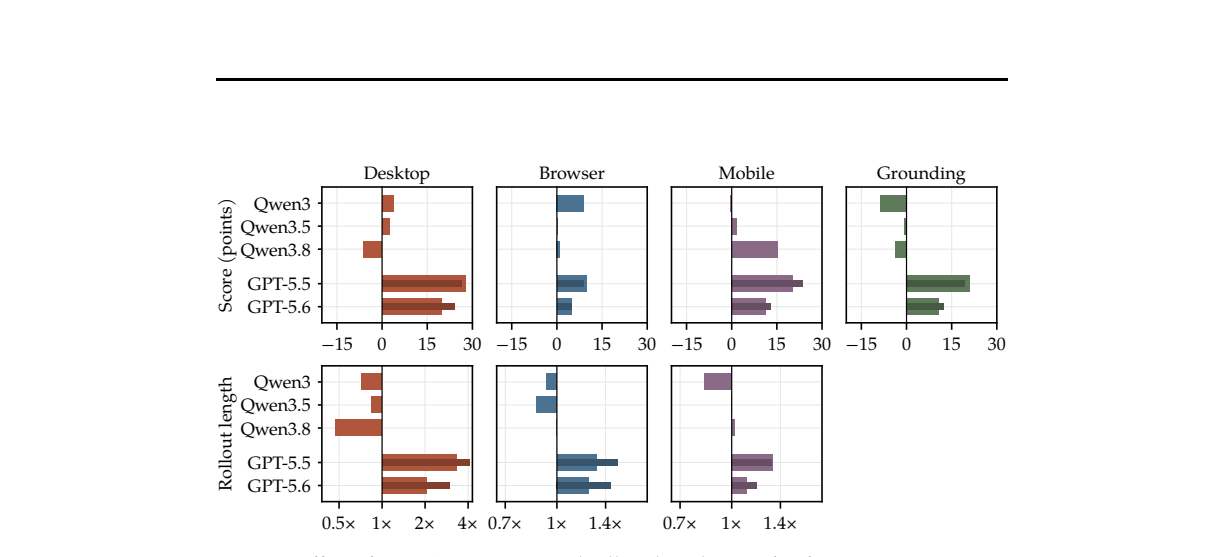
The x-axis for the rollout length ratio panels is labeled 'Rollout length' but the ticks show multipliers (0.5×, 1×, 2×, etc.). Clarify in the caption what quantity is being measured (e.g., number of steps or tokens) and what the baseline (1×) corresponds to.
show 2 more
The paper says, at §2.1.2, Table 2
Pith says: minor objection 3 of 4
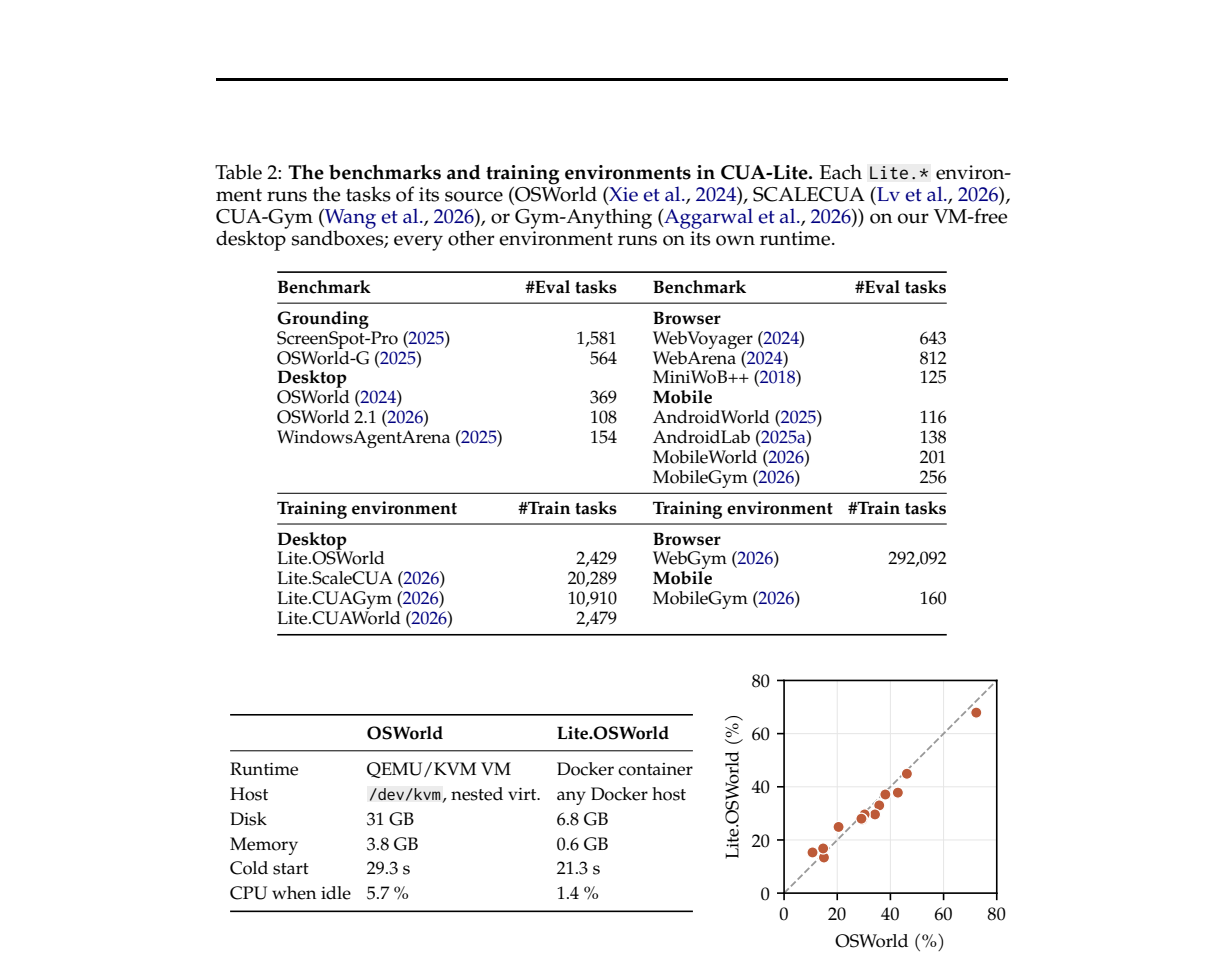
The notation 'Lite.*' is used for VM-free sandboxes, but the benchmarks table also lists bare 'OSWorld' and 'WebArena' which run on their native runtimes. A brief note in the caption or surrounding text reminding the reader that Lite.* environments are the containerized versions would avoid confusion.
The paper says, at §4.2 (paragraph 'Choosing training tasks')
Pith says: minor objection 4 of 4
The rationale for switching the desktop RL training from Lite.ScaleCUA to LibreOffice tasks (SFT saturation) is plausible but the evidence for saturation is not shown. A brief sentence referencing the held-out evaluation score after SFT on Lite.ScaleCUA would strengthen the justification.
What would settle it
Sample 100 tasks from each of the four training environments used in §4 (Lite.OSWorld synthesized, Lite.ScaleCUA, WebGym, MobileGym). For each, a human annotator determines ground-truth task success from screenshots or recordings and compares to the verifier's verdict. Report precision, recall, and F1. If recall < 0.95 or precision < 0.95 for any environment, repeat the SFT and GRPO runs from §4.1–4.2 with rollouts filtered to include only those where both verifier and human agree (and for RL, use a reward of 1 only when both agree). If the resulting held-out improvements shrink by more than half relative to the original improvements, the headline training claims are not robust to verifier noise.
from the skeptic's reading
How the review went
4 readings by deepseek-v4-flash · 20 Oct 2026
- Reader holds up
- Skeptic agrees
- Editor wrote the verdict above
- Referee minor revision: 1 major objection, 4 minor
Not run on this paper: the simulated authors' defence.
Pith did not check this review's objections against the paper.
The review in full
The review in brief, machine-written
This is a solid systems paper. The main contribution—three standardized abstractions (environment interface, data format, per-model harnesses) that let evaluation, RL, and SFT share one infrastructure—is genuinely useful. The field has been reinventing the same glue code for every model-benchmark pair, and this paper ships a credible fix. The VM-free desktop sandboxes are a practical contribution: they replicate OSWorld at a sixth of the memory with a Spearman rank correlation of 0.98, which is real engineering value. The data conversion and harness implementations are thorough (14 model families, 9 datasets, 12 benchmarks). The authors release everything and every number comes with a reproducing command—that deserves credit.
The training experiments in §4 are best understood as a demonstration that the platform works end-to-end, not as the paper's primary contribution. SFT on GPT-5.5 rollouts and then GRPO on verifiable tasks does improve Qwen3.5-4B, noticeably on browser (+55.6 points after SFT, +12.8 more after RL).
The soft spot the stress-test highlights—unquantified verifier accuracy—is real but the paper already states it as a limitation (b117) and is transparent about which environments use model judges. The problem is that for the training environments actually used in §4 (Lite.OSWorld synthesized tasks, Lite.ScaleCUA, WebGym, MobileGym), the paper provides no measurement of verifier precision/recall against human judgment. The reported gains could partly reflect the model learning verifier heuristics rather than genuine task competence. This is a common issue in the area, but it does leave the most quantitatively impressive results on uncertain footing. The platform contribution does not depend on these numbers being right; the training section is a case study, not the paper's central claim.
Minor note: the desktop and mobile evaluation in §4 is on the same applications as training, so the gains don't show cross-task transfer. The authors flag this.
Verdict: This paper is worth a serious referee. The platform is well-conceived and well-executed. The training results are suggestive but need a caveat about verifier dependence. The paper will likely become a practical tool for people building computer-use agents.
The strongest objection
The paper's training pipeline in §4 critically depends on verifiers: GPT-5.5 rollouts are kept only if the verifier passes (Table E.2), and GRPO rewards are verifier scores (§4.2). The paper explicitly states it did not fully audit the training verifiers and that a model judge scores some tasks in Lite.CUAGym and Lite.CUAWorld (b117). For the training environments actually used in §4—Lite.OSWorld synthesized tasks, Lite.ScaleCUA, WebGym, and MobileGym—the paper provides no measurement of verifier accuracy (precision or recall) against human judgment. Without such a measurement, the magnitude of the reported SFT gains (up to +55.6 points on browser, Table 4) and RL gains (up to +12.1 points on browser, §4.2) cannot be attributed entirely to genuine task competence; they could partly reflect the model learning to exploit verifier heuristics or the filtering dropping only the easiest failures. The paper acknowledges this as a limitation but does not bound its potential impact, leaving the most quantitatively impressive results on uncertain footing.
The reader's weakest_assumption identifies the training verifier reliability as the key risk, and the paper acknowledges this limitation (b117). However, the concern does not undermine the core contribution of the platform—the unified interfaces, conversions, and shared harnesses—which are well-engineered and independently valuable. The training demonstration is one illustrative result, and the consistent improvements across three platforms suggest some genuine learning even if verifier noise inflates the numbers slightly. The paper's transparency about the limitation also mitigates the concern for a platform paper. Thus the original ACCEPT verdict remains appropriate, though a future version could strengthen confidence by auditing the verifiers.
The referee's report
If adopted, CUA-Lite has the potential to substantially reduce duplication of effort in CUA research by providing a common interface across diverse environments (VM-based, containerized, browser, mobile), a unified data format that spans grounding labels to full rollouts, and shared model harnesses that make evaluation, RL, and SFT trivially reusable. The VM-free desktop sandbox (Lite.OSWorld) is a practical contribution: it runs on any Docker host, uses one-sixth of OSWorld's memory, and achieves near-identical scores (Spearman 0.98, average 2.7-point difference). The conversion of 1.26M samples from 9 datasets into a single format lowers the barrier for combining heterogeneous training data. The reference scores on 12 benchmarks and the recorded rollouts from frontier models are valuable community resources. The training demonstration, though limited in scope, shows that the platform can be used end-to-end to improve an open-weight model.
Pith's reading of the paper (a machine's summary, not the authors')
This paper introduces CUA-Lite, an open platform that standardizes the development of computer-use agents (CUAs) around three abstractions: a unified environment interface (Lite.Gym) that wraps any runtime (VM, browser, emulator) into a Gym-style loop; a unified supervised data format (Lite.Sample) that stores everything from GUI grounding labels to full rollouts; and a per-model harness shared across evaluation, reinforcement learning (RL), and supervised fine-tuning (SFT). On this standard, the authors integrate 12 existing benchmarks across desktop, browser, and mobile, contribute over 30,000 verifiable training tasks via low-cost VM-free Docker sandboxes that closely replicate OSWorld, convert nine public datasets into the common format, and record fresh rollouts from frontier API models. They demonstrate that SFT on these rollouts and subsequent RL with GRPO can significantly boost an open-weight model (Qwen3.5-4B) on all three platforms, and they release code, data, and models to encourage community contributions.
What carries the argument. Three standardized abstractions: (1) Lite.Gym, a Gym-style environment interface that provides a unified observation format (screenshot and/or text) and a per-platform GUI action space (computer tool for desktop/browser, mobile tool for mobile) plus optional extra tools; (2) Lite.Sample, a multi-turn message format that interleaves tool calls with observations in a role-tagged structure, storing any type of supervised data; (3) per-model harnesses that adapt a model to both Lite.Gym and Lite.Sample for evaluation, RL, and SFT, with shared modules across model families. Additionally, the VM-free desktop sandboxes (Lite.*) replace QEMU-based VMs with Docker containers, reducing resource usage while maintaining high fidelity.
Core claim. The paper's central claim is that a single, open standard for environment interfaces, supervised data formats, and model harnesses can unify the currently scattered resources for computer-use agents, enabling seamless integration of benchmarks, shared infrastructure across evaluation and training, and reproducible comparison. The authors demonstrate this by building CUA-Lite, which provides a Lite.Gym interface that normalizes observation and action spaces across three platforms, a Lite.Sample format that absorbs all existing public datasets and fresh rollouts, and one harness per model that drives evaluation, RL, and SFT from the same code. As evidence, they show that their VM-free sandboxes (Lite.OSWorld) replicate OSWorld at a sixth of the memory cost with near-identical evaluation scores (Spearman 0.98); that SFT on GPT-5.5 rollouts lifts Qwen3.5-4B by +22.2 points on desktop, +55.6 on browser, and +12.2 on mobile; and that additional GRPO training on verifiable tasks further improves these gains on held-out tasks.
The premise it rests on. The training verifiers used for synthesized tasks in Lite.OSWorld and converted datasets in Lite.CUAGym and Lite.CUAWorld correctly identify successful task completion, so that SFT data and RL rewards are based on valid rollouts; the authors acknowledge they did not fully audit these verifiers.
If the paper is right (Pith's inferences, not the authors')
Researchers can plug new environments and models into CUA-Lite with minimal adapter code, accelerating benchmarking and iteration.
Training pipelines (SFT and RL) automatically inherit the same reward signals and rollout mechanics as evaluation, reducing engineering overhead and improving reproducibility.
The VM-free sandboxes lower the barrier to training on desktop tasks, making large-scale reinforcement learning more accessible.
Standardized data format enables easy merging of datasets from different sources, potentially creating larger and more diverse training corpora.
Reference scores across 12 benchmarks provide a common ruler for future model comparisons, though they are intentionally not claimed as reproductions of prior results.
If the community adopts CUA-Lite's abstractions, the fragmentation in computer-use agent research could give way to a shared ecosystem where environment, data, and model contributions interoperate out of the box.
The paper's limited audit of training verifiers (acknowledged limitation) means that some SFT data and RL rewards may be noisy; a follow-up verification study could strengthen confidence in the reported improvements.
The platform's openness to contributions could lead to community-driven maintenance and expansion, similar to how OpenHands or Hugging Face ecosystems evolve, though this requires sustained engagement.
Check this review
Pith stored no record of this review's passes and took no fingerprint of it. Reviews made by code from 13 Nov 2026 on carry both.
How often reviews like this one are right
Reviews like this one: written by deepseek-v4-flash, where what was read was not recorded.
How often objections from reviews like this one are right: not yet measured
Reviews by people
This review was written by a machine. No person has reviewed this paper on Pith yet. A scientist listed on Pith can review it for a fee, and their review is published here whatever it concludes.
The paper
Abstract
Open resources for computer use agents (CUAs) – environments, datasets, and models – remain scattered: without a standard, these resources cannot be integrated and scaled; additionally, evaluation, RL, and SFT cannot share one infrastructure. We present CUA-Lite, an open platform for developing CUAs, built around three standardized abstractions: (1) Unified environment interface, under which we integrate 12 benchmarks across desktop, browser, and mobile, plus lightweight VM-free sandboxes that replicate OSWorld's desktop at much lower cost, providing over 30,000 verifiable tasks. (2) Unified supervised data format, into which we convert the major public CUA datasets, from GUI grounding and understanding to full rollouts, and record our fresh rollouts from frontier CUAs on these verifiable environments. (3) Model harnesses shared across evaluation, RL, and SFT, one per model and implemented for 14 model families. Each harness runs its model in these computer environments, producing the rollouts that evaluation and RL consume, or renders stored supervised data into the model's own training format for SFT. We release reference scores across the integrated benchmarks, and show that RL and SFT through the same harness improve open-weight models. We release our dataset, code, and models, and the platform is open to contributions.
The paper's own sentences, arranged, kept beside the review and separate from it. Each label is drawn from a closed vocabulary; the number beside it is the probability the classifier gave that label. No sentence in this record was written by a model.
abstract compiled · 2026-10-20
The authors' main claim, as the classifier picked it out 0.99
“We release reference scores across the integrated benchmarks, and show that RL and SFT through the same harness improve open-weight models.”
How the main claim is stated: asserted 1.00
What the abstract itself states, as probabilities: claims first 0.10 · states limitation 0.13 · human participants 0.05 · controlled comparison 0.15 · randomized assignment 0.01 · states quantitative result 0.93 · compares with prior results 0.45 · mentions code or data availability 0.99
The abstract, sentence by sentence
This table labels the abstract only (arXiv listing abstract v1). The number is the probability the classifier gave the label.
| Sentence | Role | The authors' own work | States the main conclusion | Strength |
|---|---|---|---|---|
| Open resources for computer use agents (CUAs) -- environments, datasets, and models -- remain scattered: without a standard, these resources cannot be integrated and scaled; additionally, evaluation, RL, and SFT cannot share one infrastructure. | gap 0.65 | 0.08 | 0.06 | asserted 1.00 |
| We present CUA-Lite, an open platform for developing CUAs, built around three standardized abstractions: (1) Unified environment interface, under which we integrate 12 benchmarks across desktop, browser, and mobile, plus lightweight VM-free sandboxes that replicate OSWorld's desktop at much lower cost, providing over 30,000 verifiable tasks. | contribution 0.90 | 0.94 | 0.14 | asserted 1.00 |
| (2) Unified supervised data format, into which we convert the major public CUA datasets, from GUI grounding and understanding to full rollouts, and record our fresh rollouts from frontier CUAs on these verifiable environments. | method 0.59 | 0.94 | 0.05 | asserted 0.99 |
| (3) Model harnesses shared across evaluation, RL, and SFT, one per model and implemented for 14 model families. | contribution 0.63 | 0.92 | 0.06 | asserted 0.98 |
| Each harness runs its model in these computer environments, producing the rollouts that evaluation and RL consume, or renders stored supervised data into the model's own training format for SFT. | method 0.99 | 0.74 | 0.07 | asserted 0.99 |
| We release reference scores across the integrated benchmarks, and show that RL and SFT through the same harness improve open-weight models. | result 0.96 | 0.95 | 0.49 | asserted 1.00 |
| We release our dataset, code, and models, and the platform is open to contributions. | contribution 0.97 | 0.90 | 0.07 | asserted 1.00 |
What kind of paper the classifier reports this is: method or tool 1.00 · evidence from observation or experiment 0.97
What was examined, and what was not
Sources read
- arXiv listing abstract v1
Not examined
- full text
- figures and tables
- references and citing sentences
- relations to other papers
Levels run
- P abstract
Not run
- S sections
- T body sentences
- C citations
- R cross-paper relations
How the labels were made
Compiled by classifier-1.13.0 via TypeSafe API, question bank abstract-p1-20260923, 2026-10-20: 1 request, 5,763 input tokens.
Every quoted sentence on this record is the authors'. Every label is from Pith's closed vocabulary, with the probability shown beside it. This record as JSON
Figures (7)
Figures are the authors', reproduced from the paper.
References (47)
- [1] Pranjal Aggarwal, Graham Neubig, and Sean Welleck. Gym-Anything : Turn any software into an agent environment. arXiv preprint arXiv:2604.06126, 2026. URL https://arxiv.org/abs/2604.06126 on PithPith's reviewarXiv
- [2] Ahmed Awadallah, Yash Lara, Raghav Magazine, Hussein Mozannar, Akshay Nambi, Yash Pandya, Aravind Rajeswaran, Corby Rosset, Alexey Taymanov, Vibhav Vineet, et al. Fara-7B : An efficient agentic model for computer use. arXiv preprint arXiv:2511.19663, 2025. URL https://arxiv.or... on PitharXiv
- [3] Hao Bai, Alexey Taymanov, Tong Zhang, Aviral Kumar, and Spencer Whitehead. WebGym : Scaling training environments for long-horizon visual web agents with realistic tasks. In Proceedings of the IEEE/CVF Conference on Computer Vision and Pattern Recognition (CVPR) , 2026 on Pith
- [4] Shuai Bai, Yuxuan Cai, Ruizhe Chen, Keqin Chen, Xionghui Chen, Zesen Cheng, Lianghao Deng, Wei Ding, Chang Gao, Chunjiang Ge, et al. Qwen3-VL technical report. arXiv preprint arXiv:2511.21631, 2025 a . URL https://arxiv.org/abs/2511.21631 on PithPith's reviewarXiv
- [5] Shuai Bai, Keqin Chen, Xuejing Liu, Jialin Wang, Wenbin Ge, Sibo Song, Kai Dang, Peng Wang, Shijie Wang, Jun Tang, et al. Qwen2.5-VL technical report. arXiv preprint arXiv:2502.13923, 2025 b . URL https://arxiv.org/abs/2502.13923 on PithPith's reviewarXiv
- [6] Rogerio Bonatti, Dan Zhao, Francesco Bonacci, Dillon Dupont, Sara Abdali, Yinheng Li, Yadong Lu, Justin Wagle, Kazuhito Koishida, Arthur Bucker, et al. Windows Agent Arena : Evaluating multi-modal OS agents at scale. In International Conference on Machine Learning (ICML), 2025 on Pith
- [7] Wentong Chen, Junbo Cui, Jinyi Hu, Yujia Qin, Junjie Fang, Yue Zhao, Chongyi Wang, Jun Liu, Guirong Chen, Yupeng Huo, et al. GUIC ourse: From general vision language model to versatile GUI agent. In Proceedings of the 63rd Annual Meeting of the Association for Computational Li... on Pithdoi:10.18653/v1/2025.acl-long.1065
- [8] Xiang Deng, Yu Gu, Boyuan Zheng, Shijie Chen, Sam Stevens, Boshi Wang, Huan Sun, and Yu Su. Mind2Web : Towards a generalist agent for the web. In Advances in Neural Information Processing Systems (NeurIPS), 2023. doi:10.52202/075280-1220 on Pithdoi:10.52202/075280-1220
- [9] Hongliang He, Wenlin Yao, Kaixin Ma, Wenhao Yu, Yong Dai, Hongming Zhang, Zhenzhong Lan, and Dong Yu. W eb V oyager: Building an end-to-end web agent with large multimodal models. In Proceedings of the 62nd Annual Meeting of the Association for Computational Linguistics (Volum... on Pithdoi:10.18653/v1/2024.acl-long.371
- [10] Jing Yu Koh, Robert Lo, Lawrence Jang, Vikram Duvvur, Ming Lim, Po-Yu Huang, Graham Neubig, Shuyan Zhou, Russ Salakhutdinov, and Daniel Fried. V isual W eb A rena: Evaluating multimodal agents on realistic visual web tasks. In Proceedings of the 62nd Annual Meeting of the Asso... on Pithdoi:10.18653/v1/2024.acl-long.50
- [11] Quyu Kong, Xu Zhang, Zhenyu Yang, Nolan Gao, Chen Liu, Panrong Tong, Chenglin Cai, Hanzhang Zhou, Jianan Zhang, Liangyu Chen, et al. M obile W orld: Benchmarking autonomous mobile agents in agent-user interactive and MCP -augmented environments. In Proceedings of the 64th Annu... on Pithdoi:10.18653/v1/2026.acl-long.278
- [12] Hanyu Lai, Xiao Liu, Yanxiao Zhao, Han Xu, Hanchen Zhang, Bohao Jing, Yanyu Ren, Shuntian Yao, Yuxiao Dong, and Jie Tang. ComputerRL : Scaling end-to-end online reinforcement learning for computer use agents. In International Conference on Learning Representations (ICLR), 2026 on Pith
- [13] Thibault Le Sellier de Chezelles , Maxime Gasse, Alexandre Lacoste, Massimo Caccia, Alexandre Drouin, L \'e o Boisvert, Megh Thakkar, Tom Marty, Rim Assouel, Sahar Omidi Shayegan , et al. The BrowserGym ecosystem for web agent research. Transactions on Machine Learning Researc... on Pith
- [14] Kaixin Li, Ziyang Meng, Hongzhan Lin, Ziyang Luo, Yuchen Tian, Jing Ma, Zhiyong Huang, and Tat-Seng Chua. ScreenSpot-Pro : GUI grounding for professional high-resolution computer use. In Proceedings of the 33rd ACM International Conference on Multimedia (MM) , 2025. doi:10.114... on Pithdoi:10.1145/3746027.3755688
- [15] Evan Zheran Liu, Kelvin Guu, Panupong Pasupat, Tianlin Shi, and Percy Liang. Reinforcement learning on web interfaces using workflow-guided exploration. In International Conference on Learning Representations (ICLR), 2018 on Pith
- [16] Zhaoyang Liu, JingJing Xie, Zichen Ding, Zehao Li, Bowen Yang, Zhenyu Wu, Xuehui Wang, Qiushi Sun, Shi Liu, Weiyun Wang, et al. Scale CUA : Scaling open-source computer use agents with cross-platform data. In International Conference on Learning Representations (ICLR), 2026 a on Pith
- [17] Zichen Liu, Anya Sims, Keyu Duan, Changyu Chen, Simon Yu, Xiangxin Zhou, Haotian Xu, Shaopan Xiong, Bo Liu, Chenmien Tan, et al. GEM : A gym for generalist LLMs . In International Conference on Learning Representations (ICLR), 2026 b on Pith
- [18] Quanfeng Lu, Wenqi Shao, Zitao Liu, Lingxiao Du, Fanqing Meng, Boxuan Li, Botong Chen, Siyuan Huang, Kaipeng Zhang, and Ping Luo. GUIOdyssey : A comprehensive dataset for cross-app GUI navigation on mobile devices. In Proceedings of the IEEE/CVF International Conference on Com... on Pithdoi:10.1109/iccv51701.2025.02080
- [19] Bowen Lv, Xiao Liu, Yanyu Ren, Hanyu Lai, Bohao Jing, Hanchen Zhang, Yanxiao Zhao, Shuntian Yao, Jie Tang, and Yuxiao Dong. SCALECUA : Scaling computer use agents with verifiable task synthesis and efficient online RL . arXiv preprint arXiv:2607.11185, 2026. URL https://arxiv.... on PithPith's reviewarXiv
- [20] Chang Ma, Junlei Zhang, Zhihao Zhu, Cheng Yang, Yujiu Yang, Yaohui Jin, Zhenzhong Lan, Lingpeng Kong, and Junxian He. AgentBoard : An analytical evaluation board of multi-turn LLM agents. In Advances in Neural Information Processing Systems (NeurIPS), Datasets and Benchmarks T... on Pithdoi:10.52202/079017-2365
show 27 more
- [21] Meta PyTorch and Hugging Face . OpenEnv : Agentic execution environments, 2025. URL https://github.com/huggingface/OpenEnv. Release v0.5.0, accessed 2026-09-24 on Pith
- [22] Jian Mu, Chaoyun Zhang, Chiming Ni, Lu Wang, Bo Qiao, Kartik Mathur, Qianhui Wu, Yuhang Xie, Xiaojun Ma, Mengyu Zhou, et al. GUI-360 ^ : A comprehensive dataset and benchmark for computer-using agents. arXiv preprint arXiv:2511.04307, 2025. URL https://arxiv.org/abs/2511.04307 on PitharXiv
- [23] Yujia Qin, Yining Ye, Junjie Fang, Haoming Wang, Shihao Liang, Shizuo Tian, Junda Zhang, Jiahao Li, Yunxin Li, Shijue Huang, et al. UI-TARS : Pioneering automated GUI interaction with native agents. arXiv preprint arXiv:2501.12326, 2025. URL https://arxiv.org/abs/2501.12326 on PithPith's reviewarXiv
- [24] Christopher Rawles, Sarah Clinckemaillie, Yifan Chang, Jonathan Waltz, Gabrielle Lau, Marybeth Fair, Alice Li, William E. Bishop, Wei Li, Folawiyo Campbell-Ajala, et al. AndroidWorld : A dynamic benchmarking environment for autonomous agents. In International Conference on Lea... on Pith
- [25] Zhihong Shao, Peiyi Wang, Qihao Zhu, Runxin Xu, Junxiao Song, Xiao Bi, Haowei Zhang, Mingchuan Zhang, Y. K. Li, Y. Wu, et al. DeepSeekMath : Pushing the limits of mathematical reasoning in open language models. arXiv preprint arXiv:2402.03300, 2024. URL https://arxiv.org/abs/2... on PithPith's reviewarXiv
- [26] Fei Tang, Zhiqiong Lu, Boxuan Zhang, Weiming Lu, Jun Xiao, Yueting Zhuang, and Yongliang Shen. ClawGUI : A unified framework for training, evaluating, and deploying GUI agents. arXiv preprint arXiv:2604.11784, 2026. URL https://arxiv.org/abs/2604.11784 on PithPith's reviewarXiv
- [27] Mark Towers, Ariel Kwiatkowski, John Balis, Gianluca De Cola, Tristan Deleu, Manuel Goul \ a o, Andreas Kallinteris, Markus Krimmel, Arjun KG, Rodrigo Perez-Vicente, et al. Gymnasium: A standard interface for reinforcement learning environments. In Advances in Neural Informati... on Pithdoi:10.52202/085713-4916
- [28] Daniel Toyama, Philippe Hamel, Anita Gergely, Gheorghe Comanici, Amelia Glaese, Zafarali Ahmed, Tyler Jackson, Shibl Mourad, and Doina Precup. AndroidEnv : A reinforcement learning platform for Android . arXiv preprint arXiv:2105.13231, 2021. URL https://arxiv.org/abs/2105.13231 on PithPith's reviewarXiv
- [29] Venus Team , Zhuohan Cai, Haoxing Chen, Jiaxuan Chen, Weizhi Chen, Changlong Gao, Zhangxuan Gu, Yuan Guo, Yusong Hu, Jianrong Jiang, et al. UI-Venus-2 technical report. arXiv preprint arXiv:2609.00028, 2026. URL https://arxiv.org/abs/2609.00028 on PithPith's reviewarXiv
- [30] Bowen Wang, Dunjie Lu, Junli Wang, Tianyi Bai, Shixuan Liu, Zhipeng Zhang, Haiquan Wang, Hao Hu, Tianbao Xie, Shuai Bai, et al. CUA-Gym : Scaling verifiable training environments and tasks for computer-use agents. arXiv preprint arXiv:2605.25624, 2026. URL https://arxiv.org/ab... on PithPith's reviewarXiv
- [31] Shuai Wang, Weiwen Liu, Jingxuan Chen, Yuqi Zhou, Weinan Gan, Xingshan Zeng, Yuhan Che, Shuai Yu, Xinlong Hao, Kun Shao, et al. GUI agents with foundation models: A comprehensive survey. arXiv preprint arXiv:2411.04890, 2025 a . URL https://arxiv.org/abs/2411.04890 on PithPith's reviewarXiv
- [32] Xingyao Wang, Boxuan Li, Yufan Song, Frank F. Xu, Xiangru Tang, Mingchen Zhuge, Jiayi Pan, Yueqi Song, Bowen Li, Jaskirat Singh, et al. OpenHands : An open platform for AI software developers as generalist agents. In International Conference on Learning Representations (ICLR), 2025 b on Pith
- [33] Xinyuan Wang, Bowen Wang, Dunjie Lu, Junlin Yang, Tianbao Xie, Junli Wang, Jiaqi Deng, Xiaole Guo, Yiheng Xu, Chen Wu, et al. Open CUA : Open foundations for computer-use agents. In Advances in Neural Information Processing Systems (NeurIPS), 2025 c . doi:10.52202/085713-4669 on Pithdoi:10.52202/085713-4669
- [34] WebHarbor Team and Contributors . WebHarbor : Docking real websites for evolving GUI agent environments, 2026. URL https://aiming-lab.github.io/webharbor.github.io. Project website on Pith
- [35] Dingbang Wu, Rui Hao, Haiyang Wang, Shuzhe Wu, Han Xiao, Zhenghong Li, Bojiang Zhou, Zheng Ju, Zichen Liu, Lue Fan, et al. MobileGym : A verifiable and highly parallel simulation platform for mobile GUI agent research. arXiv preprint arXiv:2605.26114, 2026. URL https://arxiv.o... on PithPith's reviewarXiv
- [36] Zhiheng Xi, Jixuan Huang, Chenyang Liao, Baodai Huang, Jiaqi Liu, Honglin Guo, Yajie Yang, Rui Zheng, Junjie Ye, Jiazheng Zhang, et al. AgentGym-RL : An open-source framework to train LLM agents for long-horizon decision making via multi-turn RL . In International Conference o... on Pith
- [37] Han Xiao, Guozhi Wang, Yuxiang Chai, Zimu Lu, Weifeng Lin, Hao He, Lue Fan, Liuyang Bian, Rui Hu, Liang Liu, et al. UI-Genie : A self-improving approach for iteratively boosting MLLM -based mobile GUI agents. In Advances in Neural Information Processing Systems (NeurIPS), 2025... on Pithdoi:10.52202/085713-5028
- [38] Tianbao Xie, Danyang Zhang, Jixuan Chen, Xiaochuan Li, Siheng Zhao, Ruisheng Cao, Toh Jing Hua, Zhoujun Cheng, Dongchan Shin, Fangyu Lei, et al. OSWorld : Benchmarking multimodal agents for open-ended tasks in real computer environments. In Advances in Neural Information Proce... on Pithdoi:10.52202/079017-1650
- [39] Tianbao Xie, Jiaqi Deng, Xiaochuan Li, Junlin Yang, Haoyuan Wu, Jixuan Chen, Wenjing Hu, Xinyuan Wang, Yuhui Xu, Zekun Wang, et al. Scaling computer-use grounding via user interface decomposition and synthesis. In Advances in Neural Information Processing Systems (NeurIPS), 20... on Pithdoi:10.52202/085713-0817
- [40] Yifan Xu, Xiao Liu, Xueqiao Sun, Siyi Cheng, Hao Yu, Hanyu Lai, Shudan Zhang, Dan Zhang, Jie Tang, and Yuxiao Dong. A ndroid L ab: Training and systematic benchmarking of Android autonomous agents. In Proceedings of the 63rd Annual Meeting of the Association for Computational ... on Pithdoi:10.18653/v1/2025.acl-long.107
- [41] Yiheng Xu, Zekun Wang, Junli Wang, Dunjie Lu, Tianbao Xie, Amrita Saha, Doyen Sahoo, Tao Yu, and Caiming Xiong. Aguvis: Unified pure vision agents for autonomous GUI interaction. In International Conference on Machine Learning (ICML), 2025 b on Pith
- [42] Taofeng Xue, Chong Peng, Mianqiu Huang, Linsen Guo, Tiancheng Han, Haozhe Wang, Jianing Wang, Xiaocheng Zhang, Xin Yang, Dengchang Zhao, et al. EvoCUA : Evolving computer use agents via learning from scalable synthetic experience. arXiv preprint arXiv:2601.15876, 2026. URL htt... on PitharXiv
- [43] Mengqi Yuan, Zilong Zhou, Xinzhuang Xiong, Weiming Wu, Jiayang Sun, Jiamin Song, Kaiqian Cui, Bowen Wang, Haoyuan Wu, Yitong Li, et al. OSWorld 2.0 : Benchmarking computer use agents on long-horizon real-world tasks. arXiv preprint arXiv:2606.29537, 2026. URL https://arxiv.org... on PithPith's reviewarXiv
- [44] Zhong Zhang, Yaxi Lu, Yikun Fu, Yupeng Huo, Shenzhi Yang, Yesai Wu, Han Si, Xin Cong, Haotian Chen, Yankai Lin, et al. A gent CPM - GUI : Building mobile-use agents with reinforcement fine-tuning. In Proceedings of the 2025 Conference on Empirical Methods in Natural Language P... on Pithdoi:10.18653/v1/2025.emnlp-demos.12
- [45] Longtao Zheng, Zhiyuan Huang, Zhenghai Xue, Xinrun Wang, Bo An, and Shuicheng Yan. AgentStudio : A toolkit for building general virtual agents. In International Conference on Learning Representations (ICLR), 2025 on Pith
- [46] Hanzhang Zhou, Xu Zhang, Panrong Tong, Jianan Zhang, Liangyu Chen, Quyu Kong, Chenglin Cai, Chen Liu, Yue Wang, Jingren Zhou, et al. MAI-UI technical report: Real-world centric foundation GUI agents. arXiv preprint arXiv:2512.22047, 2025. URL https://arxiv.org/abs/2512.22047 on PitharXiv
- [47] Shuyan Zhou, Frank F. Xu, Hao Zhu, Xuhui Zhou, Robert Lo, Abishek Sridhar, Xianyi Cheng, Tianyue Ou, Yonatan Bisk, Daniel Fried, et al. WebArena : A realistic web environment for building autonomous agents. In International Conference on Learning Representations (ICLR), 2024 on Pith
Challenges and discussion
Disagree with the review, or know something it missed? Leave a comment, or challenge this review formally: a challenge becomes a permanent entry in this paper's record, and its decision is published here.
Come back by email
A short list of the week's newly reviewed papers. Nothing is sent until you confirm from your inbox, and every email has a link that stops it. No account.
No comments yet.
Sign in to comment