Quantum Physics · arXiv:2610.41413 v1 · submitted 30 Oct 2026 · 34 references
Real-time BP decoding of a high-rate QEC code
The paper says
“We present a real-time FPGA decoder for a high-rate [[512,174,8]] 3D product qLDPC code. We construct a circuit-level detector-error model for a compact syndrome-extraction schedule and propose a small parallel ensemble of row-wise serial min-sum decoders with cumulative memory.”
more of the abstract
The decoder matches BP+OSD-CS10 accuracy with one core and Relay-BP accuracy with three cores. The FPGA implementation meets the latency budget of neutral-atom and trapped-ion systems. An ASIC implementation would improve the latency, enabling real time decoding even for superconducting systems. At a physical error rate of p = 10−3, three FPGA devices decode 174 logical qubits with a logical error rate of 5 × 10⁻⁷ and effective distance 6. For p = 10−4, and assuming the number of BP iterations is capped to 30, the decoder's average latency is 5.1 \textmu s and its worst-case latency is 97.9 \textmu s.
from the abstract
Pith says
Machine review · deepseek-v4-flash · 2 Nov 2026 · what was read was not recorded · not checked by a person
It can be wrong. Challenge this review or reply to it.
Holds up, with conditions. Real FPGA work with honest component-level reporting, but the abstract welds an eight-round simulated accuracy onto a one-round measured core, and that joint claim was never validated. This line is wrong
3 major objections · 4 minor
How often objections from reviews like this one are right: not yet measured
Not checked: figures, code, what the 34 references say.
The paper says, at I, IV.C, Abstract (b5, b38, b138)
The review did not quote this passage.
Pith says: Objection 1 of 3 · major
There is a load-bearing mismatch between the accuracy pipeline and the hardware pipeline. Section I and sentence b38 attach d_eff=6 and the 5e-7 logical error rate to eight-round floating-point simulation with a noiseless final Z-basis measurement, while Section IV.C and the one-round quantized curve in Fig. 2 correspond to a single-round DEM with 576 check rows and 20,080 error columns, without idling errors and with a noisy final Z-basis measurement.
more of objection 1
The abstract sentence b5, claiming that three FPGA devices decode 174 logical qubits with a logical error rate of 5e-7 and effective distance 6, therefore asserts a hardware capability that has not been directly measured. The reported BRAM occupancy of more than 50% for one core shows that the roughly eightfold larger joint DEM needed for the eight-round experiment cannot even be stored on the current cores, and eight independent one-round decodes would not reproduce the eight-round result because cross-round error correlations and the final noiseless round are represented only in the joint DEM. The authors do disclose the one-round FPGA choice in Section I, but the abstract and conclusions do not qualify the claim accordingly. This needs to be fixed by either implementing and validating the multi-round DEM on hardware or rewriting the central claims to separate simulated accuracy from measured one-round hardware latency and resource figures.
The paper says, at IV.B, Fig. 5
The review did not quote this passage.
Pith says: Objection 2 of 3 · major
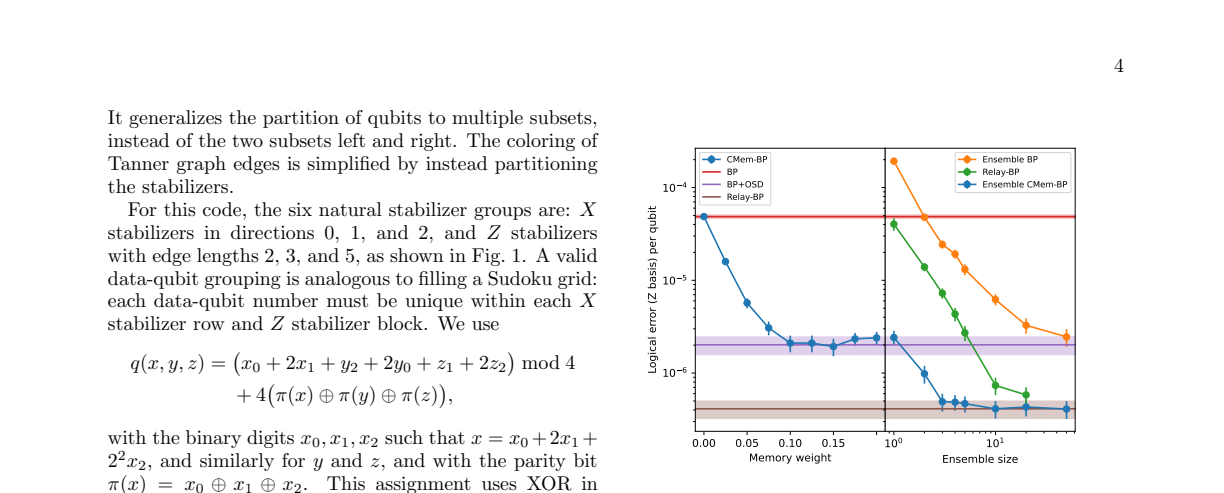
The reported accuracy depends on hyperparameters selected on the same simulation data: the memory weight gamma=0.125, the min-sum normalization constant 0.625, the 5% prior-erasure probability, the ensemble size of three, and the iteration cap T=30. The left panel of Fig. 5 shows that the logical error rate varies by orders of magnitude with gamma, and the chosen value sits near the optimum of the in-sample curve.
more of objection 2
No held-out validation, Monte Carlo error bars, or sensitivity analysis is provided. Because the claimed equivalence to BP+OSD-CS10 and Relay-BP, and the extracted d_eff=6, rest on these choices, the paper should report statistical uncertainties and test the chosen parameters at additional physical error rates and round counts, or clearly state that the hyperparameters were tuned on the reported curves.
The paper says, at IV.A, Fig. 4
The review did not quote this passage.
Pith says: Objection 3 of 3 · major
The compact multi-round schedule is load-bearing because it generates the DEM from which d_eff=6 is extracted, but its validity is argued structurally rather than verified at the level of detector-error-model diagnostics. The shifted-cycle repetition and the use of a fresh ancilla set every second cycle are described only in prose and in the Fig. 4 sketch, and no fault-enumeration or hook-error check is reported for the final schedule.
more of objection 3
Since the code has nominal distance 8 while the paper claims only d_eff=6, a single unexpected low-weight hook-error logical fault would change the extrapolation. A concrete verification step, such as Stim-based short-path logical-fault enumeration over the generated DEM, or a comparison against a known distance-preserving schedule, would make the accuracy claim reproducible and is preferable to relying on the construction argument alone.
4 minor objections
The paper says, at I and Fig. 2
Pith says: minor objection 1 of 4
The text should state consistently whether the eight-round curve uses a noiseless final Z-basis measurement and whether the one-round FPGA setup uses a noisy final measurement; the difference is mentioned but is easy to miss and affects how the 5e-7 figure should be quoted.
The paper says, at II, Fig. 3
Pith says: minor objection 2 of 4
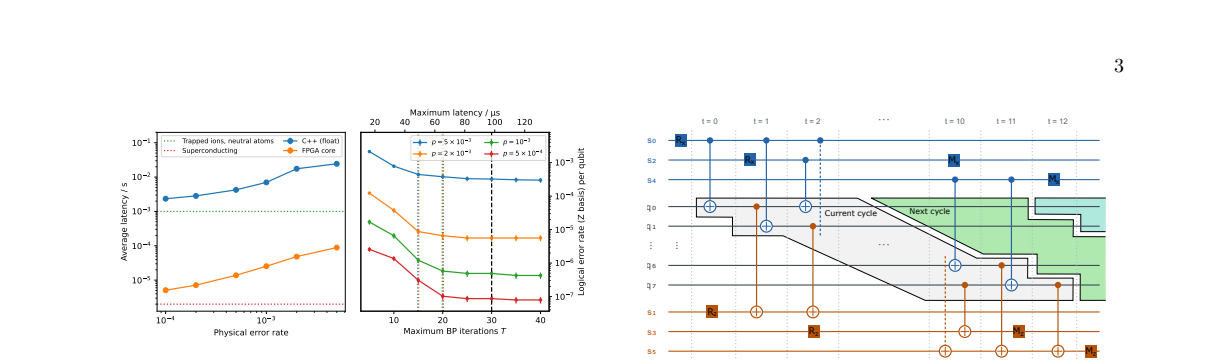
The right panel of Fig. 3 labels the upper X-axis 'Maximum latency / s' but plots values such as 20, 40, ..., 120 without a unit; if these are microseconds, the axis should say so. The left panel should also identify which curves correspond to the C++ decoder and which to the FPGA core, since the caption text is ambiguous.
show 2 more
The paper says, at IV.B, Eq. (1)
Pith says: minor objection 3 of 4
Equation (1) should state the initial condition and the convention for M_j(0), since the recursive definition of Lambda_j(k) depends on the starting values at k=0 and k=1.
The paper says, at Code and Data Availability
Pith says: minor objection 4 of 4
The paper relies on Stim-generated circuits and tuned hyperparameters, but the code and data are only available 'upon reasonable request'. Posting the DEM-generation script, the circuit, and the Monte Carlo data would substantially strengthen reproducibility of the central accuracy claim.
What would settle it
Release the decoder and run the implemented fixed-point (5/11/6-bit) CMem-BP ensemble, with the 30-iteration cap and 5% prior-erasure, on the exact eight-round DEM (with idling errors and noisy final measurement) used for the 5x10^-7/deff=6 claim; then time that eight-round DEM on the FPGA core. Pass criteria: pL at p=10^-3 stays within about 2x of the floating-point eight-round value with the p^3 slope of deff=6 intact, and the measured per-iteration latency scales with the eight-round row count, with the 30-iteration worst case reported explicitly. If the fixed-point eight-round pL is instead dominated by one-round effects, or the eight-round worst-case latency exceeds about 150 us, the abstract's 'three FPGA devices ... 5x10^-7' must be restated as a simulation result whose hardware-validated latency applies only to the one-round DEM.
from the skeptic's reading
How the review went
4 readings by deepseek-v4-flash · 2 Nov 2026
- Reader holds up, with conditions
- Skeptic partly agrees
- Editor wrote the verdict above
- Referee major revision: 3 major objections, 4 minor
Not run on this paper: the simulated authors' defence.
Pith did not check this review's objections against the paper.
The review in full
The review in brief, machine-written
Short version: this is real engineering, the decoder idea is sensible, and the component reporting is honest. The problem is the headline claim, which fuses two pipelines that are never jointly measured.
What's new and good: a full circuit-level detector-error model for a compact syndrome-extraction schedule of the [[512,174,8]] 3D product code; a CMem-BP variant whose Eq. 1 genuinely differs from standard Mem-BP; and a synthesized, timing-measured FPGA core on a named device with a 5.7 ns clock, 3.264 us per iteration, on-chip timer, full resource counts, and the >50% BRAM occupancy reported straight (b139). The accuracy is anchored in an ordinary Stim simulation, and one core matching BP+OSD-CS10 while three match Relay-BP is a reasonable, non-obvious result.
The soft spot is central and not manufactured. The abstract says three FPGAs decode 174 qubits at 5e-7 with effective distance 6 (b5). That figure comes from an eight-round floating-point simulation ending in a noiseless Z measurement (b38, Section I). The FPGA was exercised only on the one-round DEM without idling errors, ending in a noisy Z measurement. The authors state this choice but do not flag its consequence. The 3.264 us/iteration is 576 check rows at 5.7 ns: it is the one-round DEM. The 5.1 us average and 97.9 us worst case are one-round core figures. An eight-round DEM has roughly eightfold the rows and columns, would not fit in the already over-50%-occupied BRAM, and would change per-iteration time. Eight one-round decodes do not reproduce the eight-round memory experiment, because cross-round correlations and the final measurement live only in the joint DEM. The practical claim may survive a multi-round implementation, but nothing here measures it.
Lesser issues: gamma, normalization, erasure probability, ensemble size, and the iteration cap are tuned on the same curves reported, with no error bars or held-out protocol; code and data are only available 'upon reasonable request'; and the ensemble-selection rule has no stated implementation site, with the measured latencies excluding both that selection and the separately acknowledged 34 us interface.
This is for decoder-hardware people and qLDPC experimentalists, and it deserves a serious referee. The required fix is to re-scope the claims — separate simulated accuracy from measured hardware latency, or actually run the multi-round DEM on the hardware — and to release code and data so the tuning can be checked.
The strongest objection
The central claim fuses two pipelines that are never jointly validated. Pipeline A (accuracy): the 5x10^-7 logical error rate and deff=6 come from an eight-round, floating-point simulation with a noiseless final Z-basis measurement (§I, b38). Pipeline B (hardware): the FPGA core was exercised only on 'the simpler one-round setup without idling errors, ending in a noisy Z-basis measurement' (§I); the fixed-point comparison in Fig. 2, cited by b116, exists only at one round, and the measured 3.264 us/iteration, 5.1 us average, and 97.9 us worst case (b6, b138) are all one-round figures. The implemented DEM has 576 check rows and 20,080 error columns (§IV.C); the per-iteration arithmetic (576 rows at 5.7 ns = 3.28 us) confirms the core loops only over the one-round DEM, and BRAM occupancy already exceeds 50% per core (b139), so a DEM with roughly eightfold detectors for the eight-round experiment cannot even be stored. Eight independent one-round decodes do not reproduce the eight-round memory experiment, because cross-round error correlations and the final measurement are represented only in the joint eight-round DEM. Consequently the abstract's headline statement (b5), 'three FPGA devices decode 174 logical qubits with a logical error rate of 5x10^-7 and effective distance 6,' asserts a hardware capability that no measured quantity supports: b38 explicitly attaches deff=6 to the eight-round per-round curves. The authors do state the one-round FPGA choice, but they never flag this consequence, and the listed limitations (b65) do not include it. The ensemble-selection rule (smallest syndrome Hamming distance, then lowest a-priori probability) also has no stated implementation site, and the measured latencies exclude both that selection and the separately acknowledged 34 us interface.
I read the paper as making a two-part claim: (i) a small ensemble of row-wise serial min-sum decoders with cumulative memory reaches BP+OSD-CS10/Relay-BP-level accuracy on the [[512,174,8]] code under circuit-level noise, and (ii) that decoder runs in real time on FPGAs. Part (i) is a floating-point simulation result over eight rounds. Part (ii) is a measured hardware result, but the hardware was exercised on a much smaller one-round DEM, and its demonstrated accuracy (Fig. 2, one-round quantized) is not the accuracy quoted in the abstract. The decisive textual evidence is in the paper's own numbers: 576 implemented check rows, 20,080 columns, and 5.7 ns per row give 3.28 us per iteration, matching the reported 3.264 us, so the core provably processes only the one-round DEM; an eight-round DEM would have roughly eightfold rows, eightfold per-iteration latency, and a worst-case near 780 us rather than 97.9 us, even if BRAM allowed it (b139 says it does not). The eight-round accuracy claim, deff=6 included, is explicitly attributed to the eight-round curves (b38), so b5's transfer of that number to 'three FPGA devices' is unsupported by any measurement described. I do not regard the reader's weakest_assumption (circuit-level DEM fidelity to real hardware) as the sharpest issue: the Stim DEM already encodes the schedule's hook-error and idling structure, and the deff=6 slope was measured through it, so the residual there is generic depolarizing-model realism. The round-count conflation, by contrast, is visible from the paper's own stated values and requires no external assumption. I credit the paper where it is strong: the on-chip latency measurement is concrete, the latency arithmetic is internally consistent, the resource numbers are specific, the noise model is standard, and the authors openly acknowledge several limitations (b65, b139, b140). I also note the paper does state the one-round FPGA choice in §I; what it fails to state is that the abstract's headline accuracy number was therefore never measured on the hardware, so this is an unacknowledged consequence rather than a missing sentence. I do not move the verdict because nothing here demonstrates that the claim is false; a single joint validation on the eight-round DEM would close the gap, and even at roughly eightfold row count the average-case latency would likely remain within the neutral-atom/trapped-ion 1 ms budget, so the qualitative real-time claim plausibly survives. The verdict stays CONDITIONAL, with the missing joint eight-round fixed-point validation made explicit as a condition.
The referee's report
If the claims hold, the contribution is significant: it offers a high-rate qLDPC code decoded without OSD or relay post-processing, with 174 logical qubits at a 33.98% rate, and gives concrete FPGA resource counts and on-chip latency measurements. The graph-coloured BRAM banking, single-CNU row-serial schedule, and measured clock period are concrete engineering contributions, and the Stim-based construction provides a falsifiable circuit-level model. The paper also gives credit to the right baselines by comparing against BP+OSD-CS10 and Relay-BP. However, the significance is currently tempered because the headline hardware claim in the abstract fuses a simulated eight-round accuracy result with a hardware implementation that was only validated on a one-round detector-error model.
Pith's reading of the paper (a machine's summary, not the authors')
The paper sets out to show that a high-rate quantum LDPC code — one that packs 174 logical qubits into 512 physical qubits at a 33.98% rate — can be decoded in real time, not just with slow post-processing. It builds a circuit-level noise model for a compact syndrome-extraction schedule and decodes it with a small ensemble of row-wise serial min-sum belief-propagation decoders whose biases keep a cumulative memory of previous iterations. One decoder core matches BP+OSD-CS10 accuracy; three cores match Relay-BP. Measured on an FPGA, each iteration takes $3.264\,\mu\mathrm{s}$, giving a bounded worst case of $97.9\,\mu\mathrm{s}$ and an average of $5.1\,\mu\mathrm{s}$ at $p=10^{-4}$, well inside the roughly 1 ms real-time budget of neutral-atom and trapped-ion control systems. If the claim holds, high-rate codes become practical for hardware decoders without the extra stages that currently dominate latency.
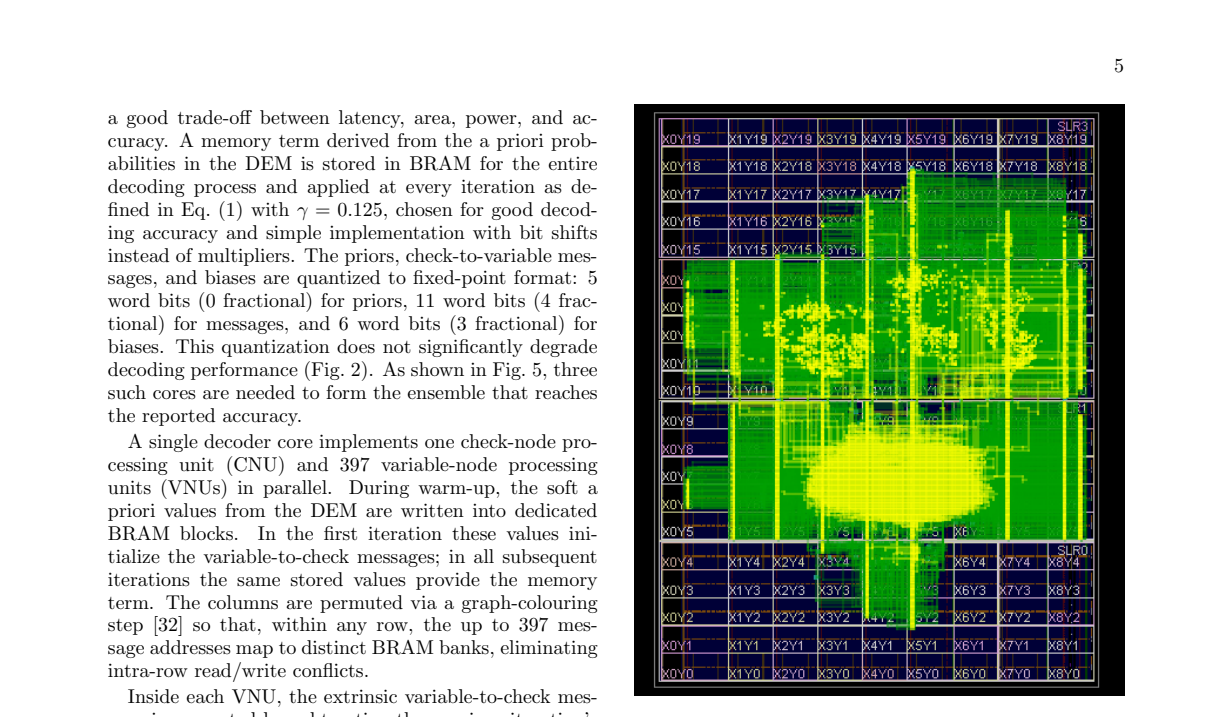
What carries the argument. Two objects carry the argument. The decoder-side mechanism is cumulative-memory belief propagation (CMem-BP), a modified BP in which the bias of each error node is updated as $\Lambda_j(k)=\Lambda_j(k-1)+\gamma(M_j(k-1)-\Lambda_j(0))$ with memory weight $\gamma=0.125$, so the decoder accumulates its own previous marginals instead of re-anchoring to the initial prior; run in a row-wise serial min-sum schedule, one core reaches BP+OSD-CS10 accuracy and three cores, diversified by random check-node order and a 5% erasure of priors, reach Relay-BP accuracy. The circuit-side mechanism is the compact syndrome-extraction schedule: stabilizers and data qubits are partitioned into groups with a Sudoku-style labelling $q(x,y,z)$ such that stabilizer group $s$ measures data group $q$ at time $t=s+q$, giving a collision-free, commuting, X/Z-interleaved schedule with six time steps per repeated round. On the FPGA, one check-node unit and 397 variable-node units are mapped with a graph-colouring column permutation that puts message addresses in distinct BRAM banks and a row ordering that separates any two check nodes sharing a variable by at least $n_p$ rows, eliminating read-after-write hazards and holding per-iteration latency to $3.264\,\mu\mathrm{s}$.
Core claim. The paper claims that real-time decoding under circuit-level noise is not reserved for low-rate codes. For the [[512,174,8]] 3D product qLDPC code, a small ensemble of row-wise serial min-sum belief-propagation decoders with cumulative memory matches the accuracy of much heavier decoders: one core reproduces BP+OSD-CS10 accuracy and three cores reproduce Relay-BP accuracy, without ordered-statistics decoding, integer programming, or relay stages. The authors report a logical error rate per logical qubit of $5\times10^{-7}$ at a physical error rate of $p=10^{-3}$, with effective distance 6, and an FPGA per-iteration latency of $3.264\,\mu\mathrm{s}$, so with the 30-iteration cap the worst case is $97.9\,\mu\mathrm{s}$ and the average latency at $p=10^{-4}$ is $5.1\,\mu\mathrm{s}$. They conclude this fits the real-time budgets of neutral-atom and trapped-ion systems and that an ASIC implementation could reach the sub-microsecond average latency superconducting systems need, while acknowledging that the code's long-range syndrome measurements remain difficult on superconducting hardware.
The premise it rests on. The load-bearing premise is that the compact syndrome-extraction schedule, built from the Sudoku-style data-qubit grouping and the shifted-cycle repetition, preserves the code's distance under hardware-like noise, so the Stim detector-error model and the measured effective distance 6 describe what a real device would do; if residual idling or hook-error correlations survive the CNOT reordering and X/Z interleaving, the reported error rates would not transfer.
If the paper is right (Pith's inferences, not the authors')
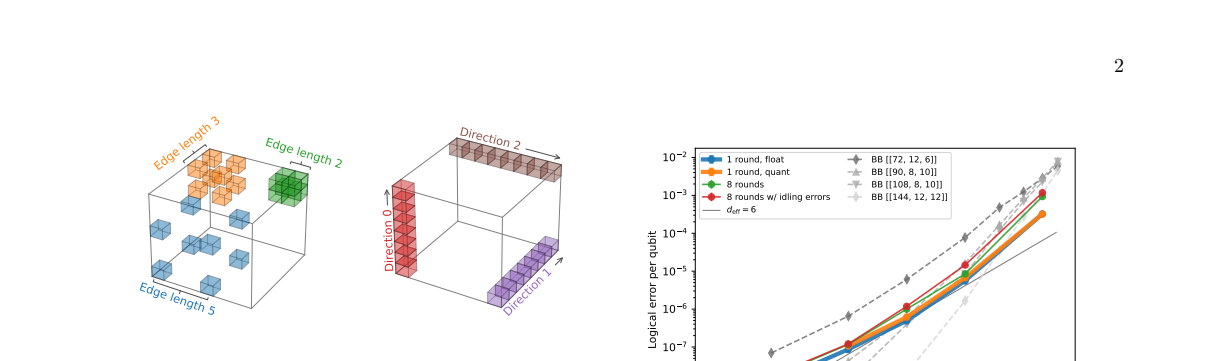
At a physical error rate of $p=10^{-3}$, three FPGA cores decode the 174 logical qubits with a logical error rate per qubit of $5\times10^{-7}$ and an effective distance of 6, below the [[72,12,6]] BB code with the same effective distance.
With the 30-iteration cap, the FPGA core has a bounded worst-case latency of $97.9\,\mu\mathrm{s}$ and, at $p=10^{-4}$, an average latency of $5.1\,\mu\mathrm{s}$ (about 1.6 iterations on average), leaving enough margin for the roughly 1 ms real-time budget of neutral-atom and trapped-ion systems.
Because the FPGA latency is deterministic and one core occupies one device, the same hardware can be time-multiplexed over many logical-qubit batches; the authors estimate more than 250 batches of 174 logical qubits within a 1 ms budget, over 40,000 logical qubits, with only three devices.
An ASIC implementation of the same fixed-point architecture would bring average latencies toward the sub-microsecond range needed by superconducting platforms, although the authors note that the code's long-range syndrome measurements are currently hard to realize there.
The decoder achieves this accuracy without OSD, integer programming, or a relay stage: a single CMem-BP core matches BP+OSD-CS10 and a three-core ensemble matches Relay-BP.
Beyond the paper: the same schedule construction — partition stabilizers and data qubits into disjoint groups and let group $s$ measure group $q$ at time $t=s+q$ — is a general recipe for compact, collision-free, interleaved syndrome extraction in any CSS code whose Tanner graph can be coloured, so the six-step-per-round depth may transfer to other product-code families.
Beyond the paper: if the cumulative-memory update is the real source of the accuracy gain, then row-wise serial min-sum with a small memory weight should also improve decoding of other high-rate qLDPC codes; a quick test is to compare plain serial BP against CMem-BP on the bivariate-bicycle codes used here as references.
Beyond the paper: the ensemble's diversity comes from random check-node order plus a 5% erasure of the a-priori error probabilities, and the paper leaves open whether the erasure fraction and ensemble size can be reduced at lower physical error rates or larger distances, which would reduce the three-FPGA requirement.
Check this review
Pith stored no record of this review's passes and took no fingerprint of it. Reviews made by code from 13 Nov 2026 on carry both.
How often reviews like this one are right
Reviews like this one: written by deepseek-v4-flash, where what was read was not recorded.
How often objections from reviews like this one are right: not yet measured
Reviews by people
This review was written by a machine. No person has reviewed this paper on Pith yet. A scientist listed on Pith can review it for a fee, and their review is published here whatever it concludes.
The paper
Abstract
We present a real-time FPGA decoder for a high-rate [[512,174,8]] 3D product qLDPC code. We construct a circuit-level detector-error model for a compact syndrome-extraction schedule and propose a small parallel ensemble of row-wise serial min-sum decoders with cumulative memory. The decoder matches BP+OSD-CS10 accuracy with one core and Relay-BP accuracy with three cores. The FPGA implementation meets the latency budget of neutral-atom and trapped-ion systems. An ASIC implementation would improve the latency, enabling real time decoding even for superconducting systems. At a physical error rate of p = 10−3, three FPGA devices decode 174 logical qubits with a logical error rate of 5 × 10⁻⁷ and effective distance 6. For p = 10−4, and assuming the number of BP iterations is capped to 30, the decoder's average latency is 5.1 \textmu s and its worst-case latency is 97.9 \textmu s.
The paper's own sentences, arranged, kept beside the review and separate from it. Each label is drawn from a closed vocabulary; the number beside it is the probability the classifier gave that label. No sentence in this record was written by a model.
abstract compiled · 2026-11-02
The authors' main claim, as the classifier picked it out 0.37
“We present a real-time FPGA decoder for a high-rate $[[512,174,8]]$ 3D product qLDPC code.”
How the main claim is stated: asserted 1.00
What the abstract itself states, as probabilities: claims first 0.05 · states limitation 0.80 · human participants 0.01 · controlled comparison 0.47 · randomized assignment 0.01 · states quantitative result 0.99 · compares with prior results 0.95 · mentions code or data availability 0.03
The abstract, sentence by sentence
This table labels the abstract only (arXiv listing abstract v1). The number is the probability the classifier gave the label.
| Sentence | Role | The authors' own work | States the main conclusion | Strength |
|---|---|---|---|---|
| We present a real-time FPGA decoder for a high-rate $[[512,174,8]]$ 3D product qLDPC code. | contribution 1.00 | 0.95 | 0.27 | asserted 1.00 |
| We construct a circuit-level detector-error model for a compact syndrome-extraction schedule and propose a small parallel ensemble of row-wise serial min-sum decoders with cumulative memory. | method 0.92 | 0.94 | 0.06 | asserted 1.00 |
| The decoder matches $\text{BP+OSD-CS}_\text{10}$ accuracy with one core and Relay-BP accuracy with three cores. | result 1.00 | 0.88 | 0.22 | asserted 1.00 |
| The FPGA implementation meets the latency budget of neutral-atom and trapped-ion systems. | result 0.90 | 0.85 | 0.19 | asserted 1.00 |
| An ASIC implementation would improve the latency, enabling real time decoding even for superconducting systems. | future work 0.57 | 0.21 | 0.10 | hedged possibility 0.70 |
| At a physical error rate of $p=10^{-3}$, three FPGA devices decode 174 logical qubits with a logical error rate of $5\times10^{-7}$ and effective distance 6. | result 1.00 | 0.90 | 0.30 | asserted 1.00 |
| For $p=10^{-4}$, and assuming the number of BP iterations is capped to 30, the decoder's average latency is $5.1\,$\textmu s and its worst-case latency is $97.9\,$\textmu s. | result 1.00 | 0.91 | 0.12 | asserted 1.00 |
What kind of paper the classifier reports this is: method or tool 1.00 · evidence from simulation or computation 0.70
What was examined, and what was not
Sources read
- arXiv listing abstract v1
Not examined
- full text
- figures and tables
- references and citing sentences
- relations to other papers
Levels run
- P abstract
Not run
- S sections
- T body sentences
- C citations
- R cross-paper relations
How the labels were made
Compiled by classifier-1.13.0 via TypeSafe API, question bank abstract-p1-20260923, 2026-11-02: 1 request, 5,672 input tokens.
Every quoted sentence on this record is the authors'. Every label is from Pith's closed vocabulary, with the probability shown beside it. This record as JSON
Figures (6)
Showing 4 of the paper's 6 figures. Figures are the authors', reproduced from the paper.
References (34)
- [1] M. Fellous-Asiani, J. H. Chai, Y. Thonnart, H. K. Ng, R. S. Whitney, and A. Auff` eves, Optimizing Resource Efficiencies for Scalable Full-Stack Quantum Computers, PRX Quantum4, 040319 (2023) on Pith
- [2] S. Bravyi, A. W. Cross, J. M. Gambetta, D. Maslov, P. Rall, and T. J. Yoder, High-threshold and low- overhead fault-tolerant quantum memory, Nature627, 778 (2024) on Pith
- [3] D. Komoto and K. Kasai, Quantum error correction near the coding theoretical bound, npj Quantum Information 11, 154 (2025) on Pith
- [4] B. Gu, A. Z. Liu, A. O. Quintavalle, Q. Xu, J. Eisert, and J. Roffe, QGPU: Parallel logic in quantum LDPC codes (2026), arXiv:2603.05398 [quant-ph] on PitharXiv
- [5] A. Bhardwaj, M. Ma, N. Meister, R. King, D. Bluvstein, J. Preskill, M. Cain, Q. Xu, and H.-Y. Huang, High-rate qLDPC processors (2026), arXiv:2607.28795 [quant-ph] on PithPith's reviewarXiv
- [6] C. Zhao, C. Duckering, A. Gu, N. Maskara, and H. Zhou, Towards Ultra-High-Rate Quantum Error Correction with Reconfigurable Atom Arrays (2026), arXiv:2604.16209 [quant-ph] on PithPith's reviewarXiv
- [7] F. Kschischang, B. Frey, and H.-A. Loeliger, Factor graphs and the sum-product algorithm, IEEE Transac- tions on Information Theory47, 498 (2001) on Pith
- [8] T. M¨ uller, T. Alexander, M. E. Beverland, M. B¨ uhler, B. R. Johnson, T. Maurer, and D. Vandeth, Improved belief propagation is sufficient for real-time decoding of quantum memory (2025), arXiv:2506.01779 [quant-ph] on PithPith's reviewarXiv
- [9] A. Gu, J. P. B. Ataides, M. D. Lukin, and S. F. Yelin, Scalable Neural Decoders for Practical Fault-Tolerant Quantum Computation (2026), arXiv:2604.08358 [quant- ph] on PithPith's reviewarXiv
- [10] P.-J. H. Derks, A. Townsend-Teague, A. G. Burchards, and J. Eisert, Designing fault-tolerant circuits using de- tector error models, Quantum9, 1905 (2025) on Pith
- [11] P. Panteleev and G. Kalachev, Degenerate Quantum LDPC Codes With Good Finite Length Performance, Quantum5, 585 (2021) on Pith
- [12] J. Roffe, D. R. White, S. Burton, and E. Campbell, De- coding across the quantum low-density parity-check code landscape, Physical Review Research2, 043423 (2020) on Pith
- [13] D. B´ ascones, F. Garc ´ ıa-Herrero, and J. Valls, Exploring the FPGA and ASIC design space of belief propagation and ordered statistics decoders for quantum error correc- tion codes, EPJ Quantum Technology12, 140 (2025) on Pith
- [14] S. Maurya, T. Maurer, M. B¨ uhler, D. Vandeth, and M. E. Beverland, FPGA-tailored algorithms for real-time de- coding of quantum LDPC codes (2026), arXiv:2511.21660 [quant-ph] on PitharXiv
- [15] J. Valls, F. Garcia-Herrero, N. Raveendran, and B. Vasi´ c, Syndrome-Based Min-Sum vs OSD-0 Decoders: FPGA Implementation and Analysis for Quantum LDPC Codes, IEEE Access9, 138734 (2021) on Pith
- [16] J. D. Crest, F. Garc ´ ıa-Herrero, M. Mhalla, V. Savin, and J. Valls, Layered Decoding of Quantum LDPC Codes (2023), arXiv:2308.13377 [quant-ph]. 7 on PithPith's reviewarXiv
- [17] N. Raveendran, J. Valls, A. K. Pradhan, N. Rengaswamy, F. Garc ´ ıa-Herrero, and B. Vasi´ c, Soft syndrome iterative decoding of quantum LDPC codes and hardware archi- tectures, EPJ Quantum Technology10, 45 (2023) on Pith
- [18] T. Maurer, M. B¨ uhler, M. Kr¨ oner, F. Haverkamp, T. M¨ uller, D. Vandeth, and B. R. Johnson, Real-time decoding of the gross code memory with FPGAs (2025), arXiv:2510.21600 [quant-ph] on PitharXiv
- [19] D. B´ ascones, A. S. Maan, V. Savin, and F. Garc ´ ıa- Herrero, A Scalable FPGA Architecture for Real-Time Decoding of Quantum LDPC Codes Using GARI (2026), arXiv:2605.01035 [quant-ph] on PithPith's reviewarXiv
- [20] D. Ostrev, D. Orsucci, F. L´ azaro, and B. Matuz, Classical product code constructions for quantum Calderbank-Shor-Steane codes, Quantum8, 1420 (2024), arXiv:2209.13474 [quant-ph] on PithPith's reviewarXiv
show 14 more
- [21] J. Chen, Z. Yi, Z. Liang, and X. Wang, Improved Be- lief Propagation Decoding Algorithms for Surface Codes, IEEE Transactions on Quantum Engineering6, 1 (2025) on Pith
- [22] Advanced Micro Devices, Inc., AMD Virtex Ul- traScale+ VU19P FPGAs,https://www.amd.com/ en/products/adaptive-socs-and-fpgas/fpga/ virtex-ultrascale-plus-vu19p.html(2026), accessed: 2026-09-02 on Pith
- [23] B. Barber, K. M. Barnes, T. Bialas, O. Bu˘ gdaycı, E. T. Campbell, N. I. Gillespie, K. Johar, R. Rajan, A. W. Richardson, L. Skoric, C. Topal, M. L. Turner, and A. B. Ziad, A real-time, scalable, fast and resource-efficient de- coder for a quantum computer, Nature Electronics8... on Pith
- [24] Google Quantum AI, Suppressing quantum errors by scaling a surface code logical qubit, Nature614, 676–681 (2023) on Pith
- [25] D. Bluvstein, A. A. Geim, S. H. Li, S. J. Evered, J. P. Bonilla Ataides, G. Baranes, A. Gu, T. Manovitz, M. Xu, M. Kalinowski,et al., A fault-tolerant neutral-atom ar- chitecture for universal quantum computation, Nature 649, 39 (2026) on Pith
- [26] F. Tripier, W. C. Chung, J. Young, S. Alam, B. Bjork, A. Brodutch, F. L. Buessen, N. J. Coble, T. Del- laert, D. Maslov, M. Roetteler, E. Tham, M. Webster, M. Ye, J. Gamble, A. Maksymov, J. P. Marceaux, and N. Delfosse, Fault-Tolerant Quantum Computing with Trapped Ions: The W... on PithPith's reviewarXiv
- [27] C. Gidney, Stim: a fast stabilizer circuit simulator, Quan- tum5, 497 (2021), arXiv:2103.02202 [quant-ph] on PithPith's reviewarXiv
- [28] A. G. Manes and J. Claes, Distance-preserving stabilizer measurements in hypergraph product codes, Quantum9, 1618 (2025), arXiv:2308.15520 [quant-ph] on PithPith's reviewarXiv
- [29] Y. Tomita and K. M. Svore, Low-distance surface codes under realistic quantum noise, Physical Review A90, 062320 (2014) on Pith
- [30] M. A. Tremblay, N. Delfosse, and M. E. Beverland, Constant-Overhead Quantum Error Correction with Thin Planar Connectivity, Physical Review Letters129, 050504 (2022) on Pith
- [31] A. Strikis, D. E. Browne, and M. E. Beverland, High- performance syndrome extraction circuits for quantum codes (2026), arXiv:2603.05481 [quant-ph] on PithPith's reviewarXiv
- [32] A. Tarable, S. Benedetto, and G. Montorsi, Mapping In- terleaving Laws to Parallel Turbo and LDPC Decoder Architectures, IEEE Transactions on Information The- ory50, 2002 (2004) on Pith
- [33] J. Liu, Y. Lee, Y. Xu, G. Huang, and X. Wu, A Scal- able Open-Source QEC System with Sub-Microsecond Decoding-Feedback Latency (2026), arXiv:2603.16203 [quant-ph] on PitharXiv
- [34] AMD, Aurora 64b/66b v13.0 LogiCORE ip product guide,https://docs.amd.com/r/en-US/ pg074-aurora-64b66b(2024), accessed: 2026-09-28 on Pith
Cited by 1 Pith paper
Reviewed papers on Pith that cite this one. The full citation record
- Machine-learning decoders for fusion-based quantum computing in real time quant-ph · Nov 2026
Challenges and discussion
Disagree with the review, or know something it missed? Leave a comment, or challenge this review formally: a challenge becomes a permanent entry in this paper's record, and its decision is published here.
Come back by email
A short list of the week's newly reviewed papers. Nothing is sent until you confirm from your inbox, and every email has a link that stops it. No account.
No comments yet.
Sign in to comment