Phase transitions in neutron stars and their links to gravitational waves
Pith reviewed 2026-05-25 01:49 UTC · model grok-4.3
The pith
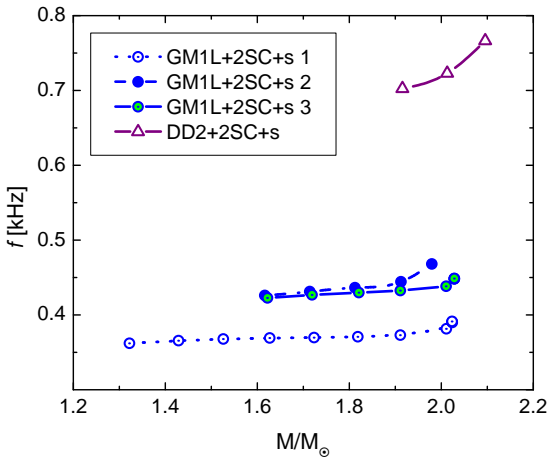
A sharp hadron-quark phase transition in neutron stars could produce detectable g-modes in gravitational waves at 1 to 1.5 kHz.
A machine-rendered reading of the paper's core claim, the machinery that carries it, and where it could break.
Core claim
The existence of a possible hadron-quark phase transition in the central regions of neutron stars is associated with the appearance of g-modes. Observations of g-modes with frequencies between 1 kHz and 1.5 kHz could be interpreted as evidence of a sharp hadron-quark phase transition in the cores of neutron stars.
What carries the argument
The g-modes associated with a sharp hadron-quark phase transition, which signal the presence of a pure quark matter core.
If this is right
- Gravitational wave detections can place constraints on the neutron star matter equation of state.
- The combined gravitational and electromagnetic observations from events like GW170817 offer new ways to study compact objects.
- A pure quark matter core in neutron stars would be indicated by specific oscillation frequencies.
- Multimessenger astronomy provides an opportunity to study dense matter through phase transition signatures.
Where Pith is reading between the lines
- Confirmation would allow astrophysical observations to probe quantum chromodynamics at high densities.
- Improved gravitational wave detectors could test for the existence of quark cores more stringently.
- Neutron star models may need to include hybrid equations of state to match future multimessenger data.
Load-bearing premise
That the theoretical calculations accurately predict g-mode frequencies from the phase transition and that such transitions occur in real neutron stars.
What would settle it
A precise measurement of g-mode frequencies from a neutron star event that falls outside the 1-1.5 kHz range, or no detection of such modes despite other indicators of dense matter, would challenge the proposed link.
Figures


read the original abstract
The recent direct observation of gravitational wave event $GW170817$ and its $GRB170817A$ signal has opened up a new window to study neutron stars and heralds a new era of Astronomy referred to as the Multimessenger Astronomy. Both gravitational and electromagnetic waves from a single astrophysical source have been detected for the first time. This combined detection offers an unprecedented opportunity to place constraints on the neutron star matter equation of state. The existence of a possible hadron-quark phase transition in the central regions of neutron stars is associated with the appearance of g-modes, which are extremely important as they could signal the presence of a pure quark matter core in the centers of neutron stars. Observations of g-modes with frequencies between 1 kHz and 1.5 kHz could be interpreted as evidence of a sharp hadron-quark phase transition in the cores of neutron stars. In this article, we shall review the description of the dense matter composing neutron stars, the determination of the equation of state of such matter, and the constraints imposed by astrophysical observations of these fascinating compact objects.
Editorial analysis
A structured set of objections, weighed in public.
Referee Report
Summary. The manuscript is a review article summarizing the description of dense matter in neutron stars, the construction of the equation of state (EOS), astrophysical constraints from observations including GW170817 and GRB170817A, and the potential role of g-modes as signatures of a sharp hadron-quark phase transition in neutron star cores. It highlights that g-modes with frequencies in the 1–1.5 kHz range could be interpreted as evidence for such a transition within the context of multimessenger astronomy.
Significance. As a review, the paper provides a useful synthesis of existing EOS models and cited calculations linking phase transitions to gravitational wave observables. If the summarized connections between hadron-quark transitions and g-mode frequencies hold, it offers a clear interpretive framework for future detections, strengthening the link between theoretical dense-matter physics and multimessenger data.
minor comments (2)
- The abstract presents the 1–1.5 kHz g-mode range as a potential signature but does not indicate the specific cited works or sections where the underlying mode calculations are reviewed; adding explicit cross-references would improve traceability for readers.
- The manuscript relies entirely on external references for the frequency predictions and EOS constructions; a brief table summarizing the key cited results (e.g., transition densities and associated g-mode frequencies) would enhance clarity without altering the review nature.
Simulated Author's Rebuttal
We thank the referee for their positive assessment of our review manuscript, which accurately summarizes its content on dense matter in neutron stars, EOS construction, constraints from GW170817/GRB170817A, and g-mode signatures of hadron-quark phase transitions. The recommendation for minor revision is noted. No specific major comments were raised in the report.
Circularity Check
No significant circularity; review summarizes external literature
full rationale
This is a review article whose abstract and structure explicitly frame the content as a summary of existing EOS constructions, mode calculations from cited works, and constraints from external observations such as GW170817. The g-mode frequency claim (1–1.5 kHz as possible evidence for a sharp hadron-quark transition) is presented as an interpretive possibility drawn from prior literature rather than a new derivation or prediction generated inside the paper. No equations, fitted parameters, or self-citations are shown to reduce the central statements to inputs defined within the manuscript itself. The derivation chain therefore remains self-contained against external benchmarks and does not exhibit any of the enumerated circularity patterns.
Axiom & Free-Parameter Ledger
axioms (1)
- domain assumption Standard models of hadronic and quark matter at high density are adequate for describing neutron star interiors.
Lean theorems connected to this paper
-
IndisputableMonolith/Foundation/RealityFromDistinction.leanreality_from_one_distinction unclear?
unclearRelation between the paper passage and the cited Recognition theorem.
Observations of g-modes with frequencies between 1 kHz and 1.5 kHz could be interpreted as evidence of a sharp hadron-quark phase transition
-
IndisputableMonolith/Cost/FunctionalEquation.leanwashburn_uniqueness_aczel unclear?
unclearRelation between the paper passage and the cited Recognition theorem.
The Lagrangian of nuclear matter... gσB(n), gωB(n) and gρB(n) are the (density dependent) meson-baryon coupling constants
What do these tags mean?
- matches
- The paper's claim is directly supported by a theorem in the formal canon.
- supports
- The theorem supports part of the paper's argument, but the paper may add assumptions or extra steps.
- extends
- The paper goes beyond the formal theorem; the theorem is a base layer rather than the whole result.
- uses
- The paper appears to rely on the theorem as machinery.
- contradicts
- The paper's claim conflicts with a theorem or certificate in the canon.
- unclear
- Pith found a possible connection, but the passage is too broad, indirect, or ambiguous to say the theorem truly supports the claim.
Forward citations
Cited by 2 Pith papers
-
Nonlinear electrodynamics in magnetars: systematic effects on radius constraints and timing analysis
NLED alters photon propagation near magnetars, producing ~10% errors in inferred radii via ray-tracing and a minimal ~350 ns travel-time delay.
-
Gradient-Produced Neutrinos
Steep matter-density gradients in neutron stars can produce neutrino-antineutrino pairs analogous to the Schwinger effect.
Reference graph
Works this paper leans on
-
[1]
Tanabashi et
Particle Data Group Collaboration, M. Tanabashi et. al., Review of Particle Physics , Phys. Rev. D98 (2018), no. 3 030001
2018
-
[2]
Gattringer and C
C. Gattringer and C. Lang, Quantum Chromodynamics on the Lattice: An Introductory Presentation , vol. 788 of Lecture Notes in Physics . Springer Berlin Heidelberg, 2010
2010
-
[3]
R. Bellwied, S. Borsanyi, Z. Fodor, J. G¨ unther, S. D. Katz, C. Ratti, and K. K. Szabo, The QCD phase diagram from analytic continuation , Phys. Lett. B751 (2015) 559–564, [ arXiv:1507.0751]
-
[4]
Ratti, Lattice QCD and heavy ion collisions: a review of recent progress , Rept
C. Ratti, Lattice QCD and heavy ion collisions: a review of recent progress , Rept. Prog. Phys. 81 (2018), no. 8 084301, [ arXiv:1804.0781]
-
[5]
C. Schmidt and S. Sharma, The phase structure of QCD , J. Phys. G44 (2017), no. 10 104002, [arXiv:1701.0470]
-
[6]
Weber, Pulsars as Astrophysical Laboratories for Nuclear and Particle Physics
F. Weber, Pulsars as Astrophysical Laboratories for Nuclear and Particle Physics . Series in High Energy Physics, Cosmology and Gravitation. Taylor & Francis, 1999
1999
-
[8]
Effect of magnetic field on the strange star
S. Chakrabarty and P. K. Sahu, Effect of magnetic field on the strange star , Phys. Rev. D53 (1996) 4687–4690, [hep-ph/9508251]
work page internal anchor Pith review Pith/arXiv arXiv 1996
-
[9]
Broderick, M
A. Broderick, M. Prakash, and J. M. Lattimer, The equation of state of neutron star matter in strong magnetic fields, The Astrophysical Journal 537 (jul, 2000) 351–367. 1LIGO/Virgo O3 run started 2019 April 1 at 15:00 UTC. In this new era, data is made publicly available to allow for rapid follow-up of events by the electromagnetic astrophysical community ...
2000
-
[10]
C. Y. Cardall, M. Prakash, and J. M. Lattimer, Effects of strong magnetic fields on neutron star structure, The Astrophysical Journal 554 (jun, 2001) 322–339
2001
-
[11]
A. K. Harding and D. Lai, Physics of Strongly Magnetized Neutron Stars , Rept. Prog. Phys. 69 (2006) 2631, [astro-ph/0606674]
work page internal anchor Pith review Pith/arXiv arXiv 2006
-
[12]
F. Weber, Strangeness in neutron stars , J. Phys. G27 (2001) 465–474, [ astro-ph/0008376]
work page internal anchor Pith review Pith/arXiv arXiv 2001
-
[13]
Shapiro delay measurement of a two solar mass neutron star
P. Demorest, T. Pennucci, S. Ransom, M. Roberts, and J. Hessels, Shapiro Delay Measurement of A Two Solar Mass Neutron Star , Nature 467 (2010) 1081–1083, [ arXiv:1010.5788]
work page internal anchor Pith review Pith/arXiv arXiv 2010
-
[14]
R. S. Lynch et. al., The Green Bank Telescope 350 MHz Drift-scan Survey II: Data Analysis and the Timing of 10 New Pulsars, Including a Relativistic Binary , Astrophys. J. 763 (2013) 81, [arXiv:1209.4296]
work page internal anchor Pith review Pith/arXiv arXiv 2013
-
[15]
A Massive Pulsar in a Compact Relativistic Binary
J. Antoniadis et. al., A Massive Pulsar in a Compact Relativistic Binary , Science 340 (2013) 6131, [arXiv:1304.6875]
work page internal anchor Pith review Pith/arXiv arXiv 2013
-
[16]
Arzoumanian, A
Z. Arzoumanian, A. Brazier, S. Burke-Spolaor, S. Chamberlin, S. Chatterjee, B. Christy, J. M. Cordes, N. J. Cornish, F. Crawford, H. T. Cromartie, K. Crowter, M. E. DeCesar, P. B. Demorest, T. Dolch, J. A. Ellis, R. D. Ferdman, E. C. Ferrara, E. Fonseca, N. Garver-Daniels, P. A. Gentile, D. Halmrast, E. A. Huerta, F. A. Jenet, C. Jessup, G. Jones, M. L. J...
2018
-
[19]
D. Haggard, M. Nynka, J. J. Ruan, V. Kalogera, S. Bradley Cenko, P. Evans, and J. A. Kennea, A Deep Chandra X-ray Study of Neutron Star Coalescence GW170817 , Astrophys. J. 848 (2017), no. 2 L25, [arXiv:1710.0585]
-
[20]
Valenti, J
S. Valenti, J. S. David, S. Yang, E. Cappellaro, L. Tartaglia, A. Corsi, S. W. Jha, D. E. Reichart, J. Haislip, and V. Kouprianov, The discovery of the electromagnetic counterpart of GW170817: Kilonova AT 2017gfo/DLT17ck, The Astrophysical Journal 848 (oct, 2017) L24
2017
-
[21]
DES, Dark Energy Camera GW-EM Collaboration, M. Soares-Santos et. al., The Electromagnetic Counterpart of the Binary Neutron Star Merger LIGO/Virgo GW170817. I. Discovery of the Optical Counterpart Using the Dark Energy Camera , Astrophys. J. 848 (2017), no. 2 L16, [ arXiv:1710.0545]
-
[22]
LIGO Scientific Collaboration and Virgo Collaboration Collaboration, B. P. Abbott et. al., Properties of the binary neutron star merger gw170817 , Phys. Rev. X 9 (Jan, 2019) 011001. 22
2019
-
[23]
Branchesi, GW170817: The Dawn of Multi-messenger Astronomy Including Gravitational Waves , pp
M. Branchesi, GW170817: The Dawn of Multi-messenger Astronomy Including Gravitational Waves , pp. 489–497. Springer International Publishing, Cham, 2018
2018
- [24]
- [25]
-
[26]
S. De, D. Finstad, J. M. Lattimer, D. A. Brown, E. Berger, and C. M. Biwer, Tidal deformabilities and radii of neutron stars from the observation of gw170817 , Phys. Rev. Lett. 121 (Aug, 2018) 091102
2018
- [27]
-
[28]
Gravitational Wave asteroseismology revisited
O. Benhar, V. Ferrari, and L. Gualtieri, Gravitational wave asteroseismology revisited, Phys. Rev. D70 (2004) 124015, [ astro-ph/0407529]
work page internal anchor Pith review Pith/arXiv arXiv 2004
-
[29]
Gravitational waves from neutron stars: Promises and challenges
N. Andersson, V. Ferrari, D. I. Jones, K. D. Kokkotas, B. Krishnan, J. S. Read, L. Rezzolla, and B. Zink, Gravitational waves from neutron stars: Promises and challenges , Gen. Rel. Grav. 43 (2011) 409–436, [arXiv:0912.0384]
work page internal anchor Pith review Pith/arXiv arXiv 2011
-
[30]
I. F. Ranea-Sandoval, O. M. Guilera, M. Mariani, and M. G. Orsaria, Oscillation modes of hybrid stars within the relativistic Cowling approximation , Journal of Cosmology and Astroparticle Physics 12 (Dec.,
- [31]
-
[32]
M. G. Alford, Color superconducting quark matter , Ann. Rev. Nucl. Part. Sci. 51 (2001) 131–160, [hep-ph/0102047]
work page internal anchor Pith review Pith/arXiv arXiv 2001
-
[33]
M. G. Alford, A. Schmitt, K. Rajagopal, and T. Schaefer, Color superconductivity in dense quark matter, Rev. Mod. Phys. 80 (2008) 1455–1515, [ arXiv:0709.4635]
work page internal anchor Pith review Pith/arXiv arXiv 2008
-
[34]
S. Carignano, D. Nickel, and M. Buballa, Influence of vector interaction and Polyakov loop dynamics on inhomogeneous chiral symmetry breaking phases , Phys. Rev. D82 (2010) 054009, [ arXiv:1007.1397]
work page internal anchor Pith review Pith/arXiv arXiv 2010
-
[35]
Inhomogeneous chiral condensates
M. Buballa and S. Carignano, Inhomogeneous chiral condensates, Prog. Part. Nucl. Phys. 81 (2015) 39–96, [arXiv:1406.1367]
work page internal anchor Pith review Pith/arXiv arXiv 2015
-
[36]
J. P. Carlomagno, D. Gomez Dumm, and N. N. Scoccola, Generalized Ginzburg-Landau approach to inhomogeneous phases in nonlocal chiral quark models, Phys. Lett. B745 (2015) 1–4, [arXiv:1411.0909]
work page internal anchor Pith review Pith/arXiv arXiv 2015
- [37]
-
[38]
Phases of Dense Quarks at Large N_c
L. McLerran and R. D. Pisarski, Phases of cold, dense quarks at large N(c) , Nucl. Phys. A796 (2007) 83–100, [arXiv:0706.2191]
work page internal anchor Pith review Pith/arXiv arXiv 2007
-
[39]
Quarkyonic Matter and Chiral Symmetry Breaking
L. McLerran, K. Redlich, and C. Sasaki, Quarkyonic Matter and Chiral Symmetry Breaking , Nucl. Phys. A824 (2009) 86–100, [ arXiv:0812.3585]
work page internal anchor Pith review Pith/arXiv arXiv 2009
-
[40]
The phase diagram of nuclear and quark matter at high baryon density
K. Fukushima and C. Sasaki, The phase diagram of nuclear and quark matter at high baryon density , Prog. Part. Nucl. Phys. 72 (2013) 99–154, [ arXiv:1301.6377]
work page internal anchor Pith review Pith/arXiv arXiv 2013
-
[41]
Ferreira, P
M. Ferreira, P. Costa, and C. m. c. Providˆ encia,Presence of a critical endpoint in the qcd phase diagram from the net-baryon number fluctuations , Phys. Rev. D 98 (Aug, 2018) 034006
2018
-
[42]
J. O. Andersen, W. R. Naylor, and A. Tranberg, Phase diagram of qcd in a magnetic field , Rev. Mod. Phys. 88 (Apr, 2016) 025001
2016
-
[43]
Ferreira, P
M. Ferreira, P. Costa, O. Louren¸ co, T. Frederico, and C. Providˆ encia,Inverse magnetic catalysis in the (2 + 1)-flavor nambu–jona-lasinio and polyakov–nambu–jona-lasinio models , Phys. Rev. D 89 (Jun,
-
[44]
G´ omez Dumm, M
D. G´ omez Dumm, M. F. Izzo Villafa˜ ne, S. Noguera, V. P. Pagura, and N. N. Scoccola,Strong magnetic fields in nonlocal chiral quark models , Phys. Rev. D 96 (Dec, 2017) 114012
2017
-
[45]
C. R. Allton, S. Ejiri, S. J. Hands, O. Kaczmarek, F. Karsch, E. Laermann, C. Schmidt, and L. Scorzato, The QCD thermal phase transition in the presence of a small chemical potential , Phys. Rev. D66 (2002) 074507, [ hep-lat/0204010]
work page internal anchor Pith review Pith/arXiv arXiv 2002
-
[46]
R. V. Gavai and S. Gupta, QCD at finite chemical potential with six time slices , Phys. Rev. D78 (2008) 114503, [arXiv:0806.2233]
work page internal anchor Pith review Pith/arXiv arXiv 2008
-
[47]
O. Kaczmarek, F. Karsch, E. Laermann, C. Miao, S. Mukherjee, P. Petreczky, C. Schmidt, W. Soeldner, and W. Unger, Phase boundary for the chiral transition in (2+1) -flavor QCD at small values of the chemical potential, Phys. Rev. D83 (2011) 014504, [ arXiv:1011.3130]
work page internal anchor Pith review Pith/arXiv arXiv 2011
-
[48]
The QCD phase diagram for small densities from imaginary chemical potential
P. de Forcrand and O. Philipsen, The QCD phase diagram for small densities from imaginary chemical potential, Nucl. Phys. B642 (2002) 290–306, [ hep-lat/0205016]
work page internal anchor Pith review Pith/arXiv arXiv 2002
-
[49]
Finite density QCD via imaginary chemical potential
M. D’Elia and M.-P. Lombardo, Finite density QCD via imaginary chemical potential , Phys. Rev. D67 (2003) 014505, [ hep-lat/0209146]
work page internal anchor Pith review Pith/arXiv arXiv 2003
-
[50]
M. D’Elia, F. Di Renzo, and M. P. Lombardo, The Strongly interacting quark gluon plasma, and the critical behaviour of QCD at imaginary mu , Phys. Rev. D76 (2007) 114509, [ arXiv:0705.3814]
work page internal anchor Pith review Pith/arXiv arXiv 2007
-
[51]
The chiral critical point of Nf=3 QCD at finite density to the order (mu/T)^4
P. de Forcrand and O. Philipsen, The Chiral critical point of N(f) = 3 QCD at finite density to the order (mu/T)**4, JHEP 11 (2008) 012, [ arXiv:0808.1096]
work page internal anchor Pith review Pith/arXiv arXiv 2008
-
[52]
Bazavov et
A. Bazavov et. al., The chiral and deconfinement aspects of the QCD transition , Phys. Rev. D85 (2012) 054503
2012
-
[53]
Y. Aoki, S. Borsanyi, S. Durr, Z. Fodor, S. D. Katz, S. Krieg, and K. K. Szabo, The QCD transition temperature: results with physical masses in the continuum limit II , JHEP 06 (2009) 088
2009
-
[54]
Bazavov, N
A. Bazavov, N. Brambilla, H. T. Ding, P. Petreczky, H. P. Schadler, A. Vairo, and J. H. Weber, Polyakov loop in 2+1 flavor QCD from low to high temperatures , Phys. Rev. D93 (2016), no. 11 114502
2016
-
[55]
J. Cleymans, B. Kampfer, M. Kaneta, S. Wheaton, and N. Xu, Centrality dependence of thermal parameters deduced from hadron multiplicities in Au + Au collisions at s(NN)**(1/2) = 130-GeV , Phys. Rev. C71 (2005) 054901, [ hep-ph/0409071]
work page internal anchor Pith review Pith/arXiv arXiv 2005
-
[56]
Energy and system size dependence of chemical freeze-out in relativistic nuclear collisions
F. Becattini, J. Manninen, and M. Gazdzicki, Energy and system size dependence of chemical freeze-out in relativistic nuclear collisions , Phys. Rev. C73 (2006) 044905, [ hep-ph/0511092]
work page internal anchor Pith review Pith/arXiv arXiv 2006
-
[57]
Hadron production in central nucleus-nucleus collisions at chemical freeze-out
A. Andronic, P. Braun-Munzinger, and J. Stachel, Hadron production in central nucleus-nucleus collisions at chemical freeze-out , Nucl. Phys. A772 (2006) 167–199, [ nucl-th/0511071]
work page internal anchor Pith review Pith/arXiv arXiv 2006
-
[58]
A. Andronic, P. Braun-Munzinger, and J. Stachel, Thermal hadron production in relativistic nuclear collisions: The Hadron mass spectrum, the horn, and the QCD phase transition , Phys. Lett. B673 (2009) 142–145, [ arXiv:0812.1186]. [Erratum: Phys. Lett.B678,516(2009)]
work page internal anchor Pith review Pith/arXiv arXiv 2009
-
[59]
P. Alba, W. Alberico, R. Bellwied, M. Bluhm, V. Mantovani Sarti, M. Nahrgang, and C. Ratti, Freeze-out conditions from net-proton and net-charge fluctuations at RHIC , Phys. Lett. B738 (2014) 305–310, [arXiv:1403.4903]
work page internal anchor Pith review Pith/arXiv arXiv 2014
-
[60]
K. A. Bugaev, A. I. Ivanytskyi, V. V. Sagun, B. E. Grinyuk, D. O. Savchenko, G. M. Zinovjev, E. G. Nikonov, L. V. Bravina, E. E. Zabrodin, D. B. Blaschke, S. Kabana, and A. V. Taranenko, Possible signals of two QCD phase transitions at NICA-FAIR energies , in European Physical Journal Web of Conferences, vol. 204 of European Physical Journal Web of Confer...
-
[61]
Vogl and W
U. Vogl and W. Weise, The Nambu and Jona Lasinio model: Its implications for hadrons and nuclei , Prog. Part. Nucl. Phys. 27 (1991) 195–272
1991
-
[62]
S. P. Klevansky, The Nambu-Jona-Lasinio model of quantum chromodynamics , Rev. Mod. Phys. 64 (1992) 649–708. 24
1992
-
[63]
QCD Phenomenology based on a Chiral Effective Lagrangian
T. Hatsuda and T. Kunihiro, QCD phenomenology based on a chiral effective Lagrangian , Phys. Rept. 247 (1994) 221–367, [ hep-ph/9401310]
work page internal anchor Pith review Pith/arXiv arXiv 1994
-
[64]
NJL-model analysis of dense quark matter
M. Buballa, NJL model analysis of quark matter at large density , Phys. Rept. 407 (2005) 205–376, [hep-ph/0402234]
work page internal anchor Pith review Pith/arXiv arXiv 2005
-
[65]
Gell-Mann and M
M. Gell-Mann and M. Levy, The axial vector current in beta decay , Nuovo Cim. 16 (1960) 705
1960
-
[66]
Ketov, Quantum Non-linear Sigma-Models: From Quantum Field Theory to Supersymmetry, Conformal Field Theory, Black Holes and Strings
S. Ketov, Quantum Non-linear Sigma-Models: From Quantum Field Theory to Supersymmetry, Conformal Field Theory, Black Holes and Strings . Physics and astronomy online library. Springer, 2000
2000
-
[67]
A. J. Mizher, M. N. Chernodub, and E. S. Fraga, Phase diagram of hot QCD in an external magnetic field: possible splitting of deconfinement and chiral transitions , Phys. Rev. D82 (2010) 105016, [arXiv:1004.2712]
work page internal anchor Pith review Pith/arXiv arXiv 2010
-
[68]
Meurice, Linear sigma model for multiflavor gauge theories , Phys
Y. Meurice, Linear sigma model for multiflavor gauge theories , Phys. Rev. D96 (2017), no. 11 114507, [arXiv:1709.0926]
-
[69]
The Phase Diagram of the Quark-Meson Model
B.-J. Schaefer and J. Wambach, The Phase diagram of the quark meson model , Nucl. Phys. A757 (2005) 479–492, [nucl-th/0403039]
work page internal anchor Pith review Pith/arXiv arXiv 2005
-
[70]
The Phase Structure of the Polyakov--Quark-Meson Model
B.-J. Schaefer, J. M. Pawlowski, and J. Wambach, The Phase Structure of the Polyakov–Quark-Meson Model, Phys. Rev. D76 (2007) 074023, [ arXiv:0704.3234]
work page internal anchor Pith review Pith/arXiv arXiv 2007
- [71]
-
[72]
A. Sedrakian, R.-A. Tripolt, and J. Wambach, Color superconductivity from the chiral quark?meson model, Phys. Lett. B780 (2018) 627–630, [ arXiv:1711.0426]
-
[73]
H. G. Dosch, M. Eidemuller, and M. Jamin, QCD sum rule analysis of the field strength correlator , Phys. Lett. B452 (1999) 379–386, [ hep-ph/9812417]
work page internal anchor Pith review Pith/arXiv arXiv 1999
-
[74]
Yu. A. Simonov, Strong interaction and bound states in the deconfinement phase of QCD , Phys. Lett. B619 (2005) 293–304, [ hep-ph/0502078]
work page internal anchor Pith review Pith/arXiv arXiv 2005
-
[75]
A. V. Nefediev, Yu. A. Simonov, and M. A. Trusov, Deconfinement and quark-gluon plasma , Int. J. Mod. Phys. E18 (2009) 549–599, [ arXiv:0902.0125]
work page internal anchor Pith review Pith/arXiv arXiv 2009
-
[76]
Quark matter in Neutron Stars within the Field Correlator Method
S. Plumari, G. F. Burgio, V. Greco, and D. Zappala, Quark matter in Neutron Stars within the Field Correlator Method, Phys. Rev. D88 (2013), no. 8 083005, [ arXiv:1307.3055]
work page internal anchor Pith review Pith/arXiv arXiv 2013
-
[77]
M. Mariani, M. Orsaria, and H. Vucetich, Constant entropy hybrid stars: a first approximation of cooling evolution, Astron. Astrophys. 601 (2017) A21, [ arXiv:1607.0520]
-
[78]
J. D. Walecka, A Theory of highly condensed matter , Annals Phys. 83 (1974) 491–529
1974
-
[79]
Boguta and A
J. Boguta and A. R. Bodmer, Relativistic calculation of nuclear matter and the nuclear surface , Nuclear Physics A 292 (Dec., 1977) 413–428
1977
-
[80]
B. D. Serot and J. D. Walecka, The relativistic nuclear many-body problem , Tech. Rep. ITP-740, Innsbruck Univ. Inst. Theor. Phys., Innsbruck, Oct, 1984
1984
-
[81]
J. M. Lattimer, K. A. van Riper, M. Prakash, and M. Prakash, Rapid cooling and the structure of neutron stars, Astrophys. J. 425 (1994) 802
1994
-
[82]
N. K. Glendenning, Compact Stars: Nuclear Physics, Particle Physics, and General Relativity . Astronomy and astrophysics library. Springer, 1997
1997
-
[83]
W. M. Spinella, A Systematic Investigation of Exotic Matter in Neutron Stars . PhD thesis, Claremont Graduate University & San Diego State University, 2017
2017
discussion (0)
Sign in with ORCID, Apple, or X to comment. Anyone can read and Pith papers without signing in.