Gravitational-wave constraints on H₀ are robust to (putative) redshift evolution in the binary black hole mass spectrum at current sensitivity
Pith reviewed 2026-05-20 03:40 UTC · model grok-4.3
The pith
Spectral-siren constraints on the Hubble constant are robust to redshift evolution in the binary black hole mass spectrum.
A machine-rendered reading of the paper's core claim, the machinery that carries it, and where it could break.
Core claim
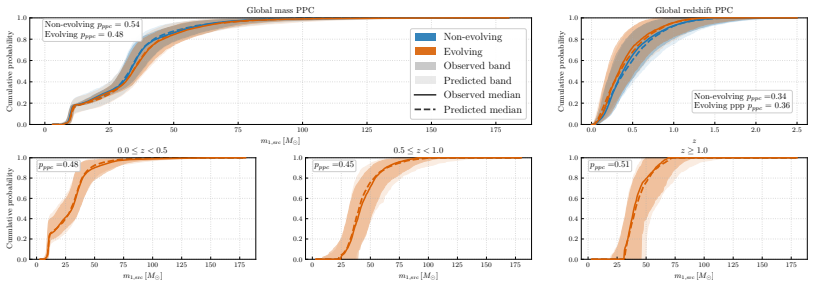
By fitting the GWTC-4.0 binary black hole events while letting the main mass scales evolve with redshift, the analysis shows that the H0 posterior shifts only modestly and without statistical significance. Targeted diagnostics and injection studies indicate this shift arises from the added model flexibility rather than from actual evolution present in the data. The resulting systematic uncertainty on H0 is subdominant to uncertainties induced by varying the number of spectral features or the functional form of the static mass model.
What carries the argument
The spectral-siren method, which infers H0 by combining gravitational-wave luminosity distances with statistical redshift information encoded in features of the source-frame black hole mass spectrum.
If this is right
- Current spectral-siren H0 measurements require no immediate correction for mass-spectrum evolution.
- Uncertainties from redshift-independent mass-model choices exceed those from allowing redshift evolution.
- Higher detector sensitivity will increasingly constrain population features directly, altering the magnitude and sign of any H0 shift.
- The robustness supports continued application of spectral sirens to cosmological inference with existing catalogs.
Where Pith is reading between the lines
- Future detectors may need even more flexible evolution parametrizations to avoid bias from over-flexible models.
- The same robustness test could be applied to other population properties such as merger rates or spin distributions.
- Injection studies remain essential for distinguishing extra model flexibility from genuine astrophysical signals in population analyses.
Load-bearing premise
Any true redshift evolution of the mass spectrum can be adequately described by allowing the main mass scales to follow a simple power-law dependence on redshift.
What would settle it
A statistically significant preference for redshift-dependent mass parameters or a substantially larger shift in the H0 posterior when future data are analyzed with more general evolution models would falsify the robustness conclusion.
Figures




read the original abstract
Spectral-siren cosmology constrains the Hubble constant $H_0$ using gravitational-wave observations of compact-binary coalescences. The method combines luminosity distances inferred from the waveform with redshift information statistically encoded in population features of the source-frame mass spectrum. Because the detector measures redshifted masses, structure in the intrinsic mass distribution acts as an internal ``ruler'', making the inference sensitive to assumptions about the population model. In particular, redshift evolution of the mass spectrum is widely discussed as a potential systematic for $H_0$ measurements. We revisit spectral-siren constraints with the GWTC-4.0 binary black hole catalog, explicitly allowing the main mass scales of a standard parametric mass model to evolve with redshift. We find no compelling evidence for evolution at current sensitivity. Allowing evolution produces a modest, non--statistically--significant shift of the $H_0$ posterior toward lower values, which we interpret with targeted posterior and event-level diagnostics. Importantly, the associated systematic uncertainty is subdominant to that induced by alternative redshift-independent descriptions of the mass spectrum, such as the number of spectral features and the functional form used to model them. Our results indicate that, at current sensitivity, spectral-siren constraints on $H_0$ are robust to redshift evolution of the mass spectrum within the flexibility explored here. Using injection studies, we show that this mild $H_0$ shift is reproduced when a non-evolving underlying population is analyzed with an evolving model, consistent with an over-flexible population description at the present signal-to-noise. The sign and magnitude of the shift can, however, depend on detector sensitivity and redshift reach as the population features become increasingly constrained directly by the data.
Editorial analysis
A structured set of objections, weighed in public.
Referee Report
Summary. The manuscript analyzes spectral-siren constraints on the Hubble constant H0 from the GWTC-4.0 binary black hole catalog. It extends a standard parametric mass model to allow the main mass scales to vary with redshift and reports no compelling evidence for such evolution at current sensitivity. Allowing this flexibility produces a modest, non-statistically-significant downward shift in the H0 posterior. Targeted injection studies with non-evolving populations fitted under the evolving model reproduce the observed shift, which the authors interpret as arising from excess model flexibility rather than physical evolution. The associated systematic is stated to be subdominant to uncertainties from alternative redshift-independent mass-spectrum descriptions. The central conclusion is that, within the explored flexibility, current spectral-siren H0 constraints are robust to redshift evolution of the mass spectrum.
Significance. If the central result holds, the work is significant for gravitational-wave cosmology. It directly addresses a frequently cited potential systematic for spectral-siren H0 measurements and shows that, at present detector sensitivity and catalog size, the added freedom does not materially degrade the H0 inference beyond other modeling choices. The injection-based diagnostic provides a concrete, reproducible way to interpret small posterior shifts as artifacts of over-flexibility. This strengthens the case for using existing and near-future GW catalogs for cosmological inference while underscoring the importance of careful population-model validation.
major comments (1)
- [Injection studies] The robustness claim rests on the assertion that the chosen parametrization absorbs any redshift evolution without strongly biasing H0. The manuscript demonstrates that an evolving model fitted to non-evolving injections reproduces the modest H0 shift seen in the real data. However, the complementary test—injection of catalogs drawn from a population with genuine redshift evolution, followed by recovery of H0 under the same evolving model—is not described. Without this test it remains unquantified whether the evolution parameters can couple to the distance-redshift mapping strongly enough to shift the H0 posterior when evolution is actually present. This is load-bearing for the claim that the method is robust within the explored flexibility.
minor comments (2)
- [Abstract] The abstract refers to 'targeted posterior and event-level diagnostics' used to interpret the H0 shift. A concise description of these diagnostics (e.g., which events drive the shift or which posterior quantities are examined) would improve clarity for readers.
- [Discussion] The statement that the sign and magnitude of the H0 shift 'can, however, depend on detector sensitivity and redshift reach' is noted but not illustrated. A short paragraph or figure showing how the shift behaves under different sensitivity assumptions would strengthen the discussion.
Simulated Author's Rebuttal
We thank the referee for their constructive and detailed review. The major comment raises an important point about the completeness of our injection studies, which we address below by performing the suggested complementary test in the revised manuscript.
read point-by-point responses
-
Referee: [Injection studies] The robustness claim rests on the assertion that the chosen parametrization absorbs any redshift evolution without strongly biasing H0. The manuscript demonstrates that an evolving model fitted to non-evolving injections reproduces the modest H0 shift seen in the real data. However, the complementary test—injection of catalogs drawn from a population with genuine redshift evolution, followed by recovery of H0 under the same evolving model—is not described. Without this test it remains unquantified whether the evolution parameters can couple to the distance-redshift mapping strongly enough to shift the H0 posterior when evolution is actually present. This is load-bearing for the claim that the method is robust within the explored flexibility.
Authors: We agree that the complementary injection study provides important additional validation for the robustness claim. In the revised manuscript we have generated synthetic catalogs drawn from populations that include genuine redshift evolution (non-zero evolution parameters on the peak mass and power-law slopes, within the same parametric family used in the analysis). These catalogs were then recovered using the evolving model. The resulting H0 posteriors are consistent with the injected value, with no statistically significant bias, and the evolution parameters are recovered without strong coupling to the distance-redshift relation at current detector sensitivity. These results are now presented in a new subsection of the injection studies, with updated discussion and figures. This strengthens the conclusion that, within the explored flexibility, the parametrization does not introduce material bias to H0 even when redshift evolution is present. revision: yes
Circularity Check
No significant circularity; derivation relies on external catalog and controlled injections
full rationale
The paper fits a standard parametric BBH mass model with explicit redshift dependence on the main mass scales to the GWTC-4.0 catalog, reports no compelling evidence for evolution, and observes a modest non-significant H0 shift. It then uses targeted injection studies of non-evolving populations analyzed with the evolving model to reproduce the same shift, interpreting it as an artifact of excess flexibility at current SNR. This chain does not reduce by construction to a self-definitional loop, a fitted parameter renamed as a prediction, or any load-bearing self-citation. The injections constitute an independent diagnostic on the chosen parametrization rather than a tautological recovery of the input data. The robustness statement is explicitly scoped to the explored functional form and current sensitivity, with the weakest assumption (that any true evolution is captured by this parametrization) stated openly. No uniqueness theorems or ansatzes imported from prior author work are invoked. The overall inference therefore remains self-contained against the external catalog and simulations.
Axiom & Free-Parameter Ledger
free parameters (1)
- redshift-evolution coefficients for mass scales
axioms (1)
- domain assumption The observed mass distribution can be described by a standard parametric model whose parameters may vary with redshift
Lean theorems connected to this paper
-
IndisputableMonolith/Cost/FunctionalEquation.leanwashburn_uniqueness_aczel unclear?
unclearRelation between the paper passage and the cited Recognition theorem.
We revisit spectral-siren constraints with the GWTC-4.0 binary black hole catalog, explicitly allowing the main mass scales of a standard parametric mass model to evolve with redshift.
-
IndisputableMonolith/Foundation/RealityFromDistinction.leanreality_from_one_distinction unclear?
unclearRelation between the paper passage and the cited Recognition theorem.
Using injection studies, we show that this mild H0 shift is reproduced when a non-evolving underlying population is analyzed with an evolving model
What do these tags mean?
- matches
- The paper's claim is directly supported by a theorem in the formal canon.
- supports
- The theorem supports part of the paper's argument, but the paper may add assumptions or extra steps.
- extends
- The paper goes beyond the formal theorem; the theorem is a base layer rather than the whole result.
- uses
- The paper appears to rely on the theorem as machinery.
- contradicts
- The paper's claim conflicts with a theorem or certificate in the canon.
- unclear
- Pith found a possible connection, but the passage is too broad, indirect, or ambiguous to say the theorem truly supports the claim.
Reference graph
Works this paper leans on
-
[1]
B. F. Schutz, Nature323, 310 (1986)
work page 1986
-
[2]
D. E. Holz and S. A. Hughes, Astrophys. J.629, 15 (2005), arXiv:astro-ph/0504616 [astro-ph]
work page internal anchor Pith review Pith/arXiv arXiv 2005
-
[3]
The gravitational-wave luminosity distance in modified gravity theories
E. Belgacem, Y. Dirian, S. Foffa, and M. Maggiore, Phys. Rev. D97, 104066 (2018), arXiv:1712.08108 [astro- ph.CO]
work page internal anchor Pith review Pith/arXiv arXiv 2018
-
[4]
Modified gravitational-wave propagation and standard sirens
E. Belgacem, Y. Dirian, S. Foffa, and M. Maggiore, Phys. Rev. D98, 023510 (2018), arXiv:1805.08731 [gr-qc]
work page internal anchor Pith review Pith/arXiv arXiv 2018
-
[5]
Belgacemet al.(LISA Cosmology Working Group), J
E. Belgacemet al.(LISA Cosmology Working Group), J. Cosmology Astropart. Phys.07, 024 (2019), arXiv:1906.01593 [astro-ph.CO]
-
[6]
A. G. Riesset al., Astrophys. J. Lett.934, L7 (2022), arXiv:2112.04510 [astro-ph.CO]
work page internal anchor Pith review Pith/arXiv arXiv 2022
-
[7]
Planck 2018 results. VI. Cosmological parameters
N. Aghanimet al.(Planck), Astron. Astrophys.641, A6 (2020), [Erratum: Astron.Astrophys. 652, C4 (2021)], arXiv:1807.06209 [astro-ph.CO]
work page internal anchor Pith review Pith/arXiv arXiv 2020
-
[8]
J. Aasiet al.(LIGO Scientific), Class. Quant. Grav.32, 074001 (2015), arXiv:1411.4547 [gr-qc]
work page internal anchor Pith review Pith/arXiv arXiv 2015
-
[9]
Advanced Virgo: a 2nd generation interferometric gravitational wave detector
F. Acerneseet al.(VIRGO), Class. Quant. Grav.32, 024001 (2015), arXiv:1408.3978 [gr-qc]
work page internal anchor Pith review Pith/arXiv arXiv 2015
-
[10]
2020, Overview of KAGRA: Detector design and construction history
T. Akutsuet al.(KAGRA), PTEP2021, 05A101 (2021), arXiv:2005.05574 [physics.ins-det]
-
[11]
A. G. Abacet al.(LIGO Scientific, KAGRA, VIRGO), Astrophys. J. Lett.995, L18 (2025), arXiv:2508.18080 [gr-qc]
work page internal anchor Pith review Pith/arXiv arXiv 2025
-
[12]
A. G. Abacet al.(LIGO Scientific, VIRGO, KAGRA), (2025), arXiv:2508.18082 [gr-qc]
work page internal anchor Pith review Pith/arXiv arXiv 2025
-
[13]
B. P. Abbottet al., Phys. Rev. Lett.119, 161101 (2017), arXiv:1710.05832 [gr-qc]
work page internal anchor Pith review Pith/arXiv arXiv 2017
-
[14]
B. P. Abbottet al.(LIGO Scientific, Virgo, Fermi- GBM, INTEGRAL), Astrophys. J. Lett.848, L13 (2017), arXiv:1710.05834 [astro-ph.HE]
work page internal anchor Pith review Pith/arXiv arXiv 2017
-
[15]
S. R. Taylor, J. R. Gair, and I. Mandel, Phys. Rev.D85, 023535 (2012), arXiv:1108.5161 [gr-qc]
work page internal anchor Pith review Pith/arXiv arXiv 2012
- [16]
-
[17]
S. Mastrogiovanni, K. Leyde, C. Karathanasis, E. Chassande-Mottin, D. A. Steer, J. Gair, A. Ghosh, R. Gray, S. Mukherjee, and S. Rinaldi, Phys. Rev. D 104, 062009 (2021), arXiv:2103.14663 [gr-qc]
- [18]
-
[19]
A. G. Abacet al.(LIGO Scientific, VIRGO, KAGRA), (2025), arXiv:2509.04348 [astro-ph.CO]
work page internal anchor Pith review Pith/arXiv arXiv 2025
-
[20]
A. G. Abacet al.(LIGO Scientific, VIRGO, KAGRA), (2025), arXiv:2508.18083 [astro-ph.HE]
work page internal anchor Pith review Pith/arXiv arXiv 2025
- [21]
-
[22]
V. Gennari, S. Mastrogiovanni, N. Tamanini, S. Marsat, and G. Pierra, Phys. Rev. D111, 123046 (2025), arXiv:2502.20445 [gr-qc]
-
[23]
R. Abbottet al.(LIGO Scientific, Virgo, KAGRA), Astro- phys. J.949, 76 (2023), arXiv:2111.03604 [astro-ph.CO]
-
[24]
M. Tagliazucchi, M. Moresco, N. Borghi, and C. Ciapetti, (2026), arXiv:2601.03347 [astro-ph.CO]
work page internal anchor Pith review Pith/arXiv arXiv 2026
-
[25]
G. Pierra and A. Papadopoulos, (2026), arXiv:2601.03257 [astro-ph.CO]
-
[26]
T. Bertheas, V. Gennari, D. Steer, and N. Tamanini, (2026), arXiv:2603.06792 [gr-qc]
-
[27]
V. Gennari, T. Bertheas, and N. Tamanini, (2026), arXiv:2604.14290 [gr-qc]
work page internal anchor Pith review Pith/arXiv arXiv 2026
-
[28]
U. Mali and R. Essick, Astrophys. J.980, 85 (2025), arXiv:2410.07416 [astro-ph.HE]
-
[29]
S. Mukherjee, Mon. Not. Roy. Astron. Soc.515, 5495 (2022), arXiv:2112.10256 [astro-ph.CO]
- [30]
-
[31]
J. Heinzel, M. Mould, and S. Vitale, Phys. Rev. D111, L061305 (2025), arXiv:2406.16844 [astro-ph.HE]. 13
-
[32]
M. Lalleman, K. Turbang, T. Callister, and N. van Remortel, (2025), arXiv:2501.10295 [astro-ph.HE]
-
[33]
R. Tenorio, A. Toubiana, T. Bruel, D. Gerosa, and J. R. Gair, Astrophys. J. Lett.994, L52 (2025), arXiv:2509.19466 [astro-ph.HE]
- [34]
-
[35]
A. Agarwalet al., Astrophys. J.987, 47 (2025), arXiv:2412.14244 [astro-ph.CO]
-
[36]
C.Karathanasis, S.Mukherjee, L.Pathak, S.Vallejo-Peña, M. R. Sah, B. Revenu, A. E. Romano, and J. Garcia- Bellido, (2026), arXiv:2604.26273 [astro-ph.CO]
work page internal anchor Pith review Pith/arXiv arXiv 2026
-
[37]
P. Madau and M. Dickinson, Ann. Rev. Astron. Astrophys. 52, 415 (2014), arXiv:1403.0007 [astro-ph.CO]
work page internal anchor Pith review Pith/arXiv arXiv 2014
-
[38]
Extracting distribution parameters from multiple uncertain observations with selection biases
I. Mandel, W. M. Farr, and J. R. Gair, Mon. Not. R. Astron. Soc.486, 1086 (2019), arXiv:1809.02063 [physics.data-an]
work page internal anchor Pith review Pith/arXiv arXiv 2019
-
[39]
E. Thrane and C. Talbot, Publ. Astron. Soc. Austral.36, e010 (2019), [Erratum: Publ.Astron.Soc.Austral. 37, e036 (2020)], arXiv:1809.02293 [astro-ph.IM]
-
[40]
Inferring the properties of a population of compact binaries in presence of selection effects
S. Vitale, D. Gerosa, W. M. Farr, and S. R. Tay- lor, (2020), 10.1007/978-981-15-4702-7, arXiv:2007.05579 [astro-ph.IM]
work page internal anchor Pith review Pith/arXiv arXiv doi:10.1007/978-981-15-4702-7 2020
-
[41]
V. Tiwari, Class. Quantum Grav.35, 145009 (2018), arXiv:1712.00482 [astro-ph.HE]
work page internal anchor Pith review Pith/arXiv arXiv 2018
-
[42]
W. M. Farr, Research Notes of the AAS3, 66 (2019), arXiv:1904.10879 [astro-ph.IM]
work page internal anchor Pith review Pith/arXiv arXiv 2019
-
[43]
C. Talbot and J. Golomb, Mon. Not. R. Astron. Soc.526, 3495 (2023), arXiv:2304.06138 [astro-ph.IM]
- [44]
-
[45]
J. Heinzel and S. Vitale, (2025), arXiv:2509.07221 [astro- ph.HE]
-
[46]
Mancarella, github.com/CosmoStatGW/pymcpop-gw (2025)
M. Mancarella, github.com/CosmoStatGW/pymcpop-gw (2025)
work page 2025
-
[47]
M. Mancarella and D. Gerosa, Phys. Rev. D111, 103012 (2025), arXiv:2502.12156 [gr-qc]
-
[48]
M. D. Hoffman and A. Gelman, J. Mach. Learn. Res.15, 1593 (2014), arXiv:1111.4246 [stat.CO]
work page internal anchor Pith review Pith/arXiv arXiv 2014
- [49]
-
[50]
O. Abril-Pla, V. Andreani, C. Carroll, L. Dong, C. J. Fonnesbeck, M. Kochurov, R. Kumar, J. Lao, C. C. Luh- mann, O. A. Martin, M. Osthege, R. Vieira, T. V. Wiecki, and R. Zinkov, PeerJ Comput. Sci.9, e1516 (2023)
work page 2023
-
[51]
D. Phan, N. Pradhan, and M. Jankowiak, NeurIPS 2019 (2019), arXiv:1912.11554 [stat]
work page internal anchor Pith review Pith/arXiv arXiv 2019
-
[52]
Pyro: Deep Universal Probabilistic Programming
E. Bingham, J. P. Chen, M. Jankowiak, F. Obermeyer, N. Pradhan, T. Karaletsos, R. Singh, P. A. Szerlip, P. Horsfall, and N. D. Goodman, J. Mach. Learn. Res. 20, 28:1 (2019), arXiv:1810.09538
work page internal anchor Pith review Pith/arXiv arXiv 2019
- [53]
-
[54]
B. P. Abbottet al.(LIGO Scientific, Virgo), Phys. Rev. X9, 031040 (2019), arXiv:1811.12907 [astro-ph.HE]
work page internal anchor Pith review Pith/arXiv arXiv 2019
-
[55]
R. Abbottet al.(LIGO Scientific, Virgo), Phys. Rev. X 11, 021053 (2021), arXiv:2010.14527 [gr-qc]
work page internal anchor Pith review Pith/arXiv arXiv 2021
-
[56]
R. Abbottet al.(KAGRA, VIRGO, LIGO Scientific), Phys. Rev. X13, 041039 (2023), arXiv:2111.03606 [gr- qc]
work page internal anchor Pith review Pith/arXiv arXiv 2023
-
[57]
Gwtc-4.0: Parameter estimation data release,
L. S. Collaboration, V. Collaboration, and K. Collabo- ration, “Gwtc-4.0: Parameter estimation data release,” (2025)
work page 2025
-
[58]
L. S. Collaboration, V. Collaboration, and K. Collabo- ration, “Gwtc-3: Compact binary coalescences observed by ligo and virgo during the second part of the third observing run — parameter estimation data release,” (2023)
work page 2023
-
[59]
L. S. Collaboration and V. Collaboration, “Gwtc-2.1: Deep extended catalog of compact binary coalescences observed by ligo and virgo during the first half of the third observing run - parameter estimation data release,” (2022)
work page 2022
-
[60]
Gwtc-4.0 cumulative search sensitivity estimates,
L. S. Collaboration, V. Collaboration, and K. Collabora- tion, “Gwtc-4.0 cumulative search sensitivity estimates,” (2025)
work page 2025
-
[61]
R. Essicket al., Phys. Rev. D112, 102001 (2025), arXiv:2508.10638 [gr-qc]
-
[62]
R. Essick, Phys. Rev. D108, 043011 (2023), arXiv:2307.02765 [gr-qc]
-
[63]
M. Fishbach, W. M. Farr, and D. E. Holz, Astrophys. J. Lett.891, L31 (2020), arXiv:1911.05882 [astro-ph.HE]
- [64]
-
[65]
S. J. Miller, S. Winney, K. Chatziioannou, and P. M. Meyers, (2026), arXiv:2604.06090 [gr-qc]
work page internal anchor Pith review Pith/arXiv arXiv 2026
-
[66]
Meng, The annals of statistics22, 1142 (1994)
X.-L. Meng, The annals of statistics22, 1142 (1994)
work page 1994
- [67]
-
[68]
R. Montenegro and P. Tetali,Mathematical Aspects of Mixing Times in Markov Chains(2005)
work page 2005
- [69]
-
[70]
Measurement prospects for the pair-instability mass cutoff with gravitational waves
M. Mould, J. Heinzel, S. Alvarez-Lopez, C. Plunkett, N. E. Wolfe, and S. Vitale, (2026), arXiv:2602.11282 [astro-ph.HE]
work page internal anchor Pith review Pith/arXiv arXiv 2026
-
[71]
Gwtc-4.0: Population properties of merging compact binaries,
L. S. Collaboration, T. V. Collaboration, and T. K. Col- laboration, “Gwtc-4.0: Population properties of merging compact binaries,” (2025)
work page 2025
- [72]
-
[73]
M. Tagliazucchi, M. Moresco, A. Agapito, M. Mancarella, S. Ferraiuolo, S. Mastrogiovanni, N. Borghi, F. Pannar- ale, and D. Bonacorsi, (2026), arXiv:2602.17756 [astro- ph.CO]. 14 Appendix A: Complete population model specification This appendix provides the full mathematical definition of the population model summarized in Sec. IIA. In partic- ular we giv...
-
[74]
Bounded-sigmoid priors (raw-space sampling)
Implementation details a. Bounded-sigmoid priors (raw-space sampling). For any parameterϕ with prescribed bounds[ϕmin, ϕmax] we sample an unconstrained latent variableϕraw and map it to the bounded domain: ϕraw ∼ N(0, σ raw),(B1) ϕ=ϕ min + (ϕmax −ϕ min) sigmoid(xraw).(B2) The scaleσraw controls concentration around the midpoint of the interval. We useσraw...
discussion (0)
Sign in with ORCID, Apple, or X to comment. Anyone can read and Pith papers without signing in.