Equation of State Extrapolation Systematics: Parametric vs. Nonparametric Inference of Neutron Star Structure
Pith reviewed 2026-05-21 22:50 UTC · model grok-4.3
The pith
Nonparametric Gaussian process extrapolations of the neutron star equation of state produce softer posteriors with broader uncertainties than piecewise polytrope methods.
A machine-rendered reading of the paper's core claim, the machinery that carries it, and where it could break.
Core claim
Replacing the high-density polytropic extension with a Gaussian process representation of the squared sound speed in the hybrid EOS framework produces softer EOS posteriors with broader uncertainties when the model is constrained by multi-messenger observations. Bayesian model comparison shows strong evidence for the ST+PDT hotspot geometry over PDT-U for PSR J0030+0451 under both extrapolation methods and a mild preference for the GP extension over piecewise polytropes.
What carries the argument
Gaussian process representation of the squared sound speed as the nonparametric high-density extension, anchored at low densities by the SLy crust EOS and a nuclear meta-model.
If this is right
- GP extrapolations yield softer EOS posteriors than PP extrapolations.
- Uncertainties on neutron-star mass-radius relations are larger under GP extrapolations.
- Bayesian evidence strongly favors the ST+PDT hotspot geometry over PDT-U for both extrapolation schemes.
- GP is mildly preferred over PP according to Bayesian evidence.
Where Pith is reading between the lines
- The wider GP uncertainties may provide a more realistic quantification of systematic error in high-density matter modeling.
- Additional high-precision observations could tighten the distinction between parametric and nonparametric extrapolations.
- The same GP anchoring strategy could incorporate future constraints from heavy-ion collisions or additional gravitational-wave events.
Load-bearing premise
The low-density EOS is accurately described by the SLy crust EOS and a nuclear meta-model constrained by chiEFT and laboratory data, providing a reliable anchor for the high-density extrapolation.
What would settle it
A future radius or tidal-deformability measurement lying outside the broader GP posterior range but inside the narrower PP range would falsify the claim that nonparametric methods better capture high-density uncertainties.
Figures
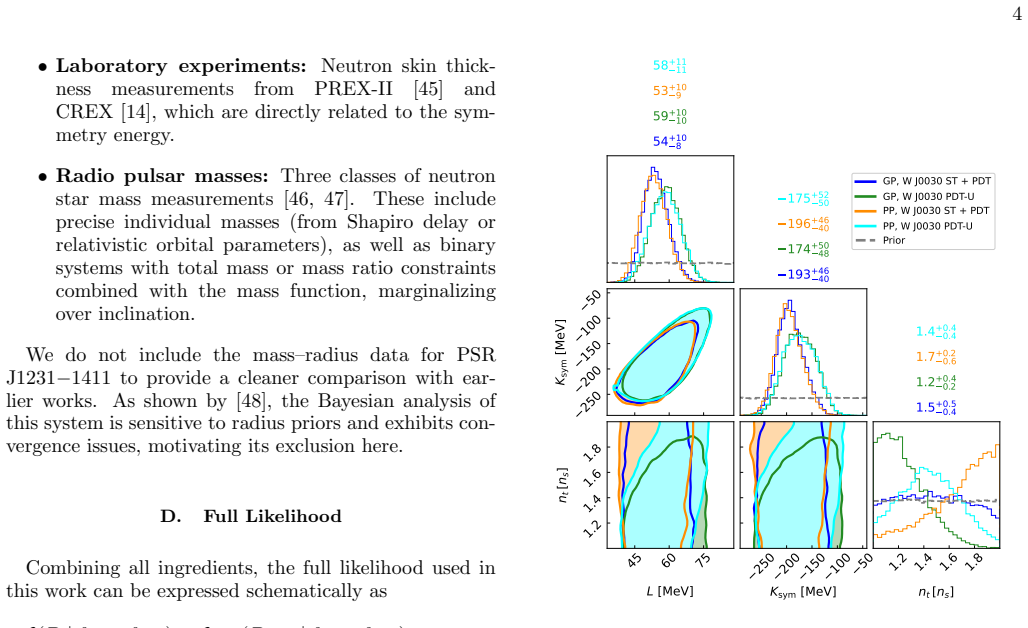


read the original abstract
The equation of state (EOS) of cold dense matter is a central open problem in nuclear astrophysics. Its inference is hindered by the lack of \textit{ab initio} control above about twice nuclear saturation density, requiring extrapolation. Parametric schemes such as piecewise polytropes (PP) are efficient but restrictive, while nonparametric approaches like Gaussian processes (GP) allow more flexibility at the cost of larger prior volumes. We extend our hybrid EOS framework by replacing the high-density polytropic extension with a GP representation of the squared sound speed, anchored at low densities by the SLy crust EOS and a nuclear meta-model constrained by $\chi$EFT and laboratory data. Using hierarchical Bayesian analysis, we jointly constrain the EOS and neutron star mass distribution with multi-messenger observations, including NICER radii, GW170817 and GW190425 tidal deformabilities, pulsar masses, and neutron skin experiments. We examine four scenarios defined by high-density extrapolation (PP vs.\ GP) and hotspot geometry in the NICER modeling of PSR~J0030$+$0451 (ST+PDT vs.\ PDT-U). GP extrapolations generally yield softer EOS posteriors with broader uncertainties. Hotspot assumptions also play an important role, shifting inferred mass--radius relations. Bayesian evidence strongly favors the ST+PDT geometry over PDT-U under both extrapolations, while GP is mildly preferred over PP. These results underscore the impact of observational modeling and EOS extrapolation on neutron star inferences, and show that a GP-based extension offers a robust way to quantify systematic uncertainties in high-density matter.
Editorial analysis
A structured set of objections, weighed in public.
Referee Report
Summary. The manuscript compares parametric piecewise polytrope (PP) and nonparametric Gaussian process (GP) extrapolations for the high-density neutron star equation of state (EOS) within a hybrid framework anchored at low densities by the SLy crust EOS and a χEFT-constrained nuclear meta-model. It performs hierarchical Bayesian inference to jointly constrain the EOS and neutron star mass distribution using NICER radii for PSR J0030+0451 (under ST+PDT and PDT-U hotspot geometries), GW170817 and GW190425 tidal deformabilities, radio pulsar masses, and neutron skin data. Key results are that GP extrapolations produce softer EOS posteriors with broader uncertainties, ST+PDT geometry is strongly favored over PDT-U, and Bayesian evidence mildly favors GP over PP.
Significance. If the results hold, the work is significant for demonstrating the sensitivity of neutron star mass-radius inferences to the choice of high-density EOS extrapolation scheme and to observational modeling assumptions such as hotspot geometry. The nonparametric GP approach provides a flexible alternative to restrictive parametric models and a means to quantify associated systematic uncertainties. The multi-messenger hierarchical analysis strengthens constraints on both the EOS and the underlying mass distribution.
major comments (2)
- [Abstract and EOS construction] The low-density EOS is fixed to the SLy crust and χEFT meta-model without marginalizing its uncertainties or parameters. This assumption is load-bearing for the central claim that GP extrapolations yield softer posteriors with broader uncertainties and are mildly preferred over PP, because unaccounted systematics in the anchor (e.g., χEFT truncation errors or laboratory constraints) would propagate differently into the more flexible GP representation than into the restrictive PP scheme (see abstract description of the hybrid EOS framework and the hierarchical Bayesian analysis).
- [Hierarchical Bayesian analysis] The hierarchical Bayesian analysis jointly fits the EOS and mass distribution but does not sample the low-density parameters jointly with the high-density extrapolation hyperparameters (GP length scale/variance or PP indices/transition densities). This omission risks biasing the evidence comparison between the two extrapolation schemes (see abstract on the joint constraints and the skeptic note on the fixed low-density anchor).
minor comments (2)
- Clarify the exact priors placed on the GP hyperparameters and on the polytropic indices/transition densities, as well as any convergence diagnostics for the MCMC sampling, to support reproducibility of the Bayes factors.
- Specify the exact data selection criteria and any cuts applied to the NICER, GW, and pulsar datasets to allow independent verification of the posterior results.
Simulated Author's Rebuttal
We thank the referee for their careful reading and constructive comments, which highlight important considerations for the robustness of our EOS extrapolation comparison. We address each major comment below, indicating planned revisions to the manuscript.
read point-by-point responses
-
Referee: The low-density EOS is fixed to the SLy crust and χEFT meta-model without marginalizing its uncertainties or parameters. This assumption is load-bearing for the central claim that GP extrapolations yield softer posteriors with broader uncertainties and are mildly preferred over PP, because unaccounted systematics in the anchor would propagate differently into the more flexible GP representation than into the restrictive PP scheme.
Authors: We agree that not marginalizing over low-density uncertainties represents a limitation, as these could in principle affect the more flexible GP model differently than the PP model. Our choice to fix the low-density anchor (SLy + χEFT meta-model) was made to isolate the impact of the high-density extrapolation method, which is the central focus of the work, while using a standard, tightly constrained low-density description. To address the referee's concern, we have performed sensitivity tests by varying the transition density and χEFT parameters within their uncertainties. These tests confirm that the qualitative results—GP yielding softer EOS with larger uncertainties and mild evidence preference—remain robust. We will add a dedicated discussion section and these sensitivity results to the revised manuscript. revision: partial
-
Referee: The hierarchical Bayesian analysis jointly fits the EOS and mass distribution but does not sample the low-density parameters jointly with the high-density extrapolation hyperparameters. This omission risks biasing the evidence comparison between the two extrapolation schemes.
Authors: The referee correctly notes that low-density parameters are held fixed rather than jointly sampled with high-density hyperparameters. Full joint sampling would substantially increase the dimensionality and computational cost of the nested sampling runs. Because the low-density model is identical for both PP and GP cases, the relative Bayesian evidence comparison between extrapolation schemes should remain informative. We have added explanatory text in the methods section detailing this approximation and its implications, along with a note that absolute evidence values may shift under full marginalization. These clarifications will be incorporated in the revision. revision: partial
Circularity Check
Minor self-citation for hybrid framework extension; central results from external data fits with no internal reduction
full rationale
The paper anchors low-density EOS to the SLy crust and a χEFT-constrained nuclear meta-model drawn from independent external sources, then performs hierarchical Bayesian inference on high-density extrapolation (PP vs. GP) using separate multi-messenger datasets (NICER radii, GW tidal deformabilities, pulsar masses). The phrase 'we extend our hybrid EOS framework' references prior author work but does not carry the load of the main claims; those claims (softer GP posteriors, broader uncertainties, Bayes factors favoring ST+PDT and mildly favoring GP) are generated by fitting the extrapolation hyperparameters to the new observations. No equation or result reduces by construction to a fitted parameter or self-citation chain. The analysis is therefore self-contained against external benchmarks, warranting only a minor self-citation flag.
Axiom & Free-Parameter Ledger
free parameters (2)
- GP hyperparameters (length scale, variance)
- Polytropic indices and transition densities
axioms (2)
- domain assumption SLy crust EOS accurately describes matter below nuclear saturation density.
- domain assumption Nuclear meta-model constrained by χEFT and laboratory data remains reliable up to ~2 rho_sat.
Lean theorems connected to this paper
-
IndisputableMonolith/Cost/FunctionalEquation.leanwashburn_uniqueness_aczel unclear?
unclearRelation between the paper passage and the cited Recognition theorem.
anchored at low densities by the SLy crust EOS and a nuclear meta-model constrained by χEFT and laboratory data... for n > nt, the EOS is extended using the GP representation
-
IndisputableMonolith/Foundation/RealityFromDistinction.leanreality_from_one_distinction unclear?
unclearRelation between the paper passage and the cited Recognition theorem.
GP extrapolations generally yield softer EOS posteriors with broader uncertainties... Bayesian evidence strongly favors the ST+PDT geometry over PDT-U
What do these tags mean?
- matches
- The paper's claim is directly supported by a theorem in the formal canon.
- supports
- The theorem supports part of the paper's argument, but the paper may add assumptions or extra steps.
- extends
- The paper goes beyond the formal theorem; the theorem is a base layer rather than the whole result.
- uses
- The paper appears to rely on the theorem as machinery.
- contradicts
- The paper's claim conflicts with a theorem or certificate in the canon.
- unclear
- Pith found a possible connection, but the passage is too broad, indirect, or ambiguous to say the theorem truly supports the claim.
Reference graph
Works this paper leans on
-
[1]
GW170817: Observation of Gravitational Waves from a Binary Neutron Star Inspiral
B. P. Abbottet al.(LIGO Scientific, Virgo), “GW170817: Observation of Gravitational Waves from a Binary Neu- tron Star Inspiral,” Phys. Rev. Lett.119, 161101 (2017), arXiv:1710.05832 [gr-qc]
work page internal anchor Pith review Pith/arXiv arXiv 2017
-
[2]
Properties of the binary neutron star merger GW170817
B. P. Abbottet al.(LIGO Scientific, Virgo), “Proper- ties of the binary neutron star merger GW170817,” Phys. Rev. X9, 011001 (2019), arXiv:1805.11579 [gr-qc]
work page internal anchor Pith review Pith/arXiv arXiv 2019
-
[3]
GW170817: Measurements of Neutron Star Radii and Equation of State
B. P. Abbottet al.(LIGO Scientific, Virgo), “GW170817: Measurements of neutron star radii and equation of state,” Phys. Rev. Lett.121, 161101 (2018), arXiv:1805.11581 [gr-qc]
work page internal anchor Pith review Pith/arXiv arXiv 2018
-
[4]
GW190425: Observation of a Compact Binary Coalescence with To- tal Mass∼3.4M ⊙,
B. P. Abbottet al.(LIGO Scientific, Virgo), “GW190425: Observation of a Compact Binary Coalescence with To- tal Mass∼3.4M ⊙,” Astrophys. J. Lett.892, L3 (2020), arXiv:2001.01761 [astro-ph.HE]
-
[5]
A NICER View of PSR J0030+0451: Nested Samples for Millisecond Pulsar Parameter Esti- mation,
T. E. Riley, A. L. Watts, S. Bogdanov, P. S. Ray, R. M. Ludlam, S. Guillot, Z. Arzoumanian, C. L. Baker, A. V. Bilous, D. Chakrabarty, K. C. Gendreau, A. K. Hard- ing, W. C. G. Ho, J. M. Lattimer, S. M. Morsink, and T. E. Strohmayer, “A NICER View of PSR J0030+0451: Nested Samples for Millisecond Pulsar Parameter Esti- mation,” (2019)
work page 2019
-
[6]
Thomas E. Rileyet al., “A NICER View of the Massive Pulsar PSR J0740+6620 Informed by Radio Timing and XMM-Newton Spectroscopy,” Astrophys. J. Lett.918, L27 (2021), arXiv:2105.06980 [astro-ph.HE]
-
[7]
M. C. Milleret al., “PSR J0030+0451 Mass and Radius from NICER Data and Implications for the Properties of Neutron Star Matter,” Astrophys. J. Lett.887, L24 (2019), arXiv:1912.05705 [astro-ph.HE]
work page internal anchor Pith review Pith/arXiv arXiv 2019
-
[8]
The Radius of PSR J0740+6620 from NICER and XMM-Newton Data
M. C. Milleret al., “The Radius of PSR J0740+6620 from NICER and XMM-Newton Data,” Astrophys. J. Lett. 918, L28 (2021), arXiv:2105.06979 [astro-ph.HE]
work page internal anchor Pith review Pith/arXiv arXiv 2021
-
[9]
Devarshi Choudhuryet al., “A NICER View of the Near- est and Brightest Millisecond Pulsar: PSR J0437–4715,” Astrophys. J. Lett.971, L20 (2024), arXiv:2407.06789 [astro-ph.HE]
-
[10]
A NICER view of the 1.4 solar-mass edge-on pulsar PSR J0614–3329,
Lucien Mauviardet al., “A NICER view of the 1.4 solar-mass edge-on pulsar PSR J0614–3329,” (2025), arXiv:2506.14883 [astro-ph.HE]
-
[11]
A Massive Pulsar in a Compact Relativistic Binary
John Antoniadiset al., “A Massive Pulsar in a Com- pact Relativistic Binary,” Science340, 6131 (2013), arXiv:1304.6875 [astro-ph.HE]
work page internal anchor Pith review Pith/arXiv arXiv 2013
-
[12]
Relativistic Shapiro delay measurements of an extremely massive millisecond pul- sar,
H. Thankful Cromartieet al., “Relativistic Shapiro delay measurements of an extremely massive millisecond pul- sar,” Nature Astron.4, 72–76 (2019), arXiv:1904.06759 [astro-ph.HE]
-
[13]
Implications of PREX-II on the equation of state of neutron-rich matter,
Brendan T. Reed, F. J. Fattoyev, C. J. Horowitz, and J. Piekarewicz, “Implications of PREX-II on the equation of state of neutron-rich matter,” (2021), arXiv:2101.03193 [nucl-th]
-
[14]
Precision Determination of the Neutral Weak Form Factor of Ca48,
D. Adhikariet al.(CREX), “Precision Determination of the Neutral Weak Form Factor of Ca48,” Phys. Rev. Lett. 129, 042501 (2022), arXiv:2205.11593 [nucl-ex]
-
[15]
Modern Theory of Nuclear Forces
Evgeny Epelbaum, Hans-Werner Hammer, and Ulf- G. Meissner, “Modern Theory of Nuclear Forces,” Rev. Mod. Phys.81, 1773–1825 (2009), arXiv:0811.1338 [nucl- th]
work page internal anchor Pith review Pith/arXiv arXiv 2009
-
[16]
Chiral effective field theory and nuclear forces
R. Machleidt and D. R. Entem, “Chiral effective field theory and nuclear forces,” Phys. Rept.503, 1–75 (2011), arXiv:1105.2919 [nucl-th]
work page internal anchor Pith review Pith/arXiv arXiv 2011
-
[17]
Three-body forces: From cold atoms to nuclei
Hans-Werner Hammer, Andreas Nogga, and Achim Schwenk, “Three-body forces: From cold atoms to nu- clei,” Rev. Mod. Phys.85, 197 (2013), arXiv:1210.4273 [nucl-th]
work page internal anchor Pith review Pith/arXiv arXiv 2013
-
[18]
Three-nucleon forces: Implementation and applications to atomic nuclei and dense matter,
Kai Hebeler, “Three-nucleon forces: Implementation and applications to atomic nuclei and dense matter,” Phys. Rept.890, 1–116 (2021), arXiv:2002.09548 [nucl-th]
-
[19]
C. Drischler, J. W. Holt, and C. Wellenhofer, “Chiral Ef- fective Field Theory and the High-Density Nuclear Equa- 10 tion of State,” Ann. Rev. Nucl. Part. Sci.71, 403–432 (2021), arXiv:2101.01709 [nucl-th]
-
[20]
Soft Interactions in Cold Quark Matter,
Tyler Gorda, Aleksi Kurkela, Risto Paatelainen, Saga S¨ appi, and Aleksi Vuorinen, “Soft Interactions in Cold Quark Matter,” Phys. Rev. Lett.127, 162003 (2021), arXiv:2103.05658 [hep-ph]
-
[21]
Ab- initio QCD Calculations Impact the Inference of the Neutron-star-matter Equation of State,
Tyler Gorda, Oleg Komoltsev, and Aleksi Kurkela, “Ab- initio QCD Calculations Impact the Inference of the Neutron-star-matter Equation of State,” Astrophys. J. 950, 107 (2023), arXiv:2204.11877 [nucl-th]
-
[22]
How Perturba- tive QCD Constrains the Equation of State at Neutron- Star Densities,
Oleg Komoltsev and Aleksi Kurkela, “How Perturba- tive QCD Constrains the Equation of State at Neutron- Star Densities,” Phys. Rev. Lett.128, 202701 (2022), arXiv:2111.05350 [nucl-th]
-
[23]
Constraints on a phenomenologically parameterized neutron-star equation of state
Jocelyn S. Read, Benjamin D. Lackey, Benjamin J. Owen, and John L. Friedman, “Constraints on a phe- nomenologically parameterized neutron-star equation of state,” Phys. Rev.D79, 124032 (2009), arXiv:0812.2163 [astro-ph]
work page internal anchor Pith review Pith/arXiv arXiv 2009
-
[24]
Spectral Representations of Neutron-Star Equations of State
Lee Lindblom, “Spectral Representations of Neutron- Star Equations of State,” Phys. Rev.D82, 103011 (2010), arXiv:1009.0738 [astro-ph.HE]
work page internal anchor Pith review Pith/arXiv arXiv 2010
-
[25]
Equation of state sensitivities when inferring neutron star and dense matter properties
S. K. Greif, G. Raaijmakers, K. Hebeler, A. Schwenk, and A. L. Watts, “Equation of state sensitivities when inferring neutron star and dense matter properties,” Mon. Not. Roy. Astron. Soc.485, 5363–5376 (2019), arXiv:1812.08188 [astro-ph.HE]
work page internal anchor Pith review Pith/arXiv arXiv 2019
-
[26]
Isaac Legred, Katerina Chatziioannou, Reed Essick, and Philippe Landry, “Implicit correlations within phe- nomenological parametric models of the neutron star equation of state,” Phys. Rev. D105, 043016 (2022), arXiv:2201.06791 [astro-ph.HE]
-
[27]
Non-parametric inference of the neutron star equation of state from gravitational wave observations
Philippe Landry and Reed Essick, “Nonparametric in- ference of the neutron star equation of state from grav- itational wave observations,” Phys. Rev. D99, 084049 (2019), arXiv:1811.12529 [gr-qc]
work page internal anchor Pith review Pith/arXiv arXiv 2019
-
[28]
Philippe Landry, Reed Essick, and Katerina Chatziioan- nou, “Nonparametric constraints on neutron star mat- ter with existing and upcoming gravitational wave and pulsar observations,” Phys. Rev. D101, 123007 (2020), arXiv:2003.04880 [astro-ph.HE]
-
[29]
Measuring the nuclear equation of state with neutron star-black hole mergers,
Nikhil Sarin, Hiranya V. Peiris, Daniel J. Mortlock, Justin Alsing, Samaya M. Nissanke, and Stephen M. Feeney, “Measuring the nuclear equation of state with neutron star-black hole mergers,” Phys. Rev. D110, 024076 (2024), arXiv:2311.05689 [gr-qc]
-
[30]
Bhaskar Biswas, Prasanta Char, Rana Nandi, and Sukanta Bose, “Towards mitigation of apparent tension between nuclear physics and astrophysical observations by improved modeling of neutron star matter,” Phys. Rev. D103, 103015 (2021), arXiv:2008.01582 [astro- ph.HE]
-
[31]
GW190814: On the properties of the secondary component of the binary,
Bhaskar Biswas, Rana Nandi, Prasanta Char, Sukanta Bose, and Nikolaos Stergioulas, “GW190814: On the properties of the secondary component of the binary,” (2020), arXiv:2010.02090 [astro-ph.HE]
-
[32]
Bhaskar Biswas, “Impact of PREX-II and Combined Radio/NICER/XMM-Newton’s Mass–radius Measure- ment of PSR J0740+6620 on the Dense-matter Equation of State,” Astrophys. J.921, 63 (2021), arXiv:2105.02886 [astro-ph.HE]
-
[33]
Asymmetric nuclear mat- ter equation of state,
I. Bombaci and U. Lombardo, “Asymmetric nuclear mat- ter equation of state,” Phys. Rev. C44, 1892–1900 (1991)
work page 1900
-
[34]
Bhaskar Biswas and Stephan Rosswog, “Simultaneously constraining the neutron star equation of state and mass distribution through multimessenger observations and nuclear benchmarks,” Phys. Rev. D112, 023045 (2025), arXiv:2408.15192 [astro-ph.HE]
-
[35]
A unified equation of state of dense matter and neutron star structure
F. Douchin and P. Haensel, “A unified equation of state of dense matter and neutron star structure,” Astron. As- trophys.380, 151 (2001), arXiv:astro-ph/0111092
work page internal anchor Pith review Pith/arXiv arXiv 2001
-
[36]
Bhaskar Biswas and Prasanta Char, “Systematics from NICER Pulse Profiles Drive Uncertainty in Multi- Messenger Inference of the Neutron Star Equation of State,” (2025), arXiv:2507.12540 [astro-ph.HE]
-
[37]
Reed Essick, Philippe Landry, and Daniel E. Holz, “Nonparametric Inference of Neutron Star Composi- tion, Equation of State, and Maximum Mass with GW170817,” Phys. Rev. D101, 063007 (2020), arXiv:1910.09740 [astro-ph.HE]
-
[38]
Serena Vinciguerraet al., “An updated mass-radius analysis of the 2017-2018 NICER data set of PSR J0030+0451,” (2023), arXiv:2308.09469 [astro-ph.HE]
-
[39]
An updated mass-radius anal- ysis of the 2017-2018 nicer data set of psr j0030+0451,
Serena Vinciguerra, Tuomo Salmi, Anna L. Watts, Devarshi Choudhury, Thomas E. Riley, Paul S. Ray, Slavko Bogdanov, Yves Kini, Sebastien Guillot, Deepto Chakrabarty, Wynn C. G. Ho, Daniela Hup- penkothen, Sharon M. Morsink, Zorawar Wadiasingh, and Micheal T. Wolff, “An updated mass-radius anal- ysis of the 2017-2018 nicer data set of psr j0030+0451,” (2023)
work page 2017
-
[40]
The Radius of the High Mass Pul- sar PSR J0740+6620 With 3.6 Years of NICER Data,
Tuomo Salmiet al., “The Radius of the High Mass Pul- sar PSR J0740+6620 With 3.6 Years of NICER Data,” (2024), arXiv:2406.14466 [astro-ph.HE]
-
[41]
Tuomo Salmi, Devarshi Choudhury, Yves Kini, Thomas Riley, Serena Vinciguerra, Anna L. Watts, Michael T. Wolff, Zaven Arzoumanian, Slavko Bogdanov, Deepto Chakrabarty, Keith Gendreau, Sebastien Guillot, Wynn C. G. Ho, Daniela Huppenkothen, Renee M. Ludlam, Sharon M. Morsink, and Paul S. Ray, “Data and software for: ’the radius of the high- mass pulsar psr ...
work page 2024
-
[42]
Devarshi Choudhury, Tuomo Salmi, Vinciguerra Serena, Thomas Riley, Yves Kini, Anna L. Watts, Bas Dorsman, Slavko Bogdanov, Sebastien Guillot, Paul S. Ray, Daniel Reardon, Ronald A. Remillard, Anna Bilous, Daniela Huppenkothen, James Lattimer, Nathan Rutherford, Za- ven Arzoumanian, Keith Gendreau, Sharon Morsink, and Wynn C. G. Ho, “Reproduction package f...
work page 2024
-
[43]
BUQEYE Collaboration, “Buqeye software repository,” https://buqeye.github.io/software/(2020), bayesian Uncertainty Quantification for Equation of State
work page 2020
-
[44]
C. Drischler, R. J. Furnstahl, J. A. Melendez, and D. R. Phillips, “How Well Do We Know the Neutron-Matter Equation of State at the Densities Inside Neutron Stars? A Bayesian Approach with Correlated Uncertainties,” Phys. Rev. Lett.125, 202702 (2020), arXiv:2004.07232 [nucl-th]
-
[45]
D. Adhikariet al.(PREX), “An Accurate Determina- tion of the Neutron Skin Thickness of 208Pb through Parity-Violation in Electron Scattering,” (2021), arXiv:2102.10767 [nucl-ex]
-
[46]
Justin Alsing, Hector O. Silva, and Emanuele Berti, “Evidence for a maximum mass cut-off in the neutron star mass distribution and constraints on the equation 11 of state,” Mon. Not. Roy. Astron. Soc.478, 1377–1391 (2018), arXiv:1709.07889 [astro-ph.HE]
work page internal anchor Pith review Pith/arXiv arXiv 2018
-
[47]
Yi-Zhong Fan, Ming-Zhe Han, Jin-Liang Jiang, Dong- Sheng Shao, and Shao-Peng Tang, “Maximum gravita- tional mass MTOV=2.25-0.07+0.08M⊙inferred at about 3% precision with multimessenger data of neutron stars,” Phys. Rev. D109, 043052 (2024), arXiv:2309.12644 [astro-ph.HE]
-
[48]
A NICER View of PSR J1231−1411: A Complex Case,
Tuomo Salmiet al., “A NICER View of PSR J1231−1411: A Complex Case,” Astrophys. J.976, 58 (2024), arXiv:2409.14923 [astro-ph.HE]
-
[49]
J. Buchner, A. Georgakakis, K. Nandra, L. Hsu, C. Rangel, M. Brightman, A. Merloni, M. Salvato, J. Donley, and D. Kocevski, “X-ray spectral modelling of the AGN obscuring region in the CDFS: Bayesian model selection and catalogue,” Astron. Astrophys.564, A125 (2014), arXiv:1402.0004 [astro-ph.HE]
work page internal anchor Pith review Pith/arXiv arXiv 2014
-
[50]
Robert E. Kass and Adrian E. Raftery, “Bayes factors,” Journal of the American Statistical Association90, 773– 795 (1995)
work page 1995
-
[51]
Infer- ring the neutron star equation of state with nuclear- physics informed semiparametric models,
Sunny Ng, Isaac Legred, Lami Suleiman, Philippe Landry, Lyla Traylor, and Jocelyn Read, “Infer- ring the neutron star equation of state with nuclear- physics informed semiparametric models,” (2025), arXiv:2507.03232 [astro-ph.HE]
discussion (0)
Sign in with ORCID, Apple, or X to comment. Anyone can read and Pith papers without signing in.