CP-violating multi-field phase transitions and gravitational waves in a hidden NJL sector
Pith reviewed 2026-05-19 17:44 UTC · model grok-4.3
The pith
In a hidden NJL sector, multi-field tunneling can slow phase transitions to β/H ~ O(100) and produce gravitational waves detectable by μAres.
A machine-rendered reading of the paper's core claim, the machinery that carries it, and where it could break.
Core claim
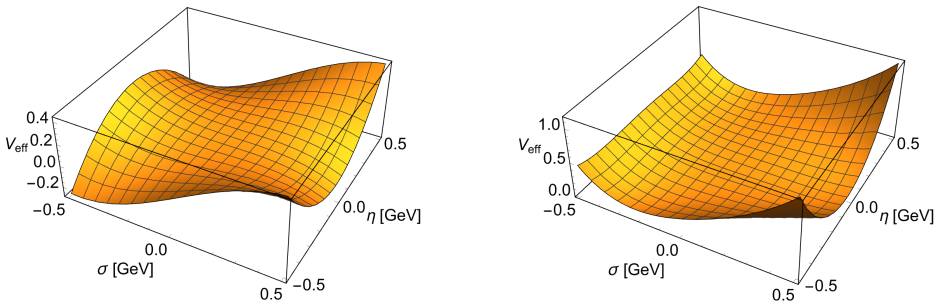
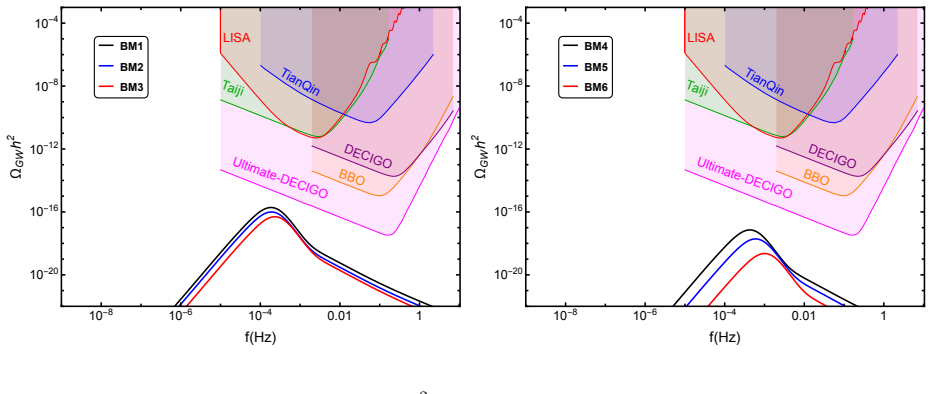
A comprehensive scan of the multi-dimensional parameter space of the extended NJL model reveals a regime where the transition rate drops to β/H ∼ O(10^2). Consequently the peak amplitude of the stochastic gravitational wave background reaches the detection sensitivity of μAres, while the macroscopic thermodynamic properties that set the wave spectrum are determined by the radial profile of the effective potential and stay insensitive to the CP-violating topological vacuum angle.
What carries the argument
The curved multi-field tunneling path through the effective potential that arises from the interplay between explicit chiral symmetry breaking and the CP-violating six-fermion interaction.
If this is right
- The slower transition rate increases the energy released into gravitational waves from bubble wall collisions and sound waves.
- The explicit mass term biases the vacua and forces transient domain walls to collapse promptly, preserving cosmological viability.
- Because wave observables depend mainly on the radial potential, predictions for future detectors can be made without precise knowledge of the CP angle.
- The same multi-field mechanism can be applied to other hidden-sector models to search for additional slow-transition regimes.
Where Pith is reading between the lines
- The spatially varying CP-violating background inside the bubble wall could source additional effects such as baryon asymmetry, an avenue left open by the present analysis.
- If lattice simulations of the NJL model confirm the mean-field tunneling rates, the predicted μAres signals become more robust targets for observation.
- The insensitivity to the CP angle suggests that similar hidden-sector models without CP violation may still produce detectable waves if the radial potential is comparably flat.
Load-bearing premise
The effective potential and the multi-field tunneling path are accurately described by the mean-field or large-N approximation of the NJL model.
What would settle it
A calculation of the bubble nucleation rate that includes higher-order corrections or lattice methods and yields β/H ≫ 100 for the same parameter region would eliminate the claimed enhancement of the gravitational wave amplitude.
Figures


read the original abstract
We investigate the dynamics of a cosmological first-order phase transition (FOPT) and the associated stochastic gravitational wave background (SGWB) in a hidden strongly coupled sector described by an extended Nambu--Jona-Lasinio (NJL) model with $N_f = 3$ fermion flavors. The model incorporates a CP-violating six-fermion 't Hooft interaction, an explicit chiral symmetry breaking mass term, and chirally symmetric eight-fermion operators that stabilize the vacuum. We perform a multi-field analysis of the tunneling dynamics, going beyond conventional single-field approximations. The interplay between explicit symmetry breaking and CP violation induces a vacuum misalignment, resulting in a curved tunneling path and a spatially varying CP-violating background across the bubble wall. Through a comprehensive scan of the multi-dimensional parameter space, we find a parameter regime where the conventionally rapid transition rate of the NJL framework is drastically reduced to $\beta/H \sim \mathcal{O}(10^2)$. Consequently, the gravitational wave (GW) production is significantly enhanced, with the predicted SGWB peak amplitudes successfully reaching the detection sensitivity of the proposed $\mu$Ares observatory. Furthermore, our analysis reveals that the macroscopic thermodynamic properties governing the SGWB are predominantly determined by the radial profile of the effective potential, rendering the resulting GW signatures remarkably insensitive to the CP-violating topological vacuum angle. Finally, the explicit symmetry breaking mass introduces a crucial energy bias between competing vacua, triggering the prompt collapse of transient domain wall configurations and thereby ensuring the cosmological viability of the model.
Editorial analysis
A structured set of objections, weighed in public.
Referee Report
Summary. The paper examines first-order phase transitions in an extended Nambu-Jona-Lasinio model with three fermion flavors, including CP-violating six-fermion interactions and stabilizing eight-fermion operators. It conducts a multi-field analysis of the tunneling dynamics, identifying through parameter scans a regime with reduced transition rate β/H ∼ O(10^2) that enhances the stochastic gravitational wave background to levels detectable by μAres. The analysis concludes that GW properties are set by the radial effective potential and are insensitive to the CP-violating angle, while explicit symmetry breaking ensures domain wall collapse for cosmological viability.
Significance. If the numerical results hold under the model's approximations, this work would significantly contribute to understanding how multi-field and CP-violating effects in strongly coupled hidden sectors can produce observable gravitational wave signals from slower phase transitions. It highlights the potential for such models to be probed by future detectors like μAres and provides insight into the dominance of radial potentials in determining macroscopic GW features.
major comments (2)
- The reported reduction to β/H ∼ O(10^2) and the resulting GW enhancement are obtained from a comprehensive scan, yet the abstract and summary provide no explicit derivation of the effective potential, error estimates, or validation against single-field limits, which is necessary to confirm the slow-transition regime.
- The effective potential and multi-field bounce are computed in the mean-field/large-N approximation of the NJL model with N_f=3. Since the model is not parametrically large-N, 1/N corrections or non-perturbative effects may shift the barrier height and the curvature of the CP-induced tunneling path, potentially increasing β/H and altering the GW amplitudes.
Simulated Author's Rebuttal
We thank the referee for the careful reading and constructive comments. We address each major comment point by point below, indicating the revisions planned for the next version of the manuscript.
read point-by-point responses
-
Referee: The reported reduction to β/H ∼ O(10^2) and the resulting GW enhancement are obtained from a comprehensive scan, yet the abstract and summary provide no explicit derivation of the effective potential, error estimates, or validation against single-field limits, which is necessary to confirm the slow-transition regime.
Authors: We agree that additional technical details would strengthen the presentation. In the revised manuscript we will expand Section II to include an explicit derivation of the multi-field effective potential, report numerical error estimates obtained from the parameter scan, and add a direct comparison of the multi-field bounce solutions to the corresponding single-field limits in order to substantiate the origin of the slow-transition regime. revision: yes
-
Referee: The effective potential and multi-field bounce are computed in the mean-field/large-N approximation of the NJL model with N_f=3. Since the model is not parametrically large-N, 1/N corrections or non-perturbative effects may shift the barrier height and the curvature of the CP-induced tunneling path, potentially increasing β/H and altering the GW amplitudes.
Authors: We acknowledge that N_f=3 lies outside the strict large-N limit. The mean-field treatment is nevertheless the standard controlled approximation used to capture the non-perturbative dynamics of the NJL model, and the reduction of β/H arises principally from the geometry of the multi-field tunneling path rather than from fine details of the barrier height. We will add a paragraph in the discussion section addressing the expected size of 1/N corrections and the robustness of the qualitative GW enhancement under these corrections. revision: partial
Circularity Check
No significant circularity in derivation or results
full rationale
The paper computes the effective potential in the mean-field/large-N NJL approximation, extracts the multi-field bounce action along the curved tunneling path, and performs a numerical scan over model parameters to identify regimes with β/H ∼ O(10^2) and enhanced SGWB amplitudes. These outputs are not equivalent to the inputs by construction; the scan explores the model's behavior rather than renaming or refitting a quantity already fixed by the potential definition. No self-definitional steps, fitted-input predictions, or load-bearing self-citations appear in the abstract or described chain. The claimed insensitivity of macroscopic GW properties to the CP angle follows directly from the radial dominance in the potential, which is an independent computational result. The derivation remains self-contained against external benchmarks such as standard bounce solvers and GW spectrum formulas.
Axiom & Free-Parameter Ledger
free parameters (3)
- six-fermion coupling strength
- explicit chiral-breaking mass
- eight-fermion operator coefficients
axioms (2)
- domain assumption The NJL model with the listed operators provides a reliable effective description of the hidden sector dynamics at the relevant energy scale.
- ad hoc to paper Higher-order corrections beyond the mean-field or large-N limit do not qualitatively alter the barrier or the multi-field trajectory.
Lean theorems connected to this paper
-
IndisputableMonolith/Cost/FunctionalEquation.leanwashburn_uniqueness_aczel unclear?
unclearRelation between the paper passage and the cited Recognition theorem.
We perform a multi-field analysis of the tunneling dynamics... The full effective potential is then constructed as Veff(σ, η, T) = Vtree(σ, η) + V1-loop(σ, η) + Vthermal(σ, η, T). ... β/H∗ = T∗ d/dT (S3/T) |T=T∗
-
IndisputableMonolith/Foundation/AlexanderDuality.leanalexander_duality_circle_linking unclear?
unclearRelation between the paper passage and the cited Recognition theorem.
The interplay between explicit symmetry breaking and CP violation induces a vacuum misalignment, resulting in a curved tunneling path
What do these tags mean?
- matches
- The paper's claim is directly supported by a theorem in the formal canon.
- supports
- The theorem supports part of the paper's argument, but the paper may add assumptions or extra steps.
- extends
- The paper goes beyond the formal theorem; the theorem is a base layer rather than the whole result.
- uses
- The paper appears to rely on the theorem as machinery.
- contradicts
- The paper's claim conflicts with a theorem or certificate in the canon.
- unclear
- Pith found a possible connection, but the passage is too broad, indirect, or ambiguous to say the theorem truly supports the claim.
Reference graph
Works this paper leans on
- [1]
-
[2]
Gravitational Waves from Phase Transitions at the Electroweak Scale and Beyond
C. Grojean and G. Servant, Phys. Rev. D75, 043507 (2007), hep-ph/0607107
work page internal anchor Pith review Pith/arXiv arXiv 2007
-
[3]
C. Caprini et al., JCAP04, 001 (2016), 1512.06239
work page internal anchor Pith review Pith/arXiv arXiv 2016
-
[4]
Planck 2018 results. VI. Cosmological parameters
N. Aghanim et al. (Planck), Astron. Astrophys.641, A6 (2020), [Erratum: Astron.Astrophys. 652, C4 (2021)], 1807.06209
work page internal anchor Pith review Pith/arXiv arXiv 2020
-
[5]
T. W. B. Kibble, Phys. Rept.67, 183 (1980)
work page 1980
-
[6]
P. Auclair et al. (LISA Cosmology Working Group), Living Rev. Rel.26, 5 (2023), 2204.05434
-
[7]
Laser Interferometer Space Antenna
P. Amaro-Seoane et al. (LISA) (2017), 1702.00786
work page internal anchor Pith review Pith/arXiv arXiv 2017
-
[8]
The construction and use of LISA sensitivity curves
T. Robson, N. J. Cornish, and C. Liu, Class. Quant. Grav.36, 105011 (2019), 1803.01944
work page internal anchor Pith review Pith/arXiv arXiv 2019
-
[9]
Science with the space-based interferometer LISA. V: Extreme mass-ratio inspirals
S. Babak, J. Gair, A. Sesana, E. Barausse, C. F. Sopuerta, C. P. L. Berry, E. Berti, P. Amaro- Seoane, A. Petiteau, and A. Klein, Phys. Rev. D95, 103012 (2017), 1703.09722
work page internal anchor Pith review Pith/arXiv arXiv 2017
-
[10]
P. A. Seoane et al. (LISA), Living Rev. Rel.26, 2 (2023), 2203.06016
work page internal anchor Pith review arXiv 2023
-
[11]
M. Colpi et al. (LISA) (2024), 2402.07571
work page internal anchor Pith review Pith/arXiv arXiv 2024
- [12]
-
[13]
TianQin: a space-borne gravitational wave detector
J. Luo et al. (TianQin), Class. Quant. Grav.33, 035010 (2016), 1512.02076
work page internal anchor Pith review Pith/arXiv arXiv 2016
-
[14]
Detecting the Cosmic Gravitational Wave Background with the Big Bang Observer
V. Corbin and N. J. Cornish, Class. Quant. Grav.23, 2435 (2006), gr-qc/0512039. 24
work page internal anchor Pith review Pith/arXiv arXiv 2006
-
[15]
Beyond LISA: Exploring Future Gravitational Wave Missions
J. Crowder and N. J. Cornish, Phys. Rev. D72, 083005 (2005), gr-qc/0506015
work page internal anchor Pith review Pith/arXiv arXiv 2005
- [16]
-
[17]
Current status of space gravitational wave antenna DECIGO and B-DECIGO
S. Kawamura et al., PTEP2021, 05A105 (2021), 2006.13545
work page internal anchor Pith review Pith/arXiv arXiv 2021
- [18]
- [19]
- [20]
- [21]
-
[22]
A. A. Osipov, B. Hiller, and A. H. Blin, Acta Phys. Polon. Supp.8, 183 (2015), 1411.2137
work page internal anchor Pith review Pith/arXiv arXiv 2015
-
[23]
J.-E. Christian, I. A. Rather, H. Gholami, and M. Hofmann, Astron. Astrophys.701, A145 (2025), 2503.13626
-
[24]
The Problem of Matter Stability in the Nambu--Jona-Lasinio Model
M. Buballa, Nucl. Phys. A611, 393 (1996), nucl-th/9609044
work page internal anchor Pith review Pith/arXiv arXiv 1996
-
[25]
The QCD critical end point in the PNJL model
P. Costa, C. A. de Sousa, M. C. Ruivo, and H. Hansen, EPL86, 31001 (2009), 0801.3616
work page internal anchor Pith review Pith/arXiv arXiv 2009
-
[26]
T. Xia, L. He, and P. Zhuang, Phys. Rev. D88, 056013 (2013), 1307.4622
work page internal anchor Pith review Pith/arXiv arXiv 2013
-
[27]
Entanglement between deconfinement transition and chiral symmetry restoration
Y. Sakai, T. Sasaki, H. Kouno, and M. Yahiro, Phys. Rev. D82, 076003 (2010), 1006.3648
work page internal anchor Pith review Pith/arXiv arXiv 2010
-
[28]
Critical endpoint in the Polyakov-loop extended NJL model
K. Kashiwa, H. Kouno, M. Matsuzaki, and M. Yahiro, Phys. Lett. B662, 26 (2008), 0710.2180
work page internal anchor Pith review Pith/arXiv arXiv 2008
-
[29]
Chiral effective model with the Polyakov loop
K. Fukushima, Phys. Lett. B591, 277 (2004), hep-ph/0310121
work page internal anchor Pith review Pith/arXiv arXiv 2004
- [30]
-
[31]
Gravitational Waves From a Dark (Twin) Phase Transition
P. Schwaller, Phys. Rev. Lett.115, 181101 (2015), 1504.07263
work page internal anchor Pith review Pith/arXiv arXiv 2015
- [32]
-
[33]
A. D. Sakharov, Pisma Zh. Eksp. Teor. Fiz.5, 32 (1967)
work page 1967
-
[34]
D. E. Morrissey and M. J. Ramsey-Musolf, New J. Phys.14, 125003 (2012), 1206.2942
work page internal anchor Pith review Pith/arXiv arXiv 2012
-
[35]
A. G. Cohen, D. B. Kaplan, and A. E. Nelson, Ann. Rev. Nucl. Part. Sci.43, 27 (1993), hep-ph/9302210
work page internal anchor Pith review Pith/arXiv arXiv 1993
-
[36]
P. L. Cho, Phys. Rev. D48, 3304 (1993), hep-ph/9212274
work page internal anchor Pith review Pith/arXiv arXiv 1993
-
[37]
R. J. Crewther, P. Di Vecchia, G. Veneziano, and E. Witten, Phys. Lett. B88, 123 (1979), [Erratum: Phys.Lett.B 91, 487 (1980)]
work page 1979
- [38]
-
[39]
Spontaneous CP-violation in the strong interaction at theta = pi
D. Boer and J. K. Boomsma, Phys. Rev. D78, 054027 (2008), 0806.1669
work page internal anchor Pith review Pith/arXiv arXiv 2008
-
[40]
J. K. Boomsma and D. Boer, PoSCONFINEMENT8, 134 (2008), 0812.3077. 25
work page internal anchor Pith review Pith/arXiv arXiv 2008
-
[41]
Chiral phase transition in an extended NJL model with higher-order multi-quark interactions
K. Kashiwa, H. Kouno, T. Sakaguchi, M. Matsuzaki, and M. Yahiro, Phys. Lett. B647, 446 (2007), nucl-th/0608078
work page internal anchor Pith review Pith/arXiv arXiv 2007
-
[42]
A. A. Osipov, B. Hiller, A. H. Blin, and J. da Providencia, Annals Phys.322, 2021 (2007), hep-ph/0607066
work page internal anchor Pith review Pith/arXiv arXiv 2021
-
[43]
A. A. Osipov, B. Hiller, J. Moreira, A. H. Blin, and J. da Providencia, Phys. Lett. B646, 91 (2007), hep-ph/0612082
work page internal anchor Pith review Pith/arXiv arXiv 2007
- [44]
- [45]
-
[46]
C. R. Allton, S. Ejiri, S. J. Hands, O. Kaczmarek, F. Karsch, E. Laermann, C. Schmidt, and L. Scorzato, Phys. Rev. D66, 074507 (2002), hep-lat/0204010
work page internal anchor Pith review Pith/arXiv arXiv 2002
-
[47]
M. A. Stephanov, Prog. Theor. Phys. Suppl.153, 139 (2004), hep-ph/0402115
work page internal anchor Pith review Pith/arXiv arXiv 2004
-
[48]
Phases of QCD: lattice thermodynamics and a field theoretical model
C. Ratti, M. A. Thaler, and W. Weise, Phys. Rev. D73, 014019 (2006), hep-ph/0506234
work page internal anchor Pith review Pith/arXiv arXiv 2006
-
[49]
Phase diagram and thermodynamics of the PNJL model
C. Ratti, M. A. Thaler, and W. Weise (2006), nucl-th/0604025
work page internal anchor Pith review Pith/arXiv arXiv 2006
-
[50]
Coupling of pion condensate, chiral condensate and Polyakov loop in an extended NJL model
Z. Zhang and Y.-X. Liu, Phys. Rev. C75, 064910 (2007), hep-ph/0610221
work page internal anchor Pith review Pith/arXiv arXiv 2007
-
[51]
S. K. Ghosh, T. K. Mukherjee, M. G. Mustafa, and R. Ray, Phys. Rev. D73, 114007 (2006), hep-ph/0603050
work page internal anchor Pith review Pith/arXiv arXiv 2006
- [52]
-
[53]
T. W. B. Kibble, J. Phys. A9, 1387 (1976)
work page 1976
-
[54]
Y. B. Zeldovich, I. Y. Kobzarev, and L. B. Okun, Zh. Eksp. Teor. Fiz.67, 3 (1974)
work page 1974
-
[55]
A review of gravitational waves from cosmic domain walls
K. Saikawa, Universe3, 40 (2017), 1703.02576
work page internal anchor Pith review Pith/arXiv arXiv 2017
-
[56]
On the estimation of gravitational wave spectrum from cosmic domain walls
T. Hiramatsu, M. Kawasaki, and K. Saikawa, JCAP02, 031 (2014), 1309.5001
work page internal anchor Pith review Pith/arXiv arXiv 2014
-
[57]
Gravitational Waves from Collapsing Domain Walls
T. Hiramatsu, M. Kawasaki, and K. Saikawa, JCAP05, 032 (2010), 1002.1555
work page internal anchor Pith review Pith/arXiv arXiv 2010
-
[58]
Gravitational Waves from Collapsing Vacuum Domains
M. Gleiser and R. Roberts, Phys. Rev. Lett.81, 5497 (1998), astro-ph/9807260
work page internal anchor Pith review Pith/arXiv arXiv 1998
-
[59]
C. Garc´ ıa-Cely, G. Landini, and´O. Zapata, Phys. Rev. D111, 063044 (2025), 2405.10367
- [60]
-
[61]
Particle Dark Matter: Evidence, Candidates and Constraints
G. Bertone, D. Hooper, and J. Silk, Phys. Rept.405, 279 (2005), hep-ph/0404175
work page internal anchor Pith review Pith/arXiv arXiv 2005
-
[62]
G. D. Kribs and E. T. Neil, Int. J. Mod. Phys. A31, 1643004 (2016), 1604.04627
work page internal anchor Pith review Pith/arXiv arXiv 2016
-
[63]
S. P. Klevansky, Rev. Mod. Phys.64, 649 (1992)
work page 1992
-
[64]
QCD Phenomenology based on a Chiral Effective Lagrangian
T. Hatsuda and T. Kunihiro, Phys. Rept.247, 221 (1994), hep-ph/9401310
work page internal anchor Pith review Pith/arXiv arXiv 1994
- [65]
- [66]
-
[67]
Nonuniform phases in a three-flavor Nambu--Jona-Lasinio model
J. Moreira, B. Hiller, W. Broniowski, A. A. Osipov, and A. H. Blin, Phys. Rev. D89, 036009 (2014), 1312.4942
work page internal anchor Pith review Pith/arXiv arXiv 2014
-
[68]
Impact of eight quark interactions on chiral phase transitions II: Thermal effects
B. Hiller, A. A. Osipov, J. Moreira, and A. H. Blin, in13th International Conference on Selected Problems of Modern Theoretical Physics (SPMTP 08): Dedicated to the 100th An- niversary of the Birth of D.I. Blokhintsev (1908-1979)(2008), 0809.2515
work page internal anchor Pith review Pith/arXiv arXiv 1908
- [69]
- [70]
- [71]
-
[72]
S. R. Coleman and E. J. Weinberg, Phys. Rev. D7, 1888 (1973)
work page 1973
-
[73]
A. D. Linde, Nucl. Phys. B216, 421 (1983), [Erratum: Nucl.Phys.B 223, 544 (1983)]
work page 1983
-
[74]
S. R. Coleman, Phys. Rev. D15, 2929 (1977), [Erratum: Phys.Rev.D 16, 1248 (1977)]
work page 1977
- [75]
-
[76]
A. H. Guth and E. J. Weinberg, Phys. Rev. D23, 876 (1981)
work page 1981
-
[77]
Gravitational waves from the electroweak phase transition
L. Leitao, A. Megevand, and A. D. Sanchez, JCAP10, 024 (2012), 1205.3070
work page internal anchor Pith review Pith/arXiv arXiv 2012
-
[78]
Detecting gravitational waves from cosmological phase transitions with LISA: an update
C. Caprini et al., JCAP03, 024 (2020), 1910.13125
work page internal anchor Pith review arXiv 2020
- [79]
-
[80]
E. W. Kolb and M. S. Turner,The Early Universe, vol. 69 (Taylor and Francis, 2019), ISBN 978-0-429-49286-0, 978-0-201-62674-2
work page 2019
discussion (0)
Sign in with ORCID, Apple, or X to comment. Anyone can read and Pith papers without signing in.