A universal model for the accretion rates and formation times of dark matter halos
Pith reviewed 2026-06-27 15:32 UTC · model grok-4.3
The pith
Mass accretion rates of dark matter halos are described by a universal six-parameter function of peak height, power spectrum slope, and growth rate.
A machine-rendered reading of the paper's core claim, the machinery that carries it, and where it could break.
Core claim
The mass accretion rates of dark matter halos are accurately described by a universal six-parameter function of the peak height ν, the slope of the linear power spectrum n_eff, and the effective linear growth rate α_eff. This description holds for median rates extracted from dark-matter-only and hydrodynamical simulations in ΛCDM and Einstein-de Sitter cosmologies at redshifts from zero to fourteen. A complementary two-parameter fit for half-mass formation redshifts improves on the Lacey and Cole function by fixing one parameter to its physical value and adding a dependence on n_eff.
What carries the argument
A universal six-parameter function of the peak height ν, the slope of the linear power spectrum n_eff, and the effective linear growth rate α_eff that fits the median mass accretion rates.
If this is right
- Mass accretion rates increase with halo mass and redshift.
- Mass accretion rates remain virtually identical in hydrodynamical and dark-matter-only simulations.
- The model is broadly consistent with some existing prescriptions but covers a larger range and achieves higher accuracy at high redshifts and low masses.
- The fitting functions are implemented in the publicly available Colossus toolkit.
Where Pith is reading between the lines
- The function could supply accretion histories as inputs to semi-analytic galaxy formation models across a wider set of cosmologies without requiring dedicated simulations.
- Dependence on the power spectrum slope suggests that variations in the initial conditions might produce measurable differences in the distribution of galaxy properties at fixed mass.
- Extending the same functional form to simulations that include baryonic feedback or modified gravity would test whether the three-variable dependence survives beyond the dark-matter-dominated cases examined here.
Load-bearing premise
The median mass accretion rates extracted from the specific simulations in ΛCDM and Einstein-de Sitter cosmologies at redshifts zero to fourteen represent the true universal behavior across all cosmologies, masses, and redshifts.
What would settle it
Median mass accretion rates measured in a new simulation using a cosmology outside the tested set, such as one with massive neutrinos or a different dark energy model, that deviate substantially from the six-parameter function's predictions would falsify the claim of universality.
Figures
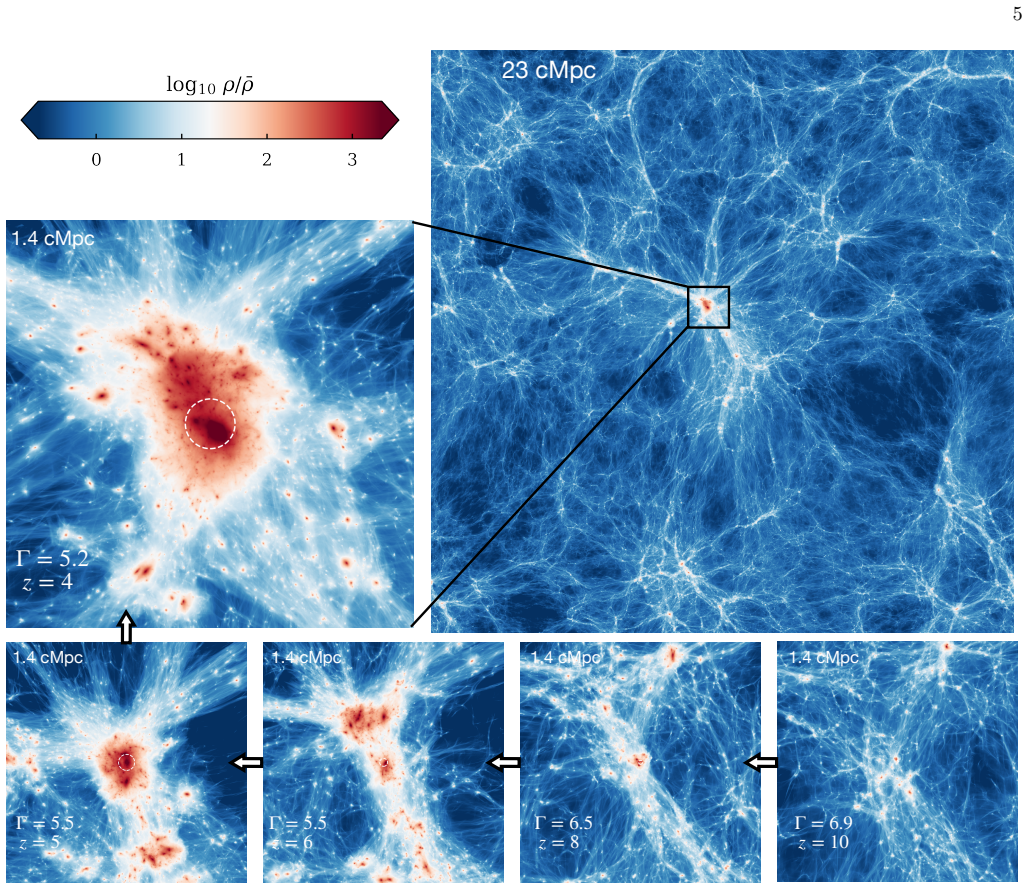
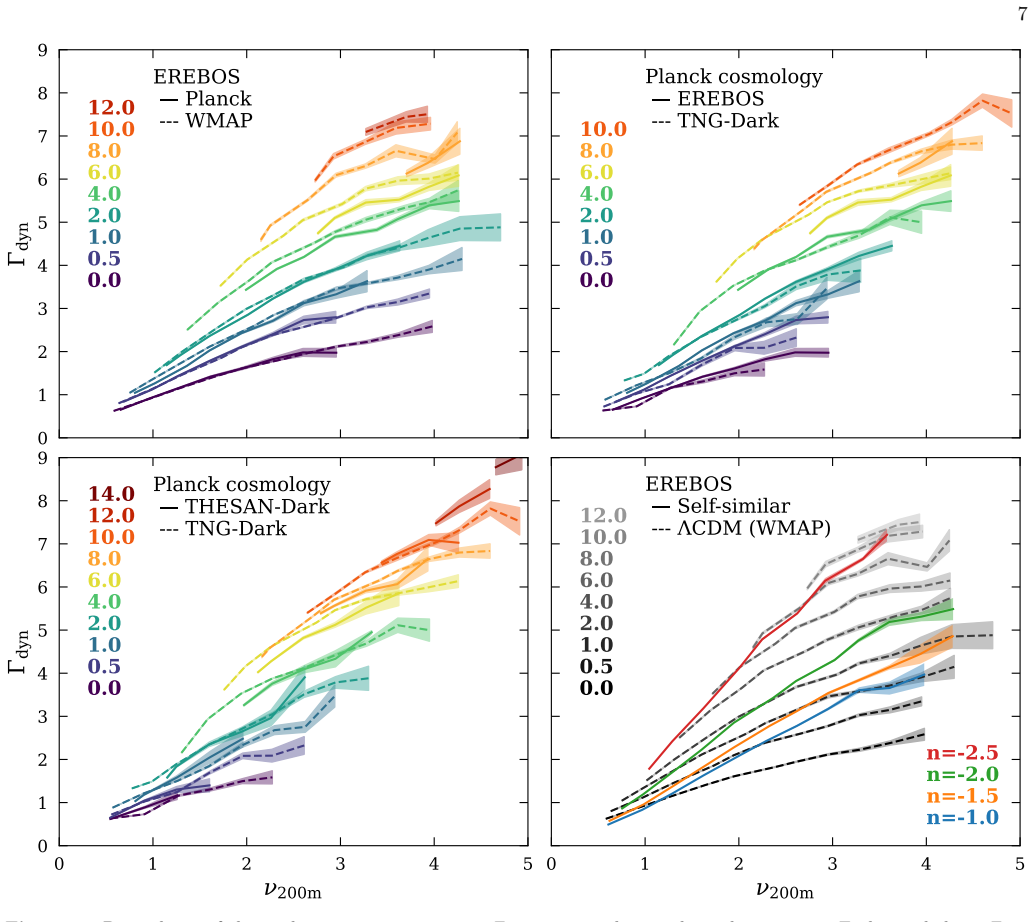
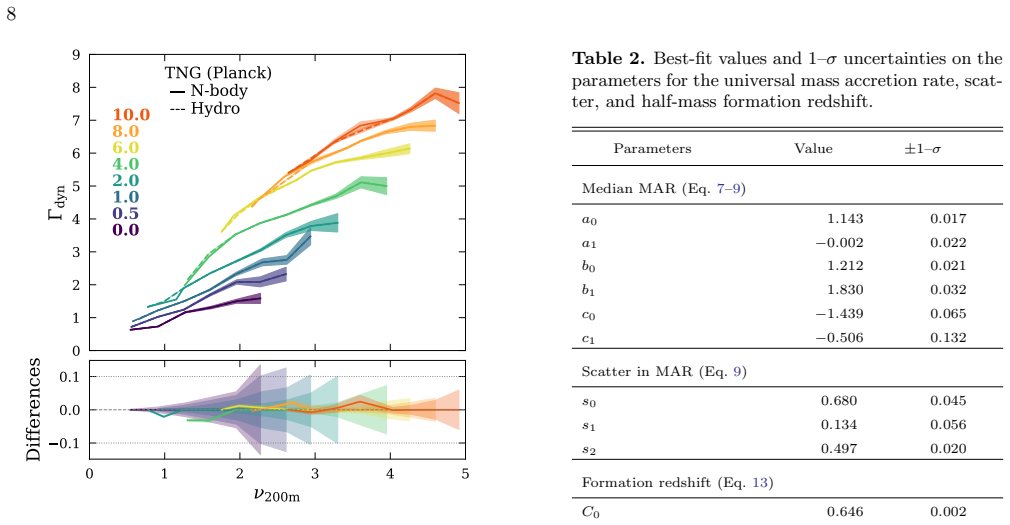
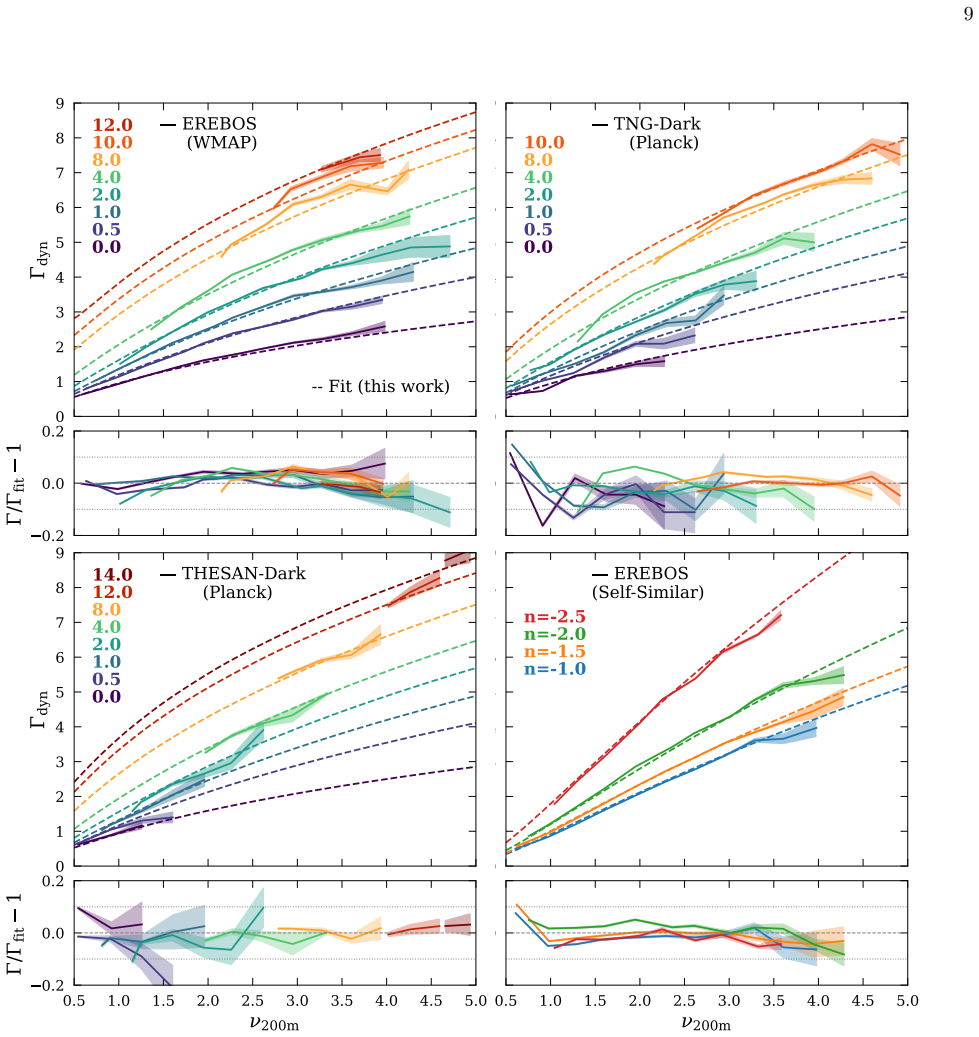
read the original abstract
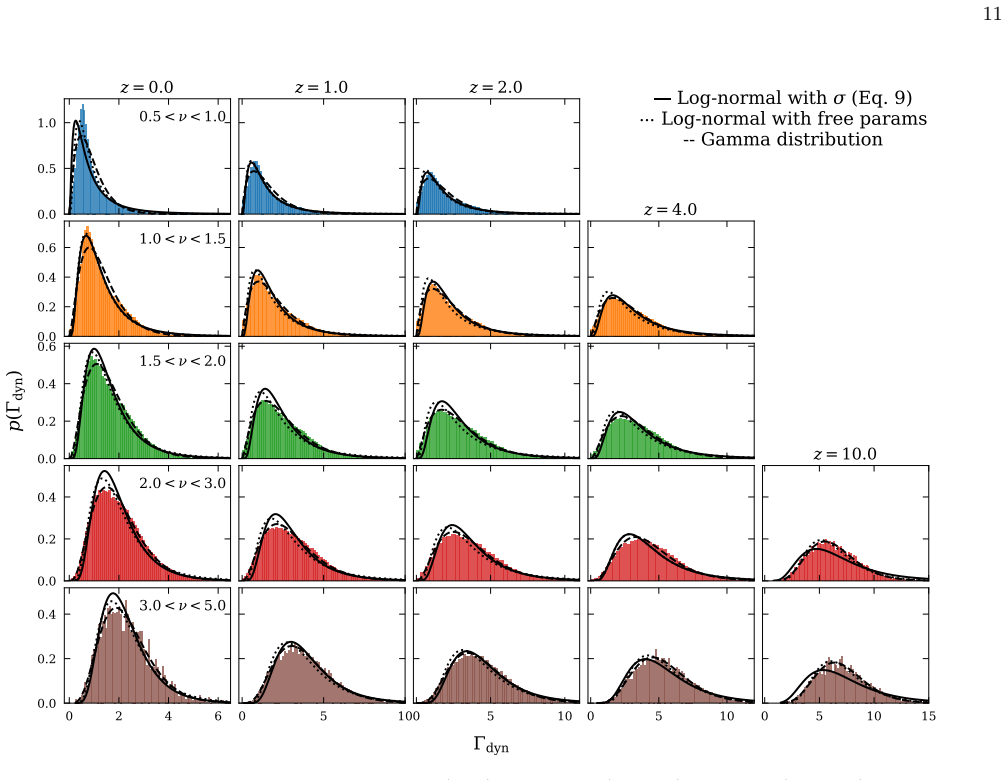
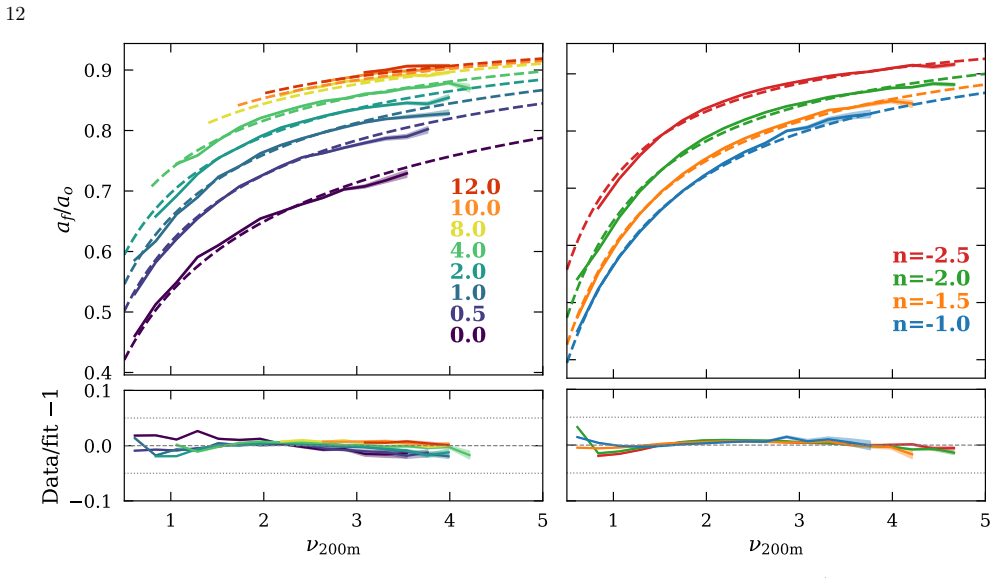
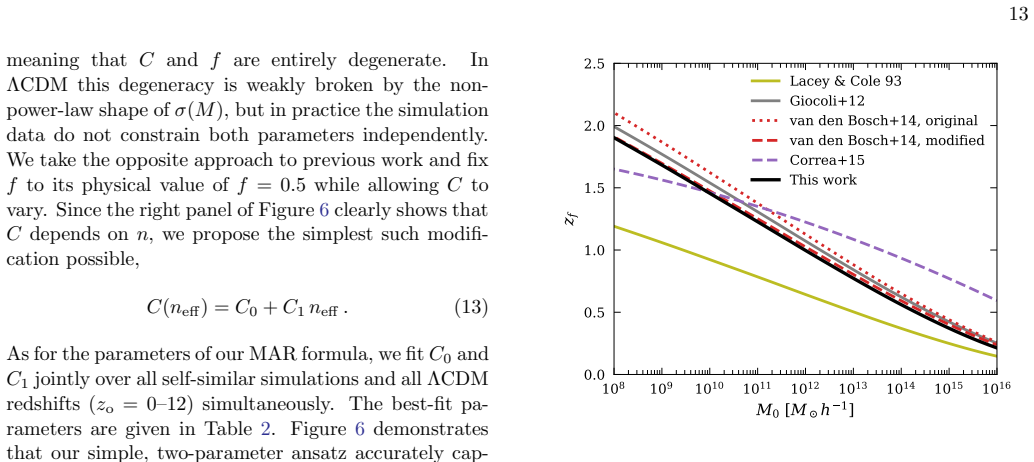
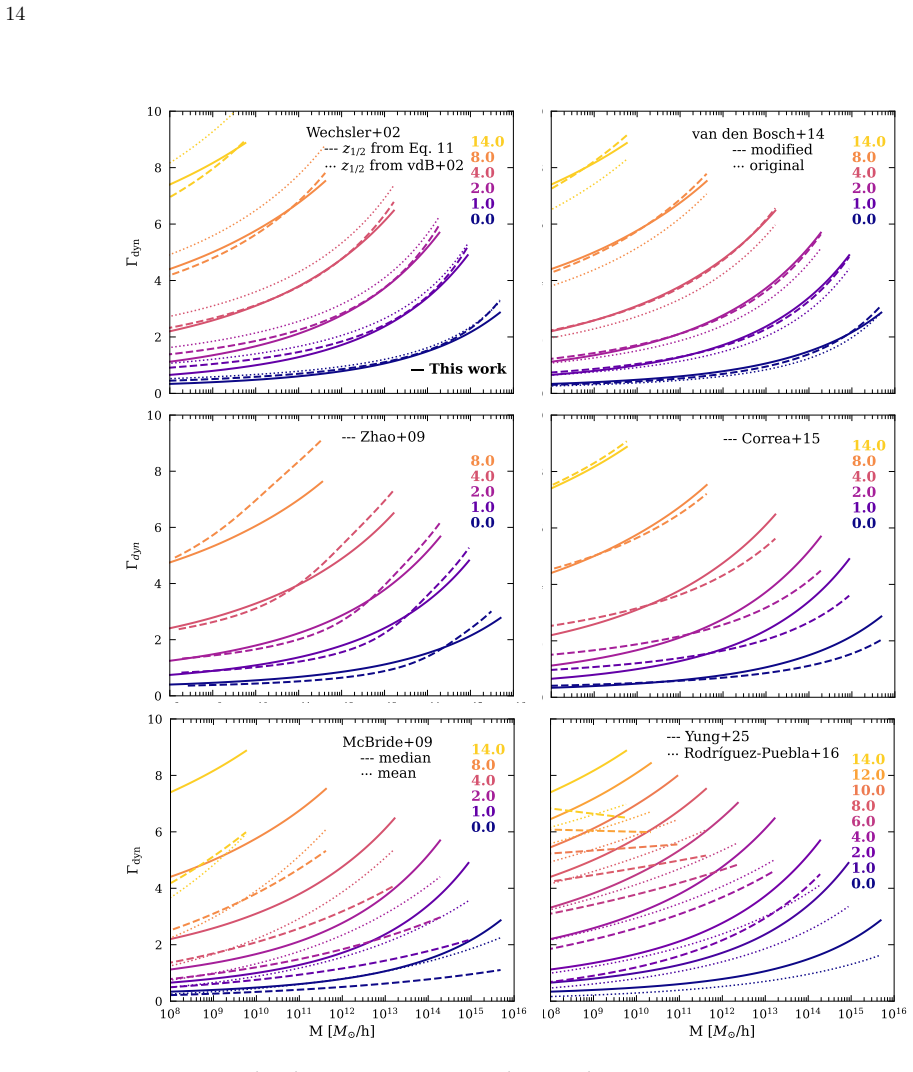
The formation histories of halos set the baseline rate at which galaxies accrete gas over cosmic time. While a number of models describe these histories and their derivative, the mass accretion rate (MAR), a simple and universal formula has remained elusive. Here we measure the median MARs and half-mass formation times of halos in dark matter-only and hydrodynamical simulations, in extremely different cosmologies ($\Lambda$CDM and Einstein-de Sitter), and across a wide range of redshifts ($z = 0$-$14$). We confirm that MARs increase with mass and redshift, and that they are virtually identical in hydrodynamical and dark matter-only simulations. We show that MARs are accurately described by a universal six-parameter function of three physical variables: the peak height $\nu$, the slope of the linear power spectrum $n_{\rm eff}$, and the effective linear growth rate $\alpha_{\rm eff}$. A complementary two-parameter fit for the formation redshift improves on the function of Lacey \& Cole by fixing one parameter to its physical value and adding a dependence on $n_{\rm eff}$. Our model is broadly consistent with some prescriptions from the literature but provides a larger range and higher accuracy at high redshifts and low masses. Our fitting functions are implemented in the publicly available \textsc{Colossus} toolkit.
Editorial analysis
A structured set of objections, weighed in public.
Referee Report
Summary. The paper measures median mass accretion rates (MARs) and half-mass formation times from dark matter-only and hydrodynamical simulations in ΛCDM and Einstein-de Sitter cosmologies at z=0–14. It claims that the MARs are accurately described by a universal six-parameter function of three variables (peak height ν, effective spectral index n_eff, and effective growth rate α_eff), and presents a complementary two-parameter fit for formation redshift that improves on Lacey & Cole by fixing one parameter to its physical value and adding n_eff dependence. The functions are implemented in the public Colossus toolkit and stated to be broadly consistent with some literature prescriptions while offering better accuracy at high z and low mass.
Significance. If the quantitative accuracy and universality hold, the result supplies a compact, cosmology-independent parametrization of halo accretion histories that could be adopted in semi-analytic galaxy formation models. The public Colossus implementation and the confirmation that hydrodynamical and dark-matter-only MARs are essentially identical are concrete strengths that aid reproducibility and community use.
major comments (3)
- [Abstract] Abstract: the statement that the six-parameter function 'accurately describes' the measured median MARs supplies no quantitative support (χ², residuals, rms error, cross-validation, or parameter uncertainties), so the data-to-claim link cannot be evaluated from the given information.
- [Fitting procedure and universality tests] Fitting and universality sections: the six parameters are determined by matching the median MARs extracted from the same ΛCDM+EdS simulation suite used to test the model; without held-out cosmologies, altered power spectra, or different dark-energy evolution, the claim that ν, n_eff and α_eff fully capture all cosmology dependence remains untested and the universality assertion is circular by construction.
- [Formation redshift section] Formation-time fit: the two-parameter model is presented as an improvement over Lacey & Cole, but no direct quantitative comparison (e.g., residuals or R² on the same data) is supplied to demonstrate the improvement or to show that fixing one parameter to its physical value is justified across the full redshift and mass range.
minor comments (2)
- [Abstract and methods] Abstract and methods: the exact halo mass range, number of halos per bin, and simulation volume/resolution details used for the median MAR extraction should be stated explicitly to allow readers to judge the statistical robustness of the fit.
- [Figures and notation] Figure captions and text: labels for the three input variables (ν, n_eff, α_eff) and the six fit parameters should be defined at first use with their precise mathematical definitions.
Simulated Author's Rebuttal
We thank the referee for the careful and constructive report. We address each major comment below and indicate where revisions will be made to strengthen the manuscript.
read point-by-point responses
-
Referee: [Abstract] Abstract: the statement that the six-parameter function 'accurately describes' the measured median MARs supplies no quantitative support (χ², residuals, rms error, cross-validation, or parameter uncertainties), so the data-to-claim link cannot be evaluated from the given information.
Authors: We agree that the abstract would benefit from quantitative support. In the revised manuscript we will add a concise statement of the typical rms residuals (approximately 0.05–0.1 dex across the probed range) and will include parameter uncertainties and a summary of fit quality in a new subsection of the results. These metrics will also be referenced briefly in the abstract. revision: yes
-
Referee: [Fitting procedure and universality tests] Fitting and universality sections: the six parameters are determined by matching the median MARs extracted from the same ΛCDM+EdS simulation suite used to test the model; without held-out cosmologies, altered power spectra, or different dark-energy evolution, the claim that ν, n_eff and α_eff fully capture all cosmology dependence remains untested and the universality assertion is circular by construction.
Authors: The two cosmologies employed (flat ΛCDM and Einstein-de Sitter) differ substantially in both expansion history and the redshift evolution of the power spectrum, and the variables ν, n_eff and α_eff were selected precisely because they encode the leading physical dependencies. Nevertheless, we acknowledge that the tests are performed on the same simulation suite. In the revision we will clarify the scope of the universality claim, explicitly note the absence of additional cosmologies, and discuss this as a limitation rather than asserting complete cosmology independence. revision: partial
-
Referee: [Formation redshift section] Formation-time fit: the two-parameter model is presented as an improvement over Lacey & Cole, but no direct quantitative comparison (e.g., residuals or R² on the same data) is supplied to demonstrate the improvement or to show that fixing one parameter to its physical value is justified across the full redshift and mass range.
Authors: We agree that a side-by-side quantitative comparison is needed. The revised manuscript will include a table or figure showing residuals and goodness-of-fit statistics for both our model and the Lacey & Cole prescription evaluated on the identical data set. We will also provide a brief physical justification for fixing the relevant parameter and demonstrate that the improvement holds across the full redshift and mass range examined. revision: yes
Circularity Check
Empirical fit presented as universal description; no reduction of derivation to inputs by construction
full rationale
The paper measures median MARs directly from a suite of DM-only and hydrodynamical simulations in ΛCDM and EdS cosmologies, then constructs a six-parameter fitting function of ν, n_eff and α_eff to describe those measurements. This is a standard empirical modeling workflow with no claimed first-principles derivation, no self-citation load-bearing step, and no instance in which a fitted parameter is renamed as an independent prediction or where an equation reduces to its inputs by definition. The universality claim rests on the representativeness of the chosen variables and simulation suite, but that is an evidentiary question rather than a circularity in the derivation chain itself. No quoted equations or steps exhibit the specific reductions required for a positive circularity finding.
Axiom & Free-Parameter Ledger
free parameters (1)
- six parameters of the MAR fitting function
axioms (2)
- domain assumption Median MARs from the dark-matter-only and hydrodynamical runs in the two cosmologies are representative of the physical accretion process.
- ad hoc to paper The three-variable functional form with six parameters is sufficient to capture all relevant dependencies without additional terms or cosmology-specific adjustments.
Reference graph
Works this paper leans on
-
[1]
Adhikari , S., Dalal , N., & Chamberlain , R. T. 2014, title Splashback in accreting dark matter halos , JCAP, 11, 19, 10.1088/1475-7516/2014/11/019
-
[2]
Astropy Collaboration , Robitaille , T. P., Tollerud , E. J., et al. 2013, title Astropy: A community Python package for astronomy , , 558, A33, 10.1051/0004-6361/201322068
-
[3]
Astropy Collaboration , Price-Whelan , A. M., Sip o cz , B. M., et al. 2018, title The Astropy Project: Building an Open-science Project and Status of the v2.0 Core Package , , 156, 123, 10.3847/1538-3881/aabc4f
-
[4]
Astropy Collaboration , Price-Whelan , A. M., Lim , P. L., et al. 2022, title The Astropy Project: Sustaining and Growing a Community-oriented Open-source Project and the Latest Major Release (v5.0) of the Core Package , , 935, 167, 10.3847/1538-4357/ac7c74
work page internal anchor Pith review doi:10.3847/1538-4357/ac7c74 2022
-
[5]
Avila , S., Knebe , A., Pearce , F. R., et al. 2014, title SUSSING MERGER TREES: the influence of the halo finder , , 441, 3488, 10.1093/mnras/stu799
-
[6]
Bardeen , J. M., Bond , J. R., Kaiser , N., & Szalay , A. S. 1986, title The statistics of peaks of Gaussian random fields , , 304, 15, 10.1086/164143
-
[7]
Behroozi , P., Wechsler , R. H., Hearin , A. P., & Conroy , C. 2019, title UNIVERSEMACHINE: The correlation between galaxy growth and dark matter halo assembly from z = 0-10 , , 488, 3143, 10.1093/mnras/stz1182
-
[8]
Behroozi , P. S., Wechsler , R. H., & Wu , H.-Y. 2013 a , title The ROCKSTAR Phase-space Temporal Halo Finder and the Velocity Offsets of Cluster Cores , , 762, 109, 10.1088/0004-637X/762/2/109
work page internal anchor Pith review doi:10.1088/0004-637x/762/2/109 2013
-
[9]
Behroozi , P. S., Wechsler , R. H., Wu , H.-Y., et al. 2013 b , title Gravitationally Consistent Halo Catalogs and Merger Trees for Precision Cosmology , , 763, 18, 10.1088/0004-637X/763/1/18
work page internal anchor Pith review doi:10.1088/0004-637x/763/1/18 2013
-
[10]
Benson , A. J. 2017, title The mass function of unprocessed dark matter haloes and merger tree branching rates , , 467, 3454, 10.1093/mnras/stx343
-
[11]
Benson , A. J., Borgani , S., De Lucia , G., Boylan-Kolchin , M., & Monaco , P. 2012, title Convergence of galaxy properties with merger tree temporal resolution , , 419, 3590, 10.1111/j.1365-2966.2011.20002.x
-
[12]
R., Cole , S., Efstathiou , G., & Kaiser , N
Bond , J. R., Cole , S., Efstathiou , G., & Kaiser , N. 1991, title Excursion set mass functions for hierarchical Gaussian fluctuations , , 379, 440, 10.1086/170520
-
[13]
Brown , S. T., McCarthy , I. G., Diemer , B., et al. 2020, title Connecting the structure of dark matter haloes to the primordial power spectrum , , 495, 4994, 10.1093/mnras/staa1491
-
[14]
Cole , S., Lacey , C. G., Baugh , C. M., & Frenk , C. S. 2000, title Hierarchical galaxy formation , , 319, 168, 10.1046/j.1365-8711.2000.03879.x
-
[15]
Correa , C. A., Wyithe , J. S. B., Schaye , J., & Duffy , A. R. 2015 a , title The accretion history of dark matter haloes - I. The physical origin of the universal function , , 450, 1514, 10.1093/mnras/stv689
-
[16]
Correa , C. A., Wyithe , J. S. B., Schaye , J., & Duffy , A. R. 2015 b , title The accretion history of dark matter haloes - III. A physical model for the concentration-mass relation , , 452, 1217, 10.1093/mnras/stv1363
-
[17]
Interpretable Machine Learning for Science with PySR and SymbolicRegression.jl
Cranmer , M. 2023, title Interpretable Machine Learning for Science with PySR and SymbolicRegression.jl , arXiv e-prints, arXiv:2305.01582, 10.48550/arXiv.2305.01582
work page internal anchor Pith review Pith/arXiv arXiv doi:10.48550/arxiv.2305.01582 2023
-
[18]
Crocce , M., Pueblas , S., & Scoccimarro , R. 2006, title Transients from initial conditions in cosmological simulations , , 373, 369, 10.1111/j.1365-2966.2006.11040.x
-
[19]
2010, title The Origin of Dark Matter Halo Profiles , arXiv:1010.2539
Dalal , N., Lithwick , Y., & Kuhlen , M. 2010, title The Origin of Dark Matter Halo Profiles , arXiv:1010.2539. 1010.2539
Pith/arXiv arXiv 2010
-
[20]
Dalal , N., White , M., Bond , J. R., & Shirokov , A. 2008, title Halo Assembly Bias in Hierarchical Structure Formation , , 687, 12, 10.1086/591512
-
[21]
Dekel , A., Birnboim , Y., Engel , G., et al. 2009, title Cold streams in early massive hot haloes as the main mode of galaxy formation , , 457, 451, 10.1038/nature07648
work page internal anchor Pith review doi:10.1038/nature07648 2009
-
[22]
2017, title The Splashback Radius of Halos from Particle Dynamics
Diemer , B. 2017, title The Splashback Radius of Halos from Particle Dynamics. I. The SPARTA Algorithm , , 231, 5, 10.3847/1538-4365/aa799c
-
[23]
2018, ApJS, 239, 35, doi: 10.3847/1538-4365/aaee8c
Diemer , B. 2018, title COLOSSUS: A Python Toolkit for Cosmology, Large-scale Structure, and Dark Matter Halos , , 239, 35, 10.3847/1538-4365/aaee8c
-
[24]
2020, title The Splashback Radius of Halos from Particle Dynamics
Diemer , B. 2020, title The Splashback Radius of Halos from Particle Dynamics. III. Halo Catalogs, Merger Trees, and Host-Subhalo Relations , , 251, 17, 10.3847/1538-4365/abbf51
-
[25]
2022, title A dynamics-based density profile for dark haloes - I
Diemer , B. 2022, title A dynamics-based density profile for dark haloes - I. Algorithm and basic results , , 513, 573, 10.1093/mnras/stac878
-
[26]
2019, ApJ, 871, 168, doi: 10.3847/1538-4357/aafad6
Diemer , B., & Joyce , M. 2019, title An Accurate Physical Model for Halo Concentrations , , 871, 168, 10.3847/1538-4357/aafad6
-
[27]
Diemer , B., & Kravtsov , A. V. 2014, title Dependence of the Outer Density Profiles of Halos on Their Mass Accretion Rate , , 789, 1, 10.1088/0004-637X/789/1/1
-
[28]
Diemer , B., & Kravtsov , A. V. 2015, title A Universal Model for Halo Concentrations , , 799, 108, 10.1088/0004-637X/799/1/108
-
[29]
Diemer , B., Kravtsov , A. V., & More , S. 2013 a , title On the Evolution of Cluster Scaling Relations , , 779, 159, 10.1088/0004-637X/779/2/159
-
[30]
Diemer , B., More , S., & Kravtsov , A. V. 2013 b , title The Pseudo-evolution of Halo Mass , , 766, 25, 10.1088/0004-637X/766/1/25
-
[31]
doi:10.1111/j.1365-2966.2009.15868.x , eprint =
Dolag , K., Borgani , S., Murante , G., & Springel , V. 2009, title Substructures in hydrodynamical cluster simulations , , 399, 497, 10.1111/j.1365-2966.2009.15034.x
-
[32]
Efstathiou , G., Frenk , C. S., White , S. D. M., & Davis , M. 1988, title Gravitational clustering from scale-free initial conditions. , , 235, 715, 10.1093/mnras/235.3.715
-
[33]
Eisenstein , D. J., & Hu , W. 1998, title Baryonic Features in the Matter Transfer Function , , 496, 605, 10.1086/305424
-
[34]
doi:10.1111/j.1365-2966.2009.15868.x , eprint =
Fakhouri , O., & Ma , C.-P. 2009, title Environmental dependence of dark matter halo growth - I. Halo merger rates , , 394, 1825, 10.1111/j.1365-2966.2009.14480.x
-
[35]
M., 2011, @doi [ ] 10.1111/j.1365-2966.2010.17821.x , 411, 1917
Fakhouri , O., Ma , C.-P., & Boylan-Kolchin , M. 2010, title The merger rates and mass assembly histories of dark matter haloes in the two Millennium simulations , , 406, 2267, 10.1111/j.1365-2966.2010.16859.x
-
[36]
Faucher-Gigu \`e re , C.-A., Kere s , D., & Ma , C.-P. 2011, title The baryonic assembly of dark matter haloes , , 417, 2982, 10.1111/j.1365-2966.2011.19457.x
-
[37]
Gao , L., Springel , V., & White , S. D. M. 2005, title The age dependence of halo clustering , , 363, L66, 10.1111/j.1745-3933.2005.00084.x
-
[38]
Garaldi , E., Kannan , R., Smith , A., et al. 2022, title The THESAN project: properties of the intergalactic medium and its connection to reionization-era galaxies , , 512, 4909, 10.1093/mnras/stac257
-
[39]
Genel , S., Bouch \'e , N., Naab , T., Sternberg , A., & Genzel , R. 2010, title The Growth of Dark Matter Halos: Evidence for Significant Smooth Accretion , , 719, 229, 10.1088/0004-637X/719/1/229
-
[40]
Genel , S., Genzel , R., Bouch \'e , N., et al. 2008, title Mergers and Mass Accretion Rates in Galaxy Assembly: The Millennium Simulation Compared to Observations of z 2 Galaxies , , 688, 789, 10.1086/592241
-
[41]
Giocoli , C., Moreno , J., Sheth , R. K., & Tormen , G. 2007, title An improved model for the formation times of dark matter haloes , , 376, 977, 10.1111/j.1365-2966.2007.11520.x
-
[42]
Giocoli , C., Tormen , G., & Sheth , R. K. 2012, title Formation times, mass growth histories and concentrations of dark matter haloes , , 422, 185, 10.1111/j.1365-2966.2012.20594.x
-
[43]
Gouin , C., Bonnaire , T., & Aghanim , N. 2021, title Shape and connectivity of groups and clusters: Effect of the dynamical state and accretion history , , 651, A56, 10.1051/0004-6361/202140327
-
[44]
, year = 1972, month = aug, volume =
Gunn , J. E., & Gott , III, J. R. 1972, title On the Infall of Matter Into Clusters of Galaxies and Some Effects on Their Evolution , , 176, 1, 10.1086/151605
-
[45]
Harris , C. R., Millman , K. J., van der Walt , S. J., et al. 2020, title Array programming with NumPy , , 585, 357, 10.1038/s41586-020-2649-2
-
[46]
P., Chaves-Montero , J., Becker , M
Hearin , A. P., Chaves-Montero , J., Becker , M. R., & Alarcon , A. 2021, title A Differentiable Model of the Assembly of Individual and Populations of Dark Matter Halos , The Open Journal of Astrophysics, 4, 7, 10.21105/astro.2105.05859
-
[47]
Henriques , B. M. B., White , S. D. M., Thomas , P. A., et al. 2015, title Galaxy formation in the Planck cosmology - I. Matching the observed evolution of star formation rates, colours and stellar masses , , 451, 2663, 10.1093/mnras/stv705
-
[48]
Hunter , J. D. 2007, title Matplotlib: A 2D Graphics Environment , Computing in Science and Engineering, 9, 90, 10.1109/MCSE.2007.55
-
[49]
Jing , Y. P. 1998, title Accurate Fitting Formula for the Two-Point Correlation Function of Dark Matter Halos , , 503, L9, 10.1086/311530
-
[50]
Joyce , M., Garrison , L., & Eisenstein , D. 2021, title Quantifying resolution in cosmological N-body simulations using self-similarity , , 501, 5051, 10.1093/mnras/staa3434
-
[51]
Kannan , R., Garaldi , E., Smith , A., et al. 2022, title Introducing the THESAN project: radiation-magnetohydrodynamic simulations of the epoch of reionization , , 511, 4005, 10.1093/mnras/stab3710
-
[52]
Kere s , D., Katz , N., Weinberg , D. H., & Dav \'e , R. 2005, title How do galaxies get their gas? , , 363, 2, 10.1111/j.1365-2966.2005.09451.x
-
[53]
A., Trujillo-Gomez , S., & Primack , J
Klypin , A. A., Trujillo-Gomez , S., & Primack , J. 2011, title Dark Matter Halos in the Standard Cosmological Model: Results from the Bolshoi Simulation , , 740, 102, 10.1088/0004-637X/740/2/102
-
[54]
Knebe , A., Knollmann , S. R., Muldrew , S. I., et al. 2011, title Haloes gone MAD: The Halo-Finder Comparison Project , , 415, 2293, 10.1111/j.1365-2966.2011.18858.x
-
[55]
Knollmann , S. R., Power , C., & Knebe , A. 2008, title Dark matter halo profiles in scale-free cosmologies , , 385, 545, 10.1111/j.1365-2966.2008.12857.x
-
[56]
Komatsu , E., Smith , K. M., Dunkley , J., et al. 2011, title Seven-year Wilkinson Microwave Anisotropy Probe (WMAP) Observations: Cosmological Interpretation , , 192, 18, 10.1088/0067-0049/192/2/18
work page internal anchor Pith review doi:10.1088/0067-0049/192/2/18 2011
-
[57]
1993, title Merger rates in hierarchical models of galaxy formation , , 262, 627
Lacey , C., & Cole , S. 1993, title Merger rates in hierarchical models of galaxy formation , , 262, 627
1993
-
[58]
Lacey , C., & Cole , S. 1994, title Merger Rates in Hierarchical Models of Galaxy Formation - Part Two - Comparison with N-Body Simulations , , 271, 676, 10.1093/mnras/271.3.676
-
[59]
Leroy , M., Garrison , L., Eisenstein , D., Joyce , M., & Maleubre , S. 2021, title Testing dark matter halo properties using self-similarity , , 501, 5064, 10.1093/mnras/staa3435
-
[60]
Lewis , A., Challinor , A., & Lasenby , A. 2000, title Efficient Computation of Cosmic Microwave Background Anisotropies in Closed Friedmann-Robertson-Walker Models , , 538, 473, 10.1086/309179
-
[61]
Ludlow , A. D., Bose , S., Angulo , R. E., et al. 2016, title The mass-concentration-redshift relation of cold and warm dark matter haloes , , 460, 1214, 10.1093/mnras/stw1046
-
[62]
Ludlow , A. D., Navarro , J. F., Boylan-Kolchin , M., et al. 2013, title The mass profile and accretion history of cold dark matter haloes , , 432, 1103, 10.1093/mnras/stt526
-
[63]
Macci \`o , A. V., Dutton , A. A., & van den Bosch , F. C. 2008, title Concentration, spin and shape of dark matter haloes as a function of the cosmological model: WMAP1, WMAP3 and WMAP5 results , , 391, 1940, 10.1111/j.1365-2966.2008.14029.x
-
[64]
Marinacci , F., Vogelsberger , M., Pakmor , R., et al. 2018, title First results from the IllustrisTNG simulations: radio haloes and magnetic fields , , 480, 5113, 10.1093/mnras/sty2206
work page internal anchor Pith review doi:10.1093/mnras/sty2206 2018
-
[65]
Massey, F. J. 1951, title The Kolmogorov-Smirnov Test for Goodness of Fit, Journal of the American Statistical Association, 46, 68. http://www.jstor.org/stable/2280095
arXiv 1951
-
[66]
Maulbetsch , C., Avila-Reese , V., Col \' n , P., et al. 2007, title The Dependence of the Mass Assembly History of Cold Dark Matter Halos on Environment , , 654, 53, 10.1086/509706
-
[67]
doi:10.1111/j.1365-2966.2009.15868.x , eprint =
McBride , J., Fakhouri , O., & Ma , C.-P. 2009, title Mass accretion rates and histories of dark matter haloes , , 398, 1858, 10.1111/j.1365-2966.2009.15329.x
-
[68]
Mirocha , J., Furlanetto , S. R., & Sun , G. 2017, title The global 21-cm signal in the context of the high- z galaxy luminosity function , , 464, 1365, 10.1093/mnras/stw2412
-
[69]
Mo , H., van den Bosch , F. C., & White , S. 2010, Galaxy Formation and Evolution , 10.1017/CBO9780511807244
-
[70]
Mo , H. J., & White , S. D. M. 1996, title An analytic model for the spatial clustering of dark matter haloes , , 282, 347, 10.1093/mnras/282.2.347
-
[71]
Moster , B. P., Naab , T., & White , S. D. M. 2018, title EMERGE - an empirical model for the formation of galaxies since z 10 , , 477, 1822, 10.1093/mnras/sty655
-
[72]
P., Pillepich , A., Springel , V., et al
Naiman , J. P., Pillepich , A., Springel , V., et al. 2018, title First results from the IllustrisTNG simulations: a tale of two elements - chemical evolution of magnesium and europium , , 477, 1206, 10.1093/mnras/sty618
work page internal anchor Pith review doi:10.1093/mnras/sty618 2018
-
[73]
Navarro , J. F., Frenk , C. S., & White , S. D. M. 1997, title A Universal Density Profile from Hierarchical Clustering , , 490, 493, 10.1086/304888
-
[74]
Neistein , E., & Dekel , A. 2008, title Constructing merger trees that mimic N-body simulations , , 383, 615, 10.1111/j.1365-2966.2007.12570.x
-
[75]
Nelson , D., Pillepich , A., Springel , V., et al. 2018, title First results from the IllustrisTNG simulations: the galaxy colour bimodality , , 475, 624, 10.1093/mnras/stx3040
work page internal anchor Pith review doi:10.1093/mnras/stx3040 2018
-
[76]
Nelson , D., Springel , V., Pillepich , A., et al. 2019, title The IllustrisTNG simulations: public data release , Computational Astrophysics and Cosmology, 6, 2, 10.1186/s40668-019-0028-x
-
[77]
Park , J., Mesinger , A., Greig , B., & Gillet , N. 2019, title Inferring the astrophysics of reionization and cosmic dawn from galaxy luminosity functions and the 21-cm signal , , 484, 933, 10.1093/mnras/stz032
-
[78]
Parkinson , H., Cole , S., & Helly , J. 2008, title Generating dark matter halo merger trees , , 383, 557, 10.1111/j.1365-2966.2007.12517.x
-
[79]
Pillepich , A., Springel , V., Nelson , D., et al. 2018, title Simulating galaxy formation with the IllustrisTNG model , , 473, 4077, 10.1093/mnras/stx2656
work page internal anchor Pith review doi:10.1093/mnras/stx2656 2018
-
[80]
Planck Collaboration , Ade , P. A. R., Aghanim , N., et al. 2014, title Planck 2013 results. XVI. Cosmological parameters , , 571, A16, 10.1051/0004-6361/201321591
discussion (0)
Sign in with ORCID, Apple, or X to comment. Anyone can read and Pith papers without signing in.