A Crash Course in Supersymmetric Field Theory Across Dimensions
Reviewed by Pith T0 review T1 audit T2 compute T3 formal T4 kernel 2026-07-08 19:34 UTCgrok-4.5pith:JOPOJGBGrecord.jsonopen to challenge →
The pith
A cross-dimensional crash course shows that the same structures of supersymmetric field theory recur from two to ten dimensions and can be made concrete by representative computations.
A machine-rendered reading of the paper's core claim, the machinery that carries it, and where it could break.
Core claim
The same structural toolkit—supersymmetry algebras, multiplets, protected quantities, moduli spaces, deformations, anomalies, holomorphy, dualities, extremization principles, indices, BPS data, and anomaly constraints—recurs from two to ten spacetime dimensions and becomes concrete when worked through representative computations, thereby supplying a common language without requiring a classification of theories in any single dimension.
What carries the argument
The recurring structures themselves (supersymmetry algebras and multiplets, protected quantities, moduli spaces, deformations, anomalies, holomorphy, dualities, extremization principles, indices, BPS data, and anomaly constraints) form the organizing spine that carries the argument from two to ten dimensions.
If this is right
- A reader who works through the notes can recognize standard setups in talks and papers that jump between dimensions.
- The same techniques for protected quantities, indices, and BPS data apply, with only dimension-dependent details, from two to ten dimensions.
- Anomaly constraints and holomorphy continue to restrict consistent supersymmetric theories across the full range treated.
- Dualities and extremization principles appear as organizing tools rather than isolated curiosities once viewed cross-dimensionally.
Where Pith is reading between the lines
- The same organizational spine could be extended to one or eleven dimensions to test how many of the structures survive outside the range covered.
- Graduate courses could adopt the cross-dimensional order instead of the usual four-dimensional-first sequence.
- The concrete computations collected here could serve as a checklist for software that computes indices or BPS spectra in various dimensions.
Load-bearing premise
The particular selection of examples and computations is representative enough that a reader who masters them can reliably recognize the basic setups appearing in current research talks and papers, even though no full classification of theories is attempted in any one dimension.
What would settle it
If a substantial share of recent research talks and papers on supersymmetric field theory introduce basic setups whose terminology and structures lie outside the notes’ recurring list and worked examples, the claim that the survey supplies enough common language fails.
Figures

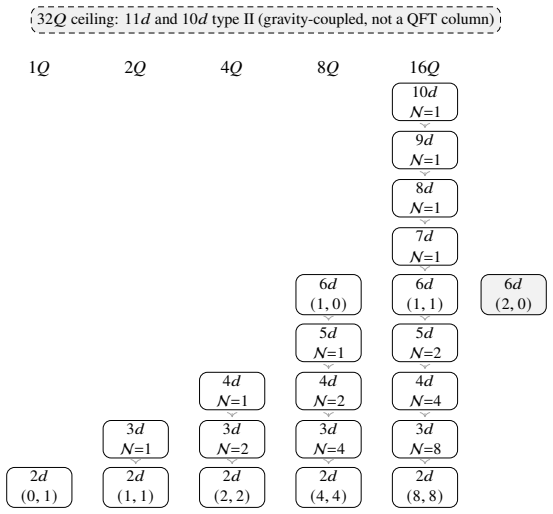


read the original abstract
These notes give a cross-dimensional crash course in supersymmetric field theory. The goal is to provide enough common language to recognize the basic setups used in talks and papers, while also working through representative computations that make the terminology concrete. We begin with supersymmetry algebras, multiplets, protected quantities, moduli spaces, deformations, and anomalies, then follow these ideas through examples in two to ten spacetime dimensions. The emphasis is on recurring structures, such as holomorphy, supersymmetric vacua, dualities, extremization principles, indices, BPS data, and anomaly constraints, rather than on a classification of theories in any one dimension.
Editorial analysis
A structured set of objections, weighed in public.
Referee Report
Summary. The manuscript is a set of pedagogical notes offering a cross-dimensional crash course in supersymmetric field theory. It organizes the material around recurring structures—supersymmetry algebras, multiplets, protected quantities, moduli spaces, deformations, anomalies, holomorphy, dualities, extremization principles, indices, BPS data, and anomaly constraints—rather than around a classification of theories in any single dimension. Representative computations are worked through in two through ten spacetime dimensions, with the stated goal of supplying enough common language for a reader to recognize the basic setups used in research talks and papers and of making the associated terminology concrete.
Significance. If the exposition is accurate and the chosen examples are well selected, the notes would be a genuine service to the community. Research talks and papers routinely move across dimensions and rely on a shared vocabulary of protected quantities, moduli problems, dualities, indices, and anomaly constraints; a single reference that emphasizes those recurring structures, rather than a full classification in one dimension, fills a real pedagogical gap between standard single-dimension textbooks and the research literature. The explicit commitment to representative computations (as opposed to pure taxonomy) is a strength of the stated design. Because the central claim is pedagogical rather than a novel research assertion, significance is measured by clarity, accuracy of the worked examples, and usefulness of the organizational principle.
minor comments (5)
- The abstract and opening statement of goals should more explicitly declare the assumed background (e.g., familiarity with ordinary QFT and with at least one standard treatment of 4d N=1 supersymmetry) and the intended audience. A crash course spanning 2–10d is ambitious; readers need a clear signal of what is presupposed so they can judge whether the notes match their preparation.
- When the notes decline a classification in any one dimension, it would help to add a short, explicit map (even a one-page table or roadmap) from the recurring structures listed in the abstract to the dimensional examples that illustrate them. That would make the selection principle legible and would address the natural question of representativeness without expanding the scope into a classification.
- Cross-references to standard textbook treatments (Wess–Bagger, Weinberg Vol. III, Freedman–Van Proeyen, the various TASI/PiTP notes on SUSY and dualities, etc.) should be placed at the first occurrence of each major structure so that a reader who wants a fuller single-dimension development can find it immediately.
- Notation for supercharges, R-symmetries, and central charges should be standardized early and kept uniform across the dimensional examples; small drifts in conventions between sections are a common source of confusion in multi-dimensional surveys.
- Where dualities, extremization principles, or anomaly constraints are illustrated, a one-sentence statement of the precise claim being checked in that example (and of what would constitute a failure of the check) would make the ‘representative computation’ more falsifiable for the student reader.
Simulated Author's Rebuttal
We thank the referee for a careful and constructive reading of our notes. We are grateful for the clear summary of the manuscript’s aims and for the assessment that a cross-dimensional, structure-first presentation can fill a genuine pedagogical gap between single-dimension textbooks and the research literature. We also appreciate the emphasis on representative computations rather than pure taxonomy as a strength of the design. The recommendation is minor revision; the report as provided does not list concrete major comments or requested changes. We therefore respond to the overall evaluation below and remain ready to incorporate any specific minor corrections the referee or editor may still wish to indicate.
read point-by-point responses
-
Referee: REFEREE SIGNIFICANCE / overall evaluation: If the exposition is accurate and the chosen examples are well selected, the notes would be a genuine service to the community. Significance is measured by clarity, accuracy of the worked examples, and usefulness of the organizational principle. RECOMMENDATION: minor_revision. (No itemized major comments are supplied.)
Authors: We agree that, for a pedagogical manuscript, significance rests on clarity, accuracy of the worked examples, and the usefulness of organizing around recurring structures (algebras and multiplets, protected quantities, moduli and deformations, holomorphy, dualities, extremization, indices, BPS data, and anomaly constraints) rather than a full classification in one dimension. That organizational principle and the commitment to representative computations in two through ten dimensions are exactly the design choices we intended. Because the report does not identify specific inaccuracies, missing examples, or passages that require rewriting, we have not made content changes in response to major comments. We will of course correct any concrete errata or minor presentational issues that the referee or editor flags, and we are happy to expand or rebalance particular examples if that is requested. We believe the manuscript already meets the standards of accuracy and selection implied by the significance assessment, and we thank the referee for the supportive framing of the notes’ intended service to the community. revision: no
Circularity Check
No significant circularity: pedagogical survey with no novel first-principles predictions or forced results.
full rationale
These notes are an explicit crash-course survey whose stated goal is pedagogical common language (SUSY algebras, multiplets, protected quantities, moduli spaces, deformations, anomalies, holomorphy, dualities, extremization, indices, BPS data, anomaly constraints) plus representative computations in 2–10d, not a classification or a novel quantitative derivation. No load-bearing step claims that a target observable is obtained from first principles while that observable is already built into the inputs by definition, fit, or self-cited uniqueness. The notes draw structures and computations from the established literature rather than closing a loop under the author’s own fitted constants or an ansatz smuggled in via self-citation. Self-citations, if any, are ordinary survey references and are not used to forbid alternatives or to force a central result. Because there is no claimed prediction that reduces by construction to a fitted input or to a self-definitional identity, the circularity score is zero; the exposition is self-contained as pedagogy against external benchmarks.
Axiom & Free-Parameter Ledger
axioms (3)
- domain assumption Existence and standard classification of supersymmetry algebras and supermultiplets in 2–10 spacetime dimensions as developed in the prior literature.
- standard math Standard quantum field theory and representation theory of Lorentz and R-symmetry groups needed to define protected quantities, moduli spaces, anomalies, and indices.
- domain assumption That dualities, extremization principles, and anomaly constraints as used in the modern SUSY literature are correctly stated in the sources the notes draw on.
Reference graph
Works this paper leans on
-
[1]
Monopole Condensation, And Confinement In N=2 Supersymmetric Yang-Mills Theory
Seiberg, Nathan and Witten, Edward. Electric-magnetic duality, monopole condensation, and confinement in N=2 supersymmetric Yang-Mills theory. Nucl. Phys. B. 1994. doi:10.1016/0550-3213(94)90124-4. arXiv:hep-th/9407087
work page internal anchor Pith review Pith/arXiv arXiv doi:10.1016/0550-3213(94)90124-4 1994
-
[2]
Monopoles, Duality and Chiral Symmetry Breaking in N=2 Supersymmetric QCD
Seiberg, Nathan and Witten, Edward. Monopoles, duality and chiral symmetry breaking in N=2 supersymmetric QCD. Nucl. Phys. B. 1994. doi:10.1016/0550-3213(94)90214-3. arXiv:hep-th/9408099
work page internal anchor Pith review Pith/arXiv arXiv doi:10.1016/0550-3213(94)90214-3 1994
-
[3]
S-duality in N=2 supersymmetric gauge theories
Argyres, Philip C. and Seiberg, Nathan. S-duality in N=2 supersymmetric gauge theories. JHEP. 2007. doi:10.1088/1126-6708/2007/12/088. arXiv:0711.0054
work page internal anchor Pith review Pith/arXiv arXiv doi:10.1088/1126-6708/2007/12/088 2007
-
[4]
New Phenomena in SU(3) Supersymmetric Gauge Theory
Argyres, Philip C. and Douglas, Michael R. New phenomena in SU(3) supersymmetric gauge theory. Nucl. Phys. B. 1995. doi:10.1016/0550-3213(95)00281-V. arXiv:hep-th/9505062
work page internal anchor Pith review Pith/arXiv arXiv doi:10.1016/0550-3213(95)00281-v 1995
-
[5]
Gaiotto, Davide. N=2 dualities. JHEP. 2012. doi:10.1007/JHEP08(2012)034. arXiv:0904.2715
work page internal anchor Pith review Pith/arXiv arXiv doi:10.1007/jhep08(2012)034 2012
-
[6]
Four-dimensional wall-crossing via three-dimensional field theory
Gaiotto, Davide and Moore, Gregory W. and Neitzke, Andrew. Four-dimensional wall-crossing via three-dimensional field theory. Commun. Math. Phys. 2010. doi:10.1007/s00220-010-1071-2. arXiv:0807.4723
work page internal anchor Pith review Pith/arXiv arXiv doi:10.1007/s00220-010-1071-2 2010
-
[7]
Seiberg-Witten Prepotential From Instanton Counting
Nekrasov, Nikita A. Seiberg-Witten prepotential from instanton counting. Adv. Theor. Math. Phys. 2003. doi:10.4310/ATMP.2003.v7.n5.a4. arXiv:hep-th/0206161
work page internal anchor Pith review Pith/arXiv arXiv doi:10.4310/atmp.2003.v7.n5.a4 2003
-
[9]
New N=2 Superconformal Field Theories in Four Dimensions
Argyres, Philip C. and Plesser, M. Ronen and Seiberg, Nathan and Witten, Edward. New N=2 superconformal field theories in four-dimensions. Nucl. Phys. B. 1996. doi:10.1016/0550-3213(95)00671-0. arXiv:hep-th/9511154
work page internal anchor Pith review Pith/arXiv arXiv doi:10.1016/0550-3213(95)00671-0 1996
-
[10]
Central charges of N=2 superconformal field theories in four dimensions
Shapere, Alfred D. and Tachikawa, Yuji. Central charges of N=2 superconformal field theories in four dimensions. JHEP. 2008. doi:10.1088/1126-6708/2008/09/109. arXiv:0804.1957
work page internal anchor Pith review Pith/arXiv arXiv doi:10.1088/1126-6708/2008/09/109 2008
-
[11]
Seiberg-Witten Theory and Random Partitions
Nekrasov, Nikita and Okounkov, Andrei. Seiberg-Witten theory and random partitions. Prog. Math. 2006. doi:10.1007/0-8176-4467-9_15. arXiv:hep-th/0306238
work page internal anchor Pith review Pith/arXiv arXiv doi:10.1007/0-8176-4467-9_15 2006
-
[12]
Liouville Correlation Functions from Four-dimensional Gauge Theories
Alday, Luis F. and Gaiotto, Davide and Tachikawa, Yuji. Liouville Correlation Functions from Four-dimensional Gauge Theories. Lett. Math. Phys. 2010. doi:10.1007/s11005-010-0369-5. arXiv:0906.3219
work page internal anchor Pith review Pith/arXiv arXiv doi:10.1007/s11005-010-0369-5 2010
-
[13]
Localization of gauge theory on a four-sphere and supersymmetric Wilson loops
Pestun, Vasily. Localization of gauge theory on a four-sphere and supersymmetric Wilson loops. Commun. Math. Phys. 2012. doi:10.1007/s00220-012-1485-0. arXiv:0712.2824
work page internal anchor Pith review Pith/arXiv arXiv doi:10.1007/s00220-012-1485-0 2012
-
[14]
Localization techniques in quantum field theories
Pestun, Vasily and others. Localization techniques in quantum field theories. J. Phys. A. 2017. doi:10.1088/1751-8121/aa63c1. arXiv:1608.02952
work page internal anchor Pith review Pith/arXiv arXiv doi:10.1088/1751-8121/aa63c1 2017
-
[15]
Introduction to Seiberg-Witten Theory and its Stringy Origin
Lerche, W. Introduction to Seiberg-Witten theory and its stringy origin. Nucl. Phys. B Proc. Suppl. 1997. doi:10.1016/S0920-5632(97)00073-X. arXiv:hep-th/9611190
work page internal anchor Pith review Pith/arXiv arXiv doi:10.1016/s0920-5632(97)00073-x 1997
-
[16]
Gaiotto, Davide and Moore, Gregory W. and Neitzke, Andrew. Framed BPS States. Adv. Theor. Math. Phys. 2013. doi:10.4310/ATMP.2013.v17.n2.a1. arXiv:1006.0146
work page internal anchor Pith review Pith/arXiv arXiv doi:10.4310/atmp.2013.v17.n2.a1 2013
-
[17]
Wall-Crossing in Coupled 2d-4d Systems
Gaiotto, Davide and Moore, Gregory W. and Neitzke, Andrew. Wall-Crossing in Coupled 2d-4d Systems. JHEP. 2012. doi:10.1007/JHEP12(2012)082. arXiv:1103.2598
work page internal anchor Pith review Pith/arXiv arXiv doi:10.1007/jhep12(2012)082 2012
-
[18]
Seiberg-Witten Geometry of Four-Dimensional $\mathcal N=2$ Quiver Gauge Theories
Nekrasov, Nikita and Pestun, Vasily. Seiberg-Witten Geometry of Four-Dimensional N=2 Quiver Gauge Theories. SIGMA. 2023. doi:10.3842/SIGMA.2023.047. arXiv:1211.2240
work page internal anchor Pith review Pith/arXiv arXiv doi:10.3842/sigma.2023.047 2023
-
[19]
Geometric constraints on the space of N=2 SCFTs I: physical constraints on relevant deformations
Argyres, Philip and Lotito, Matteo and L. Geometric constraints on the space of N = 2 SCFTs. Part I: physical constraints on relevant deformations. JHEP. 2018. doi:10.1007/JHEP02(2018)001. arXiv:1505.04814
work page internal anchor Pith review Pith/arXiv arXiv doi:10.1007/jhep02(2018)001 2018
-
[20]
Deformations of Superconformal Theories
Cordova, Clay and Dumitrescu, Thomas T. and Intriligator, Kenneth. Deformations of Superconformal Theories. JHEP. 2016. doi:10.1007/JHEP11(2016)135. arXiv:1602.01217
work page internal anchor Pith review Pith/arXiv arXiv doi:10.1007/jhep11(2016)135 2016
-
[21]
General Argyres-Douglas Theory
Xie, Dan. General Argyres-Douglas Theory. JHEP. 2013. doi:10.1007/JHEP01(2013)100. arXiv:1204.2270
work page internal anchor Pith review Pith/arXiv arXiv doi:10.1007/jhep01(2013)100 2013
-
[22]
Infinite Chiral Symmetry in Four Dimensions
Beem, Christopher and Lemos, Madalena and Liendo, Pedro and Peelaers, Wolfger and Rastelli, Leonardo and van Rees, Balt C. Infinite Chiral Symmetry in Four Dimensions. Commun. Math. Phys. 2015. doi:10.1007/s00220-014-2272-x. arXiv:1312.5344
work page internal anchor Pith review Pith/arXiv arXiv doi:10.1007/s00220-014-2272-x 2015
-
[23]
Mirror Symmetry in Three Dimensional Gauge Theories
Intriligator, Kenneth A. and Seiberg, Nathan. Mirror symmetry in three-dimensional gauge theories. Phys. Lett. B. 1996. doi:10.1016/0370-2693(96)01088-X. arXiv:hep-th/9607207
work page internal anchor Pith review Pith/arXiv arXiv doi:10.1016/0370-2693(96)01088-x 1996
-
[24]
Topological Disorder Operators in Three-Dimensional Conformal Field Theory
Borokhov, Vadim and Kapustin, Anton and Wu, Xin-kai. Topological disorder operators in three-dimensional conformal field theory. JHEP. 2002. doi:10.1088/1126-6708/2002/11/049. arXiv:hep-th/0206054
work page internal anchor Pith review Pith/arXiv arXiv doi:10.1088/1126-6708/2002/11/049 2002
-
[25]
Polyakov conjecture for hyperbolic singularities
Borokhov, Vadim. Monopole operators in three-dimensional N=4 SYM and mirror symmetry. JHEP. 2004. doi:10.1088/1126-6708/2004/03/008. arXiv:hep-th/0308131
work page internal anchor Pith review Pith/arXiv arXiv doi:10.1088/1126-6708/2004/03/008 2004
-
[26]
The Exact Superconformal R-Symmetry Extremizes Z
Jafferis, Daniel L. The Exact Superconformal R-Symmetry Extremizes Z. JHEP. 2012. doi:10.1007/JHEP05(2012)159. arXiv:1012.3210
work page internal anchor Pith review Pith/arXiv arXiv doi:10.1007/jhep05(2012)159 2012
-
[27]
Aspects of N=2 Supersymmetric Gauge Theories in Three Dimensions
Aharony, Ofer and Hanany, Amihay and Intriligator, Kenneth A. and Seiberg, Nathan and Strassler, M. J. Aspects of N=2 supersymmetric gauge theories in three-dimensions. Nucl. Phys. B. 1997. doi:10.1016/S0550-3213(97)00323-4. arXiv:hep-th/9703110
work page internal anchor Pith review Pith/arXiv arXiv doi:10.1016/s0550-3213(97)00323-4 1997
-
[28]
IR Duality in d=3 N=2 Supersymmetric USp(2N_c) and U(N_c) Gauge Theories
Aharony, Ofer. IR duality in d = 3 N=2 supersymmetric USp(2N(c)) and U(N(c)) gauge theories. Phys. Lett. B. 1997. doi:10.1016/S0370-2693(97)00530-3. arXiv:hep-th/9703215
work page internal anchor Pith review Pith/arXiv arXiv doi:10.1016/s0370-2693(97)00530-3 1997
-
[29]
Seiberg Duality in Chern-Simons Theory
Giveon, Amit and Kutasov, David. Seiberg Duality in Chern-Simons Theory. Nucl. Phys. B. 2009. doi:10.1016/j.nuclphysb.2008.11.007. arXiv:0808.0360
work page internal anchor Pith review Pith/arXiv arXiv doi:10.1016/j.nuclphysb.2008.11.007 2009
-
[30]
N=6 superconformal Chern-Simons-matter theories, M2-branes and their gravity duals
Aharony, Ofer and Bergman, Oren and Jafferis, Daniel Louis and Maldacena, Juan. N=6 superconformal Chern-Simons-matter theories, M2-branes and their gravity duals. JHEP. 2008. doi:10.1088/1126-6708/2008/10/091. arXiv:0806.1218
work page internal anchor Pith review Pith/arXiv arXiv doi:10.1088/1126-6708/2008/10/091 2008
-
[31]
From weak to strong coupling in ABJM theory
Drukker, Nadav and Marino, Marcos and Putrov, Pavel. From weak to strong coupling in ABJM theory. Commun. Math. Phys. 2011. doi:10.1007/s00220-011-1253-6. arXiv:1007.3837
work page internal anchor Pith review Pith/arXiv arXiv doi:10.1007/s00220-011-1253-6 2011
-
[32]
Exact Results for Wilson Loops in Superconformal Chern-Simons Theories with Matter
Kapustin, Anton and Willett, Brian and Yaakov, Itamar. Exact Results for Wilson Loops in Superconformal Chern-Simons Theories with Matter. JHEP. 2010. doi:10.1007/JHEP03(2010)089. arXiv:0909.4559
work page internal anchor Pith review Pith/arXiv arXiv doi:10.1007/jhep03(2010)089 2010
-
[33]
The F-Theorem and F-Maximization
Pufu, Silviu S. The F-Theorem and F-Maximization. J. Phys. A. 2017. doi:10.1088/1751-8121/aa6765. arXiv:1608.02960
work page internal anchor Pith review Pith/arXiv arXiv doi:10.1088/1751-8121/aa6765 2017
-
[34]
Mirror Symmetry in Three-Dimensional Gauge Theories, Quivers and D-branes
de Boer, Jan and Hori, Kentaro and Ooguri, Hirosi and Oz, Yaron. Mirror symmetry in three-dimensional gauge theories, quivers and D-branes. Nucl. Phys. B. 1997. doi:10.1016/S0550-3213(97)00073-4. arXiv:hep-th/9611063
work page internal anchor Pith review Pith/arXiv arXiv doi:10.1016/s0550-3213(97)00073-4 1997
-
[35]
Redlich, A. N. Gauge Noninvariance and Parity Nonconservation of Three-Dimensional Fermions. Phys. Rev. Lett. 1984. doi:10.1103/PhysRevLett.52.18
-
[36]
N=2 supersymmetric dynamics for pedestrians
Tachikawa, Yuji. N=2 Supersymmetric Dynamics for Pedestrians. 2014. doi:10.1007/978-3-319-08822-8. arXiv:1312.2684
work page internal anchor Pith review Pith/arXiv arXiv doi:10.1007/978-3-319-08822-8 2014
-
[37]
On Conformal Theories in Four Dimensions
Lawrence, Albion E. and Nekrasov, Nikita and Vafa, Cumrun. On conformal field theories in four-dimensions. Nucl. Phys. B. 1998. doi:10.1016/S0550-3213(98)00495-7. arXiv:hep-th/9803015
work page internal anchor Pith review Pith/arXiv arXiv doi:10.1016/s0550-3213(98)00495-7 1998
-
[38]
Supersymmetry enhancement by monopole operators
Bashkirov, Denis and Kapustin, Anton. Supersymmetry enhancement by monopole operators. JHEP. 2011. doi:10.1007/JHEP05(2011)015. arXiv:1007.4861
work page internal anchor Pith review Pith/arXiv arXiv doi:10.1007/jhep05(2011)015 2011
-
[39]
Contact Terms, Unitarity, and F-Maximization in Three-Dimensional Superconformal Theories
Closset, Cyril and Dumitrescu, Thomas T. and Festuccia, Guido and Komargodski, Zohar and Seiberg, Nathan. Contact Terms, Unitarity, and F-Maximization in Three-Dimensional Superconformal Theories. JHEP. 2012. doi:10.1007/JHEP10(2012)053. arXiv:1205.4142
work page internal anchor Pith review Pith/arXiv arXiv doi:10.1007/jhep10(2012)053 2012
-
[40]
Bagger, Jonathan and Lambert, Neil. Modeling Multiple M2's. Phys. Rev. D. 2007. doi:10.1103/PhysRevD.75.045020. arXiv:hep-th/0611108
work page internal anchor Pith review Pith/arXiv arXiv doi:10.1103/physrevd.75.045020 2007
-
[41]
Algebraic structures on parallel M2-branes
Gustavsson, Andreas. Algebraic structures on parallel M2-branes. Nucl. Phys. B. 2009. doi:10.1016/j.nuclphysb.2008.11.014. arXiv:0709.1260
work page internal anchor Pith review Pith/arXiv arXiv doi:10.1016/j.nuclphysb.2008.11.014 2009
-
[42]
S-Duality of Boundary Conditions In N=4 Super Yang-Mills Theory
Gaiotto, Davide and Witten, Edward. S-Duality of Boundary Conditions In N=4 Super Yang-Mills Theory. Adv. Theor. Math. Phys. 2009. doi:10.4310/ATMP.2009.v13.n3.a5. arXiv:0807.3720
work page internal anchor Pith review Pith/arXiv arXiv doi:10.4310/atmp.2009.v13.n3.a5 2009
-
[43]
The Coulomb Branch of 3d $\mathcal{N}=4$ Theories
Bullimore, Mathew and Dimofte, Tudor and Gaiotto, Davide. The Coulomb Branch of 3d N = 4 Theories. Commun. Math. Phys. 2017. doi:10.1007/s00220-017-2903-0. arXiv:1503.04817
work page internal anchor Pith review Pith/arXiv arXiv doi:10.1007/s00220-017-2903-0 2017
-
[44]
On Mirror Symmetry in Three Dimensional Abelian Gauge Theories
Kapustin, Anton and Strassler, Matthew J. On mirror symmetry in three-dimensional Abelian gauge theories. JHEP. 1999. doi:10.1088/1126-6708/1999/04/021. arXiv:hep-th/9902033
work page internal anchor Pith review Pith/arXiv arXiv doi:10.1088/1126-6708/1999/04/021 1999
-
[45]
Type IIB Superstrings, BPS Monopoles, And Three-Dimensional Gauge Dynamics
Hanany, Amihay and Witten, Edward. Type IIB superstrings, BPS monopoles, and three-dimensional gauge dynamics. Nucl. Phys. B. 1997. doi:10.1016/S0550-3213(97)00157-0. arXiv:hep-th/9611230
work page internal anchor Pith review Pith/arXiv arXiv doi:10.1016/s0550-3213(97)00157-0 1997
-
[46]
Monopole operators and Hilbert series of Coulomb branches of 3d N = 4 gauge theories
Cremonesi, Stefano and Hanany, Amihay and Zaffaroni, Alberto. Monopole operators and Hilbert series of Coulomb branches of 3d N = 4 gauge theories. JHEP. 2014. doi:10.1007/JHEP01(2014)005. arXiv:1309.2657
work page internal anchor Pith review Pith/arXiv arXiv doi:10.1007/jhep01(2014)005 2014
-
[47]
3d dualities from 4d dualities
Aharony, Ofer and Razamat, Shlomo S. and Seiberg, Nathan and Willett, Brian. 3d dualities from 4d dualities. JHEP. 2013. doi:10.1007/JHEP07(2013)149. arXiv:1305.3924
work page internal anchor Pith review Pith/arXiv arXiv doi:10.1007/jhep07(2013)149 2013
-
[48]
A topologically twisted index for three-dimensional supersymmetric theories
Benini, Francesco and Zaffaroni, Alberto. A topologically twisted index for three-dimensional supersymmetric theories. JHEP. 2015. doi:10.1007/JHEP07(2015)127. arXiv:1504.03698
work page internal anchor Pith review Pith/arXiv arXiv doi:10.1007/jhep07(2015)127 2015
-
[49]
Gauge Theories Labelled by Three-Manifolds
Dimofte, Tudor and Gaiotto, Davide and Gukov, Sergei. Gauge Theories Labelled by Three-Manifolds. Commun. Math. Phys. 2014. doi:10.1007/s00220-013-1863-2. arXiv:1108.4389
work page internal anchor Pith review Pith/arXiv arXiv doi:10.1007/s00220-013-1863-2 2014
-
[50]
Comments on twisted indices in 3d supersymmetric gauge theories
Closset, Cyril and Kim, Heeyeon. Comments on twisted indices in 3d supersymmetric gauge theories. JHEP. 2016. doi:10.1007/JHEP08(2016)059. arXiv:1605.06531
work page internal anchor Pith review Pith/arXiv arXiv doi:10.1007/jhep08(2016)059 2016
-
[51]
On Three Dimensional Quiver Gauge Theories and Integrability
Gaiotto, Davide and Koroteev, Peter. On Three Dimensional Quiver Gauge Theories and Integrability. JHEP. 2013. doi:10.1007/JHEP05(2013)126. arXiv:1304.0779
work page internal anchor Pith review Pith/arXiv arXiv doi:10.1007/jhep05(2013)126 2013
-
[52]
Green, Michael B. and Schwarz, John H. Anomaly Cancellation in Supersymmetric D=10 Gauge Theory and Superstring Theory. Phys. Lett. B. 1984. doi:10.1016/0370-2693(84)91565-X
-
[53]
A Note on the Green - Schwarz Mechanism in Open - String Theories
Sagnotti, Augusto. A Note on the Green-Schwarz mechanism in open string theories. Phys. Lett. B. 1992. doi:10.1016/0370-2693(92)91369-J. arXiv:hep-th/9210127
work page internal anchor Pith review Pith/arXiv arXiv doi:10.1016/0370-2693(92)91369-j 1992
-
[54]
Anomaly-Free Supersymmetric Models in Six Dimensions
Schwarz, John H. Anomaly-free supersymmetric models in six dimensions. Phys. Lett. B. 1996. doi:10.1016/0370-2693(96)00195-3. arXiv:hep-th/9512053
work page internal anchor Pith review Pith/arXiv arXiv doi:10.1016/0370-2693(96)00195-3 1996
-
[55]
Anomaly polynomial of general 6d SCFTs
Ohmori, Kantaro and Shimizu, Hiroyuki and Tachikawa, Yuji and Yonekura, Kazuya. Anomaly polynomial of general 6d SCFTs. PTEP. 2014. doi:10.1093/ptep/ptu140. arXiv:1408.5572
work page internal anchor Pith review Pith/arXiv arXiv doi:10.1093/ptep/ptu140 2014
-
[56]
Non-abelian Tensor-multiplet Anomalies
Harvey, Jeffrey A. and Minasian, Ruben and Moore, Gregory W. NonAbelian tensor multiplet anomalies. JHEP. 1998. doi:10.1088/1126-6708/1998/09/004. arXiv:hep-th/9808060
work page internal anchor Pith review Pith/arXiv arXiv doi:10.1088/1126-6708/1998/09/004 1998
-
[57]
Anomaly polynomial of E-string theories
Intriligator, Kenneth. Anomaly matching and a Hopf-Wess-Zumino term in 6d, N=(2,0) field theories. Nucl. Phys. B. 2015. doi:10.1016/j.nuclphysb.2014.12.003. arXiv:1404.3887
work page internal anchor Pith review Pith/arXiv arXiv doi:10.1016/j.nuclphysb.2014.12.003 2015
-
[58]
Multiplets of Superconformal Symmetry in Diverse Dimensions
C\'ordova, Clay and Dumitrescu, Thomas T. and Intriligator, Kenneth. Multiplets of Superconformal Symmetry in Diverse Dimensions. JHEP. 2019. doi:10.1007/JHEP03(2019)163. arXiv:1612.00809
work page internal anchor Pith review Pith/arXiv arXiv doi:10.1007/jhep03(2019)163 2019
-
[59]
Henningson, M. and Skenderis, K. The Holographic Weyl anomaly. JHEP. 1998. doi:10.1088/1126-6708/1998/07/023. arXiv:hep-th/9806087
work page internal anchor Pith review Pith/arXiv arXiv doi:10.1088/1126-6708/1998/07/023 1998
-
[60]
Non-trivial Fixed Points of The Renormalization Group in Six Dimensions
Seiberg, Nathan. Nontrivial fixed points of the renormalization group in six dimensions. Phys. Lett. B. 1997. doi:10.1016/S0370-2693(96)01480-4. arXiv:hep-th/9609161
work page internal anchor Pith review Pith/arXiv arXiv doi:10.1016/s0370-2693(96)01480-4 1997
-
[61]
On the Classification of 6D SCFTs and Generalized ADE Orbifolds
Heckman, Jonathan J. and Morrison, David R. and Vafa, Cumrun. On the Classification of 6D SCFTs and Generalized ADE Orbifolds. JHEP. 2014. doi:10.1007/JHEP05(2014)028. arXiv:1312.5746
work page internal anchor Pith review Pith/arXiv arXiv doi:10.1007/jhep05(2014)028 2014
-
[62]
Anomalies, Renormalization Group Flows, and the a-Theorem in Six-Dimensional (1,0) Theories
C\'ordova, Clay and Dumitrescu, Thomas T. and Intriligator, Kenneth. Anomalies, renormalization group flows, and the a-theorem in six-dimensional (1,0) theories. JHEP. 2016. doi:10.1007/JHEP10(2016)080. arXiv:1506.03807
work page internal anchor Pith review Pith/arXiv arXiv doi:10.1007/jhep10(2016)080 2016
-
[63]
Some Comments On String Dynamics
Witten, Edward. Some comments on string dynamics. 1995. arXiv:hep-th/9507121
work page internal anchor Pith review Pith/arXiv arXiv 1995
-
[64]
Strominger, Andrew. Open p-branes. Phys. Lett. B. 1996. doi:10.1016/0370-2693(96)00712-5. arXiv:hep-th/9512059
work page internal anchor Pith review Pith/arXiv arXiv doi:10.1016/0370-2693(96)00712-5 1996
-
[65]
Yi, Piljin. Anomaly of (2,0) theories. Phys. Rev. D. 2001. doi:10.1103/PhysRevD.64.106006. arXiv:hep-th/0106165
work page internal anchor Pith review Pith/arXiv arXiv doi:10.1103/physrevd.64.106006 2001
-
[66]
Del Zotto, Michele and Heckman, Jonathan J. and Tomasiello, Alessandro and Vafa, Cumrun. 6d Conformal Matter. JHEP. 2015. doi:10.1007/JHEP02(2015)054. arXiv:1407.6359
work page internal anchor Pith review Pith/arXiv arXiv doi:10.1007/jhep02(2015)054 2015
-
[67]
Heckman, Jonathan J. and Rudelius, Tom. Top Down Approach to 6D SCFTs. J. Phys. A. 2019. doi:10.1088/1751-8121/aafc81. arXiv:1805.06467
work page internal anchor Pith review Pith/arXiv arXiv doi:10.1088/1751-8121/aafc81 2019
-
[68]
Classification of 6d N=(1,0) gauge theories
Bhardwaj, Lakshya. Classification of 6d N = (1,0 ) gauge theories. JHEP. 2015. doi:10.1007/JHEP11(2015)002. arXiv:1502.06594
work page internal anchor Pith review Pith/arXiv arXiv doi:10.1007/jhep11(2015)002 2015
-
[69]
Anomaly polynomial of E-string theories
Ohmori, Kantaro and Shimizu, Hiroyuki and Tachikawa, Yuji. Anomaly polynomial of E-string theories. JHEP. 2014. doi:10.1007/JHEP08(2014)002. arXiv:1404.3887
work page internal anchor Pith review Pith/arXiv arXiv doi:10.1007/jhep08(2014)002 2014
-
[70]
Wess, Julius and Bagger, Jonathan , title =
-
[71]
The Exact Superconformal R-Symmetry Maximizes a
Intriligator, Kenneth A. and Wecht, Brian. The Exact superconformal R symmetry maximizes a. Nucl. Phys. B. 2003. doi:10.1016/S0550-3213(03)00459-0. arXiv:hep-th/0304128
work page internal anchor Pith review Pith/arXiv arXiv doi:10.1016/s0550-3213(03)00459-0 2003
-
[72]
Electric-Magnetic Duality in Supersymmetric Non-Abelian Gauge Theories
Seiberg, Nathan. Electric - magnetic duality in supersymmetric nonAbelian gauge theories. Nucl. Phys. B. 1995. doi:10.1016/0550-3213(95)00023-8. arXiv:hep-th/9411149
work page internal anchor Pith review Pith/arXiv arXiv doi:10.1016/0550-3213(95)00023-8 1995
-
[73]
The Hilbert Series of the One Instanton Moduli Space
Benvenuti, Sergio and Hanany, Amihay and Mekareeya, Noppadol. The Hilbert Series of the One Instanton Moduli Space. JHEP. 2010. doi:10.1007/JHEP06(2010)100. arXiv:1005.3026
work page internal anchor Pith review Pith/arXiv arXiv doi:10.1007/jhep06(2010)100 2010
-
[74]
Walls, Lines, and Spectral Dualities in 3d Gauge Theories
Gadde, Abhijit and Gukov, Sergei and Putrov, Pavel. Walls, Lines, and Spectral Dualities in 3d Gauge Theories. JHEP. 2014. doi:10.1007/JHEP05(2014)047. arXiv:1302.0015
work page internal anchor Pith review Pith/arXiv arXiv doi:10.1007/jhep05(2014)047 2014
-
[75]
Ferrara, S. and Wess, J. and Zumino, B. Supergauge Multiplets and Superfields. Phys. Lett. B. 1974. doi:10.1016/0370-2693(74)90283-4
-
[76]
Salam, Abdus and Strathdee, J. A. On Superfields and Fermi-Bose Symmetry. Phys. Rev. D. 1975. doi:10.1103/PhysRevD.11.1521
-
[77]
On Renormalization Group Flows in Four Dimensions
Komargodski, Zohar and Schwimmer, Adam. On Renormalization Group Flows in Four Dimensions. JHEP. 2011. doi:10.1007/JHEP12(2011)099. arXiv:1107.3987
work page internal anchor Pith review Pith/arXiv arXiv doi:10.1007/jhep12(2011)099 2011
-
[78]
Naturalness Versus Supersymmetric Non-renormalization Theorems
Seiberg, Nathan. Naturalness versus supersymmetric nonrenormalization theorems. Phys. Lett. B. 1993. doi:10.1016/0370-2693(93)91541-T. arXiv:hep-ph/9309335
work page internal anchor Pith review Pith/arXiv arXiv doi:10.1016/0370-2693(93)91541-t 1993
-
[79]
2004 TASI Lectures on Supersymmetry Breaking
Luty, Markus A. 2004 TASI lectures on supersymmetry breaking. Theoretical Advanced Study Institute in Elementary Particle Physics : Physics in D 4. 2005. arXiv:hep-th/0509029
work page internal anchor Pith review Pith/arXiv arXiv 2004
-
[80]
Comments on Supercurrent Multiplets, Supersymmetric Field Theories and Supergravity
Komargodski, Zohar and Seiberg, Nathan. Comments on Supercurrent Multiplets, Supersymmetric Field Theories and Supergravity. JHEP. 2010. doi:10.1007/JHEP07(2010)017. arXiv:1002.2228
work page internal anchor Pith review Pith/arXiv arXiv doi:10.1007/jhep07(2010)017 2010
-
[81]
Rigid Supersymmetric Theories in Curved Superspace
Festuccia, Guido and Seiberg, Nathan. Rigid Supersymmetric Theories in Curved Superspace. JHEP. 2011. doi:10.1007/JHEP06(2011)114. arXiv:1105.0689
work page internal anchor Pith review Pith/arXiv arXiv doi:10.1007/jhep06(2011)114 2011
discussion (0)
Sign in with ORCID, Apple, or X to comment. Anyone can read and Pith papers without signing in.