TOA_SP: A Multi-Strategy Framework for Single-Pulse Timing
Pith reviewed 2026-06-30 08:42 UTC · model grok-4.3
The pith
A Python package extracts single-pulse TOAs from variable sources without averaged templates, cutting residuals by 24 percent on RRAT data.
A machine-rendered reading of the paper's core claim, the machinery that carries it, and where it could break.
Core claim
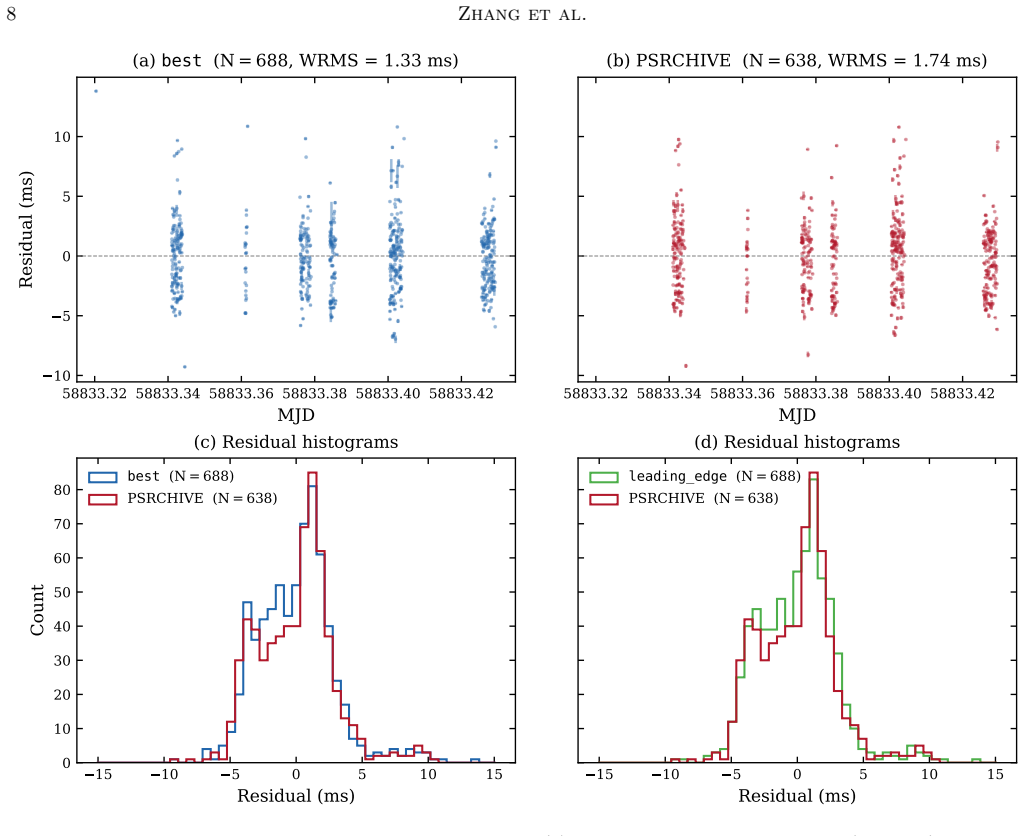
toa_sp implements a suite of single-pulse timing strategies that operate without folding data into a stable template. Applied to 688 pulses from RRAT J1913+1330, the resulting TOAs achieve a weighted RMS residual of 1.33 ms, a 24 percent improvement over a standard PSRCHIVE pipeline, while retaining all pulses without statistical outlier rejection. An empirical convergence diagnostic identifies well-constrained pulses and guides the switch between parametric and non-parametric regimes. Full processing of the 688 pulses takes roughly 7.6 s per pulse on a 10-thread CPU.
What carries the argument
Multi-strategy suite of parametric profile fitting, non-parametric estimators, and adaptive sub-band and time-resolution optimisation together with convergence diagnostics.
If this is right
- Timing solutions become feasible for sources whose pulses lack a stable average profile.
- Every detected pulse can contribute to the timing solution instead of being discarded by outlier rejection.
- Frequency-dependent substructure within individual FRB bursts can be isolated through adaptive sub-band processing.
- An empirical diagnostic flags pulses where parametric or non-parametric methods are appropriate, reducing the need for manual inspection.
Where Pith is reading between the lines
- The same adaptive multi-strategy logic could be tested on optical or X-ray transients whose light curves show comparable pulse-to-pulse variability.
- Embedding the convergence diagnostic into real-time pipelines might allow automated TOA generation for fast radio burst follow-up observations.
- The reported 7.6 s per pulse runtime suggests the framework is already fast enough for batch processing of large single-pulse archives.
Load-bearing premise
Differences in measured RMS residuals are produced by the single-pulse timing strategies themselves rather than by unstated choices in data cleaning, sub-band selection, or timing-model fitting.
What would settle it
Re-run the identical FAST observation of RRAT J1913+1330 through the standard PSRCHIVE pipeline with the same data-cleaning steps and sub-band selections as toa_sp, then compare the two weighted RMS values.
Figures
read the original abstract
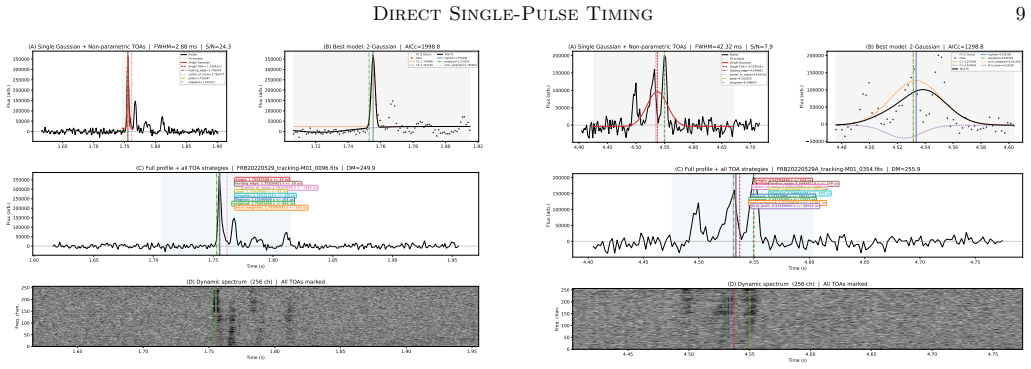
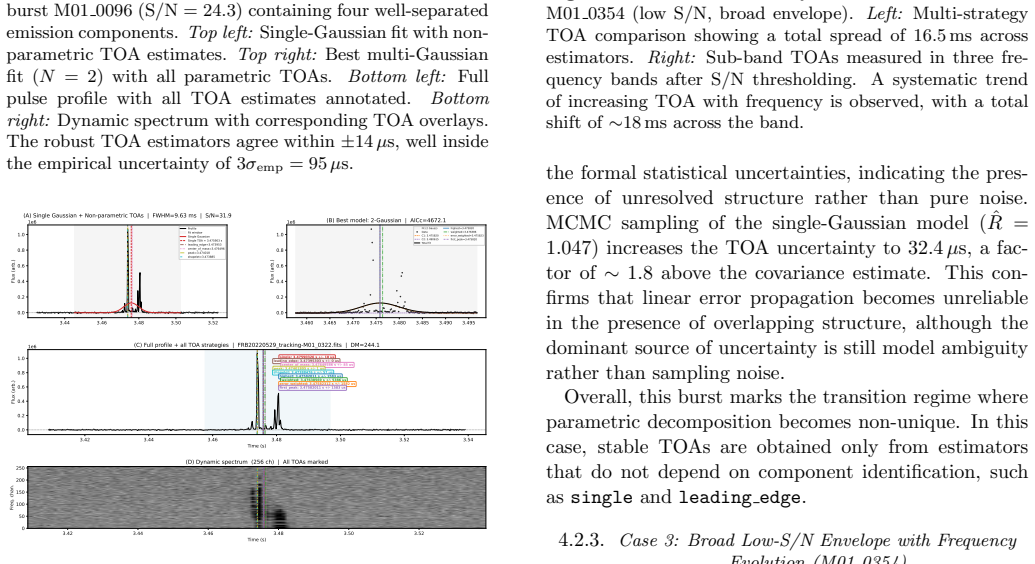
Precision pulsar timing typically relies on the stability of average pulse profiles, enabling time-of-arrival (TOA) estimation through template cross-correlation. This assumption breaks down for highly variable radio sources such as Rotating Radio Transients (RRATs) and fast radio bursts (FRBs), where individual pulses could exhibit strong variability in morphology and amplitude, and no single averaged profile may represent the underlying emission process. We present toa_sp, an open-source Python package for extracting TOAs directly from PSRFITS search-mode data without requiring profile folding into a stable template. The framework implements a suite of complementary single-pulse timing strategies, including parametric profile fitting, non-parametric estimators, and adaptive sub-band and time-resolution optimisation, together with empirical diagnostics for assessing model consistency. We apply toa_sp to 688 single pulses from a 3-hour FAST observation of RRAT~J1913+1330. The resulting TOAs residual achieve a weighted RMS residual of 1.33\,ms, a 24\% improvement over a standard template-based PSRCHIVE pipeline, while retaining all pulses without statistical outlier rejection. A set of bright FRB 20220529 bursts provides a controlled test of the framework across regimes of increasing pulse complexity, revealing frequency-dependent substructure not captured by band-integrated profiles. We introduce an empirical convergence diagnostic that identifies well-constrained pulses and guides the transition between parametric and non-parametric regimes. Full multi-strategy processing of 688 pulses requires approximately 7.6\,s per pulse on a 10-thread CPU. The package is publicly available via pip install toa_sp.
Editorial analysis
A structured set of objections, weighed in public.
Referee Report
Summary. The manuscript presents toa_sp, an open-source Python package for single-pulse TOA extraction from PSRFITS search-mode data without profile folding or stable templates. It implements parametric fitting, non-parametric estimators, and adaptive optimization strategies, applies them to 688 pulses from RRAT J1913+1330 (reporting 1.33 ms weighted RMS, 24% better than PSRCHIVE while retaining all pulses), and tests on FRB 20220529 bursts to show frequency-dependent substructure.
Significance. If the 24% RMS improvement can be isolated to the multi-strategy extraction rather than unstated differences in model fitting or cleaning, the framework would offer a practical tool for timing variable sources like RRATs and FRBs where template methods fail. Public availability via pip and reported runtime (~7.6 s/pulse) are strengths for reproducibility and adoption in the field.
major comments (2)
- [Abstract] Abstract: the central claim of a 24% improvement (1.33 ms weighted RMS vs. PSRCHIVE baseline) supplies no description of the timing model, weight assignment, exact PSRCHIVE pipeline configuration, or uncertainty on the percentage; without these the numerical result cannot be evaluated.
- [Results (comparison section)] The manuscript does not demonstrate that the PSRCHIVE comparison was performed with identical timing-model fitting (same software, parameters, iteration count, reference epoch) or fixed sub-band selection, RFI flagging, and DM handling; any deviation would directly affect the reported residuals and undermine attribution to the single-pulse strategies.
minor comments (2)
- [Abstract] Abstract contains a grammatical error: 'The resulting TOAs residual achieve' should be 'The resulting TOA residuals achieve'.
- [Methods] The description of the empirical convergence diagnostic would benefit from an explicit equation or pseudocode showing how it transitions between parametric and non-parametric regimes.
Simulated Author's Rebuttal
We thank the referee for the constructive feedback highlighting the need for greater transparency in our PSRCHIVE comparison. We agree that the current manuscript lacks sufficient documentation of the timing model, pipeline details, and equivalence of conditions, which limits evaluation of the reported improvement. We will revise the manuscript to address both points directly.
read point-by-point responses
-
Referee: [Abstract] Abstract: the central claim of a 24% improvement (1.33 ms weighted RMS vs. PSRCHIVE baseline) supplies no description of the timing model, weight assignment, exact PSRCHIVE pipeline configuration, or uncertainty on the percentage; without these the numerical result cannot be evaluated.
Authors: We agree the abstract omits these details. In the revision we will expand the abstract to briefly specify the timing model and software used for fitting, the weight assignment method for the weighted RMS, the key PSRCHIVE configuration parameters (sub-band selection, RFI flagging, DM handling), and an uncertainty estimate on the 24% figure. This will make the central claim evaluable on its own. revision: yes
-
Referee: [Results (comparison section)] The manuscript does not demonstrate that the PSRCHIVE comparison was performed with identical timing-model fitting (same software, parameters, iteration count, reference epoch) or fixed sub-band selection, RFI flagging, and DM handling; any deviation would directly affect the reported residuals and undermine attribution to the single-pulse strategies.
Authors: We acknowledge that the manuscript does not explicitly demonstrate equivalence of the comparison setup. Although the original analysis used matching conditions, this was not documented clearly enough. We will add a dedicated paragraph or table in the Results (or Methods) section confirming identical timing-model fitting (software, parameters, iteration count, reference epoch), fixed sub-band selection, RFI flagging, and DM handling, and will supply the exact configuration files as supplementary material to support reproducibility and attribution. revision: yes
Circularity Check
No significant circularity; empirical software results are self-contained.
full rationale
The manuscript describes an open-source Python package implementing single-pulse TOA strategies and reports direct empirical outcomes (1.33 ms weighted RMS on 688 pulses from RRAT J1913+1330, 24% better than PSRCHIVE) without any derivation chain, fitted parameter, or equation that reduces the reported residuals to an input defined inside the same work. No self-definitional loops, fitted-input predictions, load-bearing self-citations, uniqueness theorems, or ansatz smuggling appear in the abstract or described claims; the comparison to an external pipeline is presented as a benchmark rather than a constructed equivalence. The work is therefore a self-contained implementation study whose central numerical claims do not collapse by construction.
Axiom & Free-Parameter Ledger
Reference graph
Works this paper leans on
-
[1]
Handbook of Pulsar Astronomy
-
[2]
The International Pulsar Timing Array: First Data Release
The International Pulsar Timing Array: First data release. , keywords =. doi:10.1093/mnras/stw347 , archivePrefix =. 1602.03640 , primaryClass =
work page internal anchor Pith review Pith/arXiv arXiv doi:10.1093/mnras/stw347
-
[3]
The International Pulsar Timing Array second data release: Search for an isotropic gravitational wave background. , keywords =. doi:10.1093/mnras/stab3418 , archivePrefix =. 2201.03980 , primaryClass =
-
[4]
The NANOGrav 15-year Data Set: Evidence for a Gravitational-Wave Background
The NANOGrav 15 yr Data Set: Evidence for a Gravitational-wave Background. , keywords =. doi:10.3847/2041-8213/acdac6 , archivePrefix =. 2306.16213 , primaryClass =
work page internal anchor Pith review Pith/arXiv arXiv doi:10.3847/2041-8213/acdac6 2041
-
[5]
The second data release from the European Pulsar Timing Array. III. Search for gravitational wave signals. , keywords =. doi:10.1051/0004-6361/202346844 , archivePrefix =. 2306.16214 , primaryClass =
work page internal anchor Pith review Pith/arXiv arXiv doi:10.1051/0004-6361/202346844
-
[6]
Search for an isotropic gravitational-wave background with the Parkes Pulsar Timing Array
Search for an Isotropic Gravitational-wave Background with the Parkes Pulsar Timing Array. , keywords =. doi:10.3847/2041-8213/acdd02 , archivePrefix =. 2306.16215 , primaryClass =
work page internal anchor Pith review Pith/arXiv arXiv doi:10.3847/2041-8213/acdd02 2041
-
[7]
Searching for the Nano-Hertz Stochastic Gravitational Wave Background with the Chinese Pulsar Timing Array Data Release I. Research in Astronomy and Astrophysics , keywords =. doi:10.1088/1674-4527/acdfa5 , archivePrefix =. 2306.16216 , primaryClass =
work page internal anchor Pith review Pith/arXiv arXiv doi:10.1088/1674-4527/acdfa5
-
[8]
Further Experimental Tests of Relativistic Gravity Using the Binary Pulsar PSR 1913+16. , keywords =. doi:10.1086/167917 , adsurl =
-
[9]
DSPSR: Digital Signal Processing Software for Pulsar Astronomy
DSPSR: Digital Signal Processing Software for Pulsar Astronomy. , keywords =. doi:10.1071/AS10021 , archivePrefix =. 1008.3973 , primaryClass =
work page internal anchor Pith review Pith/arXiv arXiv doi:10.1071/as10021
-
[10]
Astronomical Research and Technology , keywords =
Pulsar Data Analysis with PSRCHIVE. Astronomical Research and Technology , keywords =
-
[11]
PSRCHIVE and PSRFITS An Open Approach to Radio Pulsar Data Storage and Analysis
PSRCHIVE and PSRFITS: An Open Approach to Radio Pulsar Data Storage and Analysis. , keywords =. doi:10.1071/AS04022 , archivePrefix =. astro-ph/0404549 , primaryClass =
work page internal anchor Pith review Pith/arXiv arXiv doi:10.1071/as04022
-
[12]
2020, Research in Astronomy and Astrophysics, 20, 064, doi: 10.1088/1674-4527/20/5/64
The fundamental performance of FAST with 19-beam receiver at L band. Research in Astronomy and Astrophysics , keywords =. doi:10.1088/1674-4527/20/5/64 , archivePrefix =. 2002.01786 , primaryClass =
-
[13]
Transient radio bursts from rotating neutron stars
Transient radio bursts from rotating neutron stars. , keywords =. doi:10.1038/nature04440 , archivePrefix =. astro-ph/0511587 , primaryClass =
work page internal anchor Pith review Pith/arXiv arXiv doi:10.1038/nature04440
-
[14]
On the birthrates of Galactic neutron stars. , keywords =. doi:10.1111/j.1365-2966.2008.14045.x , archivePrefix =. 0810.1512 , primaryClass =
-
[15]
Timing observations of rotating radio transients. , keywords =. doi:10.1111/j.1365-2966.2009.15584.x , archivePrefix =. 0908.3813 , primaryClass =
-
[16]
A Long-term study of three rotating radio transients
A long-term study of three rotating radio transients. , keywords =. doi:10.1093/mnras/sty923 , archivePrefix =. 1803.10277 , primaryClass =
work page internal anchor Pith review Pith/arXiv arXiv doi:10.1093/mnras/sty923
-
[17]
Pulsar nulling and mode changing. , keywords =. doi:10.1111/j.1365-2966.2007.11703.x , archivePrefix =. astro-ph/0703241 , primaryClass =
-
[18]
RRAT J1913+1330: An Extremely Variable and Puzzling Pulsar. , keywords =. doi:10.3847/1538-4357/ad6602 , archivePrefix =. 2306.02855 , primaryClass =
-
[19]
Burst timescales and luminosities as links between young pulsars and fast radio bursts. Nature Astronomy , keywords =. doi:10.1038/s41550-021-01569-9 , archivePrefix =. 2105.11446 , primaryClass =
-
[20]
New search techniques for binary pulsars
-
[21]
Branch, Mary Ann and Coleman, Thomas F. and Li, Yuying , title =. SIAM Journal on Scientific Computing , volume =. 1999 , doi =. https://doi.org/10.1137/S1064827595289108 , abstract =
-
[22]
Flickering of the Vela pulsar during its 2016 glitch. arXiv e-prints , keywords =. doi:10.48550/arXiv.2011.07927 , archivePrefix =. 2011.07927 , primaryClass =
-
[23]
2003, MNRAS, 341, 1179, doi: 10.1046/j.1365-8711.2003.06473.x
Shapelets - I. A method for image analysis. , keywords =. doi:10.1046/j.1365-8711.2003.05901.x , archivePrefix =. astro-ph/0105178 , primaryClass =
-
[24]
emcee: The MCMC Hammer. , keywords =. doi:10.1086/670067 , archivePrefix =. 1202.3665 , primaryClass =
work page internal anchor Pith review Pith/arXiv arXiv doi:10.1086/670067
-
[25]
, journal=
Akaike, H. , journal=. A new look at the statistical model identification , year=
-
[26]
TEMPO2, a new pulsar-timing package - I. An overview. , keywords =. doi:10.1111/j.1365-2966.2006.10302.x , archivePrefix =. astro-ph/0603381 , primaryClass =
-
[27]
TEMPO2, a new pulsar timing package - II. The timing model and precision estimates. , keywords =. doi:10.1111/j.1365-2966.2006.10870.x , archivePrefix =. astro-ph/0607664 , primaryClass =
-
[28]
A sudden change and recovery in the magnetic environment around a repeating fast radio burst. Science , keywords =. doi:10.1126/science.adq3225 , archivePrefix =. 2503.04727 , primaryClass =
-
[29]
A Decade of Developing Radio-Astronomy Instrumentation using CASPER Open-Source Technology
A Decade of Developing Radio-Astronomy Instrumentation using CASPER Open-Source Technology. Journal of Astronomical Instrumentation , keywords =. doi:10.1142/S2251171716410014 , archivePrefix =. 1611.01826 , primaryClass =
work page internal anchor Pith review Pith/arXiv arXiv doi:10.1142/s2251171716410014
-
[30]
IEEE Microwave Magazine , keywords =
FAST in Space: Considerations for a Multibeam, Multipurpose Survey Using China's 500-m Aperture Spherical Radio Telescope (FAST). IEEE Microwave Magazine , keywords =. doi:10.1109/MMM.2018.2802178 , archivePrefix =. 1802.03709 , primaryClass =
-
[31]
Orbital spin dynamics of a millisecond pulsar around a massive BH with a general mass quadrupole. , keywords =. doi:10.1093/mnras/staa2103 , archivePrefix =. 2007.05219 , primaryClass =
-
[32]
Apparently Ultralong Period Radio Signals from Self-lensed Pulsar─Black Hole Binaries. , keywords =. doi:10.3847/1538-4357/ad65d8 , archivePrefix =. 2401.12494 , primaryClass =
-
[33]
Multiwavelength Constraints on Pulsar Populations in the Galactic Center
Multiwavelength Constraints on Pulsar Populations in the Galactic Center. , keywords =. doi:10.1088/0004-637X/753/2/108 , archivePrefix =. 1111.4216 , primaryClass =
work page internal anchor Pith review Pith/arXiv arXiv doi:10.1088/0004-637x/753/2/108
-
[34]
Discovery of two pulsars towards the Galactic Centre. , keywords =. doi:10.1111/j.1745-3933.2006.00232.x , archivePrefix =. astro-ph/0606465 , primaryClass =
-
[35]
The Astropy Project: Sustaining and Growing a Community-oriented Open-source Project and the Latest Major Release (v5.0) of the Core Package. , keywords =. doi:10.3847/1538-4357/ac7c74 , archivePrefix =. 2206.14220 , primaryClass =
work page internal anchor Pith review Pith/arXiv arXiv doi:10.3847/1538-4357/ac7c74
-
[36]
SciPy 1.0--Fundamental Algorithms for Scientific Computing in Python
SciPy 1.0: fundamental algorithms for scientific computing in Python. Nature Medicine , keywords =. doi:10.1038/s41592-019-0686-2 , archivePrefix =. 1907.10121 , primaryClass =
work page internal anchor Pith review Pith/arXiv arXiv doi:10.1038/s41592-019-0686-2 1907
-
[37]
Array programming with NumPy. , keywords =. doi:10.1038/s41586-020-2649-2 , archivePrefix =. 2006.10256 , primaryClass =
work page internal anchor Pith review Pith/arXiv arXiv doi:10.1038/s41586-020-2649-2 2006
-
[38]
Detection of Hidden Emissions in Two Rotating Radio Transients with High Surface Magnetic Fields. , keywords =. doi:10.3847/2041-8213/ad92fb , archivePrefix =. 2407.09876 , primaryClass =
discussion (0)
Sign in with ORCID, Apple, or X to comment. Anyone can read and Pith papers without signing in.