Inflationary interpretation of the gravitational-wave signal in the European Pulsar Timing Array DR2 with constraints
Pith reviewed 2026-06-27 15:35 UTC · model grok-4.3
The pith
Imposing CMB, BBN and LVK constraints reduces viable inflationary parameters for the EPTA gravitational-wave signal to a narrow range that requires low reheating temperatures.
A machine-rendered reading of the paper's core claim, the machinery that carries it, and where it could break.
Core claim
After applying all relevant observational constraints the region of parameter space that can account for the EPTA signal shrinks to −11.66 ≲ log₁₀ r ≲ −1.45, 1.32 ≲ n_t ≲ 2.47, 1.78 MeV ≲ T_rh ≲ 28.2 GeV and 75.86 nHz ≲ f_end ≲ 14.45 Hz at 95 % CL. This interval favours tensor modes that re-enter the Hubble radius during radiation domination, permitting a higher tensor-to-scalar ratio and a blue-tilted spectrum, yet it simultaneously demands an unusually low reheating temperature.
What carries the argument
Four-parameter tensor power spectrum controlled by the tensor-to-scalar ratio r, the tensor tilt n_t, the reheating temperature T_rh, and the cutoff frequency f_end, which together set the amplitude, slope, and high-frequency termination of the inflationary gravitational-wave background.
If this is right
- Tensor modes responsible for the signal re-enter the horizon while the universe is radiation-dominated.
- A comparatively large tensor-to-scalar ratio remains compatible with the data once the low reheating temperature is accepted.
- The spectrum must be blue-tilted (positive n_t) inside the allowed window.
- Any viable model must produce reheating at temperatures no higher than a few tens of GeV.
Where Pith is reading between the lines
- Reheating mechanisms capable of ending inflation at such low temperatures would need to be constructed and checked against other early-universe observables.
- Future pulsar-timing arrays with improved sensitivity could tighten the upper bound on T_rh and thereby test the scenario more stringently.
- If the cutoff frequency lies near the upper end of the allowed interval, the end of inflation would occur at energy scales that might leave imprints in other cosmological probes.
Load-bearing premise
The entire EPTA signal is generated by inflationary tensor modes whose spectrum is accurately captured by a single power-law segment ending at one cutoff frequency, with no other cosmological or astrophysical sources contributing at these frequencies.
What would settle it
A measurement showing that the nanohertz spectrum deviates from the allowed ranges in r, n_t or f_end, or direct evidence that astrophysical sources dominate the EPTA band, would rule out the inflationary interpretation.
Figures
read the original abstract
The second data release of the European Pulsar Timing Array (EPTA) collaboration provides evidence for the presence of a gravitational-wave (GW) background. In this work, we explore a potential cosmological interpretation of this signal in terms of inflationary scenarios. We parametrize the tensor power spectrum in terms of the tensor-to-scalar ratio $r$, the tensor spectral index $n_t$, the reheating temperature $T_{\text{rh}}$, and the cut-off frequency $f_{\text{end}}$. We incorporate all relevant observational constraints, including those from the Cosmic Microwave Background, Big Bang Nucleosynthesis, and LIGO-Virgo-KAGRA observations. We demonstrate that imposing these constraints consistently reduces the region of parameter space that provides a viable interpretation of the EPTA signal, to $-11.66 \lesssim \log_{10}r \lesssim -1.45$, $1.32 \lesssim n_t \lesssim 2.47$, $1.78\text{ MeV} \lesssim T_{\text{rh}} \lesssim 28.2\text{ GeV}$, and $75.86\text{ nHz} \lesssim f_{\text{end}} \lesssim 14.45\text{ Hz}$ at the 95% confidence level. This favours the scenario in which the GW spectrum in the EPTA frequency band originates from tensor modes that re-entered the Hubble radius during the radiation-dominated era, allowing for a higher $r$ and a flatter spectrum. However, $T_{\text{rh}}$ must take very low values, which are challenging to explain theoretically.
Editorial analysis
A structured set of objections, weighed in public.
Referee Report
Summary. The manuscript explores a cosmological interpretation of the gravitational-wave background signal detected in the European Pulsar Timing Array (EPTA) DR2 as arising from inflationary tensor modes. It parametrizes the tensor power spectrum with four free parameters (tensor-to-scalar ratio r, tensor spectral index n_t, reheating temperature T_rh, and cut-off frequency f_end), incorporates external constraints from CMB, BBN, and LVK observations, and reports 95% CL intervals on the parameters after these constraints are applied: −11.66 ≲ log₁₀ r ≲ −1.45, 1.32 ≲ n_t ≲ 2.47, 1.78 MeV ≲ T_rh ≲ 28.2 GeV, and 75.86 nHz ≲ f_end ≲ 14.45 Hz. The results are interpreted as favoring tensor modes that re-enter during radiation domination while requiring unusually low reheating temperatures.
Significance. If the modeling assumptions are valid, the work supplies quantitative bounds on inflationary parameters that are simultaneously consistent with the EPTA signal and independent cosmological probes. It adds to the literature on PTA signals by showing how external data shrink the viable space and by identifying a preference for a blue-tilted spectrum with low T_rh, which may motivate further model-building in inflationary cosmology.
major comments (3)
- [Abstract] Abstract: The reported 95% CL intervals rest on the assumption that the entire EPTA signal is generated by the four-parameter inflationary tensor spectrum with a single cut-off at f_end and that no astrophysical (e.g., SMBHB) or additional cosmological contributions are present. No quantitative assessment of the allowed fractional contribution from other sources or robustness checks against mixed-signal models is supplied; this assumption is load-bearing for the quoted ranges.
- [Abstract] Abstract and parameter-estimation procedure: The abstract states the final constrained intervals but supplies no information on the likelihood function, prior choices for the four parameters, or the precise manner in which the three external data sets (CMB, BBN, LVK) are combined with the EPTA likelihood. Without these details the numerical intervals cannot be reproduced or their sensitivity to modeling choices evaluated.
- [Abstract] Abstract: The claim that the constraints 'consistently reduce' the viable region is presented without an explicit description of whether the external bounds are imposed as hard cuts, as additional likelihood terms, or via importance sampling; the procedure's internal consistency therefore cannot be verified from the given information.
minor comments (1)
- [Abstract] The use of approximate inequalities (≲) for the reported 95% CL bounds could be replaced by explicit interval notation for clarity.
Simulated Author's Rebuttal
We thank the referee for their careful review and constructive comments on our manuscript. We address each major comment below, providing clarifications and indicating where revisions to the abstract will be made to improve transparency without altering the core analysis.
read point-by-point responses
-
Referee: [Abstract] Abstract: The reported 95% CL intervals rest on the assumption that the entire EPTA signal is generated by the four-parameter inflationary tensor spectrum with a single cut-off at f_end and that no astrophysical (e.g., SMBHB) or additional cosmological contributions are present. No quantitative assessment of the allowed fractional contribution from other sources or robustness checks against mixed-signal models is supplied; this assumption is load-bearing for the quoted ranges.
Authors: We acknowledge that the analysis assumes the EPTA DR2 signal arises entirely from the inflationary tensor spectrum under the four-parameter model with a single cutoff. This is the explicit scope of the work, which explores one viable cosmological interpretation consistent with external bounds. A quantitative mixed-signal analysis including astrophysical contributions lies beyond the present scope and would require a substantially expanded framework. We will add a clarifying sentence to the abstract and discussion to explicitly state this modeling assumption and its bearing on the reported intervals. revision: partial
-
Referee: [Abstract] Abstract and parameter-estimation procedure: The abstract states the final constrained intervals but supplies no information on the likelihood function, prior choices for the four parameters, or the precise manner in which the three external data sets (CMB, BBN, and LVK) are combined with the EPTA likelihood. Without these details the numerical intervals cannot be reproduced or their sensitivity to modeling choices evaluated.
Authors: The likelihood function (product of EPTA, CMB, BBN, and LVK terms), prior choices (uniform in log10 r and flat in n_t, log T_rh, log f_end), and combination procedure are fully specified in Sections 3 and 4 of the manuscript. To make the abstract more self-contained, we will revise it to note that a Bayesian analysis is performed with external constraints included as multiplicative likelihood factors, with full details in the main text. revision: yes
-
Referee: [Abstract] Abstract: The claim that the constraints 'consistently reduce' the viable region is presented without an explicit description of whether the external bounds are imposed as hard cuts, as additional likelihood terms, or via importance sampling; the procedure's internal consistency therefore cannot be verified from the given information.
Authors: The external constraints are incorporated as additional terms in the joint likelihood (i.e., the total posterior is proportional to the EPTA likelihood times the CMB, BBN, and LVK likelihoods), not as hard cuts or importance sampling. This is described in the parameter-estimation section. We will revise the abstract to state that the constraints are applied through the combined likelihood, which produces the reported reduction in viable parameter space. revision: yes
Circularity Check
No circularity; constraints are direct outputs of fitting independent external data to the chosen model.
full rationale
The paper performs a standard parameter fit of the four-parameter tensor spectrum (r, n_t, T_rh, f_end) to the EPTA signal while imposing separate CMB, BBN and LVK bounds. The quoted 95% CL intervals are the resulting posterior ranges, not redefinitions or forced outputs of the inputs themselves. No self-definitional relations, relabeling of fits as predictions, or load-bearing self-citations appear in the derivation chain. External datasets are independent of the EPTA measurement and the model parametrization is stated explicitly rather than smuggled via prior work.
Axiom & Free-Parameter Ledger
free parameters (4)
- r
- n_t
- T_rh
- f_end
axioms (2)
- domain assumption Standard Λ CDM background cosmology and power-law tensor spectrum with cut-off
- ad hoc to paper The EPTA signal is produced by inflationary tensor modes
Reference graph
Works this paper leans on
-
[1]
INTRODUCTION In 1978-1979, Sazhin [1] and Dettweiler [2] proposed using residuals from the Times-Of-Arrival (TOAs) of pul- sar signals to detect a stochastic Gravitational Wave Background (GWB). Foster and Backer [3] were the first to propose monitoring highly stable millisecond pulsars in the search for a GWB, an approach now known as Pulsar Timing Array...
work page internal anchor Pith review Pith/arXiv arXiv 1978
-
[2]
In our analysis, we assume a constantn t over the entire frequency range, from CMB scales to those corresponding to PTAs and ground-based GW detectors
GWB MODEL We consider a four-parameter framework characterized by the tensor-to-scalar ratior, the tensor spectral index nt, the reheating temperatureT rh and the high-frequency cutoff of the IGW spectrum,f end. In our analysis, we assume a constantn t over the entire frequency range, from CMB scales to those corresponding to PTAs and ground-based GW dete...
-
[3]
EPTA data We use the EPTA 25-pulsar dataset,DR2new, collected over 10.3 years of observations [13]
DATA AND ANALYSIS 3.1. EPTA data We use the EPTA 25-pulsar dataset,DR2new, collected over 10.3 years of observations [13]. These measurements were obtained with new-generation backends that pro- vide substantially wider bandwidths and improved sen- sitivity, yielding robust evidence for a GWB signal with Hellings–Downs correlations (≳3σsignificance). We d...
-
[4]
“BLVK” constraints BBN+CMB bounds.The integrated GW energy density must not exceed the upper limits set by BBN and CMB observations on additional contributions to the radiation energy density, Z fend fi d f f h2ΩGW(f)≤ B i , i={BBN,CMB}.(10) For the lower integration bound,f i ={f BBN, fCMB}, we adopt respectively: the mode that are sub-Hubble at the time...
-
[5]
“CMB” constraints CMB data.The CMB polarization data provide ad- ditional information about the amplitude and the tilt of the primordial tensor power spectrum. We take into ac- count the measurement of the CMB B-mode polarization angular power spectrum from the joint BICEP2/Keck Array and Planck analysis [63] that is, at 95% CL, r0.01 <0.076 −0.55< n t <2...
-
[6]
large”-Trh and “small
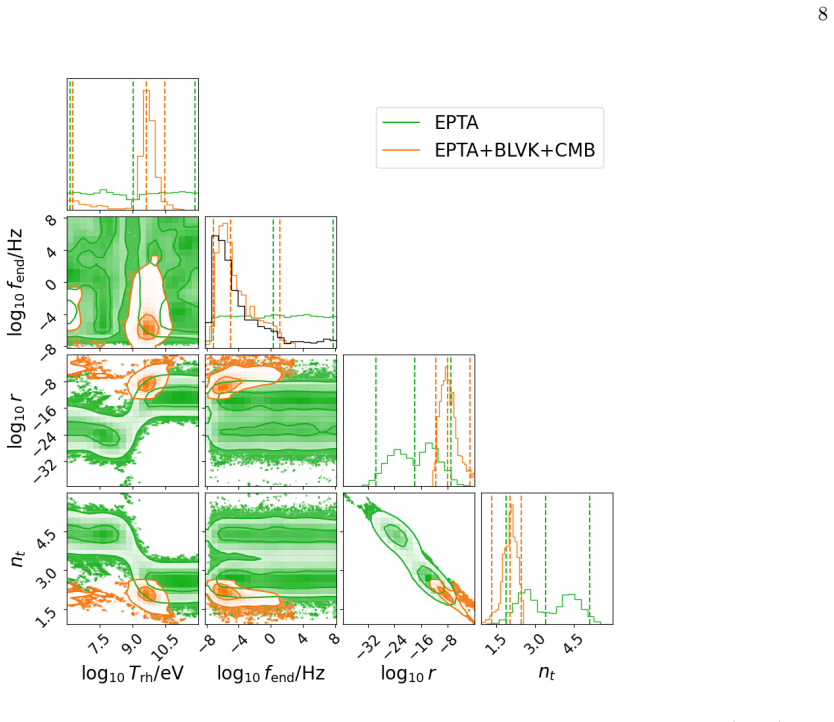
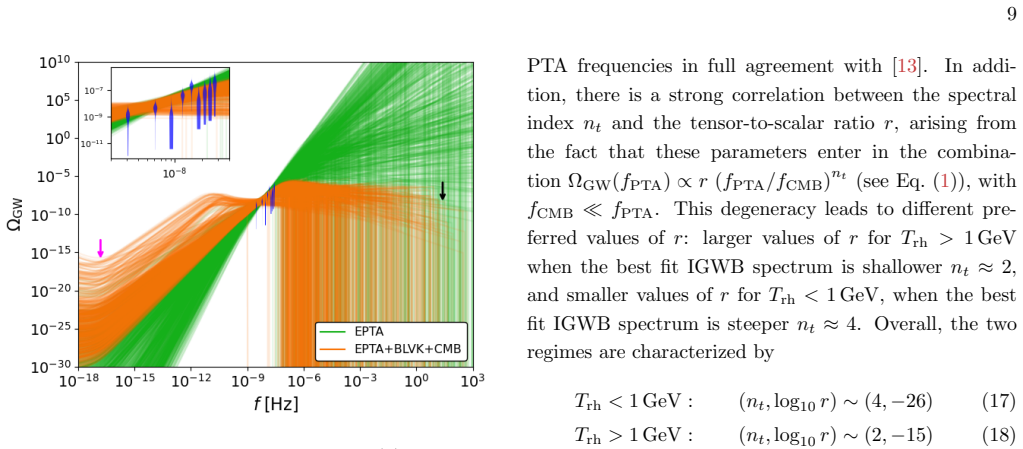
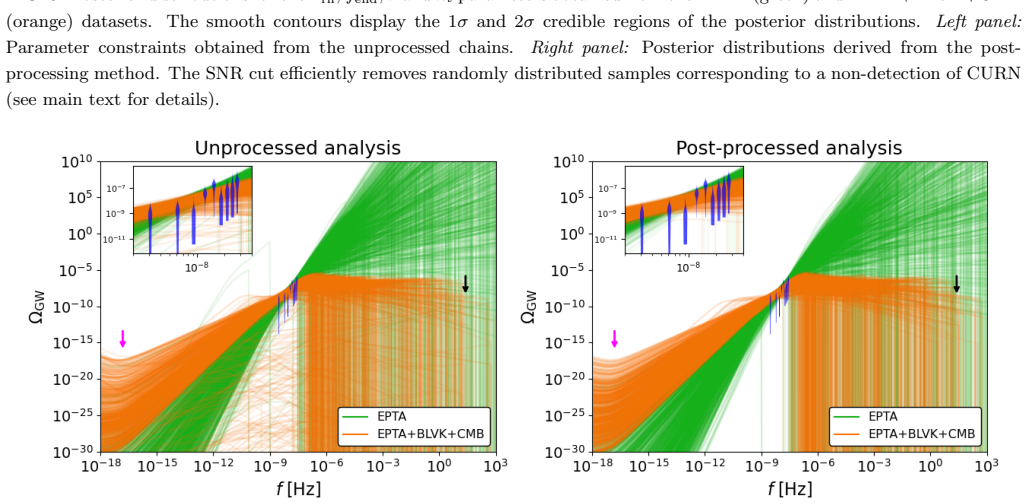
RESULTS Fig. 1 shows the main results on the cosmological pa- rameters obtained from the chains. Tab. II presents the one-dimensional marginalized constraints. Fig. 2 displays the theoretical predictions of Ω GW(f) for a subset of chains randomly selected from these analyses. 4.1. EPTA analysis We begin by presenting results of the EPTA data anal- ysis ob...
-
[7]
In this work, they adopt an FIG
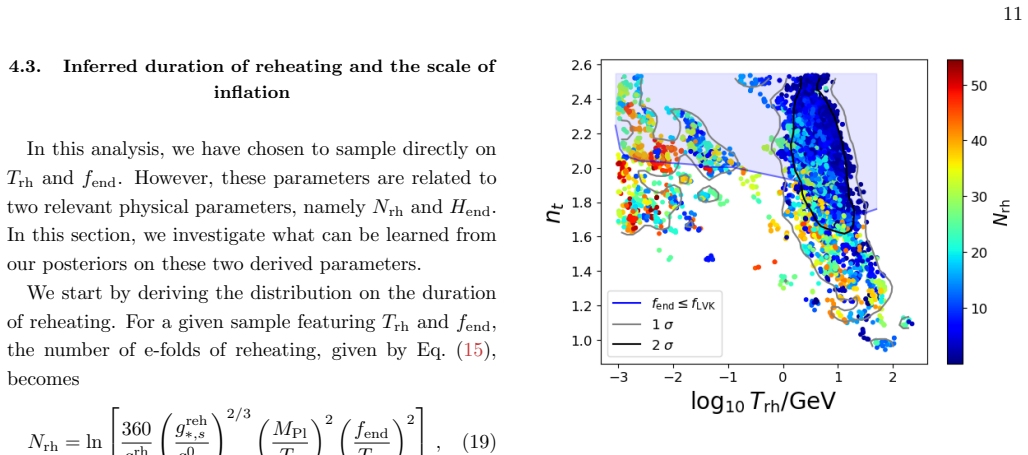
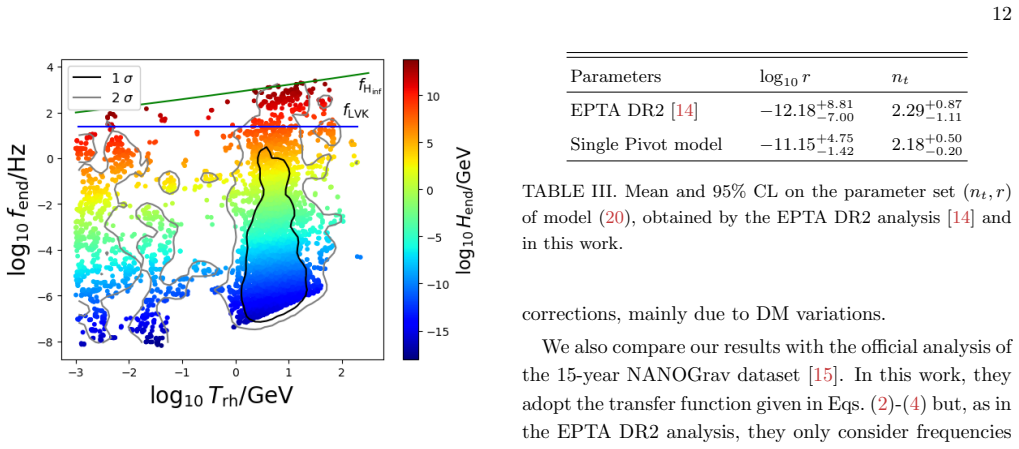
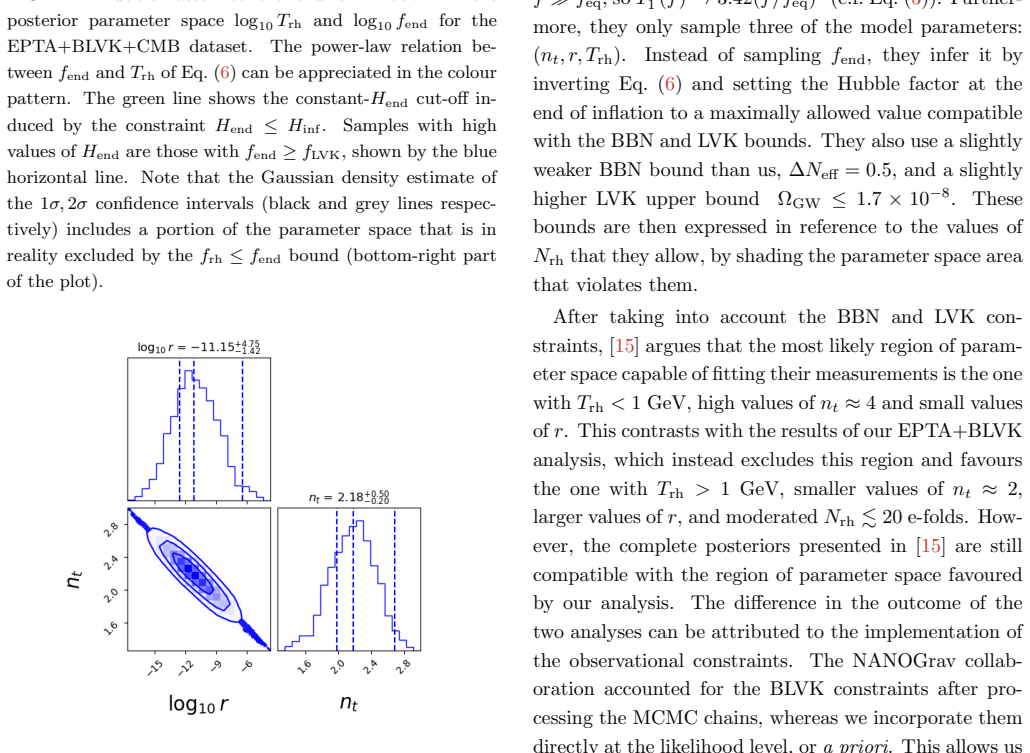
COMPARISON TO PREVIOUS ANALYSES In this section we compare our results with results de- rived in previous analyses, starting with the EPTA of- ficial DR2 analysis [14]. In this work, they adopt an FIG. 3. Number of e-folds of reheating in the posterior pa- rameter space log 10 Trh andn t for the EPTA+BLVK+CMB dataset. The light-blue shaded region correspo...
-
[8]
We have demonstrated that it is impor- tant to include external observational and physical con- straints in the parameter space selection
CONCLUSION In this work, we have investigated the parameter space within which an IGWB could account for the EPTA DR2 measurement. We have demonstrated that it is impor- tant to include external observational and physical con- straints in the parameter space selection. This shifts the parameter space of the IGWB capable of fitting PTA data towards more na...
-
[9]
Gravitational Wave Detection using Pulsar Tim- ing Arrays
ACKNOWLEDGEMENTS PT thanks his PhD supervisor Bence B´ ecsy, Go- lam Shaifullah who wrote the tutorials that served as a foundation for analysing the dataset, and Hippolyte Quelquejay Lecl` ere who provided information and ref- erences on EPTA’s methods. CC and PT thank Stas Babak for advice on implementing certain functions inENTERPRISE. The authors also...
2023
-
[10]
M. V. Sazhin, Soviet Astronomy22, 36 (1978), aDS Bib- code: 1978SvA....22...36S
1978
-
[11]
Detweiler, The Astrophysical Journal234, 1100 (1979), aDS Bibcode: 1979ApJ...234.1100D
S. Detweiler, The Astrophysical Journal234, 1100 (1979), aDS Bibcode: 1979ApJ...234.1100D
1979
-
[12]
R. S. Foster and D. C. Backer, ApJ361, 300 (1990)
1990
-
[13]
M. A. McLaughlin, Class. Quant. Grav.30, 224008 (2013), arXiv:1310.0758 [astro-ph.IM]
work page internal anchor Pith review Pith/arXiv arXiv 2013
-
[14]
Arzoumanianet al.(NANOGrav), Astrophys
Z. Arzoumanianet al.(NANOGrav), Astrophys. J. Lett. 905, L34 (2020), arXiv:2009.04496 [astro-ph.HE]
-
[15]
High-precision timing of 42 millisecond pulsars with the European Pulsar Timing Array
G. Desvigneset al.(EPTA), Mon. Not. Roy. Astron. Soc. 458, 3341 (2016), arXiv:1602.08511 [astro-ph.HE]
work page internal anchor Pith review Pith/arXiv arXiv 2016
-
[16]
S. Chenet al.(EPTA), Mon. Not. Roy. Astron. Soc.508, 4970 (2021), arXiv:2110.13184 [astro-ph.HE]
-
[17]
R. N. Manchesteret al., Publ. Astron. Soc. Austral.30, 17 (2013), arXiv:1210.6130 [astro-ph.IM]
work page internal anchor Pith review Pith/arXiv arXiv 2013
-
[18]
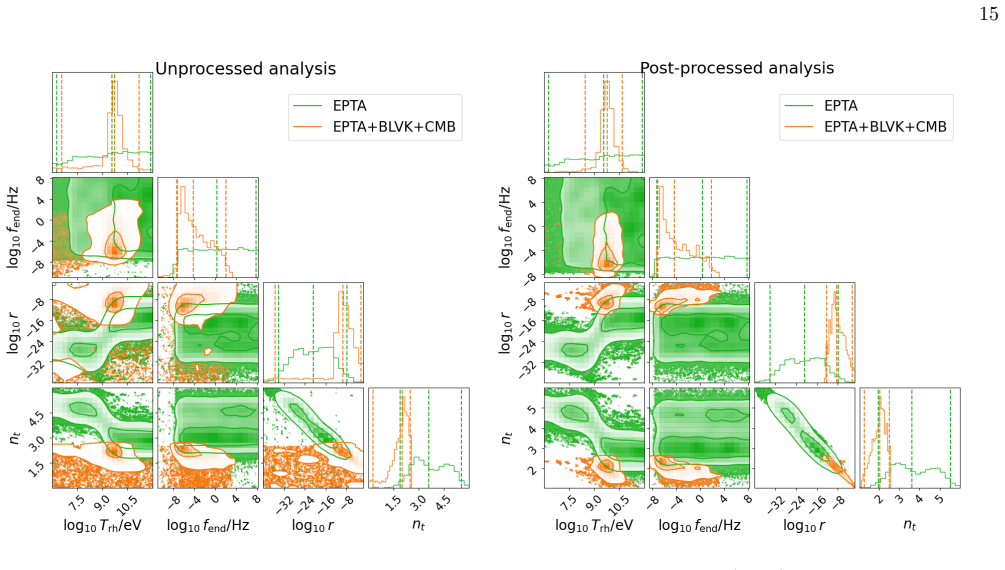
B. Goncharovet al., Astrophys. J. Lett.917, L19 (2021), 15 FIG. 6. Posterior distributions for theT rh,f end,randn t parameters obtained from the EPTA (green) and EPTA+BLVK+CMB (orange) datasets. The smooth contours display the 1σand 2σcredible regions of the posterior distributions.Left panel: Parameter constraints obtained from the unprocessed chains.Ri...
-
[19]
J. Antoniadiset al., Mon. Not. Roy. Astron. Soc.510, 4873 (2022), arXiv:2201.03980 [astro-ph.HE]
-
[20]
R. w. Hellings and G. s. Downs, Astrophys. J. Lett.265, 16 Data/Model log 10 r n t log10(Trh/eV) log 10(fend/Hz) Unprocessed EPTA−20.69 +12.90 −13.41 3.61+1.93 −1.73 Unconstrained>−7.26 EPTA+BLVK−15.53 +11.92 −20.03 2.69+2.43 −2.12 9.44+1.43 −3.19 −6.72+13.19 −0.88 EPTA+BLVK+CMB−9.40 +6.89 −26.08 2.00+0.50 −1.73 9.72+1.49 −3.13 −4.18+6.25 −3.13 Post-proce...
1983
-
[21]
The NANOGrav 15-year Data Set: Evidence for a Gravitational-Wave Background
G. Agazieet al.(NANOGrav), Astrophys. J. Lett.951, L8 (2023), arXiv:2306.16213 [astro-ph.HE]
work page internal anchor Pith review Pith/arXiv arXiv 2023
-
[22]
J. Antoniadiset al.(EPTA, InPTA:), Astron. Astrophys. 678, A50 (2023), arXiv:2306.16214 [astro-ph.HE]
work page internal anchor Pith review Pith/arXiv arXiv 2023
-
[23]
Antoniadiset al.(EPTA, InPTA), Astron
J. Antoniadiset al.(EPTA, InPTA), Astron. Astrophys. 685, A94 (2024), arXiv:2306.16227 [astro-ph.CO]
-
[24]
The NANOGrav 15-year Data Set: Search for Signals from New Physics
A. Afzalet al.(NANOGrav), Astrophys. J. Lett. 951, L11 (2023), [Erratum: Astrophys.J.Lett. 971, L27 (2024), Erratum: Astrophys.J. 971, L27 (2024)], arXiv:2306.16219 [astro-ph.HE]
work page internal anchor Pith review Pith/arXiv arXiv 2023
- [25]
-
[26]
M. C. Guzzetti, N. Bartolo, M. Liguori, and S. Matar- rese, Riv. Nuovo Cim.39, 399 (2016), arXiv:1605.01615 [astro-ph.CO]
work page internal anchor Pith review Pith/arXiv arXiv 2016
-
[27]
S. Kuroyanagi, T. Takahashi, and S. Yokoyama, JCAP 01, 071 (2021), arXiv:2011.03323 [astro-ph.CO]
-
[28]
Vagnozzi, JHEAp39, 81 (2023), arXiv:2306.16912 [astro-ph.CO]
S. Vagnozzi, JHEAp39, 81 (2023), arXiv:2306.16912 [astro-ph.CO]
-
[29]
Scalar induced gravitational waves review
G. Dom` enech, Universe7, 398 (2021), arXiv:2109.01398 [gr-qc]
work page internal anchor Pith review Pith/arXiv arXiv 2021
-
[30]
C. Yuan and Q.-G. Huang, iScience24, 102860 (2021), arXiv:2103.04739 [astro-ph.GA]
- [31]
-
[32]
G. Franciolini, A. Iovino, Junior., V. Vaskonen, and H. Veermae, Phys. Rev. Lett.131, 201401 (2023), arXiv:2306.17149 [astro-ph.CO]
-
[33]
Detecting gravitational waves from cosmological phase transitions with LISA: an update
C. Capriniet al., JCAP03, 024 (2020), arXiv:1910.13125 [astro-ph.CO]
work page internal anchor Pith review Pith/arXiv arXiv 2020
- [34]
-
[35]
A. Roper Pol, C. Caprini, A. Neronov, and D. Semikoz, Phys. Rev. D105, 123502 (2022), arXiv:2201.05630 [astro-ph.CO]
-
[36]
Vilenkin, Phys
A. Vilenkin, Phys. Rept.121, 263 (1985)
1985
-
[37]
M. B. Hindmarsh and T. W. B. Kibble, Rept. Prog. Phys. 58, 477 (1995), arXiv:hep-ph/9411342
work page internal anchor Pith review Pith/arXiv arXiv 1995
-
[38]
A review of gravitational waves from cosmic domain walls
K. Saikawa, Universe3, 40 (2017), arXiv:1703.02576 [hep-ph]
work page internal anchor Pith review Pith/arXiv arXiv 2017
-
[39]
Quelquejay Leclereet al.(European Pulsar Tim- ing Array, EPTA), Phys
H. Quelquejay Leclereet al.(European Pulsar Tim- ing Array, EPTA), Phys. Rev. D108, 123527 (2023), arXiv:2306.12234 [gr-qc]
-
[40]
N. J. Cornish and A. Sesana, Class. Quant. Grav.30, 224005 (2013), arXiv:1305.0326 [gr-qc]
work page internal anchor Pith review Pith/arXiv arXiv 2013
-
[41]
Maggiore,Gravitational Waves
M. Maggiore,Gravitational Waves. Vol. 1: Theory and Experiments(Oxford University Press, 2007)
2007
-
[42]
P. A. R. Adeet al.(Planck), Astron. Astrophys.571, A22 (2014), arXiv:1303.5082 [astro-ph.CO]
work page internal anchor Pith review Pith/arXiv arXiv 2014
- [43]
-
[44]
Inflation at the End of 2025: Constraints on $r$ and $n_s$ Using the Latest CMB and BAO Data
L. Balkenholet al., (2025), arXiv:2512.10613 [astro- ph.CO]
work page internal anchor Pith review arXiv 2025
-
[45]
M. M. Anber and L. Sorbo, Phys. Rev. D85, 123537 (2012), arXiv:1203.5849 [astro-ph.CO]
work page internal anchor Pith review Pith/arXiv arXiv 2012
-
[46]
J. L. Cook and L. Sorbo, Phys. Rev. D85, 023534 (2012), [Erratum: Phys.Rev.D 86, 069901 (2012)], arXiv:1109.0022 [astro-ph.CO]
work page internal anchor Pith review Pith/arXiv arXiv 2012
-
[47]
Scale-dependent gravitational waves from a rolling axion
R. Namba, M. Peloso, M. Shiraishi, L. Sorbo, and C. Unal, JCAP01, 041 (2016), arXiv:1509.07521 [astro- ph.CO]. 17
work page internal anchor Pith review Pith/arXiv arXiv 2016
-
[48]
Primordial Gravitational Waves from Axion-Gauge Fields Dynamics
E. Dimastrogiovanni, M. Fasiello, and T. Fujita, JCAP 01, 019 (2017), arXiv:1608.04216 [astro-ph.CO]
work page internal anchor Pith review Pith/arXiv arXiv 2017
-
[49]
R. R. Caldwell and C. Devulder, Phys. Rev. D97, 023532 (2018), arXiv:1706.03765 [astro-ph.CO]
work page internal anchor Pith review Pith/arXiv arXiv 2018
-
[50]
Phantom Inflation and Primordial Perturbation Spectrum
Y.-S. Piao and Y.-Z. Zhang, Phys. Rev. D70, 063513 (2004), arXiv:astro-ph/0401231
work page internal anchor Pith review Pith/arXiv arXiv 2004
-
[51]
G-inflation: inflation driven by the Galileon field
T. Kobayashi, M. Yamaguchi, and J. Yokoyama, Phys. Rev. Lett.105, 231302 (2010), arXiv:1008.0603 [hep-th]
work page internal anchor Pith review Pith/arXiv arXiv 2010
-
[52]
S. Endlich, A. Nicolis, and J. Wang, JCAP10, 011 (2013), arXiv:1210.0569 [hep-th]
work page internal anchor Pith review Pith/arXiv arXiv 2013
-
[53]
Blue-tilted Primordial Gravitational Waves from Massive Gravity
T. Fujita, S. Kuroyanagi, S. Mizuno, and S. Mukohyama, Phys. Lett. B789, 215 (2019), arXiv:1808.02381 [gr-qc]
work page internal anchor Pith review Pith/arXiv arXiv 2019
-
[54]
Reheating in Inflationary Cosmology: Theory and Applications
R. Allahverdi, R. Brandenberger, F.-Y. Cyr-Racine, and A. Mazumdar, Ann. Rev. Nucl. Part. Sci.60, 27 (2010), arXiv:1001.2600 [hep-th]
work page internal anchor Pith review Pith/arXiv arXiv 2010
-
[55]
Prospects of determination of reheating temperature after inflation by DECIGO
S. Kuroyanagi, K. Nakayama, and J. Yokoyama, PTEP 2015, 013E02 (2015), arXiv:1410.6618 [astro-ph.CO]
work page internal anchor Pith review Pith/arXiv arXiv 2015
-
[56]
S. Kuroyanagi, T. Chiba, and N. Sugiyama, Phys. Rev. D83, 043514 (2011), arXiv:1010.5246 [astro-ph.CO]
work page internal anchor Pith review Pith/arXiv arXiv 2011
-
[57]
M. Vallisneriet al.(NANOGrav), (2020), 10.3847/1538- 4357/ab7b67, arXiv:2001.00595 [astro-ph.HE]
-
[58]
R. S. Park, W. M. Folkner, J. G. Williams, and D. H. Boggs, The Astronomical Journal161, 105 (2021)
2021
-
[59]
Blue-tilted Tensor Spectrum and Thermal History of the Universe
S. Kuroyanagi, T. Takahashi, and S. Yokoyama, JCAP 02, 003 (2015), arXiv:1407.4785 [astro-ph.CO]
work page internal anchor Pith review Pith/arXiv arXiv 2015
-
[60]
Cosmological Backgrounds of Gravitational Waves
C. Caprini and D. G. Figueroa, Class. Quant. Grav.35, 163001 (2018), arXiv:1801.04268 [astro-ph.CO]
work page internal anchor Pith review Pith/arXiv arXiv 2018
-
[61]
Planck 2018 results. VI. Cosmological parameters
N. Aghanimet al.(Planck), Astron. Astrophys.641, A6 (2020), [Erratum: Astron.Astrophys. 652, C4 (2021)], arXiv:1807.06209 [astro-ph.CO]
work page internal anchor Pith review Pith/arXiv arXiv 2020
-
[62]
M. S. Turner, M. J. White, and J. E. Lidsey, Phys. Rev. D48, 4613 (1993), arXiv:astro-ph/9306029
work page internal anchor Pith review Pith/arXiv arXiv 1993
-
[63]
Precision calculations of the gravitational wave background spectrum from inflation
S. Kuroyanagi, T. Chiba, and N. Sugiyama, Phys. Rev. D79, 103501 (2009), arXiv:0804.3249 [astro-ph]
work page internal anchor Pith review Pith/arXiv arXiv 2009
-
[64]
Standard Model thermodynamics across the electroweak crossover
M. Laine and M. Meyer, JCAP07, 035 (2015), arXiv:1503.04935 [hep-ph]
work page internal anchor Pith review Pith/arXiv arXiv 2015
-
[65]
Constraints on Neutrino Physics from DESI DR2 BAO and DR1 Full Shape
W. Elberset al., Phys. Rev. D112, 083513 (2025), arXiv:2503.14744 [astro-ph.CO]
work page internal anchor Pith review Pith/arXiv arXiv 2025
-
[66]
The Atacama Cosmology Telescope: DR6 Constraints on Extended Cosmological Models
E. Calabreseet al.(Atacama Cosmology Telescope), JCAP11, 063 (2025), arXiv:2503.14454 [astro-ph.CO]
work page internal anchor Pith review Pith/arXiv arXiv 2025
- [67]
-
[68]
Sch¨ oneberg, JCAP06, 006 (2024), arXiv:2401.15054 [astro-ph.CO]
N. Sch¨ oneberg, JCAP06, 006 (2024), arXiv:2401.15054 [astro-ph.CO]
- [69]
-
[70]
D. H. Lyth and E. D. Stewart, Phys. Rev. D53, 1784 (1996), arXiv:hep-ph/9510204
work page internal anchor Pith review Pith/arXiv arXiv 1996
-
[71]
Bouncing Cosmologies: Progress and Problems
R. Brandenberger and P. Peter, Found. Phys.47, 797 (2017), arXiv:1603.05834 [hep-th]
work page internal anchor Pith review Pith/arXiv arXiv 2017
-
[72]
Planck 2018 results. X. Constraints on inflation
Y. Akramiet al.(Planck), Astron. Astrophys.641, A10 (2020), arXiv:1807.06211 [astro-ph.CO]
work page internal anchor Pith review Pith/arXiv arXiv 2020
-
[73]
J. A. Ellis, M. Vallisneri, S. R. Taylor, and P. T. Baker, Zenodo (2020), 10.5281/zenodo.4059815
-
[74]
Antoniadiset al.(EPTA, InPTA), Astron
J. Antoniadiset al.(EPTA, InPTA), Astron. Astrophys. 678, A49 (2023), arXiv:2306.16225 [astro-ph.HE]
-
[75]
J. Ellis and R. v. Haasteren, (2017), 10.5281/zen- odo.1037579
-
[76]
Foreman-Mackey, J
D. Foreman-Mackey, J. Open Source Softw.1, 24 (2016)
2016
-
[77]
GetDist: a Python package for analysing Monte Carlo samples
A. Lewis, JCAP08, 025 (2025), arXiv:1910.13970 [astro- ph.IM]
work page internal anchor Pith review Pith/arXiv arXiv 2025
-
[78]
C. R. Harris, K. J. Millman, S. J. van der Walt, R. Gom- mers, P. Virtanen, D. Cournapeau, E. Wieser, J. Tay- lor, S. Berg, N. J. Smith, R. Kern, M. Picus, S. Hoyer, M. H. van Kerkwijk, M. Brett, A. Haldane, J. F. del R´ ıo, M. Wiebe, P. Peterson, P. G´ erard-Marchant, K. Shep- pard, T. Reddy, W. Weckesser, H. Abbasi, C. Gohlke, and T. E. Oliphant, Nature...
2020
-
[79]
P. D. Laskyet al., Phys. Rev. X6, 011035 (2016), arXiv:1511.05994 [astro-ph.CO]
work page internal anchor Pith review Pith/arXiv arXiv 2016
-
[80]
The Effective Field Theory of Inflation
C. Cheung, P. Creminelli, A. L. Fitzpatrick, J. Kaplan, and L. Senatore, JHEP03, 014 (2008), arXiv:0709.0293 [hep-th]
work page internal anchor Pith review Pith/arXiv arXiv 2008
discussion (0)
Sign in with ORCID, Apple, or X to comment. Anyone can read and Pith papers without signing in.