REVIEW 3 major objections 5 minor 5 cited by
An improved subdominant-mode amplitude test of general relativity, extended to the (4,4) and (3,2) modes, gives the strongest constraint yet on the hexadecapolar (4,4) mode amplitude, δA44 = −0.30^{+1.16}_{−3.45}, consistent with GR.
Reviewed by Pith at T0; open to challenge. T0 means a machine referee read the full paper against a public rubric. the ladder, T0–T4 →
T0 review · deepseek-v4-flash
2026-08-03 22:07 UTC pith:MSI6FDDI
load-bearing objection Solid incremental extension of the SMA test to (4,4)/(3,2) with an honest benchmark, but the headline δA44 constraint is thinner and less calibrated than the abstract claims. the 3 major comments →
Testing general relativity with amplitudes of subdominant gravitational-wave modes
The pith
A machine-rendered reading of the paper's core claim, the machinery that carries it, and where it could break.
Core claim
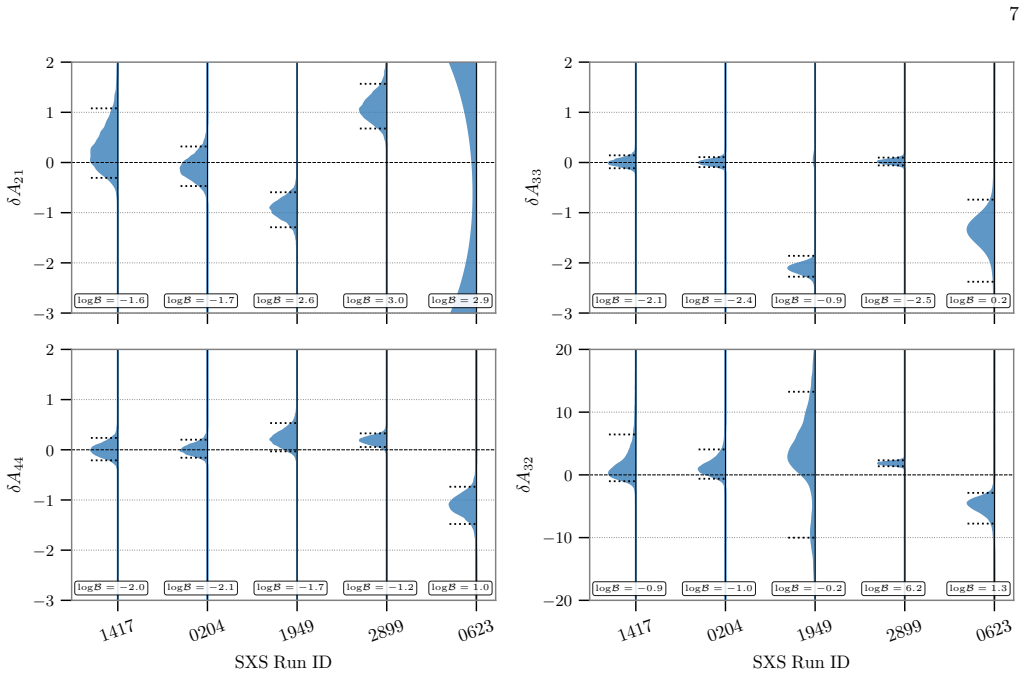
The paper claims that an improved subdominant-mode amplitude (SMA) test, which lets only the amplitudes of the (2,1), (3,3), (4,4), and (3,2) modes float while fixing the quadrupole (2,2) mode, is a reliable null test of general relativity in the aligned-spin and mildly precessing binary black hole regime. Benchmarked on Gaussian noise injections and numerical-relativity waveforms, the test returns unbiased posteriors and GR-consistent Bayes factors for those systems. Applied to the events GW241011 and GW230814, it gives δA33 = 0.00^{+0.46}_{−1.82} and δA44 = −0.30^{+1.16}_{−3.45}, the latter the tightest published bound on the (4,4) mode amplitude deviation, both consistent with GR. The aut
What carries the argument
The SMA modification of the waveform: h → dominant quadrupole terms + Σ_HOM (1+δAℓm) hℓm, with each subdominant mode amplitude modified independently while the (2,2) quadrupole mode is kept fixed. The test's statistical power is carried by the orthogonal mode SNR ρ⊥ℓm, which measures how much signal cannot be explained by the dominant quadrupole mode, and by the one-at-a-time Bayesian estimation of each δAℓm. A load-bearing degeneracy is between δA33, the inclination angle, and the reference orbital phase: when the (3,3) mode is weak, the reference phase becomes bimodal and δA33 develops a secondary peak near −2 that can mimic a deviation. The (3,2) mode is singled out because it contributes
Load-bearing premise
The event-level GR-consistency claims assume that the waveform model used for parameter estimation is an accurate GR template for those signals and that the deviation-parameter null distribution, calibrated from just 20 noise realizations, fully captures the degeneracies that can mimic deviations.
What would settle it
Run the SMA test on hundreds of Gaussian noise realizations of a GW230814-like signal and require the fraction of runs with δA44=0 outside the 99% CI to be ≈1%; if the bimodality produces an inflated false-alarm rate, the quoted CI is too narrow. Separately, reanalyze GW230814 with an independent waveform model and check whether the δA44 posterior and the GR-consistency conclusion are unchanged.
If this is right
- The (3,2) mode extends the test to near-equal-mass and face-on binaries, where the (2,1) and (3,3) modes are weak, so amplitude tests can now cover a larger share of detected black hole mergers.
- The constraint δA44 = −0.30^{+1.16}_{−3.45} for GW230814 is the strongest published bound on a (4,4) amplitude deviation and is consistent with GR.
- The δA33 posterior for GW241011, 0.00^{+0.46}_{−1.82}, likewise does not reject GR and is among the tightest constraints on that mode.
- For strongly precessing or eccentric high-mass systems, apparent deviations reported by the test (e.g., for GW231123) should be interpreted as waveform-modeling systematics rather than evidence against GR.
- Because the test also responds to phase perturbations, a nonzero δAℓm is not proof of an amplitude anomaly; it can flag phase-level deviations that the model does not include.
Where Pith is reading between the lines
- A larger Gaussian-noise injection campaign (hundreds of realizations) would calibrate the bimodal δA33 and δA44 tails; the current 20-realization p-p plot leaves the quoted 99% false-alarm rate uncertain.
- The test's phase sensitivity suggests a cheap diagnostic for catalog events: check the secondary spin posterior from the GR fit — near-extremal spins, as seen in the eccentric and phase-deformed injections, signal unmodeled physics rather than a real Kerr black hole.
- A hierarchical combination of δAℓm posteriors across many events could turn the per-event null test into a population-level bound, with the (3,2) mode as the most phase-sensitive channel.
Editorial analysis
A structured set of objections, weighed in public.
Referee Report
Summary. The paper presents an extension of the subdominant-mode amplitude (SMA) test of general relativity to the (3,2) and (4,4) modes, in addition to the previously considered (2,1) and (3,3) modes. The test is benchmarked through Gaussian-noise injections, numerical-relativity simulations (SXS), injection-recovery of amplitude deviations, and responses to phase-modified waveforms. The authors then apply the test to several O4 events, reporting a constraint on the (4,4) amplitude deviation from GW230814, δA44 = -0.30^{+1.16}_{-3.45}, which they describe as the strongest to date, and a constraint on δA33 from GW241011. The paper also demonstrates that waveform systematics can mimic GR violations for strongly precessing or eccentric binaries, and that the test responds to phase perturbations as well as amplitude perturbations.
Significance. If the statistical calibration and event-level constraints hold, the SMA test would be a useful null test of GR that is complementary to standard phasing tests, and the extension to (3,2) and (4,4) modes broadens its applicability to more symmetric and face-on binaries. The paper's systematic benchmarking against SXS waveforms and its explicit demonstration of systematics-induced biases in high-mass precessing systems are valuable contributions. However, the headline robustness claim rests on a calibration with only 20 noise realizations and on event-level results for systems whose mode SNR is marginal by the paper's own selection criterion, so the empirical validation is weaker than the abstract suggests.
major comments (3)
- [Sec. III B, Fig. 3] The statistical calibration uses only N=20 Gaussian noise realizations for a single binary configuration. The p-p plot shows δA33 touching the 3σ contour and the 60% CI contains the injected value in >80% of runs, which is a notable deviation from expectation. Since the central claim that the SMA test is a validated null test rests on this calibration, 20 realizations is too small to establish the false-alarm rate, especially for δA33, whose bimodal degeneracy with reference phase and inclination (Appendix B) is shown to produce broad, over-covering intervals. The paper should either increase N substantially or present a quantitative uncertainty on the calibration curve and discuss how the δA33 behavior affects the interpretability of event-level δA33 constraints.
- [Sec. V A, Appendix A] The headline event-level result, δA44 for GW230814, is selected using the criterion that the 68% lower bound of ρ⊥44 exceeds 2.145 (the 90th percentile of a χ2 distribution). The paper reports ρ⊥44 = 3.39^{+0.41}_{-1.26}, whose 68% lower bound is 2.13, below the stated threshold. Thus GW230814 does not satisfy the paper's own selection criterion. Moreover, no injection-recovery study is performed for a GW230814-like configuration; the only weak-HOM injection study (Appendix B, Fig. 14) is for GW250114 and shows that such configurations yield broad, bimodal δA44 posteriors dominated by degeneracies and noise. Without event-specific calibration, the quoted interval δA44 = -0.30^{+1.16}_{-3.45} cannot be interpreted as a meaningful constraint on the (4,4) amplitude, and the claim that it is the 'strongest constraint' is not established.
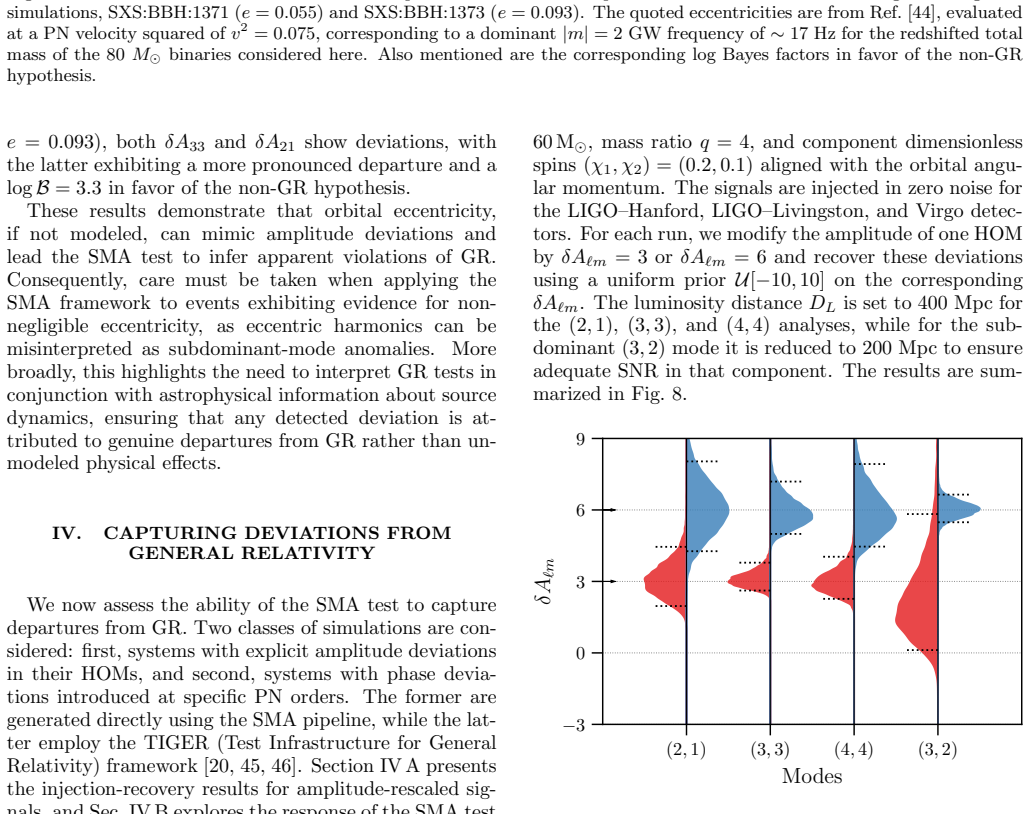
- [Sec. IV A, Fig. 8] The injection-recovery tests for amplitude deviations use IMRPhenomXPHM both to inject and to recover the signals. This is a valid check of internal consistency, but it does not probe the ability of the test to recover deviations when the template family is imperfect, which is the relevant systematic for real events. The SXS injections in Sec. III C partially offset this, but they are performed only for GR-consistent signals and do not include nonzero δAℓm. The paper should either acknowledge this limitation explicitly in the interpretation of Fig. 8 or add at least one cross-family injection-recovery (e.g., an SXS waveform with a modified subdominant mode) to demonstrate that the recovery of amplitude deviations is not an artifact of template self-consistency.
minor comments (5)
- [Sec. VI] Typo: 'ampltiude' should be 'amplitude'.
- [Fig. 4 caption] Typo: 'feect' should be 'effect'.
- [Fig. 14 caption] Typo: 'thode' should be 'those'.
- [Fig. 3] The p-p plot would benefit from a legend or explicit statement that the shaded bands are 1σ, 2σ, and 3σ for N=20; the current shading is not self-explanatory.
- [Sec. II, Eq. (5)] The definition of ρ⊥ℓm as an orthogonal SNR is clear, but the dependence on the noise-weighted inner product should be stated explicitly, including the normalization convention, since the χ2 null distribution in Appendix A relies on this.
Circularity Check
No significant circularity: the SMA test is a phenomenological consistency test validated by external NR and noise benchmarks, not by self-referential reduction.
full rationale
The paper's central operation is not a derivation that claims to predict δAℓm from first principles; it is a Bayesian parameter-estimation consistency test. Equation (2) defines δAℓm as a phenomenological rescaling of subdominant-mode amplitudes while the (2,2) mode is fixed, and the posteriors in Secs. III-V are estimated from data with flat priors. No quoted equation or fitted parameter reduces by construction to another quantity in the paper. The load-bearing validation is external rather than self-citational: the p-p plot uses 20 Gaussian noise realizations (Sec. III B, Fig. 3); the systematics checks use nine SXS numerical-relativity simulations plus two eccentric SXS simulations (Sec. III C, Figs. 5-7); the sensitivity checks inject explicit amplitude deviations and TIGER phase modifications (Secs. IV A-IV B, Figs. 8-9). These benchmarks are independent of the paper's own event-level claims. The event-level results for GW241011, GW230814, GW250114, and GW231123 are reported as posterior intervals from real detector data, not as predictions derived from the model's own inputs. Self-citations to the original SMA formalism [22,23] and to the authors' earlier GW241011 analysis [47] are contextual or comparative, and no load-bearing 'uniqueness theorem' or prior self-cited result is used to force the conclusions. The paper also explicitly documents its limitations: the calibration uses only N=20 noise realizations; δA33 bimodality and degeneracies with inclination and reference phase are identified in Sec. III B and Appendix B; waveform systematics are shown to mimic GR violations for strongly precessing and eccentric systems (Secs. III C and V C); and GW250114 yields an uninformative posterior due to limited mode SNR. These are robustness and calibration concerns, not circularity. The skeptical point that GW230814's ρ⊥44 selection is marginal and that no event-specific injection-recovery was performed is a statistical-strength concern, not a reduction of a predicted quantity to a fitted input. Overall, the paper is self-contained against external NR benchmarks and does not confuse fitted inputs with independent predictions.
Axiom & Free-Parameter Ledger
free parameters (4)
- δA21 =
GW231123: posterior piles up at prior boundary (|δA21| > 10 preferred); no well-defined central value
- δA33 =
0.00^{+0.46}_{-1.82} (GW241011)
- δA44 =
-0.30^{+1.16}_{-3.45} (GW230814)
- δA32 =
Not robustly constrained; broad posteriors and log B from -1.7 to 6.2 across SXS runs
axioms (5)
- domain assumption The GW signal is accurately described by the multipole expansion Eq. (1) and by IMRPhenomXPHM's included modes (2,2), (2,1), (3,3), (4,4), (3,2).
- domain assumption Detector noise is Gaussian and stationary with known PSD for likelihood evaluation.
- standard math The orthogonal SNR definition ρ⊥ℓm in Eq. (5) correctly isolates the mode contribution.
- domain assumption The TIGER phase-perturbation parameterization δχi in Eq. (11) represents a plausible non-GR phasing.
- domain assumption NR simulations from the SXS catalog are accurate GR ground truth.
read the original abstract
We present an improved subdominant-mode amplitude (SMA) test of general relativity (GR), which probes amplitude-level deviations in the higher-order modes of gravitational-wave (GW) signals from binary black hole mergers while keeping the dominant quadrupole mode fixed. Using a comprehensive parameter-estimation campaign, we benchmark the test against Gaussian noise fluctuations, waveform modeling systematics, and physical effects such as spin precession and orbital eccentricity. When applied to numerical-relativity simulations, the SMA test performs reliably for aligned-spin and mildly precessing systems but exhibits measurable biases for strongly precessing or eccentric binaries. Although designed to detect amplitude deviations, the test also responds coherently to phase perturbations, yielding apparent GR violations when applied to phase-modified waveforms. Applied to recent GW detections, we report the strongest constraint on the hexadecapolar $(4,4)$ mode amplitude deviation, $\delta A_{44} = -0.30^{+1.16}_{-3.45}$, consistent with GR. With these results, this work establishes the SMA test as a robust and broadly sensitive null test of general relativity and demonstrates a systematic approach for assessing the robustness of GW tests of GR.
Figures





Forward citations
Cited by 5 Pith papers
-
Accurate waveforms for generic planar-orbit binary black holes: The multipolar effective-one-body model SEOBNRv6EHM
SEOBNRv6EHM is a multipolar EOB model for eccentric planar-orbit BBHs calibrated to NR simulations, showing low waveform mismatches up to eccentricity 0.9.
-
Lessons from binary dynamics of inspiralling equal-mass boson-star mergers
Numerical simulations of equal-mass boson-star mergers reveal larger waveform deviations from black-hole binaries in late inspiral and merger, plus odd multipole excitations for certain scalar-field phases, with some ...
-
GWTC-5.0: Tests of General Relativity
Tests of general relativity on 168 LIGO–Virgo–KAGRA gravitational-wave events (including 72 new from O4b) find GR consistent with all data, improving post-Newtonian and ringdown deviation bounds by 1.2–2.6×.
-
Plunge-Merger-Ringdown Tests of General Relativity with GW250114
GW250114 data constrains GR deviations in merger amplitude to 10% and frequency to 4% at 90% CL, with first bounds on the (4,4) mode frequency at 6%.
-
Shape of U: Measuring the Curvature of the Universe with Gravitational Waves
Next-generation GW detector networks can constrain the spatial curvature parameter Ω_k to 1σ uncertainty of 0.029 using intermediate-mass binary black hole bright sirens.
Reference graph
Works this paper leans on
-
[1]
Because HOM content depends on the total mass Mtot and mass ratio q, we consider Mtot ∈ {100, 200} M⊙ and q ∈ [1.1, 7]
Effect of waveform systematics To assess waveform modeling–induced biases, we apply the SMA test to nine SXS simulations, summarized in Ta- ble I. Because HOM content depends on the total mass Mtot and mass ratio q, we consider Mtot ∈ {100, 200} M⊙ and q ∈ [1.1, 7]. Spin–orbit precession further redis- tributes power among modes and high precession is a r...
1949
-
[2]
Since the IMR- PhenomXPHM waveform used in the SMA test assumes quasi-circular orbits, it does not model these eccentric contributions
Effect of orbital eccentricity Orbital eccentricity can significantly alter the structure of gravitational radiation giving rise to additional eccen- tric harmonics that scale differently from the standard mass-asymmetry–induced modes [40–42]. Since the IMR- PhenomXPHM waveform used in the SMA test assumes quasi-circular orbits, it does not model these ec...
-
[3]
F. Acernese et al. (VIRGO), Class. Quant. Grav. 32, 024001 (2015), arXiv:1408.3978 [gr-qc]
Pith/arXiv arXiv 2015
-
[4]
B. P. Abbott et al. (KAGRA, LIGO Scientific, Virgo), Living Rev. Rel. 19, 1 (2016), arXiv:1304.0670 [gr-qc]
Pith/arXiv arXiv 2016
-
[5]
J. Aasi et al. (LIGO Scientific), Class. Quant. Grav. 32, 15 Figure 16. The posterior distributions for primary and secondary spin parameters, when inferred using the GR template applied on SXS:BBH:1371 and SXS:BBH:1373. The radial coordinate denotes the spin magnitude, and the angular component shows the tilt direction. 074001 (2015), arXiv:1411.4547 [gr-qc]
Pith/arXiv arXiv 2015
-
[6]
Acernese et al
F. Acernese et al. (Virgo), Phys. Rev. Lett. 123, 231108 (2019)
2019
-
[7]
T. Akutsu et al. (KAGRA), PTEP 2021, 05A101 (2021), arXiv:2005.05574 [physics.ins-det]
arXiv 2021
-
[8]
K. Somiya (KAGRA), Class. Quant. Grav. 29, 124007 (2012), arXiv:1111.7185 [gr-qc]
Pith/arXiv arXiv 2012
-
[9]
B. P. Abbott et al. (LIGO Scientific, Virgo), Phys. Rev. Lett. 116, 061102 (2016), arXiv:1602.03837 [gr-qc]
Pith/arXiv arXiv 2016
-
[10]
A. Buikema et al. (aLIGO), Phys. Rev. D 102, 062003 (2020), arXiv:2008.01301 [astro-ph.IM]
Pith/arXiv arXiv 2020
-
[11]
E. Capote et al. , Phys. Rev. D 111, 062002 (2025), arXiv:2411.14607 [gr-qc]
Pith/arXiv arXiv 2025
-
[12]
R. Abbott et al. (LIGO Scientific, VIRGO, KAGRA), Phys. Rev. D 112, 084080 (2025), arXiv:2112.06861 [gr- qc]
Pith/arXiv arXiv 2025
-
[13]
B. P. Abbott et al. (LIGO Scientific, Virgo), Phys. Rev. Lett. 116, 221101 (2016), [Erratum: Phys.Rev.Lett. 121, 129902 (2018)], arXiv:1602.03841 [gr-qc]
Pith/arXiv arXiv 2016
-
[14]
A. G. Abac et al. (LIGO Scientific, VIRGO, KAGRA), arXiv:2508.18082 [gr-qc] (2025)
Pith/arXiv arXiv 2025
-
[15]
A. G. Abac et al. (LIGO Scientific, Virgo, KAGRA), Tests of General Relativity III: Tests of the Remnants. In preparation (2025)
2025
-
[16]
A. G. Abac et al. (LIGO Scientific, Virgo, KAGRA), Tests of General Relativity I — Overview and General Tests. In preparation (2025)
2025
-
[17]
A. G. Abac et al. (LIGO Scientific, Virgo, KAGRA), Tests of General Relativity II — Parameterized Tests. In preparation (2025)
2025
-
[18]
S. Roy, A. S. Sengupta, and K. G. Arun, Phys. Rev. D 103, 064012 (2021), arXiv:1910.04565 [gr-qc]
Pith/arXiv arXiv 2021
-
[19]
G. Pratten et al. , Phys. Rev. D 103, 104056 (2021), arXiv:2004.06503 [gr-qc]
Pith/arXiv arXiv 2021
-
[20]
K. Chatziioannou, N. Cornish, A. Klein, and N. Yunes, Phys. Rev. D 89, 104023 (2014), arXiv:1404.3180 [gr-qc]
Pith/arXiv arXiv 2014
-
[21]
B. P. Abbott et al. (LIGO Scientific, Virgo), Phys. Rev. Lett. 123, 011102 (2019), arXiv:1811.00364 [gr-qc]
Pith/arXiv arXiv 2019
-
[22]
I. Gupta, Astrophys. J. 970, 12 (2024), arXiv:2402.07075 [astro-ph.HE]
Pith/arXiv arXiv 2024
-
[23]
M. Agathos, W. Del Pozzo, T. G. F. Li, C. Van Den Broeck, J. Veitch, and S. Vitale, Phys. Rev. D 89, 082001 (2014), arXiv:1311.0420 [gr-qc]
Pith/arXiv arXiv 2014
-
[24]
R. Abbott et al. (LIGO Scientific, Virgo), Phys. Rev. D 102, 043015 (2020), arXiv:2004.08342 [astro-ph.HE]
Pith/arXiv arXiv 2020
-
[25]
T. Islam, A. K. Mehta, A. Ghosh, V. Varma, P. Ajith, and B. S. Sathyaprakash, Phys. Rev. D 101, 024032 (2020), arXiv:1910.14259 [gr-qc]
Pith/arXiv arXiv 2020
-
[26]
A. Puecher, C. Kalaghatgi, S. Roy, Y. Setyawati, I. Gupta, B. S. Sathyaprakash, and C. Van Den Broeck, Phys. Rev. D 106, 082003 (2022), arXiv:2205.09062 [gr- qc]
Pith/arXiv arXiv 2022
-
[27]
M. Colleoni, F. A. R. Vidal, C. Garc ´ ıa-Quir´ os, S. Ak¸ cay, and S. Bera, Phys. Rev. D 111, 104019 (2025), arXiv:2412.16721 [gr-qc]
Pith/arXiv arXiv 2025
-
[28]
R. Abbott et al. (LIGO Scientific, Virgo), Astrophys. J. Lett. 896, L44 (2020), arXiv:2006.12611 [astro-ph.HE]
Pith/arXiv arXiv 2020
-
[29]
R. Abbott et al. (KAGRA, VIRGO, LIGO Scientific), Phys. Rev. X 13, 041039 (2023), arXiv:2111.03606 [gr- qc]
Pith/arXiv arXiv 2023
-
[30]
L. Blanchet, Living Rev. Rel. 17, 2 (2014), 16 arXiv:1310.1528 [gr-qc]
Pith/arXiv arXiv 2014
-
[31]
The LIGO Scientific Collaboration, The Virgo Collabo- ration, The Kagra Collaboration, and Others, arXiv e- prints , arXiv:2509.07348 (2025), arXiv:2509.07348 [gr- qc]
Pith/arXiv arXiv 2025
-
[32]
Nevertheless, for nearly equal-mass systems, both the (3 , 2) and (4, 4) modes can become relevant, particularly when the total SNR is suf- ficiently high. While the analysis here is restricted to BBHs with spins aligned to the orbital angular momentum, it is important to note that spin-orbit misalignment, lead- ing to spin precession, can further enhance...
-
[33]
Y. Pan, A. Buonanno, R. Fujita, E. Racine, and H. Tagoshi, Phys. Rev. D 83, 064003 (2011), [Erratum: Phys.Rev.D 87, 109901 (2013)], arXiv:1006.0431 [gr-qc]
Pith/arXiv arXiv 2011
-
[34]
C. Mills and S. Fairhurst, Phys. Rev. D 103, 024042 (2021), arXiv:2007.04313 [gr-qc]
Pith/arXiv arXiv 2021
- [35]
- [36]
-
[37]
M. Boyle et al. , Class. Quant. Grav. 36, 195006 (2019), arXiv:1904.04831 [gr-qc]
Pith/arXiv arXiv 2019
-
[38]
P. Schmidt, F. Ohme, and M. Hannam, Phys. Rev. D 91, 024043 (2015), arXiv:1408.1810 [gr-qc]
Pith/arXiv arXiv 2015
-
[39]
J. S. Speagle, Mon. Not. Roy. Astron. Soc. 493, 3132 (2020), arXiv:1904.02180 [astro-ph.IM]
Pith/arXiv arXiv 2020
-
[40]
G. Ashton et al. , Astrophys. J. Suppl. 241, 27 (2019), arXiv:1811.02042 [astro-ph.IM]
Pith/arXiv arXiv 2019
-
[41]
A. G. Abac et al. (LIGO Scientific, VIRGO, KAGRA), Astrophys. J. Lett. 993, L25 (2025), arXiv:2507.08219 [astro-ph.HE]
Pith/arXiv arXiv 2025
-
[42]
V. Varma, S. E. Field, M. A. Scheel, J. Blackman, D. Gerosa, L. C. Stein, L. E. Kidder, and H. P. Pfeiffer, Phys. Rev. Research. 1, 033015 (2019), arXiv:1905.09300 [gr-qc]
Pith/arXiv arXiv 2019
-
[43]
N. Yunes, K. G. Arun, E. Berti, and C. M. Will, Phys. Rev. D 80, 084001 (2009), [Erratum: Phys.Rev.D 89, 109901 (2014)], arXiv:0906.0313 [gr-qc]
Pith/arXiv arXiv 2009
-
[44]
S. Tanay, M. Haney, and A. Gopakumar, Phys. Rev. D 93, 064031 (2016), arXiv:1602.03081 [gr-qc]
Pith/arXiv arXiv 2016
-
[45]
N. Bose and A. Pai, Phys. Rev. D 104, 124021 (2021), arXiv:2107.14736 [gr-qc]
Pith/arXiv arXiv 2021
-
[46]
P. Narayan, N. K. Johnson-McDaniel, and A. Gupta, Phys. Rev. D 108, 064003 (2023), arXiv:2306.04068 [gr- qc]
Pith/arXiv arXiv 2023
-
[47]
I. Hinder, L. E. Kidder, and H. P. Pfeiffer, Phys. Rev. D 98, 044015 (2018), arXiv:1709.02007 [gr-qc]
Pith/arXiv arXiv 2018
-
[48]
T. G. F. Li, W. Del Pozzo, S. Vitale, C. Van Den Broeck, M. Agathos, J. Veitch, K. Grover, T. Sidery, R. Stu- rani, and A. Vecchio, Phys. Rev. D 85, 082003 (2012), arXiv:1110.0530 [gr-qc]
Pith/arXiv arXiv 2012
-
[49]
S. Roy, M. Haney, G. Pratten, P. T. H. Pang, and C. Van Den Broeck, arXiv:2504.21147 [gr-qc] (2025)
arXiv 2025
-
[50]
A. G. Abac et al. (LIGO Scientific, KAGRA), Astrophys. J. Lett. 993, L21 (2025), arXiv:2510.26931 [astro-ph.HE]
arXiv 2025
-
[52]
A. G. Abac et al. (LIGO Scientific, VIRGO, KAGRA), arXiv:2509.08099 [gr-qc] (2025)
Pith/arXiv arXiv 2025
-
[53]
A. G. Abac et al. (KAGRA, Virgo, LIGO Scientific), Phys. Rev. Lett. 135, 111403 (2025), arXiv:2509.08054 [gr-qc]
Pith/arXiv arXiv 2025
-
[54]
Chandra, R
K. Chandra, R. Gamba, and D. Chiaramello (2025), in preparation
2025
-
[55]
R. Gamba, D. Chiaramello, and S. Neogi, Phys. Rev. D 110, 024031 (2024), arXiv:2404.15408 [gr-qc]
Pith/arXiv arXiv 2024
-
[56]
A. Nagar, D. Chiaramello, R. Gamba, S. Albanesi, S. Bernuzzi, V. Fantini, M. Panzeri, and P. Rettegno, Phys. Rev. D 111, 064050 (2025), arXiv:2407.04762 [gr- qc]
Pith/arXiv arXiv 2025
-
[57]
S. Albanesi, R. Gamba, S. Bernuzzi, J. Fontbut´ e, A. Gon- zalez, and A. Nagar, arXiv:2503.14580 [gr-qc] (2025)
Pith/arXiv arXiv 2025
-
[58]
C. R. Harris, K. J. Millman, S. J. van der Walt, R. Gom- mers, P. Virtanen, D. Cournapeau, E. Wieser, J. Tay- lor, S. Berg, N. J. Smith, R. Kern, M. Picus, S. Hoyer, M. H. van Kerkwijk, M. Brett, A. Haldane, J. F. del R ´ ıo, M. Wiebe, P. Peterson, P. G´ erard-Marchant, K. Shep- pard, T. Reddy, W. Weckesser, H. Abbasi, C. Gohlke, and T. E. Oliphant, Natur...
2020
-
[59]
Virtanen, R
P. Virtanen, R. Gommers, T. E. Oliphant, M. Haber- land, T. Reddy, D. Cournapeau, E. Burovski, P. Pe- terson, W. Weckesser, J. Bright, S. J. van der Walt, M. Brett, J. Wilson, K. J. Millman, N. Mayorov, A. R. J. Nelson, E. Jones, R. Kern, E. Larson, C. J. Carey, ˙I. Po- lat, Y. Feng, E. W. Moore, J. VanderPlas, D. Laxalde, J. Perktold, R. Cimrman, I. Henr...
2020
-
[60]
J. D. Hunter, Computing in Science & Engineering 9, 90 (2007)
2007
-
[61]
I. M. Romero-Shaw et al. , Mon. Not. Roy. Astron. Soc. 499, 3295 (2020), arXiv:2006.00714 [astro-ph.IM]
Pith/arXiv arXiv 2020
-
[62]
Ashton, C
G. Ashton, C. Talbot, S. Roy, G. Pratten, T.-H. Pang, M. Agathos, T. Baka, E. S¨ anger, A. Mehta, J. Steinhoff, E. Maggio, A. Ghosh, and A. Vijaykumar, Bilby TGR (2024)
2024
-
[63]
C. Hoy and V. Raymond, SoftwareX 15, 100765 (2021), arXiv:2006.06639 [astro-ph.IM]
Pith/arXiv arXiv 2021
-
[64]
Koposov et al
S. Koposov et al. , joshspeagle/dynesty: v3.0.0 (2025)
2025
-
[65]
M. Harrower and C. A. Brewer, The Cartographic Journal 40, 27 (2003), https://www.tandfonline.com/doi/pdf/10.1179/000870403235002042
-
[66]
S. Fairhurst, R. Green, C. Hoy, M. Hannam, and A. Muir, Phys. Rev. D 102, 024055 (2020), arXiv:1908.05707 [gr- qc]
Pith/arXiv arXiv 2020
-
[67]
I. M. Romero-Shaw, D. Gerosa, and N. Loutrel, Mon. Not. Roy. Astron. Soc. 519, 5352 (2023), arXiv:2211.07528 [astro-ph.HE]
arXiv 2023
-
[68]
, arXiv:2510.04332 [gr-qc] (2025)
Divyajyoti et al. , arXiv:2510.04332 [gr-qc] (2025)
Pith/arXiv arXiv 2025
discussion (0)
Sign in with ORCID, Apple, or X to comment. Anyone can read and Pith papers without signing in.