REVIEW 3 major objections 4 minor 2 cited by
The paper claims that a small shortfall in the universe's horizon entanglement entropy—relative to its Bekenstein–Hawking value—would produce a late-time boost in cosmic expansion that can ease the Hubble tension, without touching the early
Reviewed by Pith at T0; open to challenge. T0 means a machine referee read the full paper against a public rubric. the ladder, T0–T4 →
T0 review · deepseek-v4-flash
2026-08-03 08:08 UTC pith:O5LJXAHT
load-bearing objection A transparent consistency test that masquerades as a detection: the HEED amplitude is inherited from the SH0ES anchor, not earned by the data. the 3 major comments →
Hubble Tension as an Effect of Horizon Entanglement Nonequilibrium
The pith
A machine-rendered reading of the paper's core claim, the machinery that carries it, and where it could break.
Core claim
The central claim is that the horizon entanglement equipartition deficit (HEED) supplies a physical origin for a holographic-style dark energy. Starting from a fractional deficit δ(a)=1−S_ent/S_BH at the apparent horizon, and applying equipartition with the Gibbons–Hawking temperature T=H/(2π) to the missing surface degrees of freedom, the paper derives a bulk density ρ_HEED = (3/8πG) c_e²(a) H²(a) with c_e²(a) = 2δ(a). Because ρ tracks H², it is automatically small at early times; a smooth late-time activation g(a; a_t, k) makes it switch on at z≲1. The net effect is a rescaling of the Friedmann equation H² = (8πG/3)(ρ_m+ρ_Λ)/(1−c_e²(a)), which boosts the present-day expansion rate by (1−c_
What carries the argument
The central object is the horizon entanglement equipartition deficit (HEED): a fractional shortfall δ(a)=1−S_ent/S_BH of the renormalized entanglement entropy across the apparent horizon relative to the Bekenstein–Hawking entropy A/(4G). The machinery is the equipartition identity ΔE_surf = (1/2)δ N_surf T_dS with N_surf = A/G and T_dS = H/(2π), which turns the entropy deficit into a surface energy deficit and then, divided by the Hubble volume, into a homogeneous bulk density scaling as H²/G. A three-parameter activation function c_e²(a)=c_e0 (1+(a_t)^k)/(1+(a_t/a)^k) controls the late-time switch-on; this function is what lets the component be negligible at recombination and active today.
Load-bearing premise
The load-bearing premise is that a fractional deficit δ(a) of the horizon's entanglement entropy relative to Bekenstein–Hawking actually exists in the late universe and follows the assumed smooth activation, and that the equipartition counting maps that deficit to a bulk energy density exactly as assumed; without an independent derivation of δ(a), the H0 boost is a fitted constant.
What would settle it
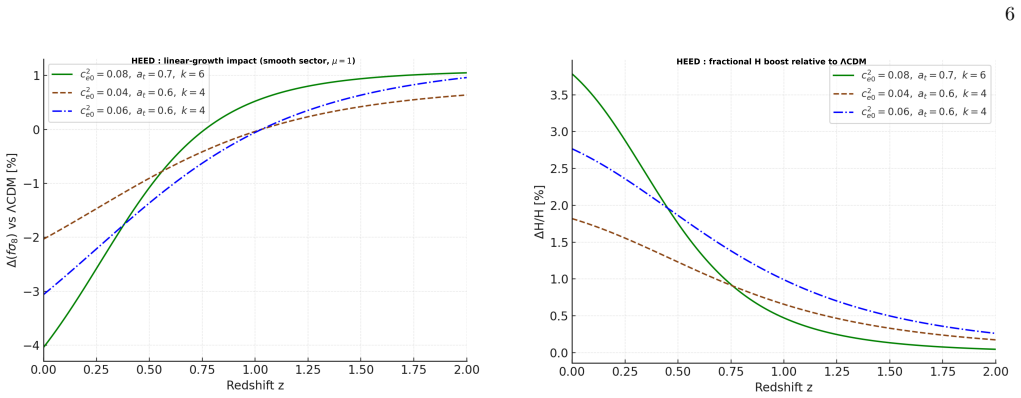
A direct calculation showing that the renormalized entanglement entropy across the apparent horizon exactly saturates the Bekenstein–Hawking value for the late-time FLRW state would eliminate the deficit and the model. Observationally, a precise measurement of the late integrated Sachs–Wolfe effect (via CMB–galaxy cross-correlation) that finds no enhancement over ΛCDM at the level predicted for c_e0 ≈ 0.06–0.10 would falsify HEED's growth side.
If this is right
- At z≲1, HEED raises H(z) by a few percent; H0 is boosted by (1−c_e0)^(−1/2) — about 3% for c_e0=0.06 and 5% for c_e0=0.10.
- Recombination physics and the sound horizon are preserved, so the early-universe ruler that anchors the CMB Hubble estimate is unchanged.
- The model predicts a mild suppression of fσ8(z) at low z and a correspondingly enhanced late integrated Sachs–Wolfe effect, offering growth-based tests.
- Fits to supernovae, BAO, cosmic chronometer, and RSD data show HEED can accommodate an anchored late-time H0 near 73 km/s/Mpc while remaining consistent with distance and growth constraints.
- The posterior favors c_e0 > 0 with activation at z_t ~ 0.7–1.5, but the sharpness k is poorly constrained and HEED is not statistically preferred over ΛCDM at current precision.
Where Pith is reading between the lines
- If HEED is right, the Hubble tension is not an early-universe problem at all: it is a late-time horizon information deficit, which would sidestep the sound-horizon pressures that constrain early dark energy.
- A sharp test would be the late ISW signal: HEED predicts enhanced ISW beyond what a smooth dark energy with the same expansion history would produce, measurable through CMB–large-scale-structure cross-correlations; the paper notes but does not perform this analysis.
- The equipartition step is a bookkeeping translation; without an independent microphysical calculation of δ(a) from, say, horizon mutual information or entanglement wedge capacity, the model is a physically motivated reparameterization of a late-time constant.
- The mild growth suppression and lower σ8 favored by the fit suggest HEED could also soften the S8 tension, though the paper presents this only as a possible bonus.
Editorial analysis
A structured set of objections, weighed in public.
Referee Report
Summary. The paper proposes a late-time infrared mechanism, HEED, to alleviate the Hubble tension. It argues that a small deficit δ(a) in horizon entanglement entropy relative to the Bekenstein–Hawking value, mapped through horizon equipartition, sources a homogeneous component with ρ_HEED ∝ c_e^2(a) H^2(a), where c_e^2(a)=2δ(a). A three-parameter activation model for c_e^2(a) is introduced, and the background expansion, effective equation of state, and linear growth are derived. The model is fitted to SN Ia, BAO, cosmic chronometer, and RSD data, with an external Gaussian prior on the effective Hubble scale H_eff^0=73 km/s/Mpc. The analysis finds c_e0>0 and late-time activation, but the paper itself notes that the best-fit HEED and ΛCDM curves are nearly indistinguishable and frames the exercise as an 'anchored consistency test'.
Significance. If a genuine IR entanglement deficit were established, the H^2/G scaling would be an interesting way to modify late-time expansion without affecting recombination, with testable consequences for H(z), fσ8(z), and the ISW effect. The paper's background algebra and growth equations are standard, and the data compilation is extensive. However, the central claim that HEED is an effect causing the boosted late-time H0 is not supported by the presented evidence: the nonzero c_e0 is induced by the imposed SH0ES anchor rather than required by the data, and no model comparison is provided. The authors' candid statement that the chains do not infer an upward shift is commendable, but it directly undercuts the title and abstract's causal language.
major comments (3)
- [Sec. III.B, Eq. (27) and Eq. (41)] The central evidence for a nonzero HEED amplitude is circular. The posterior is conditioned on an external Gaussian prior on H_eff^0 centered at 73 km/s/Mpc (Eq. 41), and Eq. (27) defines H_eff^0 = H_0 / sqrt(1 - c_e0^2). For any underlying H_0 < 73, this anchor is satisfied by c_e0^2 = 1 - (H_0/73)^2. The text itself states that 'the chains do not infer an upward shift of the Hubble scale relative to CMB-only analyses.' The reported posterior peak of c_e0 away from zero is therefore a reparameterization of the SH0ES prior, not 'direct phenomenological support' for a horizon entanglement deficit, as claimed in Sec. III.B. This invalidates the title/abstract claim that HEED is an effect causing the boosted late-time H0.
- [Sec. III.B, Figs. 4-8] No model comparison with ΛCDM is presented. The paper states that best-fit HEED and ΛCDM curves are nearly indistinguishable at current precision, yet no Δχ², AIC/BIC, DIC, or Bayes factor is reported. Without such a statistic, the analysis can at most show that HEED is not excluded by low-z data; it cannot show that the data favor HEED over ΛCDM or that HEED alleviates the Hubble tension. A free fit without the H_eff^0 anchor, or a joint analysis that treats H0 as a parameter to be inferred, is required to establish an upward shift in the expansion rate.
- [Sec. II, Eqs. (10)-(14) and Eq. (17)] The physical identification of c_e^2(a) with an entanglement entropy deficit δ(a) is not derived from an underlying model. The equipartition step ΔE_surf = (1/2)δ N_surf T_dS assumes that horizon degrees of freedom are counted by N_surf = A/G and that a fractional deficit in S_ent maps linearly to a missing surface energy. No microphysical mechanism for δ(a) is provided, and the activation function g(a;a_t,k) in Eq. (17) is ad hoc. This is acceptable for a phenomenological parameterization, but it means that the current HEED 'effect' is a fitted H^2-proportional component, not a demonstrated consequence of horizon entanglement nonequilibrium. The paper should explicitly state this limitation whenever drawing physical conclusions.
minor comments (4)
- [Sec. I] The paragraph beginning 'Two features make HEED cosmologically attractive...' appears twice nearly verbatim in the Introduction.
- [Fig. 3] The axis label '2 Ceo' appears garbled and should read 'c_e0^2' or similar. Figures 1 and 2 also lack full caption text in the provided manuscript.
- [Sec. III.A, Eqs. (34)-(36)] The BAO, CC, and RSD likelihoods are taken as diagonal Gaussian forms. The compressed BAO points from BOSS/eBOSS/DESI may have nontrivial correlations; the paper should justify the diagonal approximation or use the published covariances.
- [Sec. III.A general] The MCMC setup is described but convergence diagnostics are not reported (chain length, burn-in, acceptance fractions, Gelman-Rubin or similar). This limits reproducibility of the posterior results.
Circularity Check
The claimed HEED signal is not independently inferred: the nonzero c_e0 peak is induced by the H_eff0=73 anchor via Eqs. (41) and (27), and the reported H0 boost is that anchor relabeled.
specific steps
-
fitted input called prediction
[Sec. III.A, Eq. (41); Sec. III.B, 'Present-day HEED amplitude']
"Finally, in anchored analysis we impose an external Gaussian prior on the effective Hubble scale H_eff0, not on H0, χ²_H_eff0 = ((H_eff0 − H_eff0,⋆)/σ_H_eff0)², H_eff0 = H0/sqrt(1−c_e0²). (41) This prior is not used to infer the Hubble scale from low-z probes alone. Rather, it enables a consistency test ... A central result of the analysis is that the posterior for the HEED amplitude c_e0 peaks decisively away from zero. Pure ΛCDM, corresponding to c_e0 = 0, lies in the tail of the posterior ... This provides direct phenomenological support for a nonvanishing late-time horizon entanglement def"
The posterior is conditioned on H_eff0 = 73 (Eq. 41). By the paper's own definition Eq. (27), H_eff0 ≡ H0/sqrt(1−c_e0²), so any underlying H0 below 73 is converted into c_e0>0 through c_e0² = 1−(H0/73)². Hence the 'central result' that c_e0 peaks away from zero is the imposed SH0ES anchor rewritten in the new coordinates, not an independent inference from the low-z data. The claimed Hubble boost H_eff0/H0=(1−c_e0²)^−1/2 is the same defining relation, so the 'prediction' reduces to the input prior. The paper itself concedes this is 'an anchored consistency test (high H_eff0 imposed), rather than as a free low-z determination of the Hubble scale.'
full rationale
The formal map from an assumed fractional deficit δ(a) to ρ_HEED via horizon equipartition (Eqs. 9–14) is algebraically self-contained and not circular; it uses standard horizon thermodynamics and is not carried by self-citations of the present authors. The circularity is located in the observational claim. Eq. (41) imposes a Gaussian prior on H_eff0, and Eq. (27) defines H_eff0=H0/sqrt(1−c_e0²). This means the nonzero c_e0 reported as 'direct phenomenological support' for an entanglement deficit is the H_eff0=73 anchor transformed through the model coordinates, especially because the chains are not free determinations of H_eff0. The associated fσ8 suppression and H(z) boost are consequences of the fitted activation parameters, not independent predictions; the paper itself states that best-fit HEED and ΛCDM curves are nearly indistinguishable at current precision, and it defers both a full model comparison with ΛCDM and a microphysical model of δ(a) to future work. Thus the central headline inference—that horizon entanglement nonequilibrium causes the late-time H0 boost—is partially circular: the algebraic δ→ρ relation is noncircular, but the evidence for a nonzero δ reduces to a reparameterization of the imposed prior.
Axiom & Free-Parameter Ledger
free parameters (3)
- c_e0 =
posterior peaks away from zero (exact value not quoted)
- a_t =
posterior ~0.4–0.6
- k =
weakly constrained, possibly multi-modal
axioms (4)
- domain assumption The apparent Hubble horizon has a temperature T_dS = H/(2π) and Bekenstein–Hawking entropy S_BH = A/(4G), and equipartition E = (1/2) N T applies to its effective degrees of freedom.
- ad hoc to paper A fractional deficit δ(a) ∈ [0,1] of the renormalized horizon entanglement entropy exists in the late universe and follows the ad hoc activation g(a;a_t,k) of Eq. (17).
- ad hoc to paper The UV area-law contribution to entanglement entropy renormalizes 1/G while the IR deficit sources a new fluid, so the two can be separated without double-counting.
- domain assumption The HEED sector is smooth and non-clustering (rest-frame sound speed ≃1), so linear growth is computed with the standard GR ODE (Eq. 21).
invented entities (1)
-
Horizon entanglement equipartition deficit δ(a) (equivalently the HEED fluid ρ_HEED)
no independent evidence
read the original abstract
We propose an infrared mechanism for alleviating the Hubble constant tension, based on a small departure from entanglement equilibrium at the cosmological apparent horizon. If the horizon entanglement entropy falls slightly below the Bekenstein-Hawking value, we parametrize the shortfall by a fractional deficit $\delta(a)$ evolving with the FLRW scale factor $a$. The associated equipartition deficit at the Gibbons-Hawking temperature then sources a smooth, homogeneous component whose density scales as $H^{2}/G$, with a dimensionless coefficient $c_{e}^{2}(a)$ of order unity times $\delta(a)$. Because this component tracks $H^{2}$, it is negligible at early times but can activate at redshifts $z\lesssim 1$, raising the late time expansion rate by a few percent without affecting recombination or the sound horizon. We present a minimal three parameter activation model for $c_{e}^{2}(a)$ and derive its impact on the background expansion, effective equation of state, and linear growth for a smooth entanglement sector. The framework predicts a small boost in $H(z)$, a mild suppression of $f\sigma_{8}(z)$, and a corresponding modification of the low-$z$ distance-redshift relation. We test these predictions against current low-redshift data sets, including SN~Ia distance moduli, baryon acoustic oscillation distance measurements, cosmic chronometer $H(z)$ data, and redshift space distortion constraints, and discuss whether the $H_0$ tension can be consistently interpreted as a late-time, horizon-scale information deficit rather than an early universe modification.
Figures


Forward citations
Cited by 2 Pith papers
-
Modifying $\Lambda$CDM dynamics via out-of-equilibrium axions: reconciling SH0ES and DESI $H_0$ values
Out-of-equilibrium axion dark matter modifies late-time expansion to reconcile SH0ES H0 ≈ 73 km/s/Mpc with DESI BAO data while recovering standard behavior at higher redshifts.
-
Modifying $\Lambda$CDM dynamics via out-of-equilibrium axions: reconciling SH0ES and DESI $H_0$ values
A two-parameter model in which axion dark matter is driven out of equilibrium at late times fits SH0ES and DESI data with H0 ≈ 73 km/s/Mpc, but only when the SH0ES prior is included.
Reference graph
Works this paper leans on
-
[1]
Aghanim,et al., Planck 2018 results
Planck Collaboration, N. Aghanim,et al., Planck 2018 results. vi. cosmological parameters, Astronomy & Astrophysics 641, A6 (2020), arXiv:1807.06209 [astro-ph.CO]
Pith/arXiv arXiv 2018
-
[2]
A. G. Riesset al., A comprehensive measurement of the local value of the hubble constant with 1 km s−1 mpc−1 uncertainty from the hubble space telescope and the sh0es team, The Astrophysical Journal Letters934, L7 (2022), arXiv:2112.04510 [astro-ph.CO]
Pith/arXiv arXiv 2022
-
[3]
A. G. Adameet al.(DESI), DESI 2024 VI: cosmological constraints from the measurements of baryon acoustic oscillations, JCAP02, 021, arXiv:2404.03002 [astro-ph.CO]
Pith/arXiv arXiv 2024
-
[4]
Abdul Karimet al.(DESI), DESI DR2 results
M. Abdul Karimet al.(DESI), DESI DR2 results. II. Measurements of baryon acoustic oscillations and cosmological constraints, Phys. Rev. D112, 083515 (2025), arXiv:2503.14738 [astro-ph.CO]
Pith/arXiv arXiv 2025
-
[5]
Vagnozzi, New physics in light of theH 0 tension: An alternative view, Phys
S. Vagnozzi, New physics in light of theH 0 tension: An alternative view, Phys. Rev. D102, 023518 (2020), arXiv:1907.07569 [astro-ph.CO]
Pith/arXiv arXiv 2020
-
[6]
E. Di Valentino, O. Mena, S. Pan, L. Visinelli, W. Yang, A. Melchiorri, D. F. Mota, A. G. Riess, and J. Silk, In the realm of the hubble tension: A review of solutions, Classical and Quantum Gravity38, 153001 (2021), arXiv:2103.01183 [astro-ph.CO]
Pith/arXiv arXiv 2021
-
[7]
E. Abdalla, G. F. Abell´ an, A. Aboubrahim,et al., Cosmology intertwined: A review of the particle physics, astrophysics, and cosmology associated with the cosmological tensions and anomalies, Journal of High Energy Astrophysics34, 49 (2022), arXiv:2203.06142 [astro-ph.CO]
Pith/arXiv arXiv 2022
-
[8]
N. Sch¨ oneberg, G. Franco Abell´ an, A. P´ erez S´ anchez, S. J. Witte, V. Poulin, and J. Lesgourgues, The H0 Olympics: A fair ranking of proposed models, Phys. Rept.984, 1 (2022), arXiv:2107.10291 [astro-ph.CO]
Pith/arXiv arXiv 2022
-
[9]
S. Vagnozzi, Seven Hints That Early-Time New Physics Alone Is Not Sufficient to Solve the Hubble Tension, Universe9, 393 (2023), arXiv:2308.16628 [astro-ph.CO]
Pith/arXiv arXiv 2023
-
[10]
E. Di Valentinoet al.(CosmoVerse Network), The CosmoVerse White Paper: Addressing observational tensions in cosmology with systematics and fundamental physics, Phys. Dark Univ.49, 101965 (2025), arXiv:2504.01669 [astro- ph.CO]
Pith/arXiv arXiv 2025
-
[11]
D. Pedrotti, L. A. Escamilla, V. Marra, L. Perivolaropoulos, and S. Vagnozzi, BAO miscalibration cannot rescue late-time solutions to the Hubble tension, arXiv 10.1103/pn9j-8whx (2025), arXiv:2510.01974 [astro-ph.CO]
Pith/arXiv arXiv 2025
-
[12]
D. Scolnic, D. Brout, A. Carr, A. G. Riess, T. M. Davis, A. Dwomoh, D. O. Jones, N. Ali, W. D. Kenworthy, E. R. Peterson, K. Said, B. Popovic, G. Taylor, and et al., The pantheon+ analysis: The full data set and light-curve release, Astrophysical Journal938, 113 (2022), arXiv:2112.03863 [astro-ph.CO]
Pith/arXiv arXiv 2022
-
[13]
S. Alamet al.(BOSS), The clustering of galaxies in the completed SDSS-III Baryon Oscillation Spectroscopic Survey: cosmological analysis of the DR12 galaxy sample, Mon. Not. Roy. Astron. Soc.470, 2617 (2017), arXiv:1607.03155 [astro-ph.CO]
Pith/arXiv arXiv 2017
-
[14]
S. Alam, M. Ishak, S. Ho, W. J. Percival, A. J. Ross, G.-B. Zhao, and et al., Completed sdss-iv extended baryon oscillation spectroscopic survey: Cosmological implications from two decades of spectroscopic surveys at the apache point observatory, Physical Review D103, 083533 (2021), arXiv:2007.08991 [astro-ph.CO]
Pith/arXiv arXiv 2021
-
[15]
M. M. Ivanov, E. McDonough, J. C. Hill, M. Simonovi´ c, M. W. Toomey, S. Alexander, and M. Zaldarriaga, Constraining early dark energy with large-scale structure, Physical Review D102, 103502 (2020), arXiv:2006.11235 [astro-ph.CO]
Pith/arXiv arXiv 2020
-
[16]
J. C. Hill, E. Calabrese, S. Aiola,et al., Atacama cosmology telescope: Constraints on prerecombination early dark energy, Physical Review D105, 123536 (2022), arXiv:2109.04451 [astro-ph.CO]
Pith/arXiv arXiv 2022
-
[17]
A. G. Cohen, D. B. Kaplan, and A. E. Nelson, Effective field theory, black holes, and the cosmological constant, Physical Review Letters82, 4971 (1999)
1999
-
[18]
M. Li, A model of holographic dark energy, Physics Letters B603, 1 (2004), arXiv:hep-th/0403127 [hep-th]
Pith/arXiv arXiv 2004
-
[19]
S. D. H. Hsu, Entropy bounds and dark energy, Physics Letters B594, 13 (2004), arXiv:hep-th/0403052 [hep-th]
Pith/arXiv arXiv 2004
-
[20]
S. Wang, Y. Wang, and M. Li, Holographic dark energy, Physics Reports696, 1 (2017), arXiv:1612.00345 [astro-ph.CO]
Pith/arXiv arXiv 2017
-
[21]
G. W. Gibbons and S. W. Hawking, Cosmological event horizons, thermodynamics, and particle creation, Physical Review D15, 2738 (1977)
1977
-
[22]
J. D. Bekenstein, Black holes and entropy, Phys. Rev. D7, 2333 (1973)
1973
-
[23]
S. W. Hawking, Particle creation by black holes, Commun. Math. Phys.43, 199 (1975)
1975
-
[24]
R. M. Wald, Black hole entropy is the Noether charge, Phys. Rev. D48, R3427 (1993)
1993
-
[25]
Padmanabhan, Thermodynamical Aspects of Gravity: New insights, Rep
T. Padmanabhan, Thermodynamical Aspects of Gravity: New insights, Rep. Prog. Phys.73, 046901 (2010), arXiv:0911.5004 [gr-qc]
Pith/arXiv arXiv 2010
-
[26]
T. Padmanabhan, Equipartition of energy in the horizon degrees of freedom and the emergence of gravity, Mod. Phys. Lett. A25, 1129 (2010), arXiv:0912.3165 [gr-qc]
Pith/arXiv arXiv 2010
-
[27]
E. P. Verlinde, On the origin of gravity and the laws of Newton, JHEP04, 029, arXiv:1001.0785 [hep-th]
-
[28]
T. Padmanabhan, Emergence and Expansion of Cosmic Space as due to the Quest for Holographic Equipartition, 1206.4916 (2012), arXiv preprint, arXiv:1206.4916 [hep-th]
Pith/arXiv arXiv 2012
-
[29]
H. Casini and M. Huerta, Entanglement entropy in free quantum field theory, Journal of Physics A: Mathematical and Theoretical42, 504007 (2009), arXiv:0905.2562 [hep-th]
Pith/arXiv arXiv 2009
-
[30]
W. Donnelly and L. Freidel, Local subsystems in gauge theory and gravity, Journal of High Energy Physics2016, 102 (2016), arXiv:1601.04744 [hep-th]
Pith/arXiv arXiv 2016
-
[31]
D. Harlow, Jerusalem lectures on black holes and quantum information, Reviews of Modern Physics88, 015002 (2017), arXiv:1409.1231 [hep-th]
Pith/arXiv arXiv 2017
-
[32]
Bombelli, R
L. Bombelli, R. K. Koul, J. Lee, and R. D. Sorkin, Quantum source of entropy for black holes, Physical Review D34, 373 (1986). 18
1986
-
[33]
Srednicki, Entropy and area, Physical Review Letters71, 666 (1993), arXiv:hep-th/9303048 [hep-th]
M. Srednicki, Entropy and area, Physical Review Letters71, 666 (1993), arXiv:hep-th/9303048 [hep-th]
Pith/arXiv arXiv 1993
-
[34]
L. Susskind and J. Uglum, Black hole entropy in canonical quantum gravity and superstring theory, Phys. Rev. D50, 2700 (1994), arXiv:hep-th/9401070
Pith/arXiv arXiv 1994
-
[35]
S. N. Solodukhin, Entanglement entropy of black holes, Living Rev. Rel.14, 8 (2011), arXiv:1104.3712 [hep-th]
Pith/arXiv arXiv 2011
-
[37]
N. Engelhardt and A. C. Wall, Quantum extremal surfaces: Holographic entanglement entropy beyond the classical regime, Journal of High Energy Physics2015, 073 (2015), arXiv:1408.3203 [hep-th]
Pith/arXiv arXiv 2015
-
[38]
Jacobson, Entanglement equilibrium and the Einstein equation, Phys
T. Jacobson, Entanglement equilibrium and the Einstein equation, Phys. Rev. Lett.116, 201101 (2016), arXiv:1505.04753 [gr-qc]
Pith/arXiv arXiv 2016
-
[39]
N. Lashkari, M. B. McDermott, and M. V. Raamsdonk, Gravitational dynamics from entanglement “thermodynamics”, JHEP04, 195, arXiv:1308.3716 [hep-th]
-
[40]
R. Bousso, The holographic principle, Reviews of Modern Physics74, 825 (2002), arXiv:hep-th/0203101 [hep-th]
Pith/arXiv arXiv 2002
-
[41]
K. S. Thorne, R. H. Price, and D. A. Macdonald,Black Holes: The Membrane Paradigm(Yale University Press, 1986)
1986
-
[42]
J.-W. Lee, J. Lee, and H.-C. Kim, Dark energy from vacuum entanglement, JCAP08, 005, arXiv:hep-th/0701199
-
[43]
J.-W. Lee, H.-C. Kim, and J. Lee, Gravity from Quantum Information, J. Korean Phys. Soc.63, 1094 (2013), arXiv:1001.5445 [hep-th]
Pith/arXiv arXiv 2013
-
[44]
E. Bellini and M. Sawicki, Maximal freedom at minimum cost: linear large-scale structure in general modifications of gravity, Journal of Cosmology and Astroparticle Physics2014(07), 050, arXiv:1404.3713 [astro-ph.CO]
-
[45]
R. Kase and S. Tsujikawa, Dark energy in horndeski theories after gw170817: A review, International Journal of Modern Physics D28, 1942005 (2019), arXiv:1809.08735 [gr-qc]
Pith/arXiv arXiv 2019
-
[46]
R. M. Wald,General Relativity(University of Chicago Press, 1984)
1984
-
[47]
S. M. Carroll,Spacetime and Geometry: An Introduction to General Relativity(Addison-Wesley, 2004)
2004
-
[48]
R. R. Caldwell, A phantom menace? cosmological consequences of a dark energy component with super-negative equation of state, Physics Letters B545, 23 (2002), arXiv:astro-ph/9908168 [astro-ph]
Pith/arXiv arXiv 2002
-
[49]
A. Vikman, Can dark energy evolve to the phantom?, Physical Review D71, 023515 (2005), arXiv:astro-ph/0407107 [astro-ph]
Pith/arXiv arXiv 2005
-
[50]
G. Gubitosi, F. Piazza, and F. Vernizzi, The effective field theory of dark energy, Journal of Cosmology and Astroparticle Physics2013(02), 032, arXiv:1210.0201 [hep-th]
-
[51]
J. K. Bloomfield, E. E. Flanagan, M. Park, and S. Watson, Dark energy or modified gravity? an effective field theory approach, Physical Review D88, 083510 (2013), arXiv:1211.7054 [astro-ph.CO]
Pith/arXiv arXiv 2013
-
[52]
T. Kobayashi, M. Yamaguchi, and J. Yokoyama, Generalized g-inflation: Inflation with the most general second-order field equations, Progress of Theoretical Physics126, 511 (2011), arXiv:1105.5723 [hep-th]
Pith/arXiv arXiv 2011
-
[53]
C. Deffayet, O. Pujol` as, I. Sawicki, and A. Vikman, Imperfect dark energy from kinetic gravity braiding, JCAP10, 026, arXiv:1008.0048 [hep-th]
-
[54]
P. J. E. Peebles, The large-scale structure of the universe, Princeton University Press (1980)
1980
-
[55]
Dodelson,Modern Cosmology(Academic Press, 2003)
S. Dodelson,Modern Cosmology(Academic Press, 2003)
2003
-
[56]
E. V. Linder, Cosmic growth history and expansion history, Physical Review D72, 043529 (2005), arXiv:astro-ph/0507263 [astro-ph]
Pith/arXiv arXiv 2005
-
[57]
Kaiser, Clustering in real space and in redshift space, Monthly Notices of the Royal Astronomical Society227, 1 (1987)
N. Kaiser, Clustering in real space and in redshift space, Monthly Notices of the Royal Astronomical Society227, 1 (1987)
1987
-
[58]
A. J. S. Hamilton, Linear redshift distortions: a review, In: The Evolving Universe (Kluwer) , 185 (1998), arXiv:astro- ph/9708102 [astro-ph]
arXiv 1998
-
[59]
H. Casini, M. Huerta, and R. C. Myers, Towards a derivation of holographic entanglement entropy, JHEP05, 036, arXiv:1102.0440 [hep-th]
-
[60]
M. J. S. Beach, J. Lee, C. Rabideau, and M. Van Raamsdonk, Entanglement entropy from one-point functions in holo- graphic states, JHEP06, 085, arXiv:1604.05308 [hep-th]
-
[61]
J. Bhattacharya, M. Nozaki, T. Takayanagi, and T. Ugajin, Thermodynamical Property of Entanglement Entropy for Excited States, Phys. Rev. Lett.110, 091602 (2013), arXiv:1212.1164 [hep-th]
Pith/arXiv arXiv 2013
-
[62]
D. D. Blanco, H. Casini, L.-Y. Hung, and R. C. Myers, Relative Entropy and Holography, JHEP08, 060, arXiv:1305.3182 [hep-th]
-
[63]
C. P. Herzog and K.-W. Huang, Stress Tensors from Trace Anomalies in Conformal Field Theories, Phys. Rev. D87, 081901 (2013), arXiv:1301.5002 [hep-th]
Pith/arXiv arXiv 2013
-
[64]
Jacobson, Black hole entanglement entropy and the renormalization group, Phys
T. Jacobson, Black hole entanglement entropy and the renormalization group, Phys. Rev. D87, 084047 (2013), arXiv:1212.6824 [hep-th]
Pith/arXiv arXiv 2013
-
[65]
A. C. Wall, A Survey of Black Hole Thermodynamics (2018), arXiv preprint, arXiv:1804.10610 [gr-qc]
Pith/arXiv arXiv 2018
-
[66]
D. Brout, D. Scolnic, B. Popovic, A. G. Riess, J. Zuntz, R. Kessler, A. Carr, T. M. Davis, S. Hinton, D. O. Jones, W. D. Kenworthy, E. R. Peterson, K. Said, and et al., The pantheon+ analysis: Cosmological constraints, Astrophysical Journal 938, 110 (2022), arXiv:2202.04077 [astro-ph.CO]
Pith/arXiv arXiv 2022
-
[67]
C. Zhang, H. Zhang, S. Yuan, S. Liu, T.-J. Zhang, and Y.-C. Sun, Four new observational h(z) data from luminous red galaxies in the sloan digital sky survey data release seven, Research in Astronomy and Astrophysics14, 1221 (2014), arXiv:1207.4541 [astro-ph.CO]
Pith/arXiv arXiv 2014
-
[68]
Simon, L
J. Simon, L. Verde, and R. Jimenez, Constraints on the redshift dependence of the dark energy potential, Phys. Rev. D 71, 123001 (2005). 19
2005
-
[69]
M. Morescoet al., Improved constraints on the expansion rate of the universe up to z∼1.1 from the spectroscopic evolution of cosmic chronometers, Journal of Cosmology and Astroparticle Physics2012(08), 006
-
[70]
M. Morescoet al., A 6% measurement of the hubble parameter at z∼0.45: direct evidence of the epoch of cosmic re-acceleration, Journal of Cosmology and Astroparticle Physics2016(05), 014
-
[71]
Moresco, Raising the bar: new constraints on the hubble parameter with cosmic chronometers at z∼2, Monthly Notices of the Royal Astronomical Society: Letters450, L16 (2015)
M. Moresco, Raising the bar: new constraints on the hubble parameter with cosmic chronometers at z∼2, Monthly Notices of the Royal Astronomical Society: Letters450, L16 (2015)
2015
-
[72]
A. L. Ratsimbazafy, S. I. Loubser, S. M. Crawford, C. M. Cress, B. A. Bassett, R. C. Nichol, and P. V¨ ais¨ anen, Age-dating luminous red galaxies observed with the southern african large telescope, Monthly Notices of the Royal Astronomical Society467, 3239 (2017)
2017
-
[73]
Stern, R
D. Stern, R. Jimenez, L. Verde, M. Kamionkowski, and S. A. Stanford, Cosmic chronometers: constraining the equation of state of dark energy. i: H(z) measurements, Journal of Cosmology and Astroparticle Physics2010(02), 008
-
[74]
A. G. Sanchezet al.(BOSS), The clustering of galaxies in the SDSS-III Baryon Oscillation Spectroscopic Survey: cos- mological implications of the full shape of the clustering wedges in the data release 10 and 11 galaxy samples, Mon. Not. Roy. Astron. Soc.440, 2692 (2014), arXiv:1312.4854 [astro-ph.CO]
Pith/arXiv arXiv 2014
-
[75]
H. Gil-Mar ´ ın, W. J. Percival, L. Verde, J. R. Brownstein, C.-H. Chuang, F.-S. Kitaura, S. A. Rodr ´ ıguez-Torres, and M. D. Olmstead, The clustering of galaxies in the SDSS-III Baryon Oscillation Spectroscopic Survey: RSD measurement from the power spectrum and bispectrum of the DR12 BOSS galaxies, Mon. Not. Roy. Astron. Soc.465, 1757 (2017), arXiv:160...
Pith/arXiv arXiv 2017
-
[76]
C.-H. Chuanget al.(BOSS), The clustering of galaxies in the SDSS-III Baryon Oscillation Spectroscopic Survey: single-probe measurements from CMASS anisotropic galaxy clustering, Mon. Not. Roy. Astron. Soc.461, 3781 (2016), arXiv:1312.4889 [astro-ph.CO]
Pith/arXiv arXiv 2016
-
[77]
F. Beutleret al.(BOSS), The clustering of galaxies in the completed SDSS-III Baryon Oscillation Spectroscopic Survey: Anisotropic galaxy clustering in Fourier-space, Mon. Not. Roy. Astron. Soc.466, 2242 (2017), arXiv:1607.03150 [astro- ph.CO]
Pith/arXiv arXiv 2017
-
[78]
Y. Wang, G.-B. Zhao, C.-H. Chuang, M. Pellejero-Ibanez, C. Zhao, F.-S. Kitaura, and S. Rodriguez-Torres, The clustering of galaxies in the completed SDSS-III Baryon Oscillation Spectroscopic Survey: a tomographic analysis of structure growth and expansion rate from anisotropic galaxy clustering, Mon. Not. Roy. Astron. Soc.481, 3160 (2018), arXiv:1709.0517...
Pith/arXiv arXiv 2018
-
[79]
R. Tojeiroet al.(BOSS), The clustering of galaxies in the SDSS-III Baryon Oscillation Spectroscopic Survey: measuring structure growth using passive galaxies, Mon. Not. Roy. Astron. Soc.424, 2339 (2012), arXiv:1203.6565 [astro-ph.CO]
Pith/arXiv arXiv 2012
-
[80]
C. Blakeet al., The WiggleZ Dark Energy Survey: Joint measurements of the expansion and growth history at z<1, Mon. Not. Roy. Astron. Soc.425, 405 (2012), arXiv:1204.3674 [astro-ph.CO]
Pith/arXiv arXiv 2012
-
[81]
de la Torreet al., The VIMOS Public Extragalactic Redshift Survey (VIPERS)
S. de la Torreet al., The VIMOS Public Extragalactic Redshift Survey (VIPERS). Galaxy clustering and redshift-space distortions at z=0.8 in the first data release, Astron. Astrophys.557, A54 (2013), arXiv:1303.2622 [astro-ph.CO]
Pith/arXiv arXiv 2013
discussion (0)
Sign in with ORCID, Apple, or X to comment. Anyone can read and Pith papers without signing in.