Relaxation without ringdown for a compact object in modified gravity
Pith reviewed 2026-07-02 09:19 UTC · model grok-4.3
The pith
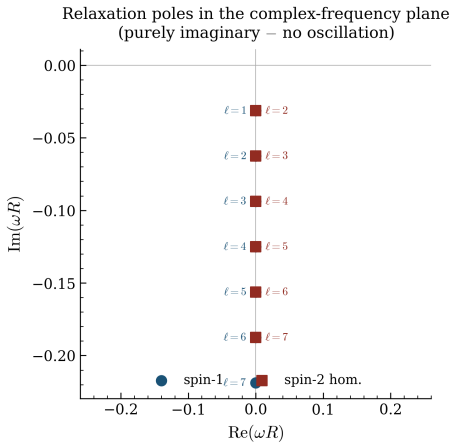
A vector-supported compact object in modified gravity relaxes purely dissipatively with no oscillatory ringdown modes.
A machine-rendered reading of the paper's core claim, the machinery that carries it, and where it could break.
Core claim
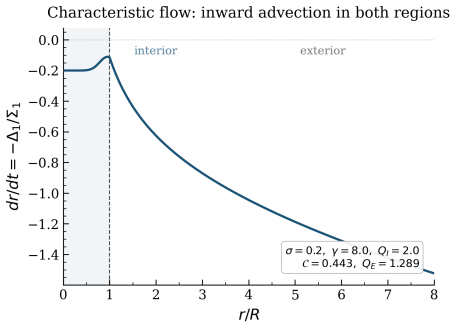
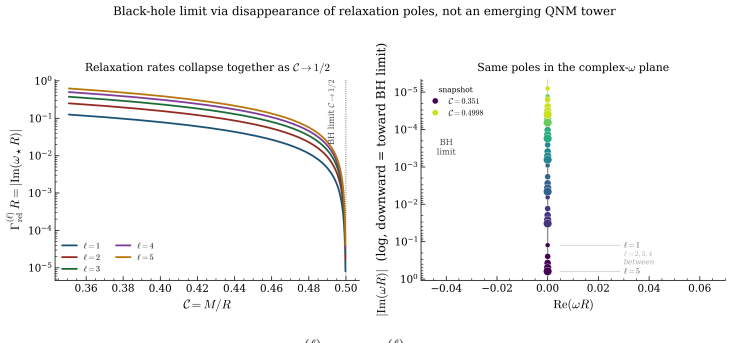
The paper claims that this compact object possesses a hidden chiral symmetry which turns its odd-parity perturbation problem into one-way transport rather than ordinary wave propagation. The regular interior together with the matching conditions break the symmetry and quantize the fluctuation spectrum, producing a retarded Green function whose poles are purely dissipative. In the black-hole limit the relaxation times diverge, the poles collapse toward zero frequency, and finite-frequency exterior perturbations decouple from the interior, so black-hole behavior is recovered through the disappearance of relaxation modes rather than the emergence of ringdown.
What carries the argument
The hidden chiral symmetry that reduces the perturbation equations to one-way transport.
If this is right
- The exterior region alone possesses no conventional quasinormal-mode spectrum.
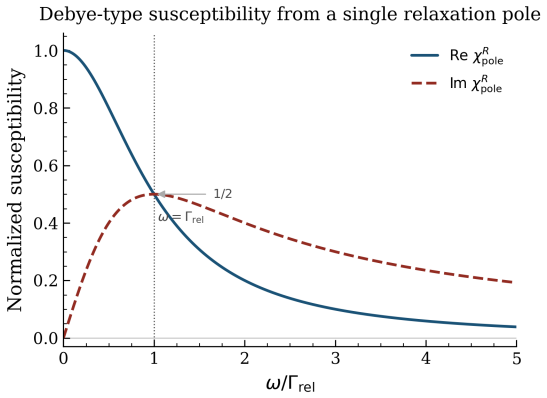
- The retarded Green function and susceptibility can be computed analytically from the interior solution.
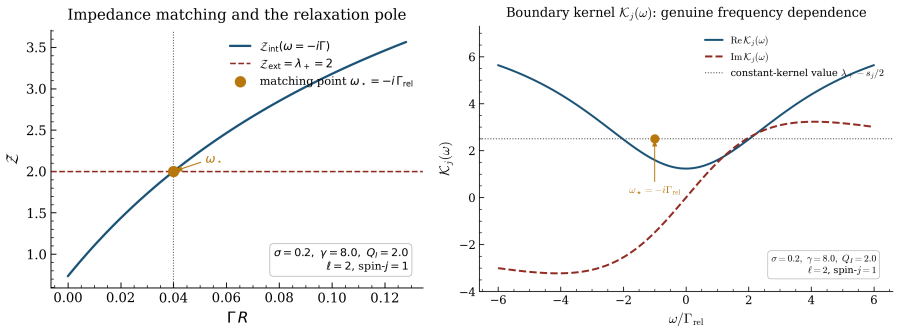
- An effective membrane response follows by integrating out the object's interior.
- In the black-hole limit finite-frequency exterior perturbations decouple from the interior.
Where Pith is reading between the lines
- Observational searches focused on ringdown signals could systematically miss objects of this class.
- The mechanism of approaching black-hole behavior by erasure of modes rather than addition of modes may appear in other theories with controlled interiors.
- Exact response functions derived this way supply benchmarks for numerical codes that simulate dynamical compact objects.
Load-bearing premise
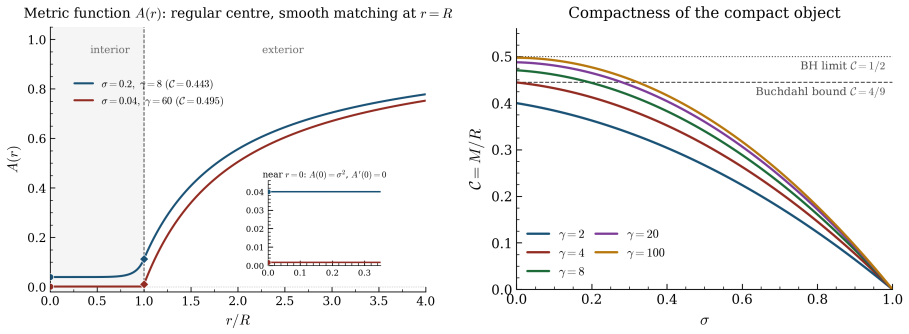
A regular vector-supported compact solution of the vector-tensor theory exists that can be matched without a surface layer to an exterior Schwarzschild geometry while violating the Buchdahl bound via anisotropic stress.
What would settle it
An explicit evaluation of the retarded Green function whose poles include any component with nonzero real frequency would falsify the claim of purely dissipative relaxation.
Figures
read the original abstract
Compact objects with black-hole-like exteriors may hide new strong-field physics in their interiors, making their dynamical response a sensitive probe of gravity beyond General Relativity. We present an analytically tractable, gravitationally bound compact object with a genuinely new dynamical signature: under a minimal passive boundary prescription, its exactly controlled odd-parity sector exhibits purely dissipative relaxation poles, rather than the oscillatory modes usually associated with black holes and exotic compact alternatives. The object we study is a regular, vector-supported compact solution of a vector--tensor theory, matched without any surface layer to an exterior Schwarzschild geometry. Owing to its anisotropic stress, it can violate the Buchdahl bound and be continuously connected to the black-hole compactness limit. Its unusual response follows from a hidden chiral symmetry, which turns the perturbation problem into one-way transport rather than ordinary wave propagation. The exterior region alone has no conventional quasinormal-mode spectrum; instead, the regular interior and the matching conditions break the symmetry and quantize the fluctuation spectrum. We analytically compute the retarded Green function and susceptibility, and derive an effective membrane response by integrating out the object's interior. In the black-hole limit, the relaxation times diverge, the poles collapse toward zero frequency, and finite-frequency exterior perturbations decouple from the interior. Black-hole behaviour is therefore approached through the disappearance of relaxation modes, not through the emergence of ringdown.
Editorial analysis
A structured set of objections, weighed in public.
Referee Report
Summary. The manuscript presents a vector-supported compact object in a vector-tensor theory that matches smoothly to an exterior Schwarzschild spacetime without surface layers. Due to anisotropic stress, it violates the Buchdahl bound and approaches black-hole compactness. The odd-parity perturbations, under a minimal passive boundary condition, exhibit purely dissipative relaxation poles due to a hidden chiral symmetry that reduces the dynamics to one-way transport. The exterior has no standard quasinormal modes; the spectrum is quantized by the interior and matching. The retarded Green function, susceptibility, and an effective membrane response are computed analytically. In the black-hole limit, relaxation times diverge and poles approach zero frequency, so black-hole behavior emerges from the disappearance of relaxation modes rather than the appearance of ringdown.
Significance. If the background construction and perturbation analysis hold, this provides an analytically tractable example of an exotic compact object with a qualitatively distinct dynamical response (purely dissipative relaxation without ringdown). The exact control over the retarded Green function, susceptibility, and membrane paradigm derivation are strengths that could inform gravitational-wave phenomenology and tests of strong-field gravity.
major comments (3)
- [Background construction (abstract, paragraph 2 and interior solution section)] The existence of a regular vector-supported interior solution matched to Schwarzschild with continuous metric and extrinsic curvature (no surface stress-energy) while violating the Buchdahl bound via anisotropic stress is load-bearing for the entire dynamical analysis. Explicit verification of regularity at the center, gravitational binding, and the junction conditions (continuity of extrinsic curvature) must be shown with the relevant equations.
- [Odd-parity perturbations and hidden chiral symmetry] The reduction of the odd-parity sector to one-way transport via the hidden chiral symmetry, and the subsequent quantization of the spectrum by the interior and matching conditions, is central to the claim of purely dissipative poles. The perturbation equations, symmetry breaking, and boundary conditions leading to this behavior require explicit derivation.
- [Retarded Green function, susceptibility, and membrane response] The analytic computation of the retarded Green function, susceptibility, and effective membrane response (obtained by integrating out the interior) underpins the black-hole limit claims. Key steps or explicit expressions for these quantities should be provided to allow verification of the pole structure and the divergence of relaxation times.
minor comments (2)
- Notation for the theory ('vector--tensor') should be standardized throughout the manuscript.
- [Black-hole limit] Clarify in the black-hole limit discussion whether the divergence of relaxation times and collapse of poles to zero frequency is shown purely analytically.
Simulated Author's Rebuttal
We thank the referee for the careful reading and constructive comments. We address each major comment below. The requested explicit verifications and derivations are feasible to add without altering the core results, and we will revise the manuscript accordingly.
read point-by-point responses
-
Referee: [Background construction (abstract, paragraph 2 and interior solution section)] The existence of a regular vector-supported interior solution matched to Schwarzschild with continuous metric and extrinsic curvature (no surface stress-energy) while violating the Buchdahl bound via anisotropic stress is load-bearing for the entire dynamical analysis. Explicit verification of regularity at the center, gravitational binding, and the junction conditions (continuity of extrinsic curvature) must be shown with the relevant equations.
Authors: We agree these explicit checks are necessary. The interior solution is already constructed in the manuscript, but we will add a dedicated subsection (or appendix) in the revision that: (i) writes the explicit metric and vector-field ansatz, (ii) expands all functions in powers of r near the center to demonstrate regularity, (iii) computes the gravitational binding energy to confirm the object is bound, and (iv) evaluates the Israel junction conditions by direct computation of the extrinsic curvature on both sides, verifying continuity and the absence of surface stress-energy. This will also make the anisotropic-stress violation of the Buchdahl bound fully explicit. revision: yes
-
Referee: [Odd-parity perturbations and hidden chiral symmetry] The reduction of the odd-parity sector to one-way transport via the hidden chiral symmetry, and the subsequent quantization of the spectrum by the interior and matching conditions, is central to the claim of purely dissipative poles. The perturbation equations, symmetry breaking, and boundary conditions leading to this behavior require explicit derivation.
Authors: We will expand the perturbation analysis section to include the full linearized odd-parity equations obtained from the vector-tensor action, explicitly exhibit the hidden chiral symmetry and the field redefinition that reduces the system to one-way transport, and derive the quantization condition arising from regularity at the center together with the matching conditions at the surface. The resulting pole structure will then be shown to follow directly from these steps. revision: yes
-
Referee: [Retarded Green function, susceptibility, and membrane response] The analytic computation of the retarded Green function, susceptibility, and effective membrane response (obtained by integrating out the interior) underpins the black-hole limit claims. Key steps or explicit expressions for these quantities should be provided to allow verification of the pole structure and the divergence of relaxation times.
Authors: In the revised manuscript we will insert the intermediate steps of the Green-function construction, the closed-form expression for the susceptibility, and the explicit integration-out procedure that yields the effective membrane response. These additions will make the analytic pole locations and the divergence of relaxation times in the black-hole limit directly verifiable from the text. revision: yes
Circularity Check
No significant circularity; derivation self-contained
full rationale
The paper defines a specific vector-tensor compact object with anisotropic stress, matched smoothly to an exterior Schwarzschild geometry, and derives its odd-parity response from the model's hidden chiral symmetry that converts the perturbation equations into one-way transport. The retarded Green function, susceptibility, and effective membrane response are obtained by direct integration of the interior solution and matching conditions. No step reduces a claimed prediction to a fitted parameter, self-citation chain, or definitional tautology; the dissipative poles are a direct algebraic consequence of the symmetry and boundary prescription within the constructed background. The result is therefore independent of external benchmarks and does not rely on load-bearing self-referential inputs.
Axiom & Free-Parameter Ledger
axioms (2)
- domain assumption A vector-tensor theory admits regular, anisotropic-stress-supported compact solutions that match smoothly to Schwarzschild exterior.
- ad hoc to paper The minimal passive boundary prescription is physically appropriate for the interior-exterior matching.
invented entities (1)
-
vector-supported compact object with hidden chiral symmetry
no independent evidence
Reference graph
Works this paper leans on
-
[1]
Quasinormal modes: the characteristic sound of black holes and neutron stars,
H.-P. Nollert, “Quasinormal modes: the characteristic sound of black holes and neutron stars,”Class. Quant. Grav.16(1999) R159–R216
1999
-
[2]
Quasi-Normal Modes of Stars and Black Holes
K. D. Kokkotas and B. G. Schmidt, “Quasi-normal modes of stars and black holes,”Living Rev. Rel.2 (1999) 2,arXiv:gr-qc/9909058
work page internal anchor Pith review Pith/arXiv arXiv 1999
-
[3]
Quasinormal modes of black holes and black branes
E. Berti, V. Cardoso, and A. O. Starinets, “Quasinormal modes of black holes and black branes,”Class. Quant. Grav.26(2009) 163001,arXiv:0905.2975 [gr-qc]
work page internal anchor Pith review Pith/arXiv arXiv 2009
-
[4]
Quasinormal modes of black holes: from astrophysics to string theory
R. A. Konoplya and A. Zhidenko, “Quasinormal modes of black holes: from astrophysics to string theory,” Rev. Mod. Phys.83(2011) 793–836,arXiv:1102.4014 [gr-qc]
work page internal anchor Pith review Pith/arXiv arXiv 2011
-
[5]
Is the gravitational-wave ringdown a probe of the event horizon?
V. Cardoso, E. Franzin, and P. Pani, “Is the gravitational-wave ringdown a probe of the event horizon?,” Phys. Rev. Lett.116no. 17, (2016) 171101,arXiv:1602.07309 [gr-qc]
work page internal anchor Pith review Pith/arXiv arXiv 2016
-
[6]
Echoes from the Abyss: Tentative evidence for Planck-scale structure at black hole horizons
J. Abedi, H. Dykaar, and N. Afshordi, “Echoes from the Abyss: Tentative evidence for Planck-scale structure at black hole horizons,”Phys. Rev. D96no. 8, (2017) 082004,arXiv:1612.00266 [gr-qc]
work page internal anchor Pith review Pith/arXiv arXiv 2017
-
[7]
V. Cardoso, S. Hopper, C. F. B. Macedo, C. Palenzuela, and P. Pani, “Echoes of ECOs: gravitational-wave signatures of exotic compact objects and of quantum corrections at the horizon scale,”Phys. Rev. D94 no. 8, (2016) 084031,arXiv:1608.08637 [gr-qc]
work page internal anchor Pith review Pith/arXiv arXiv 2016
-
[8]
Tests for the existence of horizons through gravitational wave echoes
V. Cardoso and P. Pani, “Tests for the existence of black holes through gravitational wave echoes,”Nature Astron.1no. 9, (2017) 586–591,arXiv:1709.01525 [gr-qc]
work page internal anchor Pith review Pith/arXiv arXiv 2017
-
[9]
Gravitational wave echoes through new windows
R. S. Conklin, B. Holdom, and J. Ren, “Gravitational wave echoes through new windows,”Phys. Rev. D 98no. 4, (2018) 044021,arXiv:1712.06517 [gr-qc]
work page internal anchor Pith review Pith/arXiv arXiv 2018
-
[10]
A recipe for echoes from exotic compact objects
Z. Mark, A. Zimmerman, S. M. Du, and Y. Chen, “A recipe for echoes from exotic compact objects,”Phys. Rev. D96no. 8, (2017) 084002,arXiv:1706.06155 [gr-qc]
work page internal anchor Pith review Pith/arXiv arXiv 2017
-
[11]
Black Hole Echology: The Observer's Manual
Q. Wang and N. Afshordi, “Black hole echology: The observer’s manual,”Phys. Rev. D97no. 12, (2018) 124044,arXiv:1803.02845 [gr-qc]
work page internal anchor Pith review Pith/arXiv arXiv 2018
-
[12]
Echoes from Quantum Black Holes,
Q. Wang, N. Oshita, and N. Afshordi, “Echoes from Quantum Black Holes,”Phys. Rev. D101no. 2, (2020) 024031,arXiv:1905.00446 [gr-qc]
-
[13]
K. W. Tsang, A. Ghosh, A. Samajdar, K. Chatziioannou, S. Mastrogiovanni, M. Agathos, and C. Van Den Broeck, “A morphology-independent search for gravitational wave echoes in data from the first and second observing runs of Advanced LIGO and Advanced Virgo,”Phys. Rev. D101no. 6, (2020) 064012, arXiv:1906.11168 [gr-qc]
-
[14]
Searching for black hole echoes from the LIGO-Virgo Catalog GWTC-1,
N. Uchikata, H. Nakano, T. Narikawa, N. Sago, H. Tagoshi, and T. Tanaka, “Searching for black hole echoes from the LIGO-Virgo Catalog GWTC-1,”Phys. Rev. D100no. 6, (2019) 062006, arXiv:1906.00838 [gr-qc]
-
[15]
Analytical model for gravitational-wave echoes from spinning remnants,
E. Maggio, A. Testa, S. Bhagwat, and P. Pani, “Analytical model for gravitational-wave echoes from spinning remnants,”Phys. Rev. D100no. 6, (2019) 064056,arXiv:1907.03091 [gr-qc]
-
[16]
How does a dark compact object ringdown?,
E. Maggio, L. Buoninfante, A. Mazumdar, and P. Pani, “How does a dark compact object ringdown?,” Phys. Rev. D102no. 6, (2020) 064053,arXiv:2006.14628 [gr-qc]
-
[17]
Testing the nature of dark compact objects: a status report
V. Cardoso and P. Pani, “Testing the nature of dark compact objects: a status report,”Living Rev. Rel.22 no. 1, (2019) 4,arXiv:1904.05363 [gr-qc]
work page internal anchor Pith review Pith/arXiv arXiv 2019
-
[18]
Black hole spectroscopy: from theory to experiment
E. Bertiet al., “Black hole spectroscopy: from theory to experiment,”Class. Quant. Grav.43no. 12, (2026) 123001,arXiv:2505.23895 [gr-qc]
work page internal anchor Pith review Pith/arXiv arXiv 2026
-
[19]
Love numbers of black holes and compact objects
M. J. Rodr´ ıguez, L. Santoni, and A. R. Solomon, “Love numbers of black holes and compact objects,” arXiv:2604.08653 [gr-qc]
work page internal anchor Pith review Pith/arXiv arXiv
-
[20]
Tidal Response of Compact Objects
S. Chakraborty and P. Pani, “Tidal Response of Compact Objects,”arXiv:2604.08679 [gr-qc]
work page internal anchor Pith review Pith/arXiv arXiv
-
[21]
G. Tasinato, “Ultracompact vector stars,”Phys. Rev. D106no. 4, (2022) 044022,arXiv:2205.05311 [gr-qc]. 29
-
[22]
Black Holes and Abelian Symmetry Breaking
J. Chagoya, G. Niz, and G. Tasinato, “Black Holes and Abelian Symmetry Breaking,”Class. Quant. Grav. 33no. 17, (2016) 175007,arXiv:1602.08697 [hep-th]
work page internal anchor Pith review Pith/arXiv arXiv 2016
-
[23]
Black Holes and Neutron Stars in Vector Galileons
J. Chagoya, G. Niz, and G. Tasinato, “Black Holes and Neutron Stars in Vector Galileons,”Class. Quant. Grav.34no. 16, (2017) 165002,arXiv:1703.09555 [gr-qc]
work page internal anchor Pith review Pith/arXiv arXiv 2017
-
[24]
Black holes in vector-tensor theories
L. Heisenberg, R. Kase, M. Minamitsuji, and S. Tsujikawa, “Black holes in vector-tensor theories,”JCAP 08(2017) 024,arXiv:1706.05115 [gr-qc]
work page internal anchor Pith review Pith/arXiv arXiv 2017
-
[25]
Black holes in the generalized Proca theory,
M. Minamitsuji, “Black holes in the generalized Proca theory,”Gen. Rel. Grav.49no. 7, (2017) 86
2017
-
[26]
Relativistic stars in vector-tensor theories
R. Kase, M. Minamitsuji, and S. Tsujikawa, “Relativistic stars in vector-tensor theories,”Phys. Rev. D97 no. 8, (2018) 084009,arXiv:1711.08713 [gr-qc]
work page internal anchor Pith review Pith/arXiv arXiv 2018
-
[27]
Stealth configurations in vector-tensor theories of gravity
J. Chagoya and G. Tasinato, “Stealth configurations in vector-tensor theories of gravity,”JCAP01(2018) 046,arXiv:1707.07951 [hep-th]
work page internal anchor Pith review Pith/arXiv arXiv 2018
-
[28]
Black hole perturbations in vector-tensor theories: The odd-mode analysis
R. Kase, M. Minamitsuji, S. Tsujikawa, and Y.-l. Zhang, “Black hole perturbations in vector-tensor theories: the odd-mode analysis,”JCAP02(2018) 048,arXiv:1801.01787 [gr-qc]
work page internal anchor Pith review Pith/arXiv arXiv 2018
-
[29]
Odd-parity stability of hairy black holes in $U(1)$ gauge-invariant scalar-vector-tensor theories
L. Heisenberg, R. Kase, M. Minamitsuji, and S. Tsujikawa, “Odd-parity stability of hairy black holes in gauge-invariant scalar-vector-tensor theories,”Phys. Rev. D97no. 12, (2018) 124043,arXiv:1804.00535 [gr-qc]
work page internal anchor Pith review Pith/arXiv arXiv 2018
-
[30]
Destabilization of generalized Proca stars,
S. Garc´ ıa-S´ aenz, A. Held, and J. Zhang, “Destabilization of generalized Proca stars,”Phys. Rev. Lett.127 no. 13, (2021) 131104,arXiv:2104.08049 [gr-qc]
-
[31]
Hidden conformal symmetries for black holes in modified gravity,
B. Atkins and G. Tasinato, “Hidden conformal symmetries for black holes in modified gravity,”Phys. Rev. D108no. 10, (2023) 104070,arXiv:2311.03860 [gr-qc]
-
[32]
Effective field theory of black hole perturbations in vector-tensor gravity,
K. Aoki, M. A. Gorji, S. Mukohyama, K. Takahashi, and V. Yingcharoenrat, “Effective field theory of black hole perturbations in vector-tensor gravity,”JCAP03(2024) 012,arXiv:2311.06767 [hep-th]
-
[33]
Quasinormal modes from EFT of black hole perturbations in vector-tensor gravity,
S. Tomizuka, H. Kobayashi, N. Oshita, K. Takahashi, and S. Mukohyama, “Quasinormal modes from EFT of black hole perturbations in vector-tensor gravity,”JCAP10(2025) 056,arXiv:2505.15125 [gr-qc]
-
[34]
On algebraically special perturbations of black holes,
S. Chandrasekhar, “On algebraically special perturbations of black holes,”Proc. Roy. Soc. Lond. A392 no. 1802, (1984) 1–13
1984
-
[35]
On perturbations of a Kerr black hole,
R. M. Wald, “On perturbations of a Kerr black hole,”J. Math. Phys.14no. 10, (1973) 1453–1461
1973
-
[36]
Analytic treatment of black-hole gravitational waves at the algebraically special frequency
A. Maassen van den Brink, “Analytic treatment of black hole gravitational waves at the algebraically special frequency,”Phys. Rev. D62(2000) 064009,arXiv:gr-qc/0001032
work page internal anchor Pith review Pith/arXiv arXiv 2000
-
[37]
When the Ringing Stops: Purely Imaginary Modes in the Ringdown Spectrum of Dynamical Black Holes
L. Capuano, T. Lovo, G. Prieto-Varela, S. Sarkar, A. Kuntz, E. Barausse, and D. Kothawala, “When the Ringing Stops: Purely Imaginary Modes in the Ringdown Spectrum of Dynamical Black Holes,” arXiv:2605.28951 [gr-qc]
work page internal anchor Pith review Pith/arXiv arXiv
-
[38]
Black-hole eddy currents,
T. Damour, “Black-hole eddy currents,”Phys. Rev. D18(1978) 3598–3604
1978
-
[39]
Membrane viewpoint on black holes: properties and evolution of the stretched horizon,
K. S. Thorne and R. H. Price, “Membrane viewpoint on black holes: properties and evolution of the stretched horizon,”Phys. Rev. D33(1986) 915–941
1986
-
[40]
Membrane Viewpoint on Black Holes: Properties and Evolution of the Stretched Horizon,
R. H. Price and K. S. Thorne, “Membrane Viewpoint on Black Holes: Properties and Evolution of the Stretched Horizon,”Phys. Rev. D33(1986) 915–941
1986
-
[41]
Selfsimilar collapse of isothermal spheres and star formation,
F. H. Shu, “Selfsimilar collapse of isothermal spheres and star formation,”Astrophys. J.214(1977) 488
1977
-
[42]
Anisotropic stars as ultracompact objects in General Relativity
G. Raposo, P. Pani, M. Bezares, C. Palenzuela, and V. Cardoso, “Anisotropic stars as ultracompact objects in general relativity,”Phys. Rev. D99no. 10, (2019) 104072,arXiv:1811.07917 [gr-qc]
work page internal anchor Pith review Pith/arXiv arXiv 2019
-
[43]
Black Hole Entropy from Conformal Field Theory in Any Dimension
S. Carlip, “Black hole entropy from conformal field theory in any dimension,”Phys. Rev. Lett.82(1999) 2828–2831,arXiv:hep-th/9812013
work page internal anchor Pith review Pith/arXiv arXiv 1999
-
[44]
Conformal description of horizon's states
S. N. Solodukhin, “Conformal description of horizon’s states,”Phys. Lett. B454(1999) 213–222, arXiv:hep-th/9812056
work page internal anchor Pith review Pith/arXiv arXiv 1999
-
[45]
Near-Horizon Conformal Structure of Black Holes
D. Birmingham, K. S. Gupta, and S. Sen, “Near horizon conformal structure of black holes,”Phys. Lett. B 505(2001) 191–196,arXiv:hep-th/0102051. 30
work page internal anchor Pith review Pith/arXiv arXiv 2001
-
[46]
Hidden Conformal Symmetry of the Kerr Black Hole
A. Castro, A. Maloney, and A. Strominger, “Hidden conformal symmetry of the Kerr black hole,”Phys. Rev. D82(2010) 024008,arXiv:1004.0996 [hep-th]
work page internal anchor Pith review Pith/arXiv arXiv 2010
-
[47]
Conformal structure of the Schwarzschild black hole
S. Bertini, S. L. Cacciatori, and D. Klemm, “Conformal structure of the Schwarzschild black hole,”Phys. Rev. D85(2012) 064018,arXiv:1106.0999 [hep-th]
work page internal anchor Pith review Pith/arXiv arXiv 2012
-
[48]
Hidden Conformal Symmetry and Quasi-normal Modes
B. Chen and J. Long, “Hidden Conformal Symmetry and Quasi-normal Modes,”Phys. Rev. D82(2010) 126013,arXiv:1009.1010 [hep-th]
work page internal anchor Pith review Pith/arXiv arXiv 2010
-
[49]
Static response and Love numbers of Schwarzschild black holes,
L. Hui, A. Joyce, R. Penco, L. Santoni, and A. R. Solomon, “Static response and Love numbers of Schwarzschild black holes,”JCAP04(2021) 052,arXiv:2010.00593 [hep-th]
-
[50]
On the Vanishing of Love Numbers for Kerr Black Holes,
P. Charalambous, S. Dubovsky, and M. M. Ivanov, “On the Vanishing of Love Numbers for Kerr Black Holes,”JHEP05(2021) 038,arXiv:2102.08917 [hep-th]
-
[51]
Hidden Symmetry of Vanishing Love Numbers,
P. Charalambous, S. Dubovsky, and M. M. Ivanov, “Hidden Symmetry of Vanishing Love Numbers,”Phys. Rev. Lett.127no. 10, (2021) 101101,arXiv:2103.01234 [hep-th]
-
[52]
Ladder symmetries of black holes. Implications for love numbers and no-hair theorems,
L. Hui, A. Joyce, R. Penco, L. Santoni, and A. R. Solomon, “Ladder symmetries of black holes. Implications for love numbers and no-hair theorems,”JCAP01no. 01, (2022) 032,arXiv:2105.01069 [hep-th]
-
[53]
P. Charalambous, S. Dubovsky, and M. M. Ivanov, “Love symmetry,”JHEP10(2022) 175, arXiv:2209.02091 [hep-th]
-
[54]
Hidden symmetry of the static response of black holes: applications to Love numbers,
J. Ben Achour, E. R. Livine, S. Mukohyama, and J.-P. Uzan, “Hidden symmetry of the static response of black holes: applications to Love numbers,”JHEP07(2022) 112,arXiv:2202.12828 [gr-qc]
-
[55]
Why there is no Love in black holes,
A. Lupsasca, “Why there is no Love in black holes,”arXiv:2506.05298 [gr-qc]
-
[56]
Naturalness of vanishing black-hole tides,
J. Parra-Martinez and A. Podo, “Naturalness of vanishing black-hole tides,”arXiv:2510.20694 [hep-th]
-
[57]
Tidal Love numbers and Green’s functions in black hole spacetimes,
V. De Luca, A. Garoffolo, J. Khoury, and M. Trodden, “Tidal Love numbers and Green’s functions in black hole spacetimes,”Phys. Rev. D110no. 6, (2024) 064081,arXiv:2407.07156 [gr-qc]
-
[58]
An Effective Field Theory of Gravity for Extended Objects
W. D. Goldberger and I. Z. Rothstein, “An effective field theory of gravity for extended objects,”Phys. Rev. D73(2006) 104029,arXiv:hep-th/0409156
work page internal anchor Pith review Pith/arXiv arXiv 2006
-
[59]
Dissipative Effects in the Worldline Approach to Black Hole Dynamics
W. D. Goldberger and I. Z. Rothstein, “Dissipative effects in the worldline approach to black hole dynamics,”Phys. Rev. D73(2006) 104030,arXiv:hep-th/0511133
work page internal anchor Pith review Pith/arXiv arXiv 2006
-
[60]
The Effective Field Theorist's Approach to Gravitational Dynamics
R. A. Porto, “The effective field theorist’s approach to gravitational dynamics,”Phys. Rept.633(2016) 1–104,arXiv:1601.04914 [hep-th]
work page internal anchor Pith review Pith/arXiv arXiv 2016
-
[61]
R. Kubo, M. Toda, and N. Hashitsume,Statistical Physics II: Nonequilibrium Statistical Mechanics, vol. 31 ofSpringer Series in Solid-State Sciences. Springer, Berlin, 2 ed., 1991
1991
-
[62]
On an inverse boundary value problem,
A. P. Calderon, “On an inverse boundary value problem,”Seminar on Numerical Analysis and its Applications to Continuum Physics(1980) 65–73. Reprinted in Comput. Appl. Math. 25 (2006) 133–138
1980
-
[63]
Gravitational Wave Scattering via the Born Series: Scalar Tidal Matching to O(G7) and Beyond,
S. Caron-Huot, M. Correia, G. Isabella, and M. Solon, “Gravitational Wave Scattering via the Born Series: Scalar Tidal Matching to O(G7) and Beyond,”Phys. Rev. Lett.135no. 19, (2025) 191601, arXiv:2503.13593 [hep-th]. 31
discussion (0)
Sign in with ORCID, Apple, or X to comment. Anyone can read and Pith papers without signing in.