REVIEW 2 major objections 6 minor 5 references
Coherent Epitaxial Semiconductor-Ferromagnetic Insulator InAs/EuS Interfaces: Band Alignment and Magnetic Structure
T0 review · 2 major / 6 minor · reviewed 2026-08-14 · deepseek-v4-flash
Pith's one-line read This paper establishes that a fully coherent, dislocation-free InAs/EuS interface can be grown with the Fermi level near the InAs conduction band and inside the EuS gap, and that the ferromagnetic moment is confined to EuS with a…
desk verdict A careful, useful materials study whose central claims hold, but whose headline interfacial moment-suppression number is model-dependent and should be treated with caution. read the letter →
The pith
A machine-rendered reading of the paper's core claim, the machinery that carries it, and where it could break.
The reading
What carries the argument
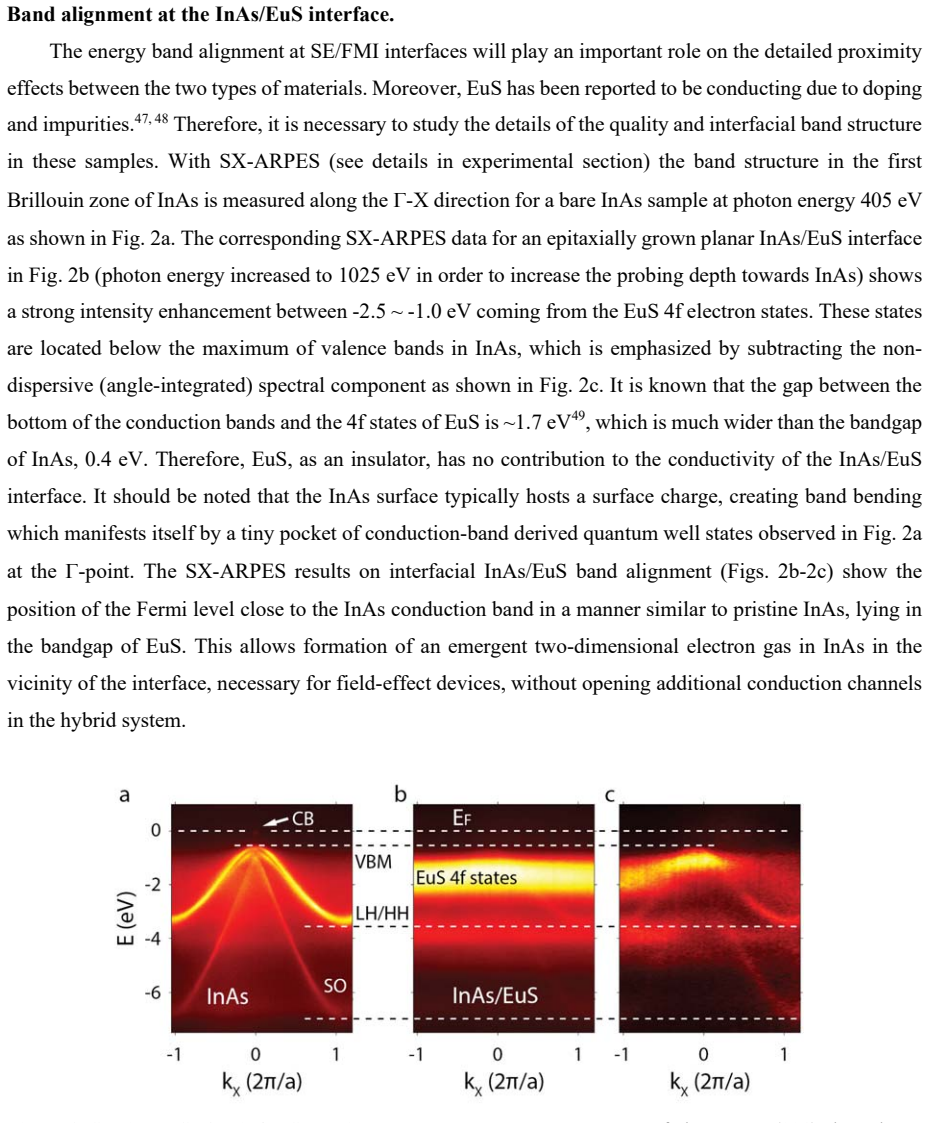
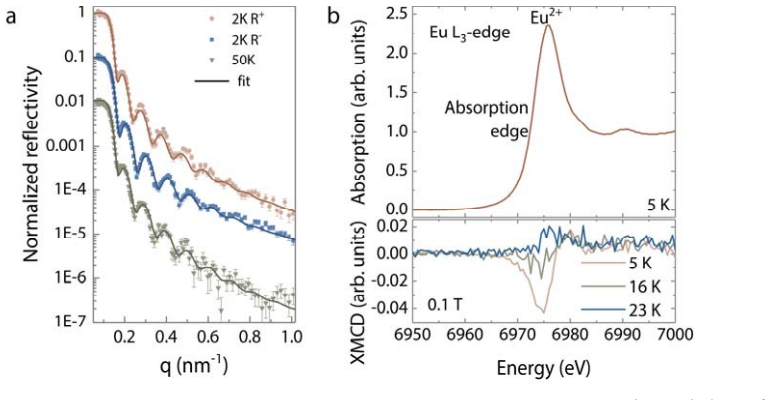
The argument is carried by the combination of a nearly lattice-matched epitaxial interface (rock-salt EuS on zinc-blende InAs with about 1% mismatch) and three depth-sensitive probes: soft-X-ray ARPES for band alignment, polarized neutron reflectivity and resonant X-ray reflectivity at the Eu M4,5 edges for the magnetic depth profile, plus spin-polarized density-functional theory for the expected proximity polarization. The resonant X-ray reflectivity analysis, which uses magnetic scattering factors for EuS obtained from EuO literature values via a Kramers-Kronig transformation, is what yields the specific interfacial layer with a moment reduced by a factor of 2.7.
What would settle it
Refit the resonant X-ray reflectivity data using experimentally measured EuS magneto-optical constants instead of EuO-derived ones and include birefringence; if the interfacial layer no longer shows a moment reduction of about 2.7-fold, the paper's central magnetic-structure claim is falsified. Alternatively, an element-specific depth-resolved measurement of the Eu moment with sub-nanometer resolution that shows a uniform moment up to the InAs interface would refute the suppression.
Extended reading notes
Core claim
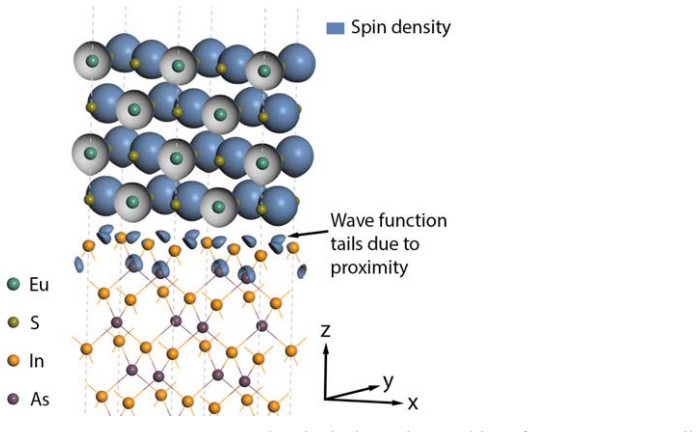
The central claim is that InAs/EuS forms a coherent, cube-on-cube epitaxial interface with no misfit dislocations, with the Fermi level at the interface close to the InAs conduction band and inside the EuS gap, and with a magnetic profile in which the ferromagnetic order is localized in the EuS film and the Eu moment in the monolayer nearest InAs is reduced by a factor of about 2.7 relative to bulk. The paper further claims that no static magnetic proximity effect in the InAs is detectable by XMCD within its sensitivity, while density-functional calculations predict a small induced spin polarization of about 0.08 $\mu_B$ per interfacial In atom. The authors interpret the interfacial moment suppression as resulting from intermixing at the interface, dilution of the Eu moment density, and enhanced next-nearest-neighbor antiferromagnetic interactions of the kind known in Eu$_x$Sr$_{1-x}$S.
Load-bearing premise
The extracted magnetic depth profile assumes that the magnetic scattering factors for EuS can be taken from EuO literature values via a Kramers-Kronig transformation, that birefringence can be neglected, and that a simplified layered structure captures the interface; if any of these assumptions fails, the claimed 2.7-fold interfacial moment suppression could be an artifact.
Editorial extensions
If this is right
- For InAs/Al/EuS topological structures, the Zeeman splitting must be supplied by the EuS/Al exchange coupling, not by direct proximity into InAs, because the induced moment in InAs is below detection and weak in the calculations.
- The coherent, dislocation-free interface removes structural disorder as a complication, so any residual proximity effect in InAs is intrinsic and weak.
- The band alignment with Fermi level near the InAs conduction band and in the EuS gap means field-effect gating of InAs remains possible without parallel conduction through the EuS.
- The suppressed interfacial Eu moment means the magnetic stray-field profile starts slightly below the bulk value, so devices relying on stray fields should account for a weakened interfacial monolayer.
- The material combination is a clean testbed for studying antiferromagnetic next-nearest-neighbor interactions at a ferromagnet/semiconductor interface.
Reading between the lines
- If the interfacial Eu moment suppression is real, gating InAs to push the electron wavefunction closer to the interface might recover a detectable proximity effect; this is a testable prediction that goes beyond the paper's measurements.
- The paper's use of EuO scattering factors for EuS could be checked by measuring the EuS magneto-optical constants directly; if those constants differ substantially, the claimed 2.7-fold suppression may need revision.
- The same growth approach could be tried on InSb or on InAs nanowire facets, where reduced dimensionality might alter the balance of nearest- versus next-nearest-neighbor exchange and change the interfacial suppression.
- The absence of an induced moment in InAs mirrors earlier null results in normal-metal/ferromagnetic-insulator hybrids, suggesting that a strong static proximity effect requires a metallic spacer or a semiconductor with different orbital character at the Fermi level.
Signed reviews
Editorial analysis
A structured set of objections, weighed in public.
Referee Report
Summary. The paper reports the growth and characterization of epitaxial InAs/EuS heterostructures, combining aberration-corrected STEM, SX-ARPES, PNR, XMCD, RXRR, and DFT calculations. The central claims are that the interface is coherent and dislocation-free, that the Fermi level lies near the InAs conduction band and inside the EuS gap, that the ferromagnetic moment is largely confined to EuS with a suppressed Eu moment in the interfacial EuS layer, and that no induced moment in InAs is detected, while DFT suggests a weak exchange field in the adjacent InAs layers.
Significance. If the results hold, this work provides a carefully characterized semiconductor/ferromagnetic-insulator platform relevant for topological superconductivity and spintronics. The study is valuable for its multi-technique approach and for explicitly reporting detection limits in the magnetic measurements. The atomic-resolution STEM and band-alignment measurements are strong assets, and the transparent discussion of the RXRR model assumptions is commendable; at the same time, the quantitative interfacial moment suppression is the least robust part of the central claim, so the paper merits revision rather than acceptance in its present form.
major comments (2)
- [Supplementary Section 3, Table S2] The claimed 2.7-fold suppression of the interfacial Eu moment is extracted from a single RXRR fit using EuO-derived scattering factors, neglecting birefringence, and assuming a simplified layered model, as acknowledged in the supplement. The fitted interfacial layer thickness is 1.4 Å, while the interface roughness at the InAs/EuS boundary is fitted to 1.9 Å, so the reduced moment could be an artifact of the structural model rather than a physical suppression. Please provide an uncertainty estimate for the suppression factor and a robustness check, for example by refitting with alternative scattering factors (ideally from measured M5-edge XANES/XMCD on this film) and with a graded-interface or intermixed-layer model. Without such an analysis, the quantitative suppression claim in the abstract and conclusions is not established.
- [Section 3, 'Distribution of magnetic moments', and Conclusions] The DFT calculation in Figure 4 reports spin moments of about 0.08 μB on In and 0.04 μB on As, but the abstract and conclusions refer to 'a small exchange field in the InAs layer' without providing a value. Since the exchange field is the physically relevant quantity for proximity effects, the authors should either quantify the exchange splitting (in meV) from their calculation, or rephrase the claim to state that only a weak spin polarization is found. As written, the step from computed local moments to an exchange field is not justified.
minor comments (6)
- [Section 3, 'Epitaxy of EuS on InAs'] The statement 'The order of the plane rotational symmetry (PRS) of EuS on InAs is 2 and its bi-crystal variant is 1 (see ref. 2 for analysis)' cites Ref. 2, which is a nanowire epitaxy paper; this reference does not appear to support the PRS analysis and should be replaced or clarified.
- [Conclusions] The phrase 'we ak magnetization' contains a typo; it should read 'weak magnetization'.
- [Supplementary Table S2] The MMS values and the interfacial layer thickness are reported without uncertainties; please add error bars or state explicitly that these are best-fit values without quoted confidence intervals.
- [Main text, 'Distribution of magnetic moments'] The main text does not state that the RXRR measurements were performed on a sample with an As capping layer (20 nm As), whereas the PNR sample used AlOx; please state the sample structure explicitly when comparing the magnetic depth profiles, since the capping layer could influence the magnetic structure.
- [Supplementary Figure S7] The reflectivity curves and asymmetry scans are shown without error bars; if the error bars are smaller than the symbols, please state this explicitly.
- [Main text, XMCD discussion] The claim that the In XMCD signal is below the detection limit would be strengthened by a quantitative detection-limit estimate (e.g., from the noise level at the In L3 edge) rather than only a qualitative statement.
Circularity Check
No significant circularity: the interfacial moment suppression is a fitted output of RXRR analysis, not a predicted quantity, and the central claims rest on independent measurements and DFT.
full rationale
This is an experimental characterization paper rather than a derivation chain. The central claims — coherent epitaxy, band alignment, magnetic localization in EuS, interfacial Eu moment suppression, and absence of detected induced In magnetization — are each supported by independent measurements (STEM/GPA, SX-ARPES, PNR, XMCD, RXRR) and a separate DFT calculation. The 2.7-fold interfacial Eu moment suppression is an RXRR fit output: Supplementary Section 3 and Table S2 report a 1.4 Å interfacial layer with MMS = 1.3 µB/Eu compared with 3.4 µB/Eu in bulk EuS, obtained by fitting reflectivity and energy scans with the Dyna code. The paper nowhere claims to predict this suppression from first principles, so the result does not reduce by construction to its inputs. The stated modeling assumptions — EuO-derived resonant scattering factors via Kramers-Kronig, neglect of birefringence, and a simplified layer stack — are explicit accuracy limitations that could affect robustness, but they are not circularity. The DFT estimate of a weak exchange field in InAs is a CASTEP calculation whose inputs are the STEM-derived interface geometry and standard pseudopotentials; it does not use the fitted magnetic profile as an input. Several self-citations appear (ref. 2 for plane-rotational-symmetry classification, refs. 41/43/45 for STEM/GPA methodology, ref. 55 for magnetic dilution interpretation), but none is load-bearing in the sense of supplying the target result or forbidding alternatives. No specific reduction of a claimed prediction to a fitted parameter or self-citation chain can be exhibited, so the circularity score is 0.
Assumptions & free parameters
free parameters (4)
- EuS layer thickness (PNR) =
2.0 +/- 0.2 nm
- Magnetic scattering length density MSLD (EuS) =
3.50 +/- 0.08 x 10^-6 Å^-2
- Interfacial EuS layer thickness (RXRR) =
1.4 Å
- Magnetic moment of interfacial EuS layer (RXRR) =
1.3 mu_B/Eu
assumptions (4)
- domain assumption PBE-GGA exchange-correlation functional describes Eu 4f magnetism in the EuS/InAs interface sufficiently for a qualitative exchange field estimate.
- domain assumption EuS magnetic scattering factors can be taken from EuO M-edge data via Kramers-Kronig transformation.
- domain assumption EuS is an insulator with no states at the Fermi level and the gap between the InAs conduction band and EuS 4f states is about 1.7 eV.
- domain assumption A simplified layered sample model with no As surface layer modification and no birefringence is adequate for RXRR fitting.
Cite this review
Pith. "Pith review of Coherent Epitaxial Semiconductor-Ferromagnetic Insulator InAs/EuS Interfaces: Band Alignment and Magnetic Structure." pith.science (2026). https://pith.science/paper/WHMEHKW6
@misc{pith2026190807096,
  author       = {Pith},
  title        = {Pith review of: Coherent Epitaxial Semiconductor-Ferromagnetic Insulator InAs/EuS Interfaces: Band Alignment and Magnetic Structure},
  year         = {2026},
  howpublished = {\url{https://pith.science/paper/WHMEHKW6}},
  note         = {Machine review of arXiv:1908.07096}
}
read the original abstract
Hybrid semiconductor-ferromagnetic insulator heterostructures are interesting due to their tunable electronic transport, self-sustained stray field and local proximitized magnetic exchange. In this work, we present lattice matched hybrid epitaxy of semiconductor - ferromagnetic insulator InAs/EuS heterostructures and analyze the atomic-scale structure as well as their electronic and magnetic characteristics. The Fermi level at the InAs/EuS interface is found to be close to the InAs conduction band and in the bandgap of EuS, thus preserving the semiconducting properties. Both neutron and X-ray reflectivity measurements show that the ferromagnetic component is mainly localized in the EuS thin film with a suppression of the Eu moment in the EuS layer nearest the InAs. Induced moments in the adjacent InAs layers were not detected although our ab initio calculations indicate a small exchange field in the InAs layer. This work presents a step towards realizing high quality semiconductor - ferromagnetic insulator hybrids, which is a critical requirement for development of various quantum and spintronic applications without external magnetic fields.
Figures

Figures from the paper (1 more)
Reference graph
Works this paper leans on
-
[1]
Epitaxial structure of EuS on InAs Figure S1 | The indexed power spectrum (fast Fourier transform - FFT) of micrographs in Figure 1 containing both EuS and InAs. Figure S2 | The GPA dilatation and rotation maps along [002], [ 2-20], [1-1-1] and [-11-1] of the micrograph displayed in Figure 1a. Note that bulk InAs far away from inter face is employed as GP...
-
[2]
PNR data analysis Figure S5 | a, Full-scale depth profiles of PNR nuclear (NSLD), magnetic (MSLD) and absorption (ASLD) scattering length density extracted from 2 K R +/R− and 50 K R (the relevant fitting parameters are listed in Tabl e S1). Regarding ASLD, Eu atoms are characterized by a non-neglec table neutron absorption cross-section, which is wavelen...
work page 2016
-
[3]
RXRR measurement RXRR measurements were carried out at the RESOXS end station present at the SIM beamline of the Swiss Light Source (SLS) at the Paul Scherrer Institute (PSI), Switzerland, in order to determine the magnetic profile structure of the EuS layer by probing the Eu M 4,5 edges, which correspond to atomic transitions from the 3d core levels to e...
work page 2004
-
[4]
As shown in bottom panel of Fig
XANES and XMCD data from In XANES/XMCD measurements were carried out as a function of tempe rature at the In L3 absorption edges. As shown in bottom panel of Fig. S8, the overlapping between the XMCD spectra obtained at 5 K and 20 K suggests that the magnetic signal around 3740 eV is an artefact. Figure S8 | Top panel: XANES spectrum collected at the In L...
-
[110]
EuS || [110] InAs Figure S3 | a,b, The proposed atomic model of InAs/EuS interfac e projected through [1-10] and [110] directions. c,d, HAADF micrograph and simulated HAADF of the proposed model through the [110] zone axis (front view). e,f, The comparison between the experimental HAADF intensity an d the simulated one. The arrows with the corresponding c...
Reviewed August 14, 2026 · model on record in the stance chip above.
Discussion (0). Continue with ORCID to comment.