Recognition: unknown
World-Value-Action Model: Implicit Planning for Vision-Language-Action Systems
Pith reviewed 2026-05-10 11:22 UTC · model grok-4.3
The pith
The WAV model performs implicit planning in vision-language-action systems by inferring actions through a latent space of trajectories shaped by a world model and value function.
A machine-rendered reading of the paper's core claim, the machinery that carries it, and where it could break.
Core claim
The central claim is that planning directly in action space produces an exponential decay in the probability of feasible trajectories as the horizon lengthens, while inference in a learned latent space of trajectories, conditioned on observations and instructions, reshapes the distribution toward regions that are both high-value and dynamically consistent. A world model supplies state predictions and a trajectory value function supplies long-horizon utility scores; together they allow the model to concentrate probability mass on workable sequences without performing explicit optimization.
What carries the argument
Latent-space inference over structured future-trajectory representations, guided by a learned world model for state prediction and a trajectory value function for utility ranking.
If this is right
- Task success rates rise in long-horizon and compositional scenarios because probability mass is steered away from low-value paths.
- Generalization improves because the latent representation encodes consequences rather than memorizing short-term action mappings.
- Robustness to disturbances increases as the inference process can re-concentrate on remaining feasible trajectories.
- The exponential decay problem of action-space planning is sidestepped without requiring hand-crafted search algorithms.
Where Pith is reading between the lines
- If the latent representation proves stable across environments, the same training recipe could be applied to multi-step tool-use tasks without enlarging the action space.
- The separation of world model and value function might allow independent updates when new dynamics data becomes available.
- The approach suggests a route to combine learned implicit planning with lightweight explicit verification at test time.
Load-bearing premise
The learned world model must accurately predict future states and the value function must correctly rank long-horizon utility so that inference can reliably shift probability toward feasible trajectories.
What would settle it
Run the trained model on a long-horizon task while measuring the divergence between its predicted future states and the actual observed states; if prediction error rises sharply with horizon length, the claimed performance gains over direct action prediction should vanish.
Figures




read the original abstract
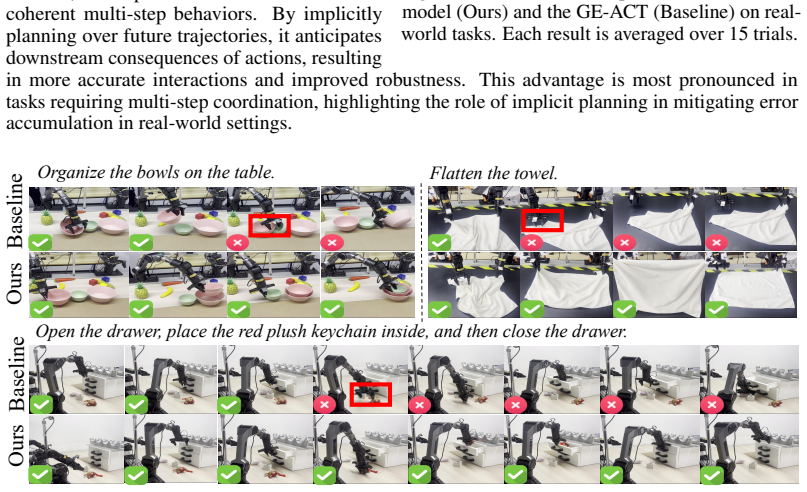
Vision-Language-Action (VLA) models have emerged as a promising paradigm for building embodied agents that ground perception and language into action. However, most existing approaches rely on direct action prediction, lacking the ability to reason over long-horizon trajectories and evaluate their consequences, which limits performance in complex decision-making tasks. In this work, we introduce World-Value-Action (WAV) model, a unified framework that enables implicit planning in VLA systems. Rather than performing explicit trajectory optimization, WAV model learn a structured latent representation of future trajectories conditioned on visual observations and language instructions. A learned world model predicts future states, while a trajectory value function evaluates their long-horizon utility. Action generation is then formulated as inference in this latent space, where the model progressively concentrates probability mass on high-value and dynamically feasible trajectories. We provide a theoretical perspective showing that planning directly in action space suffers from an exponential decay in the probability of feasible trajectories as the horizon increases. In contrast, latent-space inference reshapes the search distribution toward feasible regions, enabling efficient long-horizon decision making. Extensive simulations and real-world experiments demonstrate that the WAV model consistently outperforms state-of-the-art methods, achieving significant improvements in task success rate, generalization ability, and robustness, especially in long-horizon and compositional scenarios. Code is available at https://github.com/Win-commit/WAV.
Editorial analysis
A structured set of objections, weighed in public.
Referee Report
Summary. The paper introduces the World-Value-Action (WAV) model as a unified framework for implicit planning in Vision-Language-Action (VLA) systems. Instead of direct action prediction, it learns a structured latent representation of future trajectories conditioned on visual observations and language instructions, using a learned world model to predict future states and a trajectory value function to evaluate long-horizon utility. Action generation is cast as inference in this latent space to concentrate probability mass on high-value, dynamically feasible trajectories. A theoretical argument is given that direct planning in action space suffers exponential decay in the probability of feasible trajectories with increasing horizon, while latent-space inference avoids this by reshaping the search distribution. Extensive simulations and real-world experiments are claimed to show consistent outperformance over state-of-the-art methods in task success rate, generalization, and robustness, particularly for long-horizon and compositional tasks. Code is released at https://github.com/Win-commit/WAV.
Significance. If the central claims hold, the work would represent a meaningful advance for embodied VLA agents by replacing explicit trajectory optimization with efficient latent-space inference, potentially improving long-horizon reasoning without compounding errors from direct prediction. The release of code is a positive contribution that supports reproducibility.
major comments (3)
- [Abstract / Theoretical perspective] The theoretical perspective asserting exponential decay in the probability of feasible trajectories under direct action-space planning (stated in the abstract) is presented without any derivation, equations, or proof sketch. This is load-bearing for the motivation of latent-space inference, yet no supporting analysis appears in the manuscript.
- [Experiments section] No quantitative validation is reported for the accuracy of the learned world model on multi-step future-state prediction or for the calibration of the trajectory value function against realized returns over long horizons. These are required to substantiate the claim that latent-space inference reliably concentrates probability on feasible trajectories (abstract).
- [Experiments section] The manuscript provides no ablation isolating the contribution of the latent-space inference step itself versus improvements from representation learning or training dynamics alone, leaving open the possibility that reported gains arise from factors other than the claimed implicit planning mechanism.
minor comments (2)
- [Abstract] The abstract refers to 'extensive simulations and real-world experiments' but does not specify the number of trials, environment details, or baseline implementations, which would aid assessment of the empirical claims.
- [Abstract] Notation for the latent space, world model, and value function is introduced without explicit definitions or equations in the provided text, making the inference procedure difficult to follow precisely.
Simulated Author's Rebuttal
We thank the referee for their thoughtful and constructive feedback on our manuscript. We address each major comment point-by-point below, providing clarifications where needed and committing to revisions that strengthen the presentation of our theoretical motivation, component validations, and ablation studies.
read point-by-point responses
-
Referee: [Abstract / Theoretical perspective] The theoretical perspective asserting exponential decay in the probability of feasible trajectories under direct action-space planning (stated in the abstract) is presented without any derivation, equations, or proof sketch. This is load-bearing for the motivation of latent-space inference, yet no supporting analysis appears in the manuscript.
Authors: We agree that the theoretical motivation would be strengthened by a more formal treatment. The current manuscript offers an intuitive argument based on compounding uncertainty and the exponential reduction in the measure of feasible trajectories under direct action prediction. In the revised manuscript, we will add a dedicated subsection (or appendix) containing a proof sketch that derives the exponential decay bound for action-space planning and contrasts it with the distribution reshaping achieved by latent-space inference over high-value trajectories. revision: yes
-
Referee: [Experiments section] No quantitative validation is reported for the accuracy of the learned world model on multi-step future-state prediction or for the calibration of the trajectory value function against realized returns over long horizons. These are required to substantiate the claim that latent-space inference reliably concentrates probability on feasible trajectories (abstract).
Authors: We thank the referee for highlighting this gap. While the manuscript emphasizes end-to-end task performance, separate quantitative validation of the world model and value function would better support the claimed mechanism. We will add new results in the experiments section reporting multi-step prediction error (e.g., state prediction MSE over increasing horizons) and value-function calibration (e.g., Pearson correlation between predicted values and realized discounted returns) on held-out simulation and real-robot trajectories. revision: yes
-
Referee: [Experiments section] The manuscript provides no ablation isolating the contribution of the latent-space inference step itself versus improvements from representation learning or training dynamics alone, leaving open the possibility that reported gains arise from factors other than the claimed implicit planning mechanism.
Authors: We acknowledge the value of isolating the inference step. We will introduce a new ablation that compares the full WAV model against a direct-action-prediction variant that retains the same world model, value function, and representation learning but omits the latent-space inference procedure. This controlled comparison will be added to the experiments section to quantify the specific contribution of implicit planning. revision: yes
Circularity Check
No circularity: theoretical claim stated without reducing equations or self-referential inputs
full rationale
The provided abstract and context describe a WAV model that learns a latent representation via a world model and value function, then performs inference to concentrate probability on high-value trajectories. The key theoretical perspective asserts exponential decay of feasible trajectories in action space versus reshaping in latent space, but no equations, derivations, or parameter-fitting steps are shown that would allow reduction to fitted inputs or self-definitions. No self-citations, uniqueness theorems, or ansatzes are referenced in the text. Performance is supported by external simulations and experiments rather than by construction from the inputs themselves. The derivation chain is therefore self-contained with no load-bearing circular steps.
Axiom & Free-Parameter Ledger
Forward citations
Cited by 2 Pith papers
-
Latent State Design for World Models under Sufficiency Constraints
World models succeed when their latent states are built to meet task-specific sufficiency constraints rather than preserving the maximum amount of information.
-
World Action Models: The Next Frontier in Embodied AI
The paper introduces World Action Models as a new paradigm unifying predictive world modeling with action generation in embodied foundation models and provides a taxonomy of existing approaches.
Reference graph
Works this paper leans on
-
[1]
Cosmos World Foundation Model Platform for Physical AI
Niket Agarwal, Arslan Ali, Maciej Bala, Yogesh Balaji, Erik Barker, Tiffany Cai, Prithvijit Chat- topadhyay, Yongxin Chen, Yin Cui, Yifan Ding, et al. Cosmos world foundation model platform for physical ai.arXiv preprint arXiv:2501.03575,
work page internal anchor Pith review arXiv
-
[2]
Motus: A Unified Latent Action World Model
Hongzhe Bi, Hengkai Tan, Shenghao Xie, Zeyuan Wang, Shuhe Huang, Haitian Liu, Ruowen Zhao, Yao Feng, Chendong Xiang, Yinze Rong, Hongyan Zhao, Hanyu Liu, Zhizhong Su, Lei Ma, Hang Su, and Jun Zhu. Motus: A unified latent action world model, 2025a. URL https: //arxiv.org/abs/2512.13030. Hongzhe Bi, Hengkai Tan, Shenghao Xie, Zeyuan Wang, Shuhe Huang, Haiti...
work page internal anchor Pith review arXiv
-
[3]
$\pi_0$: A Vision-Language-Action Flow Model for General Robot Control
Kevin Black, Noah Brown, Danny Driess, Adnan Esmail, Michael Equi, Chelsea Finn, Niccolo Fusai, Lachy Groom, Karol Hausman, Brian Ichter, et al. pi0: A vision-language-action flow model for general robot control.arXiv preprint arXiv:2410.24164,
work page internal anchor Pith review arXiv
-
[4]
RT-1: Robotics Transformer for Real-World Control at Scale
Anthony Brohan, Noah Brown, Justice Carbajal, Yevgen Chebotar, Joseph Dabis, Chelsea Finn, Keerthana Gopalakrishnan, Karol Hausman, Alex Herzog, Jasmine Hsu, et al. Rt-1: Robotics transformer for real-world control at scale.arXiv preprint arXiv:2212.06817,
work page internal anchor Pith review arXiv
-
[5]
Complementarity-Free Multi-Contact Mod- eling and Optimization for Dexterous Manipulation
Qingwen Bu, Yanting Yang, Jisong Cai, Shenyuan Gao, Guanghui Ren, Maoqing Yao, Ping Luo, and Hongyang Li. Learning to Act Anywhere with Task-centric Latent Actions. InProceedings of Robotics: Science and Systems, LosAngeles, CA, USA, June 2025a. doi: 10.15607/RSS.2025. XXI.014. Qingwen Bu, Yanting Yang, Jisong Cai, Shenyuan Gao, Guanghui Ren, Maoqing Yao,...
-
[6]
Diffusion Policy: Visuomotor Policy Learning via Action Diffusion
Cheng Chi, Siyuan Feng, Yilun Du, Zhenjia Xu, Eric Cousineau, Benjamin Burchfiel, and Shu- ran Song. Diffusion policy: Visuomotor policy learning via action diffusion.arXiv preprint arXiv:2303.04137,
work page internal anchor Pith review arXiv
-
[7]
Vla-0: Building state-of-the-art vlas with zero modification.arXiv preprint arXiv:2510.13054, 2025
Ankit Goyal, Hugo Hadfield, Xuning Yang, Valts Blukis, and Fabio Ramos. Vla-0: Building state-of-the-art vlas with zero modification.arXiv preprint arXiv:2510.13054,
-
[8]
Yanjiang Guo, Lucy Xiaoyang Shi, Jianyu Chen, and Chelsea Finn. Ctrl-world: A controllable generative world model for robot manipulation.arXiv preprint arXiv:2510.10125,
-
[9]
Dream to Control: Learning Behaviors by Latent Imagination
Danijar Hafner, Timothy Lillicrap, Jimmy Ba, and Mohammad Norouzi. Dream to control: Learning behaviors by latent imagination.arXiv preprint arXiv:1912.01603, 2019a. Danijar Hafner, Timothy Lillicrap, Ian Fischer, Ruben Villegas, David Ha, Honglak Lee, and James Davidson. Learning latent dynamics for planning from pixels. InInternational conference on mac...
work page internal anchor Pith review arXiv 1912
-
[10]
TD-MPC2: Scalable, Robust World Models for Continuous Control
Nicklas Hansen, Hao Su, and Xiaolong Wang. Td-mpc2: Scalable, robust world models for continuous control.arXiv preprint arXiv:2310.16828,
work page internal anchor Pith review arXiv
-
[11]
Learning massively multitask world models for continuous control.arXiv preprint arXiv:2511.19584,
Nicklas Hansen, Hao Su, and Xiaolong Wang. Learning massively multitask world models for continuous control.arXiv preprint arXiv:2511.19584,
-
[12]
Zhi Hou, Tianyi Zhang, Yuwen Xiong, Hengjun Pu, Chengyang Zhao, Ronglei Tong, Yu Qiao, Jifeng Dai, and Yuntao Chen. Diffusion transformer policy.arXiv preprint arXiv:2410.15959,
-
[13]
Chia-Yu Hung, Navonil Majumder, Haoyuan Deng, Liu Renhang, Yankang Ang, Amir Zadeh, Chuan Li, Dorien Herremans, Ziwei Wang, and Soujanya Poria. Nora-1.5: A vision-language- action model trained using world model-and action-based preference rewards.arXiv preprint arXiv:2511.14659,
-
[14]
Physical Intelligence, Kevin Black, Noah Brown, James Darpinian, Karan Dhabalia, Danny Driess, Adnan Esmail, Michael Equi, Chelsea Finn, Niccolo Fusai, et al.arXiv preprint arXiv:2504.16054,
work page internal anchor Pith review Pith/arXiv arXiv
-
[15]
OpenVLA: An Open-Source Vision-Language-Action Model
Moo Jin Kim, Karl Pertsch, Siddharth Karamcheti, Ted Xiao, Ashwin Balakrishna, Suraj Nair, Rafael Rafailov, Ethan Foster, Grace Lam, Pannag Sanketi, et al. Openvla: An open-source vision-language-action model.arXiv preprint arXiv:2406.09246,
work page internal anchor Pith review arXiv
-
[16]
Fine-Tuning Vision-Language-Action Models: Optimizing Speed and Success
Moo Jin Kim, Chelsea Finn, and Percy Liang. Fine-tuning vision-language-action models: Optimizing speed and success.arXiv preprint arXiv:2502.19645,
work page internal anchor Pith review arXiv
-
[17]
arXiv preprint arXiv:2510.00406 (2025)
11 Hengtao Li, Pengxiang Ding, Runze Suo, Yihao Wang, Zirui Ge, Dongyuan Zang, Kexian Yu, Mingyang Sun, Hongyin Zhang, Donglin Wang, et al. Vla-rft: Vision-language-action reinforce- ment fine-tuning with verified rewards in world simulators.arXiv preprint arXiv:2510.00406,
-
[18]
Causal World Modeling for Robot Control
Lin Li, Qihang Zhang, Yiming Luo, Shuai Yang, Ruilin Wang, Fei Han, Mingrui Yu, Zelin Gao, Nan Xue, Xing Zhu, et al. Causal world modeling for robot control.arXiv preprint arXiv:2601.21998,
work page internal anchor Pith review arXiv
-
[19]
Zhixuan Liang, Yizhuo Li, Tianshuo Yang, Chengyue Wu, Sitong Mao, Tian Nian, Liuao Pei, Shunbo Zhou, Xiaokang Yang, Jiangmiao Pang, et al. Discrete diffusion vla: Bringing discrete diffusion to action decoding in vision-language-action policies.arXiv preprint arXiv:2508.20072,
-
[20]
arXiv preprint arXiv:2508.05635 (2025)
Yue Liao, Pengfei Zhou, Siyuan Huang, Donglin Yang, Shengcong Chen, Yuxin Jiang, Yue Hu, Jingbin Cai, Si Liu, Jianlan Luo, et al. Genie envisioner: A unified world foundation platform for robotic manipulation.arXiv preprint arXiv:2508.05635,
-
[21]
Qi Lv, Weijie Kong, Hao Li, Jia Zeng, Zherui Qiu, Delin Qu, Haoming Song, Qizhi Chen, Xiang Deng, and Jiangmiao Pang. F1: A vision-language-action model bridging understanding and generation to actions.arXiv preprint arXiv:2509.06951,
-
[22]
FAST: Efficient Action Tokenization for Vision-Language-Action Models
Karl Pertsch, Kyle Stachowicz, Brian Ichter, Danny Driess, Suraj Nair, Quan Vuong, Oier Mees, Chelsea Finn, and Sergey Levine. Fast: Efficient action tokenization for vision-language-action models.arXiv preprint arXiv:2501.09747,
work page internal anchor Pith review arXiv
-
[23]
SpatialVLA: Exploring Spatial Representations for Visual-Language-Action Model
Delin Qu, Haoming Song, Qizhi Chen, Yuanqi Yao, Xinyi Ye, Yan Ding, Zhigang Wang, JiaYuan Gu, Bin Zhao, Dong Wang, et al. Spatialvla: Exploring spatial representations for visual-language- action model.arXiv preprint arXiv:2501.15830,
work page internal anchor Pith review arXiv
-
[24]
Hao Shi, Bin Xie, Yingfei Liu, Lin Sun, Fengrong Liu, Tiancai Wang, Erjin Zhou, Haoqiang Fan, Xiangyu Zhang, and Gao Huang. Memoryvla: Perceptual-cognitive memory in vision-language- action models for robotic manipulation.arXiv preprint arXiv:2508.19236,
-
[25]
Yinzhou Tang, Yu Shang, Yinuo Chen, Bingwen Wei, Xin Zhang, Shu’ang Yu, Liangzhi Shi, Chao Yu, Chen Gao, Wei Wu, et al. Roboscape-r: Unified reward-observation world models for generalizable robotics training via rl.arXiv preprint arXiv:2512.03556,
-
[26]
Octo: An Open-Source Generalist Robot Policy
Octo Model Team, Dibya Ghosh, Homer Walke, Karl Pertsch, Kevin Black, Oier Mees, Sudeep Dasari, Joey Hejna, Tobias Kreiman, Charles Xu, et al. Octo: An open-source generalist robot policy.arXiv preprint arXiv:2405.12213,
work page internal anchor Pith review arXiv
-
[27]
arXiv preprint arXiv:2509.09372 (2025) 1, 9, 11, 25, 26
Yihao Wang, Pengxiang Ding, Lingxiao Li, Can Cui, Zirui Ge, Xinyang Tong, Wenxuan Song, Han Zhao, Wei Zhao, Pengxu Hou, et al. Vla-adapter: An effective paradigm for tiny-scale vision-language-action model.arXiv preprint arXiv:2509.09372,
-
[28]
Model Predictive Path Integral Control using Covariance Variable Importance Sampling
12 Grady Williams, Andrew Aldrich, and Evangelos Theodorou. Model predictive path integral control using covariance variable importance sampling.arXiv preprint arXiv:1509.01149,
-
[29]
World-Env: Leveraging World Model as a Virtual Environment for VLA Post-Training
Junjin Xiao, Yandan Yang, Xinyuan Chang, Ronghan Chen, Feng Xiong, Mu Xu, Wei-Shi Zheng, and Qing Zhang. World-env: Leveraging world model as a virtual environment for vla post-training. arXiv preprint arXiv:2509.24948,
work page internal anchor Pith review Pith/arXiv arXiv
-
[30]
World Action Models are Zero-shot Policies
Seonghyeon Ye, Yunhao Ge, Kaiyuan Zheng, Shenyuan Gao, Sihyun Yu, George Kurian, Suneel Indupuru, You Liang Tan, Chuning Zhu, Jiannan Xiang, et al. World action models are zero-shot policies.arXiv preprint arXiv:2602.15922,
work page internal anchor Pith review arXiv
-
[31]
arXiv:2502.09268 [cs.RO] https://arxiv.org/abs/2502.09268
Hongyin Zhang, Pengxiang Ding, Shangke Lyu, Ying Peng, and Donglin Wang. Gevrm: Goal-expressive video generation model for robust visual manipulation.arXiv preprint arXiv:2502.09268, 2025a. Hongyin Zhang, Zifeng Zhuang, Han Zhao, Pengxiang Ding, Hongchao Lu, and Donglin Wang. Reinbot: Amplifying robot visual-language manipulation with reinforcement learni...
-
[32]
Zhide Zhong, Haodong Yan, Junfeng Li, Xiangchen Liu, Xin Gong, Tianran Zhang, Wenxuan Song, Jiayi Chen, Xinhu Zheng, Hesheng Wang, et al. Flowvla: Visual chain of thought-based motion reasoning for vision-language-action models.arXiv preprint arXiv:2508.18269,
-
[33]
Fangqi Zhu, Zhengyang Yan, Zicong Hong, Quanxin Shou, Xiao Ma, and Song Guo. Wmpo: World model-based policy optimization for vision-language-action models.arXiv preprint arXiv:2511.09515,
discussion (0)
Sign in with ORCID, Apple, or X to comment. Anyone can read and Pith papers without signing in.