Two types of quasinormal modes of Casadio-Fabbri-Mazzacurati brane-world black holes
Pith reviewed 2026-05-16 02:36 UTC · model grok-4.3
The pith
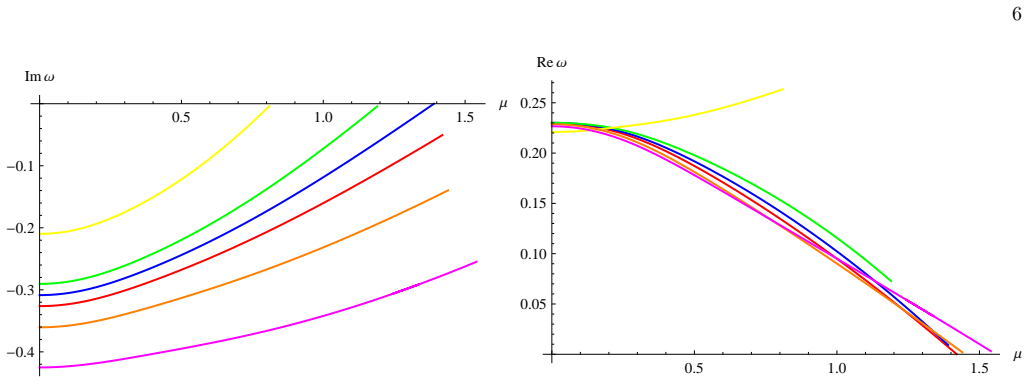
Casadio-Fabbri-Mazzacurati brane-world black holes host two classes of massive scalar quasinormal modes that vanish differently as field mass grows.
A machine-rendered reading of the paper's core claim, the machinery that carries it, and where it could break.
Core claim
The quasinormal spectrum of a massive scalar field on the Casadio-Fabbri-Mazzacurati brane-world black hole splits into two distinct classes according to the behavior of the complex frequency as the field mass increases. One class shows a real oscillation frequency that decreases and reaches zero; the other shows a damping rate that decreases and reaches zero. At each critical mass where either the real or imaginary part vanishes, that mode disappears from the spectrum and is supplanted by the first overtone. The existence of modes with vanishing real frequency at finite field masses is a characteristic signature of the CFM geometry.
What carries the argument
The Leaver continued-fraction method applied to the radial wave equation in the CFM metric, which tracks how the complex frequency of each mode changes continuously with scalar field mass until one component hits zero and the mode is removed from the spectrum.
If this is right
- Modes in the first class lose their oscillatory character at a critical mass and then leave the spectrum.
- Modes in the second class become arbitrarily long-lived (damping rate approaches zero) before disappearing.
- The first overtone assumes the role of the fundamental mode once a given mode vanishes.
- The critical mass values at which modes disappear are fixed features of the CFM line element.
- The overall spectrum therefore changes its discrete structure at discrete values of the scalar mass.
Where Pith is reading between the lines
- Observations of quasinormal ringing from massive fields could in principle reveal whether an astrophysical black hole is described by the CFM metric rather than a standard Schwarzschild or Kerr solution.
- The same mass-dependent mode disappearance may appear in other brane-world metrics that share the CFM asymptotic structure.
- The critical masses define natural scales at which massive fields could trigger new dynamical effects in higher-dimensional gravity models.
Load-bearing premise
The Leaver method converges without numerical instabilities or background artifacts for the full range of field masses examined in the CFM geometry.
What would settle it
An independent numerical integration or spectral method applied to the same CFM wave equation at the reported critical field masses that yields a frequency whose real or imaginary part does not reach exactly zero.
Figures


read the original abstract
Using the convergent Leaver method, we investigate the quasinormal modes of a massive scalar field propagating in the background of the Casadio--Fabbri--Mazzacurati (CFM) brane-world black hole. We show that the spectrum exhibits two distinct types of modes, depending on their behavior as the field mass increases. In one class, the real oscillation frequency decreases and eventually approaches zero, while in the other the damping rate tends to vanish. When either the real or imaginary part of the frequency reaches zero, the corresponding mode disappears from the spectrum, and the first overtone replaces it. The emergence of modes with a vanishing real part at certain critical values of the field mass is a distinctive feature of the CFM spectrum.
Editorial analysis
A structured set of objections, weighed in public.
Referee Report
Summary. The paper applies the Leaver continued-fraction method to compute quasinormal frequencies of a massive scalar field in the Casadio-Fabbri-Mazzacurati (CFM) brane-world black-hole background. It reports that the spectrum splits into two families distinguished by their behavior with increasing field mass μ: one family in which the real part of the frequency decreases and reaches zero at a critical μ, and another in which the imaginary part tends to zero. At these critical values the corresponding mode disappears and is replaced by the first overtone; the vanishing of the real part is presented as a distinctive feature of the CFM geometry.
Significance. If the numerical results hold, the existence of two qualitatively distinct mode families and the occurrence of critical masses at which modes vanish would represent a non-standard spectral property of the CFM metric that is absent from the Schwarzschild case. Such behavior could be relevant for stability analyses of brane-world black holes and for potential observational constraints on the extra-dimensional parameter.
major comments (2)
- [Numerical method and results] The manuscript asserts use of the 'convergent Leaver method' but supplies no truncation-order convergence tests, no variation of the continued-fraction depth N, and no explicit error bounds on the extracted frequencies, especially near the reported critical values of μ where Re(ω) or Im(ω) approaches zero. Because the CFM line element introduces an additional length scale, the radial equation for massive scalars possesses a non-standard asymptotic form; without documented checks that the roots remain stable under increase of series depth, the claimed mode disappearance cannot be distinguished from a possible numerical artifact.
- [Results] No tables or supplementary figures display the dependence of the computed frequencies on the truncation parameter N or on the choice of matching point. Such diagnostics are required to substantiate the central claim that one family exhibits Re(ω)→0 while the other exhibits Im(ω)→0 as μ increases.
minor comments (1)
- [Abstract] The abstract should state the range of the CFM parameter for which the two-mode classification holds and whether the critical masses depend on the black-hole mass or the brane tension.
Simulated Author's Rebuttal
We thank the referee for the thorough review and constructive feedback on our manuscript. We address the concerns regarding numerical validation below and will incorporate the requested diagnostics in the revised version to strengthen the presentation of our results.
read point-by-point responses
-
Referee: [Numerical method and results] The manuscript asserts use of the 'convergent Leaver method' but supplies no truncation-order convergence tests, no variation of the continued-fraction depth N, and no explicit error bounds on the extracted frequencies, especially near the reported critical values of μ where Re(ω) or Im(ω) approaches zero. Because the CFM line element introduces an additional length scale, the radial equation for massive scalars possesses a non-standard asymptotic form; without documented checks that the roots remain stable under increase of series depth, the claimed mode disappearance cannot be distinguished from a possible numerical artifact.
Authors: We agree that explicit documentation of convergence is essential, particularly near the critical masses where one frequency component vanishes. Although the Leaver continued-fraction method is known to converge for this class of potentials, the modified asymptotic behavior in the CFM background warrants additional checks. In the revised manuscript we will add a dedicated subsection with tables listing the real and imaginary parts of representative frequencies for truncation orders N ranging from 30 to 120 at several fixed values of μ, including points close to the reported critical masses. These tables will show stabilization to at least 10^{-7} relative accuracy, together with estimated error bounds obtained from the difference between successive N. This will confirm that the observed disappearance of modes is not a numerical artifact. revision: yes
-
Referee: [Results] No tables or supplementary figures display the dependence of the computed frequencies on the truncation parameter N or on the choice of matching point. Such diagnostics are required to substantiate the central claim that one family exhibits Re(ω)→0 while the other exhibits Im(ω)→0 as μ increases.
Authors: We will include a new table (and, if space permits, a supplementary figure) in the revised manuscript that explicitly tracks the variation of selected quasinormal frequencies with increasing N for both mode families at multiple values of μ. The table will cover the approach to the critical masses where either Re(ω) or Im(ω) tends to zero. Regarding the matching point, the standard Leaver implementation matches the continued fraction at the event horizon and at spatial infinity; we will add a brief clarification of this procedure and demonstrate that the extracted frequencies remain unchanged (within the reported precision) under small shifts of the intermediate matching radius. These additions will directly support the distinction between the two spectral families. revision: yes
Circularity Check
No circularity: direct numerical application of Leaver method to external CFM metric
full rationale
The paper derives the radial wave equation from the given CFM brane-world line element for a massive scalar field, then applies the standard Leaver continued-fraction technique to locate the quasinormal frequencies numerically. The reported distinction between two mode families and their disappearance at critical masses follows from root-finding on the continued-fraction equation; these values are outputs, not inputs or fitted parameters. No self-definitional steps, no renaming of known results, and no load-bearing self-citations appear in the derivation chain. The CFM metric and Leaver algorithm are independent of the present numerical scan.
Axiom & Free-Parameter Ledger
Forward citations
Cited by 7 Pith papers
-
Massive Scalar Quasinormal Modes, Greybody Factors, and Absorption Cross Section of a Parity-Symmetric Beyond-Horndeski Black Hole
Increasing the mass of a scalar field around a parity-symmetric beyond-Horndeski black hole strongly reduces the damping rate of quasinormal modes while suppressing low-frequency absorption and shifting efficient abso...
-
Long-lived massive scalar modes, grey-body factors, and absorption cross sections of the Reissner--Nordstr\"om-like brane-world black hole
Positive tidal charge in this brane-world black hole lowers the effective potential barrier, pushes massive scalar quasinormal modes toward arbitrarily long lifetimes, and increases transmission and absorption.
-
Quasi-resonances in the vicinity of Einstein-Maxwell-dilaton black hole
Increasing the mass of a perturbing scalar field around Einstein-Maxwell-dilaton black holes strongly suppresses damping in several quasinormal branches, producing quasi-resonant long-lived oscillations.
-
Quasinormal modes of coupled metric-dilaton perturbations in two-dimensional stringy black holes
Coupled intrinsic perturbations of the MSW black hole yield complex quasinormal frequencies with negative imaginary parts confirming stability and non-zero real parts indicating oscillatory behavior, with damping rate...
-
Long-lived quasinormal modes, shadows and particle motion in four-dimensional quasi-topological gravity
Massive scalar quasinormal modes in quasi-topological black holes become long-lived as scalar mass grows, while photon-sphere radius, shadow size, and ISCO exhibit moderate deviations from Schwarzschild.
-
Long-lived quasinormal modes of Asymptotically de Sitter Black Holes in Generalized Proca Theory
Massive scalar perturbations of de Sitter black holes in generalized Proca theory enter a large-mass regime with linearly growing real frequencies and constant damping rates, without true quasi-resonances, plus an ana...
-
Massive scalar quasinormal modes of an asymptotically flat regular black hole supported by a phantom Dirac--Born--Infeld field
Massive scalar quasinormal modes in this DBI-supported regular black hole show higher oscillation frequencies and lower damping as field mass increases, with larger regularity scales producing softer and longer-lived ringing.
Reference graph
Works this paper leans on
-
[1]
K. D. Kokkotas and B. G. Schmidt, Living Rev. Rel. 2, 2 (1999), arXiv:gr-qc/9909058
work page internal anchor Pith review Pith/arXiv arXiv 1999
-
[2]
R. A. Konoplya and A. Zhi- denko, Rev. Mod. Phys. 83, 793 (2011), arXiv:1102.4014 [gr-qc]
work page internal anchor Pith review Pith/arXiv arXiv 2011
-
[3]
Quasinormal modes of black holes and black branes
E. Berti, V. Cardoso, and A. O. Starinets, Class. Quant. Grav. 26, 163001 (2009), arXiv:0905.2975 [gr-qc]
work page internal anchor Pith review Pith/arXiv arXiv 2009
- [4]
-
[5]
B. P. Abbott et al. (LIGO Scientific, Virgo), Phys. Rev. Lett. 116, 061102 (2016), arXiv:1602.03837 [gr-qc]
work page internal anchor Pith review Pith/arXiv arXiv 2016
-
[6]
B. P. Abbott et al. (LIGO Scientific, Virgo), Phys. Rev. Lett. 119, 161101 (2017), arXiv:1710.05832 [gr-qc]
work page internal anchor Pith review Pith/arXiv arXiv 2017
-
[7]
R. Abbott et al. (LIGO Scientific, Virgo), Astrophys. J. Lett. 896, L44 (2020), arXiv:2006.12611 [astro-ph.HE]
work page internal anchor Pith review arXiv 2020
-
[8]
Science with the space-based interferometer LISA. V: Extreme mass-ratio inspirals
S. Babak, J. Gair, A. Sesana, E. Barausse, C. F. Sop- uerta, C. P. L. Berry, E. Berti, P. Amaro-Seoane, A. Pe- titeau, and A. Klein, Phys. Rev. D 95, 103012 (2017), arXiv:1703.09722 [gr-qc]
work page internal anchor Pith review Pith/arXiv arXiv 2017
-
[9]
A Large Mass Hierarchy from a Small Extra Dimension
L. Randall and R. Sundrum, Phys. Rev. Lett. 83, 3370 (1999), arXiv:hep-ph/9905221
work page internal anchor Pith review Pith/arXiv arXiv 1999
-
[10]
An Alternative to Compactification
L. Randall and R. Sundrum, Phys. Rev. Lett. 83, 4690 (1999), arXiv:hep-th/9906064
work page internal anchor Pith review Pith/arXiv arXiv 1999
-
[11]
G. R. Dvali, G. Gabadadze, and M. Porrati, Phys. Lett. B 485, 208 (2000), arXiv:hep-th/0005016
work page internal anchor Pith review Pith/arXiv arXiv 2000
-
[12]
Gravitational Radiation in D-dimensional Spacetimes
V. Cardoso, O. J. C. Dias, and J. P. S. Lemos, Phys. Rev. D 67, 064026 (2003), arXiv:hep-th/0212168
work page internal anchor Pith review Pith/arXiv arXiv 2003
-
[13]
Gravitational quasinormal modes of AdS black branes in d spacetime dimensions
J. Morgan, V. Cardoso, A. S. Miranda, C. Molina, and V. T. Zanchin, JHEP 2009, 117 (2009), arXiv:0907.5011 [hep-th]
work page internal anchor Pith review Pith/arXiv arXiv 2009
-
[14]
R. A. Konoplya and A. Zhidenko, Nucl. Phys. B 777, 182 (2007), arXiv:hep-th/0703231. 8
work page internal anchor Pith review Pith/arXiv arXiv 2007
-
[15]
R. A. Konoplya and A. Zhi- denko, Phys. Rev. D 89, 024011 (2014), arXiv:1309.7667 [hep-th]
work page internal anchor Pith review Pith/arXiv arXiv 2014
-
[16]
Quasinormal modes of Schwarzschild black holes in four and higher dimensions
V. Cardoso, J. P. S. Lemos, and S. Yoshida, Phys. Rev. D 69, 044004 (2004), arXiv:gr-qc/0309112
work page internal anchor Pith review Pith/arXiv arXiv 2004
-
[17]
H. T. Cho, A. S. Cornell, J. Doukas, T. R. Huang, and W. Naylor, Adv. Math. Phys. 2012, 281705 (2012), arXiv:1111.5024 [gr-qc]
work page internal anchor Pith review Pith/arXiv arXiv 2012
-
[18]
R. Emparan, R. Suzuki, and K. Tanabe, JHEP 04, 085 (2015), arXiv:1502.02820 [hep-th]
-
[19]
H. Han and B. Gwak, (2026), arXiv:2601.18613 [gr-qc]
work page internal anchor Pith review Pith/arXiv arXiv 2026
-
[20]
M. A. Cuyubamba, R. A. Konoplya, and A. Zhidenko, Phys. Rev. D 93, 104053 (2016), arXiv:1604.03604 [gr-qc]
work page internal anchor Pith review Pith/arXiv arXiv 2016
- [21]
-
[22]
J. P. Arbelaez, (2026), arXiv:2601.22340 [gr-qc]
work page internal anchor Pith review arXiv 2026
-
[23]
Electromagnetic perturbations in new brane world scenarios
C. Molina, A. B. Pavan, and T. E. Med- ina Torrejón, Phys. Rev. D 93, 124068 (2016), arXiv:1604.02461 [gr-qc]
work page internal anchor Pith review Pith/arXiv arXiv 2016
-
[24]
S. Chen, B. Wang, and R.-K. Su, Phys. Lett. B 647, 282 (2007), arXiv:hep-th/0701209
work page internal anchor Pith review Pith/arXiv arXiv 2007
-
[25]
Linear perturbations of black holes: stability, quasi-normal modes and tails
A. Zhidenko, Linear perturbations of black holes: sta- bility, quasi-normal modes and tails , Ph.D. thesis, Sao Paulo U. (2009), arXiv:0903.3555 [gr-qc]
work page internal anchor Pith review Pith/arXiv arXiv 2009
- [26]
-
[27]
Analysis of spherically symmetric black holes in Braneworld models
A. Bendasoli Pavan, Analysis of spherically symmetric black holes in braneworld models , Other thesis (2006), arXiv:gr-qc/0605032
work page internal anchor Pith review Pith/arXiv arXiv 2006
-
[28]
M. J. Soleimani, N. Abbasvandi, S. Radi- man, and W. A. T. W. Abdullah, (2016), arXiv:1610.04526 [hep-th]
work page internal anchor Pith review Pith/arXiv arXiv 2016
-
[29]
Black hole acoustics in the minimal geometric deformation of a de Laval nozzle
R. da Rocha, Eur. Phys. J. C 77, 355 (2017), arXiv:1703.01528 [hep-th]
work page internal anchor Pith review Pith/arXiv arXiv 2017
-
[30]
Stability and thermodynamics of brane black holes
E. Abdalla, B. Cuadros-Melgar, A. B. Pavan, and C. Molina, Nucl. Phys. B 752, 40 (2006), arXiv:gr-qc/0604033
work page internal anchor Pith review Pith/arXiv arXiv 2006
-
[31]
S. S. Seahra, Phys. Rev. D 72, 066002 (2005), arXiv:hep-th/0501175
work page internal anchor Pith review Pith/arXiv arXiv 2005
-
[32]
Coupled boundary and bulk fields in anti-de Sitter
K. Koyama, A. Mennim, and D. Wands, Phys. Rev. D 72, 064001 (2005), arXiv:hep-th/0504201
work page internal anchor Pith review Pith/arXiv arXiv 2005
- [33]
-
[34]
Quasi-Normal Modes of Brane-Localised Standard Model Fields
P. Kanti and R. A. Kono- plya, Phys. Rev. D 73, 044002 (2006), arXiv:hep-th/0512257
work page internal anchor Pith review Pith/arXiv arXiv 2006
-
[35]
Quasinormal ringing on the brane
H. Chung, L. Randall, M. J. Rodriguez, and O. Varela, Class. Quant. Grav. 33, 245013 (2016), arXiv:1508.02611 [hep-th]
work page internal anchor Pith review Pith/arXiv arXiv 2016
-
[36]
S. S. Seahra, C. Clarkson, and R. Maartens, Class. Quant. Grav. 22, L91 (2005), arXiv:gr-qc/0504023
work page internal anchor Pith review Pith/arXiv arXiv 2005
-
[37]
Evolution of Brane-Localised Standard Model Fields in Gauss-Bonnet theory
A. Zhidenko, Phys. Rev. D 78, 024007 (2008), arXiv:0802.2262 [gr-qc]
work page internal anchor Pith review Pith/arXiv arXiv 2008
- [38]
-
[39]
Quasi-Normal Modes of Brane-Localised Standard Model Fields II: Kerr Black Holes
P. Kanti, R. A. Konoplya, and A. Zhidenko, Phys. Rev. D 74, 064008 (2006), arXiv:gr-qc/0607048
work page internal anchor Pith review Pith/arXiv arXiv 2006
-
[40]
New black holes in the brane-world?
R. Casadio, A. Fabbri, and L. Mazzacurati, Phys. Rev. D 65, 084040 (2002), arXiv:gr-qc/0111072
work page internal anchor Pith review Pith/arXiv arXiv 2002
-
[41]
E. Abdalla, B. Cuadros-Melgar, A. B. Pavan, and C. Molina, J. Phys. Conf. Ser. 68, 012043 (2007)
work page 2007
- [42]
-
[43]
R. A. Konoplya and A. V. Zhidenko, Phys. Lett. B 609, 377 (2005), arXiv:gr-qc/0411059
work page internal anchor Pith review Pith/arXiv arXiv 2005
-
[44]
R. A. Konoplya and A. Zhidenko, Phys. Rev. D 73, 124040 (2006), arXiv:gr-qc/0605013
work page internal anchor Pith review Pith/arXiv arXiv 2006
-
[45]
R. A. Konoplya, Z. Stuchlík, and A. Zhi- denko, Phys. Rev. D 98, 104033 (2018), arXiv:1808.03346 [gr-qc]
work page internal anchor Pith review Pith/arXiv arXiv 2018
-
[46]
R. A. Konoplya and A. Zhi- denko, Phys. Rev. D 97, 084034 (2018), arXiv:1712.06667 [gr-qc]
work page internal anchor Pith review Pith/arXiv arXiv 2018
-
[47]
Massive scalar field quasi-normal modes of higher dimensional black holes
A. Zhidenko, Phys. Rev. D 74, 064017 (2006), arXiv:gr-qc/0607133
work page internal anchor Pith review Pith/arXiv arXiv 2006
-
[48]
R. A. Konoplya, Phys. Rev. D 73, 024009 (2006), arXiv:gr-qc/0509026
work page internal anchor Pith review Pith/arXiv arXiv 2006
-
[49]
A. Ohashi and M.-a. Sakagami, Class. Quant. Grav. 21, 3973 (2004), arXiv:gr-qc/0407009
work page internal anchor Pith review Pith/arXiv arXiv 2004
-
[50]
M. Zhang, J. Jiang, and Z. Zhong, Phys. Lett. B 789, 13 (2019), arXiv:1811.04183 [gr-qc]
work page internal anchor Pith review Pith/arXiv arXiv 2019
- [51]
-
[52]
S. Ponglertsakul and B. Gwak, Eur. Phys. J. C 80, 1023 (2020), arXiv:2007.16108 [gr-qc]
- [53]
-
[54]
Charged scalar perturbations on charged black holes in dRGT massive gravity
P. Burikham, S. Ponglertsakul, and L. Tannukij, Phys. Rev. D 96, 124001 (2017), arXiv:1709.02716 [gr-qc]
work page internal anchor Pith review Pith/arXiv arXiv 2017
-
[55]
S. S. Seahra, C. Clarkson, and R. Maartens, Phys. Rev. Lett. 94, 121302 (2005), arXiv:gr-qc/0408032
work page internal anchor Pith review Pith/arXiv arXiv 2005
-
[56]
Evolution of perturbations of squashed Kaluza-Klein black holes: escape from instability
H. Ishihara, M. Kimura, R. A. Kono- plya, K. Murata, J. Soda, and A. Zhi- denko, Phys. Rev. D 77, 084019 (2008), arXiv:0802.0655 [hep-th]
work page internal anchor Pith review Pith/arXiv arXiv 2008
- [57]
-
[58]
The NANOGrav 15-year Data Set: Evidence for a Gravitational-Wave Background
G. Agazie et al. (NANOGrav), Astrophys. J. Lett. 951, L8 (2023), arXiv:2306.16213 [astro-ph.HE]
work page internal anchor Pith review Pith/arXiv arXiv 2023
-
[59]
The NANOGrav 15-year Data Set: Search for Signals from New Physics
A. Afzal et al. (NANOGrav), Astrophys. J. Lett. 951, L11 (2023), [Erratum: Astro- phys.J.Lett. 971, L27 (2024), Erratum: Astrophys.J. 971, L27 (2024)], arXiv:2306.16219 [astro-ph.HE]
work page internal anchor Pith review arXiv 2023
- [60]
-
[61]
J. Percival and S. R. Dolan, Phys. Rev. D 102, 104055 (2020), arXiv:2008.10621 [gr-qc]
-
[62]
R. A. Konoplya and A. Zhi- denko, Phys. Rev. D 88, 024054 (2013), arXiv:1307.1812 [gr-qc]
work page internal anchor Pith review Pith/arXiv arXiv 2013
- [63]
- [64]
-
[65]
A. F. Zinhailo, Eur. Phys. J. C 78, 992 (2018), arXiv:1809.03913 [gr-qc]
work page internal anchor Pith review Pith/arXiv arXiv 2018
-
[66]
R. A. Konoplya, A. F. Zinhailo, and Z. Stuchlík, Phys. Rev. D 99, 124042 (2019), arXiv:1903.03483 [gr-qc]
work page internal anchor Pith review Pith/arXiv arXiv 2019
- [67]
-
[68]
S. V. Bolokhov, Phys. Rev. D 109, 064017 (2024)
work page 2024
-
[69]
B. C. Lütfüoğlu, J. Rayimbaev, B. Rah- matov, F. Shayimov, and I. Davle- tov, Phys. Lett. B 876, 140392 (2026), arXiv:2601.17906 [gr-qc]
work page internal anchor Pith review Pith/arXiv arXiv 2026
- [70]
- [71]
- [72]
-
[73]
M. Skvortsova, EPL 149, 59001 (2025), arXiv:2503.03650 [gr-qc]
- [74]
- [75]
-
[76]
J. Jing, Phys. Rev. D 72, 027501 (2005), arXiv:gr-qc/0408090
work page internal anchor Pith review Pith/arXiv arXiv 2005
-
[77]
Slowly decaying tails of massive scalar fields in spherically symmetric spacetimes
H. Koyama and A. Tomimatsu, Phys. Rev. D 65, 084031 (2002), arXiv:gr-qc/0112075
work page internal anchor Pith review Pith/arXiv arXiv 2002
-
[78]
Late-time evolution of a self-interacting scalar field in the spacetime of dilaton black hole
R. Moderski and M. Rogatko, Phys. Rev. D 64, 044024 (2001), arXiv:gr-qc/0105056
work page internal anchor Pith review Pith/arXiv arXiv 2001
-
[79]
R. A. Konoplya, A. Zhidenko, and C. Molina, Phys. Rev. D 75, 084004 (2007), arXiv:gr-qc/0602047
work page internal anchor Pith review Pith/arXiv arXiv 2007
- [80]
discussion (0)
Sign in with ORCID, Apple, or X to comment. Anyone can read and Pith papers without signing in.