Polarized Anisotropic Stochastic Gravitational Wave Background Search with Ground-Based Detector Networks
Pith reviewed 2026-06-29 20:30 UTC · model grok-4.3
The pith
A full-Stokes analysis of stochastic gravitational wave backgrounds shows that intensity-only searches can be biased by polarized sky components.
A machine-rendered reading of the paper's core claim, the machinery that carries it, and where it could break.
Core claim
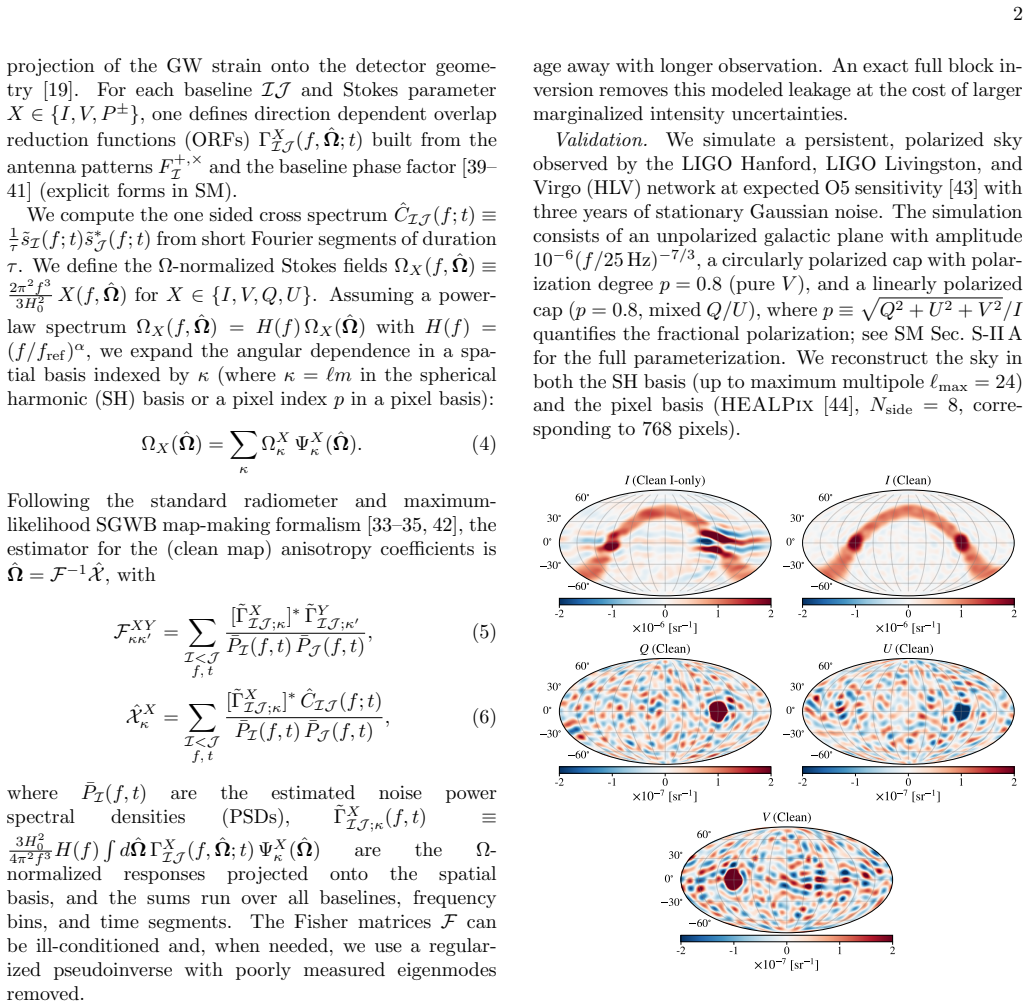
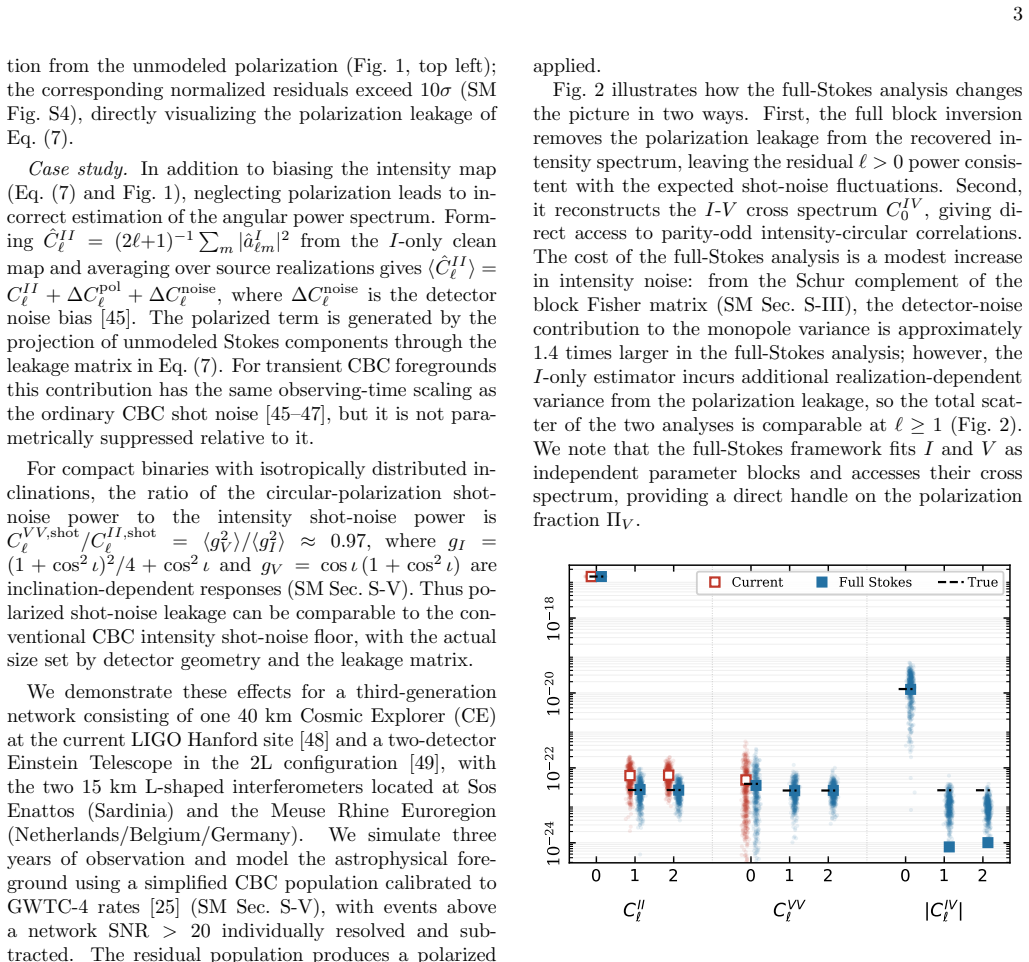
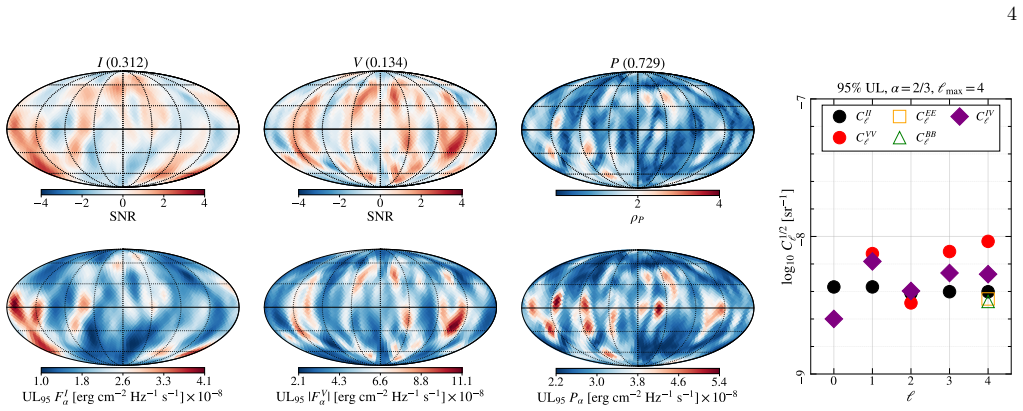
Gravitational waves admit a Stokes decomposition into intensity (I), circular polarization (V), and linear polarization (Q, U). A full-Stokes maximum-likelihood SGWB map-making analysis is implemented for ground-based detector networks that jointly reconstructs all four parameters from cross-correlation data products. Applied to LVK O3 data, the analysis constrains the polarized angular spectra C^{VV}_ℓ, C^{EE}_ℓ, C^{BB}_ℓ and |C^{IV}_ℓ|. An intensity-only model is shown to be biased when polarized sky components are present because the detector-network Fisher inner product does not generally make the Stokes responses orthogonal. For transient CBC foregrounds, polarized shot noise is not par
What carries the argument
The full-Stokes maximum-likelihood map-making procedure that jointly reconstructs the Stokes parameters I, V, Q, U from network cross-correlation data products via the detector-network Fisher inner product.
If this is right
- An intensity-only SGWB analysis will return biased sky maps and spectra whenever polarized components are present.
- Polarized shot noise from compact binary coalescences contributes at the same order as intensity shot noise and cannot be neglected.
- Constraints become available on the angular power spectra of circular polarization (V), linear polarization E and B modes, and the I-V cross-spectrum.
- Polarized anisotropies in the SGWB become detectable that remain invisible to intensity-only searches.
Where Pith is reading between the lines
- Existing upper limits on the anisotropic SGWB from O1-O3 data may need re-evaluation once polarized leakage is accounted for.
- The method could be used with future detector networks to search for parity-violating signatures through a non-zero circular polarization spectrum.
- The same non-orthogonality issue may appear in other map-making problems that involve vector or tensor fields observed by non-orthogonal detector responses.
Load-bearing premise
The detector-network Fisher inner product does not generally make the Stokes responses orthogonal.
What would settle it
Applying the full-Stokes pipeline and the intensity-only pipeline to the same LVK O3 dataset and finding statistically significant differences in the reconstructed intensity map, or finding non-zero polarized spectra C^{VV}_ℓ or C^{EE}_ℓ, would support the bias claim; identical results from both pipelines would falsify it.
Figures
read the original abstract
Gravitational waves admit a Stokes decomposition into intensity ($I$), circular polarization ($V$), and linear polarization ($Q$, $U$), analogous to Cosmic Microwave Background (CMB) polarimetry. We implement a full-Stokes maximum-likelihood SGWB map-making analysis for ground-based detector networks, promoting the standard cross-correlation data products used in existing pipelines to a joint reconstruction of $I$, $V$, $Q$, $U$. Applied to LVK O3 data, we constrain the polarized angular spectra $C^{VV}_\ell$, $C^{EE}_\ell$, $C^{BB}_\ell$ and $|C^{IV}_\ell|$. We show that an intensity-only model is biased when polarized sky components are present, since the detector-network Fisher inner product does not generally make the Stokes responses orthogonal. For transient CBC foregrounds, polarized shot noise is not parametrically suppressed relative to ordinary CBC intensity shot noise. The full Stokes framework separates the Stokes sectors while providing access to polarized anisotropies invisible to conventional intensity-only searches.
Editorial analysis
A structured set of objections, weighed in public.
Referee Report
Summary. The paper implements a full-Stokes maximum-likelihood SGWB map-making analysis for ground-based detector networks, extending standard cross-correlation pipelines to jointly reconstruct the Stokes parameters I, V, Q, U. Applied to LVK O3 data, it constrains the polarized angular spectra C^{VV}_ℓ, C^{EE}_ℓ, C^{BB}_ℓ and |C^{IV}_ℓ|. The central result is that intensity-only analyses are biased when polarized sky components are present, because the detector-network Fisher inner product does not make the Stokes responses orthogonal; the work further notes that polarized shot noise from transient CBC foregrounds is not parametrically suppressed relative to intensity shot noise.
Significance. If the maximum-likelihood implementation correctly propagates the off-diagonal Fisher blocks and the transient foreground model is complete, the result would be significant: it supplies the first joint constraints on polarized SGWB anisotropies with existing LVK data and supplies a concrete diagnostic for a previously unaccounted systematic in intensity-only searches. The approach re-uses existing cross-correlation data products, so the framework is immediately applicable to ongoing and future observing runs.
major comments (1)
- [Abstract / likelihood implementation] The claim that the full-Stokes reconstruction separates sectors without bias (Abstract) is load-bearing for both the O3 constraints and the assertion that intensity-only analyses are biased. The provided material does not describe an explicit simulation test or analytic propagation check confirming that the likelihood fully accounts for the off-diagonal Fisher blocks when polarized CBC shot noise is present; without such a check the reported spectra could acquire systematic offsets from incomplete foreground modeling.
Simulated Author's Rebuttal
We thank the referee for their thoughtful review and for highlighting the need for explicit validation of the full-Stokes likelihood. We address the major comment below and will revise the manuscript to incorporate the requested check.
read point-by-point responses
-
Referee: [Abstract / likelihood implementation] The claim that the full-Stokes reconstruction separates sectors without bias (Abstract) is load-bearing for both the O3 constraints and the assertion that intensity-only analyses are biased. The provided material does not describe an explicit simulation test or analytic propagation check confirming that the likelihood fully accounts for the off-diagonal Fisher blocks when polarized CBC shot noise is present; without such a check the reported spectra could acquire systematic offsets from incomplete foreground modeling.
Authors: The maximum-likelihood estimator is derived from the full covariance of the cross-correlation data products, so the Fisher matrix by construction includes all off-diagonal blocks between Stokes parameters I, V, Q, U. The analytic demonstration that intensity-only analyses are biased follows directly from the non-orthogonality of the network response functions under this inner product. We acknowledge, however, that the manuscript does not present an explicit end-to-end simulation injecting polarized CBC shot noise and recovering the input spectra. We will add such a validation section in the revised manuscript, using the same O3 noise curves and network geometry, to confirm unbiased recovery when the full Fisher is employed. revision: yes
Circularity Check
No significant circularity; derivation extends standard cross-correlation methods independently
full rationale
The paper's derivation chain implements a full-Stokes maximum-likelihood map-making analysis by promoting existing cross-correlation data products to joint I/V/Q/U reconstruction, then applies this to LVK O3 data to obtain constraints on C^VV_ℓ, C^EE_ℓ, C^BB_ℓ and |C^IV_ℓ|. The key statement that the detector-network Fisher inner product does not generally orthogonalize Stokes responses is presented as an intrinsic property of the inner product rather than a fitted result or self-referential definition. No equations reduce by construction to the paper's own inputs, no predictions are statistically forced from subsets of the same data, and no load-bearing uniqueness theorems or ansatzes are imported via self-citation. The framework remains self-contained against external benchmarks of standard SGWB pipelines.
Axiom & Free-Parameter Ledger
Reference graph
Works this paper leans on
-
[1]
A. G. Abacet al.(LIGO Scientific, VIRGO, KAGRA), GWTC-4.0: Updating the Gravitational-Wave Transient Catalog with Observations from the First Part of the Fourth LIGO-Virgo-KAGRA Observing Run, arXiv e- prints (2025), arXiv:2508.18082 [gr-qc]
work page internal anchor Pith review Pith/arXiv arXiv 2025
-
[2]
R. Abbottet al.(KAGRA, VIRGO, LIGO Scien- tific), GWTC-3: Compact Binary Coalescences Observed by LIGO and Virgo during the Second Part of the Third Observing Run, Phys. Rev. X13, 041039 (2023), arXiv:2111.03606 [gr-qc]
work page internal anchor Pith review Pith/arXiv arXiv 2023
-
[3]
B. P. Abbottet al.(LIGO Scientific, Virgo), Observation of Gravitational Waves from a Binary Black Hole Merger, Phys. Rev. Lett.116, 061102 (2016), arXiv:1602.03837 [gr-qc]
work page internal anchor Pith review Pith/arXiv arXiv 2016
-
[4]
B. P. Abbottet al.(LIGO Scientific, Virgo), GW170817: Observation of Gravitational Waves from a Binary Neu- tron Star Inspiral, Phys. Rev. Lett.119, 161101 (2017), arXiv:1710.05832 [gr-qc]
work page internal anchor Pith review Pith/arXiv arXiv 2017
-
[5]
The NANOGrav 15-year Data Set: Evidence for a Gravitational-Wave Background
G. Agazieet al.(NANOGrav), The NANOGrav 15 yr Data Set: Evidence for a Gravitational-wave Background, Astrophys. J. Lett.951, L8 (2023), arXiv:2306.16213 [astro-ph.HE]
work page internal anchor Pith review Pith/arXiv arXiv 2023
-
[6]
Z. Arzoumanianet al.(NANOGrav), The NANOGrav 12.5 yr Data Set: Search for an Isotropic Stochastic Gravitational-wave Background, Astrophys. J. Lett.905, L34 (2020), arXiv:2009.04496 [astro-ph.HE]
-
[7]
J. Antoniadiset al.(EPTA, InPTA:), The second data release from the European Pulsar Timing Array - III. Search for gravitational wave signals, Astron. Astrophys. 678, A50 (2023), arXiv:2306.16214 [astro-ph.HE]
work page internal anchor Pith review Pith/arXiv arXiv 2023
-
[8]
D. J. Reardon, A. Zic, R. M. Shannon, G. B. Hobbs, M. Bailes, V. Di Marco, A. Kapur, A. F. Rogers, E. Thrane, J. Askew,et al., Search for an isotropic gravitational-wave background with the parkes pulsar timing array, The Astrophysical Journal Letters951, L6 (2023)
2023
-
[9]
H. Xuet al., Searching for the Nano-Hertz Stochastic Gravitational Wave Background with the Chinese Pulsar Timing Array Data Release I, Res. Astron. Astrophys. 23, 075024 (2023), arXiv:2306.16216 [astro-ph.HE]
work page internal anchor Pith review Pith/arXiv arXiv 2023
-
[10]
R. Abbottet al.(KAGRA, Virgo, LIGO Scientific), Upper limits on the isotropic gravitational-wave back- ground from Advanced LIGO and Advanced Virgo’s third observing run, Phys. Rev. D104, 022004 (2021), arXiv:2101.12130 [gr-qc]
-
[11]
G. Cusin, C. Pitrou, and J.-P. Uzan, Anisotropy of the astrophysical gravitational wave background: Analytic expression of the angular power spectrum and correlation with cosmological observations, Phys. Rev. D96, 103019 (2017), arXiv:1704.06184 [astro-ph.CO]
work page internal anchor Pith review Pith/arXiv arXiv 2017
-
[12]
A. C. Jenkins and M. Sakellariadou, Anisotropies in the stochastic gravitational-wave background: Formal- ism and the cosmic string case, Phys. Rev. D98, 063509 (2018), arXiv:1802.06046 [astro-ph.CO]
work page internal anchor Pith review Pith/arXiv arXiv 2018
- [13]
-
[14]
Polarization-based Tests of Gravity with the Stochastic Gravitational-Wave Background
T. Callister, A. S. Biscoveanu, N. Christensen, M. Isi, A. Matas, O. Minazzoli, T. Regimbau, M. Sakellariadou, J. Tasson, and E. Thrane, Polarization-based Tests of Gravity with the Stochastic Gravitational-Wave Back- ground, Phys. Rev. X7, 041058 (2017), arXiv:1704.08373 [gr-qc]
work page internal anchor Pith review Pith/arXiv arXiv 2017
-
[15]
N. Seto and A. Taruya, Polarization analysis of gravitational-wave backgrounds from the correlation sig- nals of ground-based interferometers: Measuring a circular-polarization mode, Phys. Rev. D77, 103001 (2008), arXiv:0801.4185 [astro-ph]
work page internal anchor Pith review Pith/arXiv arXiv 2008
-
[16]
Probing circular polarization in stochastic gravitational wave background with pulsar timing arrays
R. Kato and J. Soda, Probing circular polarization in stochastic gravitational wave background with pul- sar timing arrays, Phys. Rev. D93, 062003 (2016), arXiv:1512.09139 [gr-qc]
work page internal anchor Pith review Pith/arXiv arXiv 2016
-
[17]
Detection of Anisotropies in the Gravitational-Wave Stochastic Background
B. Allen and A. C. Ottewill, Detection of anisotropies in the gravitational wave stochastic background, Phys. Rev. D56, 545 (1997), arXiv:gr-qc/9607068
work page internal anchor Pith review Pith/arXiv arXiv 1997
-
[18]
B. Allen and J. D. Romano, Detecting a stochastic background of gravitational radiation: Signal process- ing strategies and sensitivities, Phys. Rev. D59, 102001 (1999), arXiv:gr-qc/9710117
work page internal anchor Pith review Pith/arXiv arXiv 1999
-
[19]
J. D. Romano and N. J. Cornish, Detection meth- ods for stochastic gravitational-wave backgrounds: a unified treatment, Living Rev. Rel.20, 2 (2017), arXiv:1608.06889 [gr-qc]
work page internal anchor Pith review Pith/arXiv arXiv 2017
-
[20]
Z. Arzoumanianet al.(NANOGrav), The NANOGrav 12.5-year Data Set: Search for Non-Einsteinian Polariza- tion Modes in the Gravitational-wave Background, As- trophys. J. Lett.923, L22 (2021), arXiv:2109.14706 [gr- qc]
-
[21]
arXiv , author =:2306.16221 , journal =
G. Agazieet al.(NANOGrav), The NANOGrav 15 yr Data Set: Search for Anisotropy in the Gravitational- wave Background, Astrophys. J. Lett.956, L3 (2023), 6 arXiv:2306.16221 [astro-ph.HE]
-
[22]
G. Mentasti, C. Contaldi, and M. Peloso, Prospects for detecting anisotropies and polarization of the stochastic gravitational wave background with ground-based detec- tors, JCAP2023(08), 053, arXiv:2304.06640 [gr-qc]
- [23]
-
[24]
The NANOGrav 15-year Data Set: Search for Signals from New Physics
A. Afzalet al.(NANOGrav), The NANOGrav 15 yr Data Set: Search for Signals from New Physics, Astrophys. J. Lett.951, L11 (2023), [Erratum: Astrophys.J.Lett. 971, L27 (2024), Erratum: Astrophys.J. 971, L27 (2024)], arXiv:2306.16219 [astro-ph.HE]
work page internal anchor Pith review Pith/arXiv arXiv 2023
-
[25]
A. G. Abacet al.(LIGO Scientific, VIRGO, KAGRA), GWTC-4.0: Population Properties of Merging Compact Binaries, arXiv e-prints (2025), arXiv:2508.18083 [astro- ph.HE]
work page internal anchor Pith review Pith/arXiv arXiv 2025
-
[26]
arXiv , author =:2306.16220 , journal =
G. Agazieet al.(NANOGrav), The NANOGrav 15 yr Data Set: Constraints on Supermassive Black Hole Bina- ries from the Gravitational-wave Background, Astrophys. J. Lett.952, L37 (2023), arXiv:2306.16220 [astro-ph.HE]
-
[27]
Gravitational Wave Experiments and Early Universe Cosmology
M. Maggiore, Gravitational wave experiments and early universe cosmology, Phys. Rept.331, 283 (2000), arXiv:gr-qc/9909001
work page internal anchor Pith review Pith/arXiv arXiv 2000
-
[28]
Cosmological Backgrounds of Gravitational Waves
C. Caprini and D. G. Figueroa, Cosmological Back- grounds of Gravitational Waves, Class. Quant. Grav.35, 163001 (2018), arXiv:1801.04268 [astro-ph.CO]
work page internal anchor Pith review Pith/arXiv arXiv 2018
-
[29]
R. Caldwellet al., Detection of early-universe gravitational-wave signatures and fundamental physics, Gen. Rel. Grav.54, 156 (2022), arXiv:2203.07972 [gr-qc]
-
[30]
J. Gair, J. D. Romano, S. Taylor, and C. M. F. Mingarelli, Mapping gravitational-wave backgrounds using methods from CMB analysis: Application to pulsar timing arrays, Phys. Rev. D90, 082001 (2014), arXiv:1406.4664 [gr-qc]
work page internal anchor Pith review Pith/arXiv arXiv 2014
-
[31]
J. R. Gair, J. D. Romano, and S. R. Taylor, Mapping gravitational-wave backgrounds of arbitrary polarisation using pulsar timing arrays, Phys. Rev. D92, 102003 (2015), arXiv:1506.08668 [gr-qc]
work page internal anchor Pith review Pith/arXiv arXiv 2015
-
[32]
T. L. Smith and R. Caldwell, Sensitivity to a Frequency- Dependent Circular Polarization in an Isotropic Stochas- tic Gravitational Wave Background, Phys. Rev. D95, 044036 (2017), arXiv:1609.05901 [gr-qc]
work page internal anchor Pith review Pith/arXiv arXiv 2017
- [33]
-
[34]
Gravitational wave radiometry: Mapping a stochastic gravitational wave background
S. Mitra, S. Dhurandhar, T. Souradeep, A. Lazzarini, V. Mandic, S. Bose, and S. Ballmer, Gravitational wave radiometry: Mapping a stochastic gravitational wave background, Phys. Rev. D77, 042002 (2008), arXiv:0708.2728 [gr-qc]
work page internal anchor Pith review Pith/arXiv arXiv 2008
-
[35]
Miao, Physical Review A95, 10.1103/phys- reva.95.012103 (2017)
E. Thrane, S. Ballmer, J. D. Romano, S. Mitra, D. Talukder, S. Bose, and V. Mandic, Probing the anisotropies of a stochastic gravitational-wave back- ground using a network of ground-based laser in- terferometers, Physical Review D80, 10.1103/phys- revd.80.122002 (2009)
-
[36]
J. D. Romano, S. R. Taylor, N. J. Cornish, J. Gair, C. M. F. Mingarelli, and R. van Haasteren, Phase- coherent mapping of gravitational-wave backgrounds us- ing ground-based laser interferometers, Phys. Rev. D92, 042003 (2015), arXiv:1505.07179 [gr-qc]
work page internal anchor Pith review Pith/arXiv arXiv 2015
- [37]
-
[38]
N. Anil Kumar, M. C ¸ alı¸ skan, G. Sato-Polito, M. Kamionkowski, and L. Ji, Linear polarization of the stochastic gravitational-wave background with pulsar timing arrays, Phys. Rev. D110, 043501 (2024), arXiv:2312.03056 [astro-ph.CO]
- [39]
-
[40]
G.-C. Liu and K.-W. Ng, Overlap reduction functions for a polarized stochastic gravitational-wave background in the Einstein Telescope-Cosmic Explorer and the LISA-Taiji networks, Phys. Rev. D107, 104040 (2023), arXiv:2210.16143 [gr-qc]
-
[41]
N. Anil Kumar and M. Kamionkowski, Efficient Com- putation of Overlap Reduction Functions for Pulsar Timing Arrays, Phys. Rev. Lett.133, 151401 (2024), arXiv:2311.14159 [astro-ph.CO]
- [42]
-
[43]
LIGO Scientific Collaboration, Virgo Collaboration, and KAGRA Collaboration, LVK,https://dcc.ligo.org/ LIGO-T2000012/public(2022)
2022
-
[44]
K. M. G´ orski, E. Hivon, A. J. Banday, B. D. Wandelt, F. K. Hansen, M. Reinecke, and M. Bartelman, HEALPix - A Framework for high resolution discretization, and fast analysis of data distributed on the sphere, Astrophys. J. 622, 759 (2005), arXiv:astro-ph/0409513
work page internal anchor Pith review Pith/arXiv arXiv 2005
-
[45]
N. Kouvatsos, A. C. Jenkins, A. I. Renzini, J. D. Ro- mano, and M. Sakellariadou, Unbiased estimation of gravitational-wave anisotropies from noisy data, Phys. Rev. D109, 103535 (2024), arXiv:2312.09110 [astro- ph.CO]
- [46]
-
[47]
E. Belgacem, F. Iacovelli, M. Maggiore, M. Mancarella, and N. Muttoni, The spectral density of astrophysical stochastic backgrounds, JCAP04, 032, arXiv:2411.04028 [gr-qc]
-
[48]
Cosmic Explorer: The U.S. Contribution to Gravitational-Wave Astronomy beyond LIGO
D. Reitzeet al., Cosmic Explorer: The U.S. Contribu- tion to Gravitational-Wave Astronomy beyond LIGO, Bull. Am. Astron. Soc.51, 035 (2019), arXiv:1907.04833 [astro-ph.IM]
work page internal anchor Pith review Pith/arXiv arXiv 2019
-
[49]
Science with the Einstein Telescope: a comparison of different designs
M. Branchesiet al., Science with the Einstein Telescope: a comparison of different designs, JCAP2023(07), 068, arXiv:2303.15923 [gr-qc]
work page internal anchor Pith review Pith/arXiv arXiv
-
[50]
L. Valbusa Dall’Armi, A. Nishizawa, A. Ricciardone, and S. Matarrese, Circular Polarization of the Astrophysical Gravitational Wave Background, Phys. Rev. Lett.131, 041401 (2023), arXiv:2301.08205 [astro-ph.CO]
-
[51]
Chern-Simons Modified General Relativity
S. Alexander and N. Yunes, Chern-Simons Modi- fied General Relativity, Phys. Rept.480, 1 (2009), arXiv:0907.2562 [hep-th]
work page internal anchor Pith review Pith/arXiv arXiv 2009
-
[52]
LIGO Scientific Collaboration, Virgo Collaboration, and KAGRA Collaboration, Folded data for first three ob- serving runs of Advanced LIGO and Advanced Virgo, 7 Zenodo (2022)
2022
-
[53]
A. Ain, J. Suresh, and S. Mitra, Very fast stochastic gravitational wave background map making using folded data, Phys. Rev. D98, 024001 (2018), arXiv:1803.08285 [gr-qc]
work page internal anchor Pith review Pith/arXiv arXiv 2018
-
[54]
J. T. Whelan, E. L. Robinson, J. D. Romano, and E. H. Thrane, Treatment of Calibration Uncertainty in Multi-Baseline Cross-Correlation Searches for Gravita- tional Waves, J. Phys. Conf. Ser.484, 012027 (2014), arXiv:1205.3112 [gr-qc]
work page internal anchor Pith review Pith/arXiv arXiv 2014
-
[55]
K. Martinovic, C. Badger, M. Sakellariadou, and V. Mandic, Searching for parity violation with the LIGO- Virgo-KAGRA network, Phys. Rev. D104, L081101 (2021), arXiv:2103.06718 [gr-qc]
-
[56]
T. Callister, L. Jenks, D. E. Holz, and N. Yunes, New probe of gravitational parity violation through nonobser- vation of the stochastic gravitational-wave background, Phys. Rev. D111, 044041 (2025), arXiv:2312.12532 [gr- qc]
-
[57]
A. Ain, P. Dalvi, and S. Mitra, Fast Gravitational Wave Radiometry using Data Folding, Phys. Rev. D92, 022003 (2015), arXiv:1504.01714 [gr-qc]
work page internal anchor Pith review Pith/arXiv arXiv 2015
-
[58]
2014, ARA&A, 52, 415, doi: 10.1146/annurev-astro-081811-125615
P. Madau and M. Dickinson, Cosmic Star-Formation History, Ann. Rev. Astron. Astrophys.52, 415 (2014), arXiv:1403.0007 [astro-ph.CO]. 8 Supplemental Material (SM) S-I. GENERAL DEFINITIONS Our orthonormal triad, with ˆΩdepicting the propagation direction of an incoming gravitational wave, is defined as ˆΩ(θ, ϕ) = (sinθcosϕ,sinθsinϕ,cosθ),(S1) ˆℓ(θ, ϕ) = (co...
work page internal anchor Pith review Pith/arXiv arXiv 2014
discussion (0)
Sign in with ORCID, Apple, or X to comment. Anyone can read and Pith papers without signing in.