Hybrid stars among mass gap objects are excluded by twin stars at 1.4\,M_odot
Pith reviewed 2026-06-30 15:53 UTC · model grok-4.3
The pith
Hybrid stars cannot explain mass-gap compact objects because they conflict with twin stars at 1.4 solar masses.
A machine-rendered reading of the paper's core claim, the machinery that carries it, and where it could break.
Core claim
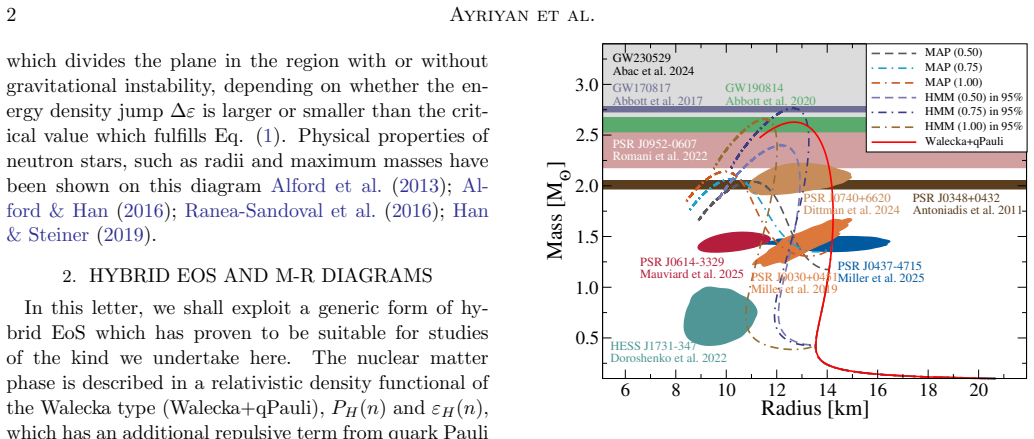
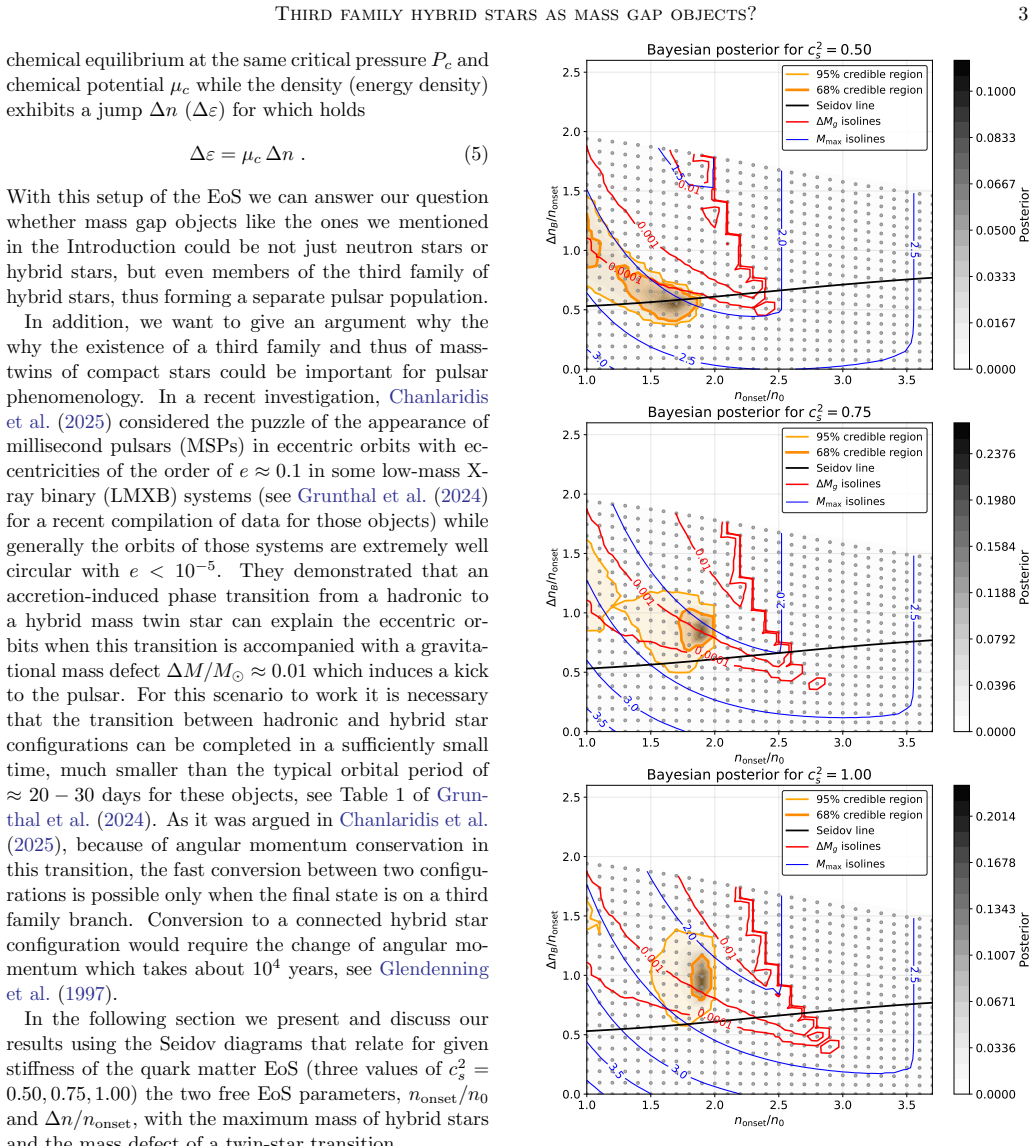
Mass-gap hybrid stars require an extremely early onset of deconfinement and very stiff quark matter. The Bayesian analysis, however, favors equations of state with deconfinement at typical neutron-star masses around 1.4 M_⊙ with mass-twin stars that, if confirmed, would rule out hybrid stars as candidates for observed mass-gap compact objects.
What carries the argument
A generic hybrid equation of state with a first-order deconfinement transition, mapped in a Seidov-type diagram and constrained by Bayesian inference on mass-radius data.
If this is right
- Confirmation of mass twins near 1.4 solar masses eliminates hybrid-star models for any compact object above 2.5 solar masses.
- The allowed region for mass-gap hybrids lies outside the posterior probability distribution obtained from current observations.
- Equations of state with very early deconfinement and stiff quark matter receive low posterior weight.
- Mass-gap objects, if they exist, cannot be explained by the same first-order transition physics that produces twins at lower masses.
Where Pith is reading between the lines
- Future radius measurements of stars near 1.4 solar masses could directly test whether the transition occurs early enough to allow or forbid mass-gap hybrids.
- The result implies that any confirmed mass-gap object is more likely a black hole or a different form of exotic matter without a strong first-order quark transition.
- The tension highlights how a single well-measured mass-radius pair at ordinary neutron-star masses can constrain the entire high-density phase diagram.
- Similar Bayesian mapping could be applied to other phase-transition models to check whether they also force mass-gap hybrids into disfavored corners.
Load-bearing premise
The chosen generic hybrid model with a sharp first-order transition represents all possible hybrid-star physics and that existing mass-radius data already exclude the required parameter region.
What would settle it
Precise confirmation of two stars with masses near 1.4 solar masses but measurably different radii, or the detection of a 3-solar-mass object whose radius and tidal deformability match a hybrid equation of state that lacks twins at 1.4 solar masses.
Figures
read the original abstract
We test whether compact objects in the so called mass gap ($2.5 < M_{\rm max}/M_\odot < 5.0$) can be hybrid stars. Using a generic hybrid equation of state with a first-order deconfinement transition, we map the allowed parameter space in a Seidov-type diagram and confront it with modern mass--radius constraints. We find that mass-gap hybrid stars require an extremely early onset of deconfinement and very stiff quark matter. The Bayesian analysis, however, favors equations of state with deconfinement at typical neutron-star masses around $1.4\,M_\odot$ with mass-twin stars that, if confirmed, would rule out hybrid stars as candidates for observed mass-gap compact objects.
Editorial analysis
A structured set of objections, weighed in public.
Referee Report
Summary. The paper maps the parameter space of a generic hybrid equation of state with a sharp first-order deconfinement transition in a Seidov-type diagram (onset density vs. energy-density jump) and confronts it with modern mass-radius constraints. It concludes that hybrid stars in the mass gap (2.5–5 M_⊙) require an extremely early onset of deconfinement together with stiff quark matter; a Bayesian analysis of the same model family instead favors deconfinement near 1.4 M_⊙, producing mass-twin stars whose confirmation would exclude hybrid stars as explanations for observed mass-gap compact objects.
Significance. If the central mapping and Bayesian preference hold within the adopted model class, the work supplies a falsifiable link between the existence of ~1.4 M_⊙ twins and the exclusion of hybrid stars from the mass-gap window, offering a concrete observational test with existing and forthcoming NICER and gravitational-wave data. The explicit Seidov-diagram exploration and use of current M-R constraints constitute a clear, reproducible step beyond purely qualitative arguments.
major comments (3)
- [§3] §3 (Bayesian analysis): the reported preference for deconfinement near 1.4 M_⊙ and the consequent twin-star branch are obtained from the posterior of the identical fit to the same mass-radius data used to exclude the mass-gap region; this renders the exclusion conditional on the model family rather than an independent test, weakening the claim that twins “rule out” mass-gap hybrids.
- [§2.1] §2.1 (model setup and Seidov diagram): the parameter-space mapping is performed exclusively for a constant-speed-of-sound quark-matter EoS with a sharp first-order transition; the title and abstract present the exclusion as applying to hybrid stars in general, yet the manuscript does not demonstrate that other constructions (density-dependent vector couplings, crossover transitions, or different high-density extrapolations) are unable to populate the mass-gap window while remaining consistent with the same M-R constraints.
- [Abstract and §4] Abstract and §4: the statement that mass-gap hybrids “require an extremely early onset … and very stiff quark matter” is derived from the boundaries of the allowed Seidov region, but the quantitative thresholds (onset density < 2 n_sat and c_s^2 > 0.8, for example) are not shown to be robust against reasonable variations in the nuclear-matter EoS or the precise mass-radius data selection.
minor comments (2)
- [Figure 3] Figure 3 (posterior contours): the 68 % and 95 % credible regions are plotted but the prior boundaries on the onset pressure and quark stiffness are not overlaid, making it difficult to judge how strongly the data pull away from the mass-gap corner.
- [§2] Notation: the symbol Δε/ε is used both for the Seidov jump and for the energy-density discontinuity at the transition; a brief clarifying sentence in §2 would remove ambiguity.
Simulated Author's Rebuttal
We thank the referee for the careful reading and constructive comments on our manuscript. We address each major comment below and indicate the revisions we will make to strengthen the presentation and clarify the scope of our results.
read point-by-point responses
-
Referee: [§3] §3 (Bayesian analysis): the reported preference for deconfinement near 1.4 M_⊙ and the consequent twin-star branch are obtained from the posterior of the identical fit to the same mass-radius data used to exclude the mass-gap region; this renders the exclusion conditional on the model family rather than an independent test, weakening the claim that twins “rule out” mass-gap hybrids.
Authors: We agree that the Bayesian posterior and the Seidov-diagram exclusion are obtained from the same mass-radius data within the same model family. The mapping identifies the narrow parameter region needed for mass-gap hybrids, while the posterior assigns low probability to that region, favoring instead the twin-star solutions near 1.4 M_⊙. The result is therefore conditional on the adopted class of hybrid EOS. We will revise the abstract, §3, and §4 to state explicitly that the exclusion of mass-gap hybrids by the twin-star branch holds within this model family, thereby removing any implication of an independent test. revision: yes
-
Referee: [§2.1] §2.1 (model setup and Seidov diagram): the parameter-space mapping is performed exclusively for a constant-speed-of-sound quark-matter EoS with a sharp first-order transition; the title and abstract present the exclusion as applying to hybrid stars in general, yet the manuscript does not demonstrate that other constructions (density-dependent vector couplings, crossover transitions, or different high-density extrapolations) are unable to populate the mass-gap window while remaining consistent with the same M-R constraints.
Authors: The analysis employs the constant-speed-of-sound parametrization because it permits a transparent exploration of the onset density and energy-density jump in the Seidov diagram while remaining consistent with a first-order transition. This is a standard and widely used approach for such mappings. We acknowledge that the title and abstract refer to “hybrid stars” without qualification. We will revise the title, abstract, and §2.1 to specify that the conclusions apply to hybrid stars with a sharp first-order deconfinement transition and constant-speed-of-sound quark matter. While a comprehensive survey of all alternative constructions lies beyond the scope of the present work, the CSS framework captures the essential features relevant to the mass-gap question. revision: yes
-
Referee: [Abstract and §4] Abstract and §4: the statement that mass-gap hybrids “require an extremely early onset … and very stiff quark matter” is derived from the boundaries of the allowed Seidov region, but the quantitative thresholds (onset density < 2 n_sat and c_s^2 > 0.8, for example) are not shown to be robust against reasonable variations in the nuclear-matter EoS or the precise mass-radius data selection.
Authors: The reported thresholds are obtained for the specific nuclear EoS and mass-radius data set adopted in the analysis. We will add a dedicated paragraph in §4 (and, if space permits, a short appendix) that tests the sensitivity of the Seidov boundaries to (i) alternative nuclear-matter parametrizations consistent with the same low-density constraints and (ii) subsets or alternative selections of the observational data. This will quantify the robustness of the quoted thresholds. revision: partial
Circularity Check
No circularity: Bayesian posterior on external M-R data is independent of the Seidov mapping
full rationale
The paper maps the hybrid EoS parameter space (onset density vs. density jump) in a Seidov diagram and directly confronts it with external observational mass-radius constraints. The Bayesian analysis is performed inside the same model family but uses those same external constraints to obtain a posterior; the favored region happens to lie at ~1.4 M_⊙ with twins. This is ordinary parameter inference, not a self-referential loop in which a fitted quantity is relabeled as an independent prediction or in which the central claim reduces to a definition or self-citation chain. No load-bearing step equates the output to the input by construction.
Axiom & Free-Parameter Ledger
free parameters (2)
- deconfinement onset density or pressure
- quark-matter stiffness parameter
axioms (1)
- domain assumption Hybrid stars are described by a generic EOS with a first-order deconfinement phase transition
Reference graph
Works this paper leans on
-
[1]
A strange star scenario for the formation of eccentric millisecond pulsar PSR J1946+3417
Jiang, Long and Wang, Na and Chen, Wen-Cong and Liu, Wei-Min and Leng, Chun-wei and Yuan, Jian-Ping and Qian, Xiang-Li. A strange star scenario for the formation of eccentric millisecond pulsar PSR J1946+3417. Res. Astron. Astrophys. 2021. doi:10.1088/1674-4527/21/9/231. arXiv:2106.05717
-
[2]
Serylak, M. and others. The eccentric millisecond pulsar, PSR J0955 - 6150 - I. Pulse profile analysis, mass measurements, and constraints on binary evolution. Astron. Astrophys. 2022. doi:10.1051/0004-6361/202142670. arXiv:2203.00607
-
[3]
PSR J1903+0327 : A Unique Milli-Second Pulsar with a Main-Sequence Companion Star
PSR J1903+0327: A Unique Millisecond Pulsar with a Main-sequence Companion Star. Astrophysics. J. , keywords =. doi:10.1088/0004-637X/744/2/183 , archivePrefix =. 1110.0507 , primaryClass =
work page internal anchor Pith review Pith/arXiv arXiv doi:10.1088/0004-637x/744/2/183
-
[4]
Einstein@Home Discovery of a PALFA Millisecond Pulsar in an Eccentric Binary Orbit
Knispel, B. and others. Einstein@Home Discovery of a PALFA Millisecond Pulsar in an Eccentric Binary Orbit. Astrophys. J. 2015. doi:10.1088/0004-637X/806/1/140. arXiv:1504.03684
work page internal anchor Pith review Pith/arXiv arXiv doi:10.1088/0004-637x/806/1/140 2015
-
[5]
Zhu, W. W. and others. Mass measurements for two binary pulsars discovered in the PALFA survey. Astrophys. J. 2019. doi:10.3847/1538-4357/ab2bef. arXiv:1907.05046
-
[6]
Grunthal, K. and others. Triple trouble with PSR J1618 - 3921: Mass measurements and orbital dynamics of an eccentric millisecond pulsar. Astron. Astrophys. 2024. doi:10.1051/0004-6361/202347482. arXiv:2409.03615
-
[7]
Blaschke, David and Grigorian, Hovik and R. Chirally improved quark Pauli blocking in nuclear matter and applications to quark deconfinement in neutron stars. Particles. 2020. doi:10.3390/particles3020033. arXiv:2005.10218
-
[8]
Contrera, G. A. and Blaschke, D. and Carlomagno, J. P. and Grunfeld, A. G. and Liebing, S. Quark-nuclear hybrid equation of state for neutron stars under modern observational constraints. Phys. Rev. C. 2022. doi:10.1103/PhysRevC.105.045808. arXiv:2201.00477
-
[9]
Revisiting the Rhoades-Ruffini bound
Blaschke, David and Wojcik, Adrian. Revisiting the Rhoades-Ruffini bound. 2026. arXiv:2604.03204
work page internal anchor Pith review Pith/arXiv arXiv 2026
-
[10]
A NICER View of the 1.4 M _ ⊙ Edge-on Pulsar PSR J0614-3329
Mauviard, Lucien and others. A NICER View of the 1.4 M _ ⊙ Edge-on Pulsar PSR J0614-3329. Astrophys. J. 2025. doi:10.3847/1538-4357/ae145d. arXiv:2506.14883
-
[11]
Miller, M. C. and others. The Radius of PSR J0437 4715 from NICER Data. Astrophys. J. Lett. 2026. doi:10.3847/2041-8213/ae5057. arXiv:2512.08790
work page internal anchor Pith review Pith/arXiv arXiv doi:10.3847/2041-8213/ae5057 2026
-
[12]
Signal of Quark Deconfinement in the Timing Structure of Pulsar Spin-Down
Glendenning, Norman K. and Pei, S. and Weber, F. Signal of quark deconfinement in the timing structure of pulsar spindown. Phys. Rev. Lett. 1997. doi:10.1103/PhysRevLett.79.1603. arXiv:astro-ph/9705235
work page internal anchor Pith review Pith/arXiv arXiv doi:10.1103/physrevlett.79.1603 1997
-
[13]
Abbott, R. and others. GW190814: Gravitational Waves from the Coalescence of a 23 Solar Mass Black Hole with a 2.6 Solar Mass Compact Object. Astrophys. J. Lett. 2020. doi:10.3847/2041-8213/ab960f. arXiv:2006.12611
work page internal anchor Pith review Pith/arXiv arXiv doi:10.3847/2041-8213/ab960f 2020
-
[14]
Abac, A. G. and others. Observation of Gravitational Waves from the Coalescence of a 2.5 4.5 M _ ⊙ Compact Object and a Neutron Star. Astrophys. J. Lett. 2024. doi:10.3847/2041-8213/ad5beb. arXiv:2404.04248
-
[15]
Abbott, B. P. and others. GW170817: Observation of Gravitational Waves from a Binary Neutron Star Inspiral. Phys. Rev. Lett. 2017. doi:10.1103/PhysRevLett.119.161101. arXiv:1710.05832
work page internal anchor Pith review Pith/arXiv arXiv doi:10.1103/physrevlett.119.161101 2017
-
[16]
Equation of State at Supranuclear Densities and the Existence of a Third Family of Superdense Stars
Gerlach, Ulrich H. Equation of State at Supranuclear Densities and the Existence of a Third Family of Superdense Stars. Phys. Rev. 1968. doi:10.1103/PhysRev.172.1325
-
[17]
Upper bound on the speed of sound in nuclear matter from transport
Hippert, Mauricio and Noronha, Jorge and Romatschke, Paul. Upper bound on the speed of sound in nuclear matter from transport. Phys. Lett. B. 2025. doi:10.1016/j.physletb.2024.139184. arXiv:2402.14085
-
[18]
Impact of massive neutron star radii on the nature of phase transitions in dense matter
Somasundaram, Rahul and Margueron, J \'e r \^o me. Impact of massive neutron star radii on the nature of phase transitions in dense matter. EPL. 2022. doi:10.1209/0295-5075/ac63de. arXiv:2104.13612
-
[19]
Rhoades, Jr., Clifford E. and Ruffini, Remo. Maximum mass of a neutron star. Phys. Rev. Lett. 1974. doi:10.1103/PhysRevLett.32.324
-
[20]
Quark Pauli principle and the transmutation of nuclear matter
McLerran, Larry and Miller, Gerald A. Quark Pauli principle and the transmutation of nuclear matter. Phys. Rev. C. 2024. doi:10.1103/PhysRevC.110.045203. arXiv:2405.11074
-
[21]
Koch, Volker and McLerran, Larry and Miller, Gerald A. and Vovchenko, Volodymyr. Examining the possibility that normal nuclear matter is quarkyonic. Phys. Rev. C. 2024. doi:10.1103/PhysRevC.110.025201. arXiv:2403.15375
-
[22]
Ayriyan, Alexander and Blaschke, David and Carlomagno, Juan Pablo and Contrera, Gustavo A. and Grunfeld, Ana Gabriela. Bayesian Analysis of Hybrid Neutron Star EOS Constraints Within an Instantaneous Nonlocal Chiral Quark Matter Model. Universe. 2025. doi:10.3390/universe11050141. arXiv:2501.00115
-
[23]
Bayesian inference favors quark matter in neutron star interiors
Ayriyan, Alexander and Ivanytskyi, Oleksii and Blaschke, David. Bayesian inference favors quark matter in neutron star interiors. 2025. arXiv:2509.02554
work page internal anchor Pith review Pith/arXiv arXiv 2025
-
[24]
Hyperon-mixed neutron star with universal many-body repulsion
Yamamoto, Y. and Furumoto, T. and Yasutake, N. and Rijken, Th. A. Hyperon-mixed neutron star with universal many-body repulsion. Eur. Phys. J. A. 2016. doi:10.1140/epja/i2016-16019-0. arXiv:1510.06099
work page internal anchor Pith review Pith/arXiv arXiv doi:10.1140/epja/i2016-16019-0 2016
-
[25]
The Stability of a Star with a Phase Change in General Relativity Theory. Sov. Astron. , year = 1971, month = oct, volume =
1971
-
[26]
Chanlaridis, S. and Ohse, D. and Alvarez-Castillo, D. E. and Antoniadis, J. and Blaschke, D. and Danchev, V. and Langer, N. and Misra, D. Formation of twin compact stars in low-mass X-ray binaries - Implications for eccentric and isolated millisecond pulsar populations. Astron. Astrophys. 2025. doi:10.1051/0004-6361/202452259. arXiv:2409.04755
-
[27]
Generic conditions for stable hybrid stars
Alford, Mark G. and Han, Sophia and Prakash, Madappa. Generic conditions for stable hybrid stars. Phys. Rev. D. 2013. doi:10.1103/PhysRevD.88.083013. arXiv:1302.4732
work page internal anchor Pith review Pith/arXiv arXiv doi:10.1103/physrevd.88.083013 2013
-
[28]
Characteristics of hybrid compact stars with a sharp hadron-quark interface
Alford, Mark G. and Han, Sophia. Characteristics of hybrid compact stars with a sharp hadron-quark interface. Eur. Phys. J. A. 2016. doi:10.1140/epja/i2016-16062-9. arXiv:1508.01261
work page internal anchor Pith review Pith/arXiv arXiv doi:10.1140/epja/i2016-16062-9 2016
-
[29]
and Han, Sophia and Schwenzer, Kai
Alford, Mark G. and Han, Sophia and Schwenzer, Kai. Signatures for quark matter from multi-messenger observations. J. Phys. G. 2019. doi:10.1088/1361-6471/ab337a. arXiv:1904.05471
-
[30]
Ranea-Sandoval, Ignacio F. and Orsaria, Milva G. and Han, Sophia and Weber, Fridolin and Spinella, William M. Color superconductivity in compact stellar hybrid configurations. Phys. Rev. C. 2017. doi:10.1103/PhysRevC.96.065807
-
[31]
The Constant-Sound-Speed parameterization for NJL models of quark matter in hybrid stars
Ranea-Sandoval, Ignacio F. and Han, Sophia and Orsaria, Milva G. and Contrera, Gustavo A. and Weber, Fridolin and Alford, Mark G. Constant-sound-speed parametrization for Nambu Jona-Lasinio models of quark matter in hybrid stars. Phys. Rev. C. 2016. doi:10.1103/PhysRevC.93.045812. arXiv:1512.09183
work page internal anchor Pith review Pith/arXiv arXiv doi:10.1103/physrevc.93.045812 2016
-
[32]
Tidal deformability with sharp phase transitions in (binary) neutron stars
Han, Sophia and Steiner, Andrew W. Tidal deformability with sharp phase transitions in (binary) neutron stars. Phys. Rev. D. 2019. doi:10.1103/PhysRevD.99.083014. arXiv:1810.10967
work page internal anchor Pith review Pith/arXiv arXiv doi:10.1103/physrevd.99.083014 2019
-
[33]
Tang, Shao-Peng and Huang, Yong-Jia and Fan, Yi-Zhong. Phase transition and nuclear symmetry energy from neutron star observations: Constraints in light of PSR J0614-3329. Phys. Rev. D. 2025. doi:10.1103/bmsk-8n85. arXiv:2507.10025
-
[34]
Strong model-agnostic constraints for twin-star solutions
Blomqvist, Sofia and Ecker, Christian and Gorda, Tyler and Vuorinen, Aleksi. Strong model-agnostic constraints for twin-star solutions. 2025. arXiv:2512.19477
-
[35]
Fortin, M. and Raduta, Adriana R. and Avancini, Sidney and Provid\^encia, Constan c a. Relativistic hypernuclear compact stars with calibrated equations of state. Phys. Rev. D. 2020. doi:10.1103/PhysRevD.101.034017. arXiv:2001.08036
-
[36]
Ho, Wynn C. G. and Elshamouty, Khaled G. and Heinke, Craig O. and Potekhin, Alexander Y. Tests of the nuclear equation of state and superfluid and superconducting gaps using the Cassiopeia A neutron star. Phys. Rev. C. 2015. doi:10.1103/PhysRevC.91.015806. arXiv:1412.7759
work page internal anchor Pith review Pith/arXiv arXiv doi:10.1103/physrevc.91.015806 2015
-
[37]
Tsiopelas, Stefanos and Sagun, Violetta. Thermal evolution of neutron stars described within the equation of state with induced surface tension. Astron. Nachr. 2021. doi:10.1002/asna.202113929
-
[38]
Neutron star cooling within the equation of state with induced surface tension
Tsiopelas, Stefanos and Sagun, Violetta. Neutron star cooling within the equation of state with induced surface tension. Particles. 2020. doi:10.3390/particles3040045. arXiv:2006.06351
-
[39]
Progress of Theoretical Physics , volume =
Takatsuka, Tatsuyuki , title = ". Progress of Theoretical Physics , volume =. 1972 , month =. doi:10.1143/PTP.48.1517 , url =
-
[40]
The impact of magnetic field on the thermal evolution of neutron stars
Aguilera, Deborah N. and Pons, Jose A. and Miralles, Juan A. The impact of magnetic field on the thermal evolution of neutron stars. Astrophys. J. Lett. 2008. doi:10.1086/527547. arXiv:0712.1353
work page internal anchor Pith review Pith/arXiv arXiv doi:10.1086/527547 2008
-
[41]
Cooling of Accretion-Heated Neutron Stars
Wijnands, Rudy and Degenaar, Nathalie and Page, Dany. Cooling of Accretion-Heated Neutron Stars. J. Astrophys. Astron. 2017. doi:10.1007/s12036-017-9466-5. arXiv:1709.07034
work page internal anchor Pith review Pith/arXiv arXiv doi:10.1007/s12036-017-9466-5 2017
-
[43]
Abbott, B. P. and others. GW190425: Observation of a Compact Binary Coalescence with Total Mass 3.4 M_. Astrophys. J. Lett. 2020. doi:10.3847/2041-8213/ab75f5. arXiv:2001.01761
-
[44]
Raaijmakers, G. and Greif, S. K. and Hebeler, K. and Hinderer, T. and Nissanke, S. and Schwenk, A. and Riley, T. E. and Watts, A. L. and Lattimer, J. M. and Ho, W. C. G. Constraints on the Dense Matter Equation of State and Neutron Star Properties from NICER s Mass Radius Estimate of PSR J0740+6620 and Multimessenger Observations. Astrophys. J. Lett. 2021...
-
[45]
Riley, Thomas E. and others. A NICER View of PSR J0030+0451: Millisecond Pulsar Parameter Estimation. Astrophys. J. Lett. 2019. doi:10.3847/2041-8213/ab481c. arXiv:1912.05702
-
[46]
Miller, M. C. and others. PSR J0030+0451 Mass and Radius from NICER Data and Implications for the Properties of Neutron Star Matter. Astrophys. J. Lett. 2019. doi:10.3847/2041-8213/ab50c5. arXiv:1912.05705
work page internal anchor Pith review Pith/arXiv arXiv doi:10.3847/2041-8213/ab50c5 2019
-
[47]
Miller, M. C. and others. The Radius of PSR J0740+6620 from NICER and XMM-Newton Data. Astrophys. J. Lett. 2021. doi:10.3847/2041-8213/ac089b. arXiv:2105.06979
work page internal anchor Pith review Pith/arXiv arXiv doi:10.3847/2041-8213/ac089b 2021
-
[48]
Raaijmakers, G. and others. Constraining the dense matter equation of state with joint analysis of NICER and LIGO/Virgo measurements. Astrophys. J. Lett. 2020. doi:10.3847/2041-8213/ab822f. arXiv:1912.11031
-
[49]
A Massive Pulsar in a Compact Relativistic Binary
Antoniadis, John and others. A Massive Pulsar in a Compact Relativistic Binary. Science. 2013. doi:10.1126/science.1233232. arXiv:1304.6875
work page internal anchor Pith review Pith/arXiv arXiv doi:10.1126/science.1233232 2013
-
[50]
Romani, Roger W. and Kandel, D. and Filippenko, Alexei V. and Brink, Thomas G. and Zheng, WeiKang. PSR J1810+1744: Companion Darkening and a Precise High Neutron Star Mass. Astrophys. J. Lett. 2021. doi:10.3847/2041-8213/abe2b4. arXiv:2101.09822
-
[51]
Romani, Roger W. and Kandel, D. and Filippenko, Alexei V. and Brink, Thomas G. and Zheng, WeiKang. PSR J0952 - 0607: The Fastest and Heaviest Known Galactic Neutron Star. Astrophys. J. Lett. 2022. doi:10.3847/2041-8213/ac8007. arXiv:2207.05124
-
[52]
Riley, Thomas E. and others. A NICER View of the Massive Pulsar PSR J0740+6620 Informed by Radio Timing and XMM-Newton Spectroscopy. Astrophys. J. Lett. 2021. doi:10.3847/2041-8213/ac0a81. arXiv:2105.06980
-
[53]
Abbott, B. P. and others. GW170817: Measurements of neutron star radii and equation of state. Phys. Rev. Lett. 2018. doi:10.1103/PhysRevLett.121.161101. arXiv:1805.11581
work page internal anchor Pith review Pith/arXiv arXiv doi:10.1103/physrevlett.121.161101 2018
-
[54]
and Suleimanov, V
Doroshenko, V. and Suleimanov, V. and Pühlhofer, G. and et al. , doi =. 2022 , Journal =
2022
-
[55]
Beznogov, M. V. and Yakovlev, D. G. Statistical theory of thermal evolution of neutron stars. Mon. Not. Roy. Astron. Soc. 2015. doi:10.1093/mnras/stu2506. arXiv:1411.6803
work page internal anchor Pith review Pith/arXiv arXiv doi:10.1093/mnras/stu2506 2015
-
[56]
Lattimer, J. M. and Prakash, M. and Pethick, C. J. and Haensel, P. Direct URCA process in neutron stars. Phys. Rev. Lett. 1991. doi:10.1103/PhysRevLett.66.2701
-
[57]
What Is the Nature of the HESS J1731-347 Compact Object?
Sagun, Violetta and Giangrandi, Edoardo and Dietrich, Tim and Ivanytskyi, Oleksii and Negreiros, Rodrigo and Provid\^encia, Constan c a. What Is the Nature of the HESS J1731-347 Compact Object?. Astrophys. J. 2023. doi:10.3847/1538-4357/acfc9e. arXiv:2306.12326
-
[59]
Potekhin, A. Y. and Chabrier, G. Magnetic neutron star cooling and microphysics. Astron. Astrophys. 2018. doi:10.1051/0004-6361/201731866. arXiv:1711.07662
work page internal anchor Pith review Pith/arXiv arXiv doi:10.1051/0004-6361/201731866 2018
-
[60]
2D Cooling of Magnetized Neutron Stars
Aguilera, Deborah N. and Pons, Jose A. and Miralles, Juan A. 2D Cooling of Magnetized Neutron Stars. Astron. Astrophys. 2008. doi:10.1051/0004-6361:20078786. arXiv:0710.0854
work page internal anchor Pith review Pith/arXiv arXiv doi:10.1051/0004-6361:20078786 2008
-
[61]
Pons, J. A. and Miralles, J. A. and Geppert, U. Magneto--thermal evolution of neutron stars. Astron. Astrophys. 2009. doi:10.1051/0004-6361:200811229. arXiv:0812.3018
work page internal anchor Pith review Pith/arXiv arXiv doi:10.1051/0004-6361:200811229 2009
-
[62]
Baiko, D. A. and Yakovlev, D. G. Direct urca process in strong magnetic fields and neutron star cooling. Astron. Astrophys. 1999. arXiv:astro-ph/9812071
work page internal anchor Pith review Pith/arXiv arXiv 1999
-
[63]
Geppert, U. and Urpin, V. , title = ". Monthly Notices of the Royal Astronomical Society , volume =. 1994 , month =. doi:10.1093/mnras/271.2.490 , url =
-
[65]
Blaschke, D. and Grigorian, H. and Voskresensky, D. N. Nuclear medium cooling scenario in the light of new Cas A cooling data and the 2 M_ pulsar mass measurements. Phys. Rev. C. 2013. doi:10.1103/PhysRevC.88.065805. arXiv:1308.4093
work page internal anchor Pith review Pith/arXiv arXiv doi:10.1103/physrevc.88.065805 2013
-
[66]
Dense Matter in Compact Stars: Theoretical Developments and Observational Constraints
Page, Dany and Reddy, Sanjay. Dense Matter in Compact Stars: Theoretical Developments and Observational Constraints. Ann. Rev. Nucl. Part. Sci. 2006. doi:10.1146/annurev.nucl.56.080805.140600. arXiv:astro-ph/0608360
-
[67]
Page, Dany and Geppert, Ulrich and Weber, Fridolin. The Cooling of compact stars. Nucl. Phys. A. 2006. doi:10.1016/j.nuclphysa.2005.09.019. arXiv:astro-ph/0508056
work page internal anchor Pith review Pith/arXiv arXiv doi:10.1016/j.nuclphysa.2005.09.019 2006
-
[68]
Ho, Wynn C. G. and Heinke, Craig O. A Neutron Star with a Carbon Atmosphere in the Cassiopeia A Supernova Remnant. Nature. 2009. doi:10.1038/nature08525. arXiv:0911.0672
work page internal anchor Pith review Pith/arXiv arXiv doi:10.1038/nature08525 2009
-
[69]
Bardeen, John and Cooper, L. N. and Schrieffer, J. R. Theory of superconductivity. Phys. Rev. 1957. doi:10.1103/PhysRev.108.1175
-
[70]
Potekhin, A. Y. and Pons, J. A. and Page, Dany. Neutron stars - cooling and transport. Space Sci. Rev. 2015. doi:10.1007/s11214-015-0180-9. arXiv:1507.06186
work page internal anchor Pith review Pith/arXiv arXiv doi:10.1007/s11214-015-0180-9 2015
-
[71]
Lattimer, James M. and van Riper, Kenneth A. and Prakash, Madappa and Prakash, Manju. Rapid cooling and the structure of neutron stars. Astrophys. J. 1994. doi:10.1086/174025
-
[72]
Negele, John W. and Vautherin, D. Neutron star matter at subnuclear densities. Nucl. Phys. A. 1973. doi:10.1016/0375-9474(73)90349-7
-
[73]
and Zdunik, J
Haensel, P. and Zdunik, J. L. Non-equilibrium processes in the crust of an accreting neutron star. Astron. and Astrophys. 1990
1990
-
[74]
The Equation of State for the Nucleonic and Hyperonic Core of Neutron Stars
Tolos, Laura and Centelles, Mario and Ramos, Angels. The Equation of State for the Nucleonic and Hyperonic Core of Neutron Stars. Publ. Astron. Soc. Austral. 2017. doi:10.1017/pasa.2017.60. arXiv:1708.08681
work page internal anchor Pith review Pith/arXiv arXiv doi:10.1017/pasa.2017.60 2017
-
[75]
NSCool: Neutron star cooling code
-
[76]
Strangeness in Neutron Star Cooling
Lim, Yeunhwan and Hyun, Chang Ho and Lee, Chang-Hwan. Strangeness in Neutron Star Cooling. J. Korean Phys. Soc. 2019. doi:10.3938/jkps.74.547. arXiv:1608.02078
work page internal anchor Pith review Pith/arXiv arXiv doi:10.3938/jkps.74.547 2019
-
[77]
Roles of Hyperons in Neutron Stars
Balberg, Shmuel and Lichtenstadt, Itamar and Cook, Gregory B. Roles of hyperons in neutron stars. Astrophys. J. Suppl. 1999. doi:10.1086/313196. arXiv:astro-ph/9810361
work page internal anchor Pith review Pith/arXiv arXiv doi:10.1086/313196 1999
-
[78]
Sagun, V. and Giangrandi, E. and Ivanytskyi, O. and Lopes, I. and Bugaev, K. A. Constraints on the fermionic dark matter from observations of neutron stars. PoS. 2022. doi:10.22323/1.380.0313. arXiv:2111.13289
-
[79]
Schwenk, Achim and Friman, Bengt and Brown, Gerald E. Renormalization group approach to neutron matter: Quasiparticle interactions, superfluid gaps and the equation of state. Nucl. Phys. A. 2003. doi:10.1016/S0375-9474(02)01290-3. arXiv:nucl-th/0207004
work page internal anchor Pith review Pith/arXiv arXiv doi:10.1016/s0375-9474(02)01290-3 2003
-
[80]
Chen, J. M. C. and Clark, J. W. and Dav\'e, R. D. and Khodel, V. V. Pairing gaps in nucleonic superfluids. Nucl. Phys. A. 1993. doi:10.1016/0375-9474(93)90314-N
-
[81]
Dittmann, Alexander J. and others. A More Precise Measurement of the Radius of PSR J0740+6620 Using Updated NICER Data. Astrophys. J. 2024. doi:10.3847/1538-4357/ad5f1e. arXiv:2406.14467
-
[82]
Shternin, Peter S. and Yakovlev, Dmitry G. and Heinke, Craig O. and Ho, Wynn C. G. and Patnaude, Daniel J. Cooling neutron star in the Cassiopeia A supernova remnant: Evidence for superfluidity in the core. Mon. Not. Roy. Astron. Soc. 2011. doi:10.1111/j.1745-3933.2011.01015.x. arXiv:1012.0045
-
[83]
Amundsen, L. and Ostgaard, E. Superfluidity of neutron matter (II). triplet pairing. Nucl. Phys. A. 1985. doi:10.1016/S0375-9474(85)80012-9
discussion (0)
Sign in with ORCID, Apple, or X to comment. Anyone can read and Pith papers without signing in.