Native-resolution retrievals of VHS 1256-1257 b spanning the JWST/NIRSpec wavelength range: Chemical composition of a partially cloudy atmosphere
Pith reviewed 2026-07-02 05:33 UTC · model grok-4.3
The pith
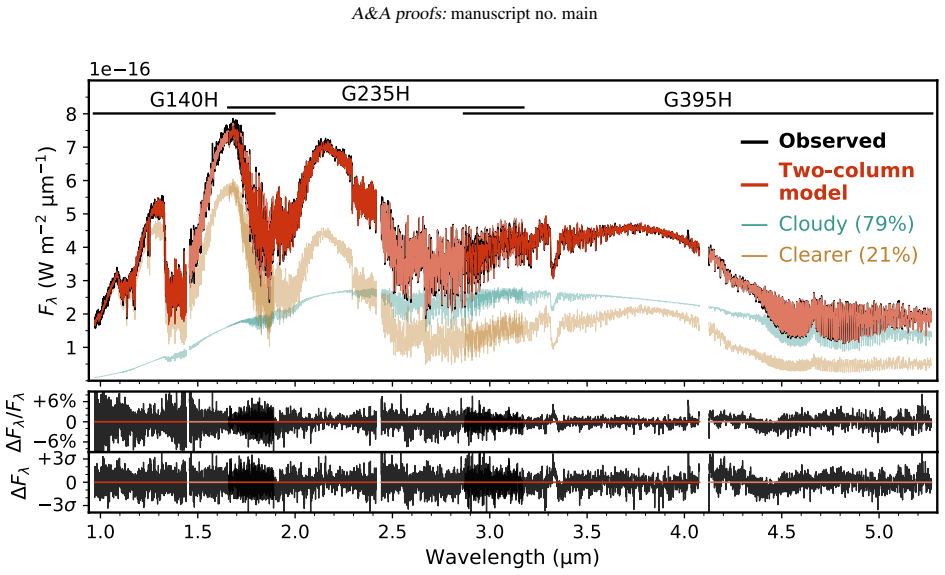
JWST native-resolution retrievals match VHS 1256 b spectra to 1% residuals with a 79% partial cloud deck and near-solar composition except depleted 18O
A machine-rendered reading of the paper's core claim, the machinery that carries it, and where it could break.
Core claim
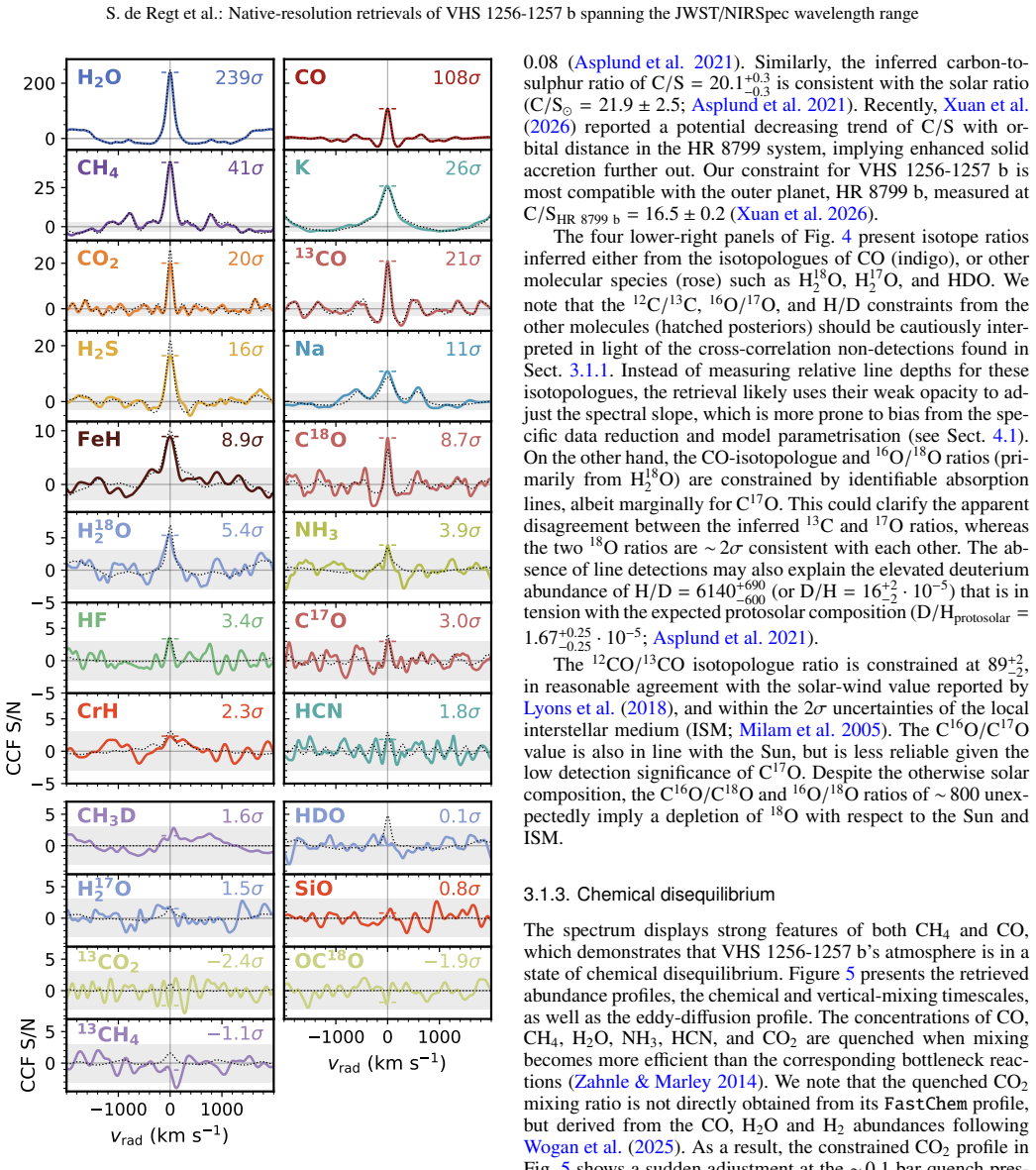
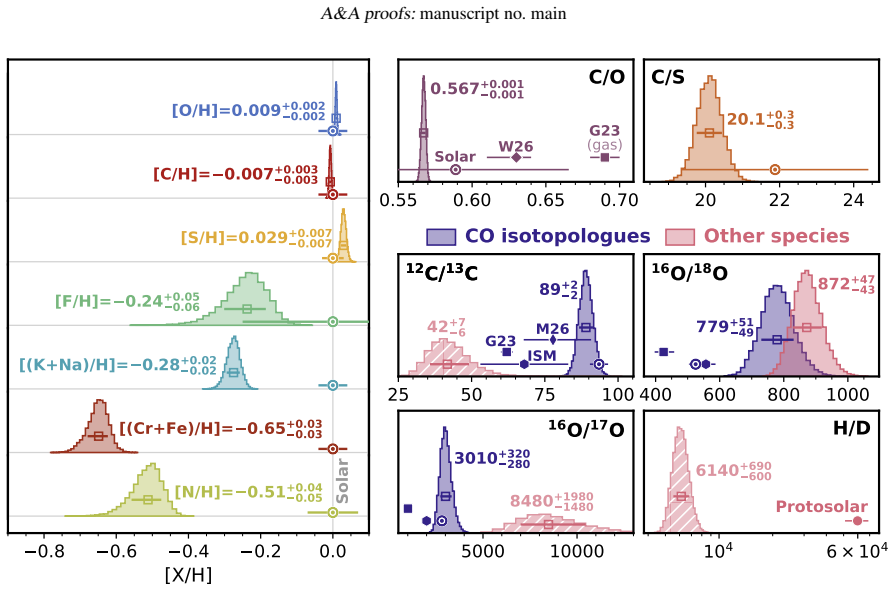
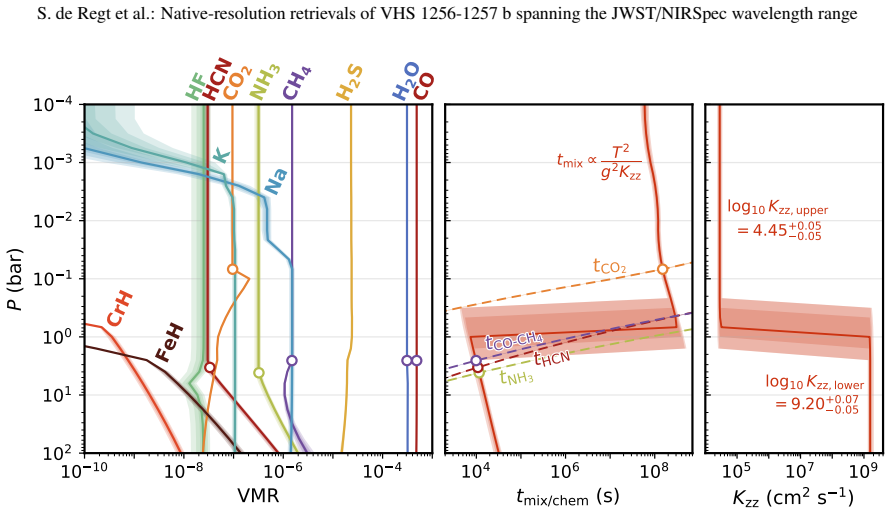
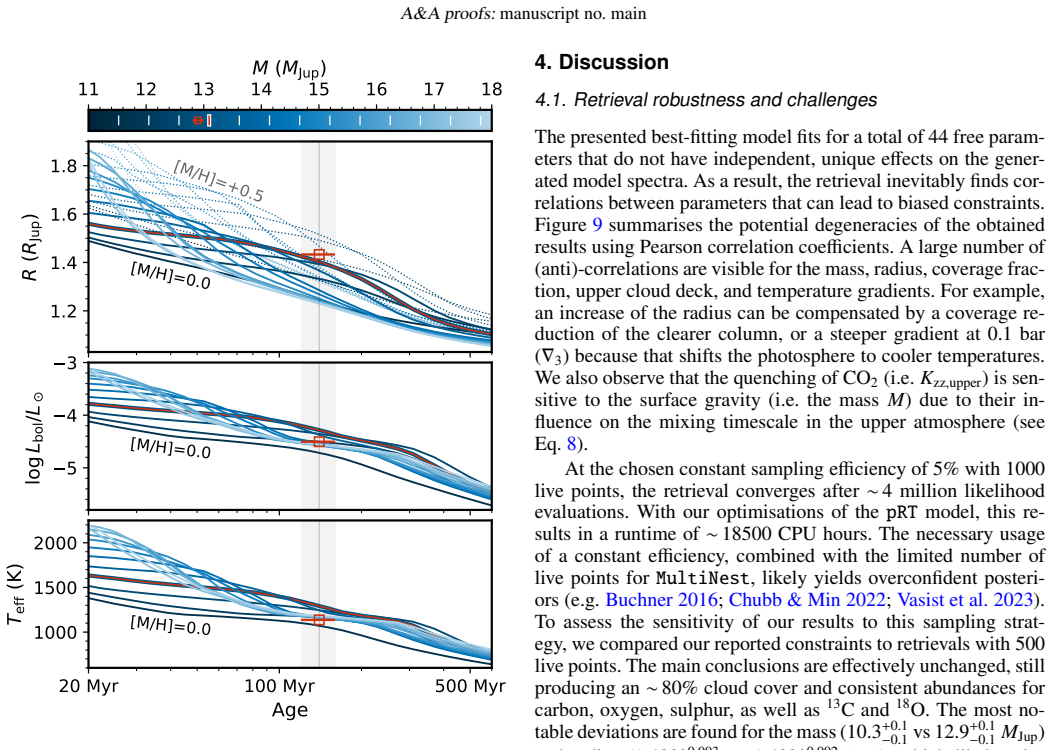
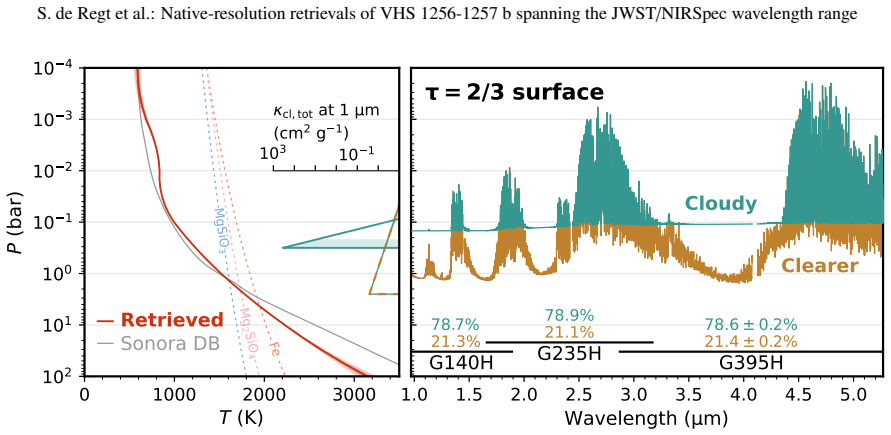
Our best-fitting model closely matches the observations, bringing the residuals down to ~1%. The retrieval finds a partial cloud deck covering ~79% of the visible surface, with a clearer column dominating at short wavelengths. From the many detected gases, we infer a metallicity, C/O ratio, and 12C/13C ratio in line with a solar composition, while the 18O isotope appears depleted relative to the Sun and local ISM. The isotope abundances are significantly lower than previous studies suggested, underlining the importance of our updated spectra.
What carries the argument
petitRADTRANS retrievals at native spectral resolution of a partially cloudy atmosphere in chemical disequilibrium, directly fitting for elemental and isotopic abundances
If this is right
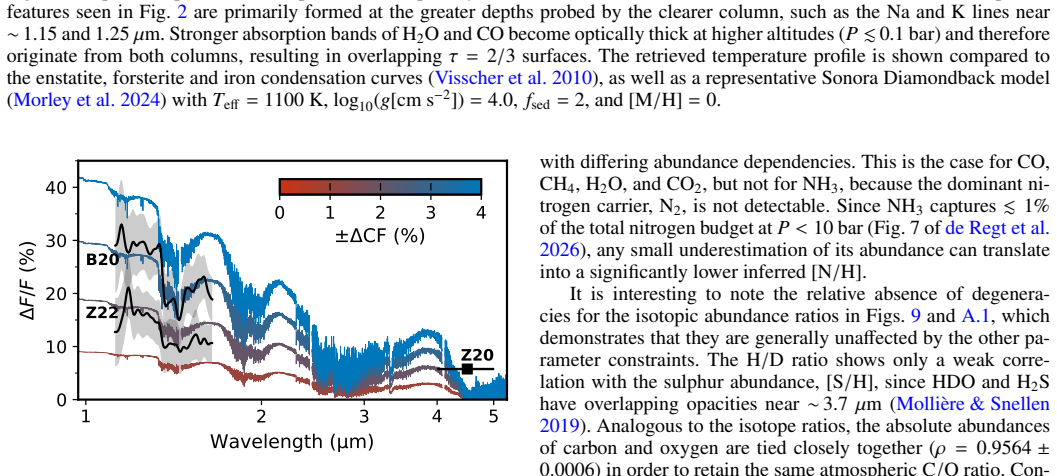
- Small 1-3% changes in cloud properties can explain the object's observed 10-30% flux variability.
- Retrieved isotope abundances fall significantly below values from earlier studies, showing the effect of the updated data reduction.
- The 18O depletion challenges expectations for top-down formation of the companion.
- Lack of host-star abundance measurements limits direct comparison of the retrieved composition to the formation environment.
Where Pith is reading between the lines
- If the 18O depletion persists under refined models, formation theories may need to incorporate differential isotope incorporation during accretion.
- Applying the same native-resolution approach to other highly variable sub-stellar companions could map how cloud and composition properties correlate with variability amplitude.
- Obtaining host-star elemental and isotopic abundances would supply the missing reference frame for interpreting the companion's composition.
Load-bearing premise
The petitRADTRANS forward model with partial clouds and chemical disequilibrium accurately captures the true atmospheric structure without significant bias from parameter degeneracies or updated data reduction steps.
What would settle it
Independent mass or radius measurements lying outside the ranges permitted by the retrieval degeneracies, or new spectra that show no 18O depletion relative to solar values.
Figures
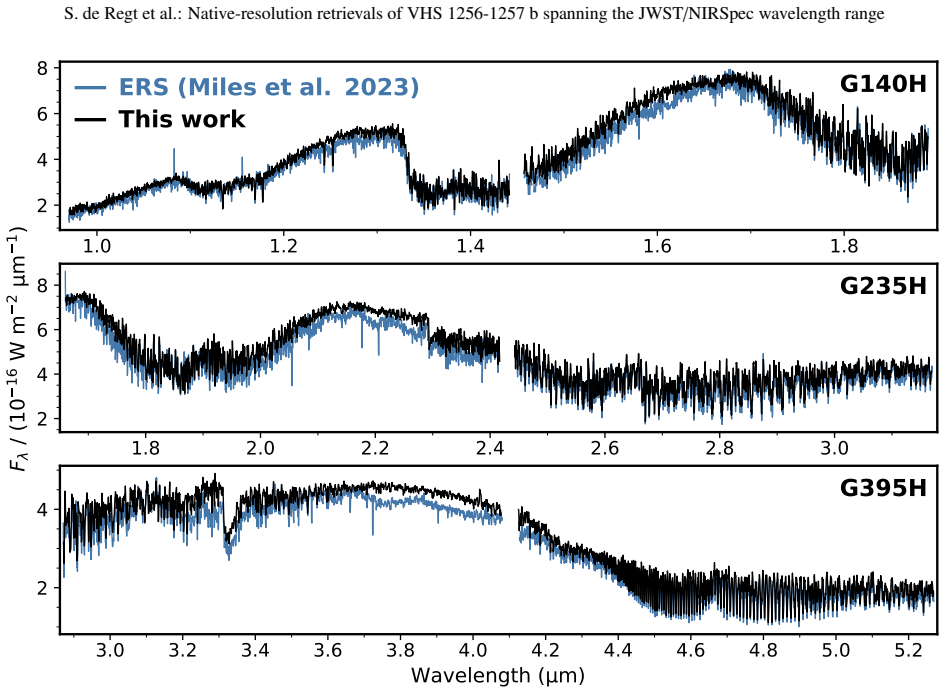
read the original abstract
The wide wavelength coverage and sensitivity offered by JWST enable detailed analyses of extrasolar atmospheres. At its highest resolution (R~2700), NIRSpec measures the absorption from atomic, molecular, and isotopic gases whose abundances reflect the chemical composition of accreted material, making them key tracers of the formation environment. Orbiting an inner M-dwarf binary at a wide separation, the planetary-mass companion VHS 1256 b is one of the most variable sub-stellar objects known, with flux variations of 10-30%. We analyse the 0.97-5.27 micron NIRSpec ERS spectra of VHS 1256 b, update the data reduction and employ petitRADTRANS for atmospheric retrievals at the native spectral resolution. We model a partially cloudy atmosphere in chemical disequilibrium and fit directly for the elemental and isotopic abundances. Our best-fitting model closely matches the observations, bringing the residuals down to ~1%. The results are cautiously interpreted as degeneracies can bias some parameter constraints, most notably the mass and radius. Still, the retrieval finds a partial cloud deck covering ~79% of the visible surface, with a clearer column dominating at short wavelengths. Small changes of 1-3% can account for the high observed variability. From the many detected gases, we infer a metallicity, C/O ratio, and 12C/13C ratio in line with a solar composition, while the 18O isotope appears depleted relative to the Sun and local ISM. The isotope abundances are significantly lower than previous studies suggested, underlining the importance of our updated spectra. The 18O-depletion defies our understanding of the likely top-down formation. Our interpretation of the retrieved composition is complicated further by the lack of host star abundances. Nevertheless, this study demonstrates the value of panchromatic, native-resolution retrievals for characterising complex extrasolar atmospheres.
Editorial analysis
A structured set of objections, weighed in public.
Referee Report
Summary. The manuscript presents native-resolution (R~2700) atmospheric retrievals of the planetary-mass companion VHS 1256 b using updated JWST/NIRSpec ERS spectra spanning 0.97-5.27 microns. The authors employ petitRADTRANS to model a partially cloudy atmosphere in chemical disequilibrium, fitting directly for elemental abundances, isotopic ratios, cloud coverage (~79%), and T-P profile parameters. The best-fit model achieves ~1% residuals; the retrieval yields solar-like metallicity, C/O, and 12C/13C while reporting 18O depletion relative to solar and local ISM values, with the result interpreted cautiously due to noted degeneracies in mass/radius and missing host-star abundances.
Significance. If the 18O depletion holds after additional validation, the result would be noteworthy for challenging top-down formation expectations and for demonstrating the diagnostic power of panchromatic native-resolution retrievals on variable, cloudy atmospheres. The low residuals and detection of multiple gases are strengths, but the central isotopic claim rests on model assumptions whose robustness is not fully quantified in the current analysis.
major comments (2)
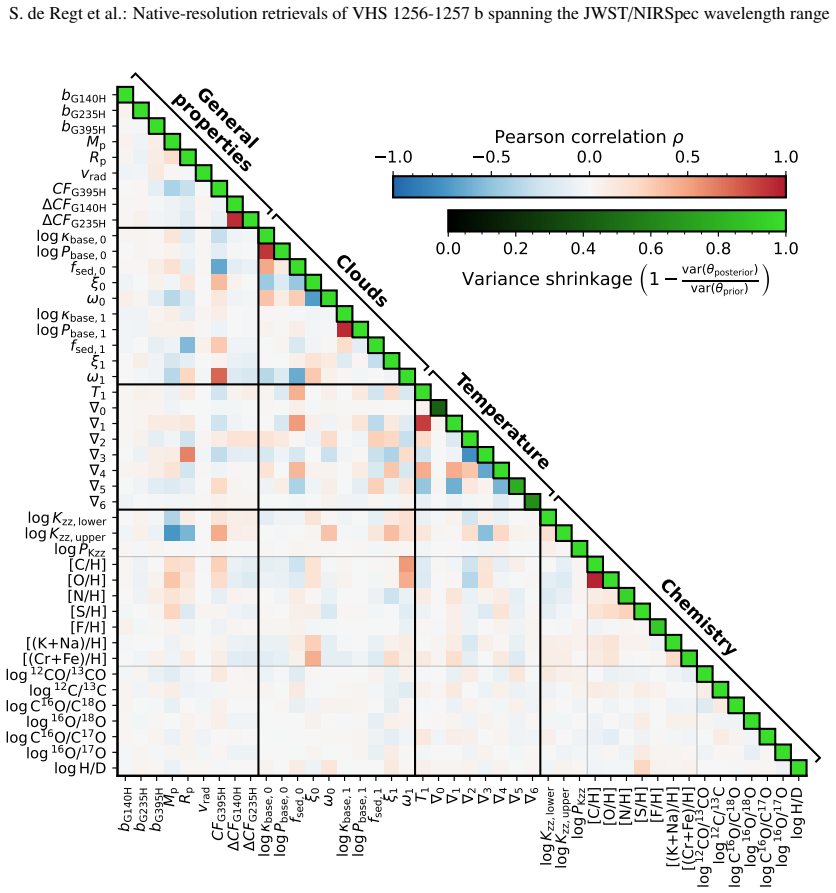
- [Results / retrieval analysis] The 18O depletion inference (abstract and results) is load-bearing for the headline claim yet lacks explicit sensitivity tests; the manuscript does not show how 1-3% changes in the updated NIRSpec reduction or fixed mass/radius values (explicitly flagged as degenerate) propagate into the retrieved 18O/16O ratio.
- [Methods / retrieval setup] The forward-model assumptions (petitRADTRANS partial-cloud disequilibrium chemistry) are stated to capture the spectrum to ~1%, but no quantitative assessment is given of whether parameter degeneracies (noted for mass/radius) bias the fitted isotopic abundances that drive the depletion conclusion.
minor comments (1)
- [Abstract] Clarify in the abstract and discussion whether the reported 'solar composition' for metallicity and C/O is a direct fit result or a post-hoc comparison, to avoid any appearance of circularity in the interpretation.
Simulated Author's Rebuttal
We thank the referee for their thoughtful and constructive report. We agree that the robustness of the 18O depletion result would benefit from explicit sensitivity tests on data reduction uncertainties and mass/radius degeneracies, which are already flagged in the manuscript but not quantified for their effect on isotopes. We will incorporate these tests in the revised manuscript. Our point-by-point responses follow.
read point-by-point responses
-
Referee: [Results / retrieval analysis] The 18O depletion inference (abstract and results) is load-bearing for the headline claim yet lacks explicit sensitivity tests; the manuscript does not show how 1-3% changes in the updated NIRSpec reduction or fixed mass/radius values (explicitly flagged as degenerate) propagate into the retrieved 18O/16O ratio.
Authors: We acknowledge that while the manuscript already cautions readers about mass/radius degeneracies and interprets the 18O depletion cautiously, it does not include explicit sensitivity tests showing how 1-3% spectral perturbations or different fixed mass/radius values affect the retrieved 18O/16O. This is a valid gap in the current analysis. In revision we will add these tests: we will re-run retrievals on spectra perturbed by the reported 1-3% level and with mass/radius fixed at the extremes of the posterior, then report the resulting range in 18O/16O to quantify stability. revision: yes
-
Referee: [Methods / retrieval setup] The forward-model assumptions (petitRADTRANS partial-cloud disequilibrium chemistry) are stated to capture the spectrum to ~1%, but no quantitative assessment is given of whether parameter degeneracies (noted for mass/radius) bias the fitted isotopic abundances that drive the depletion conclusion.
Authors: The manuscript states that the best-fit model reaches ~1% residuals and notes degeneracies, but does not provide a quantitative assessment (e.g., via correlation analysis or targeted retrievals) of whether mass/radius degeneracies bias the isotopic abundances. We agree this would strengthen the paper. In the revision we will add an explicit assessment, including posterior correlation plots between mass, radius, and the isotopic ratios, plus retrievals with mass/radius held fixed at different values to measure any induced shifts in 18O/16O. revision: yes
Circularity Check
No significant circularity; retrieval reports direct fits to data
full rationale
The paper conducts standard Bayesian atmospheric retrieval using petitRADTRANS, fitting free parameters (elemental/isotopic abundances, cloud fraction, etc.) directly to the NIRSpec spectrum. Reported values such as metallicity, C/O, and 18O depletion are the posterior best-fits under the chosen model; the text explicitly frames them as retrieval outputs rather than independent predictions or derivations. No equations reduce fitted quantities to themselves by construction, no self-citation chains justify core premises, and no ansatz or uniqueness theorem is smuggled in. The analysis is self-contained against the input spectrum and external benchmarks from prior studies.
Axiom & Free-Parameter Ledger
free parameters (4)
- cloud deck coverage fraction
- elemental abundances (metallicity, C/O)
- isotopic ratios (12C/13C, 18O)
- temperature-pressure profile parameters
axioms (3)
- domain assumption petitRADTRANS radiative transfer and opacity treatment is accurate for the wavelength range and species considered
- domain assumption chemical disequilibrium model correctly captures the atmospheric chemistry
- domain assumption updated data reduction produces spectra free of significant systematic errors
Reference graph
Works this paper leans on
-
[1]
Precipitating Condensation Clouds in Substellar Atmospheres
Precipitating Condensation Clouds in Substellar Atmospheres. , keywords =. doi:10.1086/321540 , archivePrefix =. astro-ph/0103423 , primaryClass =
work page internal anchor Pith review Pith/arXiv arXiv doi:10.1086/321540
-
[2]
The chemical make-up of the Sun: A 2020 vision. , keywords =. doi:10.1051/0004-6361/202140445 , archivePrefix =. 2105.01661 , primaryClass =
work page internal anchor Pith review Pith/arXiv arXiv doi:10.1051/0004-6361/202140445 2020
-
[3]
The Astropy Project: Sustaining and Growing a Community-oriented Open-source Project and the Latest Major Release (v5.0) of the Core Package. , keywords =. doi:10.3847/1538-4357/ac7c74 , archivePrefix =. 2206.14220 , primaryClass =
work page internal anchor Pith review Pith/arXiv arXiv doi:10.3847/1538-4357/ac7c74
-
[4]
ExoMol molecular line lists - XVI: The rotation-vibration spectrum of hot H$_2$S
ExoMol molecular line lists - XVI. The rotation-vibration spectrum of hot H _ 2 S. , keywords =. doi:10.1093/mnras/stw1133 , archivePrefix =. 1607.00499 , primaryClass =
work page internal anchor Pith review Pith/arXiv arXiv doi:10.1093/mnras/stw1133
-
[5]
ExoMol line lists III: An improved hot rotation-vibration line list for HCN and HNC
ExoMol line lists - III. An improved hot rotation-vibration line list for HCN and HNC. , keywords =. doi:10.1093/mnras/stt2011 , archivePrefix =. 1311.1328 , primaryClass =
work page internal anchor Pith review Pith/arXiv arXiv doi:10.1093/mnras/stt2011
-
[6]
^ 15 NH _ 3 in the atmosphere of a cool brown dwarf. , keywords =. doi:10.1038/s41586-023-06813-y , archivePrefix =. 2311.08054 , primaryClass =
-
[7]
MoLLIST: Molecular Line Lists, Intensities and Spectra. , keywords =. doi:10.1016/j.jqsrt.2019.106687 , adsurl =
-
[8]
The JWST weather report from the nearest brown dwarfs I: multiperiod JWST NIRSpec + MIRI monitoring of the benchmark binary brown dwarf WISE 1049AB. , keywords =. doi:10.1093/mnras/stae1602 , archivePrefix =. 2407.09194 , primaryClass =
-
[9]
The Journal of Open Source Software , keywords =
SpectralModel: a high-resolution framework for petitRADTRANS 3. The Journal of Open Source Software , keywords =. doi:10.21105/joss.07028 , adsurl =
-
[10]
The Near-Infrared Spectrograph (NIRSpec) on the James Webb Space Telescope. III. Integral-field spectroscopy. , keywords =. doi:10.1051/0004-6361/202142589 , archivePrefix =. 2202.03308 , primaryClass =
-
[11]
Collision-induced Rototranslational Absorption Spectra of H 2-He Pairs at Temperatures from 40 to 3000 K. , keywords =. doi:10.1086/166112 , adsurl =
-
[12]
Collision-induced Infrared Spectra of H 2-He Pairs at Temperatures from 18 to 7000 K. II. Overtone and Hot Bands. , keywords =. doi:10.1086/167515 , adsurl =
-
[13]
Strong Near-infrared Spectral Variability of the Young Cloudy L Dwarf Companion VHS J1256-1257 b. , keywords =. doi:10.3847/2041-8213/ab8197 , archivePrefix =. 2004.05170 , primaryClass =
-
[14]
Larry Bradley and Brigitta Sipőcz and Thomas Robitaille and Erik Tollerud and Zé Vinícius and Christoph Deil and Kyle Barbary and Tom J Wilson and Ivo Busko and Axel Donath and Hans Moritz Günther and Mihai Cara and P. L. Lim and Sebastian Meßlinger and Simon Conseil and Michael Droettboom and Azalee Bostroem and E. M. Bray and Lars Andersen Bratholm and ...
-
[15]
Constraints on the Spin Evolution of Young Planetary-Mass Companions
Constraints on the spin evolution of young planetary-mass companions. Nature Astronomy , keywords =. doi:10.1038/s41550-017-0325-8 , archivePrefix =. 1712.00457 , primaryClass =
work page internal anchor Pith review Pith/arXiv arXiv doi:10.1038/s41550-017-0325-8
-
[16]
X-ray spectral modelling of the AGN obscuring region in the CDFS: Bayesian model selection and catalogue. , keywords =. doi:10.1051/0004-6361/201322971 , archivePrefix =. 1402.0004 , primaryClass =
work page internal anchor Pith review Pith/arXiv arXiv doi:10.1051/0004-6361/201322971
-
[17]
PyMultiNest: Python interface for MultiNest
-
[18]
The Journal of Open Source Software , keywords =
UltraNest - a robust, general purpose Bayesian inference engine. The Journal of Open Source Software , keywords =. doi:10.21105/joss.03001 , archivePrefix =. 2101.09604 , primaryClass =
-
[19]
Predicting Cloud Conditions in Substellar Mass Objects Using Ultracool Dwarf Companions. , keywords =. doi:10.3847/1538-4357/ad1f6d , archivePrefix =. 2401.11038 , primaryClass =
-
[20]
Proceedings of the Physical Society , year = 1965, month = feb, volume =
The refractive index of helium. Proceedings of the Physical Society , year = 1965, month = feb, volume =. doi:10.1088/0370-1328/85/2/304 , adsurl =
-
[21]
Marvel analysis of the measured high-resolution rovibrational spectra of H2S
MARVEL analysis of the measured high-resolution rovibrational spectra of H _ 2 ^ 32 S. , keywords =. doi:10.1016/j.jqsrt.2018.07.012 , archivePrefix =. 1812.10503 , primaryClass =
work page internal anchor Pith review Pith/arXiv arXiv doi:10.1016/j.jqsrt.2018.07.012 2018
-
[22]
Exoplanet Atmosphere Retrievals in 3D Using Phase Curve Data with ARCiS: Application to WASP-43b. , keywords =. doi:10.1051/0004-6361/202142800 , archivePrefix =. 2206.09738 , primaryClass =
-
[23]
ExoMol molecular line lists - XXXV. A rotation-vibration line list for hot ammonia. , keywords =. doi:10.1093/mnras/stz2778 , archivePrefix =. 1911.10369 , primaryClass =
-
[24]
Improved direct potential fit analyses for the ground electronic states of the hydrogen halides: HF/DF/TF, HCl/DCl/TCl, HBr/DBr/TBr and HI/DI/TI. , keywords =. doi:10.1016/j.jqsrt.2014.08.028 , adsurl =
-
[25]
, year = 1962, month = sep, volume =
Rayleigh Scattering by Molecular Hydrogen. , year = 1962, month = sep, volume =. doi:10.1086/147428 , adsurl =
-
[26]
On the masses, age, and architecture of the VHS J1256-1257AB b system. , keywords =. doi:10.1093/mnras/stac3557 , archivePrefix =. 2208.08448 , primaryClass =
-
[27]
Methane emission from a cool brown dwarf. , keywords =. doi:10.1038/s41586-024-07190-w , archivePrefix =. 2404.10977 , primaryClass =
-
[28]
MULTINEST: an efficient and robust Bayesian inference tool for cosmology and particle physics. , keywords =. doi:10.1111/j.1365-2966.2009.14548.x , archivePrefix =. 0809.3437 , primaryClass =
-
[29]
emcee: The MCMC Hammer. , keywords =. doi:10.1086/670067 , archivePrefix =. 1202.3665 , primaryClass =
work page internal anchor Pith review Pith/arXiv arXiv doi:10.1086/670067
-
[30]
The Journal of Open Source Software , year = 2016, month = jun, volume =
corner.py: Scatterplot matrices in Python. The Journal of Open Source Software , year = 2016, month = jun, volume =. doi:10.21105/joss.00024 , adsurl =
-
[31]
The Montreal Open Clusters and Associations (MOCA) Database: A Census of Nearby Associations, Open Clusters, and Young Substellar Objects within 500 pc of the Sun. arXiv e-prints , keywords =. doi:10.48550/arXiv.2602.15695 , archivePrefix =. 2602.15695 , primaryClass =
-
[32]
Summary of the contents and survey properties
Gaia Early Data Release 3. Summary of the contents and survey properties. , keywords =. doi:10.1051/0004-6361/202039657 , archivePrefix =. 2012.01533 , primaryClass =
-
[33]
JWST Measurements of ^ 13 C, ^ 18 O, and ^ 17 O in the Atmosphere of Super-Jupiter VHS 1256 b. , keywords =. doi:10.3847/2041-8213/ad07e2 , archivePrefix =. 2311.05349 , primaryClass =
-
[34]
Discovery of a young planetary mass companion to the nearby M dwarf VHS J125601.92-125723.9
Discovery of a Young Planetary Mass Companion to the Nearby M Dwarf VHS J125601.92-125723.9. , keywords =. doi:10.1088/0004-637X/804/2/96 , archivePrefix =. 1505.00806 , primaryClass =
work page internal anchor Pith review Pith/arXiv arXiv doi:10.1088/0004-637x/804/2/96
-
[35]
Characterizing transiting exoplanet atmospheres with JWST
Characterizing Transiting Exoplanet Atmospheres with JWST. , keywords =. doi:10.3847/0004-637X/817/1/17 , archivePrefix =. 1511.05528 , primaryClass =
work page internal anchor Pith review Pith/arXiv arXiv doi:10.3847/0004-637x/817/1/17
-
[36]
Disentangling disc and atmospheric signatures of young brown dwarfs with JWST/NIRSpec. , keywords =. doi:10.1051/0004-6361/202555669 , archivePrefix =. 2509.11694 , primaryClass =
-
[37]
Chemical evolution imprints in the rare isotopes of nearby M dwarfs. Nature Astronomy , keywords =. doi:10.1038/s41550-025-02641-4 , archivePrefix =. 2508.18424 , primaryClass =
-
[38]
The HITRAN2024 molecular spectroscopic database. , keywords =. doi:10.1016/j.jqsrt.2026.109807 , adsurl =
-
[39]
PolyChord: next-generation nested sampling
POLYCHORD: next-generation nested sampling. , keywords =. doi:10.1093/mnras/stv1911 , archivePrefix =. 1506.00171 , primaryClass =
work page internal anchor Pith review Pith/arXiv arXiv doi:10.1093/mnras/stv1911
-
[40]
Updating the carbon dioxide line list in HITEMP. , keywords =. doi:10.1016/j.jqsrt.2024.109324 , adsurl =
-
[41]
Array programming with NumPy. , keywords =. doi:10.1038/s41586-020-2649-2 , archivePrefix =. 2006.10256 , primaryClass =
work page internal anchor Pith review Pith/arXiv arXiv doi:10.1038/s41586-020-2649-2 2006
-
[42]
Philosophical Transactions of the Royal Society of London Series A , keywords =
Lightning and charge processes in brown dwarf and exoplanet atmospheres. Philosophical Transactions of the Royal Society of London Series A , keywords =. doi:10.1098/rsta.2018.0398 , archivePrefix =. 1903.04565 , primaryClass =
-
[43]
The JWST Early Release Science Program for the Direct Imaging and Spectroscopy of Exoplanetary Systems. , keywords =. doi:10.1088/1538-3873/ac77bd , archivePrefix =. 2205.12972 , primaryClass =
-
[44]
Moderate-resolution K-band Spectroscopy of the Substellar Companion VHS 1256 b. , keywords =. doi:10.3847/1538-3881/ac84d4 , archivePrefix =. 2207.03819 , primaryClass =
-
[45]
Silicate clouds and a circumplanetary disk in the YSES-1 exoplanet system. , keywords =. doi:10.1038/s41586-025-09174-w , archivePrefix =. 2507.18861 , primaryClass =
-
[46]
Possible Dynamical Pathways to the Misalignment of the VHS 1256─1257 System. , keywords =. doi:10.3847/1538-4357/ae2eb1 , archivePrefix =. 2509.21452 , primaryClass =
-
[47]
Computing in Science and Engineering , keywords =
Matplotlib: A 2D Graphics Environment. Computing in Science and Engineering , keywords =. doi:10.1109/MCSE.2007.55 , adsurl =
-
[48]
FASTCHEM COND: equilibrium chemistry with condensation and rainout for cool planetary and stellar environments. , keywords =. doi:10.1093/mnras/stad3515 , archivePrefix =. 2309.02337 , primaryClass =
-
[49]
FastChem 4: New chemical elements and improved convergence behaviour
FastChem 4: New chemical elements and improved convergence behaviour. arXiv e-prints , keywords =. doi:10.48550/arXiv.2605.18264 , archivePrefix =. 2605.18264 , primaryClass =
work page internal anchor Pith review Pith/arXiv arXiv doi:10.48550/arxiv.2605.18264
-
[50]
Water depletion and ^ 15 NH _ 3 in the atmosphere of the coldest brown dwarf observed with JWST/MIRI. , keywords =. doi:10.1051/0004-6361/202452547 , archivePrefix =. 2410.10933 , primaryClass =
-
[51]
Workshop on Astrophysical Opacities , year = 2018, series =
Including All the Lines: Data Releases for Spectra and Opacities through 2017. Workshop on Astrophysical Opacities , year = 2018, series =
2017
-
[52]
High-precision Atmospheric Characterization of a Y Dwarf with JWST NIRSpec G395H Spectroscopy: Isotopologue, C/O Ratio, Metallicity, and the Abundances of Six Molecular Species. , keywords =. doi:10.3847/1538-3881/ad3425 , archivePrefix =. 2402.05900 , primaryClass =
-
[53]
JWST spectral retrieval of cold directly imaged planet WD0806 b and the first measurement of altitude-dependent K _ zz in exoplanet atmospheres. arXiv e-prints , keywords =. doi:10.48550/arXiv.2602.08200 , archivePrefix =. 2602.08200 , primaryClass =
-
[54]
Reference spectroscopic data for hydrogen halides. Part I: Construction and validation of the ro-vibrational dipole moment functions. , year = 2013, month = may, volume =. doi:10.1016/j.jqsrt.2013.02.005 , adsurl =
-
[55]
Rovibrational Line Lists for Nine Isotopologues of the CO Molecule in the X ^ 1 ^ + Ground Electronic State. , keywords =. doi:10.1088/0067-0049/216/1/15 , adsurl =
-
[56]
Uniform Atmospheric Retrieval Analysis of Ultracool Dwarfs. I. Characterizing Benchmarks, Gl 570D and HD 3651B. , keywords =. doi:10.1088/0004-637X/807/2/183 , archivePrefix =. 1504.06670 , primaryClass =
work page internal anchor Pith review Pith/arXiv arXiv doi:10.1088/0004-637x/807/2/183
-
[57]
Atmospheric Chemistry in Giant Planets, Brown Dwarfs, and Low-Mass Dwarf Stars. I. Carbon, Nitrogen, and Oxygen. , year = 2002, month = feb, volume =. doi:10.1006/icar.2001.6740 , adsurl =
-
[58]
A New Window into Planet Formation and Migration: Refractory-to-Volatile Elemental Ratios in Ultra-hot Jupiters. , keywords =. doi:10.3847/1538-4357/abf8a9 , archivePrefix =. 2011.10626 , primaryClass =
-
[59]
, year = 2005, month = may, volume =
CO self-shielding as the origin of oxygen isotope anomalies in the early solar nebula. , year = 2005, month = may, volume =. doi:10.1038/nature03557 , adsurl =
-
[60]
Nature Communications , year = 2018, month = mar, volume =
A light carbon isotope composition for the Sun. Nature Communications , year = 2018, month = mar, volume =. doi:10.1038/s41467-018-03093-3 , adsurl =
-
[61]
C/O ratio as a Dimension for Characterizing Exoplanetary Atmospheres
C/O Ratio as a Dimension for Characterizing Exoplanetary Atmospheres. , keywords =. doi:10.1088/0004-637X/758/1/36 , archivePrefix =. 1209.2412 , primaryClass =
work page internal anchor Pith review Pith/arXiv arXiv doi:10.1088/0004-637x/758/1/36
-
[62]
The JWST Early Release Science Program for Direct Observations of Exoplanetary Systems. VII. Molecular Mapping Performance with JWST/MIRI MRS: VHS 1256 b as a Case Study. , keywords =. doi:10.3847/1538-3881/ae5240 , adsurl =
-
[63]
On the Cool Side: Modeling the Atmospheres of Brown Dwarfs and Giant Planets
On the Cool Side: Modeling the Atmospheres of Brown Dwarfs and Giant Planets. , keywords =. doi:10.1146/annurev-astro-082214-122522 , archivePrefix =. 1410.6512 , primaryClass =
work page internal anchor Pith review Pith/arXiv arXiv doi:10.1146/annurev-astro-082214-122522
-
[64]
HCN and C _ 2 H _ 2 in the Atmosphere of a T8.5+T9 Brown Dwarf Binary. , keywords =. doi:10.3847/2041-8213/adb4ec , archivePrefix =. 2502.13610 , primaryClass =
-
[65]
The JWST Weather Report from the Isolated Exoplanet Analog SIMP 0136+0933: Pressure-dependent Variability Driven by Multiple Mechanisms. , keywords =. doi:10.3847/2041-8213/ad9eaf , archivePrefix =. 2411.16577 , primaryClass =
-
[66]
The ^ 12 C/ ^ 13 C Isotope Gradient Derived from Millimeter Transitions of CN: The Case for Galactic Chemical Evolution. , keywords =. doi:10.1086/497123 , adsurl =
-
[67]
Methane in Analogs of Young Directly Imaged Exoplanets
Methane in Analogs of Young Directly Imaged Exoplanets. , keywords =. doi:10.3847/1538-4357/aae6cd , archivePrefix =. 1810.04684 , primaryClass =
work page internal anchor Pith review Pith/arXiv arXiv doi:10.3847/1538-4357/aae6cd
-
[68]
The JWST Early-release Science Program for Direct Observations of Exoplanetary Systems II: A 1 to 20 m Spectrum of the Planetary-mass Companion VHS 1256-1257 b. , keywords =. doi:10.3847/2041-8213/acb04a , archivePrefix =. 2209.00620 , primaryClass =
-
[69]
Astronomy, physics and chemistry of H ^
The role of H ^ + _ 3 in planetary atmospheres. Astronomy, physics and chemistry of H ^. doi:10.1098/rsta.2000.0662 , adsurl =
-
[70]
Protoplanetary disk masses from CO isotopologues line emission
Protoplanetary disk masses from CO isotopologue line emission. , keywords =. doi:10.1051/0004-6361/201424712 , archivePrefix =. 1410.2093 , primaryClass =
work page internal anchor Pith review Pith/arXiv arXiv doi:10.1051/0004-6361/201424712 2093
-
[71]
Detecting isotopologues in exoplanet atmospheres using ground-based high-dispersion spectroscopy
Detecting isotopologues in exoplanet atmospheres using ground-based high-dispersion spectroscopy. , keywords =. doi:10.1051/0004-6361/201834169 , archivePrefix =. 1809.01156 , primaryClass =
work page internal anchor Pith review Pith/arXiv arXiv doi:10.1051/0004-6361/201834169
-
[72]
petitRADTRANS: a Python radiative transfer package for exoplanet characterization and retrieval
petitRADTRANS. A Python radiative transfer package for exoplanet characterization and retrieval. , keywords =. doi:10.1051/0004-6361/201935470 , archivePrefix =. 1904.11504 , primaryClass =
work page internal anchor Pith review Pith/arXiv arXiv doi:10.1051/0004-6361/201935470 1904
-
[73]
Retrieving scattering clouds and disequilibrium chemistry in the atmosphere of HR 8799e. , keywords =. doi:10.1051/0004-6361/202038325 , archivePrefix =. 2006.09394 , primaryClass =
-
[74]
Interpreting the Atmospheric Composition of Exoplanets: Sensitivity to Planet Formation Assumptions. , keywords =. doi:10.3847/1538-4357/ac6a56 , archivePrefix =. 2204.13714 , primaryClass =
-
[75]
Evidence for SiO cloud nucleation in the rogue planet PSO J318. , keywords =. doi:10.1051/0004-6361/202555732 , archivePrefix =. 2507.18691 , primaryClass =
-
[76]
Measuring the D/H Ratios of Exoplanets and Brown Dwarfs. , keywords =. doi:10.3847/2041-8213/ab3c65 , archivePrefix =. 1810.04241 , primaryClass =
-
[77]
The Sonora Substellar Atmosphere Models. III. Diamondback: Atmospheric Properties, Spectra, and Evolution for Warm Cloudy Substellar Objects. , keywords =. doi:10.3847/1538-4357/ad71d5 , archivePrefix =. 2402.00758 , primaryClass =
-
[78]
Probing the Extent of Vertical Mixing in Brown Dwarf Atmospheres with Disequilibrium Chemistry. , keywords =. doi:10.3847/1538-4357/ac8dfb , archivePrefix =. 2208.14317 , primaryClass =
-
[79]
The Sonora Substellar Atmosphere Models. IV. Elf Owl: Atmospheric Mixing and Chemical Disequilibrium with Varying Metallicity and C/O Ratios. , keywords =. doi:10.3847/1538-4357/ad18c2 , archivePrefix =. 2402.00756 , primaryClass =
-
[80]
The JWST weather report: Retrieving temperature variations, auroral heating, and static cloud coverage on SIMP-0136. , keywords =. doi:10.1051/0004-6361/202555370 , archivePrefix =. 2507.07772 , primaryClass =
discussion (0)
Sign in with ORCID, Apple, or X to comment. Anyone can read and Pith papers without signing in.