Recognition: 1 theorem link
· Lean TheoremConfronting eikonal and post-Kerr methods with numerical evolution of scalar field perturbations in spacetimes beyond Kerr
Pith reviewed 2026-05-16 14:37 UTC · model grok-4.3
The pith
Eikonal and post-Kerr approximations produce growing errors in scalar quasinormal mode frequencies on deformed Kerr spacetimes when checked against full numerical evolution.
A machine-rendered reading of the paper's core claim, the machinery that carries it, and where it could break.
Core claim
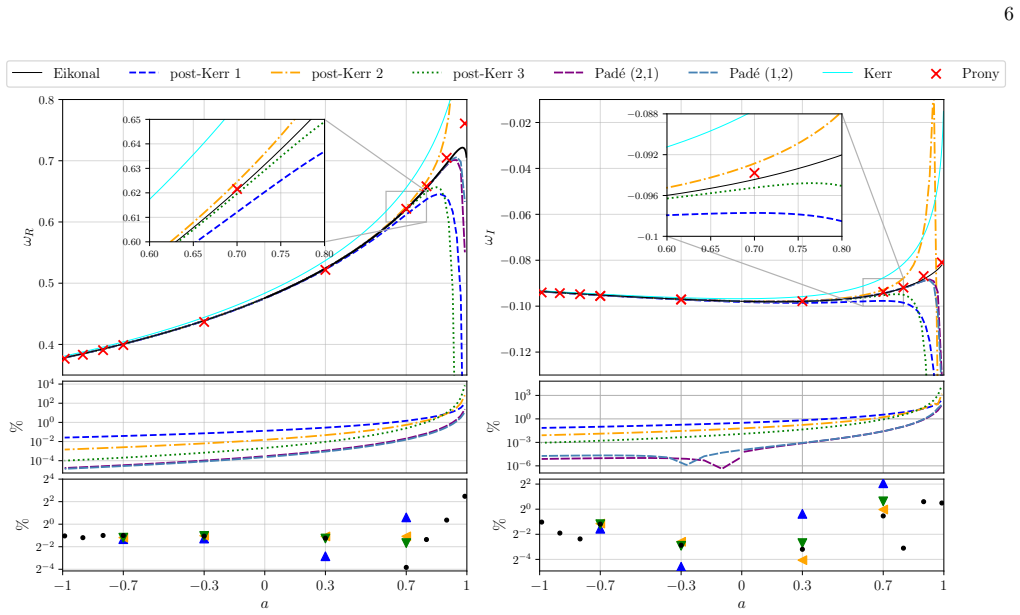
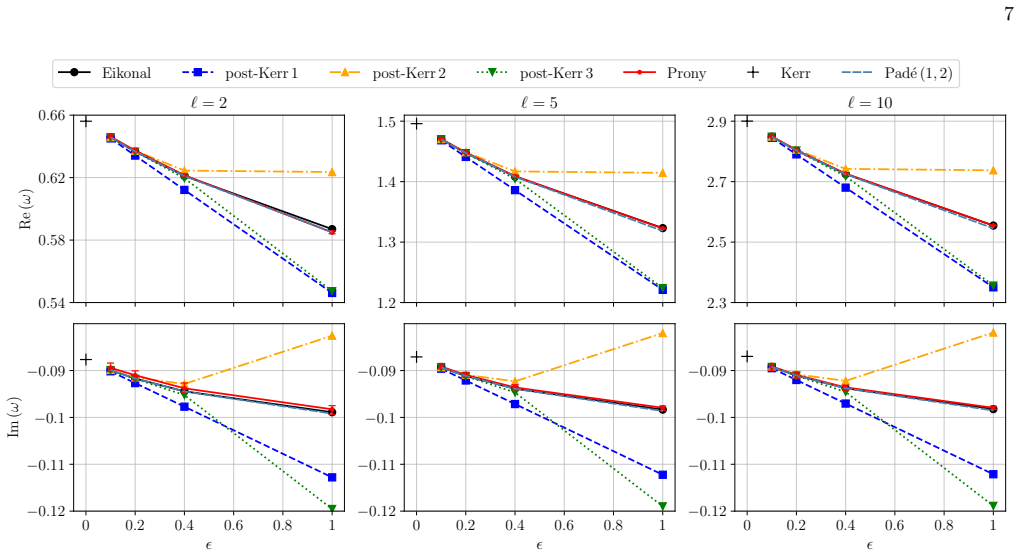
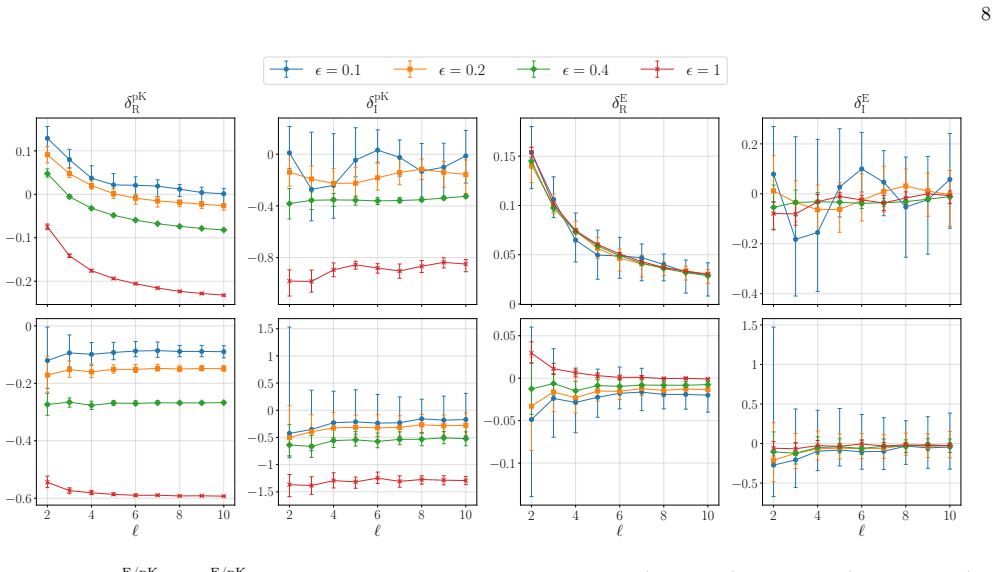
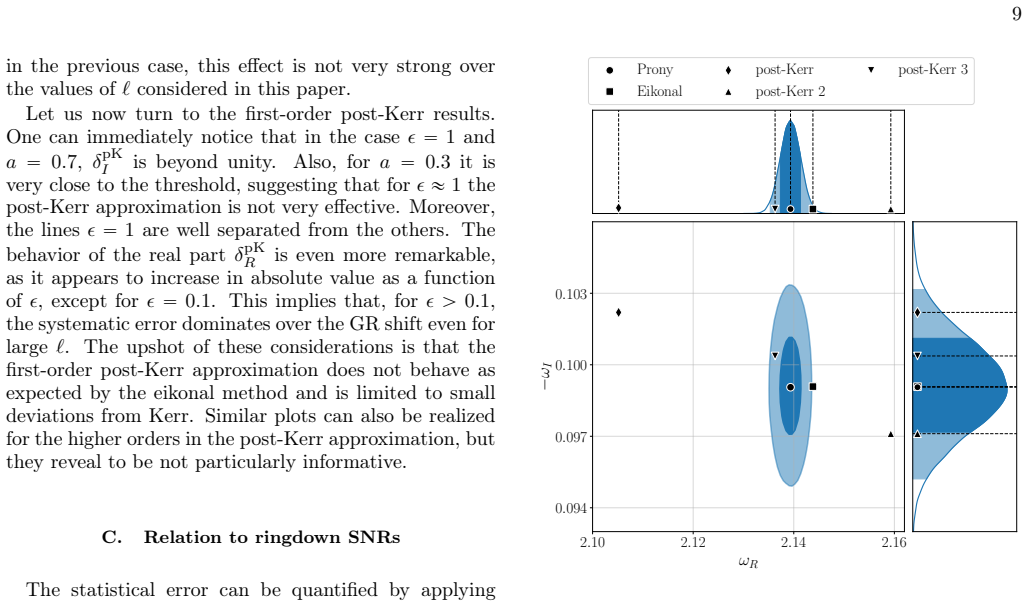
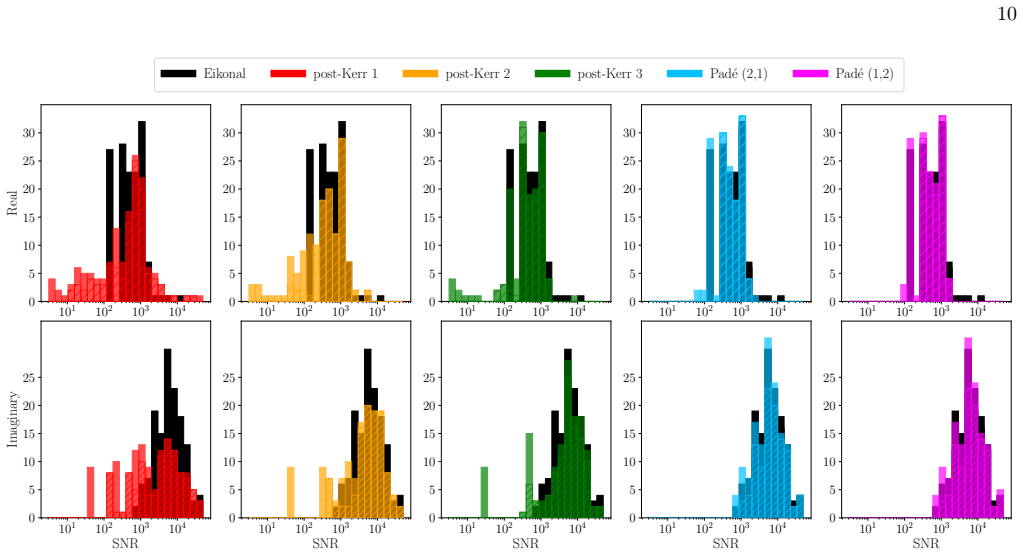
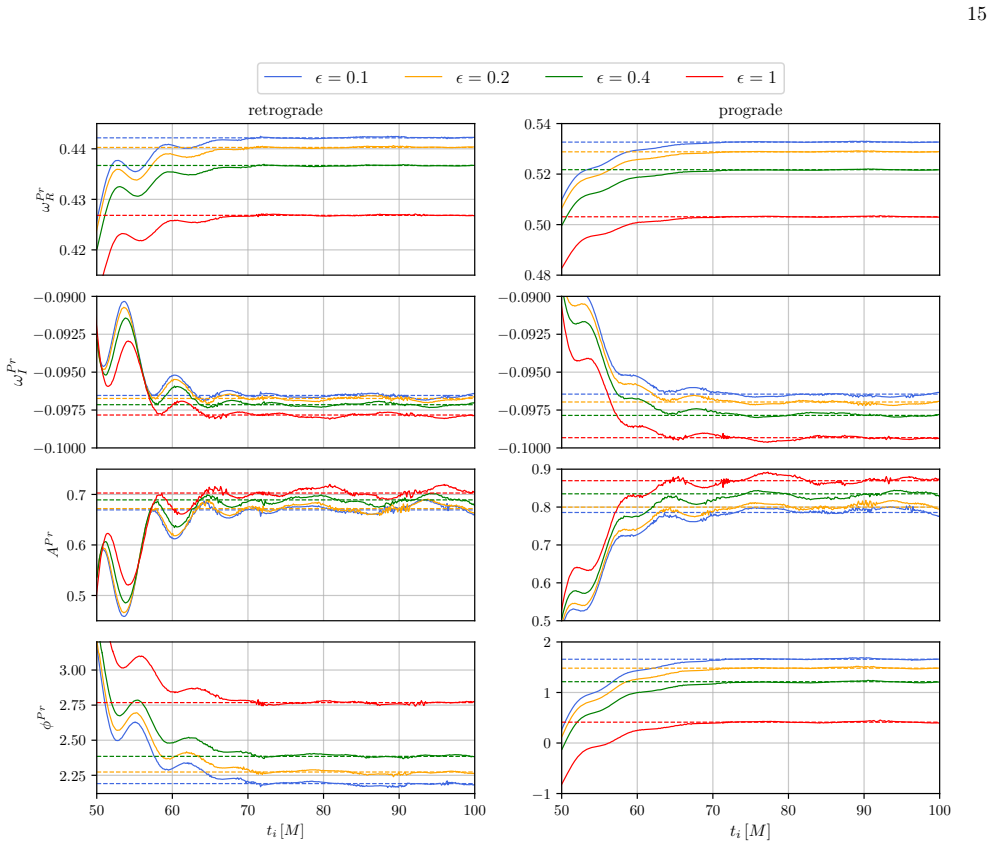
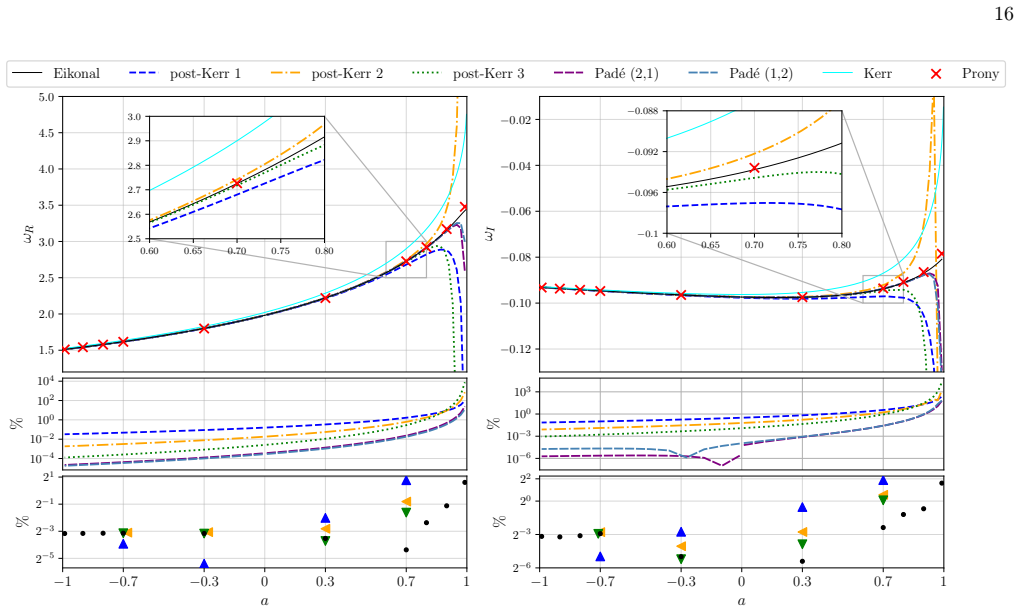
When benchmarked against 2+1-dimensional numerical evolutions of scalar perturbations, both the eikonal and post-Kerr approximations yield quasinormal frequencies whose errors increase with black-hole spin and with the strength of the deviation from Kerr; these modeling errors become comparable to or larger than projected statistical uncertainties at high signal-to-noise ratios, while near-horizon deformations affect prograde and retrograde modes asymmetrically through distinct geometric sensitivities.
What carries the argument
The 2+1-dimensional numerical time-evolution code that evolves scalar-field perturbations on a family of deformed Kerr backgrounds and extracts their quasinormal frequencies as the reference against which the eikonal and post-Kerr formulas are tested.
If this is right
- Approximate formulas remain usable only for small deviations from Kerr when the signal-to-noise ratio is moderate.
- High-precision ringdown spectroscopy of deformed black holes requires either full numerical simulations or higher-order analytic methods.
- Prograde and retrograde modes respond differently to near-horizon changes, so they must be analyzed separately in tests of modified gravity.
- The range of validity of both approximations shrinks as black-hole spin increases or as the deformation parameter grows.
Where Pith is reading between the lines
- If the numerical framework is reliable, events with signal-to-noise ratio above roughly 100 could already place meaningful bounds on certain near-horizon deformations using ringdown data alone.
- The scalar-field results suggest that similar differential effects on prograde and retrograde modes may appear in gravitational-wave perturbations of other non-Kerr black-hole solutions.
- Extending the same numerical benchmark to vector or tensor fields would test whether the reported accuracy limits apply directly to gravitational-wave ringdown.
Load-bearing premise
The 2+1-dimensional numerical evolution accurately represents the complete dynamics of scalar perturbations in the deformed spacetime for the spin and deformation values examined.
What would settle it
A single numerical run at a chosen deformation strength and angular index that extracts a frequency differing from the eikonal or post-Kerr prediction by an amount larger than the modeling error reported in the paper.
Figures

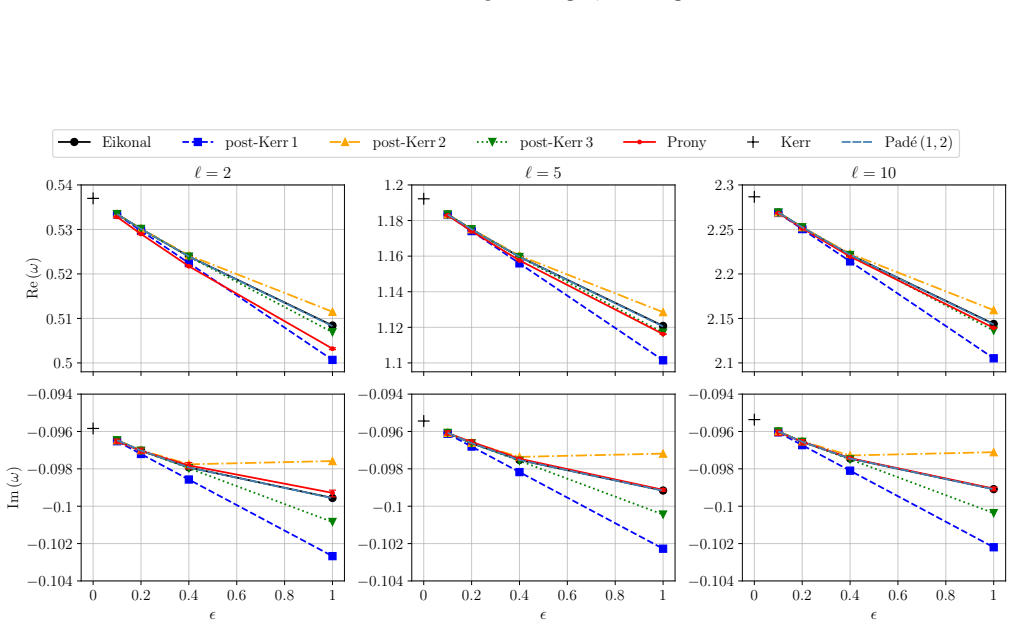
read the original abstract
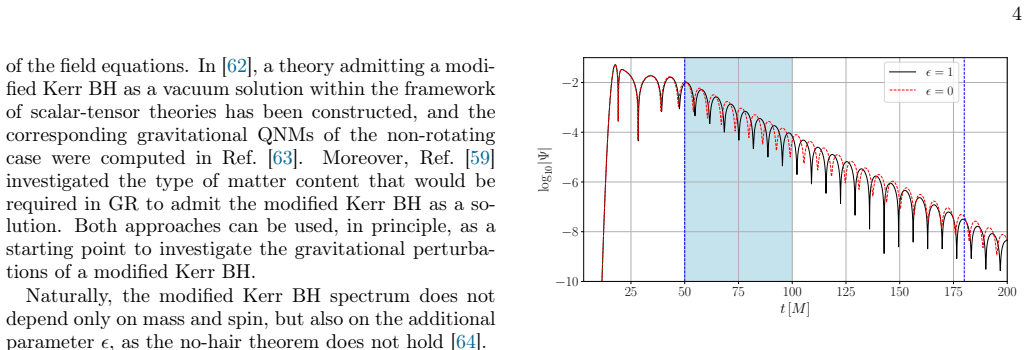
The accurate computation of quasinormal modes from rotating black holes beyond general relativity is crucial for testing fundamental physics with gravitational waves. In this study, we assess the accuracy of the eikonal and post-Kerr approximations in predicting the quasinormal mode spectrum of a scalar field on a deformed Kerr spacetime. To obtain benchmark results and to analyze the ringdown dynamics from generic perturbations, we further employ a 2+1-dimensional numerical time-evolution framework. This approach enables a systematic quantification of theoretical uncertainties across multiple angular harmonics, a broad range of spin parameters, and progressively stronger deviations from the Kerr geometry. We then confront these modeling errors with simple projections of statistical uncertainties in quasinormal mode frequencies as a function of the signal-to-noise ratio, thereby exploring the domain of validity of approximate methods for prospective high-precision black-hole spectroscopy. We also report that near-horizon deformations can affect prograde and retrograde modes differently and provide a geometrical explanation.
Editorial analysis
A structured set of objections, weighed in public.
Referee Report
Summary. The paper assesses the accuracy of eikonal and post-Kerr approximations for scalar-field quasinormal modes on deformed Kerr spacetimes by comparing them against benchmarks obtained from 2+1-dimensional numerical time evolutions of generic initial data. It quantifies modeling errors across angular harmonics, spin parameters, and increasing deviations from Kerr, then confronts these errors with projected statistical uncertainties in QNM frequencies as a function of signal-to-noise ratio, while also reporting differential effects of near-horizon deformations on prograde versus retrograde modes together with a geometrical interpretation.
Significance. If the numerical benchmarks hold, the work supplies a concrete, systematic map of the validity domains of two widely used approximate methods for black-hole spectroscopy beyond Kerr, directly relevant to high-precision tests of general relativity with future gravitational-wave detectors. The use of time-domain evolution from generic data rather than mode-specific initial data is a methodological strength that allows assessment of the full ringdown dynamics.
major comments (2)
- [Numerical Evolution Framework] The central claim that the 2+1D evolutions furnish reliable benchmark QNM frequencies rests on an unverified assumption of numerical accuracy. No resolution-doubling studies, convergence tests, or independent frequency-extraction comparisons (e.g., via Prony or matrix-pencil methods) are presented for the strongest deformations considered, leaving open the possibility that truncation or boundary-reflection errors contaminate the reported spectra.
- [Comparison with Statistical Uncertainties] The confrontation of modeling errors with statistical uncertainties is presented only qualitatively. Specific SNR values, the precise functional form of the projected frequency uncertainties, and error bars on the eikonal/post-Kerr deviations are not shown, making it impossible to judge the quantitative domain of validity claimed in the abstract.
minor comments (2)
- [Introduction] Notation for the deformation parameters and the precise form of the deformed metric should be stated explicitly in the introduction rather than deferred to later sections.
- [Results] Figure captions for the QNM frequency comparisons should include the exact spin and deformation values used in each panel to improve readability.
Simulated Author's Rebuttal
We thank the referee for the careful reading and constructive comments on our manuscript. We appreciate the positive assessment of the work's significance for black-hole spectroscopy and address each major comment below, indicating the revisions we will implement.
read point-by-point responses
-
Referee: [Numerical Evolution Framework] The central claim that the 2+1D evolutions furnish reliable benchmark QNM frequencies rests on an unverified assumption of numerical accuracy. No resolution-doubling studies, convergence tests, or independent frequency-extraction comparisons (e.g., via Prony or matrix-pencil methods) are presented for the strongest deformations considered, leaving open the possibility that truncation or boundary-reflection errors contaminate the reported spectra.
Authors: We agree that explicit demonstration of numerical accuracy is required to support the benchmark results. In the revised manuscript we will add a dedicated subsection on numerical validation that includes resolution-doubling studies and convergence tests for the strongest deformations. We will also extract frequencies using both the existing Fourier-based method and an independent Prony analysis on the same waveforms, reporting the agreement (or quantifying any residual discrepancy) to confirm that truncation and boundary errors do not contaminate the spectra at the reported precision. revision: yes
-
Referee: [Comparison with Statistical Uncertainties] The confrontation of modeling errors with statistical uncertainties is presented only qualitatively. Specific SNR values, the precise functional form of the projected frequency uncertainties, and error bars on the eikonal/post-Kerr deviations are not shown, making it impossible to judge the quantitative domain of validity claimed in the abstract.
Authors: We acknowledge that the comparison was presented qualitatively. In the revision we will add a new figure (or panel) that displays the modeling errors together with the projected statistical uncertainties for concrete SNR values (SNR = 50, 100, 200, 500, 1000). We will state the functional form used (standard 1/SNR scaling for frequency errors in ringdown analyses, with the prefactor taken from the literature on Kerr QNM parameter estimation) and include error bars on the eikonal and post-Kerr deviations. These quantitative elements will be cross-referenced in the abstract and discussion to make the claimed domain of validity explicit. revision: yes
Circularity Check
No circularity: numerical evolution supplies independent benchmark
full rationale
The paper's central claim compares eikonal and post-Kerr predictions against quasinormal frequencies extracted from a separate 2+1D numerical time-evolution code on deformed Kerr backgrounds. This benchmark is generated from first-principles evolution of the scalar wave equation with generic initial data and is not obtained by fitting or re-deriving the approximations under test. No self-definitional steps, fitted inputs renamed as predictions, or load-bearing self-citations appear in the methodology; the numerical results function as an external reference against which modeling errors are quantified and then contrasted with projected statistical uncertainties. The derivation chain is therefore self-contained.
Axiom & Free-Parameter Ledger
axioms (1)
- domain assumption The deformed Kerr spacetime is an appropriate model for black holes beyond general relativity
Lean theorems connected to this paper
-
IndisputableMonolith/Foundation/RealityFromDistinction.leanreality_from_one_distinction unclear?
unclearRelation between the paper passage and the cited Recognition theorem.
We assess the accuracy of the eikonal and post-Kerr approximations in predicting the quasinormal mode spectrum of a scalar field on a deformed Kerr spacetime... 2+1-dimensional numerical time-evolution framework... bias ratio
What do these tags mean?
- matches
- The paper's claim is directly supported by a theorem in the formal canon.
- supports
- The theorem supports part of the paper's argument, but the paper may add assumptions or extra steps.
- extends
- The paper goes beyond the formal theorem; the theorem is a base layer rather than the whole result.
- uses
- The paper appears to rely on the theorem as machinery.
- contradicts
- The paper's claim conflicts with a theorem or certificate in the canon.
- unclear
- Pith found a possible connection, but the passage is too broad, indirect, or ambiguous to say the theorem truly supports the claim.
Reference graph
Works this paper leans on
-
[1]
B. P. Abbottet al.(LIGO Scientific, Virgo), Observation of Gravitational Waves from a Binary Black Hole Merger, Phys. Rev. Lett.116, 061102 (2016), arXiv:1602.03837 [gr-qc]
work page internal anchor Pith review Pith/arXiv arXiv 2016
-
[2]
B. P. Abbottet al.(LIGO Scientific, Virgo), GWTC- 1: A Gravitational-Wave Transient Catalog of Compact Binary Mergers Observed by LIGO and Virgo during the First and Second Observing Runs, Phys. Rev. X9, 031040 (2019), arXiv:1811.12907 [astro-ph.HE]
work page internal anchor Pith review Pith/arXiv arXiv 2019
-
[3]
R. Abbottet al.(LIGO Scientific, Virgo), GWTC-2: Compact Binary Coalescences Observed by LIGO and Virgo During the First Half of the Third Observing Run, Phys. Rev. X11, 021053 (2021), arXiv:2010.14527 [gr- qc]
work page internal anchor Pith review Pith/arXiv arXiv 2021
-
[4]
R. Abbottet al.(LIGO Scientific, VIRGO), GWTC-2.1: Deep extended catalog of compact binary coalescences observed by LIGO and Virgo during the first half of the third observing run, Phys. Rev. D109, 022001 (2024), arXiv:2108.01045 [gr-qc]
work page internal anchor Pith review Pith/arXiv arXiv 2024
-
[5]
R. Abbottet al.(KAGRA, VIRGO, LIGO Scien- tific), GWTC-3: Compact Binary Coalescences Observed by LIGO and Virgo during the Second Part of the Third Observing Run, Phys. Rev. X13, 041039 (2023), arXiv:2111.03606 [gr-qc]
work page internal anchor Pith review Pith/arXiv arXiv 2023
-
[6]
The LIGO Scientific Collaboration, the Virgo Col- laboration, and the KAGRA Collaboration, GWTC- 4.0: Updating the Gravitational-Wave Transient Cata- log with Observations from the First Part of the Fourth LIGO-Virgo-KAGRA Observing Run, arXiv e-prints , arXiv:2508.18082 (2025), arXiv:2508.18082 [gr-qc]
work page internal anchor Pith review Pith/arXiv arXiv 2025
-
[7]
The LIGO Scientific Collaboration, the Virgo Collab- oration, and the KAGRA Collaboration, Black Hole Spectroscopy and Tests of General Relativity with GW250114, arXiv e-prints , arXiv:2509.08099 (2025), arXiv:2509.08099 [gr-qc]
work page internal anchor Pith review Pith/arXiv arXiv 2025
-
[8]
Black hole spectroscopy: from theory to experiment
E. Bertiet al., Black hole spectroscopy: from theory to experiment, (2025), arXiv:2505.23895 [gr-qc]
work page internal anchor Pith review Pith/arXiv arXiv 2025
-
[9]
K. D. Kokkotas and B. G. Schmidt, Quasinormal modes of stars and black holes, Living Rev. Rel.2, 2 (1999), arXiv:gr-qc/9909058
work page internal anchor Pith review Pith/arXiv arXiv 1999
-
[10]
H.-P. Nollert, TOPICAL REVIEW: Quasinormal modes: the characteristic ‘sound’ of black holes and neutron stars, Class. Quant. Grav.16, R159 (1999)
work page 1999
-
[11]
Quasinormal modes of black holes and black branes
E. Berti, V. Cardoso, and A. O. Starinets, Quasinormal modes of black holes and black branes, Class. Quant. Grav.26, 163001 (2009), arXiv:0905.2975 [gr-qc]
work page internal anchor Pith review Pith/arXiv arXiv 2009
-
[12]
R. A. Konoplya and A. Zhidenko, Quasinormal modes of black holes: From astrophysics to string theory, Rev. Mod. Phys.83, 793 (2011), arXiv:1102.4014 [gr-qc]
work page internal anchor Pith review Pith/arXiv arXiv 2011
-
[13]
N. Franchini and S. H. Völkel, Testing general rela- tivity with black hole quasi-normal modes, inRecent Progress on Gravity Tests: Challenges and Future Per- spectives, edited by C. Bambi and A. Cárdenas-Avendaño (Springer Nature Singapore, Singapore, 2024) pp. 361– 416, arXiv:2305.01696 [gr-qc]
-
[14]
R. P. Kerr, Gravitational field of a spinning mass as an example of algebraically special metrics, Phys. Rev. Lett. 11, 237 (1963)
work page 1963
-
[15]
The Science of the Einstein Telescope
A. Abacet al.(ET), The Science of the Einstein Tele- scope, (2025), arXiv:2503.12263 [gr-qc]
work page internal anchor Pith review Pith/arXiv arXiv 2025
-
[16]
M. Colpiet al.(LISA), LISA Definition Study Report, (2024), arXiv:2402.07571 [astro-ph.CO]
work page internal anchor Pith review Pith/arXiv arXiv 2024
-
[17]
Testing General Relativity with Present and Future Astrophysical Observations
E. Bertiet al., Testing General Relativity with Present and Future Astrophysical Observations, Class. Quant. 12 Grav.32, 243001 (2015), arXiv:1501.07274 [gr-qc]
work page internal anchor Pith review Pith/arXiv arXiv 2015
-
[18]
Barausseet al., Prospects for Fundamental Physics with LISA, Gen
E. Barausseet al., Prospects for Fundamental Physics with LISA, Gen. Rel. Grav.52, 81 (2020), arXiv:2001.09793 [gr-qc]
-
[19]
T. Regge and J. A. Wheeler, Stability of a Schwarzschild singularity, Phys. Rev.108, 1063 (1957)
work page 1957
-
[20]
F. J. Zerilli, Effective potential for even parity Regge- Wheelergravitationalperturbationequations,Phys.Rev. Lett.24, 737 (1970)
work page 1970
-
[21]
S. A. Teukolsky, Rotating black holes - separable wave equations for gravitational and electromagnetic pertur- bations, Phys. Rev. Lett.29, 1114 (1972)
work page 1972
-
[22]
L. Pierini and L. Gualtieri, Quasi-normal modes of rotat- ing black holes in Einstein-dilaton Gauss-Bonnet gravity: the first order in rotation, Phys. Rev. D103, 124017 (2021), arXiv:2103.09870 [gr-qc]
- [23]
-
[24]
M. Srivastava, Y. Chen, and S. Shankaranarayanan, An- alytical computation of quasinormal modes of slowly ro- tating black holes in dynamical Chern-Simons gravity, Phys. Rev. D104, 064034 (2021), arXiv:2106.06209 [gr- qc]
-
[25]
L. Pierini and L. Gualtieri, Quasinormal modes of rotat- ing black holes in Einstein-dilaton Gauss-Bonnet gravity: The second order in rotation, Phys. Rev. D106, 104009 (2022), arXiv:2207.11267 [gr-qc]
- [26]
- [27]
- [28]
- [29]
- [30]
- [31]
- [32]
- [33]
- [34]
-
[35]
A. Hussain and A. Zimmerman, Approach to computing spectral shifts for black holes beyond Kerr, Phys. Rev. D 106, 104018 (2022), arXiv:2206.10653 [gr-qc]
- [36]
-
[37]
E. W. Leaver, An Analytic representation for the quasi normal modes of Kerr black holes, Proc. Roy. Soc. Lond. A402, 285 (1985)
work page 1985
-
[38]
B. F. Schutz and C. M. Will, Black hole normal modes: A semianalytic approach, Astrophys. J. Lett.291, L33 (1985)
work page 1985
-
[39]
C. V. Vishveshwara, Scattering of Gravitational Radi- ation by a Schwarzschild Black-hole, Nature227, 936 (1970)
work page 1970
-
[40]
R. H. Price, Nonspherical perturbations of relativistic gravitational collapse. 1. Scalar and gravitational pertur- bations, Phys. Rev. D5, 2419 (1972)
work page 1972
- [41]
-
[42]
C.Goebel,Commentsonthe“vibrations” ofaBlackHole, Astrophysical Journal Letters172, L95 (1972)
work page 1972
-
[43]
V. Ferrari and B. Mashhoon, New approach to the quasi- normal modes of a black hole, Phys. Rev. D30, 295 (1984)
work page 1984
-
[44]
Post-Kerr black hole spectroscopy
K. Glampedakis, G. Pappas, H. O. Silva, and E. Berti, Post-Kerr black hole spectroscopy, Phys. Rev. D96, 064054 (2017), arXiv:1706.07658 [gr-qc]
work page internal anchor Pith review Pith/arXiv arXiv 2017
-
[45]
R. A. Konoplya, Z. Stuchlík, and A. Zhidenko, Axisym- metric black holes allowing for separation of variables in the Klein-Gordon and Hamilton-Jacobi equations, Phys. Rev. D97, 084044 (2018), arXiv:1801.07195 [gr-qc]
work page internal anchor Pith review Pith/arXiv arXiv 2018
-
[46]
Pedrotti,Studies on Quasi-Normal Modes and Shad- ows of Black Holes, Master’s thesis, Trento U
D. Pedrotti,Studies on Quasi-Normal Modes and Shad- ows of Black Holes, Master’s thesis, Trento U. (2023)
work page 2023
-
[47]
D. Pedrotti and S. Vagnozzi, Quasinormal modes-shadow correspondence for rotating regular black holes, Phys. Rev. D110, 084075 (2024), arXiv:2404.07589 [gr-qc]
- [48]
-
[49]
S. R. Dolan, The Quasinormal Mode Spectrum of a Kerr Black Hole in the Eikonal Limit, Phys. Rev. D82, 104003 (2010), arXiv:1007.5097 [gr-qc]
work page internal anchor Pith review Pith/arXiv arXiv 2010
-
[50]
K. Glampedakis and H. O. Silva, Eikonal quasinormal modes of black holes beyond General Relativity, Phys. Rev. D100, 044040 (2019), arXiv:1906.05455 [gr-qc]
-
[51]
J. L. Basdevant, The Pade approximation and its physi- cal applications, Fortsch. Phys.20, 283 (1972)
work page 1972
-
[52]
M. Del Piano, S. Hohenegger, and F. Sannino, Black hole shadow and other observables away from the horizon: Extending the effective metric descriptions, Phys. Rev. D111, 064070 (2025), arXiv:2412.13673 [gr-qc]
- [53]
-
[54]
Photon Rings around Kerr and Kerr-like Black Holes
T. Johannsen, Photon Rings around Kerr and Kerr- like Black Holes, Astrophys. J.777, 170 (2013), arXiv:1501.02814 [astro-ph.HE]
work page internal anchor Pith review Pith/arXiv arXiv 2013
-
[55]
A Metric for Rapidly Spinning Black Holes Suitable for Strong-Field Tests of the No-Hair Theorem
T. Johannsen and D. Psaltis, A Metric for Rapidly Spin- ning Black Holes Suitable for Strong-Field Tests of the No-Hair Theorem, Phys. Rev. D83, 124015 (2011), arXiv:1105.3191 [gr-qc]
work page internal anchor Pith review Pith/arXiv arXiv 2011
-
[56]
General parametrization of axisymmetric black holes in metric theories of gravity
R. Konoplya, L. Rezzolla, and A. Zhidenko, General parametrization of axisymmetric black holes in metric theories of gravity, Phys. Rev. D93, 064015 (2016), arXiv:1602.02378 [gr-qc]
work page internal anchor Pith review Pith/arXiv arXiv 2016
-
[57]
On the connection of spacetime separability and spherical photon orbits
G. Pappas and K. Glampedakis, On the connection of spacetime separability and spherical photon orbits, arXiv preprint arXiv:1806.04091 (2018)
work page internal anchor Pith review Pith/arXiv arXiv 2018
-
[58]
S. Barman and S. Mukherjee, Thermal behavior of a ra- dially deformed black hole spacetime, Eur. Phys. J. C81, 453 (2021), arXiv:2102.04066 [gr-qc]
-
[59]
E. Franzin, S. Liberati, and M. Oi, Superradiance in Kerr-like black holes, Phys. Rev. D103, 104034 (2021), arXiv:2102.03152 [gr-qc]
-
[60]
G. O. Papadopoulos and K. D. Kokkotas, Preserving Kerr symmetries in deformed spacetimes, Class. Quant. Grav.35, 185014 (2018), arXiv:1807.08594 [gr-qc]
work page internal anchor Pith review Pith/arXiv arXiv 2018
-
[61]
Dynamics of Scalar Fields in the Background of Rotating Black Holes
W. Krivan, P. Laguna, and P. Papadopoulos, Dynamics of scalar fields in the background of rotating black holes, Phys. Rev. D54, 4728 (1996), arXiv:gr-qc/9606003
work page internal anchor Pith review Pith/arXiv arXiv 1996
- [62]
- [63]
-
[64]
Testing the black hole "no-hair" hypothesis
V. Cardoso and L. Gualtieri, Testing the black hole ‘no- hair’ hypothesis, Class. Quant. Grav.33, 174001 (2016), arXiv:1607.03133 [gr-qc]
work page internal anchor Pith review Pith/arXiv arXiv 2016
-
[65]
Are LIGO's Black Holes Made From Smaller Black Holes?
M. Fishbach, D. E. Holz, and B. Farr, Are LIGO’s Black Holes Made From Smaller Black Holes?, Astrophys. J. Lett.840, L24 (2017), arXiv:1703.06869 [astro-ph.HE]
work page internal anchor Pith review Pith/arXiv arXiv 2017
-
[66]
H. Zhuet al., Nonlinear effects in black hole ringdown from scattering experiments: Spin and initial data de- pendence of quadratic mode coupling, Phys. Rev. D109, 104050 (2024), arXiv:2401.00805 [gr-qc]
-
[67]
De Amiciset al., Late-Time Tails in Nonlinear Evo- lutions of Merging Black Holes, Phys
M. De Amiciset al., Late-Time Tails in Nonlinear Evo- lutions of Merging Black Holes, Phys. Rev. Lett.135, 171401 (2025), arXiv:2412.06887 [gr-qc]
-
[68]
H. Yang, D. A. Nichols, F. Zhang, A. Zimmerman, Z. Zhang, and Y. Chen, Quasinormal-mode spectrum of Kerr black holes and its geometric interpretation, Phys. Rev. D86, 104006 (2012), arXiv:1207.4253 [gr-qc]
work page internal anchor Pith review Pith/arXiv arXiv 2012
-
[69]
Geodesic stability, Lyapunov exponents and quasinormal modes
V. Cardoso, A. S. Miranda, E. Berti, H. Witek, and V. T. Zanchin, Geodesic stability, Lyapunov exponents and quasinormal modes, Phys. Rev. D79, 064016 (2009), arXiv:0812.1806 [hep-th]
work page internal anchor Pith review Pith/arXiv arXiv 2009
-
[70]
R. A. Konoplya and Z. Stuchlík, Are eikonal quasinor- mal modes linked to the unstable circular null geodesics?, Phys. Lett. B771, 597 (2017), arXiv:1705.05928 [gr-qc]
work page internal anchor Pith review Pith/arXiv arXiv 2017
-
[71]
S. Capozziello and V. Faraoni,Beyond Einstein Gravity: A Survey of Gravitational Theories for Cosmology and Astrophysics(Springer, Dordrecht, 2011)
work page 2011
-
[72]
S. Capozziello, V. De Falco, and C. Ferrara, Comparing equivalent gravities: common features and differences, Eur. Phys. J. C82, 865 (2022), arXiv:2208.03011 [gr-qc]
-
[73]
S. Capozziello and C. Ferrara, The equivalence principle as a Noether symmetry, Int. J. Geom. Meth. Mod. Phys. 21, 2440014 (2024), arXiv:2401.09737 [gr-qc]
-
[74]
Black Hole Ringing, Quasinormal Modes, and Light Rings
G. Khanna and R. H. Price, Black Hole Ringing, Quasi- normal Modes, and Light Rings, Phys. Rev. D95, 081501 (2017), arXiv:1609.00083 [gr-qc]
work page internal anchor Pith review Pith/arXiv arXiv 2017
- [75]
- [76]
- [77]
- [78]
-
[79]
S. Borhanian and B. S. Sathyaprakash, Listening to the Universe with next generation ground-based gravitational-wave detectors, Phys. Rev. D110, 083040 (2024), arXiv:2202.11048 [gr-qc]
-
[80]
About the Significance of Quasinormal Modes of Black Holes
H.-P. Nollert, About the significance of quasinormal modes of black holes, Phys. Rev. D53, 4397 (1996), arXiv:gr-qc/9602032
work page internal anchor Pith review Pith/arXiv arXiv 1996
discussion (0)
Sign in with ORCID, Apple, or X to comment. Anyone can read and Pith papers without signing in.