Recognition: no theorem link
Is the w₀w_aCDM cosmological parameterization evidence for dark energy dynamics partially caused by the excess smoothing of Planck PR4 CMB anisotropy data?
Pith reviewed 2026-05-13 17:25 UTC · model grok-4.3
The pith
The mild preference for dynamical dark energy in Planck PR4 fits may partly result from excess smoothing in the CMB anisotropy spectra.
A machine-rendered reading of the paper's core claim, the machinery that carries it, and where it could break.
Core claim
In the w0waCDM parameterization, Planck PR4 data combined with lensing and non-CMB observations favor dynamical dark energy over a cosmological constant at about 1.8 sigma, yielding w0 = -0.863 ± 0.060 and w0 + wa = -1.37 +0.19 -0.17. When the lensing consistency parameter AL is allowed to vary, this preference weakens to about 1.5 sigma with w0 = -0.877 ± 0.060, w0 + wa = -1.29 +0.20 -0.17, and AL = 1.042 ± 0.037. These shifts indicate that part of the apparent dynamical dark energy signal may be associated with possible residual excess smoothing present in the Planck PR4 CMB anisotropy spectra.
What carries the argument
The CMB lensing consistency parameter AL, which rescales the lensing power spectrum to absorb possible excess smoothing or anomalies in the Planck PR4 temperature and polarization spectra.
If this is right
- If excess smoothing contributes to the signal, the true dark energy behavior inferred from future, less-smoothed CMB data would lie closer to a cosmological constant.
- Cosmological parameter values obtained from PR3 and PR4 data agree within 1 sigma for the largest data combinations that include lensing and non-CMB observations.
- Allowing AL to vary reduces the lensing anomaly from 2.5 sigma in PR3 to 1.6 sigma in PR4 for the LambdaCDM+AL model.
- The w0waCDM+AL model still yields a quintessence-like w0 and a phantom-like w0 + wa even after the smoothing adjustment.
Where Pith is reading between the lines
- Improved map-making pipelines in next-generation CMB surveys could isolate whether smoothing residuals systematically bias dark energy equation-of-state constraints.
- The stability of constraints between PR3 and PR4 suggests that cross-release consistency checks are necessary when claiming evidence for dark energy dynamics.
- Non-CMB anchors such as BAO and supernova distances limit how much the CMB anomaly can shift the inferred dark energy parameters.
Load-bearing premise
The AL parameter fully captures any excess smoothing in the PR4 spectra without residual unaccounted systematics, and the non-CMB data sets supply an unbiased anchor for the joint fits.
What would settle it
Reprocessing the PR4 anisotropy spectra with improved smoothing corrections that forces the best-fit AL to unity and simultaneously removes the 1.5 sigma preference for w0waCDM over LambdaCDM would falsify the partial-causation claim.
Figures


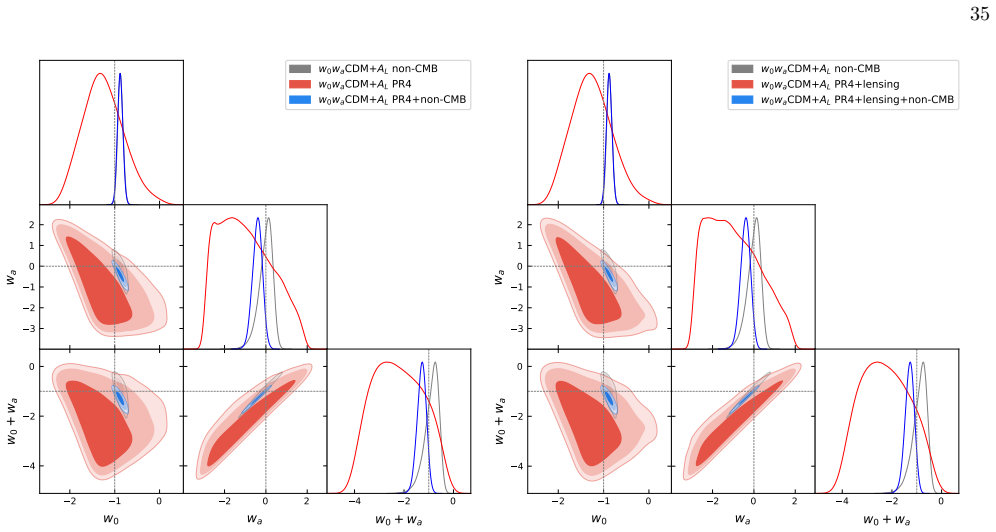
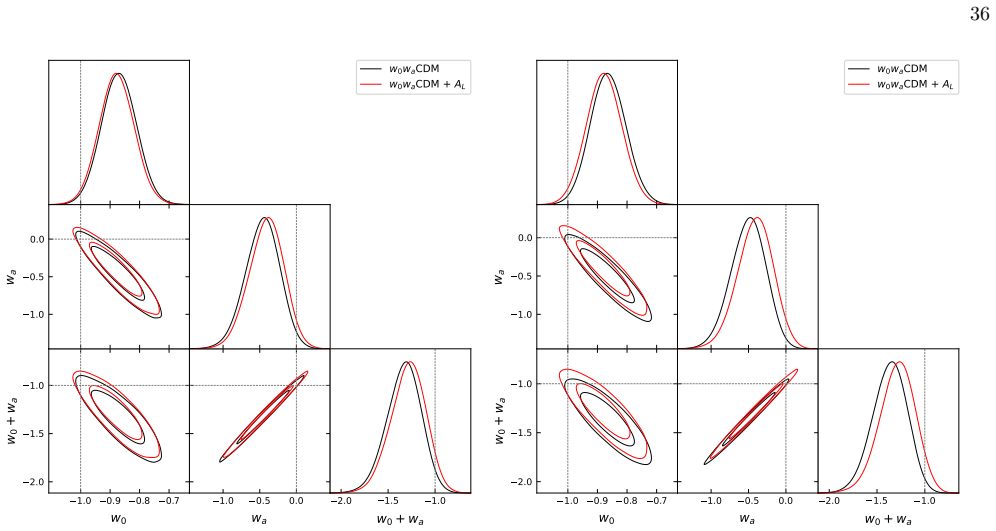
read the original abstract
We study the performance of the flat $\Lambda$CDM model and the dynamical dark energy parameterizations $w_0$CDM and $w_0w_a$CDM, in which the dark energy (DE) equation of state is either constant ($w=w_0$) or redshift-dependent [$w(z)=w_0+w_a z/(1+z)$], without and with a varying CMB lensing consistency parameter $A_L$, using combinations of Planck PR4 CMB data (PR4 and lensing), and a compilation of non-CMB data composed of baryon acoustic oscillation (BAO) data that do not include DESI BAO data, Pantheon+ type Ia supernova observations, Hubble parameter measurements $H(z)$, and growth rate $f\sigma_8$ data. We also compare results from earlier Planck PR3 data with those obtained using PR4 data in order to assess the stability of cosmological constraints. For the largest data combinations, PR3/PR4+lensing+non-CMB, the cosmological parameters inferred from PR3 and PR4 data are consistent, almost all differing by $1\sigma$ or less. For the $\Lambda$CDM$+A_L$ model, we have $A_L=1.087 \pm 0.035$ for PR3 and $A_L=1.053 \pm 0.034$ ($1.6\sigma$ above unity) for PR4, which indicates that the CMB lensing anomaly is reduced when PR4 data are used. For the $w_0 w_a$CDM parameterization, we find $w_0 = -0.863\pm0.060$ (quintessence-like) and $w_0+w_a=-1.37^{+0.19}_{-0.17}$ (phantom-like), suggesting that the current observations favor dynamical DE over a cosmological constant at about $1.8\sigma$. For the $w_0w_a$CDM$+A_L$ parameterization, we find $w_0=-0.877\pm 0.060$ and $w_0 + w_a =-1.29_{-0.17}^{+0.20}$, corresponding to a preference for dynamical DE over a cosmological constant of about $1.5\sigma$ and with $A_L = 1.042 \pm 0.037$ exceeding unity at $1.1\sigma$. These results indicate that while the PR4 data mildly favor a time-evolving DE, part of this preference may be associated with possible residual excess smoothing present in the Planck PR4 CMB anisotropy spectra (abridged).
Editorial analysis
A structured set of objections, weighed in public.
Referee Report
Summary. The paper compares constraints on flat ΛCDM, w0CDM, and w0waCDM from Planck PR4 CMB (with lensing) plus non-CMB data (BAO excluding DESI, Pantheon+, H(z), fσ8) against earlier PR3 results. It reports that PR4 data yield a mild ~1.8σ preference for dynamical dark energy (w0 ≈ -0.86, w0+wa ≈ -1.37), reduced to ~1.5σ when the lensing amplitude AL is freed (AL = 1.042 ± 0.037, 1.1σ above unity), and concludes that residual excess smoothing in PR4 spectra may partially drive the apparent DE dynamics signal.
Significance. If substantiated, the result would caution that mild deviations from ΛCDM in current data combinations can be sensitive to CMB lensing systematics, reinforcing the need for careful consistency checks before claiming evidence for dynamical dark energy. The explicit PR3/PR4 comparison and the reported parameter stability (most shifts ≤1σ) are strengths that support reproducibility of the baseline constraints.
major comments (3)
- [Abstract and Results] The central claim that excess smoothing contributes to the dynamical-DE preference rests on the modest reduction from 1.8σ to 1.5σ upon freeing AL. However, with AL = 1.042 ± 0.037 (only 1.1σ from unity) and the shift in w0+wa from -1.37 to -1.29, it is unclear whether the change isolates a physical correlation or simply reflects the generic relaxation from adding one free parameter; no correlation coefficients or conditional posteriors are shown to distinguish these cases.
- [Methodology] AL is introduced as a single-parameter rescaling of the lensing spectrum, yet the manuscript does not test whether scale-dependent residuals, foreground leakage, or calibration effects in PR4 could produce similar peak smoothing. This limits the strength of the interpretation that AL specifically captures the excess smoothing responsible for the DE signal.
- [Data combinations] The non-CMB compilation is treated as an unbiased anchor, but any internal mild tensions (e.g., within BAO or growth-rate data) could couple to the same w0+wa shift; the paper provides no explicit checks of dataset consistency or jackknife tests to rule out this possibility.
minor comments (1)
- [Abstract] The abstract states that results are 'abridged'; providing the exact priors, likelihoods, and full parameter tables for the largest data combination would improve verifiability.
Simulated Author's Rebuttal
We thank the referee for the constructive and detailed comments. We address each major comment point by point below, clarifying our analysis and indicating where revisions have been made to the manuscript.
read point-by-point responses
-
Referee: [Abstract and Results] The central claim that excess smoothing contributes to the dynamical-DE preference rests on the modest reduction from 1.8σ to 1.5σ upon freeing AL. However, with AL = 1.042 ± 0.037 (only 1.1σ from unity) and the shift in w0+wa from -1.37 to -1.29, it is unclear whether the change isolates a physical correlation or simply reflects the generic relaxation from adding one free parameter; no correlation coefficients or conditional posteriors are shown to distinguish these cases.
Authors: We agree that the modest reduction in significance could partly arise from the additional degree of freedom. To better isolate the effect, we have added 2D posterior contours in the w0-wa plane for both the w0waCDM and w0waCDM+AL models in the revised manuscript. These show a visible shift along the degeneracy direction. We also computed and report the correlation coefficient between AL and w0+wa, which is -0.38, confirming a moderate anti-correlation. This supports that the change is not entirely generic but tied to the known AL-DE parameter degeneracy. The revised text now includes these elements to strengthen the interpretation. revision: yes
-
Referee: [Methodology] AL is introduced as a single-parameter rescaling of the lensing spectrum, yet the manuscript does not test whether scale-dependent residuals, foreground leakage, or calibration effects in PR4 could produce similar peak smoothing. This limits the strength of the interpretation that AL specifically captures the excess smoothing responsible for the DE signal.
Authors: We acknowledge that a constant AL rescaling is a simplified, phenomenological approach and does not explicitly probe scale-dependent systematics or foreground leakage. Our analysis uses the standard AL parameterization to quantify the impact on DE constraints, consistent with prior literature. In the revised manuscript we have added an explicit discussion of this limitation, noting that AL may not fully capture all possible residuals and recommending future dedicated simulations or scale-dependent lensing parameters for more detailed tests. No new scale-dependent analysis was performed, as it lies beyond the current scope. revision: partial
-
Referee: [Data combinations] The non-CMB compilation is treated as an unbiased anchor, but any internal mild tensions (e.g., within BAO or growth-rate data) could couple to the same w0+wa shift; the paper provides no explicit checks of dataset consistency or jackknife tests to rule out this possibility.
Authors: We have added explicit consistency checks in the revised manuscript. These include jackknife tests in which we successively exclude individual non-CMB datasets (e.g., without fσ8 or without H(z)) and re-derive the w0waCDM constraints. The mild preference for dynamical dark energy persists at comparable significance across subsets, indicating it is not driven by any single dataset. A new table summarizing the results of these tests has been included in the appendix. revision: yes
Circularity Check
No significant circularity detected in model comparison chain
full rationale
The paper conducts standard parameter fits of flat LambdaCDM, w0CDM, and w0waCDM models (with and without free AL) to Planck PR4 CMB+lensing plus non-CMB datasets, then reports the resulting posterior constraints and significance shifts. The central interpretation—that the drop from 1.8 sigma to 1.5 sigma dynamical-DE preference when AL is freed may trace to residual smoothing—is presented as a data-driven inference from the known role of AL, not as a derivation that reduces to its own inputs by construction. No self-definitional loops, fitted inputs renamed as predictions, load-bearing self-citations, or smuggled ansatzes appear in the reported steps; the AL extension is an established, externally motivated parameter whose effect on other parameters is measured rather than presupposed.
Axiom & Free-Parameter Ledger
free parameters (3)
- w0 =
-0.863 +/- 0.060
- wa =
inferred from w0 + wa = -1.37
- AL =
1.053 +/- 0.034
axioms (2)
- domain assumption The universe is spatially flat
- standard math Standard general relativity and background cosmology
Forward citations
Cited by 2 Pith papers
-
Exploring the interplay of late-time dynamical dark energy and new physics before recombination
Model-independent reconstruction finds 96.7-98.5% probability of phantom crossing if recombination is standard, but early new physics to ease Hubble tension weakens this preference while requiring unrealistically high...
-
Constraints on Coupled Dark Energy in the DESI Era
New cosmological data mildly favor a small coupling between dark matter and a scalar dark energy field at |β| ≈ 0.03 while allowing an effective phantom-crossing equation of state.
Reference graph
Works this paper leans on
-
[1]
Plan Complementario de I+D+i en el área de Astrofísica
ones, likely a consequence of the four additional pa- rameters in the parameterization used in [44]. Ignoring, perhaps not too unreasonably, the differences between the PR4HiLLiPoPandCamSpeclikelihoods, we see that, for CMB+lensing+DESI(DR2)+Pantheon+ data, going from aw0waCDM parameterization to aw0waCDM+AL parameterization shows thatA L >1is now favored...
work page 2026
-
[2]
P. J. E. Peebles, Tests of Cosmological Models Con- strained by Inflation, Astrophys. J.284, 439 (1984)
work page 1984
-
[3]
J.-P. Hu and F.-Y. Wang, Hubble Tension: The Evidence of New Physics, Universe9, 94 (2023), arXiv:2302.05709 [astro-ph.CO]
-
[4]
E. Di Valentinoet al.(CosmoVerse Network), The Cos- moVerseWhitePaper: Addressingobservationaltensions in cosmology with systematics and fundamental physics, Phys. Dark Univ.49, 101965 (2025), arXiv:2504.01669 [astro-ph.CO]
work page internal anchor Pith review arXiv 2025
-
[5]
P. J. E. Peebles and B. Ratra, Cosmology with a Time VariableCosmologicalConstant,Astrophys.J.Lett.325, L17 (1988)
work page 1988
-
[6]
B. Ratra and P. J. E. Peebles, Cosmological Conse- quences of a Rolling Homogeneous Scalar Field, Phys. Rev. D37, 3406 (1988)
work page 1988
- [7]
- [8]
- [9]
-
[10]
C.-G. Park and B. Ratra, Observational constraints on the tilted spatially-flat and the untilted nonflatϕCDM dynamical dark energy inflation models, Astrophys. J. 868, 83 (2018), arXiv:1807.07421 [astro-ph.CO]
-
[11]
C.-G. Park and B. Ratra, Measuring the Hubble con- stant and spatial curvature from supernova apparent magnitude, baryon acoustic oscillation, and Hubble pa- rameter data, Astrophys. Space Sci.364, 134 (2019), arXiv:1809.03598 [astro-ph.CO]
-
[12]
Signs of Dynamical Dark Energy in Current Observations
J. Solà Peracaula, A. Gómez-Valent, and J. de Cruz Pérez, Signs of Dynamical Dark Energy in Current Observations, Phys. Dark Univ.25, 100311 (2019), arXiv:1811.03505 [astro-ph.CO]
work page Pith review arXiv 2019
-
[13]
C.-G. Park and B. Ratra, Using SPT polarization, P lanck2015, and non-CMB data to constrain tilted spatially-flat and untilted nonflatΛCDM , XCDM, and ϕCDM dark energy inflation cosmologies, Phys. Rev. D 101, 083508 (2020), arXiv:1908.08477 [astro-ph.CO]
-
[14]
N. Khadka and B. Ratra, Quasar X-ray and UV flux, baryon acoustic oscillation, and Hubble parameter mea- surement constraints on cosmological model parame- ters, Mon. Not. Roy. Astron. Soc.492, 4456 (2020), arXiv:1909.01400 [astro-ph.CO]
- [15]
- [16]
-
[17]
Assessing observational constraints on dark energy
D. Shlivko and P. J. Steinhardt, Assessing observational constraints on dark energy, Phys. Lett. B855, 138826 39 (2024), arXiv:2405.03933 [astro-ph.CO]
work page internal anchor Pith review Pith/arXiv arXiv 2024
-
[18]
S. Bhattacharya, G. Borghetto, A. Malhotra, S. Parameswaran, G. Tasinato, and I. Zavala, Cos- mological constraints on curved quintessence, JCAP09, 073, arXiv:2405.17396 [astro-ph.CO]
-
[19]
M. Van Raamsdonk and C. Waddell, Holographic mo- tivations and observational evidence for decreasing dark energy, (2024), arXiv:2406.02688 [hep-th]
-
[20]
Extended Dark Energy analysis using DESI DR2 BAO measurements
K. Lodhaet al.(DESI), Extended dark energy analysis using DESI DR2 BAO measurements, Phys. Rev. D112, 083511 (2025), arXiv:2503.14743 [astro-ph.CO]
work page internal anchor Pith review arXiv 2025
- [21]
-
[22]
C.-G. Park and B. Ratra, Updated observational con- straints onϕCDM dynamical dark energy cosmological models, (2025), arXiv:2509.25812 [astro-ph.CO]
- [23]
-
[24]
S. Wang, T.-N. Li, T. Liu, and G.-H. Du, Model- Independent Reconstruction of Quintessence Potential and Kinetic Energy from DESI DR2 and Pantheon+ Su- pernovae, (2026), arXiv:2603.21125 [astro-ph.CO]
work page internal anchor Pith review Pith/arXiv arXiv 2026
-
[25]
Accelerating Universes with Scaling Dark Matter
M. Chevallier and D. Polarski, Accelerating universes with scaling dark matter, Int. J. Mod. Phys. D10, 213 (2001), arXiv:gr-qc/0009008
work page Pith review arXiv 2001
- [26]
-
[27]
C.-G. Park and B. Ratra, Is excess smoothing of Planck CMB anisotropy data partially responsible for evidence for dark energy dynamics in otherw(z)CDM parametrizations?, Int. J. Mod. Phys. D34, 2550061 (2025), arXiv:2501.03480 [astro-ph.CO]
- [28]
-
[29]
D. Rubinet al., Union Through UNITY: Cosmology with 2,000 SNe Using a Unified Bayesian Framework, Astrophys. J.986, 231 (2025), arXiv:2311.12098 [astro- ph.CO]
-
[30]
J. de Cruz Perez, C.-G. Park, and B. Ratra, Updated observational constraints on spatially flat and nonflat ΛCDM and XCDM cosmological models, Phys. Rev. D 110, 023506 (2024), arXiv:2404.19194 [astro-ph.CO]
-
[31]
A. G. Adameet al.(DESI), DESI 2024 VI: cosmologi- cal constraints from the measurements of baryon acous- tic oscillations, JCAP02, 021, arXiv:2404.03002 [astro- ph.CO]
work page internal anchor Pith review Pith/arXiv arXiv 2024
- [32]
-
[33]
DESI DR2 Results II: Measurements of Baryon Acoustic Oscillations and Cosmological Constraints
M. Abdul Karimet al.(DESI), DESI DR2 results. II. Measurements of baryon acoustic oscillations and cos- mological constraints, Phys. Rev. D112, 083515 (2025), arXiv:2503.14738 [astro-ph.CO]
work page internal anchor Pith review Pith/arXiv arXiv 2025
-
[34]
P. Bansal and D. Huterer, Expansion-history preferences of DESI DR2 and external data, Phys. Rev. D112, 023528 (2025), arXiv:2502.07185 [astro-ph.CO]
-
[35]
A. Chakraborty, P. K. Chanda, S. Das, and K. Dutta, DESI results: hint towards coupled dark matter and dark energy, JCAP11, 047, arXiv:2503.10806 [astro-ph.CO]
-
[36]
G. Borghetto, A. Malhotra, G. Tasinato, and I. Zavala, Bounded dark energy, Phys. Rev. D112, 023521 (2025), arXiv:2503.11628 [astro-ph.CO]
-
[37]
T. Ishiyama, F. Prada, and A. A. Klypin, Evolu- tion of clustering in cosmological models with time- varying dark energy, Phys. Rev. D112, 043504 (2025), arXiv:2503.19352 [astro-ph.CO]
-
[38]
E. Moghtaderi, B. R. Hull, J. Quintin, and G. Gesh- nizjani, How much null-energy-condition breaking can the Universe endure?, Phys. Rev. D111, 123552 (2025), arXiv:2503.19955 [gr-qc]
- [39]
-
[40]
A. Paliathanasis, Dark energy within the generalized un- certainty principle in light of DESI DR2, JCAP09, 067, arXiv:2503.20896 [astro-ph.CO]
- [41]
-
[42]
D. Shlivko, P. J. Steinhardt, and C. L. Steinhardt, Op- timal parameterizations for observational constraints on thawing dark energy, (2025), arXiv:2504.02028 [astro- ph.CO]
- [43]
- [44]
-
[45]
S. Roy Choudhury, Cosmology in Extended Parame- ter Space with DESI Data Release 2 Baryon Acous- tic Oscillations: A 2σ+ Detection of Nonzero Neutrino Masses with an Update on Dynamical Dark Energy and Lensing Anomaly, Astrophys. J. Lett.986, L31 (2025), arXiv:2504.15340 [astro-ph.CO]
- [46]
-
[47]
G. Ye and S.-J. Lin, On the tension between DESI DR2 BAOandCMB, (2025),arXiv:2505.02207[astro-ph.CO]
- [48]
-
[49]
Y. Wang and K. Freese, Model-independent dark energy measurements from DESI DR2 and Planck 2015 data, JCAP02, 023, arXiv:2505.17415 [astro-ph.CO]
-
[50]
P. Mukherjee and A. A. Sen, New expansion rate anoma- lies at characteristic redshifts geometrically determined using DESI-DR2 BAO and DES-SN5YR observations, Rept. Prog. Phys.88, 098401 (2025), arXiv:2505.19083 [astro-ph.CO]
-
[51]
M. van der Westhuizen, D. Figueruelo, R. Thubisi, S. Sahlu, A. Abebe, and A. Paliathanasis, Compartmen- talization in the dark sector of the universe after DESI DR2 BAO data, Phys. Dark Univ.50, 102107 (2025), 40 arXiv:2505.23306 [astro-ph.CO]
-
[52]
Y. Cai, X. Ren, T. Qiu, M. Li, and X. Zhang, The Quin- tom theory of dark energy after DESI DR2, (2025), arXiv:2505.24732 [astro-ph.CO]
work page internal anchor Pith review Pith/arXiv arXiv 2025
-
[53]
A. González-Fuentes and A. Gómez-Valent, Reconstruc- tion of dark energy and late-time cosmic expansion using the Weighted Function Regression method, JCAP12, 049, arXiv:2506.11758 [astro-ph.CO]
-
[54]
S.BaruaandS.Desai,Constraintsondarkenergymodels using late Universe probes, Phys. Dark Univ.49, 101995 (2025), arXiv:2506.12709 [astro-ph.CO]
-
[55]
E. Özülker, E. Di Valentino, and W. Giarè, Dark Energy Crosses the Line: Quantifying and Testing the Evidence for Phantom Crossing, (2025), arXiv:2506.19053 [astro- ph.CO]
- [56]
- [57]
-
[58]
New Insights into Dark Energy from DESI DR2 with CMB and SNIa
D.-C. Qiang, J.-Y. Jia, and H. Wei, New Insights into Dark Energy from DESI DR2 with CMB and SNIa, (2025), arXiv:2507.09981 [astro-ph.CO]
work page internal anchor Pith review Pith/arXiv arXiv 2025
- [59]
-
[60]
H. Chaudhary, S. Capozziello, V. K. Sharma, and G. Mustafa, Does DESI DR2 Challenge ΛCDM Paradigm?, Astrophys. J.992, 194 (2025), arXiv:2507.21607 [astro-ph.CO]
-
[61]
Resolving the Planck-DESI tension by nonminimally coupled quintessence
J.-Q. Wang, R.-G. Cai, Z.-K. Guo, and S.-J. Wang, Resolving the Planck-DESI tension by non-minimally coupled quintessence, (2025), arXiv:2508.01759 [astro- ph.CO]
work page internal anchor Pith review Pith/arXiv arXiv 2025
-
[62]
S. Roy Choudhury, T. Okumura, and K. Umetsu, Cos- mological Constraints on Nonphantom Dynamical Dark Energy with DESI Data Release 2 Baryon Acoustic Os- cillations: A 3σ+ Lensing Anomaly, Astrophys. J. Lett. 994, L26 (2025), arXiv:2509.26144 [astro-ph.CO]
-
[63]
F. Dong and C. Park, The Most Probable Behavior of the Dark Energy Equation of State Indicates a Thawing Quintessence Field: Tomographic Alcock–Paczyński Test with Redshift-space Correlation Function II, Astrophys. J.998, 66 (2026), arXiv:2510.24089 [astro-ph.CO]
- [64]
-
[65]
J. de Cruz Pérez, A. Gómez-Valent, and J. Solà Per- acaula, Dynamical Dark Energy models in light of the latest observations, (2025), arXiv:2512.20616 [astro- ph.CO]
- [66]
-
[67]
O. Avsajanishvili, Background dynamics and observa- tional constraints of flat and non-flatΛ(t)CDM models fromH(z)and DESI DR2 BAO measurements, (2026), arXiv:2603.03468 [astro-ph.CO]
-
[68]
D. Shlivko and V. Poulin, Phantom-Crossing Dark En- ergy and theΩm Tug-of-War, (2026), arXiv:2603.22406 [astro-ph.CO]
-
[69]
E. Calabrese, A. Slosar, A. Melchiorri, G. F. Smoot, and O. Zahn, Cosmic Microwave Weak lensing data as a test for the dark universe, Phys. Rev. D77, 123531 (2008), arXiv:arXiv:0803.2309 [astro-ph]
- [70]
-
[71]
S. Roy Choudhury and T. Okumura, Updated Cosmo- logical Constraints in Extended Parameter Space with Planck PR4, DESI Baryon Acoustic Oscillations, and Supernovae: Dynamical Dark Energy, Neutrino Masses, Lensing Anomaly, and the Hubble Tension, Astrophys. J. Lett.976, L11 (2024), arXiv:2409.13022 [astro-ph.CO]
- [72]
-
[73]
The Atacama Cosmology Telescope: DR6 Power Spectra, Likelihoods and $\Lambda$CDM Parameters
T. Louiset al.(Atacama Cosmology Telescope), The Atacama Cosmology Telescope: DR6 power spectra, likelihoods andΛCDM parameters, JCAP11, 062, arXiv:2503.14452 [astro-ph.CO]
work page internal anchor Pith review Pith/arXiv arXiv
-
[74]
E. Camphuiset al.(SPT-3G), SPT-3G D1: CMB tem- perature and polarization power spectra and cosmology from 2019 and 2020 observations of the SPT-3G Main field, (2025), arXiv:2506.20707 [astro-ph.CO]
work page internal anchor Pith review arXiv 2019
-
[75]
Planck 2018 results. VI. Cosmological parameters
N. Aghanimet al.(Planck), Planck 2018 results. VI. Cosmological parameters, Astron. Astrophys.641, A6 (2020), [Erratum: Astron.Astrophys. 652, C4 (2021)], arXiv:1807.06209 [astro-ph.CO]
work page internal anchor Pith review Pith/arXiv arXiv 2018
- [76]
-
[77]
The Pantheon+ Analysis: Cosmological Constraints
D. Broutet al., The Pantheon+ Analysis: Cosmo- logical Constraints, Astrophys. J.938, 110 (2022), arXiv:2202.04077 [astro-ph.CO]
work page internal anchor Pith review Pith/arXiv arXiv 2022
-
[78]
D. Blas, J. Lesgourgues, and T. Tram, The Cosmic Lin- ear Anisotropy Solving System (CLASS) II: Approx- imation schemes, JCAP1107, 034, arXiv:1104.2933, arXiv:1104.2933 [astro-ph.CO]
work page internal anchor Pith review arXiv
-
[79]
Cobaya: Code for Bayesian Analysis of hierarchical physical models
J. Torrado and A. Lewis, Cobaya: Code for Bayesian Analysis of hierarchical physical models, JCAP05, 057, arXiv:2005.05290 [astro-ph.IM]
work page internal anchor Pith review arXiv 2005
-
[80]
A.Lewis,GetDist: aPythonpackageforanalysingMonte Carlo samples, arXiv:1910.13970 [astro-ph.IM]
work page internal anchor Pith review arXiv 1910
discussion (0)
Sign in with ORCID, Apple, or X to comment. Anyone can read and Pith papers without signing in.