Recognition: unknown
Induced Multi-phase Inflation with Reheating: Leptogenesis and Dark Matter Production in Metric versus Palatini
Pith reviewed 2026-05-10 17:14 UTC · model grok-4.3
The pith
Multi-phase inflation in metric and Palatini gravity produces spectral indices consistent with data while yielding sharply different tensor-to-scalar ratios and viable non-thermal dark matter plus leptogenesis.
A machine-rendered reading of the paper's core claim, the machinery that carries it, and where it could break.
Core claim
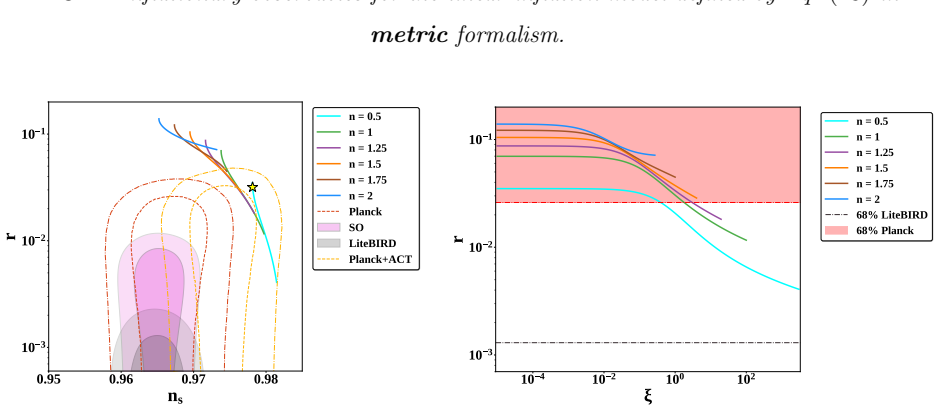
The paper claims that scalar-induced multi-phase inflation with non-minimal coupling yields ns approximately 0.93 to 0.98 in both metric and Palatini cases. Metric realizations permit tensor-to-scalar ratios up to 0.03, whereas Palatini realizations give r less than or equal to 10 to the minus 5, with sub-Planckian field excursions. Reheating occurs via inflaton decays into Higgs and fermionic dark matter through the portal coupling lambda12 and Yukawa y chi, with radiative stability requiring couplings between 10 to the minus 7 and 10 to the minus 3. This produces reheating temperatures from 4 MeV to 10^15 GeV, allows non-thermal dark matter production for masses from keV to PeV with y chi,
What carries the argument
Non-minimally coupled scalar field driving multi-phase inflation, with reheating and particle production controlled by the portal coupling lambda12 and the Yukawa coupling y chi under radiative stability constraints.
If this is right
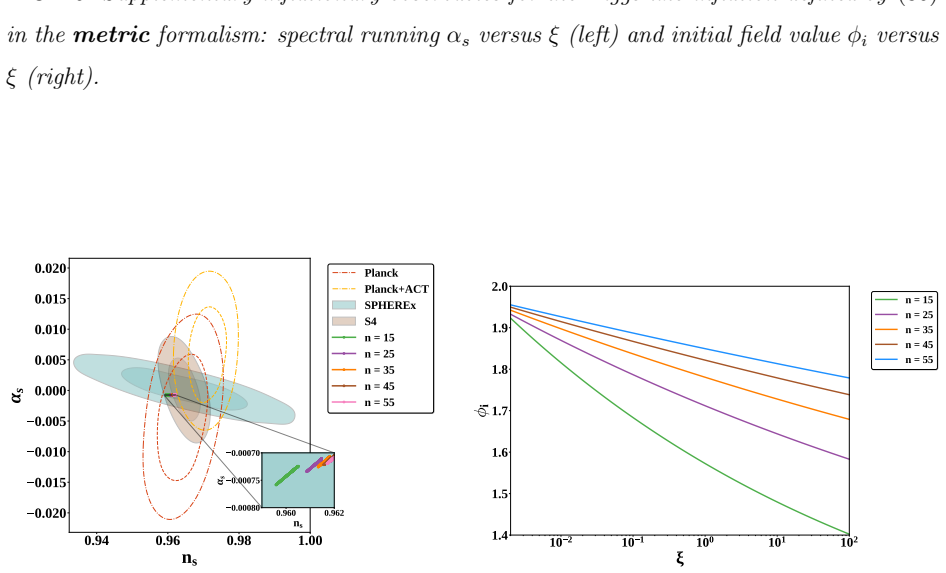
- Both metric and Palatini formulations produce scalar spectral indices between 0.93 and 0.98 that match Planck and combined Planck plus ACT data.
- Metric models allow tensor-to-scalar ratios up to 0.03 while Palatini models are restricted to values below 10 to the minus 5.
- Non-thermal dark matter production from inflaton decays is viable for masses between keV and PeV when the Yukawa coupling is below 10 to the minus 6.
- Successful non-thermal leptogenesis requires the inflaton-right-handed neutrino Yukawa coupling to lie in a range set by the lightest right-handed neutrino mass between 10^9 and 10^14 GeV and the maximum temperature after reheating.
- Palatini scenarios impose narrower parameter space because they demand smaller couplings and lower maximum temperatures.
Where Pith is reading between the lines
- Palatini realizations would predict an absence of detectable primordial gravitational waves at the level r approximately 0.01, directing future experiments toward other observables such as specific dark matter properties or non-Gaussianities.
- The tight radiative stability bounds suggest that protecting the inflationary plateau may require additional symmetries or dynamical mechanisms not explored in the paper.
- The framework could be extended by including the effects of the produced dark matter or right-handed neutrinos on the subsequent thermal history, potentially tightening the leptogenesis window further.
Load-bearing premise
Radiative stability of the inflationary plateau requires the portal and Yukawa couplings to remain small enough that reheating proceeds only through perturbative inflaton decays.
What would settle it
A future measurement of the tensor-to-scalar ratio r greater than 0.03 would rule out the Palatini realizations and strain the metric realizations described.
Figures







read the original abstract
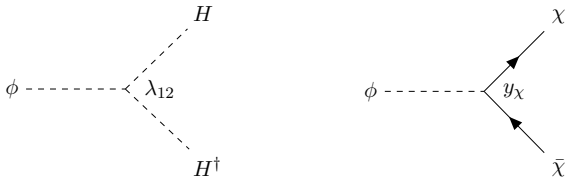
We study non-minimally coupled scalar-induced multi-phase inflation in metric and Palatini gravity, considering linear, Brans-Dicke-like, and Higgs-like sectors. The scalar spectral index lies in the range \( n_s \simeq 0.93 \ \text{--} \ 0.98 \), consistent with \textit{Planck} and combined \textit{Planck}+ACT data. The tensor-to-scalar ratio can reach \( r \sim 0.03 \) in metric, whereas Palatini models generically predict \( r \lesssim 10^{-5} \). In the Palatini case, field excursions remain sub-Planckian, and the perturbative unitarity cutoff is raised. Reheating proceeds via perturbative inflaton decays into Higgs bosons and fermionic dark matter (DM) through the portal coupling \( \lambda_{12} \) and Yukawa coupling \( y_\chi \). Radiative stability of the inflationary plateau constrains the couplings to \( y_\chi, \lambda_{12} \sim 10^{-7} \ \text{--} \ 10^{-3} \), implying \( 4\,\mathrm{MeV} \lesssim T_{\rm rh} \lesssim 10^{15}\,\mathrm{GeV} \). Palatini realizations require smaller couplings and thus a narrower reheating window. Non-thermal DM production $\chi$ from inflaton decays is viable for DM mass \( m_\chi \sim \mathrm{keV} \ \text{--} \ \mathrm{PeV} \) with \( y_\chi \lesssim 10^{-6} \) over large parameter regions. We estimate the inflaton-right-handed neutrino (RHN) Yukawa coupling \( y_N \) required for successful baryogenesis via non-thermal leptogenesis within a Type-I seesaw framework, for the lightest RHN mass \( M_{N_1} \sim 10^{9} \ \text{--} \ 10^{14}\,\mathrm{GeV} \), provided \( M_{N_1} > T_{\rm max} \), where \( T_{\rm max} \) follows from radiatively consistent reheating. In Palatini scenarios, the lower maximal temperature and tighter stability bounds further restrict the leptogenesis parameter space.
Editorial analysis
A structured set of objections, weighed in public.
Referee Report
Summary. The paper studies non-minimally coupled scalar-induced multi-phase inflation in metric and Palatini gravity across linear, Brans-Dicke-like, and Higgs-like sectors. It reports ns in the range 0.93–0.98 (consistent with Planck and Planck+ACT), r up to ~0.03 in metric gravity versus r ≲ 10^{-5} in Palatini, sub-Planckian field excursions in Palatini, and reheating via perturbative inflaton decays to Higgs and fermionic DM through λ12 and yχ. Radiative stability is invoked to bound yχ, λ12 ~ 10^{-7}–10^{-3}, yielding 4 MeV ≲ Trh ≲ 10^{15} GeV, with viability claims for non-thermal DM (mχ ~ keV–PeV, yχ ≲ 10^{-6}) and non-thermal leptogenesis via yN for MN1 ~ 10^9–10^{14} GeV.
Significance. If the stability bounds and reheating derivations hold, the work provides a comparative analysis of metric versus Palatini realizations that links inflation to post-inflationary DM and baryogenesis, with potentially observable differences in r and field excursions. The explicit parameter windows for DM and leptogenesis under stability constraints could guide model building, though the absence of detailed loop calculations limits immediate falsifiability.
major comments (1)
- [Reheating and stability analysis] Reheating and stability analysis (abstract and associated reheating discussion): the claim that radiative stability constrains yχ, λ12 ∼ 10^{-7}–10^{-3} and thereby fixes 4 MeV ≲ Trh ≲ 10^{15} GeV is load-bearing for the DM viability (mχ ∼ keV–PeV) and leptogenesis (MN1 > Tmax) ranges, yet no explicit one-loop effective potential, renormalization-scale choice, or truncation-order check is supplied to confirm that slow-roll parameters remain controlled across this coupling interval.
minor comments (2)
- [Abstract] The abstract states consistency with Planck and Planck+ACT data for ns but does not quote the specific central values or error bars used for comparison.
- [Reheating discussion] Notation for the portal coupling λ12 and Yukawa yχ is introduced without an explicit Lagrangian term or interaction vertex diagram in the provided text.
Simulated Author's Rebuttal
We thank the referee for the careful reading of our manuscript and the constructive feedback. We appreciate the positive assessment of the comparative analysis between metric and Palatini realizations and the potential implications for dark matter and leptogenesis. We address the single major comment below.
read point-by-point responses
-
Referee: [Reheating and stability analysis] Reheating and stability analysis (abstract and associated reheating discussion): the claim that radiative stability constrains yχ, λ12 ∼ 10^{-7}–10^{-3} and thereby fixes 4 MeV ≲ Trh ≲ 10^{15} GeV is load-bearing for the DM viability (mχ ∼ keV–PeV) and leptogenesis (MN1 > Tmax) ranges, yet no explicit one-loop effective potential, renormalization-scale choice, or truncation-order check is supplied to confirm that slow-roll parameters remain controlled across this coupling interval.
Authors: We agree that an explicit derivation of the radiative stability bounds would strengthen the presentation and make the constraints on y_χ and λ_{12} more transparent. The quoted range follows from requiring that one-loop corrections (via the Coleman-Weinberg potential) do not lift the inflationary plateau enough to violate slow-roll conditions, using the standard renormalization prescription in non-minimally coupled models where the scale is chosen at the background field value during inflation. To address the concern directly, in the revised manuscript we will add a dedicated subsection (or appendix) that: (i) writes the explicit one-loop effective potential for the relevant sectors, (ii) specifies the renormalization-scale choice and its justification, and (iii) provides a truncation-order estimate by power-counting higher-loop contributions and verifying that they remain sub-dominant for the quoted coupling window. This addition will confirm that the slow-roll parameters stay controlled and will support the subsequent DM and leptogenesis viability ranges. We believe these clarifications will also improve the falsifiability of the stability claims. revision: yes
Circularity Check
No significant circularity; stability constraint is independent of viability claims
full rationale
The derivation begins with the inflationary potential in metric and Palatini gravity, yielding ns in 0.93-0.98 and r values as direct outputs of the slow-roll parameters. Radiative stability is imposed as an external consistency requirement on the portal and Yukawa couplings (yχ, λ12 ∼ 10^{-7}–10^{-3}), which then determines the allowed Trh window via standard perturbative decay rate formulas. DM and leptogenesis viability are subsequently checked inside that window (mχ ∼ keV–PeV, yχ ≲ 10^{-6}, yN estimates for M_N1 > T_max). This is a one-way restriction of parameter space rather than any reduction of the claimed predictions to the inputs by construction. No self-definitional loop, fitted quantity renamed as prediction, or load-bearing self-citation appears in the chain; the stability condition is falsifiable independently of the final DM/leptogenesis statements.
Axiom & Free-Parameter Ledger
free parameters (3)
- portal coupling λ12
- Yukawa coupling yχ
- inflaton-RHN Yukawa yN
axioms (3)
- domain assumption Reheating proceeds via perturbative inflaton decays to Higgs and fermionic DM
- domain assumption Type-I seesaw framework for leptogenesis with lightest RHN mass M_N1
- domain assumption Inflationary plateau remains radiatively stable for the chosen couplings
Forward citations
Cited by 1 Pith paper
-
Nonthermal leptogenesis via cosmological gravitational particle production is tested by inflationary gravitational waves
Certain inflation models produce right-handed neutrinos via gravitational effects sufficient for leptogenesis to explain the baryon asymmetry, testable by inflationary gravitational waves.
Reference graph
Works this paper leans on
-
[1]
phenomenological filter
Integrating out the heavyN j yields the effective Majorana mass matrix for light neutrinos [112, 113] emν =−m T DM −1 N mD =− v2 2 Y T M −1 N Y,(81) whereM N = diag(MN1, MN2, MN3). The essence of the seesaw mechanism can be captured in its simplest single-generation form: the light neutrino mass is approximatelym ν ≈m 2 D/MN, where a large Majorana massM ...
-
[2]
Starobinsky,A New Type of Isotropic Cosmological Models Without Singularity,Phys
A.A. Starobinsky,A New Type of Isotropic Cosmological Models Without Singularity,Phys. Lett. B91(1980) 99
1980
-
[3]
Guth,The Inflationary Universe: A Possible Solution to the Horizon and Flatness Problems,Phys.Rev.D23(1981) 347
A.H. Guth,The Inflationary Universe: A Possible Solution to the Horizon and Flatness Problems,Phys.Rev.D23(1981) 347. 58
1981
-
[4]
Linde,A New Inflationary Universe Scenario: A Possible Solution of the Horizon, Flatness, Homogeneity, Isotropy and Primordial Monopole Problems,Phys.Lett.B108 (1982) 389
A.D. Linde,A New Inflationary Universe Scenario: A Possible Solution of the Horizon, Flatness, Homogeneity, Isotropy and Primordial Monopole Problems,Phys.Lett.B108 (1982) 389
1982
-
[5]
A. Albrecht and P.J. Steinhardt,Cosmology for Grand Unified Theories with Radiatively Induced Symmetry Breaking,Phys.Rev.Lett.48(1982) 1220. [5]BICEP, Keckcollaboration,Improved Constraints on Primordial Gravitational Waves using Planck, WMAP, and BICEP/Keck Observations through the 2018 Observing Season, Phys. Rev. Lett.127(2021) 151301 [2110.00483]. [6]...
-
[6]
F. Bauer and D.A. Demir,Higgs-Palatini Inflation and Unitarity,Phys. Lett. B698(2011) 425 [1012.2900]
-
[7]
S. Rasanen and E. Tomberg,Planck scale black hole dark matter from Higgs inflation, JCAP01(2019) 038 [1810.12608]
-
[8]
Enckell, K
V.-M. Enckell, K. Enqvist, S. R¨ as¨ anen and L.-P. Wahlman,Inflation with r2 term in the palatini formulation,Journal of Cosmology and Astroparticle Physics2019(2019) 022
2019
-
[9]
Tenkanen,Tracing the high energy theory of gravity: an introduction to Palatini inflation,Gen
T. Tenkanen,Tracing the high energy theory of gravity: an introduction to Palatini inflation,Gen. Rel. Grav.52(2020) 33 [2001.10135]
-
[10]
McDonald,Does Palatini Higgs Inflation Conserve Unitarity?,JCAP04(2021) 069 [2007.04111]
J. McDonald,Does Palatini Higgs Inflation Conserve Unitarity?,JCAP04(2021) 069 [2007.04111]
- [11]
-
[12]
N. Bostan, R.H. Dejrah, C. Dioguardi and A. Racioppi,Natural inflation in Palatini F(R,X),JCAP07(2025) 082 [2503.16324]
-
[13]
N. Bostan, R.H. Dejrah, C. Dioguardi and A. Racioppi,Natural inflation in PalatiniF(R), 2511.20557
-
[14]
Zee,A Broken Symmetric Theory of Gravity,Phys
A. Zee,A Broken Symmetric Theory of Gravity,Phys. Rev. Lett.42(1979) 417
1979
-
[15]
Spokoiny,INFLATION AND GENERATION OF PERTURBATIONS IN BROKEN SYMMETRIC THEORY OF GRAVITY,Phys
B.L. Spokoiny,INFLATION AND GENERATION OF PERTURBATIONS IN BROKEN SYMMETRIC THEORY OF GRAVITY,Phys. Lett. B147(1984) 39. 59
1984
-
[16]
Fakir and W.G
R. Fakir and W.G. Unruh,Induced gravity inflation,Phys. Rev. D41(1990) 1792
1990
-
[17]
J.L. Cervantes-Cota and H. Dehnen,Induced gravity inflation in the SU(5) GUT,Phys. Rev. D51(1995) 395 [astro-ph/9412032]
-
[18]
I.D. Gialamas, A. Karam and A. Racioppi,Dynamically induced Planck scale and inflation in the Palatini formulation,JCAP11(2020) 014 [2006.09124]
-
[19]
Silk and M.S
J. Silk and M.S. Turner,Double Inflation,Phys. Rev. D35(1987) 419
1987
-
[20]
Polarski and A.A
D. Polarski and A.A. Starobinsky,Spectra of perturbations produced by double inflation with an intermediate matter dominated stage,Nucl. Phys. B385(1992) 623
1992
-
[21]
Adams, G.G
J.A. Adams, G.G. Ross and S. Sarkar,Multiple inflation,Nuclear Physics B503(1997) 405
1997
-
[22]
C.P. Burgess, R. Easther, A. Mazumdar, D.F. Mota and T. Multamaki,Multiple inflation, cosmic string networks and the string landscape,JHEP05(2005) 067 [hep-th/0501125]
-
[23]
M. Artymowski, Z. Lalak and M. Lewicki,Multi-phase induced inflation in theories with non-minimal coupling to gravity,JCAP01(2017) 011 [1607.01803]
-
[24]
K. Kannike, A. Racioppi and M. Raidal,Linear inflation from quartic potential,JHEP01 (2016) 035 [1509.05423]
-
[25]
M. Artymowski and A. Racioppi,Scalar-tensor linear inflation,JCAP04(2017) 007 [1610.09120]
-
[26]
A. Cerioni, F. Finelli, A. Tronconi and G. Venturi,Inflation and Reheating in Induced Gravity,Phys. Lett. B681(2009) 383 [0906.1902]
-
[27]
Z. Lalak and L. Nakonieczny,Darkflation—One scalar to rule them all?,Phys. Dark Univ. 15(2017) 125 [1609.06887]
-
[28]
K.D. Lozanov and M.A. Amin,Equation of State and Duration to Radiation Domination after Inflation,Phys. Rev. Lett.119(2017) 061301 [1608.01213]
-
[29]
Racioppi,Coleman-Weinberg linear inflation: metric vs
A. Racioppi,Coleman-Weinberg linear inflation: metric vs. Palatini formulation,JCAP12 (2017) 041 [1710.04853]
- [30]
-
[31]
M. Drees and Y. Xu,Small field polynomial inflation: reheating, radiative stability and lower bound,JCAP09(2021) 012 [2104.03977]
-
[32]
N. Bernal and Y. Xu,Polynomial inflation and dark matter,Eur. Phys. J. C81(2021) 877 60 [2106.03950]
-
[33]
A. Ghoshal, M.Y. Khlopov, Z. Lalak and S. Porey,Post-inflationary production of particle dark matter: Hilltop and Coleman-Weinberg inflation,Phys. Rev. D109(2024) 063037 [2306.09409]
-
[34]
A. Ghoshal, Z. Lalak, S. Pal and S. Porey,Post-inflationary leptogenesis and dark matter production: metric versus Palatini formalism,JHEP06(2024) 038 [2401.17262]
-
[35]
M. Drees and Y. Xu,Parameter space of leptogenesis in polynomial inflation,JCAP04 (2024) 036 [2401.02485]
-
[36]
Rubin, W.K
V.C. Rubin, W.K. Ford, Jr. and N. Thonnard,Rotational properties of 21 SC galaxies with a large range of luminosities and radii, from NGC 4605 (R=4kpc) to UGC 2885 (R=122kpc).,Astrophys. J.238(1980) 471
1980
-
[37]
A direct empirical proof of the existence of dark matter
D. Clowe, M. Bradac, A.H. Gonzalez, M. Markevitch, S.W. Randall, C. Jones et al.,A direct empirical proof of the existence of dark matter,Astrophys. J. Lett.648(2006) L109 [astro-ph/0608407]. [40]Planckcollaboration,Planck 2018 results. VI. Cosmological parameters,Astron. Astrophys.641(2020) A6 [1807.06209]
work page Pith review arXiv 2006
-
[38]
Particle Dark Matter: Evidence, Candidates and Constraints
G. Bertone, D. Hooper and J. Silk,Particle dark matter: Evidence, candidates and constraints,Phys. Rept.405(2005) 279 [hep-ph/0404175]
work page Pith review arXiv 2005
-
[39]
D.J.H. Chung, E.W. Kolb, A. Riotto and L. Senatore,Isocurvature constraints on gravitationally produced superheavy dark matter,Phys. Rev. D72(2005) 023511 [astro-ph/0411468]
-
[40]
Reheating in Inflationary Cosmology: Theory and Applications,
R. Allahverdi, R. Brandenberger, F.-Y. Cyr-Racine and A. Mazumdar,Reheating in Inflationary Cosmology: Theory and Applications,Ann. Rev. Nucl. Part. Sci.60(2010) 27 [1001.2600]
- [41]
-
[42]
Y. Mambrini and K.A. Olive,Gravitational Production of Dark Matter during Reheating, Phys. Rev. D103(2021) 115009 [2102.06214]. [46]Particle Data Groupcollaboration,Review of Particle Physics,PTEP2022(2022) 083C01. 61
-
[43]
Sakharov,Violation of CP Invariance, C asymmetry, and baryon asymmetry of the universe,Pisma Zh
A.D. Sakharov,Violation of CP Invariance, C asymmetry, and baryon asymmetry of the universe,Pisma Zh. Eksp. Teor. Fiz.5(1967) 32
1967
-
[44]
Matter and Antimatter in the Universe,
L. Canetti, M. Drewes and M. Shaposhnikov,Matter and Antimatter in the Universe,New J. Phys.14(2012) 095012 [1204.4186]. [49]Super-Kamiokandecollaboration,Evidence for oscillation of atmospheric neutrinos, Phys. Rev. Lett.81(1998) 1562 [hep-ex/9807003]. [50]SNOcollaboration,Measurement of the rate ofν e +d→p+p+e − interactions produced by 8B solar neutrin...
-
[45]
Minkowski,µ→eγat a Rate of One Out of10 9 Muon Decays?,Phys
P. Minkowski,µ→eγat a Rate of One Out of10 9 Muon Decays?,Phys. Lett. B67(1977) 421
1977
-
[46]
Complex Spinors and Unified Theories
M. Gell-Mann, P. Ramond and R. Slansky,Complex Spinors and Unified Theories,Conf. Proc. C790927(1979) 315 [1306.4669]
work page Pith review arXiv 1979
-
[47]
Mohapatra and G
R.N. Mohapatra and G. Senjanovic,Neutrino Mass and Spontaneous Parity Nonconservation,Phys. Rev. Lett.44(1980) 912
1980
-
[48]
Magg and C
M. Magg and C. Wetterich,Neutrino mass problem and gauge hierarchy,Physics Letters B 94(1980) 61
1980
-
[49]
R. Foot, H. Lew, X.G. He and G.C. Joshi,Seesaw Neutrino Masses Induced by a Triplet of Leptons,Z. Phys. C44(1989) 441
1989
-
[50]
Zee,A Theory of Lepton Number Violation, Neutrino Majorana Mass, and Oscillation, Phys
A. Zee,A Theory of Lepton Number Violation, Neutrino Majorana Mass, and Oscillation, Phys. Lett. B93(1980) 389
1980
- [51]
-
[52]
Fukugita and T
M. Fukugita and T. Yanagida,Baryogenesis Without Grand Unification,Phys. Lett. B174 (1986) 45
1986
-
[53]
Towards a complete theory of thermal leptogenesis in the SM and MSSM
G.F. Giudice, A. Notari, M. Raidal, A. Riotto and A. Strumia,Towards a complete theory of thermal leptogenesis in the SM and MSSM,Nucl. Phys. B685(2004) 89 [hep-ph/0310123]
work page internal anchor Pith review Pith/arXiv arXiv 2004
-
[54]
F. Hahn-Woernle and M. Plumacher,Effects of reheating on leptogenesis,Nucl. Phys. B 806(2009) 68 [0801.3972]
-
[55]
Quantum Grav.21 3817 [arXiv:gr-qc/0403063]
E.E. Flanagan,The Conformal frame freedom in theories of gravitation,Class. Quant. 62 Grav.21(2004) 3817 [gr-qc/0403063]
-
[56]
V. Faraoni and S. Nadeau,The (pseudo)issue of the conformal frame revisited,Phys. Rev. D75(2007) 023501 [gr-qc/0612075]
-
[57]
T. Chiba and M. Yamaguchi,Conformal-Frame (In)dependence of Cosmological Observations in Scalar-Tensor Theory,JCAP10(2013) 040 [1308.1142]
-
[58]
M. Postma and M. Volponi,Equivalence of the Einstein and Jordan frames,Phys. Rev. D 90(2014) 103516 [1407.6874]
-
[59]
The Unity of Cosmological Attractors
M. Galante, R. Kallosh, A. Linde and D. Roest,Unity of Cosmological Inflation Attractors, Phys. Rev. Lett.114(2015) 141302 [1412.3797]
work page Pith review arXiv 2015
-
[60]
Lyth and A.R
D.H. Lyth and A.R. Liddle,The primordial density perturbation: Cosmology, inflation and the origin of structure(2009)
2009
-
[61]
A. Racioppi and M. Vasar,On the number of e-folds in the Jordan and Einstein frames, Eur. Phys. J. Plus137(2022) 637 [2111.09677]
-
[62]
Linde, M
A. Linde, M. Noorbala and A. Westphal,Observational consequences of chaotic inflation with nonminimal coupling to gravity,Journal of Cosmology and Astroparticle Physics2011 (2011) 013–013
2011
-
[63]
Planck 2018 results. X. Constraints on inflation
A.R. Liddle and S.M. Leach,How long before the end of inflation were observable perturbations produced?,Physical Review D68(2003) . [70]Planckcollaboration,Planck 2018 results. X. Constraints on inflation,Astron. Astrophys. 641(2020) A10 [1807.06211]. [71]ACTcollaboration,The Atacama Cosmology Telescope: DR6 Constraints on Extended Cosmological Models,2503.14454
work page internal anchor Pith review arXiv 2003
-
[64]
M. Hazumi et al.,Litebird satellite: Jaxa’s new strategic l-class mission for all-sky surveys of cosmic microwave background polarization, inSpace Telescopes and Instrumentation 2020: Optical, Infrared, and Millimeter Wave, SPIE, Dec., 2020, DOI. [73]Simons Observatorycollaboration,The Simons Observatory: Science goals and forecasts, JCAP02(2019) 056 [1808.07445]
work page Pith review arXiv 2020
-
[65]
On the Geometry of the String Landscape and the Swampland
H. Ooguri and C. Vafa,On the Geometry of the String Landscape and the Swampland, Nucl. Phys. B766(2007) 21 [hep-th/0605264]
work page Pith review arXiv 2007
-
[66]
De Sitter Space and the Swampland
G. Obied, H. Ooguri, L. Spodyneiko and C. Vafa,De Sitter Space and the Swampland, 1806.08362. 63
- [67]
- [68]
-
[69]
Lectures on Reheating after Inflation,
K.D. Lozanov,Lectures on Reheating after Inflation,1907.04402
-
[70]
J.F. Dufaux, G.N. Felder, L. Kofman, M. Peloso and D. Podolsky,Preheating with trilinear interactions: Tachyonic resonance,JCAP07(2006) 006 [hep-ph/0602144]
-
[71]
Coleman and E
S. Coleman and E. Weinberg,Radiative corrections as the origin of spontaneous symmetry breaking,Phys. Rev. D7(1973) 1888
1973
-
[72]
Bostan,Reheating constraints to palatini Coleman-Weinberg inflation,Turkish Journal of Physics48(2024) 28
N. Bostan,Reheating constraints to palatini Coleman-Weinberg inflation,Turkish Journal of Physics48(2024) 28
2024
-
[73]
Drees and Y
M. Drees and Y. Xu,Small field polynomial inflation: reheating, radiative stability and lower bound,Journal of Cosmology and Astroparticle Physics2021(2021) 012
2021
-
[74]
Sarkar,Big bang nucleosynthesis and physics beyond the standard model,Rept
S. Sarkar,Big bang nucleosynthesis and physics beyond the standard model,Rept. Prog. Phys.59(1996) 1493 [hep-ph/9602260]
-
[75]
M. Kawasaki, K. Kohri and N. Sugiyama,MeV scale reheating temperature and thermalization of neutrino background,Phys. Rev. D62(2000) 023506 [astro-ph/0002127]
-
[76]
S. Hannestad,What is the lowest possible reheating temperature?,Phys. Rev. D70(2004) 043506 [astro-ph/0403291]
-
[77]
De Bernardis, L
F. De Bernardis, L. Pagano and A. Melchiorri,New constraints on the reheating temperature of the universe after wmap-5,Astroparticle Physics30(2008) 192
2008
-
[78]
Bounds on very low reheating scenarios after Planck
P.F. de Salas, M. Lattanzi, G. Mangano, G. Miele, S. Pastor and O. Pisanti,Bounds on very low reheating scenarios after Planck,Phys. Rev. D92(2015) 123534 [1511.00672]. [88]Planckcollaboration,Planck 2018 results. X. Constraints on inflation,Astron. Astrophys. 641(2020) A10 [1807.06211]
work page Pith review arXiv 2015
-
[79]
Largest temperature of the radiation era and its cosmological implications
G.F. Giudice, E.W. Kolb and A. Riotto,Largest temperature of the radiation era and its cosmological implications,Phys. Rev. D64(2001) 023508 [hep-ph/0005123]
work page Pith review arXiv 2001
-
[80]
Ghoshal, Z
A. Ghoshal, Z. Lalak, S. Pal and S. Porey,Post-inflationary leptogenesis and dark matter production: metric versus palatini formalism,Journal of High Energy Physics2024(2024)
2024
discussion (0)
Sign in with ORCID, Apple, or X to comment. Anyone can read and Pith papers without signing in.