Recognition: unknown
All-charm tetraquarks at hadron colliders: A high-precision fragmentation perspective
Pith reviewed 2026-05-10 15:10 UTC · model grok-4.3
The pith
This paper supplies the TQ4Q2.0 fragmentation functions for all-heavy tetraquarks in high-energy hadronic collisions.
A machine-rendered reading of the paper's core claim, the machinery that carries it, and where it could break.
Core claim
We present the TQ4Q2.0 fragmentation functions for the production of all-heavy S-wave tetraquarks with scalar, axial-vector, and tensor quantum numbers in high-energy hadronic collisions. This work extends the previous framework by incorporating nonconstituent heavy-quark contributions and introducing a replica-based uncertainty-quantification strategy derived from multi-scale variations. The construction follows a nonrelativistic QCD factorization approach combining gluon- and heavy-quark-initiated fragmentation channels at leading power, with initial-scale inputs modeled through updated potential-inspired wave functions and subsequent DGLAP evolution performed via the threshold-aware HF-NR
What carries the argument
The TQ4Q2.0 fragmentation functions that give the probability for a gluon or heavy quark to fragment into an all-heavy tetraquark state, starting from low-scale wave-function inputs and evolved to collider energies.
If this is right
- Precise predictions for all-charm tetraquark production cross sections become available for high-energy hadron colliders.
- Systematic uncertainties arising from long-distance matrix elements and multiscale perturbative inputs are quantified for reliable use in phenomenology.
- The publicly released grids enable studies of jet-associated observables involving these tetraquarks within existing simulation frameworks.
- A complete baseline is established for future collider analyses of all-heavy multiquark states.
Where Pith is reading between the lines
- The functions could be applied directly to reinterpret existing LHC data searches for fully heavy tetraquarks.
- The replica-based uncertainty method may transfer to fragmentation calculations for other exotic heavy states or mixed-flavor tetraquarks.
- This completes a resummation-driven program that could guide extensions to higher-order corrections or different collision energies.
Load-bearing premise
The initial values at the low starting energy scale are taken from wave functions inspired by quark potential models, and the factorization into short-distance and long-distance parts holds at the leading level for these tetraquark states.
What would settle it
A measurement of all-charm tetraquark production rates in proton-proton collisions at the LHC that deviates substantially from the cross sections predicted by convoluting the TQ4Q2.0 functions with parton distributions would falsify the leading-power description.
Figures
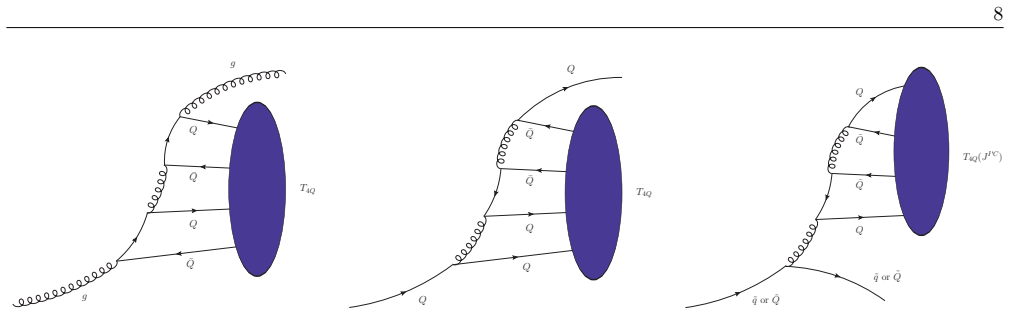


read the original abstract
We present the TQ4Q2.0 fragmentation functions for the production of all-heavy (fully heavy) $S$-wave tetraquarks ($T_{4Q}$) with scalar ($0^{++}$), axial-vector ($1^{+-}$), and tensor ($2^{++}$) quantum numbers in high-energy hadronic collisions. This work extends the previous TQ4Q1.1 framework by incorporating nonconstituent heavy-quark contributions and introducing a replica-based uncertainty-quantification strategy derived from multi-scale variations (MHOUs). The construction follows a nonrelativistic QCD factorization approach, combining gluon- and heavy-quark-initiated fragmentation channels at leading power. Initial-scale inputs are modeled through updated potential-inspired wave functions, while the subsequent DGLAP evolution is performed via the threshold-aware HF-NRevo scheme. A comprehensive systematic analysis of uncertainties is carried out, with contributions from color-composite long-distance matrix elements (LDMEs) and perturbative multiscale inputs. The resulting TQ4Q2.0 grids, publicly released in LHAPDF6 format, provide the first complete phenomenological set for all-heavy exotics, enabling precise studies of all-charm tetraquark production and jet-associated observables within the JETHAD environment. This article completes the high-energy resummation-driven generation of the TQ4Q program and establishes a definitive baseline for future collider-oriented analyses of all-heavy multiquark dynamics.
Editorial analysis
A structured set of objections, weighed in public.
Referee Report
Summary. The manuscript constructs and publicly releases the TQ4Q2.0 fragmentation functions for all-charm S-wave tetraquarks (T_{4Q}) with 0^{++}, 1^{+-}, and 2^{++} quantum numbers. It extends the prior TQ4Q1.1 framework by adding nonconstituent heavy-quark contributions, employs NRQCD factorization at leading power for gluon- and heavy-quark-initiated channels, models initial-scale inputs via updated potential-inspired wave functions, performs DGLAP evolution with the threshold-aware HF-NRevo scheme, and quantifies uncertainties through a replica-based multi-scale variation (MHOU) strategy on color-composite LDMEs and perturbative inputs. The grids are provided in LHAPDF6 format for use in the JETHAD environment.
Significance. If the leading-power NRQCD assumption holds, this supplies the first complete phenomenological fragmentation-function set for all-heavy tetraquarks together with systematic uncertainty bands, directly enabling collider studies of all-charm exotic production and jet-associated observables. The public grid release and the incorporation of a threshold-aware evolution scheme are concrete strengths that lower the barrier for phenomenological applications.
major comments (2)
- [Abstract and the NRQCD factorization framework section] The central claim rests on the applicability of leading-power NRQCD factorization to all-heavy tetraquarks, yet the manuscript provides no explicit power-counting argument or numerical estimate showing that higher-power operators (involving two heavy-quark pairs or additional color-octet transitions) remain suppressed at the relevant fragmentation scales; this assumption is load-bearing for the entire TQ4Q2.0 construction.
- [Section describing initial-scale modeling and LDME determination] Initial-scale inputs are obtained from potential-inspired wave functions whose parameters are fitted rather than derived; while the replica strategy quantifies variation among these inputs, it does not remove the model dependence that enters the LDMEs and therefore propagates directly into the quoted fragmentation functions.
minor comments (2)
- [Abstract] The abstract states that the work 'completes the high-energy resummation-driven generation of the TQ4Q program'; a brief explicit statement of what remains for future work would improve clarity.
- [Introduction or notation section] Notation for the three quantum-number channels (0^{++}, 1^{+-}, 2^{++}) is introduced without a compact table summarizing the corresponding color and spin structures; adding such a table would aid readability.
Simulated Author's Rebuttal
We thank the referee for the careful reading of the manuscript and the constructive comments. We address each major comment below.
read point-by-point responses
-
Referee: [Abstract and the NRQCD factorization framework section] The central claim rests on the applicability of leading-power NRQCD factorization to all-heavy tetraquarks, yet the manuscript provides no explicit power-counting argument or numerical estimate showing that higher-power operators (involving two heavy-quark pairs or additional color-octet transitions) remain suppressed at the relevant fragmentation scales; this assumption is load-bearing for the entire TQ4Q2.0 construction.
Authors: We acknowledge that the manuscript does not contain an explicit power-counting argument or numerical estimate for the suppression of higher-power operators. The leading-power NRQCD factorization is adopted following the standard velocity scaling rules established for heavy quarkonia, where higher-power contributions are suppressed by powers of the relative velocity v^2 (with v^2 approximately 0.1-0.3 for charm systems, inferred from binding energies). Analogous scaling is expected to hold for all-heavy tetraquarks. We will add a concise discussion of this velocity power counting to the NRQCD factorization framework section, including references to the relevant literature. A quantitative numerical estimate of higher-power effects would require dedicated non-perturbative calculations of additional LDMEs that lie outside the present scope. revision: partial
-
Referee: [Section describing initial-scale modeling and LDME determination] Initial-scale inputs are obtained from potential-inspired wave functions whose parameters are fitted rather than derived; while the replica strategy quantifies variation among these inputs, it does not remove the model dependence that enters the LDMEs and therefore propagates directly into the quoted fragmentation functions.
Authors: We agree that the initial-scale inputs are obtained from potential-inspired wave functions with fitted parameters and that the replica strategy quantifies variations within this framework without eliminating the underlying model dependence. This dependence is inherent to the current phenomenological determination of the color-composite LDMEs, as first-principles calculations are not yet available. The replica approach provides a practical estimate of the associated uncertainties through multi-scale variations. We will revise the initial-scale modeling section to explicitly note this model dependence and its propagation into the fragmentation functions. revision: yes
Circularity Check
No significant circularity; model construction is explicit
full rationale
The paper explicitly states that it constructs the TQ4Q2.0 fragmentation functions by applying standard NRQCD factorization at leading power, with initial-scale inputs modeled via potential-inspired wave functions and DGLAP evolution via HF-NRevo. It acknowledges the inputs as modeled rather than derived from first principles and extends a prior framework without claiming the central result reduces to unverified self-citation or fitted parameters renamed as predictions. No load-bearing step equates the output FFs to the inputs by construction; the work is a transparent phenomenological model release, self-contained against external benchmarks like standard NRQCD applications in quarkonium studies.
Axiom & Free-Parameter Ledger
free parameters (2)
- LDMEs
- initial-scale wave-function parameters
axioms (2)
- domain assumption NRQCD factorization at leading power
- domain assumption Validity of DGLAP evolution with HF-NRevo scheme
Forward citations
Cited by 1 Pith paper
-
Multimodal Fragmentation of All-Heavy Pentaquarks: Uncertainty-Aware Predictions for Hadron Colliders
Develops uncertainty-aware fragmentation functions PQ5Q1.1 for all-charm pentaquarks using multimodal perturbative and nonperturbative modeling for collider predictions.
Reference graph
Works this paper leans on
-
[1]
Science Requirements and Detector Concepts for the Electron-Ion Collider: EIC Yellow Report
R. Abdul Khaleket al., Nucl. Phys. A1026, 122447 (2022), arXiv:2103.05419 [physics.ins-det]
work page internal anchor Pith review arXiv 2022
-
[2]
Abdul Khalek et al., in2022 Snowmass Summer Study(2022),2203.13199
R. Abdul Khaleket al., in2022 Snowmass Summer 41 Study(2022) arXiv:2203.13199 [hep-ph]
-
[3]
M. Hentschinskiet al., Acta Phys. Polon. B54, 2 (2023), arXiv:2203.08129 [hep-ph]
-
[4]
S. Amorosoet al., Acta Phys. Polon. B53, A1 (2022), arXiv:2203.13923 [hep-ph]
- [5]
-
[6]
C. Allaireet al., Comput. Softw. Big Sci.8, 5 (2024), arXiv:2307.08593 [physics.acc-ph]
-
[7]
Future Circular Collider Feasibility Study Report: Vol- ume 1, Physics, Experiments, Detectors,
M. Benediktet al.(FCC), Eur. Phys. J. C85, 1468 (2025), arXiv:2505.00272 [hep-ex]
-
[8]
M. Benediktet al.(FCC), Eur. Phys. J. ST234, 5713 (2025), arXiv:2505.00274 [physics.acc-ph]
-
[9]
M. Benediktet al.(FCC), Eur. Phys. J. ST234, 5113 (2025), [Erratum: Eur.Phys.J.ST None, (2025)], arXiv:2505.00273 [physics.acc-ph]
- [10]
- [11]
- [12]
- [13]
- [14]
- [15]
- [16]
- [17]
- [18]
- [19]
- [20]
- [21]
- [22]
- [23]
-
[24]
Fully charm tetraquark production at hadronic collisions with gluon radiation effects
Y. Wang and R. Zhu, (2025), arXiv:2510.02085 [hep- ph]
work page internal anchor Pith review Pith/arXiv arXiv 2025
- [25]
-
[26]
F. Feng and M.-M. Liu, Phys. Rev. D113, 054010 (2026), arXiv:2601.07243 [hep-ph]
- [27]
-
[28]
Braaten, How theZ c(3900) Reveals the Spectra of Quarkonium Hybrid and Tetraquark Mesons, Phys
E. Braaten, Phys. Rev. Lett.111, 162003 (2013), arXiv:1305.6905 [hep-ph]
-
[29]
M. Berwein, N. Brambilla, J. Tarr´ us Castell` a, and A. Vairo, Phys. Rev. D92, 114019 (2015), arXiv:1510.04299 [hep-ph]
-
[30]
P. Minkowski and W. Ochs, Eur. Phys. J. C9, 283 (1999), arXiv:hep-ph/9811518
-
[31]
V. Mathieu, N. Kochelev, and V. Vento, Int. J. Mod. Phys. E18, 1 (2009), arXiv:0810.4453 [hep-ph]
- [32]
-
[33]
T. Cs¨ org˝ o, T. Novak, R. Pasechnik, A. Ster, and I. Szanyi, Eur. Phys. J. C81, 180 (2021), arXiv:1912.11968 [hep-ph]
- [34]
-
[35]
Gell-Mann, Phys
M. Gell-Mann, Phys. Lett.8, 214 (1964)
1964
-
[36]
R. L. Jaffe, Phys. Rev. D15, 267 (1977)
1977
-
[37]
R. L. Jaffe, Phys. Rev. D15, 281 (1977)
1977
-
[38]
R. L. Jaffe, Phys. Rev. Lett.38, 195 (1977), [Erratum: Phys.Rev.Lett. 38, 617 (1977)]
1977
-
[39]
J. P. Ader, J. M. Richard, and P. Taxil, Phys. Rev. D 25, 2370 (1982)
1982
-
[40]
J. L. Rosner, Phys. Rev. D33, 2043 (1986)
2043
-
[41]
S. Pepin and F. Stancu, Phys. Rev. D57, 4475 (1998), arXiv:hep-ph/9710528
-
[42]
J. Vijande, A. Valcarce, and J. M. Richard, Phys. Rev. D85, 014019 (2012), arXiv:1111.5921 [hep-ph]
-
[43]
A. Esposito, A. Pilloni, and A. D. Polosa, Phys. Rept. 668, 1 (2017), arXiv:1611.07920 [hep-ph]
- [44]
- [45]
- [46]
-
[47]
A. Ali, L. Maiani, and A. D. Polosa,Multiquark Hadrons(Cambridge University Press, 2019)
2019
- [48]
-
[49]
D. Acostaet al.(CDF), Phys. Rev. Lett.93, 072001 (2004), arXiv:hep-ex/0312021
-
[50]
R. Aaijet al.(LHCb), Phys. Rev. Lett.110, 222001 (2013), arXiv:1302.6269 [hep-ex]
- [51]
- [52]
- [53]
- [54]
-
[55]
A model-independent study of resonant structure inB + →D +D−K+ decays,
R. Aaijet al.(LHCb), Phys. Rev. Lett.125, 242001 (2020), arXiv:2009.00025 [hep-ex]
-
[56]
Aaijet al.(LHCb), Nature Phys.18, 751 (2022), 2109.01038
R. Aaijet al.(LHCb), Nature Phys.18, 751 (2022), arXiv:2109.01038 [hep-ex]
-
[57]
R. Aaijet al.(LHCb), Nature Commun.13, 3351 (2022), arXiv:2109.01056 [hep-ex]
-
[58]
S. Fleming, R. Hodges, and T. Mehen, Phys. Rev. D 104, 116010 (2021), arXiv:2109.02188 [hep-ph]
- [59]
-
[60]
R. Hodges,Studies ofT + cc Decays and Transverse- Momentum-DependentJ/ψProduction Using Effec- tive Field Theory, Phd thesis (2024), arXiv:2404.18907 [hep-ph]
- [61]
-
[62]
E. Braaten, L.-P. He, K. Ingles, and J. Jiang, Phys. Rev. D101, 096020 (2020), arXiv:2004.12841 [hep-ph]
-
[63]
R. Aaijet al.(LHCb), Sci. Bull.65, 1983 (2020), arXiv:2006.16957 [hep-ex]
- [64]
- [65]
-
[66]
A. Hayrapetyanet al.(CMS), Phys. Rev. Lett.132, 111901 (2024), arXiv:2306.07164 [hep-ex]
-
[67]
Hayrapetyanet al.(CMS), Nature648, 58 (2025), arXiv:2506.07944 [hep-ex]
A. Hayrapetyanet al.(CMS), Nature648, 58 (2025), arXiv:2506.07944 [hep-ex]
-
[68]
Hayrapetyanet al.(CMS), (2026), arXiv:2602.02252 [hep-ex]
A. Hayrapetyanet al.(CMS), (2026), arXiv:2602.02252 [hep-ex]
- [69]
-
[70]
Nogga (LHCb), PoSQNP2024, 118 (2025)
P. Nogga (LHCb), PoSQNP2024, 118 (2025)
2025
-
[71]
M. Aaboudet al.(ATLAS), Eur. Phys. J. C77, 76 (2017), arXiv:1612.02950 [hep-ex]
-
[72]
Khachatryanet al.(CMS), JHEP09, 094 (2014), arXiv:1406.0484 [hep-ex]
V. Khachatryanet al.(CMS), JHEP09, 094 (2014), arXiv:1406.0484 [hep-ex]
-
[73]
A. Hayrapetyanet al.(CMS), Phys. Rev. D110, 092002 (2024), arXiv:2407.03223 [nucl-ex]
- [74]
- [75]
-
[76]
A. Pineda, Prog. Part. Nucl. Phys.67, 735 (2012), arXiv:1111.0165 [hep-ph]
-
[77]
L. Maiani, A. D. Polosa, and V. Riquer, Phys. Rev. D100, 014002 (2019), arXiv:1903.10253 [hep-ph]
-
[78]
R. Maciu la, W. Sch¨ afer, and A. Szczurek, Phys. Lett. B812, 136010 (2021), arXiv:2009.02100 [hep-ph]
- [79]
-
[80]
M. Karliner, S. Nussinov, and J. L. Rosner, Phys. Rev. D95, 034011 (2017), arXiv:1611.00348 [hep-ph]
discussion (0)
Sign in with ORCID, Apple, or X to comment. Anyone can read and Pith papers without signing in.