Recognition: unknown
Exponential Quintessence: Analytic Relationship Between the Current Equation of State Parameter and the Potential Parameter
Pith reviewed 2026-05-08 16:45 UTC · model grok-4.3
The pith
Quintessence models with exponential potentials allow an analytic formula that directly relates the present equation of state to the slope λ, giving λ < 1.94 for the measured dark energy density.
A machine-rendered reading of the paper's core claim, the machinery that carries it, and where it could break.
Core claim
The central discovery is an analytic expression connecting the present-day quintessence equation-of-state parameter w_φ0 to the exponential potential parameter λ, obtained under the condition that the field stays sub-dominant during radiation and matter eras. The expression yields both a method to infer λ from w_φ0 and the specific upper limit λ < 1.94 for Ω_φ0 = 0.685 that still allows current acceleration.
What carries the argument
The closed-form analytic relationship between the current equation of state w_φ0 and the potential slope λ for V(φ) = V0 exp(−λ φ / m_pl).
If this is right
- The value of λ can be inferred immediately from a measured w_φ0 without solving differential equations.
- The upper bound λ < 1.94 ensures the field does not alter the standard sequence of radiation and matter domination.
- Future tighter measurements of the equation of state will translate directly into tighter limits on allowed exponential potentials.
- Accelerated expansion at the present epoch requires λ to lie below the value fixed by today's density parameter.
Where Pith is reading between the lines
- If surveys report a w_φ0 that would force λ above 1.94, the simple exponential model would be ruled out under the sub-dominance assumption.
- The relation offers a quick consistency check for any proposed λ against both early-universe requirements and late-time acceleration.
- Similar analytic mappings might be constructible for other potential shapes if comparable approximations are valid.
- The bound could be updated as more precise values of Ω_φ0 become available from observations.
Load-bearing premise
The quintessence field must remain sufficiently sub-dominant during the radiation and matter dominated periods for the analytic approximations to hold.
What would settle it
A combination of a measured w_φ0 and confirmed standard early cosmology that requires λ > 1.94 would falsify the analytic bound derived in the paper.
Figures


read the original abstract
Motivated by the indications of time-varying dark energy equation of state reported from DESI, we investigate a quintessence model with an exponential potential $V_0 e^{-\lambda\phi/m_{\mathrm{pl}}}$. We derive an analytical relationship between the current equation of state parameter for the quintessence field and the potential parameter $\lambda$ required to realize sufficient duration of radiation and matter domination. Our results provide a useful analytical relation for inferring the potential parameter $\lambda$ from the observed current equation of state parameter. Furthermore, based on this framework, we provide a new analytical upper bound on the potential parameter $\lambda$ for current accelerated expansion. Concretely, we obtain $\lambda<1.94$ by adopting $\Omega_{\phi0}=0.685$.
Editorial analysis
A structured set of objections, weighed in public.
Referee Report
Summary. The manuscript derives an analytic relationship between the present-day quintessence equation-of-state parameter w_φ0 and the exponential-potential slope λ, obtained by integrating the Klein-Gordon and Friedmann equations under the assumption that the scalar field remains sub-dominant throughout radiation and matter domination. Adopting Ω_φ0 = 0.685, the authors obtain the concrete upper bound λ < 1.94 required for sufficient duration of those epochs and for current accelerated expansion. The work is motivated by DESI indications of time-varying dark energy.
Significance. If the sub-dominance approximation holds, the closed-form w_φ0(λ, Ω_φ0) relation supplies a practical analytic tool for constraining exponential quintessence models against current and future data without full numerical integration. The derived bound λ < 1.94 is a new explicit analytic limit on viable parameter space for accelerated expansion.
major comments (1)
- [Derivation of the analytic relationship and the bound λ < 1.94] The derivation of the analytic w_φ0(λ) relation and the bound λ < 1.94 rests on the assumption that ρ_φ ≪ ρ_r, ρ_m until z ≈ 0. For λ approaching 1.94 the early-time tracking value w_φ = (λ² − 3)/(λ² + 3) rises toward ∼0.8, which can advance the onset of φ-domination and invalidate the closed-form expressions used to reach the present-day relation. No numerical integration of the coupled background equations is reported to confirm that Ω_φ(z) remains ≪ 1 for z > 1 at λ = 1.94.
minor comments (1)
- [Abstract and results section] The abstract and main text should explicitly state the precise numerical value of w_φ0 that corresponds to the quoted λ < 1.94 bound, together with the quantitative criterion adopted for 'sufficient duration' of radiation and matter domination.
Simulated Author's Rebuttal
We thank the referee for their careful reading of the manuscript and for identifying an important point regarding the validity of the sub-dominance assumption underlying our analytic derivation. We address this comment directly below and outline the revisions we will make.
read point-by-point responses
-
Referee: The derivation of the analytic w_φ0(λ) relation and the bound λ < 1.94 rests on the assumption that ρ_φ ≪ ρ_r, ρ_m until z ≈ 0. For λ approaching 1.94 the early-time tracking value w_φ = (λ² − 3)/(λ² + 3) rises toward ∼0.8, which can advance the onset of φ-domination and invalidate the closed-form expressions used to reach the present-day relation. No numerical integration of the coupled background equations is reported to confirm that Ω_φ(z) remains ≪ 1 for z > 1 at λ = 1.94.
Authors: We agree that the sub-dominance assumption is essential to the closed-form expressions and that its consistency must be verified, especially near the reported upper limit. The early-time attractor for the exponential potential is actually Ω_φ = 3(1 + w_b)/λ² with w_φ = w_b (provided λ² > 3(1 + w_b)); in the matter era this gives Ω_φ ≈ 3/λ². At λ = 1.94 this yields Ω_φ ≈ 0.8, confirming that the assumption is violated. We will therefore revise the manuscript to (1) include numerical solutions of the coupled Klein-Gordon and Friedmann equations for λ values from 1.0 to 1.94, (2) identify the largest λ for which Ω_φ(z) remains below a few percent for z > 1, and (3) replace the bound λ < 1.94 with a self-consistent upper limit that respects the sub-dominance condition while still allowing the observed Ω_φ0 = 0.685 and accelerated expansion today. A new paragraph discussing the range of validity of the analytic w_φ0(λ, Ω_φ0) relation will also be added. These changes will be incorporated in the revised version. revision: yes
Circularity Check
No significant circularity; analytic relation follows directly from background equations under external approximation
full rationale
The claimed derivation obtains a closed-form w_φ0(λ, Ω_φ0) relation by integrating the Klein-Gordon and Friedmann equations under the stated assumption that ρ_φ remains negligible until z≈0. This assumption is an external input, not derived from or equivalent to the final relation. No parameters are fitted to a data subset and then relabeled as a prediction, no self-citations supply the load-bearing step, and the λ<1.94 bound is obtained by imposing the acceleration condition w_φ0 < -1/3 on the derived expression at fixed Ω_φ0=0.685. The chain is therefore self-contained against the dynamical equations and does not reduce to its inputs by construction.
Axiom & Free-Parameter Ledger
axioms (2)
- domain assumption Flat FLRW metric with radiation, matter, and quintessence components obeying the standard Friedmann and Klein-Gordon equations.
- domain assumption Quintessence field energy density remains negligible during radiation and matter domination.
Reference graph
Works this paper leans on
-
[1]
2, the kinetic energy of the scalar field dominates the early universe
As can be seen from Fig. 2, the kinetic energy of the scalar field dominates the early universe. This state is known as kination. During the kination phase, the kinetic 2 While Ωϕ should be determined through a new MCMC analysis for the present model, we adopt the value for ΛCDM model because the precise choice of Ω ϕ does not essentially affect the follo...
-
[2]
In the upper panels, blue, orange and green lines represent the energy densities of scalar field, radiation, matter, respectively
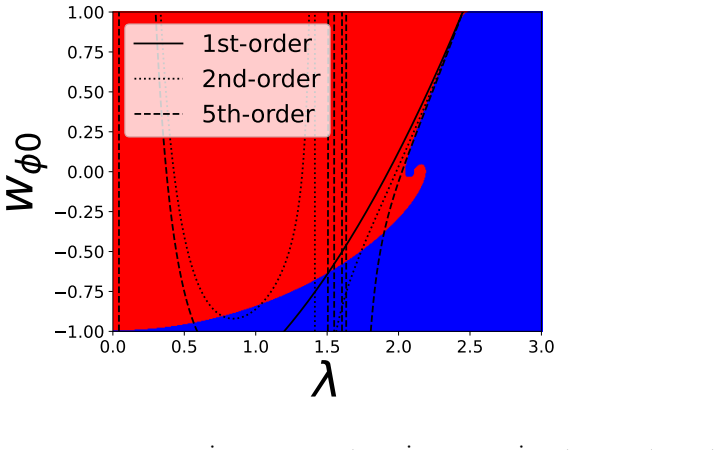
The left panels (a,c) correspond tow ϕ0 =−0.687473, while the right panel (b,d) show the results for a more fine-tuned value,w ϕ0 =−0.687473593. In the upper panels, blue, orange and green lines represent the energy densities of scalar field, radiation, matter, respectively. In the lower panels, the red, purple, orange, and green lines denote the density ...
-
[3]
As a result, the separatrix disappears forλ > √ 6, and all trajectories that reach the present epoch originate from the ˙ϕ <0 region when solved backward in time
This is because, forλ > √ 6,A + loses its character as a repeller as one of the eigenvalues of the Jacobian atA + becomes negative. As a result, the separatrix disappears forλ > √ 6, and all trajectories that reach the present epoch originate from the ˙ϕ <0 region when solved backward in time. We now discuss the origin of two branches ofwϕ0 observed aroun...
-
[4]
A. G. Adameet al.(DESI), DESI 2024 VI: cosmological constraints from the measurements of baryon acoustic oscillations, JCAP02, 021, arXiv:2404.03002 [astro-ph.CO]
work page internal anchor Pith review arXiv 2024
-
[5]
DESI DR2 Results II: Measurements of Baryon Acoustic Oscillations and Cosmological Constraints
M. Abdul Karimet al.(DESI), DESI DR2 results. II. Measurements of baryon acoustic os- cillations and cosmological constraints, Phys. Rev. D112, 083515 (2025), arXiv:2503.14738 [astro-ph.CO]
work page internal anchor Pith review arXiv 2025
-
[6]
Y. Tada and T. Terada, Quintessential interpretation of the evolving dark energy in light of DESI observations, Phys. Rev. D109, L121305 (2024), arXiv:2404.05722 [astro-ph.CO]
- [7]
-
[8]
S. Roy Choudhury, T. Okumura, and K. Umetsu, Cosmological Constraints on Nonphantom Dynamical Dark Energy with DESI Data Release 2 Baryon Acoustic Oscillations: A 3σ+ 15 Lensing Anomaly, Astrophys. J. Lett.994, L26 (2025), arXiv:2509.26144 [astro-ph.CO]
-
[9]
Model-independent reconstruction of cosmic thermodynamics and dark energy dynamics
A. Maqsood and T. Duary, Model-independent reconstruction of cosmic thermodynamics and dark energy dynamics (2026), arXiv:2604.18723 [astro-ph.CO]
work page internal anchor Pith review Pith/arXiv arXiv 2026
-
[10]
H. Woo, W. L. Matthewson, and A. Shafieloo, Model-independent consistency tests of DESI DR2 BAO and SN Ia (2026), arXiv:2604.19393 [astro-ph.CO]
work page internal anchor Pith review Pith/arXiv arXiv 2026
-
[11]
J. J. Halliwell, Scalar Fields in Cosmology with an Exponential Potential, Phys. Lett. B185, 341 (1987)
1987
-
[12]
A. B. Burd and J. D. Barrow, Inflationary Models with Exponential Potentials, Nucl. Phys. B308, 929 (1988), [Erratum: Nucl.Phys.B 324, 276–276 (1989)]
1988
-
[13]
P. G. Ferreira and M. Joyce, Cosmology with a primordial scaling field, Phys. Rev. D58, 023503 (1998), arXiv:astro-ph/9711102
work page Pith review arXiv 1998
-
[14]
E. J. Copeland, A. R. Liddle, and D. Wands, Exponential potentials and cosmological scaling solutions, Phys. Rev. D57, 4686 (1998), arXiv:gr-qc/9711068
work page Pith review arXiv 1998
- [15]
-
[16]
C. F. Kolda and W. Lahneman, Exponential quintessence and the end of acceleration (2001), arXiv:hep-ph/0105300
work page internal anchor Pith review arXiv 2001
-
[17]
E. J. Copeland, M. Sami, and S. Tsujikawa, Dynamics of dark energy, Int. J. Mod. Phys. D 15, 1753 (2006), arXiv:hep-th/0603057
work page Pith review arXiv 2006
- [18]
- [19]
-
[20]
Tamanini, Dynamics of cosmological scalar fields, Phys
N. Tamanini, Dynamics of cosmological scalar fields, Phys. Rev. D89, 083521 (2014), arXiv:1401.6339 [gr-qc]
-
[21]
M. Gosenca and P. Coles, Dynamical Analysis of Scalar Field Cosmologies with Spatial Cur- vature, Open J. Astrophys.1, 1 (2016), arXiv:1502.04020 [gr-qc]
-
[22]
Dynamical systems applied to cosmology: dark energy and modified gravity
S. Bahamonde, C. G. B¨ ohmer, S. Carloni, E. J. Copeland, W. Fang, and N. Tamanini, Dynam- ical systems applied to cosmology: dark energy and modified gravity, Phys. Rept.775-777, 1 (2018), arXiv:1712.03107 [gr-qc]. 16
work page Pith review arXiv 2018
-
[23]
A. Sava¸ s Arapo˘ glu and A. Emrah Y¨ ukselci, Dynamical System Analysis of Quintessence Models with Exponential Potential - Revisited, Mod. Phys. Lett. A34, 1950069 (2019), arXiv:1711.03824 [gr-qc]
-
[24]
D. Andriot, S. Parameswaran, D. Tsimpis, T. Wrase, and I. Zavala, Exponential quintessence: curved, steep and stringy?, JHEP08, 117, arXiv:2405.09323 [hep-th]
-
[25]
De Sitter Space and the Swampland
G. Obied, H. Ooguri, L. Spodyneiko, and C. Vafa, De Sitter Space and the Swampland (2018), arXiv:1806.08362 [hep-th]
work page Pith review arXiv 2018
-
[26]
M. Nitta and K. Uzawa, Dynamical de Sitter conjecture and quintessence model (2025), arXiv:2501.02258 [hep-th]
-
[27]
M. Cicoli, J. P. Conlon, A. Maharana, S. Parameswaran, F. Quevedo, and I. Zavala, String cosmology: From the early universe to today, Phys. Rept.1059, 1 (2024), arXiv:2303.04819 [hep-th]
- [28]
- [29]
- [30]
-
[31]
Ratra, Quantum Mechanics of Exponential Potential Inflation, Phys
B. Ratra, Quantum Mechanics of Exponential Potential Inflation, Phys. Rev. D40, 3939 (1989)
1989
-
[32]
A. P. Rebesh and B. I. Lev, Analytical solutions of the classical and quantum cosmological models with an exponential potential, Phys. Rev. D100, 123533 (2019)
2019
-
[33]
Simple Analytical Solutions of the Wheeler-DeWitt Equation in the Classical Hamilton-Jacobi Limit
N. Maki, C.-M. Lin, and K. Kohri, Simple Analytical Solutions of the Wheeler-DeWitt Equa- tion in the Classical Hamilton-Jacobi Limit (2026), arXiv:2604.25240 [hep-th]
work page internal anchor Pith review Pith/arXiv arXiv 2026
- [34]
- [35]
- [36]
-
[37]
G. Alestas, M. Caldarola, I. Ocampo, S. Nesseris, and S. Tsujikawa, DESI constraints on two-field quintessence with exponential potentials (2025), arXiv:2510.21627 [astro-ph.CO]
-
[38]
S. Bhattacharya, G. Borghetto, A. Malhotra, S. Parameswaran, G. Tasinato, and I. Zavala, Cosmological constraints on curved quintessence, JCAP09, 073, arXiv:2405.17396 [astro- ph.CO]
- [39]
- [40]
-
[41]
Z. Bayat and M. P. Hertzberg, Examining quintessence models with DESI data, JCAP08, 065, arXiv:2505.18937 [astro-ph.CO]
-
[42]
A. Pourtsidou, Exponential quintessence with momentum coupling to dark matter, JCAP02, 014, arXiv:2509.15091 [astro-ph.CO]
-
[43]
J. Beltr´ an Jim´ enez, K. Ichiki, X. Liu, F. A. Teppa Pannia, and S. Tsujikawa, Revisiting observational constraints on coupled exponential quintessence with energy and momentum transfers: degeneracy with massive neutrinos (2026), arXiv:2603.15805 [astro-ph.CO]
-
[44]
S. Sultana and S. Chattopadhyay, Cosmological dynamics of exponential quintessence con- strained by BAO, cosmic chronometers, and DES-SN5YR/Pantheon + data, Eur. Phys. J. C 86, 408 (2026), arXiv:2604.06941 [astro-ph.CO]
work page internal anchor Pith review Pith/arXiv arXiv 2026
-
[45]
N. Maki and K. Kohri, Exponential Quintessence Model: Analytical Quantification of the Fine-Tuning Problem in Dark Energy (2026), arXiv:2602.19118 [astro-ph.CO]
work page internal anchor Pith review arXiv 2026
-
[46]
M. Kawasaki, K. Kohri, and N. Sugiyama, Cosmological constraints on late time entropy production, Phys. Rev. Lett.82, 4168 (1999), arXiv:astro-ph/9811437
-
[47]
M. Kawasaki, K. Kohri, and N. Sugiyama, MeV scale reheating temperature and thermaliza- tion of neutrino background, Phys. Rev. D62, 023506 (2000), arXiv:astro-ph/0002127
-
[48]
K. Ichikawa, M. Kawasaki, and F. Takahashi, The Oscillation effects on thermalization of the neutrinos in the Universe with low reheating temperature, Phys. Rev. D72, 043522 (2005), arXiv:astro-ph/0505395
-
[49]
P. F. de Salas, M. Lattanzi, G. Mangano, G. Miele, S. Pastor, and O. Pisanti, Bounds on very low reheating scenarios after Planck, Phys. Rev. D92, 123534 (2015), arXiv:1511.00672 [astro-ph.CO]. 18
work page Pith review arXiv 2015
-
[50]
T. Hasegawa, N. Hiroshima, K. Kohri, R. S. L. Hansen, T. Tram, and S. Hannestad, MeV-scale reheating temperature and thermalization of oscillating neutrinos by radiative and hadronic decays of massive particles, JCAP12, 012, arXiv:1908.10189 [hep-ph]
-
[51]
N. Barbieri, T. Brinckmann, S. Gariazzo, M. Lattanzi, S. Pastor, and O. Pisanti, Current Constraints on Cosmological Scenarios with Very Low Reheating Temperatures, Phys. Rev. Lett.135, 181003 (2025), arXiv:2501.01369 [astro-ph.CO]
-
[52]
Planck 2018 results. VI. Cosmological parameters
N. Aghanimet al.(Planck), Planck 2018 results. VI. Cosmological parameters, Astron. As- trophys.641, A6 (2020), [Erratum: Astron.Astrophys. 652, C4 (2021)], arXiv:1807.06209 [astro-ph.CO]. 19
work page internal anchor Pith review arXiv 2018
discussion (0)
Sign in with ORCID, Apple, or X to comment. Anyone can read and Pith papers without signing in.