Aether-SHELLQs: JWST integral-field spectroscopy of candidate obscured quasars at z ~ 6
Pith reviewed 2026-06-27 15:34 UTC · model grok-4.3
The pith
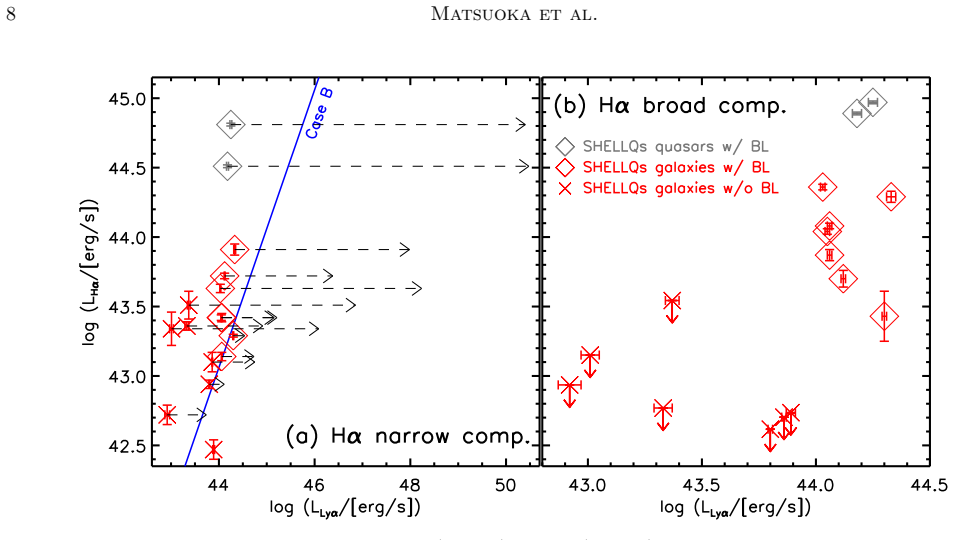
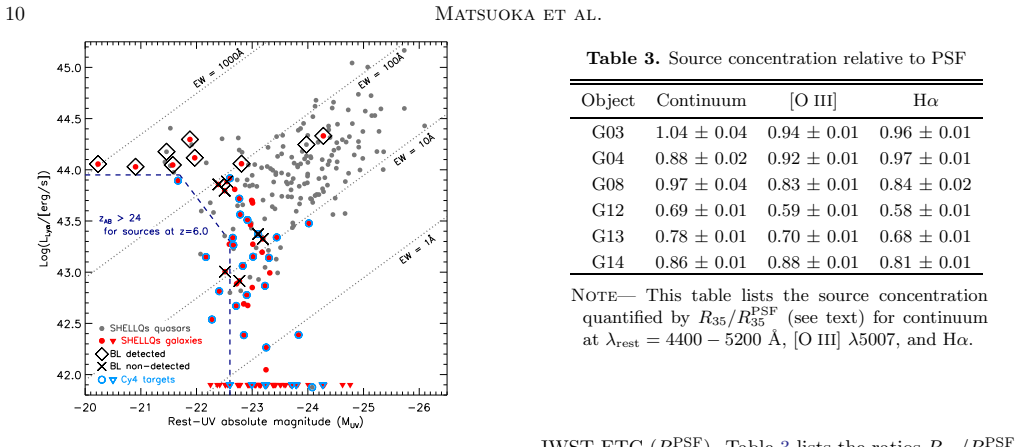
The presence of broad Balmer lines in z~6 SHELLQs candidates correlates strongly with Lyα luminosity, implying AGN fractions above 77% for L_Lyα greater than 10^44 erg s^{-1} and below 15% for lower values.
A machine-rendered reading of the paper's core claim, the machinery that carries it, and where it could break.
Core claim
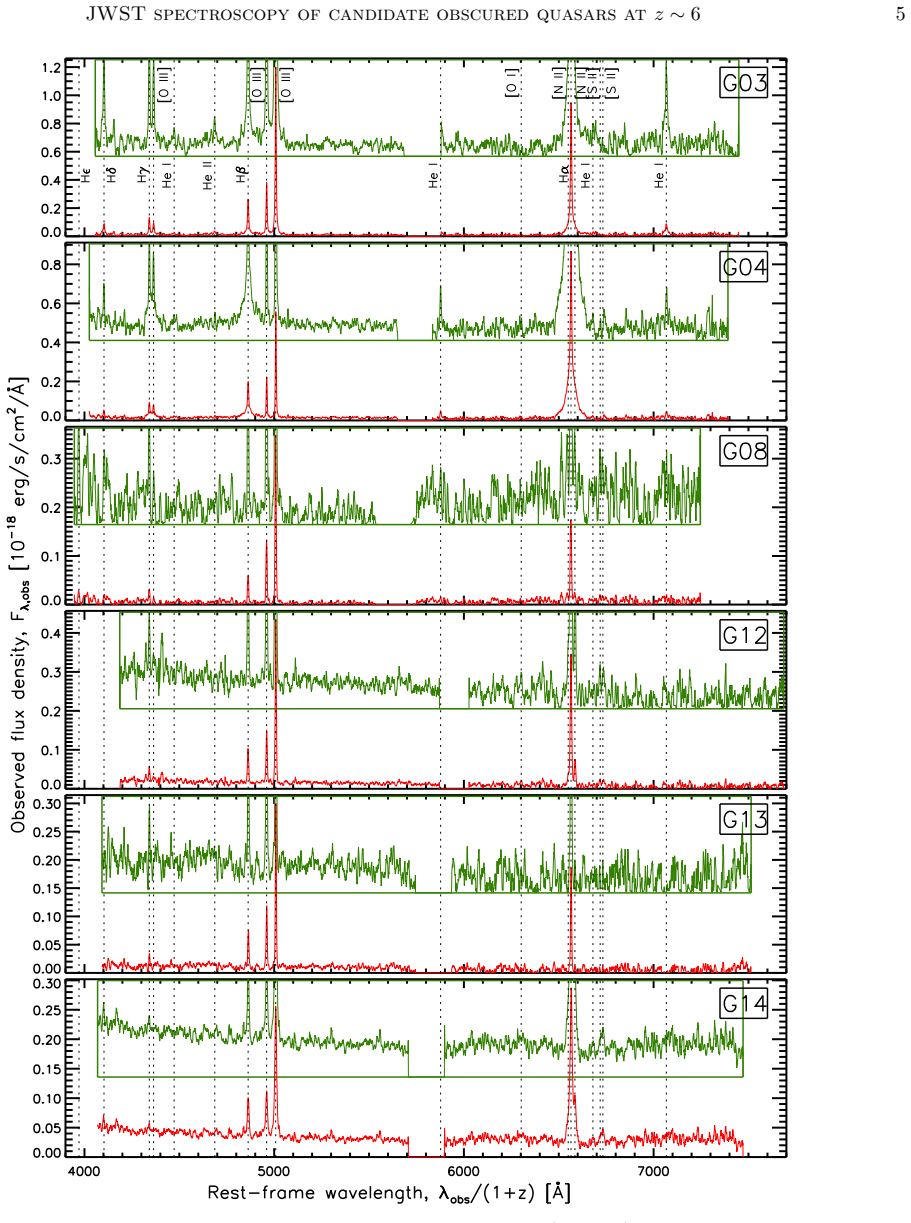
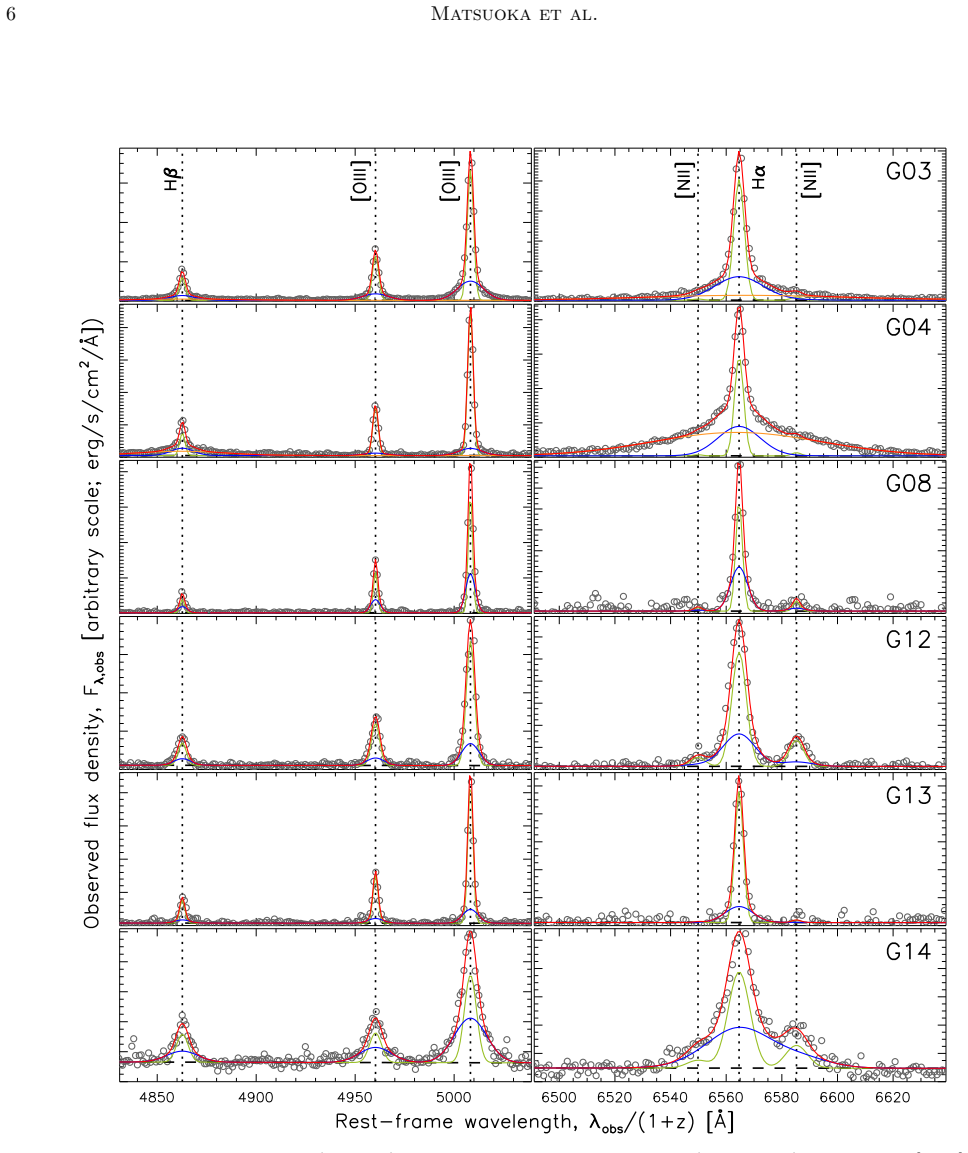
JWST NIRSpec IFU observations of six z~6 SHELLQs candidates show that two objects display broad Balmer lines with FWHM greater than 3000 km s^{-1}, indicating AGNs, while the remaining four have comparable permitted and forbidden line profiles. Combined with previously reported similar objects, the presence of broad lines correlates strongly with Lyα luminosity, producing inferred AGN fractions above 77 percent for L_Lyα greater than 10^44 erg s^{-1} and below 15 percent below that threshold. Dust-extinction corrections from the Balmer decrement would require unrealistically high Lyα luminosities, pointing to multiple zones in the line-emitting gas. The IFU maps reveal compact AGN hosts and
What carries the argument
The correlation between detection of a broad Balmer-line component (FWHM > 3000 km s^{-1}) and Lyα luminosity, used to classify objects as AGNs or non-AGNs and to derive the luminosity-dependent AGN fraction.
If this is right
- Dust corrections inferred from the Balmer decrement would produce unrealistically high Lyα luminosities, indicating that the line-emitting gas consists of multiple zones.
- AGN hosts appear compact while the non-AGN galaxies display extended ionized gas on scales up to 10 kpc and star-formation rates of 60-600 solar masses per year.
- These objects occupy the intermediate luminosity range between classical luminous quasars and the low-luminosity AGNs, including Little Red Dots, found by JWST.
- One extended galaxy shows a rotation signature while most others exhibit little ordered kinematics with velocity widths of 200-300 km s^{-1}.
Where Pith is reading between the lines
- The sharp change in AGN fraction near 10^44 erg s^{-1} may mark a minimum luminosity or black-hole mass required to sustain a broad-line region at these redshifts.
- Mapping the spatial distribution of ionized gas in a larger sample could test whether the extended structures around non-AGN candidates are powered solely by star formation or contain hidden nuclei.
- Kinematic data from future IFU observations could distinguish whether the lack of ordered motion in most objects reflects mergers or turbulent disks during early galaxy assembly.
- The placement of these sources between luminous quasars and fainter JWST AGNs suggests a continuous sequence whose luminosity function can be tested with wider surveys.
Load-bearing premise
A broad component in Balmer lines with FWHM exceeding 3000 km s^{-1} indicates an AGN while the absence of such a component means the object is not an AGN.
What would settle it
Additional spectroscopy of SHELLQs candidates with L_Lyα below 10^44 erg s^{-1} that finds a large fraction showing broad Balmer lines, or of candidates above the threshold that finds mostly narrow lines, would directly test the reported correlation and fractions.
Figures
read the original abstract
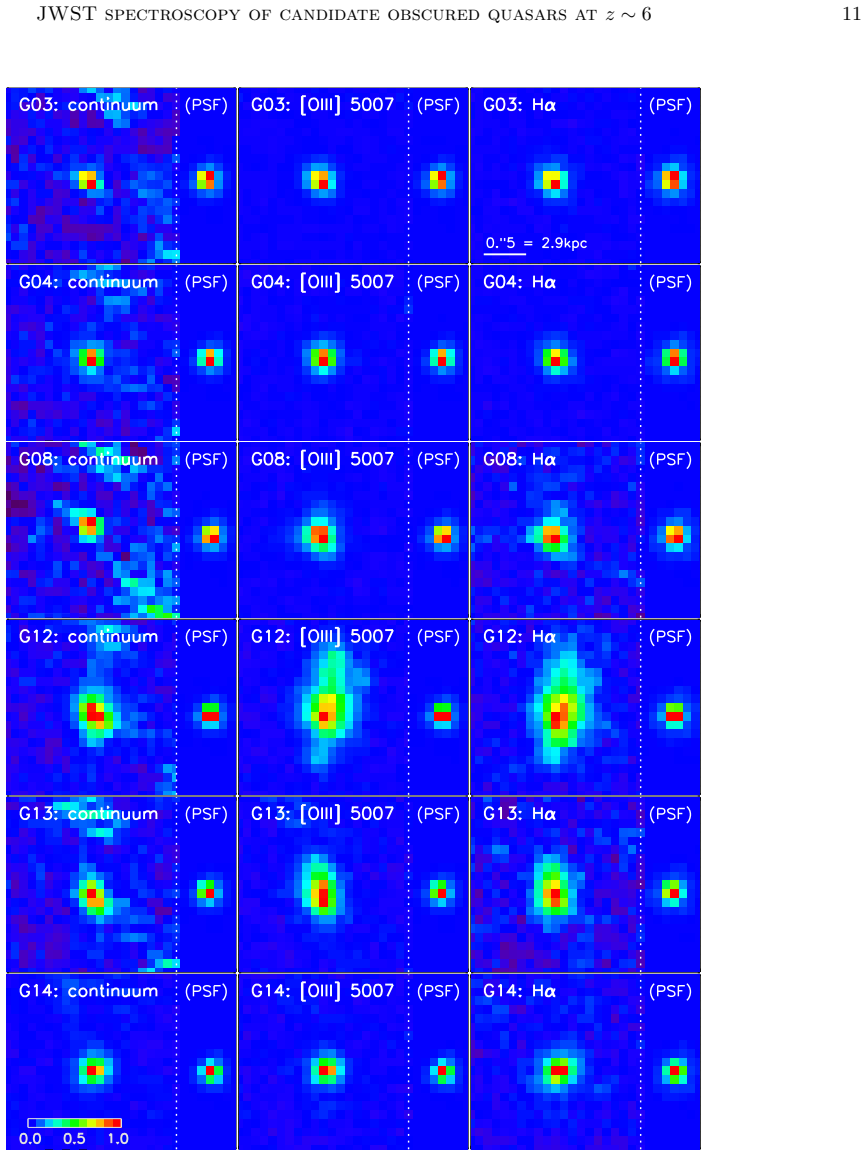
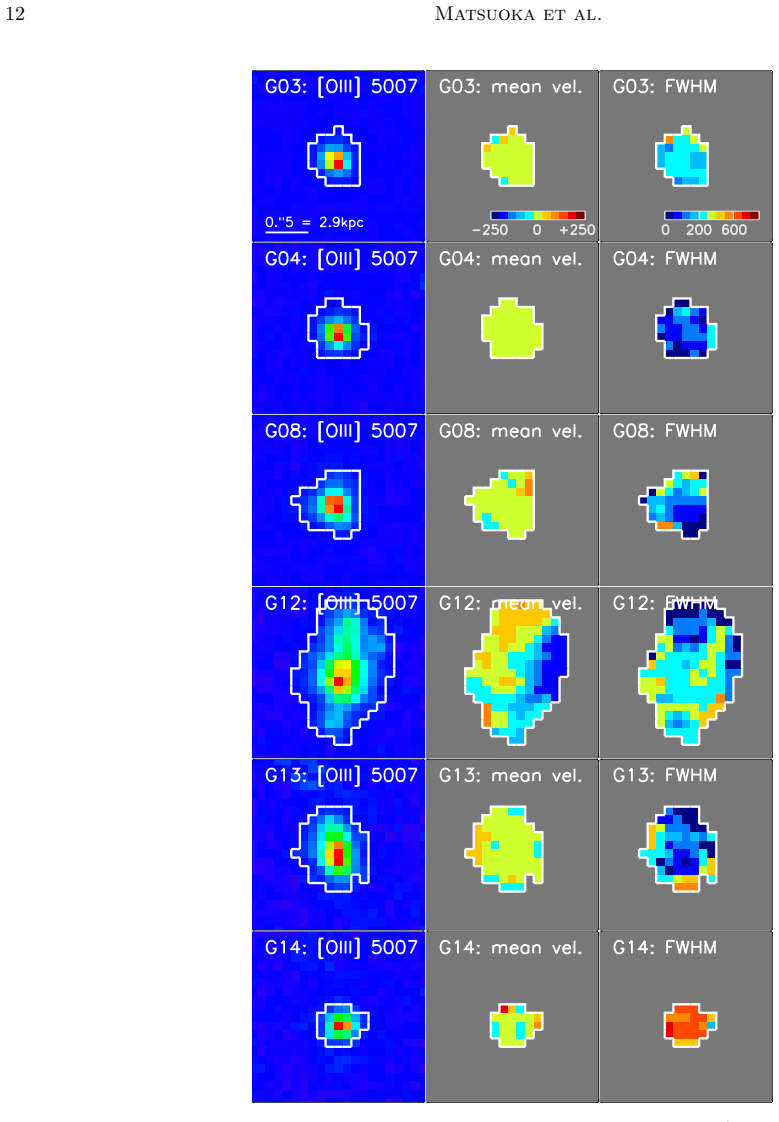
We present James Webb Space Telescope (JWST) NIRSpec integral field unit (IFU) observations of six galaxies at $z \sim 6$, obtained as part of the Aether project (General Observers program 5645). The targets were originally identified by the Subaru High-$z$ Exploration of Low-Luminosity Quasars (SHELLQs) survey, as candidate obscured quasars with luminous ($\gtrsim10^{43}$ erg s$^{-1}$) but narrow ($\lesssim500$ km s$^{-1}$) Ly$\alpha$ emission. Two objects exhibit a broad component in their Balmer lines (FWHM $>3000$ km s$^{-1}$), indicating the presence of active galactic nuclei (AGNs), while the remaining four show similar profiles in permitted and forbidden lines. Combining these data with similar SHELLQs objects reported previously, we find that the presence of broad lines is strongly correlated with Ly$\alpha$ luminosity ($L_{\rm Ly\alpha}$); the inferred AGN fraction is $>$77 % and $<$15 % above and below $L_{\rm Ly\alpha} =10^{44}$ erg s$^{-1}$, respectively. Dust-extinction corrections inferred from the Balmer decrement would imply unrealistically high Ly$\alpha$ luminosities, suggesting that the line-emitting gas consists of multiple zones. The IFU data reveal diverse spatial structures. The AGN hosts are compact, whereas the other galaxies show extended ionized gas on scales up to 10 kpc and star formation rates of 60 - 600 $M_\odot$ yr$^{-1}$. One of the extended objects exhibits a signature of rotation, while most of the others show little ordered kinematics, with velocity widths (FWHM) up to 200 - 300 km s$^{-1}$. These objects populate the intermediate luminosity regime between classical luminous quasars and the low-luminosity AGNs discovered by JWST, including Little Red Dots, potentially linking the two populations.
Editorial analysis
A structured set of objections, weighed in public.
Referee Report
Summary. The manuscript presents JWST NIRSpec IFU spectroscopy of six z ≈ 6 galaxies selected as candidate obscured quasars from the SHELLQs survey based on luminous narrow Lyα emission. Two targets show broad Balmer lines with FWHM > 3000 km s⁻¹, interpreted as AGNs, while the other four exhibit similar profiles in permitted and forbidden lines. When combined with previously reported SHELLQs objects, the presence of broad lines correlates strongly with Lyα luminosity, yielding AGN fractions of >77% above and <15% below L_Lyα = 10^44 erg s⁻¹. Additional findings include evidence for multiple emission zones from Balmer decrement analysis, diverse spatial structures with compact AGN hosts versus extended ionized gas in non-AGN candidates, and high star formation rates in the latter.
Significance. If the AGN classification and resulting luminosity-dependent fractions are robust, the work provides important constraints on the demographics of AGNs at z ~ 6, potentially linking classical quasars to the population of low-luminosity AGNs and Little Red Dots discovered by JWST. The IFU data on spatial and kinematic properties of the hosts add value beyond the classification.
major comments (2)
- [Abstract and central claims] The reported AGN fractions (>77% and <15% above/below L_Lyα = 10^44 erg s⁻¹) and the claimed strong correlation depend on a binary classification of objects as AGN or non-AGN based solely on the detection of a broad Balmer component (FWHM > 3000 km s⁻¹). The manuscript does not supply the formal detection significances for the broad components in the two objects, quantitative upper limits on broad components in the four others, or tests ruling out alternative origins for broad permitted lines such as merger-driven kinematics or outflows in high-SFR systems at z ~ 6.
- [Abstract] No information is provided on sample completeness, the total number of objects in the combined SHELLQs sample, statistical tests for the correlation, or error budgets on the fractions, making it difficult to assess the robustness of the luminosity threshold.
minor comments (2)
- [Abstract] The abstract states that dust-extinction corrections would imply unrealistically high Lyα luminosities but does not quantify the Balmer decrement values or the resulting implied luminosities.
- [Abstract] The velocity widths of 200-300 km s⁻¹ for the extended objects are given without specifying whether these are FWHM or velocity dispersion, and without comparison to the instrumental resolution.
Simulated Author's Rebuttal
We thank the referee for the careful and constructive review. The comments highlight areas where additional quantitative details and discussion will strengthen the presentation of our AGN classification and luminosity-dependent fractions. We address each point below and have revised the manuscript to incorporate the requested information where possible.
read point-by-point responses
-
Referee: [Abstract and central claims] The reported AGN fractions (>77% and <15% above/below L_Lyα = 10^44 erg s⁻¹) and the claimed strong correlation depend on a binary classification of objects as AGN or non-AGN based solely on the detection of a broad Balmer component (FWHM > 3000 km s⁻¹). The manuscript does not supply the formal detection significances for the broad components in the two objects, quantitative upper limits on broad components in the four others, or tests ruling out alternative origins for broad permitted lines such as merger-driven kinematics or outflows in high-SFR systems at z ~ 6.
Authors: We agree that the original text omitted explicit detection significances and upper limits. In the revised manuscript we add these from our spectral fits: the broad Balmer components in the two objects are detected at 6.2σ and 5.8σ, while 3σ upper limits on any broad component in the remaining four objects correspond to <8% of the narrow-line flux and FWHM < 800 km s⁻¹. We have also expanded the discussion to address alternative origins, noting that the absence of correspondingly broad forbidden lines and the compact spatial distribution of the broad emission favor a BLR origin over merger-driven kinematics or outflows; however, we acknowledge that these arguments are not definitive and higher-S/N or multi-epoch data would be required for stronger exclusion. The binary classification therefore rests on both the width threshold and supporting line-profile evidence, but we accept that more quantitative detail was needed. revision: yes
-
Referee: [Abstract] No information is provided on sample completeness, the total number of objects in the combined SHELLQs sample, statistical tests for the correlation, or error budgets on the fractions, making it difficult to assess the robustness of the luminosity threshold.
Authors: The combined sample comprises the six new targets plus five previously published SHELLQs objects with comparable NIRSpec data, for a total of eleven sources. We have added this total, a brief statement on selection (the parent SHELLQs Lyα-selected sample is not IFU-complete), binomial confidence intervals on the reported fractions, and a Fisher exact test (p = 0.008) for the luminosity correlation. These additions are now included in the revised abstract and results section. We note that the small sample size limits the power of more sophisticated statistics, but the trend remains robust under the binomial errors. revision: yes
Circularity Check
No significant circularity; claims rest on direct measurements
full rationale
The paper reports JWST NIRSpec IFU spectroscopy of six z~6 SHELLQs targets, classifying two as AGNs via detected broad Balmer components (FWHM>3000 km s^{-1}) and four as non-AGNs based on similar permitted/forbidden line profiles. The correlation with L_Lyα and the AGN fractions (>77% above, <15% below 10^44 erg s^{-1}) are obtained by direct counting after combining with prior SHELLQs objects. No equations, fits, or self-referential definitions reduce these fractions to inputs by construction. Prior SHELLQs citations supply context but are not load-bearing for the new classification or correlation; the result remains falsifiable via independent line-width measurements.
Axiom & Free-Parameter Ledger
axioms (1)
- domain assumption Broad Balmer lines with FWHM >3000 km s^{-1} indicate the presence of an AGN
Reference graph
Works this paper leans on
-
[1]
2018, PASJ, 70, S4, doi: 10.1093/pasj/psx066
Aihara, H., Arimoto, N., Armstrong, R., et al.\ 2018, , 70, S4. doi:10.1093/pasj/psx066
work page internal anchor Pith review doi:10.1093/pasj/psx066 2018
-
[2]
Aihara, H., AlSayyad, Y., Ando, M., et al.\ 2022, , 74, 247. doi:10.1093/pasj/psab122
-
[3]
Akins, H. B., Casey, C. M., Berg, D. A., et al.\ 2025a, , 980, 2, L29. doi:10.3847/2041-8213/adab76
-
[4]
Akins, H. B., Casey, C. M., Lambrides, E., et al.\ 2025b, , 991, 1, 37. doi:10.3847/1538-4357/ade984
-
[5]
Alexandroff, R., Strauss, M. A., Greene, J. E., et al.\ 2013, , 435, 4, 3306. doi:10.1093/mnras/stt1500
-
[6]
Ananna, T. T., Bogd \'a n, \'A ., Kov \'a cs, O. E., et al.\ 2024, , 969, L18. doi:10.3847/2041-8213/ad5669
-
[7]
Arita, J., Kashikawa, N., Matsuoka, Y., et al.\ 2026, arXiv:2602.11736. doi:10.48550/arXiv.2602.11736
work page internal anchor Pith review Pith/arXiv arXiv doi:10.48550/arxiv.2602.11736 2026
-
[8]
Arrigoni Battaia, F., Hennawi, J. F., Prochaska, J. X., et al.\ 2019, , 482, 3, 3162. doi:10.1093/mnras/sty2827
-
[9]
Baldwin, J. A., Phillips, M. M., & Terlevich, R.\ 1981, , 93, 5. doi:10.1086/130766
-
[10]
Baggen, J. F. W., van Dokkum, P., Brammer, G., et al.\ 2024, , 977, L13. doi:10.3847/2041-8213/ad90b8
-
[11]
Barro, G., P \'e rez-Gonz \'a lez, P. G., Kocevski, D. D., et al.\ 2024, , 963, 128. doi:10.3847/1538-4357/ad167e
-
[12]
P., Morganson, E., et al.\ 2015, , 804, 2, 118
Ba \ n ados, E., Venemans, B. P., Morganson, E., et al.\ 2015, , 804, 2, 118. doi:10.1088/0004-637X/804/2/118
-
[13]
J., et al.\ 2016, , 831, 1, 39
Borisova, E., Cantalupo, S., Lilly, S. J., et al.\ 2016, , 831, 1, 39. doi:10.3847/0004-637X/831/1/39
-
[14]
Boroson, T. A. & Green, R. F.\ 1992, , 80, 109. doi:10.1086/191661
-
[15]
Bogd \'a n, \'A ., Goulding, A. D., Natarajan, P., et al.\ 2024, Nature Astronomy, 8, 126. doi:10.1038/s41550-023-02111-9
-
[16]
Bouwens, R. J., Oesch, P. A., Stefanon, M., et al.\ 2021, , 162, 47. doi:10.3847/1538-3881/abf83e
-
[17]
Bowler, R. A. A., Dunlop, J. S., McLure, R. J., et al.\ 2015, , 452, 1817. doi:10.1093/mnras/stv1403
-
[18]
J., Curtis-Lake, E., et al.\ 2024, , 535, 2, 1796
Boyett, K., Bunker, A. J., Curtis-Lake, E., et al.\ 2024, , 535, 2, 1796. doi:10.1093/mnras/stae2430
-
[19]
Brocklehurst, M.\ 1971, , 153, 471. doi:10.1093/mnras/153.4.471
-
[20]
Calzetti, D., Armus, L., Bohlin, R. C., et al.\ 2000, , 533, 682. doi:10.1086/308692
work page internal anchor Pith review doi:10.1086/308692 2000
-
[21]
Castellano, M., Fontana, A., Treu, T., et al.\ 2022, , 938, L15. doi:10.3847/2041-8213/ac94d0
-
[22]
Carnall, A. C., McLure, R. J., Dunlop, J. S., et al.\ 2023, , 619, 716. doi:10.1038/s41586-023-06158-6
-
[23]
P., Mason, C., et al.\ 2024, , 528, 4, 7052
Chen, Z., Stark, D. P., Mason, C., et al.\ 2024, , 528, 4, 7052. doi:10.1093/mnras/stae455
-
[24]
Carniani, S., D'Eugenio, F., Ji, X., et al.\ 2024, arXiv:2409.20533. doi:10.48550/arXiv.2409.20533
-
[25]
2024, , 633, 318, 10.1038/s41586-024-07860-9
Carniani, S., Hainline, K., D'Eugenio, F., et al.\ 2024, , 633, 318. doi:10.1038/s41586-024-07860-9
-
[26]
Casey, C. M., Akins, H. B., Kokorev, V., et al.\ 2024, , 975, L4. doi:10.3847/2041-8213/ad7ba7
-
[27]
Clarke, L., Shapley, A. E., Sanders, R. L., et al.\ 2024, , 977, 133. doi:10.3847/1538-4357/ad8ba4
-
[28]
Decarli, R., Walter, F., Venemans, B. P., et al.\ 2017, , 545, 457. doi:10.1038/nature22358
-
[29]
Decarli, R., Loiacono, F., Farina, E. P., et al.\ 2024, , 689, A219. doi:10.1051/0004-6361/202449239
-
[30]
Decarli, R., Dotti, M., Ba \ n ados, E., et al.\ 2019, , 880, 157. doi:10.3847/1538-4357/ab297f
-
[31]
doi:10.1051/0004-6361/201936813
Decarli, R., Mignoli, M., Gilli, R., et al.\ 2019, , 631, L10. doi:10.1051/0004-6361/201936813
-
[32]
2024, , 684, A87, 10.1051/0004-6361/202347755
de Graaff, A., Rix, H.-W., Carniani, S., et al.\ 2024, , 684, A87. doi:10.1051/0004-6361/202347755
-
[33]
D., et al.\ 2025, , 993, 1, 91
Ding, X., Onoue, M., Silverman, J. D., et al.\ 2025, , 993, 1, 91. doi:10.3847/1538-4357/ae045b
-
[34]
Ding, X., Onoue, M., Silverman, J. D., et al.\ 2023, , 621, 51. doi:10.1038/s41586-023-06345-5
-
[35]
Dom \' nguez, A., Siana, B., Henry, A. L., et al.\ 2013, , 763, 145. doi:10.1088/0004-637X/763/2/145
-
[36]
Donnan, C. T., McLure, R. J., Dunlop, J. S., et al.\ 2024, , 533, 3222. doi:10.1093/mnras/stae2037
-
[37]
Fan, X., Ba \ n ados, E., & Simcoe, R. A.\ 2023, , 61, 373. doi:10.1146/annurev-astro-052920-102455
-
[38]
Feltre, A., Charlot, S., & Gutkin, J.\ 2016, , 456, 3354. doi:10.1093/mnras/stv2794
-
[39]
Finkelstein, S. L., Bagley, M. B., Ferguson, H. C., et al.\ 2023, , 946, L13. doi:10.3847/2041-8213/acade4
-
[40]
Finkelstein, S. L., Ryan, R. E., Papovich, C., et al.\ 2015, , 810, 71. doi:10.1088/0004-637X/810/1/71
-
[41]
R., Siana, B., Kriek, M., et al.\ 2019, , 873, 102
Freeman, W. R., Siana, B., Kriek, M., et al.\ 2019, , 873, 102. doi:10.3847/1538-4357/ab0655
-
[42]
Fujimoto, S., Wang, B., Weaver, J. R., et al.\ 2024, , 977, 250. doi:10.3847/1538-4357/ad9027
-
[43]
J., Labb´ e, I., Zitrin, A., et al
Furtak, L. J., Labb \'e , I., Zitrin, A., et al.\ 2024, , 628, 57. doi:10.1038/s41586-024-07184-8
-
[44]
doi:10.1088/0004-637X/733/2/101
Genzel, R., Newman, S., Jones, T., et al.\ 2011, , 733, 101. doi:10.1088/0004-637X/733/2/101
-
[45]
E., Alexandroff, R., Strauss, M
Greene, J. E., Alexandroff, R., Strauss, M. A., et al.\ 2014, , 788, 1, 91. doi:10.1088/0004-637X/788/1/91
-
[46]
Greene, J. E. & Ho, L. C.\ 2005, , 630, 122. doi:10.1086/431897
work page internal anchor Pith review doi:10.1086/431897 2005
-
[47]
Gloudemans, A. J., Duncan, K. J., Eilers, A.-C., et al.\ 2025, , 986, 2, 130. doi:10.3847/1538-4357/adddb9
-
[48]
Greene, J. E., Labbe, I., Goulding, A. D., et al.\ 2024, , 964, 39. doi:10.3847/1538-4357/ad1e5f
-
[49]
Gloudemans, A. J., Duncan, K. J., Eilers, A.-C., et al.\ 2025, arXiv:2501.04912. doi:10.48550/arXiv.2501.04912
-
[50]
Goulding, A. D., Greene, J. E., Setton, D. J., et al.\ 2023, , 955, L24. doi:10.3847/2041-8213/acf7c5
-
[51]
Gutkin, J., Charlot, S., & Bruzual, G.\ 2016, , 462, 1757. doi:10.1093/mnras/stw1716
-
[52]
Harikane, Y., Ono, Y., Ouchi, M., et al.\ 2022, , 259, 20. doi:10.3847/1538-4365/ac3dfc
-
[53]
2023, ApJ, 959, 39, doi: 10.3847/1538-4357/ad029e
Harikane, Y., Zhang, Y., Nakajima, K., et al.\ 2023, , 959, 39. doi:10.3847/1538-4357/ad029e
-
[54]
2015, PASA, 32, e027, doi: 10.1017/pasa.2015.25
Hayes, M.\ 2015, , 32, e027. doi:10.1017/pasa.2015.25
-
[55]
Heckman, T. M. & Best, P. N.\ 2014, , 52, 589. doi:10.1146/annurev-astro-081913-035722
work page internal anchor Pith review doi:10.1146/annurev-astro-081913-035722 2014
-
[56]
1986, PASP, 98, 609, doi: 10.1086/131801
Horne, K.\ 1986, , 98, 609. doi:10.1086/131801
-
[57]
Hutchison, T. A., Welch, B. D., Rigby, J. R., et al.\ 2024, , 136, 4, 044503. doi:10.1088/1538-3873/ad34fd
-
[58]
Inayoshi, K., Kimura, S. S., & Noda, H.\ 2025, , 77, 4, 811. doi:10.1093/pasj/psaf050
-
[59]
2025, ApJL, 980, L27, doi: 10.3847/2041-8213/adaebd
Inayoshi, K. & Maiolino, R.\ 2025, , 980, 2, L27. doi:10.3847/2041-8213/adaebd
-
[60]
K., Yamanaka, S., Ouchi, M., et al.\ 2020, , 72, 101
Inoue, A. K., Yamanaka, S., Ouchi, M., et al.\ 2020, , 72, 101. doi:10.1093/pasj/psaa100
-
[61]
Iwamoto, R., Matsuoka, Y., Imanishi, M., et al.\ 2025, , 979, 183. doi:10.3847/1538-4357/ada27b
-
[62]
doi:10.1051/0004-6361/202555410
Iwasawa, K., Gilli, R., Vito, F., et al.\ 2026, , 706, A305. doi:10.1051/0004-6361/202555410
-
[63]
Izumi, T., Matsuoka, Y., Onoue, M., et al.\ 2024, , 972, 1, 116. doi:10.3847/1538-4357/ad57c6
-
[64]
Izumi, T., Matsuoka, Y., Fujimoto, S., et al.\ 2021, , 914, 36. doi:10.3847/1538-4357/abf6dc
-
[65]
Izumi, T., Onoue, M., Matsuoka, Y., et al.\ 2021, , 908, 235. doi:10.3847/1538-4357/abd7ef
-
[66]
Izumi, T., Onoue, M., Matsuoka, Y., et al.\ 2019, , 71, 111. doi:10.1093/pasj/psz096
-
[67]
Izumi, T., Onoue, M., Shirakata, H., et al.\ 2018, , 70, 36. doi:10.1093/pasj/psy026
-
[68]
Juod z balis, I., Maiolino, R., Baker, W. M., et al.\ 2024, , 636, 594. doi:10.1038/s41586-024-08210-5
-
[69]
M., et al.\ 2026, , 546, 3, stag086
Juod z balis, I., Maiolino, R., Baker, W. M., et al.\ 2026, , 546, 3, stag086. doi:10.1093/mnras/stag086
-
[70]
doi:10.1111/j.1365-2966.2009.15868.x , eprint =
Kauffmann, G. & Heckman, T. M.\ 2009, , 397, 135. doi:10.1111/j.1365-2966.2009.14960.x
-
[71]
Kauffmann, G., Heckman, T. M., Tremonti, C., et al.\ 2003, , 346, 1055. doi:10.1111/j.1365-2966.2003.07154.x
-
[72]
Kawanomoto, S., Uraguchi, F., Komiyama, Y., et al.\ 2018, , 70, 66. doi:10.1093/pasj/psy056
-
[73]
Kato, N., Matsuoka, Y., Onoue, M., et al.\ 2020, , 72, 84. doi:10.1093/pasj/psaa074
-
[74]
Star Formation in Galaxies Along the Hubble Sequence
Kennicutt, R. C.\ 1998, , 36, 189. doi:10.1146/annurev.astro.36.1.189
work page internal anchor Pith review doi:10.1146/annurev.astro.36.1.189 1998
-
[75]
Theoretical Modeling of Starburst Galaxies
Kewley, L. J., Dopita, M. A., Sutherland, R. S., et al.\ 2001, , 556, 121. doi:10.1086/321545
work page internal anchor Pith review doi:10.1086/321545 2001
-
[76]
2024, A&A, 691, A52, doi: 10.1051/0004-6361/202348857
Killi, M., Watson, D., Brammer, G., et al.\ 2024, , 691, A52. doi:10.1051/0004-6361/202348857
-
[77]
Kocevski, D. D., Finkelstein, S. L., Barro, G., et al.\ 2025, , 986, 2, 126. doi:10.3847/1538-4357/adbc7d
-
[78]
D., Onoue, M., Inayoshi, K., et al
Kocevski, D. D., Onoue, M., Inayoshi, K., et al.\ 2023, , 954, L4. doi:10.3847/2041-8213/ace5a0
-
[79]
2023, ApJL, 957, L7, doi: 10.3847/2041-8213/ad037a
Kokorev, V., Fujimoto, S., Labbe, I., et al.\ 2023, , 957, L7. doi:10.3847/2041-8213/ad037a
-
[80]
2025, ApJ, 995, 24, doi: 10.3847/1538-4357/ae119e
Kokubo, M. & Harikane, Y.\ 2025, , 995, 1, 24. doi:10.3847/1538-4357/ae119e
discussion (0)
Sign in with ORCID, Apple, or X to comment. Anyone can read and Pith papers without signing in.